Critical Analysis of Provisional Application of ECT in the Yukos Case
VerifiedAdded on 2020/01/07
|24
|9766
|431
Report
AI Summary
This report provides a comprehensive critical analysis of the Yukos case, focusing on the provisional application of the Energy Charter Treaty (ECT). The report delves into the concept of provisional application and its relevance to the case, particularly examining Russia's role as a signatory that did not ratify the treaty but provisionally applied it. It explores the jurisdictional ascertainment by the tribunal, comparing the approaches suggested by the Russian Federation and the claimants. The analysis includes an overview of the Yukos case, detailing the company's operations, the legal actions against it, and the alleged violations of the ECT. Furthermore, the report discusses the impact of the findings of the Yukos case, particularly the decision by the Dutch court, and the consequences for international investment law. The conclusion summarizes the key findings and implications of the case, highlighting the complexities of treaty application and the protection of foreign investments in the energy sector.
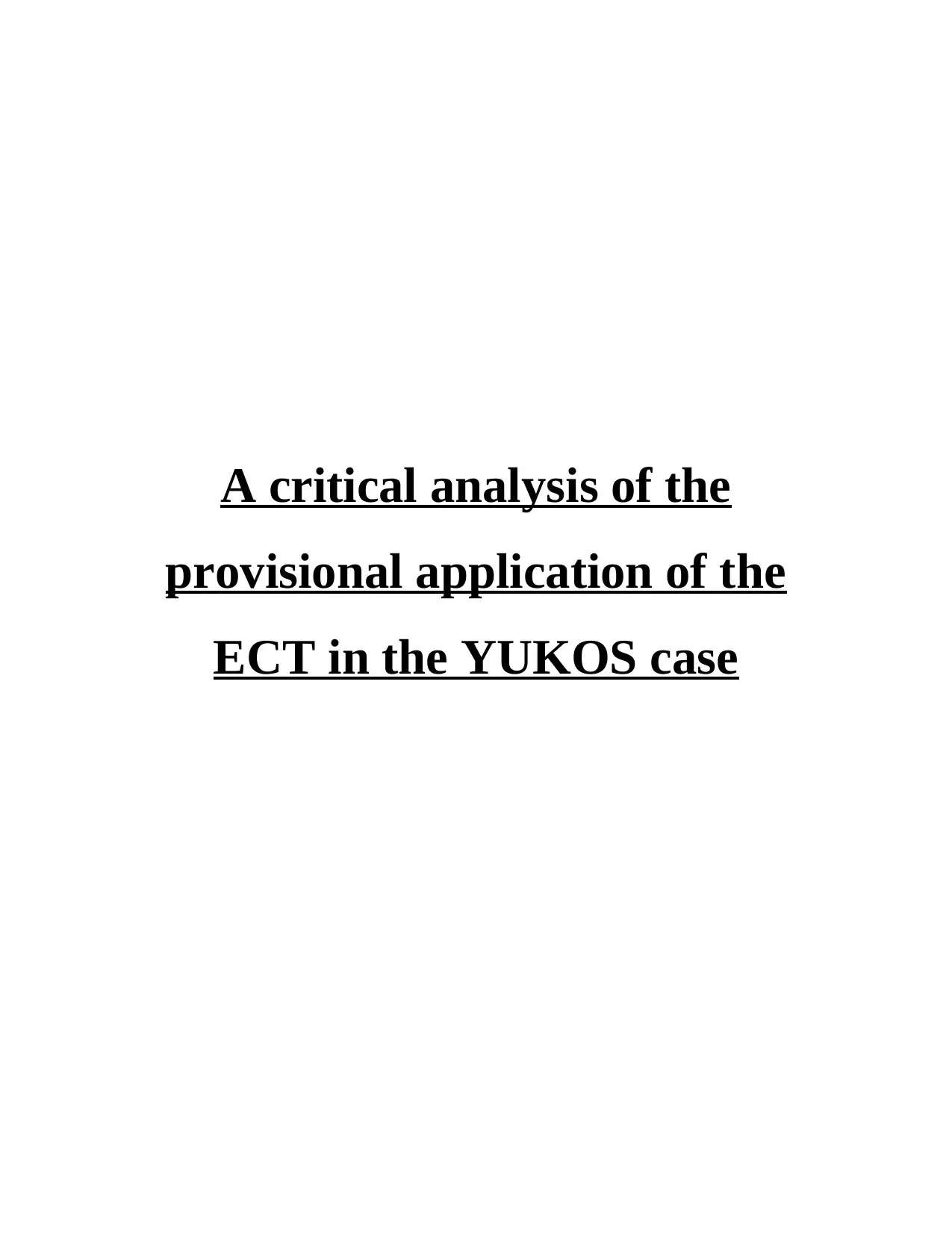
A critical analysis of the
provisional application of the
ECT in the YUKOS case
provisional application of the
ECT in the YUKOS case

Paraphrase This Document
Need a fresh take? Get an instant paraphrase of this document with our AI Paraphraser
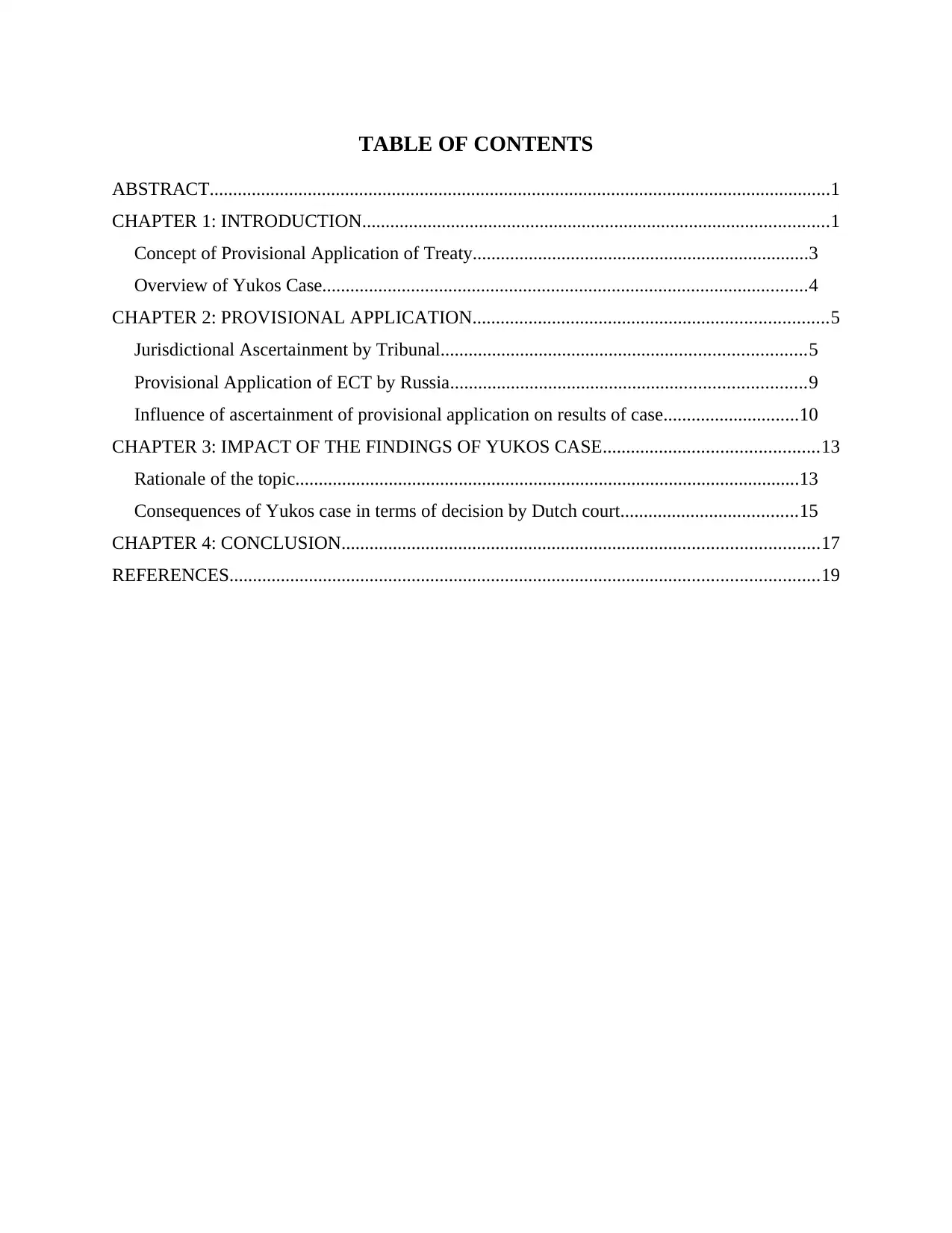
TABLE OF CONTENTS
ABSTRACT.....................................................................................................................................1
CHAPTER 1: INTRODUCTION....................................................................................................1
Concept of Provisional Application of Treaty........................................................................3
Overview of Yukos Case........................................................................................................4
CHAPTER 2: PROVISIONAL APPLICATION............................................................................5
Jurisdictional Ascertainment by Tribunal..............................................................................5
Provisional Application of ECT by Russia............................................................................9
Influence of ascertainment of provisional application on results of case.............................10
CHAPTER 3: IMPACT OF THE FINDINGS OF YUKOS CASE..............................................13
Rationale of the topic............................................................................................................13
Consequences of Yukos case in terms of decision by Dutch court......................................15
CHAPTER 4: CONCLUSION......................................................................................................17
REFERENCES..............................................................................................................................19
ABSTRACT.....................................................................................................................................1
CHAPTER 1: INTRODUCTION....................................................................................................1
Concept of Provisional Application of Treaty........................................................................3
Overview of Yukos Case........................................................................................................4
CHAPTER 2: PROVISIONAL APPLICATION............................................................................5
Jurisdictional Ascertainment by Tribunal..............................................................................5
Provisional Application of ECT by Russia............................................................................9
Influence of ascertainment of provisional application on results of case.............................10
CHAPTER 3: IMPACT OF THE FINDINGS OF YUKOS CASE..............................................13
Rationale of the topic............................................................................................................13
Consequences of Yukos case in terms of decision by Dutch court......................................15
CHAPTER 4: CONCLUSION......................................................................................................17
REFERENCES..............................................................................................................................19

⊘ This is a preview!⊘
Do you want full access?
Subscribe today to unlock all pages.

Trusted by 1+ million students worldwide
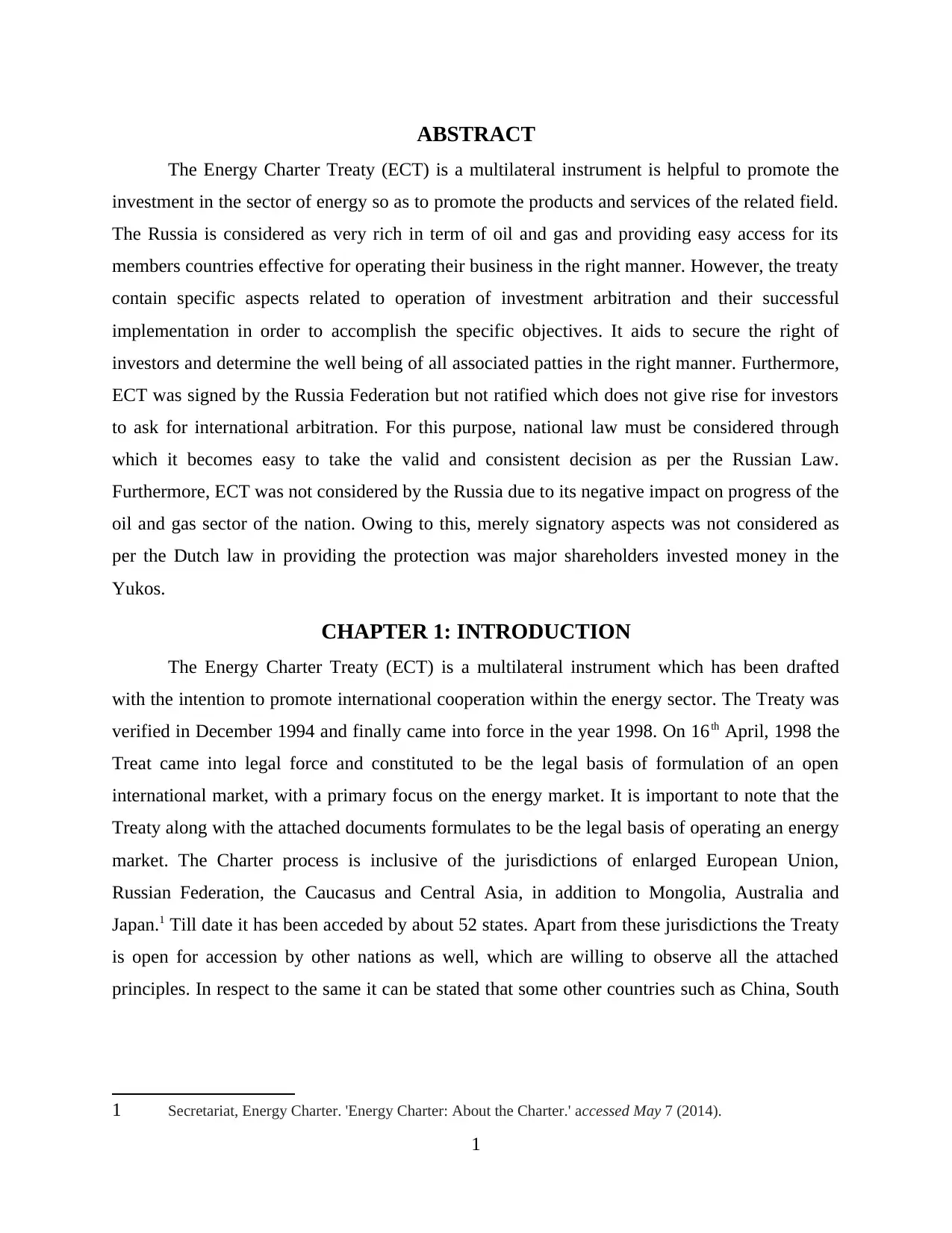
ABSTRACT
The Energy Charter Treaty (ECT) is a multilateral instrument is helpful to promote the
investment in the sector of energy so as to promote the products and services of the related field.
The Russia is considered as very rich in term of oil and gas and providing easy access for its
members countries effective for operating their business in the right manner. However, the treaty
contain specific aspects related to operation of investment arbitration and their successful
implementation in order to accomplish the specific objectives. It aids to secure the right of
investors and determine the well being of all associated patties in the right manner. Furthermore,
ECT was signed by the Russia Federation but not ratified which does not give rise for investors
to ask for international arbitration. For this purpose, national law must be considered through
which it becomes easy to take the valid and consistent decision as per the Russian Law.
Furthermore, ECT was not considered by the Russia due to its negative impact on progress of the
oil and gas sector of the nation. Owing to this, merely signatory aspects was not considered as
per the Dutch law in providing the protection was major shareholders invested money in the
Yukos.
CHAPTER 1: INTRODUCTION
The Energy Charter Treaty (ECT) is a multilateral instrument which has been drafted
with the intention to promote international cooperation within the energy sector. The Treaty was
verified in December 1994 and finally came into force in the year 1998. On 16th April, 1998 the
Treat came into legal force and constituted to be the legal basis of formulation of an open
international market, with a primary focus on the energy market. It is important to note that the
Treaty along with the attached documents formulates to be the legal basis of operating an energy
market. The Charter process is inclusive of the jurisdictions of enlarged European Union,
Russian Federation, the Caucasus and Central Asia, in addition to Mongolia, Australia and
Japan.1 Till date it has been acceded by about 52 states. Apart from these jurisdictions the Treaty
is open for accession by other nations as well, which are willing to observe all the attached
principles. In respect to the same it can be stated that some other countries such as China, South
1 Secretariat, Energy Charter. 'Energy Charter: About the Charter.' accessed May 7 (2014).
1
The Energy Charter Treaty (ECT) is a multilateral instrument is helpful to promote the
investment in the sector of energy so as to promote the products and services of the related field.
The Russia is considered as very rich in term of oil and gas and providing easy access for its
members countries effective for operating their business in the right manner. However, the treaty
contain specific aspects related to operation of investment arbitration and their successful
implementation in order to accomplish the specific objectives. It aids to secure the right of
investors and determine the well being of all associated patties in the right manner. Furthermore,
ECT was signed by the Russia Federation but not ratified which does not give rise for investors
to ask for international arbitration. For this purpose, national law must be considered through
which it becomes easy to take the valid and consistent decision as per the Russian Law.
Furthermore, ECT was not considered by the Russia due to its negative impact on progress of the
oil and gas sector of the nation. Owing to this, merely signatory aspects was not considered as
per the Dutch law in providing the protection was major shareholders invested money in the
Yukos.
CHAPTER 1: INTRODUCTION
The Energy Charter Treaty (ECT) is a multilateral instrument which has been drafted
with the intention to promote international cooperation within the energy sector. The Treaty was
verified in December 1994 and finally came into force in the year 1998. On 16th April, 1998 the
Treat came into legal force and constituted to be the legal basis of formulation of an open
international market, with a primary focus on the energy market. It is important to note that the
Treaty along with the attached documents formulates to be the legal basis of operating an energy
market. The Charter process is inclusive of the jurisdictions of enlarged European Union,
Russian Federation, the Caucasus and Central Asia, in addition to Mongolia, Australia and
Japan.1 Till date it has been acceded by about 52 states. Apart from these jurisdictions the Treaty
is open for accession by other nations as well, which are willing to observe all the attached
principles. In respect to the same it can be stated that some other countries such as China, South
1 Secretariat, Energy Charter. 'Energy Charter: About the Charter.' accessed May 7 (2014).
1
Paraphrase This Document
Need a fresh take? Get an instant paraphrase of this document with our AI Paraphraser
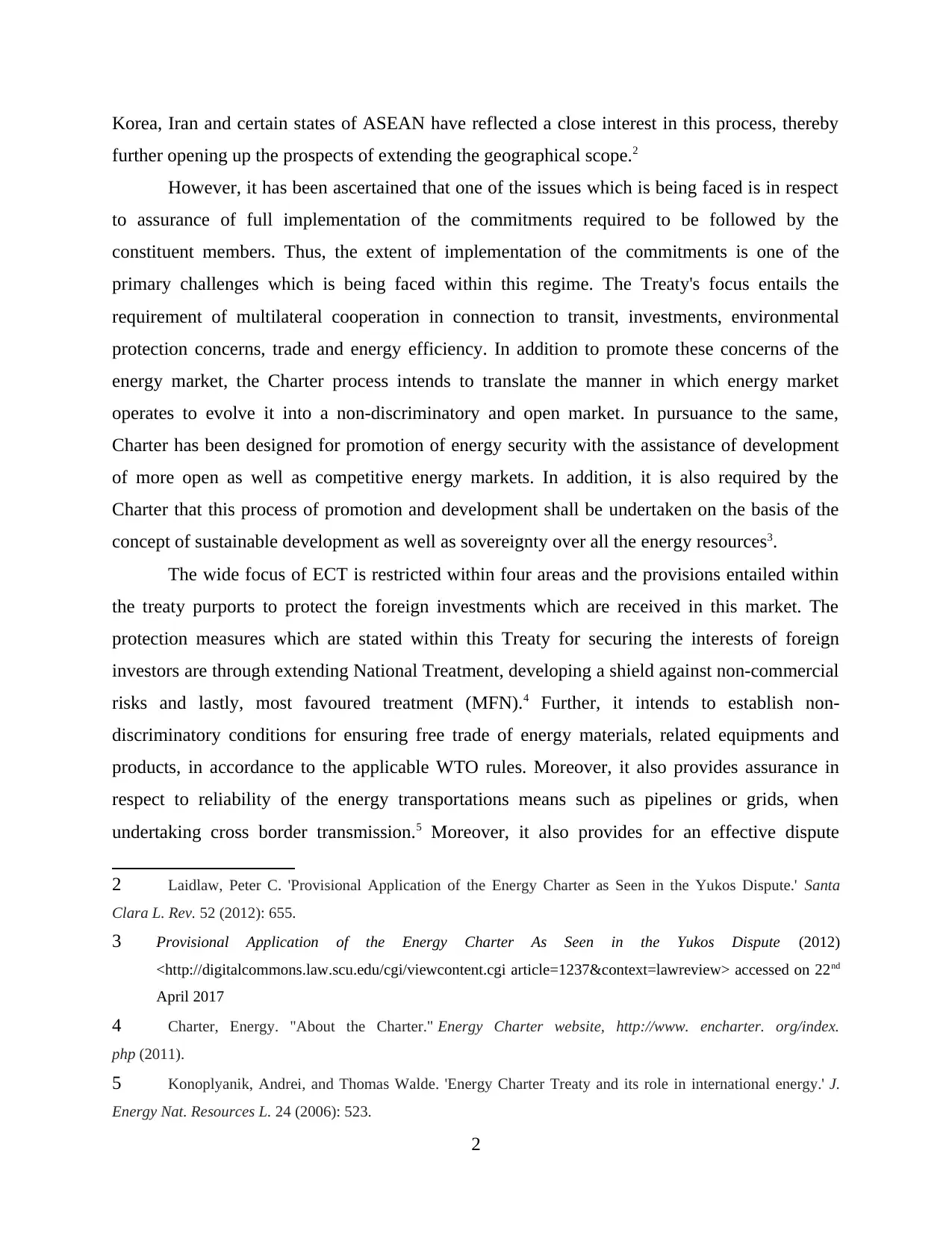
Korea, Iran and certain states of ASEAN have reflected a close interest in this process, thereby
further opening up the prospects of extending the geographical scope.2
However, it has been ascertained that one of the issues which is being faced is in respect
to assurance of full implementation of the commitments required to be followed by the
constituent members. Thus, the extent of implementation of the commitments is one of the
primary challenges which is being faced within this regime. The Treaty's focus entails the
requirement of multilateral cooperation in connection to transit, investments, environmental
protection concerns, trade and energy efficiency. In addition to promote these concerns of the
energy market, the Charter process intends to translate the manner in which energy market
operates to evolve it into a non-discriminatory and open market. In pursuance to the same,
Charter has been designed for promotion of energy security with the assistance of development
of more open as well as competitive energy markets. In addition, it is also required by the
Charter that this process of promotion and development shall be undertaken on the basis of the
concept of sustainable development as well as sovereignty over all the energy resources3.
The wide focus of ECT is restricted within four areas and the provisions entailed within
the treaty purports to protect the foreign investments which are received in this market. The
protection measures which are stated within this Treaty for securing the interests of foreign
investors are through extending National Treatment, developing a shield against non-commercial
risks and lastly, most favoured treatment (MFN).4 Further, it intends to establish non-
discriminatory conditions for ensuring free trade of energy materials, related equipments and
products, in accordance to the applicable WTO rules. Moreover, it also provides assurance in
respect to reliability of the energy transportations means such as pipelines or grids, when
undertaking cross border transmission.5 Moreover, it also provides for an effective dispute
2 Laidlaw, Peter C. 'Provisional Application of the Energy Charter as Seen in the Yukos Dispute.' Santa
Clara L. Rev. 52 (2012): 655.
3 Provisional Application of the Energy Charter As Seen in the Yukos Dispute (2012)
<http://digitalcommons.law.scu.edu/cgi/viewcontent.cgi article=1237&context=lawreview> accessed on 22nd
April 2017
4 Charter, Energy. "About the Charter." Energy Charter website, http://www. encharter. org/index.
php (2011).
5 Konoplyanik, Andrei, and Thomas Walde. 'Energy Charter Treaty and its role in international energy.' J.
Energy Nat. Resources L. 24 (2006): 523.
2
further opening up the prospects of extending the geographical scope.2
However, it has been ascertained that one of the issues which is being faced is in respect
to assurance of full implementation of the commitments required to be followed by the
constituent members. Thus, the extent of implementation of the commitments is one of the
primary challenges which is being faced within this regime. The Treaty's focus entails the
requirement of multilateral cooperation in connection to transit, investments, environmental
protection concerns, trade and energy efficiency. In addition to promote these concerns of the
energy market, the Charter process intends to translate the manner in which energy market
operates to evolve it into a non-discriminatory and open market. In pursuance to the same,
Charter has been designed for promotion of energy security with the assistance of development
of more open as well as competitive energy markets. In addition, it is also required by the
Charter that this process of promotion and development shall be undertaken on the basis of the
concept of sustainable development as well as sovereignty over all the energy resources3.
The wide focus of ECT is restricted within four areas and the provisions entailed within
the treaty purports to protect the foreign investments which are received in this market. The
protection measures which are stated within this Treaty for securing the interests of foreign
investors are through extending National Treatment, developing a shield against non-commercial
risks and lastly, most favoured treatment (MFN).4 Further, it intends to establish non-
discriminatory conditions for ensuring free trade of energy materials, related equipments and
products, in accordance to the applicable WTO rules. Moreover, it also provides assurance in
respect to reliability of the energy transportations means such as pipelines or grids, when
undertaking cross border transmission.5 Moreover, it also provides for an effective dispute
2 Laidlaw, Peter C. 'Provisional Application of the Energy Charter as Seen in the Yukos Dispute.' Santa
Clara L. Rev. 52 (2012): 655.
3 Provisional Application of the Energy Charter As Seen in the Yukos Dispute (2012)
<http://digitalcommons.law.scu.edu/cgi/viewcontent.cgi article=1237&context=lawreview> accessed on 22nd
April 2017
4 Charter, Energy. "About the Charter." Energy Charter website, http://www. encharter. org/index.
php (2011).
5 Konoplyanik, Andrei, and Thomas Walde. 'Energy Charter Treaty and its role in international energy.' J.
Energy Nat. Resources L. 24 (2006): 523.
2
resolution mechanism for participating states or investors and host states. Lastly, it requires the
members states to promote energy efficiency and undertake every possible attempt for reducing
the environmental impact of the processes of energy production as well as usage.
However, Russia withdrawals from the ECT in order to protect its own right and
determining the growth in term of oil and gas sector. This aids to meet the expectations of all
related stakeholders or protecting them effectively for the investment purpose in the country.
Also, country just develop own regulation for securing the right of involved parties. However,
the country found that ECT is biased towards the consumers and members stated6. However, it is
already rich in context of oil and gas through which it becomes easy to protect the right of
investors and stop the free transit of oil and gas from central Asia to Europe. Currently the
country is getting the gas from Uzbekistan, Turkmenistan and Kazakhstan before making the
decision related to sale to Europe as Russian gas. Thus, it does not consider highly beneficial to
ratify the ECT7.
Concept of Provisional Application of Treaty
Article 45 of ECT specifically provides for provisional application of the Treaty within a
jurisdiction. In accordance to Article 45 (1) the signatories were empowered to provisionally
apply the Treaty till the time it comes into force within their respective jurisdiction.8 Moreover, it
has been subjected to a proviso, in accordance to which the provisional application shall be
completely in compliance with its constitution, laws and regulations. It is important to note that
provisional application under Article 45 of ECT was possible only during the initial years when
it was open for signature i.e. during the time period of 17th December 1994 to 16th June 1995.
During those years when the treaty was open for signing, each of the signatories were required to
file a declaration to the effect of in ability to accept provisional application under Article 45 of
6 Kryvoi, Y.,The Yukos Arbitration Decision in a Nutshell (2015)
<http://www.cisarbitration.com/2015/06/19/the-yukos-arbitration-decision-in-a-nutshell/> accessed on 22nd
April 2017
7 Russia's withdrawal from the Energy Charter Treaty (2017)
<http://www.nortonrosefulbright.com/knowledge/publications/22691/russias-withdrawal-from-the-energy-charter-
treaty> accessed on 22nd April 2017.
8 The Energy Charter Treaty (September 2004) <http://www.ena.lt/pdfai/Treaty.pdf> accessed on 11th April
2017
3
members states to promote energy efficiency and undertake every possible attempt for reducing
the environmental impact of the processes of energy production as well as usage.
However, Russia withdrawals from the ECT in order to protect its own right and
determining the growth in term of oil and gas sector. This aids to meet the expectations of all
related stakeholders or protecting them effectively for the investment purpose in the country.
Also, country just develop own regulation for securing the right of involved parties. However,
the country found that ECT is biased towards the consumers and members stated6. However, it is
already rich in context of oil and gas through which it becomes easy to protect the right of
investors and stop the free transit of oil and gas from central Asia to Europe. Currently the
country is getting the gas from Uzbekistan, Turkmenistan and Kazakhstan before making the
decision related to sale to Europe as Russian gas. Thus, it does not consider highly beneficial to
ratify the ECT7.
Concept of Provisional Application of Treaty
Article 45 of ECT specifically provides for provisional application of the Treaty within a
jurisdiction. In accordance to Article 45 (1) the signatories were empowered to provisionally
apply the Treaty till the time it comes into force within their respective jurisdiction.8 Moreover, it
has been subjected to a proviso, in accordance to which the provisional application shall be
completely in compliance with its constitution, laws and regulations. It is important to note that
provisional application under Article 45 of ECT was possible only during the initial years when
it was open for signature i.e. during the time period of 17th December 1994 to 16th June 1995.
During those years when the treaty was open for signing, each of the signatories were required to
file a declaration to the effect of in ability to accept provisional application under Article 45 of
6 Kryvoi, Y.,The Yukos Arbitration Decision in a Nutshell (2015)
<http://www.cisarbitration.com/2015/06/19/the-yukos-arbitration-decision-in-a-nutshell/> accessed on 22nd
April 2017
7 Russia's withdrawal from the Energy Charter Treaty (2017)
<http://www.nortonrosefulbright.com/knowledge/publications/22691/russias-withdrawal-from-the-energy-charter-
treaty> accessed on 22nd April 2017.
8 The Energy Charter Treaty (September 2004) <http://www.ena.lt/pdfai/Treaty.pdf> accessed on 11th April
2017
3
⊘ This is a preview!⊘
Do you want full access?
Subscribe today to unlock all pages.
Trusted by 1+ million students worldwide
ECT.9 The Russian Federation and Belarus were the only two nations, who did not file such a
declaration and thus, allowed provisional application of the Treaty. Until June 2013, 5 of the
original signatories did not ratify the Charter, out of which only Russian Federation and Belarus
are the two nations which have accepted provisional application.10 However, in pursuance to the
existing legal concerns, the legal rights arising out of such a provisional application is open to
interpretation. Thus, this is one of the aspects of international law in consonance to provisions of
ECT which is unclear and needs an authoritative judicial consideration.
In furtherance to the same, it was officially communicated by Russian Federation on 20th
August 2009 that the nation no longer intends to ratify the Treaty and attain the title of
Contracting Party to ECT. As stated in Article 45 [3(a)] of ECT, communication of such a
notification has the effect of terminating the provisional application of ECT within Russia,
within a time period of 60 days from the receipt of such a notification. In consequence to such a
termination the Nation shall also not be required to adhere by the Protocol of Energy efficiency
as well as other environmental aspects. Thus, currently Belarus is the only nation which is
entitled for provisional application of this Treaty, in accordance to Article 45 of ECT. The
following discussion shall be focused upon different aspects of Yukos Universal Ltd. v. The
Russian Federation (2009) (hereinafter called as the Yukos Case).
Overview of Yukos Case
Yukos was one of the Joint Stock company established in 1993 and further privatilzed in
1995 with primary operations in the Oil and Gas Sector. The main production susbsidiary was in
the name of Yuganskneftegaz (YNG). By the year 2002 Yukos captured the position of largest
corporate in Russia and was also listed as one of the top 10 corporates of the world in the sector
of oil and gas. It has been complained by the claimant that various measures were undertaken by
Russia since July 2003 to declare Yukos as bankrupt in the year 2006.11 In pursuance to the
same, its name was also struck off in November 2007, along with nationalization of all its assets.
9 Gardiner, Richard K. Treaty interpretation. (Oxford University Press, USA, 2015).
10 The Energy Charter Treaty (2015)
<http://www.energycharter.org/process/energy-charter-treaty-1994/energy-charter-treaty/> accessed on 11th April
2017
11 Yukos v. Russia: Issues and legal reasoning behind US$50 billion awards (2014)
<https://www.iisd.org/itn/2014/09/04/yukos-v-russia-issues-and-legal-reasoning-behind-us50-billion-
awards/> accessed on 18th April 2017
4
declaration and thus, allowed provisional application of the Treaty. Until June 2013, 5 of the
original signatories did not ratify the Charter, out of which only Russian Federation and Belarus
are the two nations which have accepted provisional application.10 However, in pursuance to the
existing legal concerns, the legal rights arising out of such a provisional application is open to
interpretation. Thus, this is one of the aspects of international law in consonance to provisions of
ECT which is unclear and needs an authoritative judicial consideration.
In furtherance to the same, it was officially communicated by Russian Federation on 20th
August 2009 that the nation no longer intends to ratify the Treaty and attain the title of
Contracting Party to ECT. As stated in Article 45 [3(a)] of ECT, communication of such a
notification has the effect of terminating the provisional application of ECT within Russia,
within a time period of 60 days from the receipt of such a notification. In consequence to such a
termination the Nation shall also not be required to adhere by the Protocol of Energy efficiency
as well as other environmental aspects. Thus, currently Belarus is the only nation which is
entitled for provisional application of this Treaty, in accordance to Article 45 of ECT. The
following discussion shall be focused upon different aspects of Yukos Universal Ltd. v. The
Russian Federation (2009) (hereinafter called as the Yukos Case).
Overview of Yukos Case
Yukos was one of the Joint Stock company established in 1993 and further privatilzed in
1995 with primary operations in the Oil and Gas Sector. The main production susbsidiary was in
the name of Yuganskneftegaz (YNG). By the year 2002 Yukos captured the position of largest
corporate in Russia and was also listed as one of the top 10 corporates of the world in the sector
of oil and gas. It has been complained by the claimant that various measures were undertaken by
Russia since July 2003 to declare Yukos as bankrupt in the year 2006.11 In pursuance to the
same, its name was also struck off in November 2007, along with nationalization of all its assets.
9 Gardiner, Richard K. Treaty interpretation. (Oxford University Press, USA, 2015).
10 The Energy Charter Treaty (2015)
<http://www.energycharter.org/process/energy-charter-treaty-1994/energy-charter-treaty/> accessed on 11th April
2017
11 Yukos v. Russia: Issues and legal reasoning behind US$50 billion awards (2014)
<https://www.iisd.org/itn/2014/09/04/yukos-v-russia-issues-and-legal-reasoning-behind-us50-billion-
awards/> accessed on 18th April 2017
4
Paraphrase This Document
Need a fresh take? Get an instant paraphrase of this document with our AI Paraphraser
The remaining assets were acquired by state owned entities in the name of Gazprom and Rasneft.
The primary allegations in the present case are in relation to violation of provisions of ECT,
through initating a criminal prosecution against the corporate as well as its management. The
CEO of Yukos, Mikhail Khodorkovsky was charged and convicted for the criminal activities of
embezzelment, forgery, tax evasion and fraud. It was also determined some other executives of
the corporate fled from the nation to avoid any form of charges against them.12
During the arbitration proceedings it was alleged by Russia that the CEO was an
'oligarch' and further indicated towards involvement in other illegal activities. It was further also
stated by Russia that Yukos can be characterized as a 'criminal enterprise' which has been
involved in the specific activities of embezzlement, tax evasion, tax fraud and avoidance of other
compliances to eliminate enforcement of other aspects of tax laws, including transfer pricing.13
The alleged intention behind indulgence in all these activities is to divert all the proceeds to
offshore shell entities which are owned the mentioned oligarchs.
On the other hand, it was claimed by claimants that Russia by using its powers imposed
tax re-assessments, fines, VAT charges and asset freezes, apart from threatening to to revoke the
permit and annulling an important merger with Sibneft. It was also alleged by the claimants that
they were also coerced to sell away YNG, one of the most important entities looking into
production facilities. It was further alleged by the claimant that these measures amounted to
violation of the requirements of ECT, in the form of Fair and Equitable Treatment (FET) as
enunciated in Article 10 (1) and indirect expropriation of investment made by the claimants
under Article 13 (1).
CHAPTER 2: PROVISIONAL APPLICATION
Jurisdictional Ascertainment by Tribunal
The arbitration tribunal while dealing with matter, declared the Jurisdictional issue
through the interim award. The primary question which was considered by the tribunal was the
manner in which Article 45(1) and Article 45(2) shall be read. The Russian Federation suggested
following a piecemeal approach, in pursuance to which each of the provision of ECT shall be
12 Blyschak, Paul M. 'Yukos universal v. Russia: Shell companies and treaty shopping in international energy
disputes.' Rich. J. Global L. & Bus. 10 (2010) 179.
13 Brauch, Martin Dietrich. 'Yukos v. Russia: Issues and legal reasoning behind US $50 billion awards.'
(Investment Treaty News, 2014).
5
The primary allegations in the present case are in relation to violation of provisions of ECT,
through initating a criminal prosecution against the corporate as well as its management. The
CEO of Yukos, Mikhail Khodorkovsky was charged and convicted for the criminal activities of
embezzelment, forgery, tax evasion and fraud. It was also determined some other executives of
the corporate fled from the nation to avoid any form of charges against them.12
During the arbitration proceedings it was alleged by Russia that the CEO was an
'oligarch' and further indicated towards involvement in other illegal activities. It was further also
stated by Russia that Yukos can be characterized as a 'criminal enterprise' which has been
involved in the specific activities of embezzlement, tax evasion, tax fraud and avoidance of other
compliances to eliminate enforcement of other aspects of tax laws, including transfer pricing.13
The alleged intention behind indulgence in all these activities is to divert all the proceeds to
offshore shell entities which are owned the mentioned oligarchs.
On the other hand, it was claimed by claimants that Russia by using its powers imposed
tax re-assessments, fines, VAT charges and asset freezes, apart from threatening to to revoke the
permit and annulling an important merger with Sibneft. It was also alleged by the claimants that
they were also coerced to sell away YNG, one of the most important entities looking into
production facilities. It was further alleged by the claimant that these measures amounted to
violation of the requirements of ECT, in the form of Fair and Equitable Treatment (FET) as
enunciated in Article 10 (1) and indirect expropriation of investment made by the claimants
under Article 13 (1).
CHAPTER 2: PROVISIONAL APPLICATION
Jurisdictional Ascertainment by Tribunal
The arbitration tribunal while dealing with matter, declared the Jurisdictional issue
through the interim award. The primary question which was considered by the tribunal was the
manner in which Article 45(1) and Article 45(2) shall be read. The Russian Federation suggested
following a piecemeal approach, in pursuance to which each of the provision of ECT shall be
12 Blyschak, Paul M. 'Yukos universal v. Russia: Shell companies and treaty shopping in international energy
disputes.' Rich. J. Global L. & Bus. 10 (2010) 179.
13 Brauch, Martin Dietrich. 'Yukos v. Russia: Issues and legal reasoning behind US $50 billion awards.'
(Investment Treaty News, 2014).
5
compared with the prevailing legal framework in the signatory nation. On the other hand, it was
recommended by the claimants that the tribunal shall adopt the principles enunciated under the
Provisional Application approach, in accordance to which it shall only be assessed if the
principle of provisional application is in consistence with the constitution as well as legal
framework applicable in the respective signatory nation.14
In accordance to the opinion of Russian Federation, Article 45(1) and 45(2) are
completely exclusive to each other and provides two distinct regimes. Thus, it was alleged by
them that interpretation of the concerned articles shall be undertaken in an exclusive manner.
The specific assertions made by the Russian Federation in regard to interpretation of these
provisions were:
A piecemeal comparison of the provisions of ECT shall be undertaken to ascertain the
inconsistency existing in the laws, in accordance to Article 45 (1).
On the other hand, Article 45 (2) requires the nation to make a separate declaration in
order to opt out of provisional application of the provisions of ECT.15
On the basis of these assertions it can be stated that the Russian Federation pertinently
pointed out towards the exclusive nature of these two articles of 45(1) and 45(2). However, in
the opinion of Claimants Article 45(1) is substantive in nature, capable of being invoked only
after satisfying the requirements enumerated in Article 45 (2). Thus, in view of this nature
Article 45 of ECT provides for a single regime encompassing two provisions.16 The former
provision purports to cover the substantive aspect of provisional application, whereas the other
provision provides for procedural aspects. While analysing specific aspects at the interim stage,
the tribunal at the first instance addressed the sub-issue of the requirement of making a
declaration under Article 45(2) of ECT, with the purpose of invoking the provision of Article
45(1). Further, the tribunal considered that requirement of signatories to give any form of notice
14 Laidlaw, Peter C. 'Provisional Application of the Energy Charter as Seen in the Yukos Dispute.' Santa Clara
L. Rev. 52 (2012) 655.
15 Olson, Cody. 'Enforcement of International Investment Arbitration Awards Against the Russian
Federation.' Am. Rev. Int'l Arb. 22 (2011) 711-711.
16 The Yukos Interim Awards on Jurisdiction and Admissibility Confirms Provisional Application of Energy
Charter Treaty (2010) <https://www.asil.org/insights/volume/14/issue/23/yukos-interim-awards-jurisdiction-
and-admissibility-confirms-provisional> accessed on 18th April 2017
6
recommended by the claimants that the tribunal shall adopt the principles enunciated under the
Provisional Application approach, in accordance to which it shall only be assessed if the
principle of provisional application is in consistence with the constitution as well as legal
framework applicable in the respective signatory nation.14
In accordance to the opinion of Russian Federation, Article 45(1) and 45(2) are
completely exclusive to each other and provides two distinct regimes. Thus, it was alleged by
them that interpretation of the concerned articles shall be undertaken in an exclusive manner.
The specific assertions made by the Russian Federation in regard to interpretation of these
provisions were:
A piecemeal comparison of the provisions of ECT shall be undertaken to ascertain the
inconsistency existing in the laws, in accordance to Article 45 (1).
On the other hand, Article 45 (2) requires the nation to make a separate declaration in
order to opt out of provisional application of the provisions of ECT.15
On the basis of these assertions it can be stated that the Russian Federation pertinently
pointed out towards the exclusive nature of these two articles of 45(1) and 45(2). However, in
the opinion of Claimants Article 45(1) is substantive in nature, capable of being invoked only
after satisfying the requirements enumerated in Article 45 (2). Thus, in view of this nature
Article 45 of ECT provides for a single regime encompassing two provisions.16 The former
provision purports to cover the substantive aspect of provisional application, whereas the other
provision provides for procedural aspects. While analysing specific aspects at the interim stage,
the tribunal at the first instance addressed the sub-issue of the requirement of making a
declaration under Article 45(2) of ECT, with the purpose of invoking the provision of Article
45(1). Further, the tribunal considered that requirement of signatories to give any form of notice
14 Laidlaw, Peter C. 'Provisional Application of the Energy Charter as Seen in the Yukos Dispute.' Santa Clara
L. Rev. 52 (2012) 655.
15 Olson, Cody. 'Enforcement of International Investment Arbitration Awards Against the Russian
Federation.' Am. Rev. Int'l Arb. 22 (2011) 711-711.
16 The Yukos Interim Awards on Jurisdiction and Admissibility Confirms Provisional Application of Energy
Charter Treaty (2010) <https://www.asil.org/insights/volume/14/issue/23/yukos-interim-awards-jurisdiction-
and-admissibility-confirms-provisional> accessed on 18th April 2017
6
⊘ This is a preview!⊘
Do you want full access?
Subscribe today to unlock all pages.
Trusted by 1+ million students worldwide
or declaration, when intending to receive benefits of the Limitation Clause as enunciated under
Article 45(1).
The interpretation of this situation was commenced by the tribunal by considering Article
31 and 32 of Vienna Convention on Law of Treaties (VCLT). It was opined by the tribunal in
this respect that the approach being suggested by Russian Federation is unambiguous in nature.
In other words, the piecemeal approach was preferred by the court which enunciated the idea of
two separate regimes being provided by Article 45 of ECT.17 It was specifically opined by the
court that it was unnecessary to pursue the travaux preparatories, attached with VCLT.
Therefore, it was opined that the Limitation Clause as provided by ECT is self-executing in
nature, while the other provision is liable to be invoked as a separate measures by the concerned
nations. In addition to these ascertainments, it has been opined by the court that if the tribunal
had followed the travaux preparatories of VCLT, it would have definitely concluded existence of
a single regime for being pursued by the signatory nations.
Furthermore, it was declared by the arbitral tribunal that a plain reading of Article 45(1)
directly concludes that the meaning of the wording of the concerned article along with the
practice prevalent in other signatory nations, leads to a conclusion that there does not exist any
form of requirement to make a formal declaration in any form.18 Finally, the Tribunal assessed
the Limitation Clause and the manner in which it shall be interpreted. The method of Principle
analysis as well as comparison on the basis of piecemeal approach was considered. As stated the
issue was analysed in three successive stages, wherein the requirement of Russia to make a
declaration in pursuance to Article 45 (2) was ascertained for enjoying the benefits under Article
45 (1) or the Limitation Clause. By stating that there was no need to make any such declaration,
it was also established that there existed two exclusive regimes in Article 45 for provisional
application. Thus, it was established that the declaration referred under Article 45 (2) is not any
form linked to the Limitation Clause in Article 45 (1).19 The tribunal took assistance from Article
17 Provisional Application Of The Energy Charter Treaty: Article 45(1) “Limitation Clause” (2010)
<http://kluwerarbitrationblog.com/2010/02/16/provisional-application-of-the-energy-charter-treaty-article-
451-limitation-clause/> accessed on 18th April 2017
18 Abi-Saab, Georges. "The appellate body and treaty interpretation." Treaty interpretation and the Vienna
Convention on the Law of Treaties: 30 years on. (Brill, 2010).
19 Dörr, Oliver, and Kirsten Schmalenbach, eds. Vienna Convention on the Law of Treaties: a commentary.
(Springer Science & Business Media, 2011).
7
Article 45(1).
The interpretation of this situation was commenced by the tribunal by considering Article
31 and 32 of Vienna Convention on Law of Treaties (VCLT). It was opined by the tribunal in
this respect that the approach being suggested by Russian Federation is unambiguous in nature.
In other words, the piecemeal approach was preferred by the court which enunciated the idea of
two separate regimes being provided by Article 45 of ECT.17 It was specifically opined by the
court that it was unnecessary to pursue the travaux preparatories, attached with VCLT.
Therefore, it was opined that the Limitation Clause as provided by ECT is self-executing in
nature, while the other provision is liable to be invoked as a separate measures by the concerned
nations. In addition to these ascertainments, it has been opined by the court that if the tribunal
had followed the travaux preparatories of VCLT, it would have definitely concluded existence of
a single regime for being pursued by the signatory nations.
Furthermore, it was declared by the arbitral tribunal that a plain reading of Article 45(1)
directly concludes that the meaning of the wording of the concerned article along with the
practice prevalent in other signatory nations, leads to a conclusion that there does not exist any
form of requirement to make a formal declaration in any form.18 Finally, the Tribunal assessed
the Limitation Clause and the manner in which it shall be interpreted. The method of Principle
analysis as well as comparison on the basis of piecemeal approach was considered. As stated the
issue was analysed in three successive stages, wherein the requirement of Russia to make a
declaration in pursuance to Article 45 (2) was ascertained for enjoying the benefits under Article
45 (1) or the Limitation Clause. By stating that there was no need to make any such declaration,
it was also established that there existed two exclusive regimes in Article 45 for provisional
application. Thus, it was established that the declaration referred under Article 45 (2) is not any
form linked to the Limitation Clause in Article 45 (1).19 The tribunal took assistance from Article
17 Provisional Application Of The Energy Charter Treaty: Article 45(1) “Limitation Clause” (2010)
<http://kluwerarbitrationblog.com/2010/02/16/provisional-application-of-the-energy-charter-treaty-article-
451-limitation-clause/> accessed on 18th April 2017
18 Abi-Saab, Georges. "The appellate body and treaty interpretation." Treaty interpretation and the Vienna
Convention on the Law of Treaties: 30 years on. (Brill, 2010).
19 Dörr, Oliver, and Kirsten Schmalenbach, eds. Vienna Convention on the Law of Treaties: a commentary.
(Springer Science & Business Media, 2011).
7
Paraphrase This Document
Need a fresh take? Get an instant paraphrase of this document with our AI Paraphraser
31 and 32 of VCLT for understanding the manner in which treaty shall be interpreted. Moreover,
special reliance was placed on ordinary meaning of the provisions of Treaty, along with the fact
that the common practice which has been followed by other signatories was not on delivering a
declaration for placing reliance on the Limitation Clause. It was noted by the Tribunal that six
states, namely Austria, Italy, Luxembourg, Portugal, Romania, and Turkey placed reliance on the
Limitation Clause and did not make any prior declaration in pursuance to Article 45 (1).
Further, the examination of Limitation Clause by the Tribunal led to the conclusion that
the stand of the claimants was correct in connection to application of âall-or-nothingâ approach,
in pursuance to which either the Charter would be applied in its entirety or not at all. The
Tribunal in pursuance to this opinion as well as after referring to VCLT, agreed to the fact that
Russia had given its consent for application of the treaty in its entirety.20 However, the whole
application of Treaty shall be in a provisional manner till the time it is not ratified by the nations.
Further, it was also opined that this stand shall be final, unless the basic principle related to
provisional application is in itself inconsistent with the applicable rules, regulations and the
constitution of the treaty.
The decision of the arbitral tribunal in respect to the given facts of the case, has provided
a landmark judgement for reinforcing the binding nature which is attached with international
law. A reference can be made to the principle of Pacta Sunt Servanda, which has been
enunciated in Article 27 of the VCLT. This is one of the cardinal principles which states that a
State under general circumstances is prohibited to take recourse under domestic law, on failing to
abide by the requirements of international laws. This principle has been entailed in one of the
most definitive authority in the form of VCLT. Through Article 26 it is also stated by VCLT that
every treaty having a binding effect shall also be required to perform in good faith. In pursuance
to the same every state is under an obligation to undertake essential steps to stay in compliance
with the primary object as well as purpose of the concerned treaty.21 It is an unacceptable
practice to invoke restrictions entailed within the domestic laws for allowing themselves to not
comply with the obligations imposed under the Treaty, which has been duly ratified. The shelf
cases (1969) had clearly established that a treat could be ratified only after consent of the
20 Hofmann, Nathalie. "Interpretation Rules and Good Faith as Obstacles to the UK's Ratification of the CISG
and to the Harmonization of Contract Law in Europe." Pace Int'l L. Rev. 22 (2010) 145.
21 Hofmann, Nathalie. "Interpretation Rules and Good Faith as Obstacles to the UK's Ratification of the CISG
and to the Harmonization of Contract Law in Europe." Pace Int'l L. Rev. 22 (2010) 145.
8
special reliance was placed on ordinary meaning of the provisions of Treaty, along with the fact
that the common practice which has been followed by other signatories was not on delivering a
declaration for placing reliance on the Limitation Clause. It was noted by the Tribunal that six
states, namely Austria, Italy, Luxembourg, Portugal, Romania, and Turkey placed reliance on the
Limitation Clause and did not make any prior declaration in pursuance to Article 45 (1).
Further, the examination of Limitation Clause by the Tribunal led to the conclusion that
the stand of the claimants was correct in connection to application of âall-or-nothingâ approach,
in pursuance to which either the Charter would be applied in its entirety or not at all. The
Tribunal in pursuance to this opinion as well as after referring to VCLT, agreed to the fact that
Russia had given its consent for application of the treaty in its entirety.20 However, the whole
application of Treaty shall be in a provisional manner till the time it is not ratified by the nations.
Further, it was also opined that this stand shall be final, unless the basic principle related to
provisional application is in itself inconsistent with the applicable rules, regulations and the
constitution of the treaty.
The decision of the arbitral tribunal in respect to the given facts of the case, has provided
a landmark judgement for reinforcing the binding nature which is attached with international
law. A reference can be made to the principle of Pacta Sunt Servanda, which has been
enunciated in Article 27 of the VCLT. This is one of the cardinal principles which states that a
State under general circumstances is prohibited to take recourse under domestic law, on failing to
abide by the requirements of international laws. This principle has been entailed in one of the
most definitive authority in the form of VCLT. Through Article 26 it is also stated by VCLT that
every treaty having a binding effect shall also be required to perform in good faith. In pursuance
to the same every state is under an obligation to undertake essential steps to stay in compliance
with the primary object as well as purpose of the concerned treaty.21 It is an unacceptable
practice to invoke restrictions entailed within the domestic laws for allowing themselves to not
comply with the obligations imposed under the Treaty, which has been duly ratified. The shelf
cases (1969) had clearly established that a treat could be ratified only after consent of the
20 Hofmann, Nathalie. "Interpretation Rules and Good Faith as Obstacles to the UK's Ratification of the CISG
and to the Harmonization of Contract Law in Europe." Pace Int'l L. Rev. 22 (2010) 145.
21 Hofmann, Nathalie. "Interpretation Rules and Good Faith as Obstacles to the UK's Ratification of the CISG
and to the Harmonization of Contract Law in Europe." Pace Int'l L. Rev. 22 (2010) 145.
8
concerned parties.22 Thus, ratification of a treaty makes all the provisions binding in nature and
requires execution of the same in good faith. This approach can be seconded by the principle on
the basis of which contract law operates and makes the concerned parties liable for their actions.
Thus, a Treaty is also similar to a contract which is entered between parties making them bound
to perform each of the obligations in the stipulated manner. Applying this principle on facts of
the Yukos case, it was concluded by the Tribunal that to allow Russia from not abiding by the
obligations required under the principle of provisional application on the basis of their domestic
law, shall directly have the effect of undermining the fundamental principle of creating binding
nature of provisional application.23
Provisional Application of ECT by Russia
After ascertainment of the separate legal regimes and the requirement for declaration
under the Treaty, the Tribunal considered whether the Russian Legal System allowed the concept
of provisional application or if the domestic law of nation contradicted application of a treaty in
this manner. After analysing all the relevant laws and the applicable practices, it was ascertained
by the Tribunal that this concept was completely in compliance with the legal laws and
regulations as well as the Constitution of Russia.24 This could also be clearly demonstrated by the
long tradition which the nation has been following in respect to provisional application ODF
other 45 treaties. In pursuance to these determinants it was opined by the Tribunal that Russia
was under an obligation to provisionally apply each of the Articles of ECT, which also included
the dispute resolution provision25.
Furthermore, it was argued by Russia that under provisional application of the treaty they
are liable to apply treaty provisions, provisionally, only to the extent they are consistent with the
22 Schreuer, Christoph. "Diversity and harmonization of treaty interpretation in investment arbitration." Treaty
Interpretation and the Vienna Convention on the Law of Treaties: 30 Years on. (Brill, 2010).
23 Schreuer, Christoph. "Diversity and harmonization of treaty interpretation in investment arbitration." Treaty
Interpretation and the Vienna Convention on the Law of Treaties: 30 Years on. (Brill, 2010).
24 Waibel, Michael. "Demystifying the art of interpretation." European Journal of International Law 22.2
(2011) 571-588.
25 The Yukos Saga Continues (2016)
<http://www.hendersonchambers.co.uk/wp-content/uploads/2016/04/Alerter-from-Matthieu-Gregoire-
Yukos-Saga-Continues-April-21-2016.pdf> accessed on 22nd April 2017
9
requires execution of the same in good faith. This approach can be seconded by the principle on
the basis of which contract law operates and makes the concerned parties liable for their actions.
Thus, a Treaty is also similar to a contract which is entered between parties making them bound
to perform each of the obligations in the stipulated manner. Applying this principle on facts of
the Yukos case, it was concluded by the Tribunal that to allow Russia from not abiding by the
obligations required under the principle of provisional application on the basis of their domestic
law, shall directly have the effect of undermining the fundamental principle of creating binding
nature of provisional application.23
Provisional Application of ECT by Russia
After ascertainment of the separate legal regimes and the requirement for declaration
under the Treaty, the Tribunal considered whether the Russian Legal System allowed the concept
of provisional application or if the domestic law of nation contradicted application of a treaty in
this manner. After analysing all the relevant laws and the applicable practices, it was ascertained
by the Tribunal that this concept was completely in compliance with the legal laws and
regulations as well as the Constitution of Russia.24 This could also be clearly demonstrated by the
long tradition which the nation has been following in respect to provisional application ODF
other 45 treaties. In pursuance to these determinants it was opined by the Tribunal that Russia
was under an obligation to provisionally apply each of the Articles of ECT, which also included
the dispute resolution provision25.
Furthermore, it was argued by Russia that under provisional application of the treaty they
are liable to apply treaty provisions, provisionally, only to the extent they are consistent with the
22 Schreuer, Christoph. "Diversity and harmonization of treaty interpretation in investment arbitration." Treaty
Interpretation and the Vienna Convention on the Law of Treaties: 30 Years on. (Brill, 2010).
23 Schreuer, Christoph. "Diversity and harmonization of treaty interpretation in investment arbitration." Treaty
Interpretation and the Vienna Convention on the Law of Treaties: 30 Years on. (Brill, 2010).
24 Waibel, Michael. "Demystifying the art of interpretation." European Journal of International Law 22.2
(2011) 571-588.
25 The Yukos Saga Continues (2016)
<http://www.hendersonchambers.co.uk/wp-content/uploads/2016/04/Alerter-from-Matthieu-Gregoire-
Yukos-Saga-Continues-April-21-2016.pdf> accessed on 22nd April 2017
9
⊘ This is a preview!⊘
Do you want full access?
Subscribe today to unlock all pages.
Trusted by 1+ million students worldwide

1 out of 24


Your All-in-One AI-Powered Toolkit for Academic Success.
+13062052269
info@desklib.com
Available 24*7 on WhatsApp / Email
![[object Object]](/_next/static/media/star-bottom.7253800d.svg)
Unlock your academic potential
Copyright © 2020–2026 A2Z Services. All Rights Reserved. Developed and managed by ZUCOL.