Case Study Analysis: Contemporary Issues in Leadership at Zappos
VerifiedAdded on 2022/11/26
|13
|3591
|448
Case Study
AI Summary
This case study analysis examines the contemporary issues faced by managers within organizations, using Zappos as a primary example. The report explores the ethical and moral dilemmas that arise due to organizational culture, including white-collar crime, employee rights, sexual harassment, romantic involvement, organizational justice, whistleblowing, and social responsibility. It delves into Zappos' adoption of Holacracy and its impact on the company's core values and management approach, and discusses challenges related to new entrants, substitute products, and supplier/customer bargaining power. The study provides proposed solutions, analyzes threats, and addresses ethical challenges encountered by Zappos, offering recommendations based on management theories and real-world scenarios. The report highlights the importance of organizational culture and its influence on operational activities and decision-making processes.
Running Head: Case Study Analysis: 0
Case Study Analysis
July 4
2019
Case Study Analysis
July 4
2019

Paraphrase This Document
Need a fresh take? Get an instant paraphrase of this document with our AI Paraphraser
Case Study Analysis: 1
Executive Summary
The report summarize about the contemporary issues which are faced by the managers in an
organization. In an organization sometimes there is situation of dilemma which is connected to
moral and ethical values, as there are different levels of managers working in an organization
they had to face these challenges at work place. There are some key areas which are defined for
the contemporary issues. The report also defined the critical analysis of organizational culture
and its impact on management of business; the study also concludes recommendation by
analyzing the management theories. In the corporate sector global economy plays critical role
which explains about the international exchange of goods that creates new platform for
organization to expand their business globally but with new opportunities there are some threats
arise for every organization those threats and opportunities in front of organization are briefly
explained in the report.
Executive Summary
The report summarize about the contemporary issues which are faced by the managers in an
organization. In an organization sometimes there is situation of dilemma which is connected to
moral and ethical values, as there are different levels of managers working in an organization
they had to face these challenges at work place. There are some key areas which are defined for
the contemporary issues. The report also defined the critical analysis of organizational culture
and its impact on management of business; the study also concludes recommendation by
analyzing the management theories. In the corporate sector global economy plays critical role
which explains about the international exchange of goods that creates new platform for
organization to expand their business globally but with new opportunities there are some threats
arise for every organization those threats and opportunities in front of organization are briefly
explained in the report.
Case Study Analysis: 2
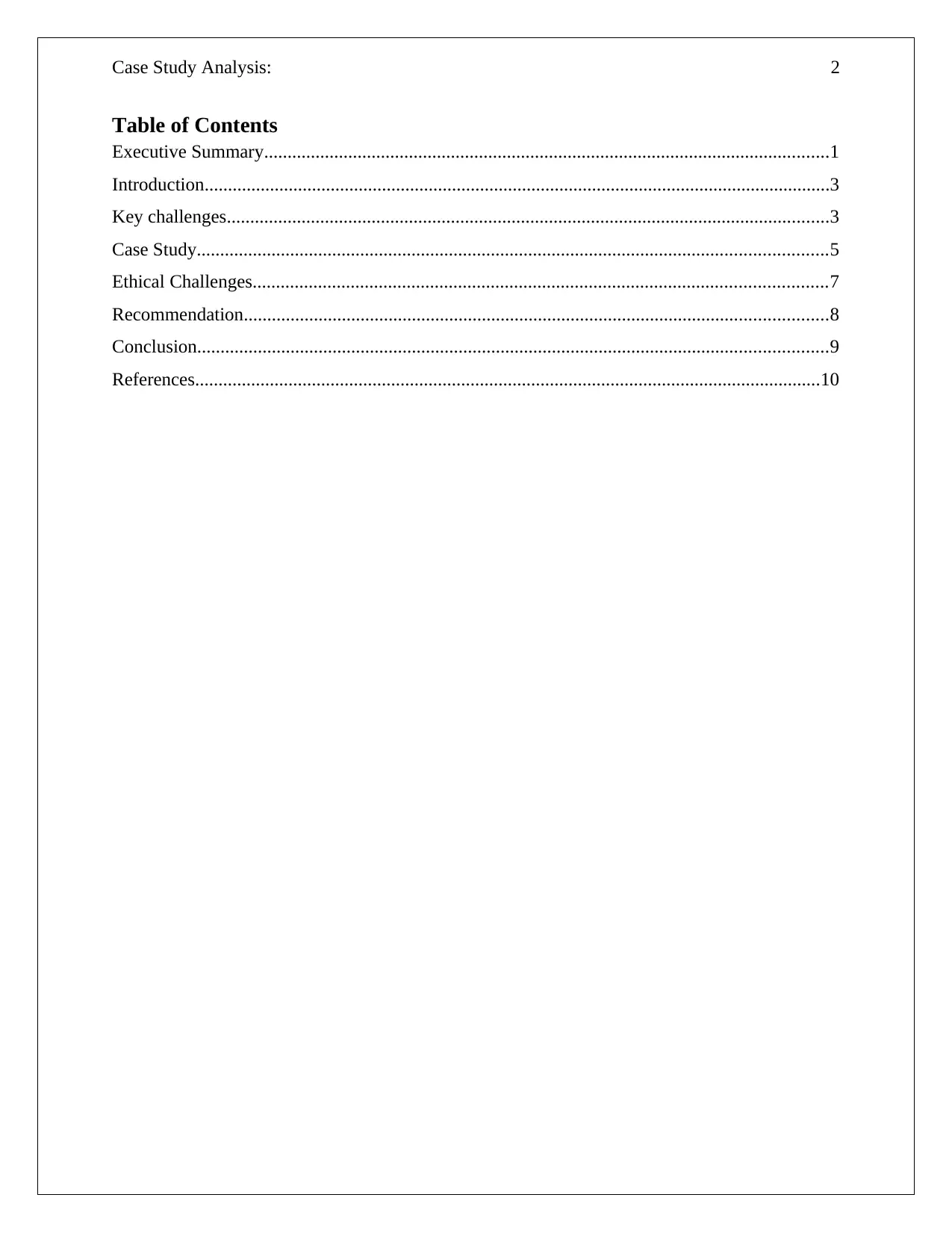
Table of Contents
Executive Summary.........................................................................................................................1
Introduction......................................................................................................................................3
Key challenges.................................................................................................................................3
Case Study.......................................................................................................................................5
Ethical Challenges...........................................................................................................................7
Recommendation.............................................................................................................................8
Conclusion.......................................................................................................................................9
References......................................................................................................................................10
Table of Contents
Executive Summary.........................................................................................................................1
Introduction......................................................................................................................................3
Key challenges.................................................................................................................................3
Case Study.......................................................................................................................................5
Ethical Challenges...........................................................................................................................7
Recommendation.............................................................................................................................8
Conclusion.......................................................................................................................................9
References......................................................................................................................................10
⊘ This is a preview!⊘
Do you want full access?
Subscribe today to unlock all pages.

Trusted by 1+ million students worldwide
Case Study Analysis: 3
Introduction
This report is totally based upon the organizational culture; its importance in an organization is
critically explained in the report. The organizational culture plays critical role in developing an
environment or a decorum which are affective for the operations or other activities. Sometimes
there are some situation arise which creates ethical or moral dilemma for the managers, they are
not able to make any decision, those problems are discussed in the report and recommendations
are provided to resolve the situations. In this report by analyzing the case study of the
organization ‘Zappos’ contemporary issues which is one of the factor of organizational culture is
defined in the report. The company adapts the strategy of Holacracy which was totally depending
on the culture and values of the company. It was implemented by the chairman of company and
according to the policy the higher authority of the company was only liable to take action and
other decision making.
Key challenges
In an organization there are several levels of managers who are assigned with their own specific
tasks or responsibilities. There are some situations at which mangers have to face moral and
ethical dilemma where they are not able to take decision (Boon, Den Hartog, & Lepak, 2019).
These are contemporary issues mainly arise due to organizational culture. The challenges are
discussed briefly below:
i. White collar crime: This crime can be examined in many forms which are sending
of the personal mail by using the resources of the company, during working hours
performing personal tasks etc. all the activities performed by an individual they are
considered as illegal. It does not matter that impact of activity is large or small these
issues are critical for any organization (den Hond, Järvi, & Välikangas, 2019).
ii. Employee Rights: At work places while managing the rights of employees there are
some situations of ethical dilemmas. If data of employee are used through the
information system of the company leads to ethical concern (Colton, Edenfield, &
Holmes, 2019). Manager or other senior authorities should ensure that none other
person able to access the data related to any employee, it is the responsibility of the
Introduction
This report is totally based upon the organizational culture; its importance in an organization is
critically explained in the report. The organizational culture plays critical role in developing an
environment or a decorum which are affective for the operations or other activities. Sometimes
there are some situation arise which creates ethical or moral dilemma for the managers, they are
not able to make any decision, those problems are discussed in the report and recommendations
are provided to resolve the situations. In this report by analyzing the case study of the
organization ‘Zappos’ contemporary issues which is one of the factor of organizational culture is
defined in the report. The company adapts the strategy of Holacracy which was totally depending
on the culture and values of the company. It was implemented by the chairman of company and
according to the policy the higher authority of the company was only liable to take action and
other decision making.
Key challenges
In an organization there are several levels of managers who are assigned with their own specific
tasks or responsibilities. There are some situations at which mangers have to face moral and
ethical dilemma where they are not able to take decision (Boon, Den Hartog, & Lepak, 2019).
These are contemporary issues mainly arise due to organizational culture. The challenges are
discussed briefly below:
i. White collar crime: This crime can be examined in many forms which are sending
of the personal mail by using the resources of the company, during working hours
performing personal tasks etc. all the activities performed by an individual they are
considered as illegal. It does not matter that impact of activity is large or small these
issues are critical for any organization (den Hond, Järvi, & Välikangas, 2019).
ii. Employee Rights: At work places while managing the rights of employees there are
some situations of ethical dilemmas. If data of employee are used through the
information system of the company leads to ethical concern (Colton, Edenfield, &
Holmes, 2019). Manager or other senior authorities should ensure that none other
person able to access the data related to any employee, it is the responsibility of the
Paraphrase This Document
Need a fresh take? Get an instant paraphrase of this document with our AI Paraphraser
Case Study Analysis: 4
management of organization and manager for the safety of the rights of the
employee’s and their privacy.
iii. Sexual Harassment: The unwelcome attention sexually either verbally or physically
in at work place affects the working ability of any employee also it impacts on
working environment in many ways. Such issues affect the value and image of
organization, its impact can be seen on the productivity of the company. It also has
the impact on the cost of company as organization might have to pay the damages to
the person who suffered the harassment (Gilbreath, 2019).
iv. Romantic Involvement: Sometimes in an organization some of the employees get
involved romantically during working hours at their work place which affect the
entire environment. Such acts an unprofessional behavior of the employees at the
work place. It adversely impact on the thinking or deviate other employee (Straker &
Nusem, 2019).
v. Organizational Justice: It is also one of the moral and ethical dilemmas which may
arise amongst the employee in both ways distributive or procedural who are
concerned for organizational justice.
a. Distributive Justice: The factor which is related to the decency of the results
which is delivered to any individual.
b. Procedural Justice: It focuses on the fairness about the process which is followed
to get the results. Its purpose is to examine the procedure which is used by the
organization were properly or accurately implemented (Xu, Gollan, & Wilkinson,
2018).
vi. Whistleblowing: Sometimes when the dedicated employees of the organization get
involved in the wrongdoing or in some unethical work, such information when
reached to the authorities of organization than process is known as whistleblowing;
the person who provides such information are known as whistleblowers. Organization
manages the whistle blowing by examining the situation, if it is appropriate for
disclosing the wrong doing (Raman, Garg, & Thapliyal, 2019).
vii. Social Responsibility: The obligation of the organization which explains to
maintaining the ethical behavior in an organization. It is the responsibility of manager
management of organization and manager for the safety of the rights of the
employee’s and their privacy.
iii. Sexual Harassment: The unwelcome attention sexually either verbally or physically
in at work place affects the working ability of any employee also it impacts on
working environment in many ways. Such issues affect the value and image of
organization, its impact can be seen on the productivity of the company. It also has
the impact on the cost of company as organization might have to pay the damages to
the person who suffered the harassment (Gilbreath, 2019).
iv. Romantic Involvement: Sometimes in an organization some of the employees get
involved romantically during working hours at their work place which affect the
entire environment. Such acts an unprofessional behavior of the employees at the
work place. It adversely impact on the thinking or deviate other employee (Straker &
Nusem, 2019).
v. Organizational Justice: It is also one of the moral and ethical dilemmas which may
arise amongst the employee in both ways distributive or procedural who are
concerned for organizational justice.
a. Distributive Justice: The factor which is related to the decency of the results
which is delivered to any individual.
b. Procedural Justice: It focuses on the fairness about the process which is followed
to get the results. Its purpose is to examine the procedure which is used by the
organization were properly or accurately implemented (Xu, Gollan, & Wilkinson,
2018).
vi. Whistleblowing: Sometimes when the dedicated employees of the organization get
involved in the wrongdoing or in some unethical work, such information when
reached to the authorities of organization than process is known as whistleblowing;
the person who provides such information are known as whistleblowers. Organization
manages the whistle blowing by examining the situation, if it is appropriate for
disclosing the wrong doing (Raman, Garg, & Thapliyal, 2019).
vii. Social Responsibility: The obligation of the organization which explains to
maintaining the ethical behavior in an organization. It is the responsibility of manager
Case Study Analysis: 5
who ensure or motivates their employee for the ethical behavior and organizational
responsibilities.
Case Study
Background of company
Zappos is an e-commerce company of shoes and apparel; the head quarter of company is situated
at Henderson, Nevada, USA. The company was founded twelve years ago by Nick Swinmurn in
1999. The idea to invest in the company was strike in the mind of the company when he tries to
search for the pair of shoes for himself, but when he missed the pair he approached to Tony
Hsieh and Alfred Lin and they found the online footwear company by joining together at first
they named it as ‘ShoeSite to Zappo.’ Later on it get merged with Venture Frogs, and later they
adopt name of the company as ‘Zappos.’ It is a contemporary organization and the core values of
the company are completely defined by the culture followed by them (Zhu, & Warner, 2019).
Core Values of Company
1. To deliver Wow experience to every customer through service.
2. Embracing the changes
3. To create fun, and little weirdness
4. Always be adventurous, creative and open minded.
5. To pursue growth and learning
6. Develop open and loyal relationships through the communication
7. Design a positive, dedicated team and maintain the spirit of family.
8. Always remain passionate for the work and determined.
9. Be humble always (Wanasika, & Krahnke, 2018).
Approach of Zappos to Management in performance
It is the comprehensive case which was arises in the company, according to the study the Zappos
conceptualize on the management in performance. They evaluate the concern with the approach
who ensure or motivates their employee for the ethical behavior and organizational
responsibilities.
Case Study
Background of company
Zappos is an e-commerce company of shoes and apparel; the head quarter of company is situated
at Henderson, Nevada, USA. The company was founded twelve years ago by Nick Swinmurn in
1999. The idea to invest in the company was strike in the mind of the company when he tries to
search for the pair of shoes for himself, but when he missed the pair he approached to Tony
Hsieh and Alfred Lin and they found the online footwear company by joining together at first
they named it as ‘ShoeSite to Zappo.’ Later on it get merged with Venture Frogs, and later they
adopt name of the company as ‘Zappos.’ It is a contemporary organization and the core values of
the company are completely defined by the culture followed by them (Zhu, & Warner, 2019).
Core Values of Company
1. To deliver Wow experience to every customer through service.
2. Embracing the changes
3. To create fun, and little weirdness
4. Always be adventurous, creative and open minded.
5. To pursue growth and learning
6. Develop open and loyal relationships through the communication
7. Design a positive, dedicated team and maintain the spirit of family.
8. Always remain passionate for the work and determined.
9. Be humble always (Wanasika, & Krahnke, 2018).
Approach of Zappos to Management in performance
It is the comprehensive case which was arises in the company, according to the study the Zappos
conceptualize on the management in performance. They evaluate the concern with the approach
⊘ This is a preview!⊘
Do you want full access?
Subscribe today to unlock all pages.
Trusted by 1+ million students worldwide
Case Study Analysis: 6
of Human Resource management and after it they provide the possible solutions. Management in
performance is strictly defined with the culture and value of an organization. If the performance
management of Zappos is analyzed they always work on the innovations which deserve the
applause. The major key factor behind the success of this concept is the feedback which
company takes from their customer and on the basis of that they work (Kelly, 2019). The
performance of the employees is completely examined on the basis of the core values of the
company. In the company anyone can give the feedback about the behavior of employee if it is
as per the context of the core values.
Discussion of Issue/Problem
One of the partners of company Tony Hsieh decided to adopt the policy of Holacracy in the
company. Basically Holacracy is a philosophy in which the authority of the company and
decision making ability are defined by the self-organizing team rather than to discuss with the
other management resources. This policy or strategy is adopted various profit or nonprofit
organization in different countries (Khan, Soundararajan, & Shoham, 2019). The decision was
taken by considering the relaxed environment of the company and satisfaction. When in the
company employees start opposes the policy then tony issued an email to his 1443 employees
that if they are not able to follow the policy they may leave the organization till the date which
was decided by the Tony. After the email 14% of the employees of the organization served the
notice, apart from that 20% of technical department some of them were in the middle of the
project which was a Supercloud Project (Pidun, 2019). The increase in the attrition significantly
become the problem for company, to overcome from this situation the collaboration between the
employees for their work was motivated but it leads to the confusion for some of employees
about the requirement which they have to complete. The policy of holacracy was introduced to
explain the core values of the company.
Zappos.com always consider the quality and satisfaction of their customer and Tony choose
Holacracy to maintain the core values and to make employees dedicated. The vision of the
company is on delivering the Wow to their customer for that they do not compromise with
quality of the product. The company has to minimize the cost and to raise the gain margins so
they choose other methods to reduce the cost.
of Human Resource management and after it they provide the possible solutions. Management in
performance is strictly defined with the culture and value of an organization. If the performance
management of Zappos is analyzed they always work on the innovations which deserve the
applause. The major key factor behind the success of this concept is the feedback which
company takes from their customer and on the basis of that they work (Kelly, 2019). The
performance of the employees is completely examined on the basis of the core values of the
company. In the company anyone can give the feedback about the behavior of employee if it is
as per the context of the core values.
Discussion of Issue/Problem
One of the partners of company Tony Hsieh decided to adopt the policy of Holacracy in the
company. Basically Holacracy is a philosophy in which the authority of the company and
decision making ability are defined by the self-organizing team rather than to discuss with the
other management resources. This policy or strategy is adopted various profit or nonprofit
organization in different countries (Khan, Soundararajan, & Shoham, 2019). The decision was
taken by considering the relaxed environment of the company and satisfaction. When in the
company employees start opposes the policy then tony issued an email to his 1443 employees
that if they are not able to follow the policy they may leave the organization till the date which
was decided by the Tony. After the email 14% of the employees of the organization served the
notice, apart from that 20% of technical department some of them were in the middle of the
project which was a Supercloud Project (Pidun, 2019). The increase in the attrition significantly
become the problem for company, to overcome from this situation the collaboration between the
employees for their work was motivated but it leads to the confusion for some of employees
about the requirement which they have to complete. The policy of holacracy was introduced to
explain the core values of the company.
Zappos.com always consider the quality and satisfaction of their customer and Tony choose
Holacracy to maintain the core values and to make employees dedicated. The vision of the
company is on delivering the Wow to their customer for that they do not compromise with
quality of the product. The company has to minimize the cost and to raise the gain margins so
they choose other methods to reduce the cost.
Paraphrase This Document
Need a fresh take? Get an instant paraphrase of this document with our AI Paraphraser
Case Study Analysis: 7
Proposed Solution
By analyzing the outcomes it was proposed to Zappos policy of Holacracy as an effective
strategy but it will not impact on the growth of the company. The approach of the holacracy
bounded the organization to realize that it there is lack in the structure of the company. Later on
it was instead of implementing hierarchy when holcracy was adopted the labor turnover was
reduced. The possible solution which was provided regarding the holacracy in company that
instead of implementing the new strategy in the company there should be a communication
between the employee and management related to cultural values of the company and
operational goals. It is the key responsibility of the managers to coach their employees towards
the goal and vision of the company. The organization may consider the initiative as a long term
not taken the strategy as experimental basis they may achieve the desirable results (Kurz, Jost,
Roth, & Ohlhausen, 2019).
Threats of the company
i. Threat of New Entrants: When the potential of the company will grow, other
facilities also have to be change including the manufacturing, equipment suppliers,
advanced technology etc. The biggest challenge in front of the company is
recruitment of the fresher’s in their organization as it will increase their capital and as
a start-up to compete with the other company’s revenue or capital plays key role
(Tarba, Ahammad, Junni, Stokes, & Morag, 2019).
ii. Threat of Substitute: Another challenge of the company is for introducing the
substitute or launching of other product because it will help to increase the profit or it
will act as an advantage against the competitor when that substitute will be designed
or produced by Zappo. But if the substitute will be produced by their competitor in
better quality and before them in market it will create trouble for Zappo (Taylor,
Santiago, & Hynes, 2019).
iii. Bargaining power of Supplier: The supplier of Zappos completely reliable on them
similarly Zappos is rely on them.
Proposed Solution
By analyzing the outcomes it was proposed to Zappos policy of Holacracy as an effective
strategy but it will not impact on the growth of the company. The approach of the holacracy
bounded the organization to realize that it there is lack in the structure of the company. Later on
it was instead of implementing hierarchy when holcracy was adopted the labor turnover was
reduced. The possible solution which was provided regarding the holacracy in company that
instead of implementing the new strategy in the company there should be a communication
between the employee and management related to cultural values of the company and
operational goals. It is the key responsibility of the managers to coach their employees towards
the goal and vision of the company. The organization may consider the initiative as a long term
not taken the strategy as experimental basis they may achieve the desirable results (Kurz, Jost,
Roth, & Ohlhausen, 2019).
Threats of the company
i. Threat of New Entrants: When the potential of the company will grow, other
facilities also have to be change including the manufacturing, equipment suppliers,
advanced technology etc. The biggest challenge in front of the company is
recruitment of the fresher’s in their organization as it will increase their capital and as
a start-up to compete with the other company’s revenue or capital plays key role
(Tarba, Ahammad, Junni, Stokes, & Morag, 2019).
ii. Threat of Substitute: Another challenge of the company is for introducing the
substitute or launching of other product because it will help to increase the profit or it
will act as an advantage against the competitor when that substitute will be designed
or produced by Zappo. But if the substitute will be produced by their competitor in
better quality and before them in market it will create trouble for Zappo (Taylor,
Santiago, & Hynes, 2019).
iii. Bargaining power of Supplier: The supplier of Zappos completely reliable on them
similarly Zappos is rely on them.
Case Study Analysis: 8
iv. Bargaining power of customer: In order to gain the attention of customer and to
compete with other companies Zappos. They have to consider the preference of
customer related to quality and price of the product and to maintain the both of these
factors the company has to reduce their other capital.
Ethical Challenges
Every organization has to face ethical challenges; Zappos was also from one of those companies
which addressed some critical challenges. In 2008 company had to lay off their 8% of the highly
valued employees. It was very difficult decision which was taken by the company as to lay off
the experienced employees meant that it affect half productivity and other tasks. Another
challenge which was when it got merged with the Amazon (Park, & Kohler, 2019). It was
confusion amongst customer regarding the merging with the Amazon. It was explained later by
Tony that the decision was taken for the benefit of the customers. As the company was founded
on the basis of the customer centric model and decided to take action on the same. To promote
values of their customers and later on with this merging the company and its customers get
benefit. Some of the biggest challenges which were faced by the company they were related to
the technical errors. In October 2011 due to some glitch some of the order of company were
delayed, deleted, also some of them get delivered on incorrect location due to which company
has to face loss of $ 1.6 million. In 20012 the database of the company was hacked due to which
information of customer get leaked including the contact number, email address, delivery
location and last digit of the cards were compromised (Shima, Kobayashi, & Shirasaka, 2019).
Another challenge which the company may face is threat of the globalization and core
sustainability. In the international market to maintain the price of the product when there are
similar products in cheap prices. The company has the policy of free shipping when the company
will ship their products at international scale than to maintain it will be a challenge for Zappos
(Slovak, 2019). According to their ideal procedure for hiring the employees which is based upon
holacracy so it is challenging task to choose the candidate who are compatible with the process
of the company. As the company adapt the strategy with the good intentions but it is not easy
task to implement the new changes amongst the 1500 employees. Another ethical challenge
which raised in the company due to holacracry; that when the decision making will be conduct
iv. Bargaining power of customer: In order to gain the attention of customer and to
compete with other companies Zappos. They have to consider the preference of
customer related to quality and price of the product and to maintain the both of these
factors the company has to reduce their other capital.
Ethical Challenges
Every organization has to face ethical challenges; Zappos was also from one of those companies
which addressed some critical challenges. In 2008 company had to lay off their 8% of the highly
valued employees. It was very difficult decision which was taken by the company as to lay off
the experienced employees meant that it affect half productivity and other tasks. Another
challenge which was when it got merged with the Amazon (Park, & Kohler, 2019). It was
confusion amongst customer regarding the merging with the Amazon. It was explained later by
Tony that the decision was taken for the benefit of the customers. As the company was founded
on the basis of the customer centric model and decided to take action on the same. To promote
values of their customers and later on with this merging the company and its customers get
benefit. Some of the biggest challenges which were faced by the company they were related to
the technical errors. In October 2011 due to some glitch some of the order of company were
delayed, deleted, also some of them get delivered on incorrect location due to which company
has to face loss of $ 1.6 million. In 20012 the database of the company was hacked due to which
information of customer get leaked including the contact number, email address, delivery
location and last digit of the cards were compromised (Shima, Kobayashi, & Shirasaka, 2019).
Another challenge which the company may face is threat of the globalization and core
sustainability. In the international market to maintain the price of the product when there are
similar products in cheap prices. The company has the policy of free shipping when the company
will ship their products at international scale than to maintain it will be a challenge for Zappos
(Slovak, 2019). According to their ideal procedure for hiring the employees which is based upon
holacracy so it is challenging task to choose the candidate who are compatible with the process
of the company. As the company adapt the strategy with the good intentions but it is not easy
task to implement the new changes amongst the 1500 employees. Another ethical challenge
which raised in the company due to holacracry; that when the decision making will be conduct
⊘ This is a preview!⊘
Do you want full access?
Subscribe today to unlock all pages.
Trusted by 1+ million students worldwide
Case Study Analysis: 9
by the highest authority of the company which leads to the losing of job titles including
managers.
Recommendation
In 21st Century Zappos is the company with the great business and strong platform to expand.
Due to unique business model the sales and marketing of the company increased a lot. Later on
when the company get merge with the Amazon it was a very great and smart deal. It helps the
company in getting the resources. Company should evolve their technical infrastructure to make
change for the technical environment. The company which has access with the customer through
the smartphone, computer, tablets are growing better, hence when the company choose the
technology leads and provide the advantage in preset era.
Conclusion
In this study the Zappos case study is analyzed and that is totally based upon contemporary
issues. In the report the discussion is made about the organization culture and contemporary
issues. The report also concludes about the challenges which manger or higher authorities may
face in the organization. This report and its analysis are completely based upon the contemporary
issues. In the report the discussion is done the strategy which was adapted by the company, it
was implemented in the company in order to change the environment. The company is dedicated
towards the customer satisfaction, and quality so to maintain the transparency in the company it
was decided. There was also some adverse effect of the strategy which company has to face.
Most of the employees of company left and they were not ready to accept it.
by the highest authority of the company which leads to the losing of job titles including
managers.
Recommendation
In 21st Century Zappos is the company with the great business and strong platform to expand.
Due to unique business model the sales and marketing of the company increased a lot. Later on
when the company get merge with the Amazon it was a very great and smart deal. It helps the
company in getting the resources. Company should evolve their technical infrastructure to make
change for the technical environment. The company which has access with the customer through
the smartphone, computer, tablets are growing better, hence when the company choose the
technology leads and provide the advantage in preset era.
Conclusion
In this study the Zappos case study is analyzed and that is totally based upon contemporary
issues. In the report the discussion is made about the organization culture and contemporary
issues. The report also concludes about the challenges which manger or higher authorities may
face in the organization. This report and its analysis are completely based upon the contemporary
issues. In the report the discussion is done the strategy which was adapted by the company, it
was implemented in the company in order to change the environment. The company is dedicated
towards the customer satisfaction, and quality so to maintain the transparency in the company it
was decided. There was also some adverse effect of the strategy which company has to face.
Most of the employees of company left and they were not ready to accept it.
Paraphrase This Document
Need a fresh take? Get an instant paraphrase of this document with our AI Paraphraser
Case Study Analysis: 10
References
Boon, C., Den Hartog, D. N., & Lepak, D. P. (2019). A systematic review of human resource
management systems and their measurement. Journal of Management,
0149206318818718.
Colton, J. S., Edenfield, A. C., & Holmes, S. (2019). Workplace democracy and the problem of
equality. Technical Communication, 66(1), 53-67.
den Hond, F., Järvi, K., & Välikangas, L. (2019). 17 Partial De-Organizing for Innovation and
Strategic Renewal? A Study of an Industrial Innovation Programme. Organization
outside Organizations: The Abundance of Partial Organization in Social Life, 359.
Gilbreath, B. (2019). How Leading Brands Deliver Marketing with Meaning. In Marketing
Wisdom (pp. 47-60). Springer, Singapore.
Kelly, R. (2019). Leadership Development and Structure—From Egosystems to Ecosystems.
In Constructing Leadership 4.0 (pp. 69-99). Palgrave Macmillan, Cham.
Khan, Z., Soundararajan, V., & Shoham, A. (2019). Global post-merger agility, transactive
memory systems and human resource management practices. Human Resource
Management Review, 100697.
References
Boon, C., Den Hartog, D. N., & Lepak, D. P. (2019). A systematic review of human resource
management systems and their measurement. Journal of Management,
0149206318818718.
Colton, J. S., Edenfield, A. C., & Holmes, S. (2019). Workplace democracy and the problem of
equality. Technical Communication, 66(1), 53-67.
den Hond, F., Järvi, K., & Välikangas, L. (2019). 17 Partial De-Organizing for Innovation and
Strategic Renewal? A Study of an Industrial Innovation Programme. Organization
outside Organizations: The Abundance of Partial Organization in Social Life, 359.
Gilbreath, B. (2019). How Leading Brands Deliver Marketing with Meaning. In Marketing
Wisdom (pp. 47-60). Springer, Singapore.
Kelly, R. (2019). Leadership Development and Structure—From Egosystems to Ecosystems.
In Constructing Leadership 4.0 (pp. 69-99). Palgrave Macmillan, Cham.
Khan, Z., Soundararajan, V., & Shoham, A. (2019). Global post-merger agility, transactive
memory systems and human resource management practices. Human Resource
Management Review, 100697.
Case Study Analysis: 11
Kurz, L., Jost, L., Roth, K., & Ohlhausen, P. (2019). Focusing Sustainable Human Resource
Management—Framework for Sustainability Management in Research Organizations.
In Social Responsibility and Sustainability (pp. 57-73). Springer, Cham.
Park, S. Y., & Kohler, T. (2019). Collaboration for sustainable tourism through strategic
bridging: A case of travel2change. Journal of Vacation Marketing, 25(1), 99-110.
Pidun, U. (2019). Corporate Ambition. In Corporate Strategy(pp. 11-31). Springer Gabler,
Wiesbaden.
Raman, G. V., Garg, S., & Thapliyal, S. (2019). Integrative Live Case: A Contemporary
Business Ethics Pedagogy. Journal of Business Ethics, 155(4), 1009-1032.
Savage, G., Franz, A., & Wasek, J. S. (2019). Holacratic Engineering Management and
Innovation. Engineering Management Journal, 31(1), 8-21.
Shima, S., Kobayashi, N., & Shirasaka, S. (2019). A Proposal of Architectural Framework for
Self-Organizing Management Utilizing Multi-Layer Customer Value Chain
Analysis. Review of Integrative Business and Economics Research, 8(2), 1-13.
Slovak, C. (2019). Customer-centric experiences through data. Applied Marketing
Analytics, 4(3), 206-213.
Straker, K., & Nusem, E. (2019). Designing value propositions: An exploration and extension of
Sinek’s ‘Golden Circle’model. Journal of Design, Business & Society, 5(1), 59-76.
Tarba, S. Y., Ahammad, M. F., Junni, P., Stokes, P., & Morag, O. (2019). The impact of
organizational culture differences, synergy potential, and autonomy granted to the
acquired high-tech firms on the M&A performance. Group & Organization
Management, 44(3), 483-520.
Taylor, A., Santiago, F., & Hynes, R. (2019). Relationships among leadership, organizational
culture, and support for innovation. In Effective and Creative Leadership in Diverse
Workforces (pp. 11-42). Palgrave Macmillan, Cham.
Turner, M. R., McIntosh, T., Reid, S. W., & Buckley, M. R. (2019). Corporate implementation
of socially controversial CSR initiatives: Implications for human resource
management. Human Resource Management Review, 29(1), 125-136.
Kurz, L., Jost, L., Roth, K., & Ohlhausen, P. (2019). Focusing Sustainable Human Resource
Management—Framework for Sustainability Management in Research Organizations.
In Social Responsibility and Sustainability (pp. 57-73). Springer, Cham.
Park, S. Y., & Kohler, T. (2019). Collaboration for sustainable tourism through strategic
bridging: A case of travel2change. Journal of Vacation Marketing, 25(1), 99-110.
Pidun, U. (2019). Corporate Ambition. In Corporate Strategy(pp. 11-31). Springer Gabler,
Wiesbaden.
Raman, G. V., Garg, S., & Thapliyal, S. (2019). Integrative Live Case: A Contemporary
Business Ethics Pedagogy. Journal of Business Ethics, 155(4), 1009-1032.
Savage, G., Franz, A., & Wasek, J. S. (2019). Holacratic Engineering Management and
Innovation. Engineering Management Journal, 31(1), 8-21.
Shima, S., Kobayashi, N., & Shirasaka, S. (2019). A Proposal of Architectural Framework for
Self-Organizing Management Utilizing Multi-Layer Customer Value Chain
Analysis. Review of Integrative Business and Economics Research, 8(2), 1-13.
Slovak, C. (2019). Customer-centric experiences through data. Applied Marketing
Analytics, 4(3), 206-213.
Straker, K., & Nusem, E. (2019). Designing value propositions: An exploration and extension of
Sinek’s ‘Golden Circle’model. Journal of Design, Business & Society, 5(1), 59-76.
Tarba, S. Y., Ahammad, M. F., Junni, P., Stokes, P., & Morag, O. (2019). The impact of
organizational culture differences, synergy potential, and autonomy granted to the
acquired high-tech firms on the M&A performance. Group & Organization
Management, 44(3), 483-520.
Taylor, A., Santiago, F., & Hynes, R. (2019). Relationships among leadership, organizational
culture, and support for innovation. In Effective and Creative Leadership in Diverse
Workforces (pp. 11-42). Palgrave Macmillan, Cham.
Turner, M. R., McIntosh, T., Reid, S. W., & Buckley, M. R. (2019). Corporate implementation
of socially controversial CSR initiatives: Implications for human resource
management. Human Resource Management Review, 29(1), 125-136.
⊘ This is a preview!⊘
Do you want full access?
Subscribe today to unlock all pages.
Trusted by 1+ million students worldwide

1 out of 13


Related Documents


Your All-in-One AI-Powered Toolkit for Academic Success.
+13062052269
info@desklib.com
Available 24*7 on WhatsApp / Email
![[object Object]](/_next/static/media/star-bottom.7253800d.svg)
Unlock your academic potential
Copyright © 2020–2026 A2Z Services. All Rights Reserved. Developed and managed by ZUCOL.