Zara Case Study: Supply Strategy, Risks, and Performance Analysis
VerifiedAdded on 2021/11/11
|14
|4839
|90
Case Study
AI Summary
This case study examines Zara's organizational performance, focusing on its supply chain strategy and its impact on the fashion industry. The report delves into Zara's approach to production, including smaller lot sizes, centralized design, and in-house manufacturing, highlighting how these strategies contribute to reduced lead times and increased flexibility. It analyzes Zara's performance across five key objectives: quality, speed, dependability, flexibility, and cost. The study also identifies potential business risks and outlines the company's risk management strategies. By examining Zara's strategic alignment, the report provides insights into how the company achieves and sustains its competitive advantage through efficient operations and responsiveness to market demands. The report underscores Zara's ability to quickly adapt to fashion trends and maintain customer satisfaction through its supply chain management and operational excellence.
Running head: ZARA CASE STUDY
Zara Case Study
Name of the Student
Name of the University
Author’s Note:
Zara Case Study
Name of the Student
Name of the University
Author’s Note:

Paraphrase This Document
Need a fresh take? Get an instant paraphrase of this document with our AI Paraphraser
1
ZARA CASE STUDY
Executive Summary
The main aim of this report is to understand the case study of Zara and the organizational
performance. The organizational performance encompasses three distinct specified areas of
the outcomes of that particular organization, known as financial performance like profits,
return on investment and return on asset and many more, performance of product market like
market share or sales and finally shareholder returns such as economic value added or total
shareholder returns. This respective organizational performance even demands the proactive
control of several cross functional activities, which would create, accumulate and deliver the
value. This value pathway should be discovered, the value delivery performance should be
measured and the performance gaps should be closed for the business cases. The sustaining
of organizational performances usually starts with value proposition and are required to be
understood or delivered on time. This report has clearly demonstrated the supply strategy,
performance on the basis of five performance objectives, several business risks and their
management for Zara.
ZARA CASE STUDY
Executive Summary
The main aim of this report is to understand the case study of Zara and the organizational
performance. The organizational performance encompasses three distinct specified areas of
the outcomes of that particular organization, known as financial performance like profits,
return on investment and return on asset and many more, performance of product market like
market share or sales and finally shareholder returns such as economic value added or total
shareholder returns. This respective organizational performance even demands the proactive
control of several cross functional activities, which would create, accumulate and deliver the
value. This value pathway should be discovered, the value delivery performance should be
measured and the performance gaps should be closed for the business cases. The sustaining
of organizational performances usually starts with value proposition and are required to be
understood or delivered on time. This report has clearly demonstrated the supply strategy,
performance on the basis of five performance objectives, several business risks and their
management for Zara.
2
ZARA CASE STUDY
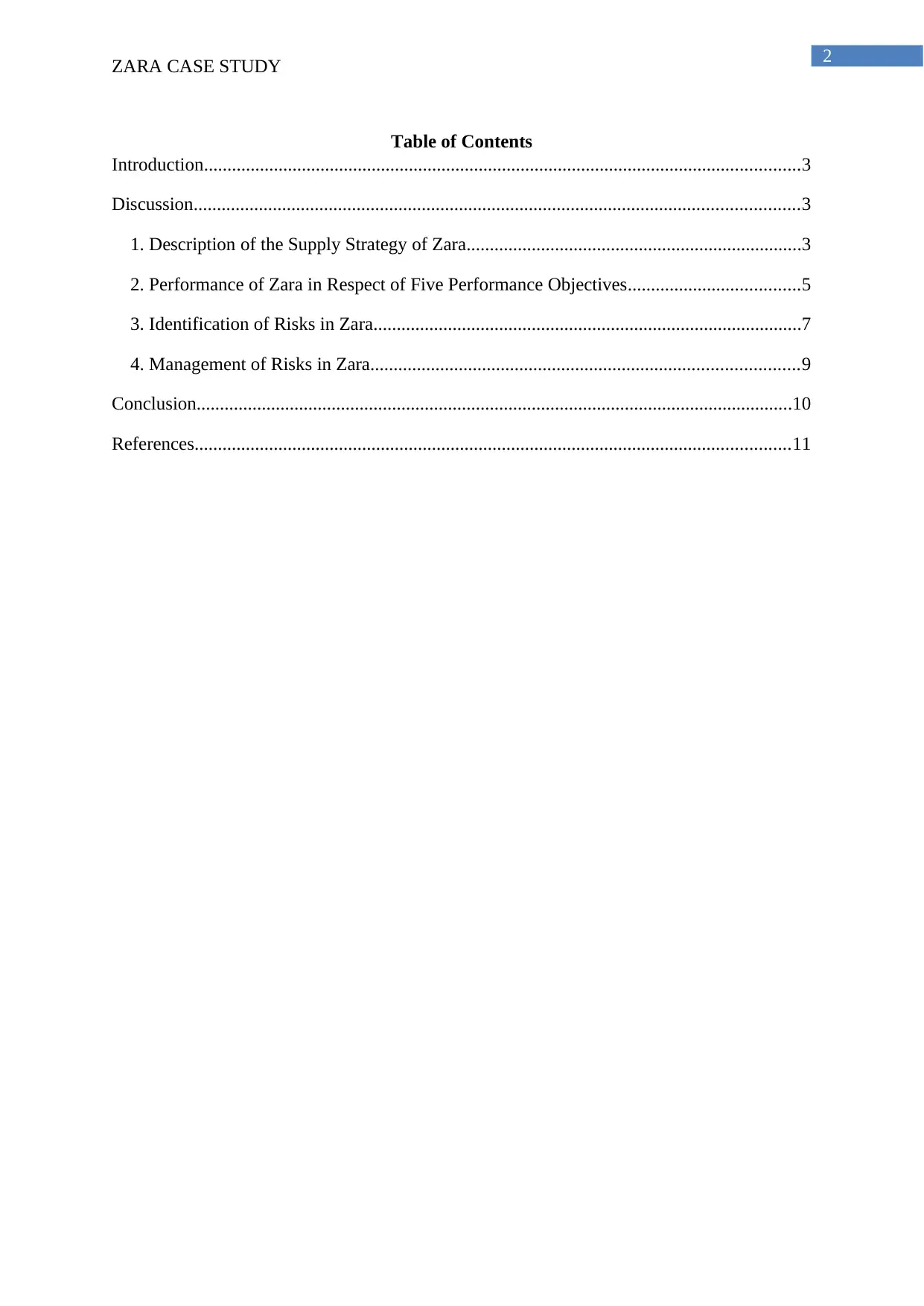
Table of Contents
Introduction................................................................................................................................3
Discussion..................................................................................................................................3
1. Description of the Supply Strategy of Zara........................................................................3
2. Performance of Zara in Respect of Five Performance Objectives.....................................5
3. Identification of Risks in Zara............................................................................................7
4. Management of Risks in Zara............................................................................................9
Conclusion................................................................................................................................10
References................................................................................................................................11
ZARA CASE STUDY
Table of Contents
Introduction................................................................................................................................3
Discussion..................................................................................................................................3
1. Description of the Supply Strategy of Zara........................................................................3
2. Performance of Zara in Respect of Five Performance Objectives.....................................5
3. Identification of Risks in Zara............................................................................................7
4. Management of Risks in Zara............................................................................................9
Conclusion................................................................................................................................10
References................................................................................................................................11
⊘ This is a preview!⊘
Do you want full access?
Subscribe today to unlock all pages.

Trusted by 1+ million students worldwide
3
ZARA CASE STUDY
Introduction
Organizational performance consists of the actual result or output of the organization
as being measured against the several intended outputs (Choudhary Akhtar & Zaheer, 2013).
The organizational performance is enhanced after proper inclusion of strategic planners,
organizational development, finance, operations, legal and many more. Most of the
organizations have significantly attempted in managing the respective organizational
performance with the help of a methodology, known as balanced scorecard. With this
particular methodology, the overall performance is being tracked as well as measured within
multiple dimensions like financial performance, customer services, social responsibilities,
system of measuring performance, employee stewardship, improvement of performance and
even organizational performance (Park & Shaw, 2013).
The following report outlines a brief discussion on the sustainability of organizational
performance for the popular and important fashion retailer, Zara (Hansen, 2012). This report
provides a proper description on the supply strategy, performance measurement of Zara over
five performance objectives, identification of risks and management of risks for this
organization.
Discussion
1. Description of the Supply Strategy of Zara
The supply chain leaders can build as well as maintain the resilient supply chains
within the complex globalized environment. With the adoption or development of robust
supply chain strategies, rapid changes could be brought with agility and flexibility for the
respective business (Noruzy et al., 2013). A well aligned strategy of supply chain could not
support properly and only after driving it. The respective strategy services of the
organizational supply chain are important for the purpose of aligning the processes of supply
chain as well as operating model with the business strategies. The designing, development as
well as implementing the strategies of supply chain for creating resilient supply chain to
deliver the relevant business results. The digital supply chain could not only help the business
in unlocking the greater values or opportunities but also in creating the strategic competitive
advantages (Shaw, Park & Kim, 2013). The particular organization could even help in the
transformation of supply chain into digitalized supply network, which could frequently
respond as per the business requirements.
ZARA CASE STUDY
Introduction
Organizational performance consists of the actual result or output of the organization
as being measured against the several intended outputs (Choudhary Akhtar & Zaheer, 2013).
The organizational performance is enhanced after proper inclusion of strategic planners,
organizational development, finance, operations, legal and many more. Most of the
organizations have significantly attempted in managing the respective organizational
performance with the help of a methodology, known as balanced scorecard. With this
particular methodology, the overall performance is being tracked as well as measured within
multiple dimensions like financial performance, customer services, social responsibilities,
system of measuring performance, employee stewardship, improvement of performance and
even organizational performance (Park & Shaw, 2013).
The following report outlines a brief discussion on the sustainability of organizational
performance for the popular and important fashion retailer, Zara (Hansen, 2012). This report
provides a proper description on the supply strategy, performance measurement of Zara over
five performance objectives, identification of risks and management of risks for this
organization.
Discussion
1. Description of the Supply Strategy of Zara
The supply chain leaders can build as well as maintain the resilient supply chains
within the complex globalized environment. With the adoption or development of robust
supply chain strategies, rapid changes could be brought with agility and flexibility for the
respective business (Noruzy et al., 2013). A well aligned strategy of supply chain could not
support properly and only after driving it. The respective strategy services of the
organizational supply chain are important for the purpose of aligning the processes of supply
chain as well as operating model with the business strategies. The designing, development as
well as implementing the strategies of supply chain for creating resilient supply chain to
deliver the relevant business results. The digital supply chain could not only help the business
in unlocking the greater values or opportunities but also in creating the strategic competitive
advantages (Shaw, Park & Kim, 2013). The particular organization could even help in the
transformation of supply chain into digitalized supply network, which could frequently
respond as per the business requirements.
Paraphrase This Document
Need a fresh take? Get an instant paraphrase of this document with our AI Paraphraser
4
ZARA CASE STUDY
Zara manages to bring major changes in the business operations to the next level so
that the fashion industry is benefitted from their supply chain management. For improving the
total competitiveness in the fashion industry, Zara have tried to extend and adopt the major
requirements in the business (Hansen, 2012). To reduce the lead time, the strategy of quick
response is developed and two core principles, called partnership within suppliers and
retailers for improving sharing of information and proper adoption of the technologies like
POS data and EDI are applied (Dobre, 2013). There are four strategies of supply chain that
are developed and executed for gaining the competitive advantages. The first and the
foremost strategy is improvement of visibility through the infrastructure of information
technology, optimum end to end supply chain costs, improvement of customer service levels
and flexibility for the business strategies and future growth. The supplier relationships are
also checked for developing mutual capabilities for the proper improvement of customer
service and effectiveness of supply chain.
The supply strategies of Zara fashion retailer are given below:
i) Producing in Smaller Lot: The first and the foremost supply strategy of Zara is that
they produce in smaller lot. This smaller lot is termed as the specified features of lean
manufacturing (Wu, Straub & Liang, 2015). Proper decisions are to be undertaken, so that
when the customer visits their store for new products, revenue is created.
ii) Centralizing Design and Product Development: The second strategy of Zara is to
centralize the design as well as product development. The new products are developed for
both in house staffs and even through the merchandizers. The suppliers even require sending
proper samples to the buyers several times (Hansen, 2012). The eradication of back and forth
communication is responsible for reducing the overall time for marketing drastically.
iii) Utilization of Work Cell Company: The new team of product development
comprises of its own sales, production planners, designers and procurement, similar to the
cellular manufacturing (Chen et al., 2014). This particular strategy helps Zara retailer to
properly streamline their internal communications.
iv) Controlling of Scheduling Strictly: In Zara, their store managers could place order
at least 2 times in one week and the shipments are delivered and prepared in 24 hours. The
products were kept on display at stores as per arrived. When they will run their business at
the most steady pace, Zara could reduce the waiting time at all steps of the way.
ZARA CASE STUDY
Zara manages to bring major changes in the business operations to the next level so
that the fashion industry is benefitted from their supply chain management. For improving the
total competitiveness in the fashion industry, Zara have tried to extend and adopt the major
requirements in the business (Hansen, 2012). To reduce the lead time, the strategy of quick
response is developed and two core principles, called partnership within suppliers and
retailers for improving sharing of information and proper adoption of the technologies like
POS data and EDI are applied (Dobre, 2013). There are four strategies of supply chain that
are developed and executed for gaining the competitive advantages. The first and the
foremost strategy is improvement of visibility through the infrastructure of information
technology, optimum end to end supply chain costs, improvement of customer service levels
and flexibility for the business strategies and future growth. The supplier relationships are
also checked for developing mutual capabilities for the proper improvement of customer
service and effectiveness of supply chain.
The supply strategies of Zara fashion retailer are given below:
i) Producing in Smaller Lot: The first and the foremost supply strategy of Zara is that
they produce in smaller lot. This smaller lot is termed as the specified features of lean
manufacturing (Wu, Straub & Liang, 2015). Proper decisions are to be undertaken, so that
when the customer visits their store for new products, revenue is created.
ii) Centralizing Design and Product Development: The second strategy of Zara is to
centralize the design as well as product development. The new products are developed for
both in house staffs and even through the merchandizers. The suppliers even require sending
proper samples to the buyers several times (Hansen, 2012). The eradication of back and forth
communication is responsible for reducing the overall time for marketing drastically.
iii) Utilization of Work Cell Company: The new team of product development
comprises of its own sales, production planners, designers and procurement, similar to the
cellular manufacturing (Chen et al., 2014). This particular strategy helps Zara retailer to
properly streamline their internal communications.
iv) Controlling of Scheduling Strictly: In Zara, their store managers could place order
at least 2 times in one week and the shipments are delivered and prepared in 24 hours. The
products were kept on display at stores as per arrived. When they will run their business at
the most steady pace, Zara could reduce the waiting time at all steps of the way.
5
ZARA CASE STUDY
v) Keeping Production In House: Zara even tries to stay away from the lower cost
country sourcing and then making investments within their in house manufacturing as
required (Birasnav, 2014). The most significant reason behind this is that they have the belief
that their in house production could help them in increasing the total business flexibility.
vi) Automation in Production as well as Warehouse Facilities: As Zara strongly
believes in their time based competition, the specified automation is the main source for them
in helping to increment the accuracy or speed of their operations.
vii) Adherence to Every Rule: The next important strategy of supplies in this
organization of Zara is proper adherence to each and every rule. However, the proper
implementation of any of the rules would not be effective (Carter & Greer, 2013). Next, this
organization will also have to stick to their rules, with the core purpose that the supply chain
is eventually running smoothly and perfectly.
The supply strategy of Zara is considered as one of the best examples of strategic
alignment, since processes, people as well as practice support and time bound strategies are
enhanced.
2. Performance of Zara in Respect of Five Performance Objectives
The five performance objectives play pivotal roles in any business. Each and every
aspect of operation allow the management in drawing attention to certain areas that are not
being performed properly for any company. Moreover, these performance objectives provide
significant opportunities for addressing those areas (Awadh & Alyahya, 2013). The major
features of these objectives enable the organizational management in assessing the operations
both externally and internally for getting the competitive advantages. Zara had been
performing well since the starting of their business and providing benefits and unique
products to their customers. The five performance objectives are quality, speed,
dependability, flexibility and cost (Hansen, 2012). The performance of Zara in respect to
these five above mentioned performance objectives are as follows:
i) Quality: The first and the foremost performance objective is quality. In Zara,
quality is considered as the most visible part of what their operation is undergoing and how it
is acting as the consistent indicator of the expectations of customers (Hansen, 2012). The
operations require to be done correctly and could vary as per their business processes. These
organizational operations even regard quality as the most relevant objective. Moreover, Zara
has also focused on quality for finding out their customers to obtain competitive advantages
ZARA CASE STUDY
v) Keeping Production In House: Zara even tries to stay away from the lower cost
country sourcing and then making investments within their in house manufacturing as
required (Birasnav, 2014). The most significant reason behind this is that they have the belief
that their in house production could help them in increasing the total business flexibility.
vi) Automation in Production as well as Warehouse Facilities: As Zara strongly
believes in their time based competition, the specified automation is the main source for them
in helping to increment the accuracy or speed of their operations.
vii) Adherence to Every Rule: The next important strategy of supplies in this
organization of Zara is proper adherence to each and every rule. However, the proper
implementation of any of the rules would not be effective (Carter & Greer, 2013). Next, this
organization will also have to stick to their rules, with the core purpose that the supply chain
is eventually running smoothly and perfectly.
The supply strategy of Zara is considered as one of the best examples of strategic
alignment, since processes, people as well as practice support and time bound strategies are
enhanced.
2. Performance of Zara in Respect of Five Performance Objectives
The five performance objectives play pivotal roles in any business. Each and every
aspect of operation allow the management in drawing attention to certain areas that are not
being performed properly for any company. Moreover, these performance objectives provide
significant opportunities for addressing those areas (Awadh & Alyahya, 2013). The major
features of these objectives enable the organizational management in assessing the operations
both externally and internally for getting the competitive advantages. Zara had been
performing well since the starting of their business and providing benefits and unique
products to their customers. The five performance objectives are quality, speed,
dependability, flexibility and cost (Hansen, 2012). The performance of Zara in respect to
these five above mentioned performance objectives are as follows:
i) Quality: The first and the foremost performance objective is quality. In Zara,
quality is considered as the most visible part of what their operation is undergoing and how it
is acting as the consistent indicator of the expectations of customers (Hansen, 2012). The
operations require to be done correctly and could vary as per their business processes. These
organizational operations even regard quality as the most relevant objective. Moreover, Zara
has also focused on quality for finding out their customers to obtain competitive advantages
⊘ This is a preview!⊘
Do you want full access?
Subscribe today to unlock all pages.
Trusted by 1+ million students worldwide
6
ZARA CASE STUDY
properly. This quality has clearly influenced on the customer satisfaction or customer
dissatisfaction (Tseng & Lee, 2014). The proper customer perception on these higher quality
services and products are enhanced for maintaining customer satisfaction and hence gets a
chance to get long term customers. Due to their better performance in respect to quality, Zara
have the capability of producing products and services as per specification consistently.
ii) Speed: The second performance objective is speed. At the organization of Zara,
speed refers to the elapsed time within the customers requesting their services or products and
them receiving those products or services (Hansen, 2012). The most important and significant
advantage of the organizational external customers of the immediate delivery of services and
goods is stated that the faster the customers could have their products, the more likely they
would buy them and Zara would receive more competitive advantages (Felício, Gonçalves &
da Conceição Gonçalves, 2013). The faster responses to the external customer is extremely
helpful by the speedy decision making and speedy material or information movement within
their business operations. Zara is also checking their inventories constantly due to this
performance objective of speed and hence is able to update them periodically. This is helping
them in reducing their issues with stock and maintenance of stocks.
iii) Dependability: The next performance objective is dependability. This particular
objective for Zara refers to doing of things within time so that the customers could receive
their services and goods whenever they are required, or at least when they are being
promised. The customers may only judge the operational dependability as soon as the service
or product is being delivered. In the beginning of the business, it might not affect the
likelihood that the respective customers would select their service that is being consumed
already (Gomez-Mejia, Berrone & Franco-Santos, 2014). This dependability could even
override every single criterion and in every aspect, the customer would be enhanced. Zara has
been performing quite well in respect to dependability and this factor would even save time.
Zara has got stability from their performance in dependability and thus is able to stop their
disruption in operations.
iv) Flexibility: Another important objective of performance is flexibility. This
objective refers to the fact that flexibility could change the overall operation in any specific
method. It might mean that the alteration in the operation and the procedure of executing this
operation (Hansen, 2012). Zara mainly focuses on the fact that the customers would require
operation for changing so that it could provide four distinct kinds of requirements. The
ZARA CASE STUDY
properly. This quality has clearly influenced on the customer satisfaction or customer
dissatisfaction (Tseng & Lee, 2014). The proper customer perception on these higher quality
services and products are enhanced for maintaining customer satisfaction and hence gets a
chance to get long term customers. Due to their better performance in respect to quality, Zara
have the capability of producing products and services as per specification consistently.
ii) Speed: The second performance objective is speed. At the organization of Zara,
speed refers to the elapsed time within the customers requesting their services or products and
them receiving those products or services (Hansen, 2012). The most important and significant
advantage of the organizational external customers of the immediate delivery of services and
goods is stated that the faster the customers could have their products, the more likely they
would buy them and Zara would receive more competitive advantages (Felício, Gonçalves &
da Conceição Gonçalves, 2013). The faster responses to the external customer is extremely
helpful by the speedy decision making and speedy material or information movement within
their business operations. Zara is also checking their inventories constantly due to this
performance objective of speed and hence is able to update them periodically. This is helping
them in reducing their issues with stock and maintenance of stocks.
iii) Dependability: The next performance objective is dependability. This particular
objective for Zara refers to doing of things within time so that the customers could receive
their services and goods whenever they are required, or at least when they are being
promised. The customers may only judge the operational dependability as soon as the service
or product is being delivered. In the beginning of the business, it might not affect the
likelihood that the respective customers would select their service that is being consumed
already (Gomez-Mejia, Berrone & Franco-Santos, 2014). This dependability could even
override every single criterion and in every aspect, the customer would be enhanced. Zara has
been performing quite well in respect to dependability and this factor would even save time.
Zara has got stability from their performance in dependability and thus is able to stop their
disruption in operations.
iv) Flexibility: Another important objective of performance is flexibility. This
objective refers to the fact that flexibility could change the overall operation in any specific
method. It might mean that the alteration in the operation and the procedure of executing this
operation (Hansen, 2012). Zara mainly focuses on the fact that the customers would require
operation for changing so that it could provide four distinct kinds of requirements. The
Paraphrase This Document
Need a fresh take? Get an instant paraphrase of this document with our AI Paraphraser
7
ZARA CASE STUDY
flexibility of the organization subsequently introduce modified or new products and services.
Zara also has the ability of producing wider range and mixing of their products and services.
They have mixed jackets and sweaters and hence came up with the idea of hoodie jackets
(Petrenko et al., 2016). Another important flexibility of this organization is the flexibility in
delivery. The flexibility for changing as well as adapting is held quickly for the market
conditions and hence competitive edges are provided. The large centralized organizations do
not get proper flexibility for capitalization.
v) Cost: The fifth performance objective is cost. For this organization of Zara, costs
are the most significant operational objective. The lesser the cost of producing the services
and goods, the lesser could be the cost for the customers. When Zara is not competing on the
price, they are focusing to keep the costs lower. Moreover, Zara provides seasonal discounts
for all of their customers and the operations have the core interest to keep low cost as per
their quality level (Parveen, Jaafar & Ainin, 2015). The productivity of this organization has
raised and has indicated on how successful the operation could be at any point. Hence, the
internal effectiveness has increased and proper improvements are made for the other
operational objectives.
3. Identification of Risks in Zara
Zara is a popular fashion retailer that has its roots in Spain. It was funded by Amancio
Ortega and Rosalia Mera in the year of 1975. Zara is the major brand of the specific Inditex
group, which is the world’s largest retailer of apparel. This particular organization has been
constantly providing best quality of products and services to their customers and hence
enhancing several competitive advantages. They have been consistently expanding their
business throughout the world in the last 42 years. However, they have faced some of the
most significant risks or issues in their business and these are required to be changed properly
(Hansen, 2012). The major business risks of Zara are as follows:
i) Risk due to Expansion: The entry in the new market is the first and the foremost
risk faced by Zara. Since, they are expanding their business constantly, there is always a
chance that one market might not accept the products and services, provided by Zara and
hence they have faced these issues subsequently (Hamann et al., 2013). Zara has faced
financial crisis due to such risk and it should be mitigated as soon as possible to avoid further
issues within the company. Moreover, competition is increased in that particular market and
the internal structural changes are to be made periodically.
ZARA CASE STUDY
flexibility of the organization subsequently introduce modified or new products and services.
Zara also has the ability of producing wider range and mixing of their products and services.
They have mixed jackets and sweaters and hence came up with the idea of hoodie jackets
(Petrenko et al., 2016). Another important flexibility of this organization is the flexibility in
delivery. The flexibility for changing as well as adapting is held quickly for the market
conditions and hence competitive edges are provided. The large centralized organizations do
not get proper flexibility for capitalization.
v) Cost: The fifth performance objective is cost. For this organization of Zara, costs
are the most significant operational objective. The lesser the cost of producing the services
and goods, the lesser could be the cost for the customers. When Zara is not competing on the
price, they are focusing to keep the costs lower. Moreover, Zara provides seasonal discounts
for all of their customers and the operations have the core interest to keep low cost as per
their quality level (Parveen, Jaafar & Ainin, 2015). The productivity of this organization has
raised and has indicated on how successful the operation could be at any point. Hence, the
internal effectiveness has increased and proper improvements are made for the other
operational objectives.
3. Identification of Risks in Zara
Zara is a popular fashion retailer that has its roots in Spain. It was funded by Amancio
Ortega and Rosalia Mera in the year of 1975. Zara is the major brand of the specific Inditex
group, which is the world’s largest retailer of apparel. This particular organization has been
constantly providing best quality of products and services to their customers and hence
enhancing several competitive advantages. They have been consistently expanding their
business throughout the world in the last 42 years. However, they have faced some of the
most significant risks or issues in their business and these are required to be changed properly
(Hansen, 2012). The major business risks of Zara are as follows:
i) Risk due to Expansion: The entry in the new market is the first and the foremost
risk faced by Zara. Since, they are expanding their business constantly, there is always a
chance that one market might not accept the products and services, provided by Zara and
hence they have faced these issues subsequently (Hamann et al., 2013). Zara has faced
financial crisis due to such risk and it should be mitigated as soon as possible to avoid further
issues within the company. Moreover, competition is increased in that particular market and
the internal structural changes are to be made periodically.
8
ZARA CASE STUDY
ii) Strategic Risk: The second common type of risk for Zara is strategic risk. Each and
every business decision consists of few strategic risks. The respective decisions that are
designed for leading them closer to the business objectives, there is risk that they will not
consider. It is mainly because the decision could be a wrong one and could even occur for the
poor execution of operations and the lack of changes or resources within the respective
business environment.
iii) Physical Risk: Another important and popular type of risk for Zara is physical
risk. This type of risk is mainly for the assets and customers (Colwell & Joshi, 2013). The
most common physical risks for Zara are water damage, vandalism, theft and fires. The
subsequent physical damage could also result in replacement or repairing costs and hence can
also lead to the legal costs. Since, Zara is a popular and one of the largest fashion retailers
that has several branches, any type of physical damage could bring major issues in their
business and they would face business losses.
iv) Compliance Risk: The fourth important and noteworthy risk within their
organization of Zara is compliance risk. The business is being governed by the major forms
of regulations and legislations. The significant possibility of failing in adherence to all of the
rules or guidelines of Zara subsequently equate to the compliance risk and hence can lead
their reputational and prosecution changes (Verrier et al., 2014). The lack of appropriate
processes and analytics is yet another important reason for the compliance risk.
v) Human Risk: The employees of Zara themselves could create subsequent risk to
their business by several number of ways. The employee behaviour within the workplace
could eventually create the risks when they are non compliant and incompetent and the
behaviour of these employees outside their workplace could create major impact on them
(Hansen, 2012). The risk of fraud is one of the major examples of human risks.
vi) Technological Risk: Technological risks are the most common risks that are being
faced in the business. All of these risks could even range from any specific thing, right from
basic outage of power to cyber attacks, malware, software and hardware failure and many
more (Hyland, Lee & Mills, 2015). Some of the risks could even lead to the time loss by
equipment or systems and corruption or loss of data and even in some of the cases of data
breaching.
vii) Financial Risk: The seventh type of risk that is common for Zara is financial risk.
There are several methods, by which the business could face the financial risks. Few of these
ZARA CASE STUDY
ii) Strategic Risk: The second common type of risk for Zara is strategic risk. Each and
every business decision consists of few strategic risks. The respective decisions that are
designed for leading them closer to the business objectives, there is risk that they will not
consider. It is mainly because the decision could be a wrong one and could even occur for the
poor execution of operations and the lack of changes or resources within the respective
business environment.
iii) Physical Risk: Another important and popular type of risk for Zara is physical
risk. This type of risk is mainly for the assets and customers (Colwell & Joshi, 2013). The
most common physical risks for Zara are water damage, vandalism, theft and fires. The
subsequent physical damage could also result in replacement or repairing costs and hence can
also lead to the legal costs. Since, Zara is a popular and one of the largest fashion retailers
that has several branches, any type of physical damage could bring major issues in their
business and they would face business losses.
iv) Compliance Risk: The fourth important and noteworthy risk within their
organization of Zara is compliance risk. The business is being governed by the major forms
of regulations and legislations. The significant possibility of failing in adherence to all of the
rules or guidelines of Zara subsequently equate to the compliance risk and hence can lead
their reputational and prosecution changes (Verrier et al., 2014). The lack of appropriate
processes and analytics is yet another important reason for the compliance risk.
v) Human Risk: The employees of Zara themselves could create subsequent risk to
their business by several number of ways. The employee behaviour within the workplace
could eventually create the risks when they are non compliant and incompetent and the
behaviour of these employees outside their workplace could create major impact on them
(Hansen, 2012). The risk of fraud is one of the major examples of human risks.
vi) Technological Risk: Technological risks are the most common risks that are being
faced in the business. All of these risks could even range from any specific thing, right from
basic outage of power to cyber attacks, malware, software and hardware failure and many
more (Hyland, Lee & Mills, 2015). Some of the risks could even lead to the time loss by
equipment or systems and corruption or loss of data and even in some of the cases of data
breaching.
vii) Financial Risk: The seventh type of risk that is common for Zara is financial risk.
There are several methods, by which the business could face the financial risks. Few of these
⊘ This is a preview!⊘
Do you want full access?
Subscribe today to unlock all pages.
Trusted by 1+ million students worldwide
9
ZARA CASE STUDY
methods might be internal or might be external as well like fluctuations in the financial
markets or even exchange rates (Kunze, Boehm & Bruch, 2013). The non payments from
their clients is yet another important reason for financial risk, poor financial planning or
projection.
4. Management of Risks in Zara
The above mentioned seven risks can be managed or mitigated by Zara after
undertaking some of the major strategies (Hansen, 2012). The most relevant and important
strategies for mitigation of risks are as follows:
i) Strategies for Expansion Risk: Regarding the expansion in the United States and
China, Zara is facing major issues. However, this particular issue could be easily resolved
with the help of product diversification and market survey (Ling, 2013). When they will have
proper knowledge about the market, bringing products would be quite easier for them.
ii) Strategies for Strategic Risk: For the various strategic risks in this organization of
Zara, they can conduct periodical competitor analyses and take their decisions on the basis of
robust figures and researches. Proper goals as well as key performance indicators should also
be set by this organization. The identification of potential risks in advance and establishment
of KPIs or tolerance levels should also be undertaken by Zara (Hansen, 2012).
iii) Strategies for Physical Risk: The major physical risks could be reduced for Zara
is by installing safety features like smoke or fire alarms, fire escapes and sprinkler systems
(Yang, Huang & Hsu, 2014). The safety of the offices and products or services should be
increased by security guards and burglar alarms.
iv) Strategies for Compliance Risk: Regarding compliance risks, Zara should ensure
that they have specified roles or employees for managing as well as enforcing the business
compliance. Moreover, the correct processes and analytics should be ensure for the purpose
of monitoring the compliance.
v) Strategies for Human Risk: The management of human risk is done by robust
process of recruitment and rigorous training of staffs. Performance management is the next
strategy for reducing the human risks (Valmohammadi & Roshanzamir, 2015). Networking
of staff support is another important strategy for the reduction of the human risks.
vi) Strategies for Technological Risk: For reducing the technological or technical
risks, the power sources should be ensured to be backed up and the processes or staffs should
ZARA CASE STUDY
methods might be internal or might be external as well like fluctuations in the financial
markets or even exchange rates (Kunze, Boehm & Bruch, 2013). The non payments from
their clients is yet another important reason for financial risk, poor financial planning or
projection.
4. Management of Risks in Zara
The above mentioned seven risks can be managed or mitigated by Zara after
undertaking some of the major strategies (Hansen, 2012). The most relevant and important
strategies for mitigation of risks are as follows:
i) Strategies for Expansion Risk: Regarding the expansion in the United States and
China, Zara is facing major issues. However, this particular issue could be easily resolved
with the help of product diversification and market survey (Ling, 2013). When they will have
proper knowledge about the market, bringing products would be quite easier for them.
ii) Strategies for Strategic Risk: For the various strategic risks in this organization of
Zara, they can conduct periodical competitor analyses and take their decisions on the basis of
robust figures and researches. Proper goals as well as key performance indicators should also
be set by this organization. The identification of potential risks in advance and establishment
of KPIs or tolerance levels should also be undertaken by Zara (Hansen, 2012).
iii) Strategies for Physical Risk: The major physical risks could be reduced for Zara
is by installing safety features like smoke or fire alarms, fire escapes and sprinkler systems
(Yang, Huang & Hsu, 2014). The safety of the offices and products or services should be
increased by security guards and burglar alarms.
iv) Strategies for Compliance Risk: Regarding compliance risks, Zara should ensure
that they have specified roles or employees for managing as well as enforcing the business
compliance. Moreover, the correct processes and analytics should be ensure for the purpose
of monitoring the compliance.
v) Strategies for Human Risk: The management of human risk is done by robust
process of recruitment and rigorous training of staffs. Performance management is the next
strategy for reducing the human risks (Valmohammadi & Roshanzamir, 2015). Networking
of staff support is another important strategy for the reduction of the human risks.
vi) Strategies for Technological Risk: For reducing the technological or technical
risks, the power sources should be ensured to be backed up and the processes or staffs should
Paraphrase This Document
Need a fresh take? Get an instant paraphrase of this document with our AI Paraphraser
10
ZARA CASE STUDY
be put in the top priority for ensuring that technology is kept up to data (Hansen, 2012). The
installation of malware and antivirus software as well as creation of data breach plan is the
next important strategy for the technological risks in Zara.
vii) Strategies for Financial Risk: Proper financial projection and planning and
putting credit control process are the major strategies of financial risks (Giauque,
Anderfuhren-Biget & Varone, 2013). Reporting and analytics should be made robust for
monitoring the financial success.
Conclusion
Therefore, from the above discussion, it can be concluded that the balance of focus on
the subsequent exploitation or exploration of activities on the basis of organizational
performance on the proper emergence of social technologies. The positivity of the
organization is checked and affected on the basis of organizational performance. This also
shows that the adoption of social technology after affecting the performance and through
frequent absorptive capacities. The organizational performance is measured in respect to
delivery of value as per stakeholders or customers. Through the process architecture, the
organizational resources are properly managed vertically as per the organizational chart and
the value is created or delivered horizontally. Regarding the performance management, it is
the field of business performance management that considers the core visibility of several
operations within the closed loop model in each and every facet of the company. The above
report has clearly outlined the case study of Zara. It is one of the most popular and the largest
fashion retailer in the world and has amazing supply strategies. Zara have gained major
competitive advantages in their business with the strategies made and hence are termed as
more effective and efficient.
ZARA CASE STUDY
be put in the top priority for ensuring that technology is kept up to data (Hansen, 2012). The
installation of malware and antivirus software as well as creation of data breach plan is the
next important strategy for the technological risks in Zara.
vii) Strategies for Financial Risk: Proper financial projection and planning and
putting credit control process are the major strategies of financial risks (Giauque,
Anderfuhren-Biget & Varone, 2013). Reporting and analytics should be made robust for
monitoring the financial success.
Conclusion
Therefore, from the above discussion, it can be concluded that the balance of focus on
the subsequent exploitation or exploration of activities on the basis of organizational
performance on the proper emergence of social technologies. The positivity of the
organization is checked and affected on the basis of organizational performance. This also
shows that the adoption of social technology after affecting the performance and through
frequent absorptive capacities. The organizational performance is measured in respect to
delivery of value as per stakeholders or customers. Through the process architecture, the
organizational resources are properly managed vertically as per the organizational chart and
the value is created or delivered horizontally. Regarding the performance management, it is
the field of business performance management that considers the core visibility of several
operations within the closed loop model in each and every facet of the company. The above
report has clearly outlined the case study of Zara. It is one of the most popular and the largest
fashion retailer in the world and has amazing supply strategies. Zara have gained major
competitive advantages in their business with the strategies made and hence are termed as
more effective and efficient.
11
ZARA CASE STUDY
References
Awadh, A. M., & Alyahya, M. S. (2013). Impact of organizational culture on employee
performance. International Review of Management and Business Research, 2(1), 168.
Birasnav, M. (2014). Knowledge management and organizational performance in the service
industry: The role of transformational leadership beyond the effects of transactional
leadership. Journal of Business Research, 67(8), 1622-1629.
Carter, S. M., & Greer, C. R. (2013). Strategic leadership: Values, styles, and organizational
performance. Journal of Leadership & Organizational Studies, 20(4), 375-393.
Chen, Y., Wang, Y., Nevo, S., Jin, J., Wang, L., & Chow, W. S. (2014). IT capability and
organizational performance: the roles of business process agility and environmental
factors. European Journal of Information Systems, 23(3), 326-342.
Choudhary, A. I., Akhtar, S. A., & Zaheer, A. (2013). Impact of transformational and servant
leadership on organizational performance: A comparative analysis. Journal of
business ethics, 116(2), 433-440.
Colwell, S. R., & Joshi, A. W. (2013). Corporate ecological responsiveness: Antecedent
effects of institutional pressure and top management commitment and their impact on
organizational performance. Business Strategy and the Environment, 22(2), 73-91.
Dobre, O. I. (2013). Employee motivation and organizational performance. Review of
Applied Socio-Economic Research, 5(1).
Felício, J. A., Gonçalves, H. M., & da Conceição Gonçalves, V. (2013). Social value and
organizational performance in non-profit social organizations: Social
entrepreneurship, leadership, and socioeconomic context effects. Journal of Business
Research, 66(10), 2139-2146.
Giauque, D., Anderfuhren-Biget, S., & Varone, F. (2013). HRM practices, intrinsic
motivators, and organizational performance in the public sector. Public Personnel
Management, 42(2), 123-150.
Gomez-Mejia, L. R., Berrone, P., & Franco-Santos, M. (2014). Compensation and
organizational performance: Theory, research, and practice. Routledge.
ZARA CASE STUDY
References
Awadh, A. M., & Alyahya, M. S. (2013). Impact of organizational culture on employee
performance. International Review of Management and Business Research, 2(1), 168.
Birasnav, M. (2014). Knowledge management and organizational performance in the service
industry: The role of transformational leadership beyond the effects of transactional
leadership. Journal of Business Research, 67(8), 1622-1629.
Carter, S. M., & Greer, C. R. (2013). Strategic leadership: Values, styles, and organizational
performance. Journal of Leadership & Organizational Studies, 20(4), 375-393.
Chen, Y., Wang, Y., Nevo, S., Jin, J., Wang, L., & Chow, W. S. (2014). IT capability and
organizational performance: the roles of business process agility and environmental
factors. European Journal of Information Systems, 23(3), 326-342.
Choudhary, A. I., Akhtar, S. A., & Zaheer, A. (2013). Impact of transformational and servant
leadership on organizational performance: A comparative analysis. Journal of
business ethics, 116(2), 433-440.
Colwell, S. R., & Joshi, A. W. (2013). Corporate ecological responsiveness: Antecedent
effects of institutional pressure and top management commitment and their impact on
organizational performance. Business Strategy and the Environment, 22(2), 73-91.
Dobre, O. I. (2013). Employee motivation and organizational performance. Review of
Applied Socio-Economic Research, 5(1).
Felício, J. A., Gonçalves, H. M., & da Conceição Gonçalves, V. (2013). Social value and
organizational performance in non-profit social organizations: Social
entrepreneurship, leadership, and socioeconomic context effects. Journal of Business
Research, 66(10), 2139-2146.
Giauque, D., Anderfuhren-Biget, S., & Varone, F. (2013). HRM practices, intrinsic
motivators, and organizational performance in the public sector. Public Personnel
Management, 42(2), 123-150.
Gomez-Mejia, L. R., Berrone, P., & Franco-Santos, M. (2014). Compensation and
organizational performance: Theory, research, and practice. Routledge.
⊘ This is a preview!⊘
Do you want full access?
Subscribe today to unlock all pages.
Trusted by 1+ million students worldwide

1 out of 14


Related Documents


Your All-in-One AI-Powered Toolkit for Academic Success.
+13062052269
info@desklib.com
Available 24*7 on WhatsApp / Email
![[object Object]](/_next/static/media/star-bottom.7253800d.svg)
Unlock your academic potential
Copyright © 2020–2026 A2Z Services. All Rights Reserved. Developed and managed by ZUCOL.