Zara: Retail Theory and Practice Report - Business Analysis
VerifiedAdded on 2021/01/02
|11
|3540
|193
Report
AI Summary
This report provides a comprehensive analysis of Zara, a prominent fashion retailer, examining its operations within the broader retail industry. It begins with an introduction to the retail sector and a detailed background of Zara, including its history, global presence, and product offerings. The report then identifies and discusses key issues faced by Zara, such as its slow product introduction cycle compared to competitors, controversies surrounding its marketing campaigns, and increasing competition in key markets. It delves into the relevant changes within the UK fashion retail market, highlighting significant shifts from the 1950s to the present, and employs a PESTLE analysis to assess the impact of political, economic, social, technological, environmental, and legal factors on Zara's business. Furthermore, a SWOT analysis is conducted to evaluate Zara's internal strengths and weaknesses, as well as external opportunities and threats. The report concludes with strategic recommendations for Zara to address the identified challenges and capitalize on emerging opportunities, aiming to improve its market share and customer base. The report also provides a detailed overview of retail sector.
Retail Theory and
Practice
Practice

Paraphrase This Document
Need a fresh take? Get an instant paraphrase of this document with our AI Paraphraser
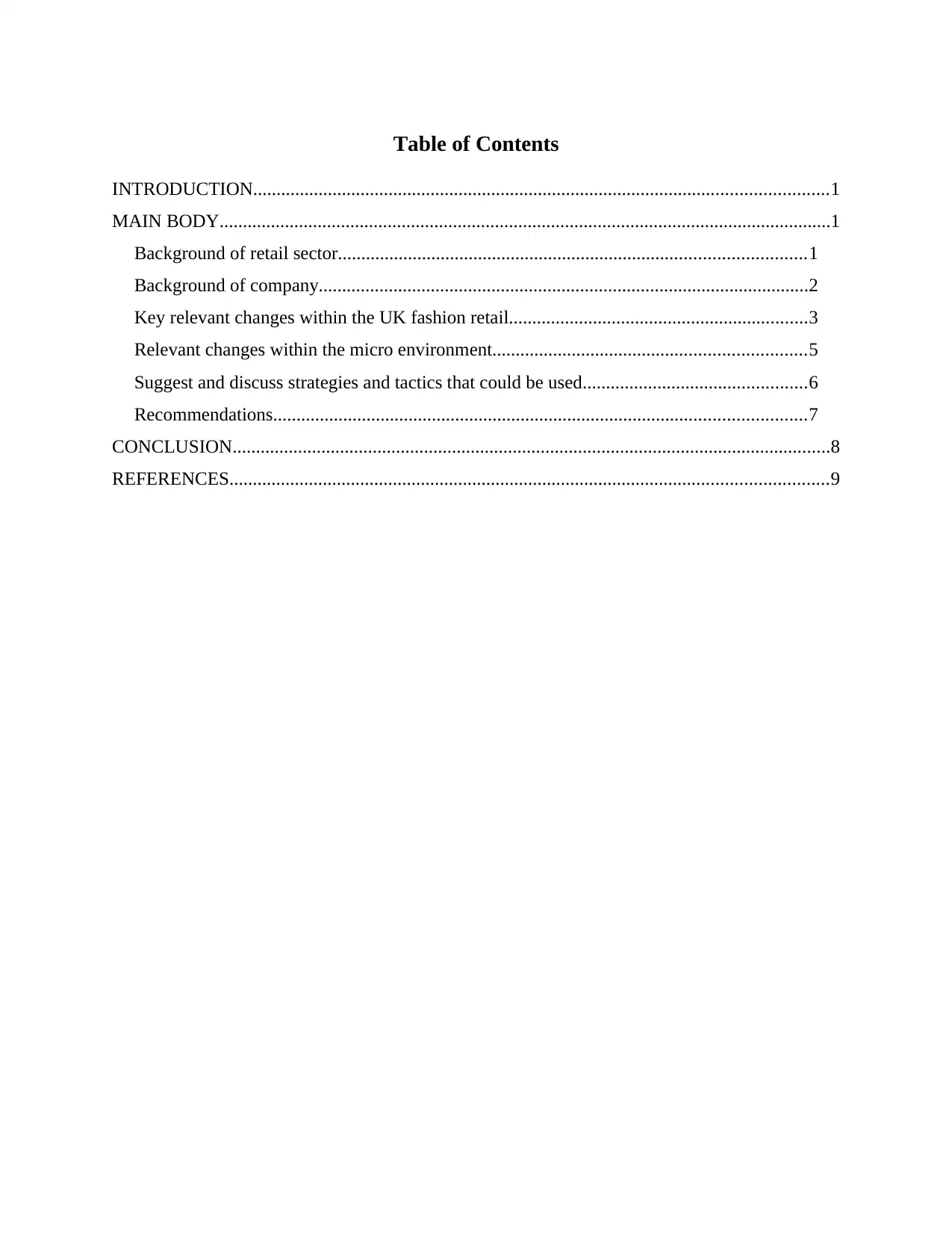
Table of Contents
INTRODUCTION...........................................................................................................................1
MAIN BODY...................................................................................................................................1
Background of retail sector....................................................................................................1
Background of company.........................................................................................................2
Key relevant changes within the UK fashion retail................................................................3
Relevant changes within the micro environment...................................................................5
Suggest and discuss strategies and tactics that could be used................................................6
Recommendations..................................................................................................................7
CONCLUSION................................................................................................................................8
REFERENCES................................................................................................................................9
INTRODUCTION...........................................................................................................................1
MAIN BODY...................................................................................................................................1
Background of retail sector....................................................................................................1
Background of company.........................................................................................................2
Key relevant changes within the UK fashion retail................................................................3
Relevant changes within the micro environment...................................................................5
Suggest and discuss strategies and tactics that could be used................................................6
Recommendations..................................................................................................................7
CONCLUSION................................................................................................................................8
REFERENCES................................................................................................................................9
INTRODUCTION
Retail refers to the process of selling products and services to the customers via a
distribution channel in order to earn profit. Retail business satisfies the demand of customers by
using their supply chain. Retail business are very essential for the people as they provides daily
household products and services to the customers. Zara is the taken firm for this assignment
report which is a fashion retailer having a wide range of fashions products to customers. This
company was founded in 1975 in Spain. This report will cover the various issues faced by Zara
in the market. Further the changes in the retail sector will be discussed by using the Pestle
analysis. This report will also cover the competitors of Zara and their strategies. In the end,
Recommendations will be provided to the company for resolving and handling the issues.
MAIN BODY
Background of retail sector
The retail industry is the last step in the process of selling products to the customers. The
difference between the whole seller and retail is that the wholesalers sells the products to the
business firms whereas retailer sells the products directly to customers. Wholesale sector plays a
major role in the functioning of the retail sector as the wholesalers provide their products to the
retailers firms which are necessary for their smooth running (Berry, Broadbent and Otley,
2016). Any business who is providing their products to the customers directly is a retail
establishment. There are various types of retailers as discussed below:
Department stores: It is a large retail store which is segmented into small departments
and provides wide range of merchandise such as J.C. Penney's.
Discount stores: It is the mass-merchandisers or membership warehouses, such as Costco
Category killers: These are the large stores which specializes only in one type of
merchandise, such as Home Depot.
E-tailers: These provides their products to the customers by online platforms such as
Amazon.
Specialty stores: These concentrate on one type of product and sells it in a unique way
such as The Body Shop.
Grocery stores: These provides food and beverage to the customers such as Kroger and
Jumbo.
1
Retail refers to the process of selling products and services to the customers via a
distribution channel in order to earn profit. Retail business satisfies the demand of customers by
using their supply chain. Retail business are very essential for the people as they provides daily
household products and services to the customers. Zara is the taken firm for this assignment
report which is a fashion retailer having a wide range of fashions products to customers. This
company was founded in 1975 in Spain. This report will cover the various issues faced by Zara
in the market. Further the changes in the retail sector will be discussed by using the Pestle
analysis. This report will also cover the competitors of Zara and their strategies. In the end,
Recommendations will be provided to the company for resolving and handling the issues.
MAIN BODY
Background of retail sector
The retail industry is the last step in the process of selling products to the customers. The
difference between the whole seller and retail is that the wholesalers sells the products to the
business firms whereas retailer sells the products directly to customers. Wholesale sector plays a
major role in the functioning of the retail sector as the wholesalers provide their products to the
retailers firms which are necessary for their smooth running (Berry, Broadbent and Otley,
2016). Any business who is providing their products to the customers directly is a retail
establishment. There are various types of retailers as discussed below:
Department stores: It is a large retail store which is segmented into small departments
and provides wide range of merchandise such as J.C. Penney's.
Discount stores: It is the mass-merchandisers or membership warehouses, such as Costco
Category killers: These are the large stores which specializes only in one type of
merchandise, such as Home Depot.
E-tailers: These provides their products to the customers by online platforms such as
Amazon.
Specialty stores: These concentrate on one type of product and sells it in a unique way
such as The Body Shop.
Grocery stores: These provides food and beverage to the customers such as Kroger and
Jumbo.
1
⊘ This is a preview!⊘
Do you want full access?
Subscribe today to unlock all pages.

Trusted by 1+ million students worldwide
Convenience stores: These include gas stations and corner stores.
Background of company
Zara is a fashion retail firm who was founded in the year 1975 by Amancio Ortega and
Rosalía Mera. The parent company of Zara is Inditex group which is the world's largest retailer.
By 2017, Zara was managing up to 20 clothing collections a year. The company has more than
10,000 stores worldwide. The Inditex group is employing more than 17000 employees through
out the stores of Zara (Bloom and et. al., 2012). Zara also started their own online boutique.
Company is strongly active on social media platforms. The products of the company includes
men's and women's clothing, as well as children's clothing products. The revenue of the firm in
2018 was $18.9 billion annually.
Issues faced by the Zara
Fashion industry is getting very famous in this world as people are getting more
conscious towards their living standard. Fashion covers various areas including footwear,
lifestyle, make-up, clothing, hairstyle, etc. Zara is a retail fashion firm who is experiencing
various issues in the market (Dholakia, Dholakia and Chattopadhyay, 2012). This is because the
firm is operating in various countries and the company is finding it difficult to handle the various
people from different countries. The issues faced by the Zara is discussed below:
Zara takes five week time in introducing their new fashion products from concept to the
sales which is comparatively more than the competitors such as ASOS, Boohoo, and
Missguided. This is a major issues which is impacting the sales of the company as these
competitors takes less then 1 week time in introducing their new fashion products (Zara is
facing a massive threat that could jeopardize the business, 2017).
Zara is facing critics from the people due to various issues such as Using Swastik on
their handbags which was withdrawn from the market. The printing of shirts similar to
the Holocaust prisoners. Another instance is the printing “Black is the new white” on t
shirts which is considered as racial discrimination. Also a discrimination suit was filed by
the Ian Jack Miller, corporate attorney of Zara as he was fired because he was a Jewish
American gay (Controversies of Zara, 2018).
Recently, in March, 2019, Zara started a campaign on Instagram in which a young girl
dressed in a puffy sleeved dress sitting on a bed. Company has faced heavy critics from
the social media users as they find it inappropriate to represent a teenage girl as a adult
2
Background of company
Zara is a fashion retail firm who was founded in the year 1975 by Amancio Ortega and
Rosalía Mera. The parent company of Zara is Inditex group which is the world's largest retailer.
By 2017, Zara was managing up to 20 clothing collections a year. The company has more than
10,000 stores worldwide. The Inditex group is employing more than 17000 employees through
out the stores of Zara (Bloom and et. al., 2012). Zara also started their own online boutique.
Company is strongly active on social media platforms. The products of the company includes
men's and women's clothing, as well as children's clothing products. The revenue of the firm in
2018 was $18.9 billion annually.
Issues faced by the Zara
Fashion industry is getting very famous in this world as people are getting more
conscious towards their living standard. Fashion covers various areas including footwear,
lifestyle, make-up, clothing, hairstyle, etc. Zara is a retail fashion firm who is experiencing
various issues in the market (Dholakia, Dholakia and Chattopadhyay, 2012). This is because the
firm is operating in various countries and the company is finding it difficult to handle the various
people from different countries. The issues faced by the Zara is discussed below:
Zara takes five week time in introducing their new fashion products from concept to the
sales which is comparatively more than the competitors such as ASOS, Boohoo, and
Missguided. This is a major issues which is impacting the sales of the company as these
competitors takes less then 1 week time in introducing their new fashion products (Zara is
facing a massive threat that could jeopardize the business, 2017).
Zara is facing critics from the people due to various issues such as Using Swastik on
their handbags which was withdrawn from the market. The printing of shirts similar to
the Holocaust prisoners. Another instance is the printing “Black is the new white” on t
shirts which is considered as racial discrimination. Also a discrimination suit was filed by
the Ian Jack Miller, corporate attorney of Zara as he was fired because he was a Jewish
American gay (Controversies of Zara, 2018).
Recently, in March, 2019, Zara started a campaign on Instagram in which a young girl
dressed in a puffy sleeved dress sitting on a bed. Company has faced heavy critics from
the social media users as they find it inappropriate to represent a teenage girl as a adult
2
Paraphrase This Document
Need a fresh take? Get an instant paraphrase of this document with our AI Paraphraser
model for attracting the customers through their campaigns. Zara deleted the post from
social media after backslashed from the internet users (Zara is blasted over 'suggestive'
and 'inappropriate' kids wear advert featuring a child model, 2019).
Zara is also facing stiff competition from the retailers such as Gap, H&M and
Aeropostale in India. These competitors has high sales then the Zara in the India which is
negatively impacting the firm in enhancing their market share and customer base (Zara
posts slowest sales growth in India, 2019).
Key relevant changes within the UK fashion retail
There are a lot of challenges happens in the retail market from the early 50's to present
(Dos Santos, Svensson and Padin, 2013). These changes were happened due to the change in
demand and needs of customers and market. Some of these changes are discussed below:
1950’s Manufacturer is king: In 1950, the manufacturer refers to the king of the market.
The needs of the customers were not high due to which whatever the manufacturers produce,
customers used it.
1960’s Consumer is king: The manufacturers started to produce products and services
according to the taste & preferences of customers. Due to this, customers were considered as the
king.
1970’s trade is king: In this era, the manufacturers produce the products and services
based on the trend in trade and market. Due to this, trade was considered as the king and the
business firms run according to the trade.
1980’s marketing emphasis: In this era, firms started to focus on the marketing for
selling the goods in order to enhance the profit and productivity.
2000’s relation/ethical /societal influences on retailing: This is the modern era in which
the business organisations started to manufacture the products based on the needs and demand of
customers.
Changes in the retail environment can be further understood by using the PESTLE
analysis as discussed below:
PESTLE analysis is a useful tool for determining the impact of macro external factors on
the business environment and operations. These factors are discussed below: Political Factor: These factors are associated with the government stability and laws
such as tax policy, interest rate, labour law etc. Recently the government of UK has
3
social media after backslashed from the internet users (Zara is blasted over 'suggestive'
and 'inappropriate' kids wear advert featuring a child model, 2019).
Zara is also facing stiff competition from the retailers such as Gap, H&M and
Aeropostale in India. These competitors has high sales then the Zara in the India which is
negatively impacting the firm in enhancing their market share and customer base (Zara
posts slowest sales growth in India, 2019).
Key relevant changes within the UK fashion retail
There are a lot of challenges happens in the retail market from the early 50's to present
(Dos Santos, Svensson and Padin, 2013). These changes were happened due to the change in
demand and needs of customers and market. Some of these changes are discussed below:
1950’s Manufacturer is king: In 1950, the manufacturer refers to the king of the market.
The needs of the customers were not high due to which whatever the manufacturers produce,
customers used it.
1960’s Consumer is king: The manufacturers started to produce products and services
according to the taste & preferences of customers. Due to this, customers were considered as the
king.
1970’s trade is king: In this era, the manufacturers produce the products and services
based on the trend in trade and market. Due to this, trade was considered as the king and the
business firms run according to the trade.
1980’s marketing emphasis: In this era, firms started to focus on the marketing for
selling the goods in order to enhance the profit and productivity.
2000’s relation/ethical /societal influences on retailing: This is the modern era in which
the business organisations started to manufacture the products based on the needs and demand of
customers.
Changes in the retail environment can be further understood by using the PESTLE
analysis as discussed below:
PESTLE analysis is a useful tool for determining the impact of macro external factors on
the business environment and operations. These factors are discussed below: Political Factor: These factors are associated with the government stability and laws
such as tax policy, interest rate, labour law etc. Recently the government of UK has
3
updated their tax rate which is negatively impacting the performance of Zara and demand
of its customers. The stability of the UK government is a positive impact for the company
as the company can take proper decisions for improving the market share and
profitability of the firm. Also management needs to consider the change in such laws for
taking proper measures. Economic Factor: These factors deals with the economic growth, inflation rate,
exchange rates etc. which can impact the Zara and UK economy. The recent recession
and Brexit has caused unemployment issues among the people. This can negatively
impact the company in terms of productivity, revenue and purchasing behaviour of
customer (Fuentes and Hagberg, 2013) . However, few customers having good economic
conditions can buy the product of the company which is useful for the firm in improving
the productivity even if the sales are falling. Social Factor: These factor are associated with the social and culture changes. The
company is providing the products to the customers based on their needs at affordable
prices which is positively impacting the firm in improving the sales and revenue. Also
Zara has started their own online boutique for selling the products online. Apart from
this, company has also started kids wear for improving the sales and revenue further. Technological Factor: These factors are associated with the advancements in the
technology. Zara has started the selling of their products from online platforms as the
trend of online shopping is increasing. Also the company is planning to launch a mobile
application for tracking the online delivery of the products. These steps are necessary for
the company in improving the customers satisfaction and productivity of the company in
the market. Environmental Factor: These factors deals with the protecting the environment from the
operations and activities of the organisations. This factor can negatively impact the
product of the Zara as customers wants that the product they are using must be made
from the sustainable resources. The company has taken initiatives for protecting the
environment such as eliminating the wastage using TQM, Using energy efficient products
etc. These initiatives are useful for Zara in improving the brand image of the firm(Glover
and et. al., 2014).
4
of its customers. The stability of the UK government is a positive impact for the company
as the company can take proper decisions for improving the market share and
profitability of the firm. Also management needs to consider the change in such laws for
taking proper measures. Economic Factor: These factors deals with the economic growth, inflation rate,
exchange rates etc. which can impact the Zara and UK economy. The recent recession
and Brexit has caused unemployment issues among the people. This can negatively
impact the company in terms of productivity, revenue and purchasing behaviour of
customer (Fuentes and Hagberg, 2013) . However, few customers having good economic
conditions can buy the product of the company which is useful for the firm in improving
the productivity even if the sales are falling. Social Factor: These factor are associated with the social and culture changes. The
company is providing the products to the customers based on their needs at affordable
prices which is positively impacting the firm in improving the sales and revenue. Also
Zara has started their own online boutique for selling the products online. Apart from
this, company has also started kids wear for improving the sales and revenue further. Technological Factor: These factors are associated with the advancements in the
technology. Zara has started the selling of their products from online platforms as the
trend of online shopping is increasing. Also the company is planning to launch a mobile
application for tracking the online delivery of the products. These steps are necessary for
the company in improving the customers satisfaction and productivity of the company in
the market. Environmental Factor: These factors deals with the protecting the environment from the
operations and activities of the organisations. This factor can negatively impact the
product of the Zara as customers wants that the product they are using must be made
from the sustainable resources. The company has taken initiatives for protecting the
environment such as eliminating the wastage using TQM, Using energy efficient products
etc. These initiatives are useful for Zara in improving the brand image of the firm(Glover
and et. al., 2014).
4
⊘ This is a preview!⊘
Do you want full access?
Subscribe today to unlock all pages.
Trusted by 1+ million students worldwide
Legal Factor: These factor are associated with the government policies, regulation etc.
Zara is following the employment laws such as minimum wages act, health and safety at
work act, fair compensation act etc. which are positively impacting the brand image of
Zara.
Relevant changes within the micro environment
Swot analysis is a framework used to identify position of the firm and to know its
strength, weakness, opportunities and threats to develop strategies. Zara is a retail industry of
clothing and accessories. The below is the internal analysis of the company -
Strengths of Zara Unique designs: The clothes of the company are of unique designs, standard quality and
have fabulous finish. Zara has the ability to design varieties of clothes which includes
casual wear, office wear, party wear as well as others. Global presence: Zara is exploring in the retail sector globally. It has 10,000 stores world
wide. The organisation has to keep expanding to sustain its presence across the globe. Superb supply chain: Zara process its designs within 2 weeks and deliver them to store.
This fast supply chain allows the industry to make competitive advantage from the other
competitors who takes minimum 6 weeks or even more. It makes millions of products per
year which attracts more customers to come to store and check the fresh collections.
Weaknesses of Zara Lack of advertising: One of the crucial weakness of the concern is that it lacks
advertising. The company can seek more customers and can earn more profit with the
help of advertisement. Low safety stock: The firm maintains low stock to keep the consumer to visit into the
showroom to check out the new collection (Hagberg and Kjellberg, 2015). If a specific
product is required by the customer, it wont be able to meet because of low safety stock.
Opportunities for Zara - Online E-commerce: It is an opportunity for the retail industry to start their online trend
of buying so that the products can be available on other E-commerce stores too. Online
will benefit to the customers too by saving their time and can shop comfortably. This will
also boost its sales.
5
Zara is following the employment laws such as minimum wages act, health and safety at
work act, fair compensation act etc. which are positively impacting the brand image of
Zara.
Relevant changes within the micro environment
Swot analysis is a framework used to identify position of the firm and to know its
strength, weakness, opportunities and threats to develop strategies. Zara is a retail industry of
clothing and accessories. The below is the internal analysis of the company -
Strengths of Zara Unique designs: The clothes of the company are of unique designs, standard quality and
have fabulous finish. Zara has the ability to design varieties of clothes which includes
casual wear, office wear, party wear as well as others. Global presence: Zara is exploring in the retail sector globally. It has 10,000 stores world
wide. The organisation has to keep expanding to sustain its presence across the globe. Superb supply chain: Zara process its designs within 2 weeks and deliver them to store.
This fast supply chain allows the industry to make competitive advantage from the other
competitors who takes minimum 6 weeks or even more. It makes millions of products per
year which attracts more customers to come to store and check the fresh collections.
Weaknesses of Zara Lack of advertising: One of the crucial weakness of the concern is that it lacks
advertising. The company can seek more customers and can earn more profit with the
help of advertisement. Low safety stock: The firm maintains low stock to keep the consumer to visit into the
showroom to check out the new collection (Hagberg and Kjellberg, 2015). If a specific
product is required by the customer, it wont be able to meet because of low safety stock.
Opportunities for Zara - Online E-commerce: It is an opportunity for the retail industry to start their online trend
of buying so that the products can be available on other E-commerce stores too. Online
will benefit to the customers too by saving their time and can shop comfortably. This will
also boost its sales.
5
Paraphrase This Document
Need a fresh take? Get an instant paraphrase of this document with our AI Paraphraser
Lacking some flagship designs: Zara lacks its design identity. This is because it do not
sell any particular design repeatedly. Organisation should focus on selling some designs
in regular intervals, which can create more demand for the flagship designs and brand
identity can be built.
Threats for Zara Competition: There are some competitors such as Mango and H&M which are also
known for their unique designs. This competition affects the margin of Zara in the retail
sector. Reach: As the entity operates exclusively from its stores, every customer can't reach it.
Zara do not have small displays or shops (Hamister, 2012). This can affect the brand
loyalty and customers can switch to competitors.
Competitor Analysis of Zara
Competitive analysis is an area of strategic investigation which helps to gain information
regarding what the rivals doing and how these competitors affect the financial position of the
company. There is always an intense competition in the retail fashion industry. One of the brand
that is giving tough competition to Zara is H&M. In 1947, H&M started its business whereas
Zara has been in business since 1975. H&M has more experience in the field of fashion but Zara
implement strategies which leads the firm to make competitive advantage in the retail segment.
Designs of Zara are unique and clothes are of superior quality with excellent finish and are
customer-based (Hristov and Reynolds, 2015). Fresh stock is an effective strategy which it
implements on its sale. Thus, the company pulls its customers to visit the store repeatedly for the
latest collection. Whereas H&M keep its inventory in excess which creates dead stocks more
than sale.
Suggest and discuss strategies and tactics that could be used
The management of Zara can use the following theories for their handling their issues and
change as discussed below:
Conflict theory
This theory is founded by Karl Marx which states society is in a situation of permanent
conflict because of striving for extinct resources. According to conflict theory, individuals who
are rich and wealthy are holding on power by dominating the powerless and poor people. A basic
6
sell any particular design repeatedly. Organisation should focus on selling some designs
in regular intervals, which can create more demand for the flagship designs and brand
identity can be built.
Threats for Zara Competition: There are some competitors such as Mango and H&M which are also
known for their unique designs. This competition affects the margin of Zara in the retail
sector. Reach: As the entity operates exclusively from its stores, every customer can't reach it.
Zara do not have small displays or shops (Hamister, 2012). This can affect the brand
loyalty and customers can switch to competitors.
Competitor Analysis of Zara
Competitive analysis is an area of strategic investigation which helps to gain information
regarding what the rivals doing and how these competitors affect the financial position of the
company. There is always an intense competition in the retail fashion industry. One of the brand
that is giving tough competition to Zara is H&M. In 1947, H&M started its business whereas
Zara has been in business since 1975. H&M has more experience in the field of fashion but Zara
implement strategies which leads the firm to make competitive advantage in the retail segment.
Designs of Zara are unique and clothes are of superior quality with excellent finish and are
customer-based (Hristov and Reynolds, 2015). Fresh stock is an effective strategy which it
implements on its sale. Thus, the company pulls its customers to visit the store repeatedly for the
latest collection. Whereas H&M keep its inventory in excess which creates dead stocks more
than sale.
Suggest and discuss strategies and tactics that could be used
The management of Zara can use the following theories for their handling their issues and
change as discussed below:
Conflict theory
This theory is founded by Karl Marx which states society is in a situation of permanent
conflict because of striving for extinct resources. According to conflict theory, individuals who
are rich and wealthy are holding on power by dominating the powerless and poor people. A basic
6
concept of this theory is that the people and groups living in the society works to increase their
own profit.
Breaking down conflict theory
This theory has been applied to describe large variety of social elements such as wealth
and poverty, racial discrimination, violence and wars. It gives credit for developments in the
history of humans like civil rights and democracy. The conflict theory is concerned with the
approach of social inequality in the splitting of resources and targets on disputes that remains
between classes.
Wheel of retailing
The wheel of retailing theory was propounded by Professor Malcom P. McNair. It is a
hypothesis which describes the development of retailers in which they try to gain market share
and earn brand image. It explains how the new retailers enter in the market with low-margin,
status and prices at the bottom of the wheel and moderately capture the share in the market with
increase in profit and prestige (Nguyen, 2013). The theory consists of three phases – Entry,
trading up and vulnerability. Zara used the wheel of retailing by investing in the stores and by
selecting the prime location to operate. The first store was featured with low price products of
clothing. Than, improvements were made by adapting new technologies, and use of several
groups of designers. Zara also started its online business and used RFID chip in its showroom.
As a result, the expansion of industry took place with increase in profitability and brand loyalty.
Recommendations
Following recommendations are provided to the Zara for handling the issues in a proper
manner.
Zara needs to implement new and updated technology in their business operations along
with the hiring of technically skilled persons so that the firm can provide the products in a
less amount of time.
Zara needs to determine the trends and preference of the customers by using the market
research. Through this, the company can understand the concepts of their new products in
the mindset of customers.
The company needs to use the proper marketing techniques keeping in mind about the
mentality of the customers so that any issues can be avoided such as in case of using
7
own profit.
Breaking down conflict theory
This theory has been applied to describe large variety of social elements such as wealth
and poverty, racial discrimination, violence and wars. It gives credit for developments in the
history of humans like civil rights and democracy. The conflict theory is concerned with the
approach of social inequality in the splitting of resources and targets on disputes that remains
between classes.
Wheel of retailing
The wheel of retailing theory was propounded by Professor Malcom P. McNair. It is a
hypothesis which describes the development of retailers in which they try to gain market share
and earn brand image. It explains how the new retailers enter in the market with low-margin,
status and prices at the bottom of the wheel and moderately capture the share in the market with
increase in profit and prestige (Nguyen, 2013). The theory consists of three phases – Entry,
trading up and vulnerability. Zara used the wheel of retailing by investing in the stores and by
selecting the prime location to operate. The first store was featured with low price products of
clothing. Than, improvements were made by adapting new technologies, and use of several
groups of designers. Zara also started its online business and used RFID chip in its showroom.
As a result, the expansion of industry took place with increase in profitability and brand loyalty.
Recommendations
Following recommendations are provided to the Zara for handling the issues in a proper
manner.
Zara needs to implement new and updated technology in their business operations along
with the hiring of technically skilled persons so that the firm can provide the products in a
less amount of time.
Zara needs to determine the trends and preference of the customers by using the market
research. Through this, the company can understand the concepts of their new products in
the mindset of customers.
The company needs to use the proper marketing techniques keeping in mind about the
mentality of the customers so that any issues can be avoided such as in case of using
7
⊘ This is a preview!⊘
Do you want full access?
Subscribe today to unlock all pages.
Trusted by 1+ million students worldwide
swastik etc. It will also assist the firm in enhancing the brand image among the
customer's which will help the firm in getting an upper competitive edge in the market.
CONCLUSION
It has been concluded from the above report that there are various issues which can
impact the business operations of the retail firms. The management of organisations has the
responsibility to determine such issues which can pertain the firm in accomplishing their desired
goals and objectives. Apart from that, There are a large number of changes which occurred in the
retail environment in the recent years. The changes can be determined by the management of the
firms by determining the macro and micro environmental factors. These factors can be
determined by using the PESTLE and SWOT analysis. Also the organisation can handle the
change by using the theories such as conflict theory and Wheel of retailing.
8
customer's which will help the firm in getting an upper competitive edge in the market.
CONCLUSION
It has been concluded from the above report that there are various issues which can
impact the business operations of the retail firms. The management of organisations has the
responsibility to determine such issues which can pertain the firm in accomplishing their desired
goals and objectives. Apart from that, There are a large number of changes which occurred in the
retail environment in the recent years. The changes can be determined by the management of the
firms by determining the macro and micro environmental factors. These factors can be
determined by using the PESTLE and SWOT analysis. Also the organisation can handle the
change by using the theories such as conflict theory and Wheel of retailing.
8
Paraphrase This Document
Need a fresh take? Get an instant paraphrase of this document with our AI Paraphraser
REFERENCES
Books and Journals
Berry, A. J., Broadbent, J. and Otley, D. T. eds., 2016. Management control: theories, issues and
practices. Macmillan International Higher Education.
Bloom, N. and et. al., 2012. Management practices across firms and countries. Academy of
Management Perspectives. 26(1). pp.12-33.
Dholakia, N., Dholakia, R. R. and Chattopadhyay, A., 2012. India’s emerging retail systems:
coexistence of tradition and modernity. Journal of Macromarketing. 32(3). pp.252-265.
Dos Santos, M. A., Svensson, G. and Padin, C., 2013. Indicators of sustainable business
practices: Woolworths in South Africa. Supply Chain Management: An International
Journal. 18(1). pp.104-108.
Fuentes, C. and Hagberg, J., 2013. Socio-cultural retailing: what can retail marketing learn from
this interdisciplinary field?. International Journal of Quality and Service Sciences. 5(3).
pp.290-308.
Glover, J. L. and et. al., 2014. An Institutional Theory perspective on sustainable practices across
the dairy supply chain. International Journal of Production Economics. 152. pp.102-
111.
Hagberg, J. and Kjellberg, H., 2015. How much is it? Price representation practices in retail
markets. Marketing Theory. 15(2). pp.179-199.
Hamister, J. W., 2012. Supply chain management practices in small retailers. International
Journal of Retail & Distribution Management. 40(6). pp.427-450.
Hristov, L. and Reynolds, J., 2015. Perceptions and practices of innovation in retailing:
Challenges of definition and measurement. International Journal of Retail &
Distribution Management. 43(2). pp.126-147.
Nguyen, B., 2013. Retail fairness: Exploring consumer perceptions of fairness towards retailers’
marketing tactics. Journal of Retailing and Consumer Services. 20(3). pp.311-324.
Online
Zara is facing a massive threat that could jeopardize the business. 2017. [Online]. Available
Through: <https://www.businessinsider.in/zara-is-facing-a-massive-threat-that-could-
jeopardize-the-business/articleshow/58814258.cms>.
Controversies of Zara. 2018. [Online]. Available Through:
<http://fortune.com/2018/06/22/melania-trump-jacket-zara-controversy-swastika-
holocaust-clothing/>.
Zara is blasted over 'suggestive' and 'inappropriate' kidswear advert featuring a child model .
2019. [Online]. Available Through: <https://www.dailymail.co.uk/femail/article-
6848039/Zara-REMOVES-photos-new-childrens-campaign-Instagram.html>.
Zara posts slowest sales growth in India. 2019. [Online]. Available Through:
<https://economictimes.indiatimes.com/industry/cons-products/fashion-/-cosmetics-/-
jewellery/zara-posts-slowest-sales-growth-in-india-stiff-competition-from-global-rivals-
like-hm-and-gap/articleshow/53183154.cms?from=mdr>.
9
Books and Journals
Berry, A. J., Broadbent, J. and Otley, D. T. eds., 2016. Management control: theories, issues and
practices. Macmillan International Higher Education.
Bloom, N. and et. al., 2012. Management practices across firms and countries. Academy of
Management Perspectives. 26(1). pp.12-33.
Dholakia, N., Dholakia, R. R. and Chattopadhyay, A., 2012. India’s emerging retail systems:
coexistence of tradition and modernity. Journal of Macromarketing. 32(3). pp.252-265.
Dos Santos, M. A., Svensson, G. and Padin, C., 2013. Indicators of sustainable business
practices: Woolworths in South Africa. Supply Chain Management: An International
Journal. 18(1). pp.104-108.
Fuentes, C. and Hagberg, J., 2013. Socio-cultural retailing: what can retail marketing learn from
this interdisciplinary field?. International Journal of Quality and Service Sciences. 5(3).
pp.290-308.
Glover, J. L. and et. al., 2014. An Institutional Theory perspective on sustainable practices across
the dairy supply chain. International Journal of Production Economics. 152. pp.102-
111.
Hagberg, J. and Kjellberg, H., 2015. How much is it? Price representation practices in retail
markets. Marketing Theory. 15(2). pp.179-199.
Hamister, J. W., 2012. Supply chain management practices in small retailers. International
Journal of Retail & Distribution Management. 40(6). pp.427-450.
Hristov, L. and Reynolds, J., 2015. Perceptions and practices of innovation in retailing:
Challenges of definition and measurement. International Journal of Retail &
Distribution Management. 43(2). pp.126-147.
Nguyen, B., 2013. Retail fairness: Exploring consumer perceptions of fairness towards retailers’
marketing tactics. Journal of Retailing and Consumer Services. 20(3). pp.311-324.
Online
Zara is facing a massive threat that could jeopardize the business. 2017. [Online]. Available
Through: <https://www.businessinsider.in/zara-is-facing-a-massive-threat-that-could-
jeopardize-the-business/articleshow/58814258.cms>.
Controversies of Zara. 2018. [Online]. Available Through:
<http://fortune.com/2018/06/22/melania-trump-jacket-zara-controversy-swastika-
holocaust-clothing/>.
Zara is blasted over 'suggestive' and 'inappropriate' kidswear advert featuring a child model .
2019. [Online]. Available Through: <https://www.dailymail.co.uk/femail/article-
6848039/Zara-REMOVES-photos-new-childrens-campaign-Instagram.html>.
Zara posts slowest sales growth in India. 2019. [Online]. Available Through:
<https://economictimes.indiatimes.com/industry/cons-products/fashion-/-cosmetics-/-
jewellery/zara-posts-slowest-sales-growth-in-india-stiff-competition-from-global-rivals-
like-hm-and-gap/articleshow/53183154.cms?from=mdr>.
9

1 out of 11


Related Documents


Your All-in-One AI-Powered Toolkit for Academic Success.
+13062052269
info@desklib.com
Available 24*7 on WhatsApp / Email
![[object Object]](/_next/static/media/star-bottom.7253800d.svg)
Unlock your academic potential
Copyright © 2020–2025 A2Z Services. All Rights Reserved. Developed and managed by ZUCOL.