Customer Service Skills Training Plan for Zeller Company Employees
VerifiedAdded on 2023/06/15
|5
|1047
|319
Report
AI Summary
This report outlines a comprehensive training plan for Zeller Company employees to address customer service issues identified through surveys and brainstorming sessions. The plan focuses on technical training, customer service, product knowledge, professional ethics, and communication skills. The training design includes setting objectives, motivating employees, and sourcing an external trainer to enhance credibility. The delivery method involves off-the-job training with blended learning techniques to maximize engagement. Evaluation will be conducted using Kirkpatrick's four levels to assess reactions, learning, behavior changes, and overall results, ensuring the training meets its objectives and improves Zeller's customer service performance.
A PLAN FOR TRAINING ZELLER COMPANY EMPLOYEE’S ON CUSTOMER SERVICE
SKILLS AND TECHNIQUES
Submitted by
Affiliation
Supervisor’s name
Date of submission
SKILLS AND TECHNIQUES
Submitted by
Affiliation
Supervisor’s name
Date of submission
Paraphrase This Document
Need a fresh take? Get an instant paraphrase of this document with our AI Paraphraser

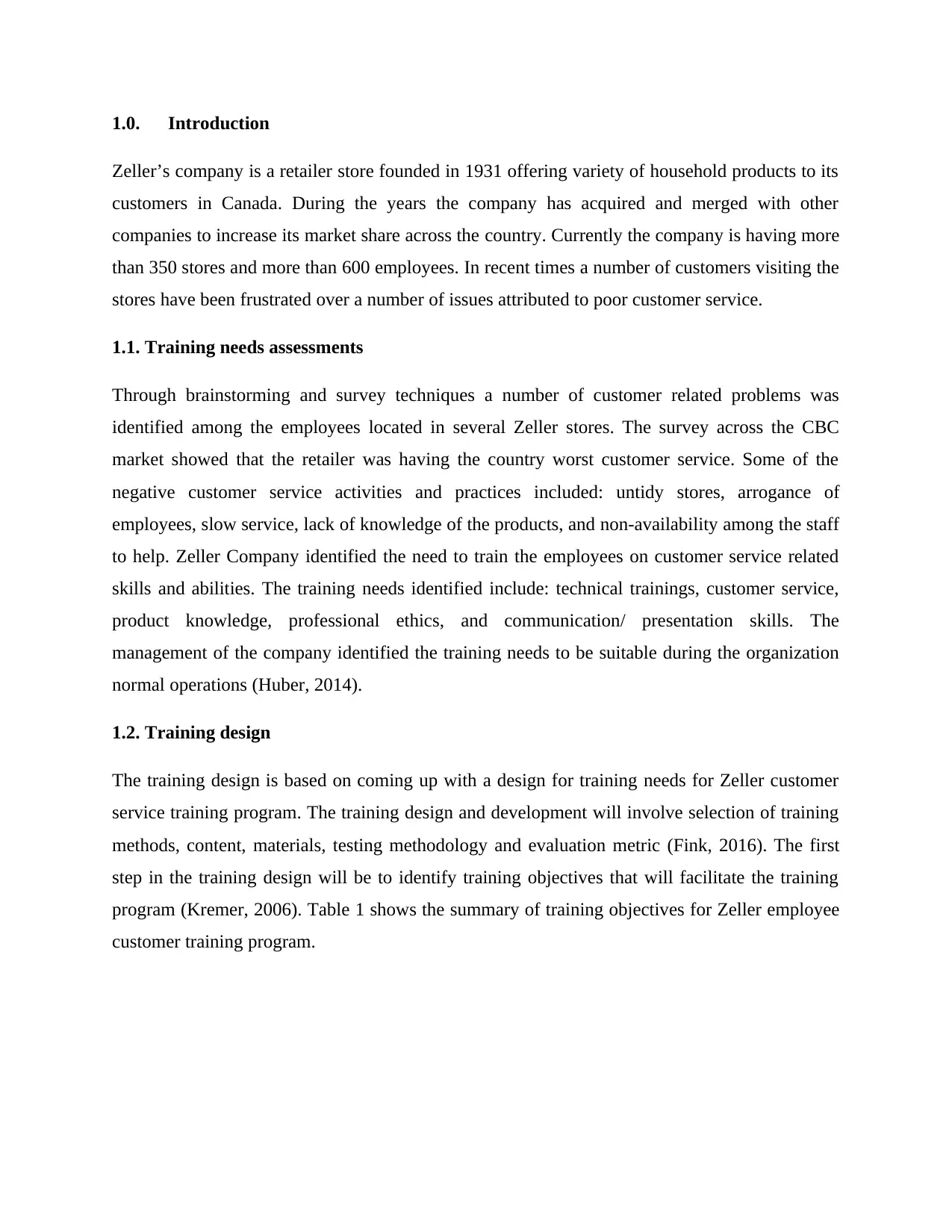
1.0. Introduction
Zeller’s company is a retailer store founded in 1931 offering variety of household products to its
customers in Canada. During the years the company has acquired and merged with other
companies to increase its market share across the country. Currently the company is having more
than 350 stores and more than 600 employees. In recent times a number of customers visiting the
stores have been frustrated over a number of issues attributed to poor customer service.
1.1. Training needs assessments
Through brainstorming and survey techniques a number of customer related problems was
identified among the employees located in several Zeller stores. The survey across the CBC
market showed that the retailer was having the country worst customer service. Some of the
negative customer service activities and practices included: untidy stores, arrogance of
employees, slow service, lack of knowledge of the products, and non-availability among the staff
to help. Zeller Company identified the need to train the employees on customer service related
skills and abilities. The training needs identified include: technical trainings, customer service,
product knowledge, professional ethics, and communication/ presentation skills. The
management of the company identified the training needs to be suitable during the organization
normal operations (Huber, 2014).
1.2. Training design
The training design is based on coming up with a design for training needs for Zeller customer
service training program. The training design and development will involve selection of training
methods, content, materials, testing methodology and evaluation metric (Fink, 2016). The first
step in the training design will be to identify training objectives that will facilitate the training
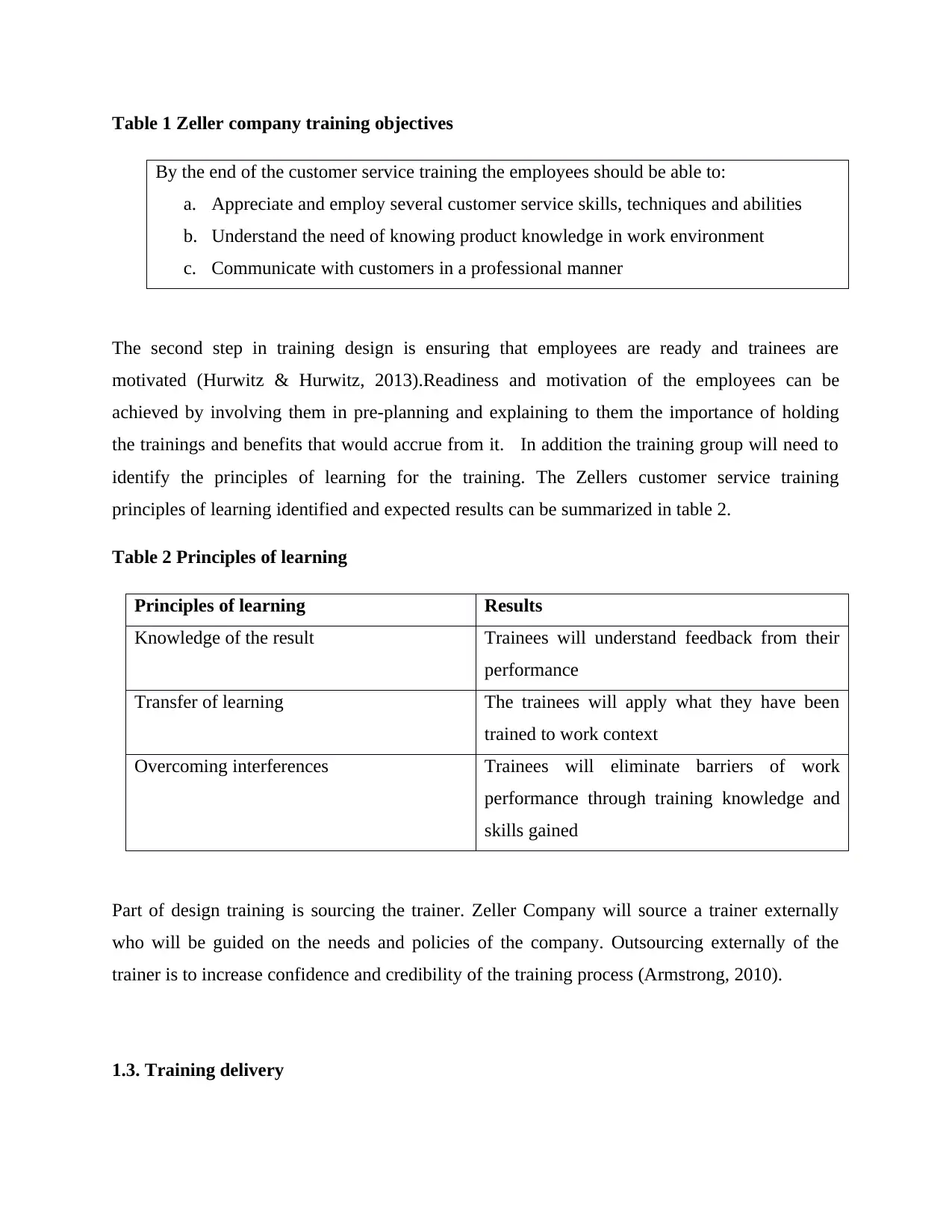
program (Kremer, 2006). Table 1 shows the summary of training objectives for Zeller employee
customer training program.
Zeller’s company is a retailer store founded in 1931 offering variety of household products to its
customers in Canada. During the years the company has acquired and merged with other
companies to increase its market share across the country. Currently the company is having more
than 350 stores and more than 600 employees. In recent times a number of customers visiting the
stores have been frustrated over a number of issues attributed to poor customer service.
1.1. Training needs assessments
Through brainstorming and survey techniques a number of customer related problems was
identified among the employees located in several Zeller stores. The survey across the CBC
market showed that the retailer was having the country worst customer service. Some of the
negative customer service activities and practices included: untidy stores, arrogance of
employees, slow service, lack of knowledge of the products, and non-availability among the staff
to help. Zeller Company identified the need to train the employees on customer service related
skills and abilities. The training needs identified include: technical trainings, customer service,
product knowledge, professional ethics, and communication/ presentation skills. The
management of the company identified the training needs to be suitable during the organization
normal operations (Huber, 2014).
1.2. Training design
The training design is based on coming up with a design for training needs for Zeller customer
service training program. The training design and development will involve selection of training
methods, content, materials, testing methodology and evaluation metric (Fink, 2016). The first
step in the training design will be to identify training objectives that will facilitate the training
program (Kremer, 2006). Table 1 shows the summary of training objectives for Zeller employee
customer training program.

Table 1 Zeller company training objectives
By the end of the customer service training the employees should be able to:
a. Appreciate and employ several customer service skills, techniques and abilities
b. Understand the need of knowing product knowledge in work environment
c. Communicate with customers in a professional manner
The second step in training design is ensuring that employees are ready and trainees are
motivated (Hurwitz & Hurwitz, 2013).Readiness and motivation of the employees can be
achieved by involving them in pre-planning and explaining to them the importance of holding
the trainings and benefits that would accrue from it. In addition the training group will need to
identify the principles of learning for the training. The Zellers customer service training
principles of learning identified and expected results can be summarized in table 2.
Table 2 Principles of learning
Principles of learning Results
Knowledge of the result Trainees will understand feedback from their
performance
Transfer of learning The trainees will apply what they have been
trained to work context
Overcoming interferences Trainees will eliminate barriers of work
performance through training knowledge and
skills gained
Part of design training is sourcing the trainer. Zeller Company will source a trainer externally
who will be guided on the needs and policies of the company. Outsourcing externally of the
trainer is to increase confidence and credibility of the training process (Armstrong, 2010).
1.3. Training delivery
By the end of the customer service training the employees should be able to:
a. Appreciate and employ several customer service skills, techniques and abilities
b. Understand the need of knowing product knowledge in work environment
c. Communicate with customers in a professional manner
The second step in training design is ensuring that employees are ready and trainees are
motivated (Hurwitz & Hurwitz, 2013).Readiness and motivation of the employees can be
achieved by involving them in pre-planning and explaining to them the importance of holding
the trainings and benefits that would accrue from it. In addition the training group will need to
identify the principles of learning for the training. The Zellers customer service training
principles of learning identified and expected results can be summarized in table 2.
Table 2 Principles of learning
Principles of learning Results
Knowledge of the result Trainees will understand feedback from their
performance
Transfer of learning The trainees will apply what they have been
trained to work context
Overcoming interferences Trainees will eliminate barriers of work
performance through training knowledge and
skills gained
Part of design training is sourcing the trainer. Zeller Company will source a trainer externally
who will be guided on the needs and policies of the company. Outsourcing externally of the
trainer is to increase confidence and credibility of the training process (Armstrong, 2010).
1.3. Training delivery
⊘ This is a preview!⊘
Do you want full access?
Subscribe today to unlock all pages.

Trusted by 1+ million students worldwide

It is the process of choosing the training methods and schedules to be employed during training
sessions (Huber, 2014). A formal off the job training will be used this is by choosing an external
training ground out of the employees job environment. Reason for choosing off job training is to
keep away any form of job distractions and increase trainer’s concentrations. The training
method employed will be a blended learning delivery method involving use of live classroom
instructions supported with other teaching aids like manuals, e-learning materials. The methods
were chosen to increase trainer-trainee interactions in respective of the organization level
(Armstrong, 2010).
1.4. Evaluation training
It involves a process of establishing whether training needs have been met through trainings
(Cummings & Worley, 2014).IT Evaluation of training program is a suitable method to
determine if training activities have met the goals set during needs assessments. Evaluation is
done based on four levels of reactions, learning, behavior and results. Several tools and
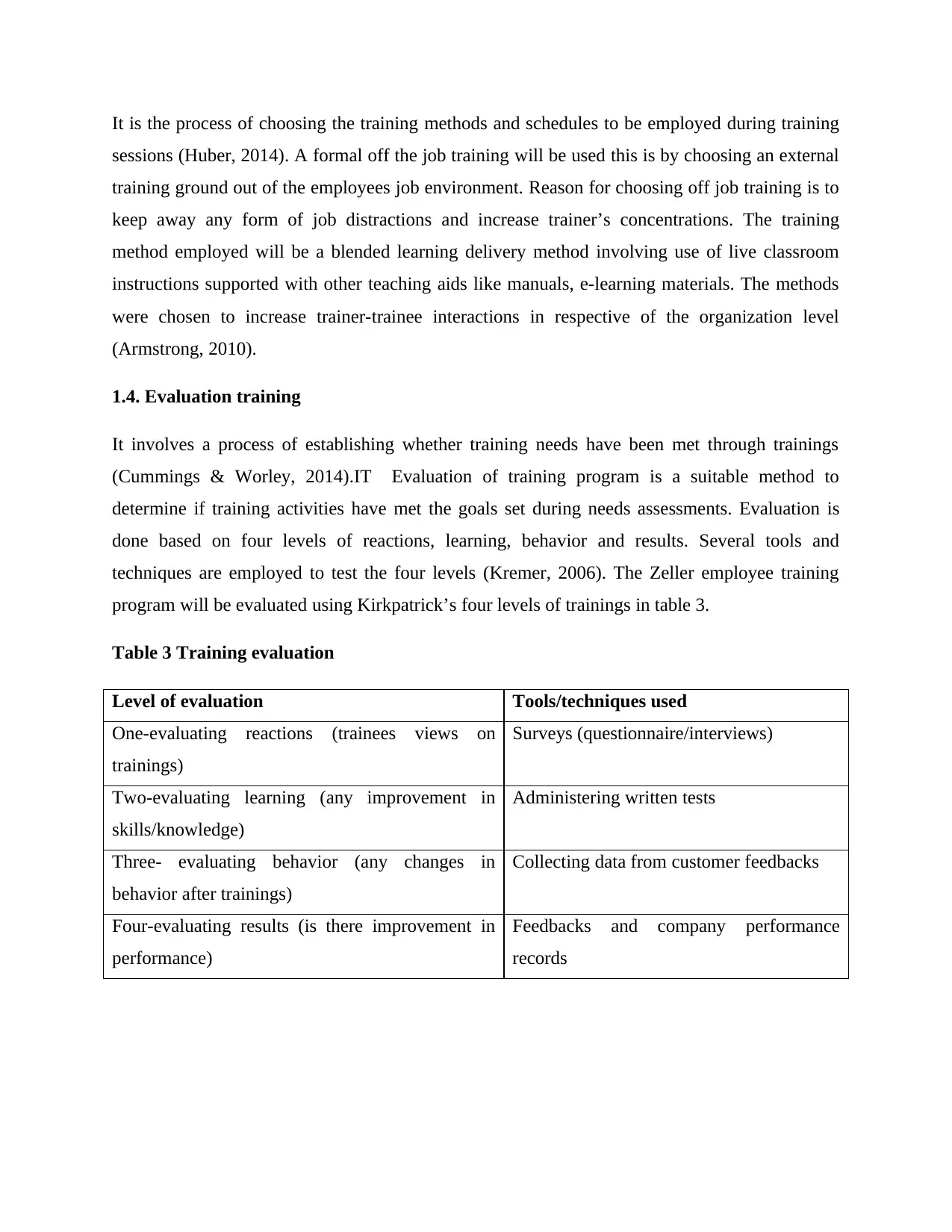
techniques are employed to test the four levels (Kremer, 2006). The Zeller employee training
program will be evaluated using Kirkpatrick’s four levels of trainings in table 3.
Table 3 Training evaluation
Level of evaluation Tools/techniques used
One-evaluating reactions (trainees views on
trainings)
Surveys (questionnaire/interviews)
Two-evaluating learning (any improvement in
skills/knowledge)
Administering written tests
Three- evaluating behavior (any changes in
behavior after trainings)
Collecting data from customer feedbacks
Four-evaluating results (is there improvement in
performance)
Feedbacks and company performance
records
sessions (Huber, 2014). A formal off the job training will be used this is by choosing an external
training ground out of the employees job environment. Reason for choosing off job training is to
keep away any form of job distractions and increase trainer’s concentrations. The training
method employed will be a blended learning delivery method involving use of live classroom
instructions supported with other teaching aids like manuals, e-learning materials. The methods
were chosen to increase trainer-trainee interactions in respective of the organization level
(Armstrong, 2010).
1.4. Evaluation training
It involves a process of establishing whether training needs have been met through trainings
(Cummings & Worley, 2014).IT Evaluation of training program is a suitable method to
determine if training activities have met the goals set during needs assessments. Evaluation is
done based on four levels of reactions, learning, behavior and results. Several tools and
techniques are employed to test the four levels (Kremer, 2006). The Zeller employee training
program will be evaluated using Kirkpatrick’s four levels of trainings in table 3.
Table 3 Training evaluation
Level of evaluation Tools/techniques used
One-evaluating reactions (trainees views on
trainings)
Surveys (questionnaire/interviews)
Two-evaluating learning (any improvement in
skills/knowledge)
Administering written tests
Three- evaluating behavior (any changes in
behavior after trainings)
Collecting data from customer feedbacks
Four-evaluating results (is there improvement in
performance)
Feedbacks and company performance
records
Paraphrase This Document
Need a fresh take? Get an instant paraphrase of this document with our AI Paraphraser

References
Armstrong, M. (2010). Human resource management. London, England: Mc Graw Hill.
Cummings & Worley. (2014). Human resource management and planning techniques. Chicago:
Cengage Learning.
Fink, A. &. (2016). How to Conduct trainings for employees: A Step-by-step Guide. Beverly
Hills. CA: Sage.
Huber, G. (2014). . Facilitating employee trainings and contributions to organizational
knowledge. . Creativity and Innovation Management, 10(3), 23=68.
Hurwitz & Hurwitz. (2013). Personal, Team, and Organizational Development. In Leadership is
Half the Story: A Fresh Look at Followership, Leadership, and Collaboration. University
of Toronto Press, 10(4), 23-78.
Kremer, M. (2006). Schools, teachers and training outcomes in employment sectors. Handbook
of the economics of education, 2, 947-1017.
Armstrong, M. (2010). Human resource management. London, England: Mc Graw Hill.
Cummings & Worley. (2014). Human resource management and planning techniques. Chicago:
Cengage Learning.
Fink, A. &. (2016). How to Conduct trainings for employees: A Step-by-step Guide. Beverly
Hills. CA: Sage.
Huber, G. (2014). . Facilitating employee trainings and contributions to organizational
knowledge. . Creativity and Innovation Management, 10(3), 23=68.
Hurwitz & Hurwitz. (2013). Personal, Team, and Organizational Development. In Leadership is
Half the Story: A Fresh Look at Followership, Leadership, and Collaboration. University
of Toronto Press, 10(4), 23-78.
Kremer, M. (2006). Schools, teachers and training outcomes in employment sectors. Handbook
of the economics of education, 2, 947-1017.
1 out of 5
Related Documents
Your All-in-One AI-Powered Toolkit for Academic Success.
+13062052269
info@desklib.com
Available 24*7 on WhatsApp / Email
Unlock your academic potential
Copyright © 2020–2026 A2Z Services. All Rights Reserved. Developed and managed by ZUCOL.