EBP107: Evidence-Based Practice - Journal Article Summary Analysis

Verified

Added on  2022/08/26

|6
|848
|17
Homework Assignment
AI Summary
This assignment presents a comprehensive summary and analysis of a systematic review and meta-analysis article titled "Zingiberaceae extracts for pain". The study, as reviewed by the student, investigated the hypo-analgesic effects of Zingiberaceae species, including turmeric and ginger, on chronic pain. The assignment addresses key aspects of the research, including the study's aims, methodology (a meta-analysis of randomized controlled trials), participant characteristics, outcomes (pain and inflammation reduction), and ethical considerations. The review concluded that Zingiberaceae extracts are effective and safe for long-term use. The assignment also includes the retrieval of two additional relevant articles, demonstrating the student's ability to locate supporting research. The assignment is based on the article by Lakhan, Ford & Tepper (2015), and also includes references to Bartels et al. (2015) and Daily, Yang & Park (2016). The article is a level 1 evidence based research study.
Document Page
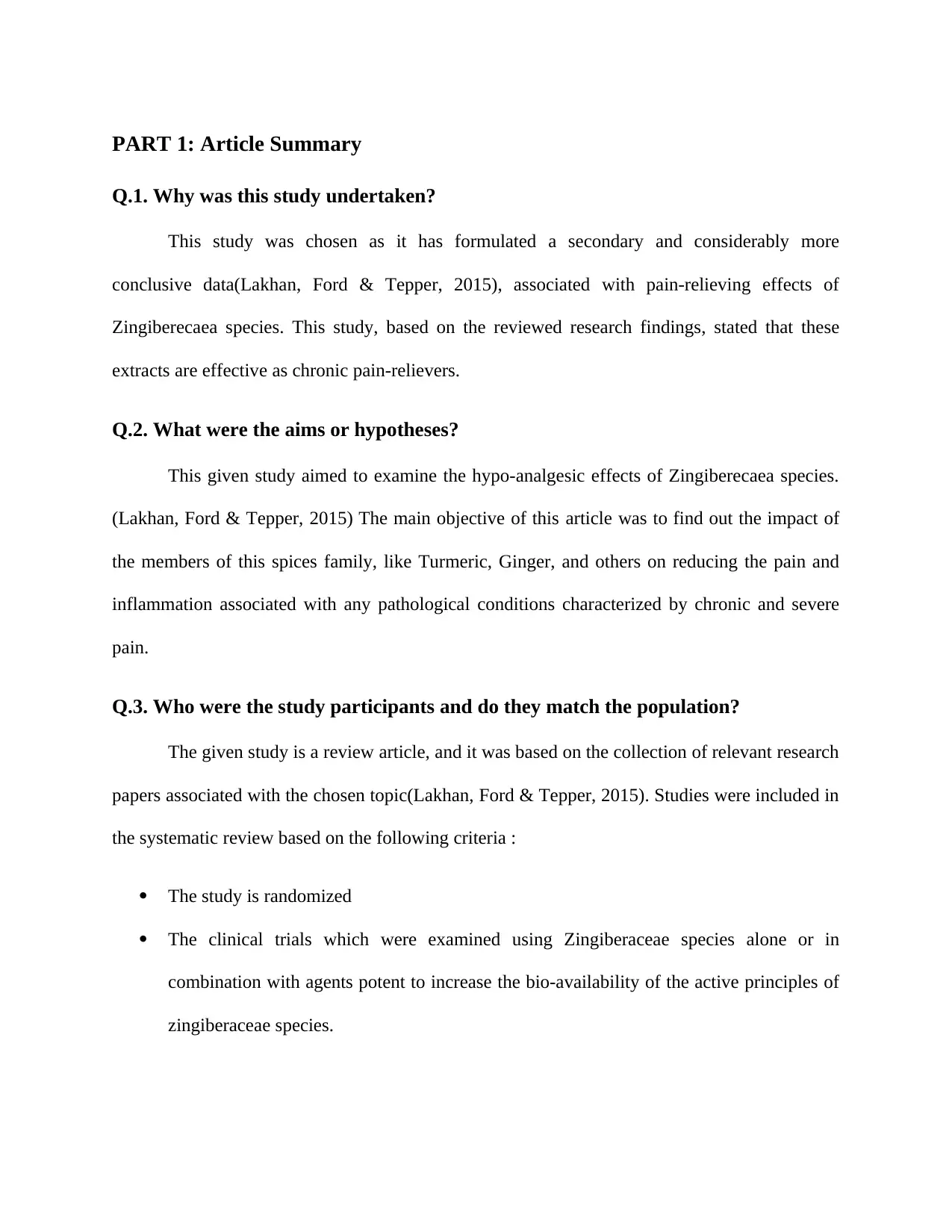
PART 1: Article Summary
Q.1. Why was this study undertaken?
This study was chosen as it has formulated a secondary and considerably more
conclusive data(Lakhan, Ford & Tepper, 2015), associated with pain-relieving effects of
Zingiberecaea species. This study, based on the reviewed research findings, stated that these
extracts are effective as chronic pain-relievers.
Q.2. What were the aims or hypotheses?
This given study aimed to examine the hypo-analgesic effects of Zingiberecaea species.
(Lakhan, Ford & Tepper, 2015) The main objective of this article was to find out the impact of
the members of this spices family, like Turmeric, Ginger, and others on reducing the pain and
inflammation associated with any pathological conditions characterized by chronic and severe
pain.
Q.3. Who were the study participants and do they match the population?
The given study is a review article, and it was based on the collection of relevant research
papers associated with the chosen topic(Lakhan, Ford & Tepper, 2015). Studies were included in
the systematic review based on the following criteria :
The study is randomized
The clinical trials which were examined using Zingiberaceae species alone or in
combination with agents potent to increase the bio-availability of the active principles of
zingiberaceae species.
tabler-icon-diamond-filled.svg

Paraphrase This Document

Need a fresh take? Get an instant paraphrase of this document with our AI Paraphraser
Document Page
The research papers which examined the extent of the effect of these spice extracts on
pain as a study outcome.
Q.4. What was the study design?
The given study is a Meta-analytical paper. Therefore, it included the collection of
various relevant articles. The research articles were searched through different databases such as
Pubmed, ScienceDirect, and Cochrane(Lakhan, Ford & Tepper, 2015). It was done with the use
of the standard and taxonomic names of the Zingiberaceae species and their constitutive specific
bioactive substances, like Curcumin (In Turmeric), as the relative keywords.
Q.5. What were the overall outcomes?
The results of the study put forth a conclusive opinion about the fact that the extracts of
does reduce pain and inflammation associated with chronic pain related ailments(Lakhan, Ford
& Tepper, 2015). Moreover, based on the analysis of different research studies, this review
paper also suggested that long term use of these designated spice extracts are safe and effective
as well.
Q.6. Were sufficient implications for clinical practice discussed?
The study is based on a review analysis. Therefore it was based on a randomized
controlled meta-analysis of researches, which has put forth about the clinical implications of the
spice extracts(Lakhan, Ford & Tepper, 2015). The study concluded about the pain-relieving
effects of the species, based on the review of eight randomized controlled clinical studies and
also considered it it to be safe and effective.
Document Page
Q.7. What ethical considerations were addressed, and/or not addressed, in the
article?
Since the study is a meta-analytical systematic review and didn’t involve any subjective
examination of Primary data (Experimental or Survey based; Animal or Human-based), therefore
there was not any direct inculcation of ethical issues. However, since the study dealt with
secondary data, therefore proper adherence to the validity and reliability of the inclusive studies
were given. The study papers were taken from licensed sources.
Q.8. Where does this study sit on a hierarchy of evidence?
The given study can be considered to be at Level 1, according to the hierarchy of
evidence. This is because it has put forth a sysrematic review or meta-analysis of more than three
relevant and evidence based clinical studies that were of similar results as well.
Document Page
Part 2: Article Retrieval
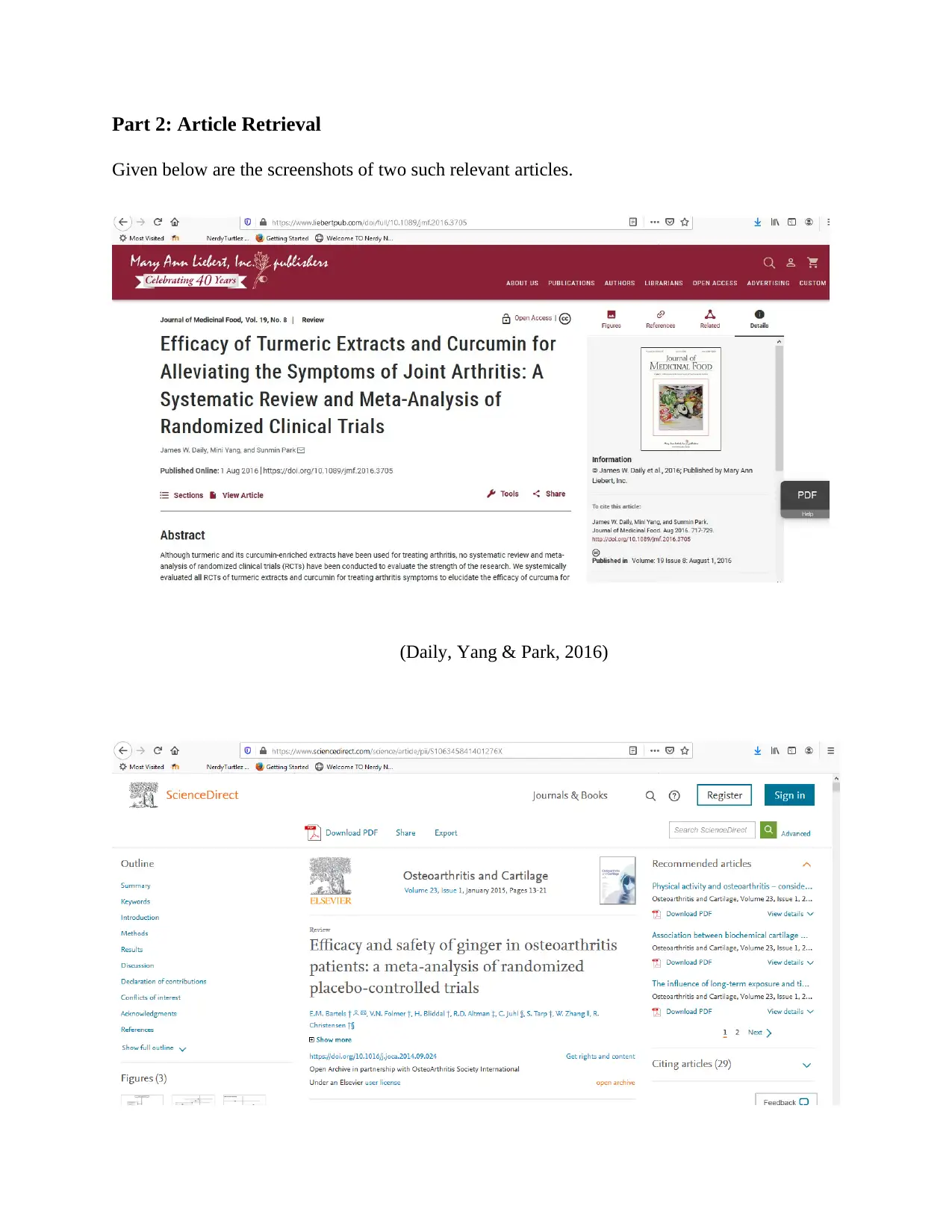
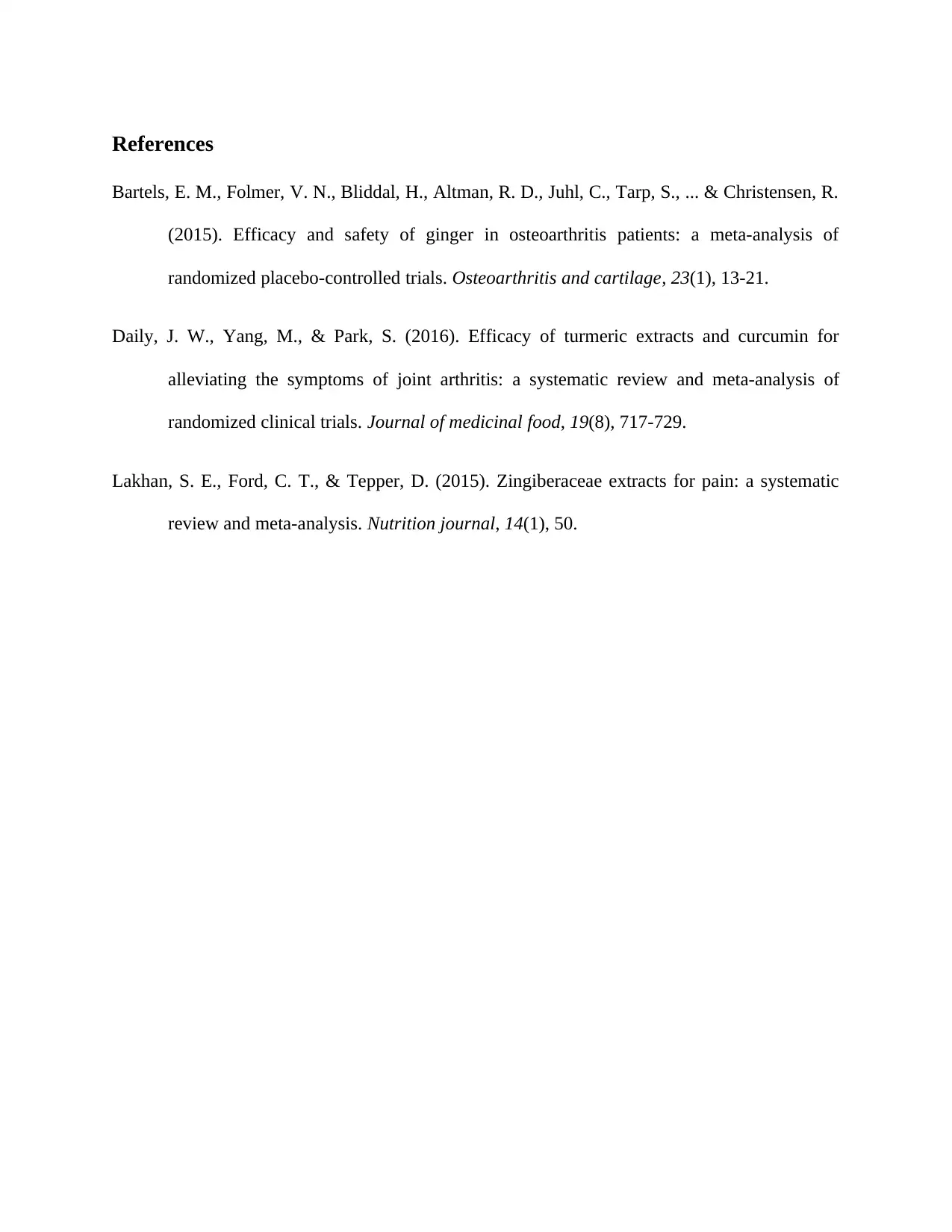
Given below are the screenshots of two such relevant articles.
(Daily, Yang & Park, 2016)
tabler-icon-diamond-filled.svg

Paraphrase This Document

Need a fresh take? Get an instant paraphrase of this document with our AI Paraphraser
Document Page
(Bartels et al., 2015)
Document Page
References
Bartels, E. M., Folmer, V. N., Bliddal, H., Altman, R. D., Juhl, C., Tarp, S., ... & Christensen, R.
(2015). Efficacy and safety of ginger in osteoarthritis patients: a meta-analysis of
randomized placebo-controlled trials. Osteoarthritis and cartilage, 23(1), 13-21.
Daily, J. W., Yang, M., & Park, S. (2016). Efficacy of turmeric extracts and curcumin for
alleviating the symptoms of joint arthritis: a systematic review and meta-analysis of
randomized clinical trials. Journal of medicinal food, 19(8), 717-729.
Lakhan, S. E., Ford, C. T., & Tepper, D. (2015). Zingiberaceae extracts for pain: a systematic
review and meta-analysis. Nutrition journal, 14(1), 50.
chevron_up_icon
1 out of 6
circle_padding
hide_on_mobile
zoom_out_icon
[object Object]