Finance Report: Zylla Limited's Funding and Appraisal Methods

Verified

Added on  2020/12/10

|7
|1300
|310
Report
AI Summary
This report provides a comprehensive analysis of Zylla Limited's financial strategies, focusing on both short-term and long-term sources of finance. It examines various sources, including trade creditors, bill discounting, factoring, owner's savings, bank loans, and debentures, providing insights into how these options can meet the company's working capital requirements and long-term funding needs. Furthermore, the report delves into investment appraisal techniques, such as the payback period, net present value (NPV), and internal rate of return (IRR), to evaluate the performance of potential projects. Through detailed calculations and analysis, the report aims to assist Zylla Limited's management in making informed financial decisions, ensuring the company's sustained growth and operational efficiency. The conclusion summarizes the key findings, emphasizing the importance of strategic financial planning and investment analysis for Zylla Limited's success.

Document Page
TASK 4
tabler-icon-diamond-filled.svg

Paraphrase This Document

Need a fresh take? Get an instant paraphrase of this document with our AI Paraphraser
Document Page
Table of Contents
INTRODUCTION...........................................................................................................................1
MAIN BODY...................................................................................................................................1
1. Short term or long term source of finance...............................................................................1
2. Investment appraisal techniques and recommendation............................................................2
CONCLUSION................................................................................................................................3
REFERENCES................................................................................................................................5
Document Page
INTRODUCTION
Zylla limited is UK based company which operates numbers of ferries and it provide the
river crossing services to the general public (Andor, Mohanty and Toth, 2015). This company
move the individual, vehicles and goods from one side to another side of river. This report
include the short term as well as long term source for finance which help the company to meet
with it's working capital requirement. In addition, it include the investment appraisal techniques
which help the manager to take their decision according to it.
MAIN BODY
1. Short term or long term source of finance
Short term source of Finance: These source of finance usually for the smaller period
such as within a year. It also called working capital finance because every organisation have to
maintain funds to complete their task. It help the business to done their operational work
successfully and it further help Zylla company to achieve their organisational goals & objectives.
Their are some short term sources which fulfil the requirement of working capital and it is
discussed below:
Trade creditors: It is the most important source of finance and it means purchase goods
from suppliers without immediate payment of goods. It help the organisation to fulfil their
working capital requirement in order to complete daily activities of operations. It is a short term
source of finance which help the Zylla company to achieve their task.
Bill Discounting: It is source of working capital finance which help the Zylla company
to fulfil the requirement of working capital for running their regular business. In this discounting
bill, seller receive the amount of sale from the intermediator before it's due date. So the
intermediator charge the fee for this service.
Factoring: It is source of finance where financial transaction happen between the owner
or third party. This process provide the instead cash which is required by the organisation to
achieve their daily targets. Manager of Zylla company can use this source of finance to fulfil the
need to working capital (Johnson, Pfeiffer and Schneider, 2013).
Long term source: It include those instruments which is mutual after a year and it
include the private or public funding which have more then one year time to pay. Their are
various source but some of it discussed below:
1
Document Page
Owners saving: It is the person who invest money in their business in case of sole
traders or partnership. Both the cases, individual used their own money to complete their
operations functions. In case of company, invested amount in the organisation by the
shareholders is called share capital. This is the long term source of finance, which can be used by
the Zylla company (Singh, Jain and Yadav, 2012).
Bank loan: Most of the organisation take loan from the bank for the completion of task
or regular production. It fulfil the working capital requirement for the longer period, so another
source of funding is bank which provide loan for the personal or professional purpose. Zylla
company can take loan from bank or fulfil their requirement related to the working capital. Long
term finance have long time period to pay back.
Debenture: It is a corporate finance where organisation borrow money at fixed rate and
timely provide the interest on it. It is the another way to fulfil the requirement of funds in the
organisation through long term source. Zylla company can use this source to fulfil the
requirement of working capital. When company required fund for the further functioning then
they offer debenture to their shareholders and timely provide the interest on their investments.
2. Investment appraisal techniques and recommendation
With the help of various appraisal techniques, organisation can easily evaluate the
performance of each new project. These techniques include the payback period, net present
values, accounting rate of return, internal rate of return etc (Kafuku, Sharifand and Zakuan,
2015).
Payback Period (PP): It is refer to the time period which required to recover the initial
cost of investment. Lower payback period will be selected because it is beneficial for the
company.
Payback Period = Cost of Project / Annual inflow
Cost of Project = Investment – Scrap Value
Net present value (NPV): It is the difference of current value of cash inflow or current
value of cash outflow. It help the organisation to measure their present value after the investment
(Laird and Venables, 2017).
NPV (Net Present Value) = Cash Inflow – Cash Outflow
2
tabler-icon-diamond-filled.svg

Paraphrase This Document

Need a fresh take? Get an instant paraphrase of this document with our AI Paraphraser
Document Page
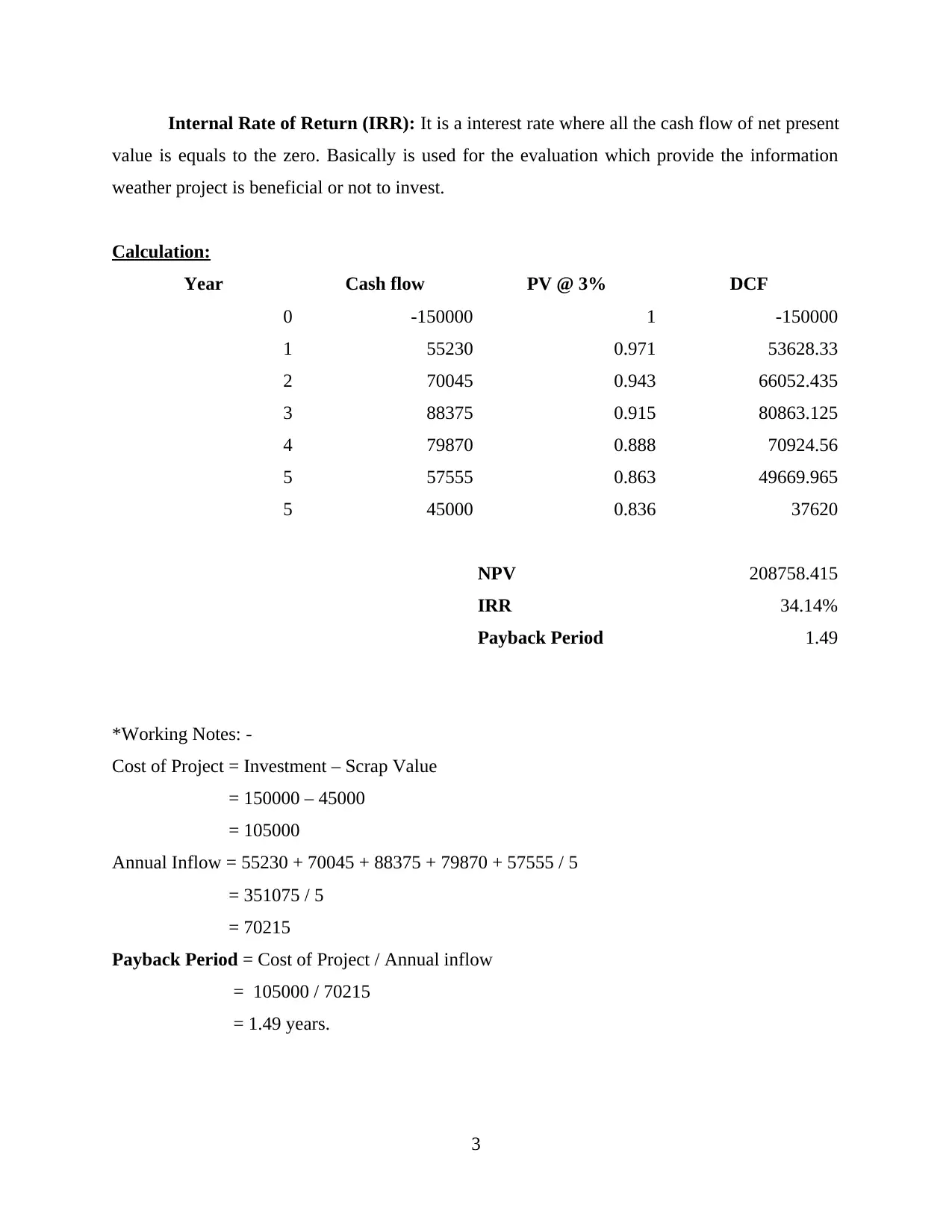
Internal Rate of Return (IRR): It is a interest rate where all the cash flow of net present
value is equals to the zero. Basically is used for the evaluation which provide the information
weather project is beneficial or not to invest.
Calculation:
Year Cash flow PV @ 3% DCF
0 -150000 1 -150000
1 55230 0.971 53628.33
2 70045 0.943 66052.435
3 88375 0.915 80863.125
4 79870 0.888 70924.56
5 57555 0.863 49669.965
5 45000 0.836 37620
NPV 208758.415
IRR 34.14%
Payback Period 1.49
*Working Notes: -
Cost of Project = Investment – Scrap Value
= 150000 – 45000
= 105000
Annual Inflow = 55230 + 70045 + 88375 + 79870 + 57555 / 5
= 351075 / 5
= 70215
Payback Period = Cost of Project / Annual inflow
= 105000 / 70215
= 1.49 years.
3
Document Page
CONCLUSION
From the above discussion is has been concluded that, short term as well as long term
finance help the organisation to complete their requirement regarding funds. Because every
business need to maintain working capital for the daily requirement of business to run their
operational functions. Company will take finance from various sources according to their
requirement. In addition, with the help of investment appraisal techniques manager of the
company analyse that which project is beneficial of the business or not.
4
Document Page
REFERENCES
Books & Journals
Andor, G., Mohanty, S. K. and Toth, T., 2015. Capital budgeting practices: A survey of Central
and Eastern European firms. Emerging Markets Review. 23. pp.148-172.
Johnson, N. B., Pfeiffer, T. and Schneider, G., 2013. Multistage capital budgeting for shared
investments. Management Science. 59(5). pp.1213-1228.
Kafuku, J. M., Saman, M. Z. M., Sharif, S. and Zakuan, N., 2015. Investment decision issues
from remanufacturing system perspective: literature review and further
research. Procedia CIRP. 26. pp.589-594.
Laird, J. J. and Venables, A. J., 2017. Transport investment and economic performance: A
framework for project appraisal. Transport Policy. 56. pp.1-11.
Singh, S., Jain, P. K. and Yadav, S. S., 2012. Capital budgeting decisions: evidence from
India. Journal of Advances in Management Research. 9(1). pp.96-112.
5
chevron_up_icon
1 out of 7
circle_padding
hide_on_mobile
zoom_out_icon
[object Object]