Analysis of HSBC's Human Resource Development and Training Programs
VerifiedAdded on 2020/06/05
|21
|6124
|90
Report
AI Summary
This report provides an in-depth analysis of HSBC's human resource development (HRD) strategies. It begins with an introduction to HRD techniques, emphasizing mentorship, workshops, and their impact on workforce efficiency. The report focuses on HSBC, examining its history, network, and employee base, and explores various learning styles such as visual, auditory, kinesthetic, and Kolb's learning style, along with their advantages and disadvantages. It also discusses the application of learning curves to monitor employee skill development and training needs at different management levels within HSBC. The report highlights the importance of aligning training programs with organizational goals and employee needs to improve performance and achieve business success. The analysis includes the identification of training gaps and the design of events to fulfill the factors which generated a proper outcome of organizing a proper human resource.

HUMAN RESOURCE
DEVELOPMENT
DEVELOPMENT

Paraphrase This Document
Need a fresh take? Get an instant paraphrase of this document with our AI Paraphraser

TABLE OF CONTENTS
INTRODUCTION...........................................................................................................................1
1.1 ..........................................................................................................................................1
1.2 ..........................................................................................................................................4
1.3 .........................................................................................................................................5
2.1 ..........................................................................................................................................6
2.2 .........................................................................................................................................7
2.3 ..........................................................................................................................................8
3.1 ........................................................................................................................................10
3.2 ........................................................................................................................................12
3.3 ........................................................................................................................................13
4.1 ........................................................................................................................................13
4.2 ........................................................................................................................................14
4.3 ........................................................................................................................................15
Conclusion.....................................................................................................................................15
REFERENCES..............................................................................................................................16
INTRODUCTION...........................................................................................................................1
1.1 ..........................................................................................................................................1
1.2 ..........................................................................................................................................4
1.3 .........................................................................................................................................5
2.1 ..........................................................................................................................................6
2.2 .........................................................................................................................................7
2.3 ..........................................................................................................................................8
3.1 ........................................................................................................................................10
3.2 ........................................................................................................................................12
3.3 ........................................................................................................................................13
4.1 ........................................................................................................................................13
4.2 ........................................................................................................................................14
4.3 ........................................................................................................................................15
Conclusion.....................................................................................................................................15
REFERENCES..............................................................................................................................16

ILLUSTRATION INDEX
Illustration 1: Klob's diagram..........................................................................................................3
Illustration 2: Learning curve...........................................................................................................5
Illustration 3: ADDIE's diagram......................................................................................................9
Illustration 1: Klob's diagram..........................................................................................................3
Illustration 2: Learning curve...........................................................................................................5
Illustration 3: ADDIE's diagram......................................................................................................9
⊘ This is a preview!⊘
Do you want full access?
Subscribe today to unlock all pages.

Trusted by 1+ million students worldwide
INTRODUCTION
To develop the core skills in workforce there is need to acquire better training and
development techniques in organisation which in context with facilitating better operational
activities. Thus, such human resource development techniques involves better mentorship,
regular workshop or organising symposium will increase the worker's efficiency and confidence.
It also focuses on the factors of human resource development that enhances on developing the
workforce of the organisation and to accomplish individuals goals as well organisational. It
provides classroom training, college course, and organisational effort to planned change, these
options can be used to develop employees skills. As business are continuously focusing to
achieve higher position in market and increasing the potential of employees to increase the
organisational profitability that leads them to desired success. In the present assesment there will
be study based on HSBC and the various services awarded by them in context with better
internal environment management. It started its operations in 1865 and have an extensive
network across UK and employing about 50000 employees. Hence, the report id based on the
different modes of facilitate the learnings to employees and which in turn enhances the better
organisational planning as well as designing the framework. However, there will be analysis
based on the requirements of training to workforce at different department as well as variations
in their duties of performance with the influence of government regulations.
However, the annual turnover of this bank can be as 47.96 billion as well as the operating
income of the firm in 2016 was 7.122 billion. Thus, it can be said that the firm is not operating in
the good instinct as they are currently facing losses in attaining capital and funds from the
investors. Hence, the equity and assets of the business are 175.38 billion and 2.374 billion in the
year 2016.
1.1
The initial requirement to enhance the knowledge, skills and abilities to improve and
acquire success will be with the help of various learning techniques. It also helps in improving
the information and not only strengthen the cognition of an individual (Honey and Mumford,
1992). To attain skills there are many learning styles that varies to assist the individual in
obtaining knowledge in their own styles. It is the situation where an individual is apparent to
have distinct of preferences of learning with different styles of learning(Armstrong, and Taylor,
To develop the core skills in workforce there is need to acquire better training and
development techniques in organisation which in context with facilitating better operational
activities. Thus, such human resource development techniques involves better mentorship,
regular workshop or organising symposium will increase the worker's efficiency and confidence.
It also focuses on the factors of human resource development that enhances on developing the
workforce of the organisation and to accomplish individuals goals as well organisational. It
provides classroom training, college course, and organisational effort to planned change, these
options can be used to develop employees skills. As business are continuously focusing to
achieve higher position in market and increasing the potential of employees to increase the
organisational profitability that leads them to desired success. In the present assesment there will
be study based on HSBC and the various services awarded by them in context with better
internal environment management. It started its operations in 1865 and have an extensive
network across UK and employing about 50000 employees. Hence, the report id based on the
different modes of facilitate the learnings to employees and which in turn enhances the better
organisational planning as well as designing the framework. However, there will be analysis
based on the requirements of training to workforce at different department as well as variations
in their duties of performance with the influence of government regulations.
However, the annual turnover of this bank can be as 47.96 billion as well as the operating
income of the firm in 2016 was 7.122 billion. Thus, it can be said that the firm is not operating in
the good instinct as they are currently facing losses in attaining capital and funds from the
investors. Hence, the equity and assets of the business are 175.38 billion and 2.374 billion in the
year 2016.
1.1
The initial requirement to enhance the knowledge, skills and abilities to improve and
acquire success will be with the help of various learning techniques. It also helps in improving
the information and not only strengthen the cognition of an individual (Honey and Mumford,
1992). To attain skills there are many learning styles that varies to assist the individual in
obtaining knowledge in their own styles. It is the situation where an individual is apparent to
have distinct of preferences of learning with different styles of learning(Armstrong, and Taylor,
Paraphrase This Document
Need a fresh take? Get an instant paraphrase of this document with our AI Paraphraser

2014). HSBC aid in training and development sessions for the employees by implementing
different styles of learning such as:
1. Visual: This learning style is foremost style where huge number of employees learns by
visualising things that are envisioned and helps in acquiring quick learning (Martin, O.,
Kolomitro and Lam, 2014). HSBC, can prefer this learning and encouraging employees
by using charts, diagrams, and pictures etc.
2. Auditory: This learning style refers to the many individuals that learns things by listening
or discoursing, faster and easy learning. With the help of this style HSBC, can arrange
their training and development sessions by means of debates, lectures.
3. Formal and informal: It involves learning through oral message or in the form of written
techniques which is in context will facilitate the employees to prepare notes and learn
through it. With reference to it, HSBC can provide recording tools to employees while
attending training sessions.
4. Kinesthetic: This refers mostly to those individuals who wants to obtain a quick learning
through practical learning. Case studies and role plays can be a good example for HSBC
to implement and train and develop skill of employees.
5. Kolb's Learning style: this technique helps in making analysis over the experience which
must be helpful in determining the obstacles which were felt before. Therefore, after
analysing the facts there is need to make computation of such knowledge and find the
outcomes. The results will help in creating the new experience.
different styles of learning such as:
1. Visual: This learning style is foremost style where huge number of employees learns by
visualising things that are envisioned and helps in acquiring quick learning (Martin, O.,
Kolomitro and Lam, 2014). HSBC, can prefer this learning and encouraging employees
by using charts, diagrams, and pictures etc.
2. Auditory: This learning style refers to the many individuals that learns things by listening
or discoursing, faster and easy learning. With the help of this style HSBC, can arrange
their training and development sessions by means of debates, lectures.
3. Formal and informal: It involves learning through oral message or in the form of written
techniques which is in context will facilitate the employees to prepare notes and learn
through it. With reference to it, HSBC can provide recording tools to employees while
attending training sessions.
4. Kinesthetic: This refers mostly to those individuals who wants to obtain a quick learning
through practical learning. Case studies and role plays can be a good example for HSBC
to implement and train and develop skill of employees.
5. Kolb's Learning style: this technique helps in making analysis over the experience which
must be helpful in determining the obstacles which were felt before. Therefore, after
analysing the facts there is need to make computation of such knowledge and find the
outcomes. The results will help in creating the new experience.
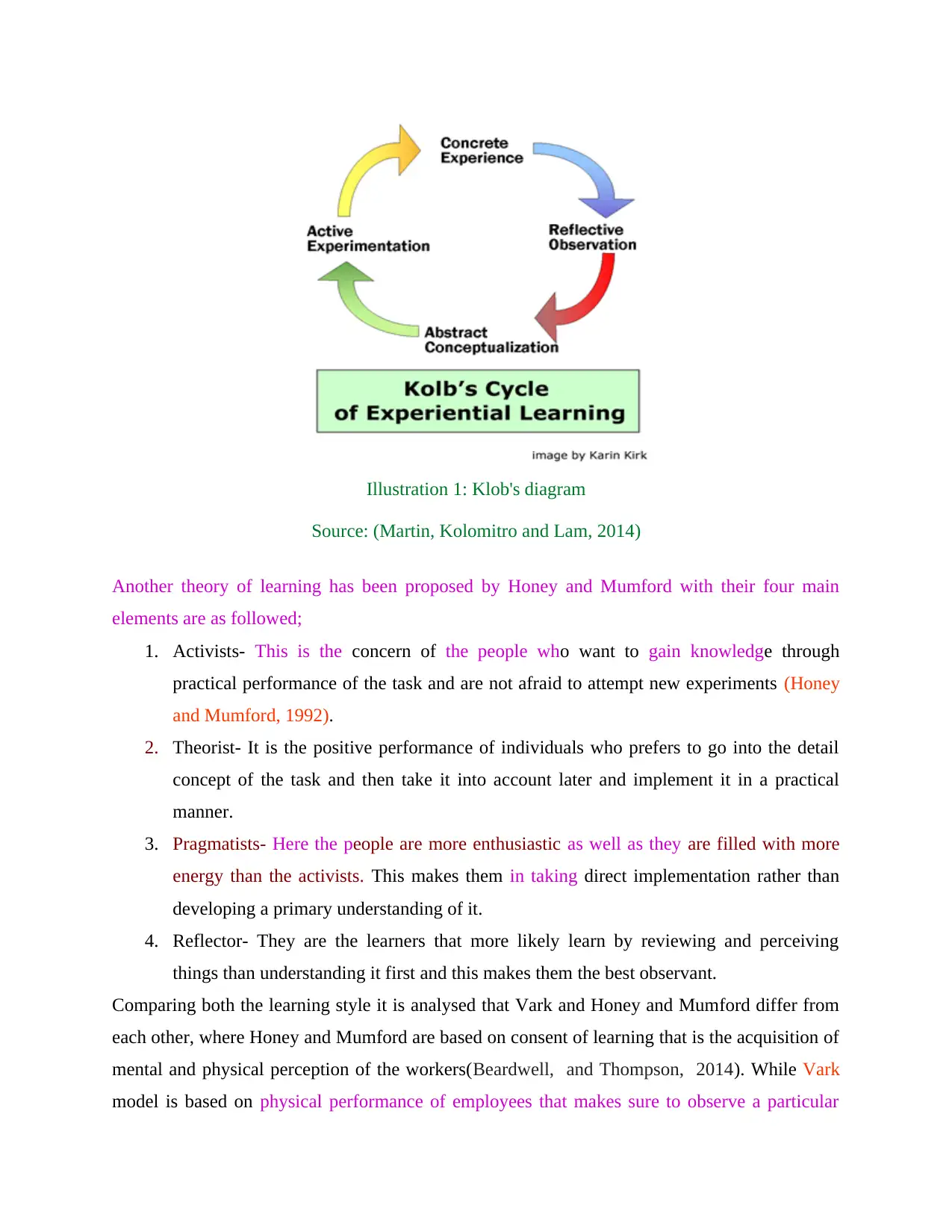
Illustration 1: Klob's diagram
Source: (Martin, Kolomitro and Lam, 2014)
Another theory of learning has been proposed by Honey and Mumford with their four main
elements are as followed;
1. Activists- This is the concern of the people who want to gain knowledge through
practical performance of the task and are not afraid to attempt new experiments (Honey
and Mumford, 1992).
2. Theorist- It is the positive performance of individuals who prefers to go into the detail
concept of the task and then take it into account later and implement it in a practical
manner.
3. Pragmatists- Here the people are more enthusiastic as well as they are filled with more
energy than the activists. This makes them in taking direct implementation rather than
developing a primary understanding of it.
4. Reflector- They are the learners that more likely learn by reviewing and perceiving
things than understanding it first and this makes them the best observant.
Comparing both the learning style it is analysed that Vark and Honey and Mumford differ from
each other, where Honey and Mumford are based on consent of learning that is the acquisition of
mental and physical perception of the workers(Beardwell, and Thompson, 2014). While Vark
model is based on physical performance of employees that makes sure to observe a particular
Source: (Martin, Kolomitro and Lam, 2014)
Another theory of learning has been proposed by Honey and Mumford with their four main
elements are as followed;
1. Activists- This is the concern of the people who want to gain knowledge through
practical performance of the task and are not afraid to attempt new experiments (Honey
and Mumford, 1992).
2. Theorist- It is the positive performance of individuals who prefers to go into the detail
concept of the task and then take it into account later and implement it in a practical
manner.
3. Pragmatists- Here the people are more enthusiastic as well as they are filled with more
energy than the activists. This makes them in taking direct implementation rather than
developing a primary understanding of it.
4. Reflector- They are the learners that more likely learn by reviewing and perceiving
things than understanding it first and this makes them the best observant.
Comparing both the learning style it is analysed that Vark and Honey and Mumford differ from
each other, where Honey and Mumford are based on consent of learning that is the acquisition of
mental and physical perception of the workers(Beardwell, and Thompson, 2014). While Vark
model is based on physical performance of employees that makes sure to observe a particular
⊘ This is a preview!⊘
Do you want full access?
Subscribe today to unlock all pages.
Trusted by 1+ million students worldwide
thing that is originated or constructed by four distinct styles to intercept things like that (Bhalli,
Khan and Sattar, 2016).
Advantages and disadvantages of Kinesthetic and activists:
basis Advantages Disadvantages
Kinesthetic The learning is basically based
on the practical informations
such as performing the daily
tasks and experiencing the
things
There will be lack of
theoretical informations.
Activists These are the people who learn
things by doing as well as
present their ideas to the
world.
There will be various conflicts
between views and ideas of
each individuals.
Different learning style contribute the training plan:
In accordance with the various learning style such as Kinesthetic, activists etc. are
helping the professionals in terms of analysing the actual requirements of workforce. Therefore,
in terms of developing and improving the efficiency of the employees there is need to analyse
their own behaviours and capacity to learn the duties and jobs
1.2
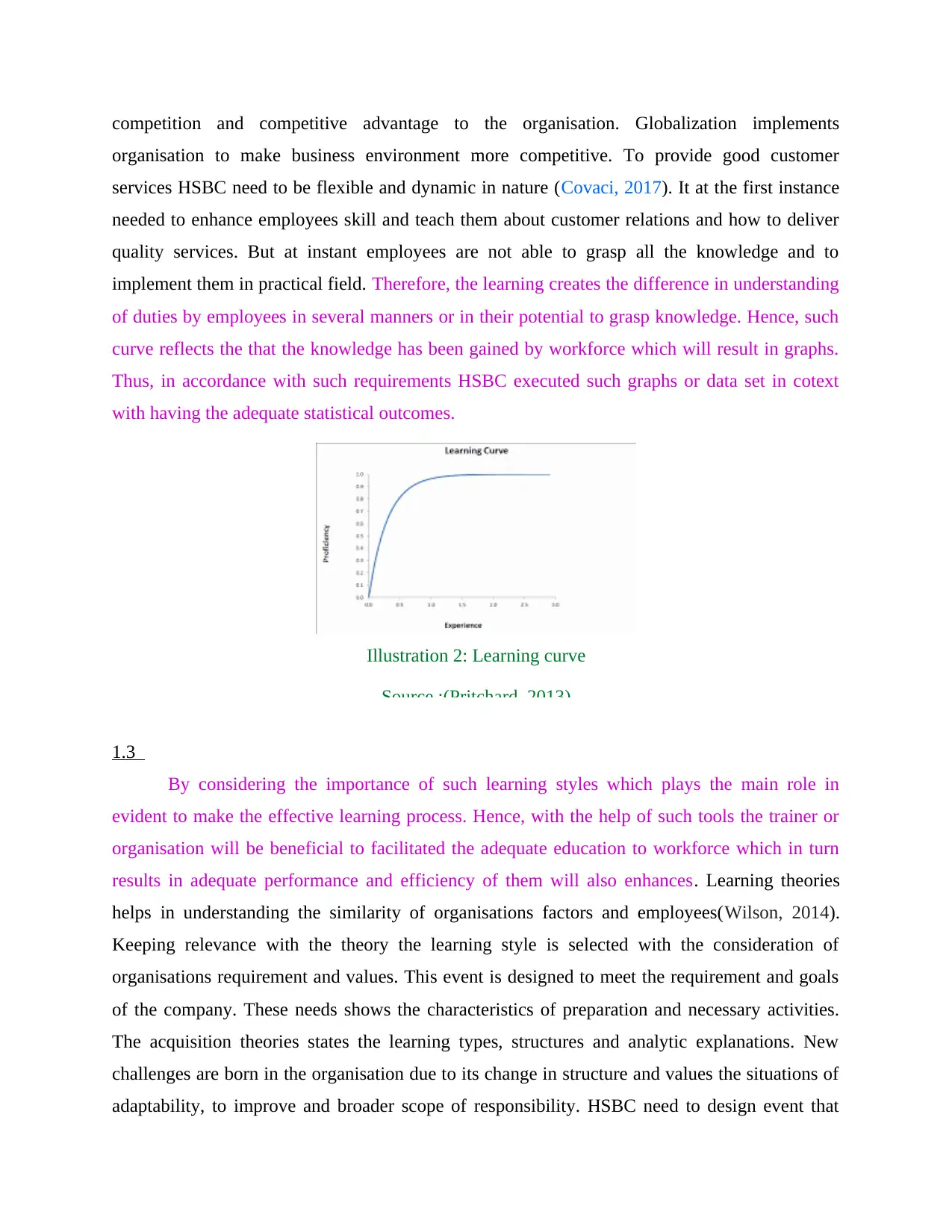
In accordance with the Learning curve, the chart or graph that is used to improve the
personal skills of the employees over time (Pritchard, 2013). It shows the sudden or frequent
change of improvement in the skills of employees over time by doing the same job. It is used to
measure and analyse the percentage of improvement in employees skills. HSBC uses this
learning curve to control and monitor the continuous improvement of employee skills and
abilities. This curve shows the improvement progress of each employee in the organisation. It
helps in monitoring or measuring the productivity and output of the employees, so the managers
can easily understand from the graph the need to improve HR(Pritchard, 2013).
HSBC needs to transfer learning knowledge into employment. Good employees makes it
easier and can effectively transfer their knowledge by implementing it practically. Human
resource is considered to be the most important function of the organisation as it brings
Khan and Sattar, 2016).
Advantages and disadvantages of Kinesthetic and activists:
basis Advantages Disadvantages
Kinesthetic The learning is basically based
on the practical informations
such as performing the daily
tasks and experiencing the
things
There will be lack of
theoretical informations.
Activists These are the people who learn
things by doing as well as
present their ideas to the
world.
There will be various conflicts
between views and ideas of
each individuals.
Different learning style contribute the training plan:
In accordance with the various learning style such as Kinesthetic, activists etc. are
helping the professionals in terms of analysing the actual requirements of workforce. Therefore,
in terms of developing and improving the efficiency of the employees there is need to analyse
their own behaviours and capacity to learn the duties and jobs
1.2
In accordance with the Learning curve, the chart or graph that is used to improve the
personal skills of the employees over time (Pritchard, 2013). It shows the sudden or frequent
change of improvement in the skills of employees over time by doing the same job. It is used to
measure and analyse the percentage of improvement in employees skills. HSBC uses this
learning curve to control and monitor the continuous improvement of employee skills and
abilities. This curve shows the improvement progress of each employee in the organisation. It
helps in monitoring or measuring the productivity and output of the employees, so the managers
can easily understand from the graph the need to improve HR(Pritchard, 2013).
HSBC needs to transfer learning knowledge into employment. Good employees makes it
easier and can effectively transfer their knowledge by implementing it practically. Human
resource is considered to be the most important function of the organisation as it brings
Paraphrase This Document
Need a fresh take? Get an instant paraphrase of this document with our AI Paraphraser
competition and competitive advantage to the organisation. Globalization implements
organisation to make business environment more competitive. To provide good customer
services HSBC need to be flexible and dynamic in nature (Covaci, 2017). It at the first instance
needed to enhance employees skill and teach them about customer relations and how to deliver
quality services. But at instant employees are not able to grasp all the knowledge and to
implement them in practical field. Therefore, the learning creates the difference in understanding
of duties by employees in several manners or in their potential to grasp knowledge. Hence, such
curve reflects the that the knowledge has been gained by workforce which will result in graphs.
Thus, in accordance with such requirements HSBC executed such graphs or data set in cotext
with having the adequate statistical outcomes.
Illustration 2: Learning curve
Source :(Pritchard, 2013)
1.3
By considering the importance of such learning styles which plays the main role in
evident to make the effective learning process. Hence, with the help of such tools the trainer or
organisation will be beneficial to facilitated the adequate education to workforce which in turn
results in adequate performance and efficiency of them will also enhances. Learning theories
helps in understanding the similarity of organisations factors and employees(Wilson, 2014).
Keeping relevance with the theory the learning style is selected with the consideration of
organisations requirement and values. This event is designed to meet the requirement and goals
of the company. These needs shows the characteristics of preparation and necessary activities.
The acquisition theories states the learning types, structures and analytic explanations. New
challenges are born in the organisation due to its change in structure and values the situations of
adaptability, to improve and broader scope of responsibility. HSBC need to design event that
organisation to make business environment more competitive. To provide good customer
services HSBC need to be flexible and dynamic in nature (Covaci, 2017). It at the first instance
needed to enhance employees skill and teach them about customer relations and how to deliver
quality services. But at instant employees are not able to grasp all the knowledge and to
implement them in practical field. Therefore, the learning creates the difference in understanding
of duties by employees in several manners or in their potential to grasp knowledge. Hence, such
curve reflects the that the knowledge has been gained by workforce which will result in graphs.
Thus, in accordance with such requirements HSBC executed such graphs or data set in cotext
with having the adequate statistical outcomes.
Illustration 2: Learning curve
Source :(Pritchard, 2013)
1.3
By considering the importance of such learning styles which plays the main role in
evident to make the effective learning process. Hence, with the help of such tools the trainer or
organisation will be beneficial to facilitated the adequate education to workforce which in turn
results in adequate performance and efficiency of them will also enhances. Learning theories
helps in understanding the similarity of organisations factors and employees(Wilson, 2014).
Keeping relevance with the theory the learning style is selected with the consideration of
organisations requirement and values. This event is designed to meet the requirement and goals
of the company. These needs shows the characteristics of preparation and necessary activities.
The acquisition theories states the learning types, structures and analytic explanations. New
challenges are born in the organisation due to its change in structure and values the situations of
adaptability, to improve and broader scope of responsibility. HSBC need to design event that
fulfil the factors which generated a proper outcome of organising a proper human resource. To
select styles and designing the event they need to make sure that events make a clear picture and
maintain its objective and keep relevancy and clarity and impact on performance(Sternberg, and
Zhang, 2014). This is to specify the influential factors which are being supported by making
effective discussion and designs which are needed in executing training has been facilitated by
Mumford, Vark and Honey.
However, with the help of various methods which are helpful in making te adequate
determination of the informations and make the changes in the operational activities of the
business. Thus, it will be helpful for the company in context with making the adequate training
and development program in premises. Therefore, with the help of such techniques the
employees will develop the strong understanding as well as make the efficient efforts.
2.1
The gap between the employees training and related training needs so to enhance the
individual performance and to increase organisational activities. There are many levels in the
organisation where company operates and it is essential for HSBC to loctate the needs for its
staff and to attain the best result from it. Therefore, differences may arise while conducting
training programs at different levels of the organisation as they are diverse for people employed
at such levels. Employees need to undergo such training programs to enhance their skills,
abilities and knowledge towards their work and attain success in the same. HSBC has maintained
a healthy working environment for its employees to learn and overcome their issues related to
different skills and customer visit. Below are the training needs of staff at different levels-
Top level management- It is the upper level management of the company that includes,
upper management and owners of HSBC. These level individual needs important training needs
which regards to managing the work and the functions within firm so to make effective decisions
and enhancing the skills and capabilities of individuals. Here, the management requires training
related to managing organisation and compete in such markets(Burr, and Pearne, 2013).
Middle level management- This is another level management within HSBC and involves
different managers at different managing positions. This level mainly comprises supervisors, line
managers etc that take the responsibility for the management and functions of the organisation.
Therefore, they need to have diverse need of training regarding manage the workload and
delegate the duties and direct the employees for efficient work and reach towards organisational
select styles and designing the event they need to make sure that events make a clear picture and
maintain its objective and keep relevancy and clarity and impact on performance(Sternberg, and
Zhang, 2014). This is to specify the influential factors which are being supported by making
effective discussion and designs which are needed in executing training has been facilitated by
Mumford, Vark and Honey.
However, with the help of various methods which are helpful in making te adequate
determination of the informations and make the changes in the operational activities of the
business. Thus, it will be helpful for the company in context with making the adequate training
and development program in premises. Therefore, with the help of such techniques the
employees will develop the strong understanding as well as make the efficient efforts.
2.1
The gap between the employees training and related training needs so to enhance the
individual performance and to increase organisational activities. There are many levels in the
organisation where company operates and it is essential for HSBC to loctate the needs for its
staff and to attain the best result from it. Therefore, differences may arise while conducting
training programs at different levels of the organisation as they are diverse for people employed
at such levels. Employees need to undergo such training programs to enhance their skills,
abilities and knowledge towards their work and attain success in the same. HSBC has maintained
a healthy working environment for its employees to learn and overcome their issues related to
different skills and customer visit. Below are the training needs of staff at different levels-
Top level management- It is the upper level management of the company that includes,
upper management and owners of HSBC. These level individual needs important training needs
which regards to managing the work and the functions within firm so to make effective decisions
and enhancing the skills and capabilities of individuals. Here, the management requires training
related to managing organisation and compete in such markets(Burr, and Pearne, 2013).
Middle level management- This is another level management within HSBC and involves
different managers at different managing positions. This level mainly comprises supervisors, line
managers etc that take the responsibility for the management and functions of the organisation.
Therefore, they need to have diverse need of training regarding manage the workload and
delegate the duties and direct the employees for efficient work and reach towards organisational
⊘ This is a preview!⊘
Do you want full access?
Subscribe today to unlock all pages.
Trusted by 1+ million students worldwide
goal. Comparing to the top level management there is need to have training related to organising
and directing workers towards organisational goals.
Lower level management- These individual at the operating and directing level of
the organisations sand need to follow instruction fol-owed by middle level superiors.
Therefore, they undergo training needs effectively so the delegated task can be completed
effectively. To achieve the goals and success proper time engagement need to be circulated.
Advantages Disadvantages
Top level management These are the professionals
such as owners, founders as
well as directors of the
organisation which in turn
looks for the requirements of
funds in the operational
activity.
They do not have the direct
interaction with the lower level
workforce as they will not
being able to fetch their
attention.
Middle level management These are heads of various
operational departments and
helps in executing the
requirements of funds and the
operational activities.
They will not have authority to
expand the funds as to gather
the good amount of revenue.
Lower level management They are having direct
interaction with the workforce
and execute the operational
activities of the business as
well as make efforts to
perform such tasks.
They will not able to exceed
the funds as well as make
efforts to lower down such
funds.
2.2
The different training methods and types available in the organ' such as on-job or off-job
for their workers so to make them easily complete their desired outcomes in an effective and
efficient manner. Therefore, it is important for HSBC to organise training programs for their
and directing workers towards organisational goals.
Lower level management- These individual at the operating and directing level of
the organisations sand need to follow instruction fol-owed by middle level superiors.
Therefore, they undergo training needs effectively so the delegated task can be completed
effectively. To achieve the goals and success proper time engagement need to be circulated.
Advantages Disadvantages
Top level management These are the professionals
such as owners, founders as
well as directors of the
organisation which in turn
looks for the requirements of
funds in the operational
activity.
They do not have the direct
interaction with the lower level
workforce as they will not
being able to fetch their
attention.
Middle level management These are heads of various
operational departments and
helps in executing the
requirements of funds and the
operational activities.
They will not have authority to
expand the funds as to gather
the good amount of revenue.
Lower level management They are having direct
interaction with the workforce
and execute the operational
activities of the business as
well as make efforts to
perform such tasks.
They will not able to exceed
the funds as well as make
efforts to lower down such
funds.
2.2
The different training methods and types available in the organ' such as on-job or off-job
for their workers so to make them easily complete their desired outcomes in an effective and
efficient manner. Therefore, it is important for HSBC to organise training programs for their
Paraphrase This Document
Need a fresh take? Get an instant paraphrase of this document with our AI Paraphraser
employees to enhance their personnel leadership style and development to achieve the desired
goal. Their conducting personality development programs, customer relations, workshops makes
or develops the efficiency of employees in the organisation. It is important for the employees to
take part in different training programs so to succeed in the business market(Grohmann, and
Kauffeld, 2013). On the job method has various advantages such as motivates employees by
making them learn different skills and to enhance their learning skills of new joining and make
them with training for the functionns of the organisation. It also make sure to provide the
knowledge and information of HSBC policies and terms and conditions. But it has limitations as
it is costly procedure and requires participation of employees.
Moreover, another training method is off job training, this implies training with
different styles such as role play, vestibule training etc. and they are beneficial with these
trainings are given in class room teaching and also provides audio video classes to employees.
HSBC want to provide such learning to its employees in relation to enhance their abilities and
efficiency. More advantage of this procedure is that it helps in saving time and helps in acquiring
information much earlier. Its disadvantage is that it is completely not in control of the workplace
and might affect the quality(Wang, 2018).
2.3
It is defined as the process that includes different steps and also helps in evaluating the
outcomes. Its most important aim is to carry out systematic approach in the best effective manner
to develop the best outcomes. The business need to develop effective training and development
program to organise event related to their training for the new joiners in HSBC so to enhance
their skills and abilities and for effective work(Pazey, and Cole, 2013). These steps are for
planning training and development plan for the employee such as-
Identifying issues - The very first and most important path of the organisation's is to
identify the need of training within HSBC and try to focus on their performance level.
The organisation need to forecast the new provision for services so that employees are
easily understood and relate to their customer services.
Questions and answer session- This is next step of training and planing and development
for workers so to make them responsible to carry out new services effectively and
increase provisions to satisfy customers demand. Moreover, involving them with the
goal. Their conducting personality development programs, customer relations, workshops makes
or develops the efficiency of employees in the organisation. It is important for the employees to
take part in different training programs so to succeed in the business market(Grohmann, and
Kauffeld, 2013). On the job method has various advantages such as motivates employees by
making them learn different skills and to enhance their learning skills of new joining and make
them with training for the functionns of the organisation. It also make sure to provide the
knowledge and information of HSBC policies and terms and conditions. But it has limitations as
it is costly procedure and requires participation of employees.
Moreover, another training method is off job training, this implies training with
different styles such as role play, vestibule training etc. and they are beneficial with these
trainings are given in class room teaching and also provides audio video classes to employees.
HSBC want to provide such learning to its employees in relation to enhance their abilities and
efficiency. More advantage of this procedure is that it helps in saving time and helps in acquiring
information much earlier. Its disadvantage is that it is completely not in control of the workplace
and might affect the quality(Wang, 2018).
2.3
It is defined as the process that includes different steps and also helps in evaluating the
outcomes. Its most important aim is to carry out systematic approach in the best effective manner
to develop the best outcomes. The business need to develop effective training and development
program to organise event related to their training for the new joiners in HSBC so to enhance
their skills and abilities and for effective work(Pazey, and Cole, 2013). These steps are for
planning training and development plan for the employee such as-
Identifying issues - The very first and most important path of the organisation's is to
identify the need of training within HSBC and try to focus on their performance level.
The organisation need to forecast the new provision for services so that employees are
easily understood and relate to their customer services.
Questions and answer session- This is next step of training and planing and development
for workers so to make them responsible to carry out new services effectively and
increase provisions to satisfy customers demand. Moreover, involving them with the
training events that helps in improving decision making process effectively and to
achieve their best results(Jossberger, Brand-Gruwel, and Boshuizen, 2017).
Discussion to execute the best outcome- By carrying out training and development event
for their employees, it is an effective decision to include all of its employees in the
decision making process and to attain best results. Moreover, employees involvement in
the process and reviewing their decisions for new service policies is helpful in satisfying
the demands of customers in the financial business.
Scrutinizing the solutions- The last step of T&D event in taking the employees for the
organisation and deliver conclusion regarding their discussion to implement new services
and policies so to attract customers.
Illustration 3: ADDIE's diagram
source :(Newcomer, Hatry and Wholey,
2015)
Analyse: There is need to analyse the requirements of the training and development in
context with making the improvements in the operational performances of the workforce in
which will be helpful in attaining the organisational goals.
Design: After analysing the requirements of the training development program there is
need to plan the schedule which in turn have the adequate time for the employees in learning the
duties as well as it does not affect the business operations.
Develop: The execution of the plan as well as accessing the efforts made by workforce.
Thus, there is need to make development in the duties of the workforce.
Implement: After analysing the needs of workforce there is need to plan the strategies
and techniques to implement such plans.
achieve their best results(Jossberger, Brand-Gruwel, and Boshuizen, 2017).
Discussion to execute the best outcome- By carrying out training and development event
for their employees, it is an effective decision to include all of its employees in the
decision making process and to attain best results. Moreover, employees involvement in
the process and reviewing their decisions for new service policies is helpful in satisfying
the demands of customers in the financial business.
Scrutinizing the solutions- The last step of T&D event in taking the employees for the
organisation and deliver conclusion regarding their discussion to implement new services
and policies so to attract customers.
Illustration 3: ADDIE's diagram
source :(Newcomer, Hatry and Wholey,
2015)
Analyse: There is need to analyse the requirements of the training and development in
context with making the improvements in the operational performances of the workforce in
which will be helpful in attaining the organisational goals.
Design: After analysing the requirements of the training development program there is
need to plan the schedule which in turn have the adequate time for the employees in learning the
duties as well as it does not affect the business operations.
Develop: The execution of the plan as well as accessing the efforts made by workforce.
Thus, there is need to make development in the duties of the workforce.
Implement: After analysing the needs of workforce there is need to plan the strategies
and techniques to implement such plans.
⊘ This is a preview!⊘
Do you want full access?
Subscribe today to unlock all pages.
Trusted by 1+ million students worldwide

1 out of 21


Related Documents


Your All-in-One AI-Powered Toolkit for Academic Success.
+13062052269
info@desklib.com
Available 24*7 on WhatsApp / Email
![[object Object]](/_next/static/media/star-bottom.7253800d.svg)
Unlock your academic potential
Copyright © 2020–2026 A2Z Services. All Rights Reserved. Developed and managed by ZUCOL.