Exploring Communication Theories and Student Barriers Post-Pandemic
VerifiedAdded on 2023/06/08
|9
|2383
|86
Report
AI Summary
This report examines business communication within organizations, emphasizing its role in employee relations, customer satisfaction, and overall organizational success. It delves into various organizational communication theories, including Theory X and Y, Agenda Setting Theory, Bureaucracy Theory, Acceptance Theory of Authority, Speech Act Theory, and the Theory of Corporate Colonization. The report further analyzes barriers preventing students from returning to campus post-pandemic, such as lack of motivation, financial constraints, listening and emotional challenges, and physical obstacles. It proposes strategies to overcome these barriers, including university awareness campaigns, counseling services, financial aid adjustments, and the use of digital media to encourage campus engagement. The report concludes by recommending improved communication between students and the university through various channels like email and social media, highlighting the importance of effective communication in addressing student concerns and enhancing their overall educational experience. Desklib provides access to this and other solved assignments for students.
Business
Communication
Communication

Paraphrase This Document
Need a fresh take? Get an instant paraphrase of this document with our AI Paraphraser
Abstract
Business Communication refers to the process of receiving or sending messages in an
organization. It includes non-verbal, cultural, verbal or public commination in order to customer
satisfaction and to develop healthy relationships among the employees. As a management
function, communication is the process of communicating and interpreting ideas, feelings,
opinions about the work performance, organisational efficiency as well as goals achievement in
organisation. No organization can ever succeed or progress without effective communication. A
manager must be an effective communicator and no organization can succeed or progress, build
up reputation without effective communication skills. The poor communication may leads the
system in bad business results and mismanagement. The main aim of this report to show that
effective communication is crucial for the progress as well as survival of a business involvement.
Any business lies in effective communication, this report also point out different theories of
organisational communication and the need of communication skills in the in a business
environment.
Business Communication refers to the process of receiving or sending messages in an
organization. It includes non-verbal, cultural, verbal or public commination in order to customer
satisfaction and to develop healthy relationships among the employees. As a management
function, communication is the process of communicating and interpreting ideas, feelings,
opinions about the work performance, organisational efficiency as well as goals achievement in
organisation. No organization can ever succeed or progress without effective communication. A
manager must be an effective communicator and no organization can succeed or progress, build
up reputation without effective communication skills. The poor communication may leads the
system in bad business results and mismanagement. The main aim of this report to show that
effective communication is crucial for the progress as well as survival of a business involvement.
Any business lies in effective communication, this report also point out different theories of
organisational communication and the need of communication skills in the in a business
environment.
Contents
Abstract............................................................................................................................................2
INTRODUCTION...........................................................................................................................1
Different Theories of organisational communication..................................................................1
Barriers preventing students from returning to campus...............................................................2
Strategies to overcome barriers....................................................................................................4
CONCLUSION ...............................................................................................................................5
REFERENCES................................................................................................................................6
Abstract............................................................................................................................................2
INTRODUCTION...........................................................................................................................1
Different Theories of organisational communication..................................................................1
Barriers preventing students from returning to campus...............................................................2
Strategies to overcome barriers....................................................................................................4
CONCLUSION ...............................................................................................................................5
REFERENCES................................................................................................................................6
⊘ This is a preview!⊘
Do you want full access?
Subscribe today to unlock all pages.

Trusted by 1+ million students worldwide
INTRODUCTION
Businesses communication refers to the process of delivering information from one person to
another person outside and inside the organisation. Business communication helps to enhance the
relations and morale of employees as well as increases the managerial efficiency (Veltsos, 2017).
Effective communication leads the organisation towards success because it depends on the
better decision makings. Basically, business communication is of four types which includes the
internal downward, internal upward, internal lateral and external business communication. This
report will cover the theories of organisation communication. In addition to that it will
summarize the barriers preventing students from returning campus and the strategies to
overcomes these barriers.
Analysis and discussion
Organisational communication is defined as the channels which includes interpersonal
exchange of information, views, etc. between the employees, staff and the management (Downs,
DeWine and Greenbaum, 2020). It is a form of communication in which organisations such as
government bodies, corporations, non-profits, including both the internal communications that
happen in the organisation. Organisational communication is good in building trust which rise
engagement. It helps in set up stronger working relationships between all the members in the
organisation which increase the loyalty.
Different Theories of organisational communication
Theory X and Theory Y
The theory was developed by Douglas McGregor, it is based on directly hostile premise
of human nature (Keerthana and Babu, 2018). In this theory, McGregor states the creativity,
development of self-control as well as acknowledge people as the greatest liability of an
organisation. It is very important theory for the organisational communication. He also gave
suggestions that workers should be rewarded based on their effort and performance for achieving
goals which set by the organisation not only the basis of an individual ability.
Agenda setting theory
It is a type of theory which is completely based on ability to influence the topics of public
programme in efficient way. The study of this theory states that media discover various methods
to target the audience as well as established a hierarchical structure.
1
Businesses communication refers to the process of delivering information from one person to
another person outside and inside the organisation. Business communication helps to enhance the
relations and morale of employees as well as increases the managerial efficiency (Veltsos, 2017).
Effective communication leads the organisation towards success because it depends on the
better decision makings. Basically, business communication is of four types which includes the
internal downward, internal upward, internal lateral and external business communication. This
report will cover the theories of organisation communication. In addition to that it will
summarize the barriers preventing students from returning campus and the strategies to
overcomes these barriers.
Analysis and discussion
Organisational communication is defined as the channels which includes interpersonal
exchange of information, views, etc. between the employees, staff and the management (Downs,
DeWine and Greenbaum, 2020). It is a form of communication in which organisations such as
government bodies, corporations, non-profits, including both the internal communications that
happen in the organisation. Organisational communication is good in building trust which rise
engagement. It helps in set up stronger working relationships between all the members in the
organisation which increase the loyalty.
Different Theories of organisational communication
Theory X and Theory Y
The theory was developed by Douglas McGregor, it is based on directly hostile premise
of human nature (Keerthana and Babu, 2018). In this theory, McGregor states the creativity,
development of self-control as well as acknowledge people as the greatest liability of an
organisation. It is very important theory for the organisational communication. He also gave
suggestions that workers should be rewarded based on their effort and performance for achieving
goals which set by the organisation not only the basis of an individual ability.
Agenda setting theory
It is a type of theory which is completely based on ability to influence the topics of public
programme in efficient way. The study of this theory states that media discover various methods
to target the audience as well as established a hierarchical structure.
1
Paraphrase This Document
Need a fresh take? Get an instant paraphrase of this document with our AI Paraphraser
Bureaucracy Theory
This theory is very crucial for organisational communication because it explains that how a
system authority based on impersonal rules, guide organisations and the behaviour of individual
along with decision making. It is beneficial in strictly controlling the workers effectively
(Goldhaber, 2020). With context to communication this theory assumes as hierarchical approach
where each organisational member reports to the higher command for communication in order to
deliver their messages.
Acceptance theory of authority
This theory was developed in 1938 by Chester Barnard in his book “The functions of the
executive.” This theory explains the value of communication, maintenance of self-respect and
feelings of personal integrity. The formal channels are very essential for connecting to the
members of entire organisation with each and every individual, reporting and exhibiting
dependency to someone else.
The speech act theory and the learning origination
This theory is also being considered as the most important organisational communication
theory. It is defined by the idea that language carry meaning beyond just the definition of the
words that are used. This theory suppose that human beings cannot act without explanation what
is being said by others but it is progressively used to help organisations address challenges and
issues (Conrad and Cheney, 2018). Another use of this theory is used to fill the performance gap
in their business departments or their employees by the idea of learning organisations.
Theory of corporate colonization
This theory states that the corporate sector has efficiently evolved to become the primary
institution of the UK. This sector has also succeeded to settle most aspect of our lives, including
media, family relations and government.
Barriers preventing students from returning to campus
Barriers are anything that used or acting to block someone from doing something, or to
block something from happening or from going somewhere. During pandemic, the educational
system was shifted from offline to online. Universities were run their classes on online platforms
by audio or video calling because of COVID-19 lockdown students were also not allowed to go
in campus. But after the successful process of vaccination, the lockdown is over now and it
2
This theory is very crucial for organisational communication because it explains that how a
system authority based on impersonal rules, guide organisations and the behaviour of individual
along with decision making. It is beneficial in strictly controlling the workers effectively
(Goldhaber, 2020). With context to communication this theory assumes as hierarchical approach
where each organisational member reports to the higher command for communication in order to
deliver their messages.
Acceptance theory of authority
This theory was developed in 1938 by Chester Barnard in his book “The functions of the
executive.” This theory explains the value of communication, maintenance of self-respect and
feelings of personal integrity. The formal channels are very essential for connecting to the
members of entire organisation with each and every individual, reporting and exhibiting
dependency to someone else.
The speech act theory and the learning origination
This theory is also being considered as the most important organisational communication
theory. It is defined by the idea that language carry meaning beyond just the definition of the
words that are used. This theory suppose that human beings cannot act without explanation what
is being said by others but it is progressively used to help organisations address challenges and
issues (Conrad and Cheney, 2018). Another use of this theory is used to fill the performance gap
in their business departments or their employees by the idea of learning organisations.
Theory of corporate colonization
This theory states that the corporate sector has efficiently evolved to become the primary
institution of the UK. This sector has also succeeded to settle most aspect of our lives, including
media, family relations and government.
Barriers preventing students from returning to campus
Barriers are anything that used or acting to block someone from doing something, or to
block something from happening or from going somewhere. During pandemic, the educational
system was shifted from offline to online. Universities were run their classes on online platforms
by audio or video calling because of COVID-19 lockdown students were also not allowed to go
in campus. But after the successful process of vaccination, the lockdown is over now and it
2
becomes barriers in front of the students to return to college. There are some reasons that
indicates the barriers that preventing students from returning to campus which includes lack of
motivation, finances can be tight, listening barriers, emotional barriers as well as physical
barriers.
Lack of motivation – Everyone needs motivation in their lives because lack of
motivation leads to distraction and creates mental health issues. Sometimes students
facing problem and lose their confidence for doing or achieving great things in life. They
often feel weak, distracted from their studies and don't want to face people because they
have the fear that other students make joke of their weakness. In lockdown, students lose
their hopes to returning campus and felt demotivated (Aichhorn and Puck, 2017). So, the
lack of motivation can be considered as a barrier that preventing students from returning
to campus.
Finances can be tight- Financial barriers are creating various difficulties. Most of the
Students live far from their campus, as they belong to different places in UK. Some of
them can’t afford the money to travel, for reaching the campus and some students have
financial problem in their families so they are not able to pay their fees on time. This is
the another barrier preventing students from returning to campus.
Listening barriers- During lockdown, students were habitual with the online classes and
the environment at their home. Every student took their classes by home on online
platforms. After the lockdown over, they feel tensed and don't want to attend the real
classrooms they were find that online study is much easier and enjoyable from face to
face interactions. Their teachers also use the mute function to avoid distraction in online
classes.
Emotional barriers- In the lockdown time, students took advantage of online classes and
feel stress free at home. Many students have emotional issues they have scared of talking
face to face with teachers, with the help of online platforms they off their camera and
clearly communicate their feelings to teachers (Browning, Sørnes, and Svenkerud,,
2022). So, emotional barrier is the another reason that prevent student from returning
campus.
Physical barriers- Some students don't take college life seriously as they prefer self-
study at home is more comforting instead of going to college and attend classes. In the
3
indicates the barriers that preventing students from returning to campus which includes lack of
motivation, finances can be tight, listening barriers, emotional barriers as well as physical
barriers.
Lack of motivation – Everyone needs motivation in their lives because lack of
motivation leads to distraction and creates mental health issues. Sometimes students
facing problem and lose their confidence for doing or achieving great things in life. They
often feel weak, distracted from their studies and don't want to face people because they
have the fear that other students make joke of their weakness. In lockdown, students lose
their hopes to returning campus and felt demotivated (Aichhorn and Puck, 2017). So, the
lack of motivation can be considered as a barrier that preventing students from returning
to campus.
Finances can be tight- Financial barriers are creating various difficulties. Most of the
Students live far from their campus, as they belong to different places in UK. Some of
them can’t afford the money to travel, for reaching the campus and some students have
financial problem in their families so they are not able to pay their fees on time. This is
the another barrier preventing students from returning to campus.
Listening barriers- During lockdown, students were habitual with the online classes and
the environment at their home. Every student took their classes by home on online
platforms. After the lockdown over, they feel tensed and don't want to attend the real
classrooms they were find that online study is much easier and enjoyable from face to
face interactions. Their teachers also use the mute function to avoid distraction in online
classes.
Emotional barriers- In the lockdown time, students took advantage of online classes and
feel stress free at home. Many students have emotional issues they have scared of talking
face to face with teachers, with the help of online platforms they off their camera and
clearly communicate their feelings to teachers (Browning, Sørnes, and Svenkerud,,
2022). So, emotional barrier is the another reason that prevent student from returning
campus.
Physical barriers- Some students don't take college life seriously as they prefer self-
study at home is more comforting instead of going to college and attend classes. In the
3
⊘ This is a preview!⊘
Do you want full access?
Subscribe today to unlock all pages.
Trusted by 1+ million students worldwide
pandemic situation the students were became so lazy as they were not allowed to go
anywhere. So, because of physical barriers students preventing themselves from returning
to campus.
Strategies to overcome barriers
There are the strategies that the university should apply to overcome the barriers preventing
students from returning to campus are mention below:
The government of UK has released various guidelines to preventing people from Corona
virus such as wear mask, maintain social distancing as well as stay home in lockdowns
etc. The university should aware the students and provide the information related to
COVID – 19.
The University should spread awareness and COVID-19 guidelines which was
announced by the UK government and take care that every student follow and apply the
precautions in order to prevent themselves from the infection.
To reduce the emotional barriers of students, university should hire a counsellor in the
campus. The counselor can provide emotional support and guidance to the students that
will helps them to overcome emotional barriers.With the help of counsellor students will
able to openly communicate their throughts and feelings and this will also improve their
communication skills. If the university will hire counsellor to take care of the students it
will attract the students and their attention towards campus (Nguyen, 2021).
Universities financial department need to focus on the fees structure, because that affects
the financial issue to most of the students. They should reduce the extra funds on
student's fees structure and follow a relevant fees procedure according to per students
study areas.
Univerities must announce information in the campus to follow the classrooms
precautions such as wash hand on daily basis, wear masks and apply hand sanitizers to
prevent from the virus. This will reduce the fear of the students and give them of hope to
return to campus.
Universities should also use digital media to attract the students towards campus and
encourage them to take offline classes. They can help students by telling them the
importance of campus classes. They can also upload relevant sources for students on the
campus online platforms such as on univrsity's official website, facebook, instagram and
4
anywhere. So, because of physical barriers students preventing themselves from returning
to campus.
Strategies to overcome barriers
There are the strategies that the university should apply to overcome the barriers preventing
students from returning to campus are mention below:
The government of UK has released various guidelines to preventing people from Corona
virus such as wear mask, maintain social distancing as well as stay home in lockdowns
etc. The university should aware the students and provide the information related to
COVID – 19.
The University should spread awareness and COVID-19 guidelines which was
announced by the UK government and take care that every student follow and apply the
precautions in order to prevent themselves from the infection.
To reduce the emotional barriers of students, university should hire a counsellor in the
campus. The counselor can provide emotional support and guidance to the students that
will helps them to overcome emotional barriers.With the help of counsellor students will
able to openly communicate their throughts and feelings and this will also improve their
communication skills. If the university will hire counsellor to take care of the students it
will attract the students and their attention towards campus (Nguyen, 2021).
Universities financial department need to focus on the fees structure, because that affects
the financial issue to most of the students. They should reduce the extra funds on
student's fees structure and follow a relevant fees procedure according to per students
study areas.
Univerities must announce information in the campus to follow the classrooms
precautions such as wash hand on daily basis, wear masks and apply hand sanitizers to
prevent from the virus. This will reduce the fear of the students and give them of hope to
return to campus.
Universities should also use digital media to attract the students towards campus and
encourage them to take offline classes. They can help students by telling them the
importance of campus classes. They can also upload relevant sources for students on the
campus online platforms such as on univrsity's official website, facebook, instagram and
4
Paraphrase This Document
Need a fresh take? Get an instant paraphrase of this document with our AI Paraphraser
twitter. It will encourage and help the students to overcome the barriers that preventing
students to return to campus.
Recommendations
Communication between students and college are very important in order to flow the
communication effectively. Lack of communication Without communication, students won’t be
able to know what’s happening around them which would affect their education and life on the
campus. Lack of communication might lead to a lack of awareness about certain issues and thus
to fail to solve them.
It is a recommendation to the universities that they should openly communicate with
students regarding their queries.
They should use E-mails messages which may helpful for communication. They can be
used email for sending important reminders to students regarding tests, functions,
activities and any games in the campus.
They can use the social media to communicate with students by Facebook and Instagram.
They should post more relevant contents regarding campus updates. It can attract students
and also helps in enhance their communication.
CONCLUSION
From the above report it has been concluded that, business communication is an essential
method for exchange the ideas and thoughts among several people, within or outside the
organisation. If actual communication is crucial because only a single individual can know the
appropriate reason for communicating information. There are several organisational
communication theories that explain the importance of communication as well as the learnings.
The pandemic has affected many organisation as well as the educational system which makes
impact on the student’s life. There is also a discussion on various barriers that preventing
students from returning to campus. University should evaluate these problems and make
appropriate strategies in order to successfully reducing these barriers.
5
students to return to campus.
Recommendations
Communication between students and college are very important in order to flow the
communication effectively. Lack of communication Without communication, students won’t be
able to know what’s happening around them which would affect their education and life on the
campus. Lack of communication might lead to a lack of awareness about certain issues and thus
to fail to solve them.
It is a recommendation to the universities that they should openly communicate with
students regarding their queries.
They should use E-mails messages which may helpful for communication. They can be
used email for sending important reminders to students regarding tests, functions,
activities and any games in the campus.
They can use the social media to communicate with students by Facebook and Instagram.
They should post more relevant contents regarding campus updates. It can attract students
and also helps in enhance their communication.
CONCLUSION
From the above report it has been concluded that, business communication is an essential
method for exchange the ideas and thoughts among several people, within or outside the
organisation. If actual communication is crucial because only a single individual can know the
appropriate reason for communicating information. There are several organisational
communication theories that explain the importance of communication as well as the learnings.
The pandemic has affected many organisation as well as the educational system which makes
impact on the student’s life. There is also a discussion on various barriers that preventing
students from returning to campus. University should evaluate these problems and make
appropriate strategies in order to successfully reducing these barriers.
5
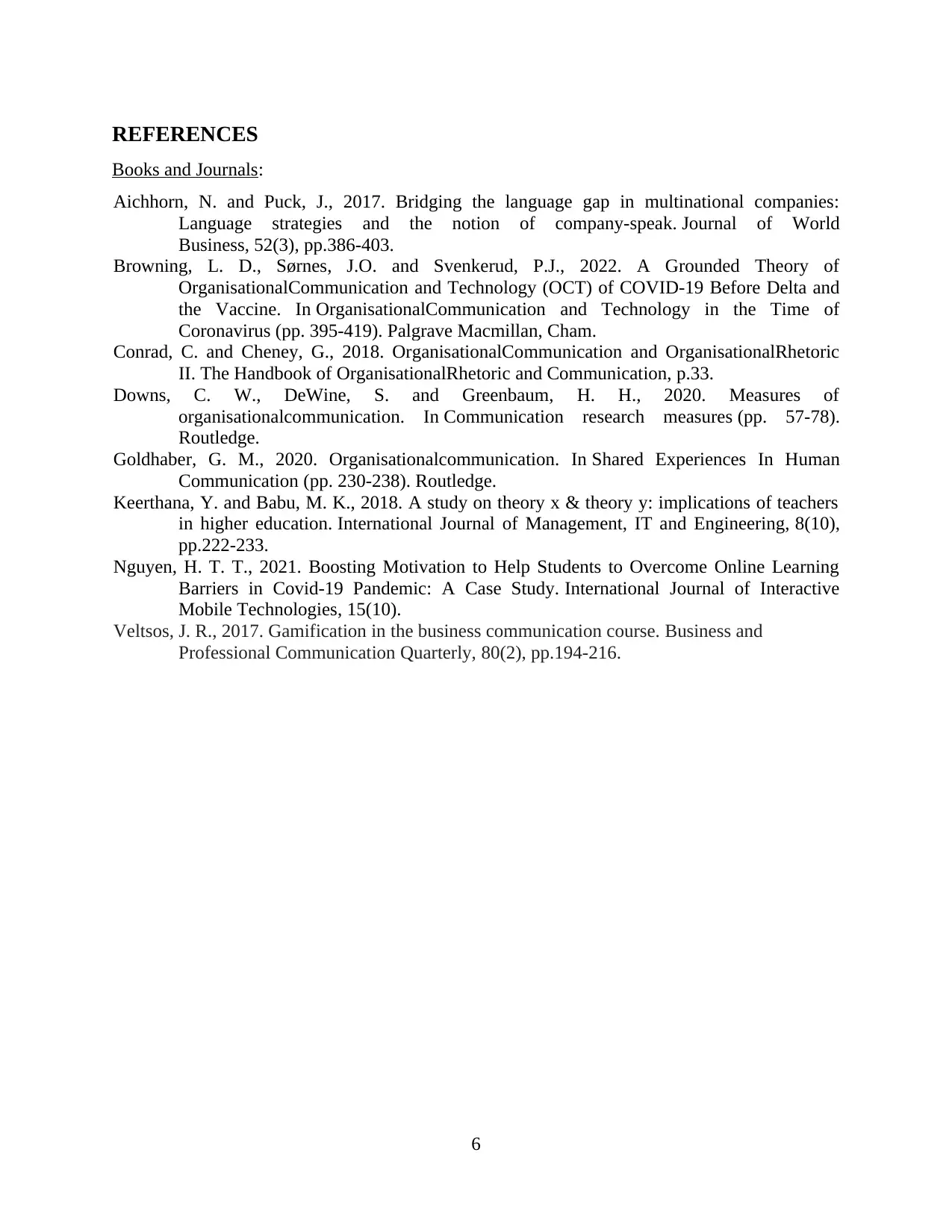
REFERENCES
Books and Journals:
Aichhorn, N. and Puck, J., 2017. Bridging the language gap in multinational companies:
Language strategies and the notion of company-speak. Journal of World
Business, 52(3), pp.386-403.
Browning, L. D., Sørnes, J.O. and Svenkerud, P.J., 2022. A Grounded Theory of
OrganisationalCommunication and Technology (OCT) of COVID-19 Before Delta and
the Vaccine. In OrganisationalCommunication and Technology in the Time of
Coronavirus (pp. 395-419). Palgrave Macmillan, Cham.
Conrad, C. and Cheney, G., 2018. OrganisationalCommunication and OrganisationalRhetoric
II. The Handbook of OrganisationalRhetoric and Communication, p.33.
Downs, C. W., DeWine, S. and Greenbaum, H. H., 2020. Measures of
organisationalcommunication. In Communication research measures (pp. 57-78).
Routledge.
Goldhaber, G. M., 2020. Organisationalcommunication. In Shared Experiences In Human
Communication (pp. 230-238). Routledge.
Keerthana, Y. and Babu, M. K., 2018. A study on theory x & theory y: implications of teachers
in higher education. International Journal of Management, IT and Engineering, 8(10),
pp.222-233.
Nguyen, H. T. T., 2021. Boosting Motivation to Help Students to Overcome Online Learning
Barriers in Covid-19 Pandemic: A Case Study. International Journal of Interactive
Mobile Technologies, 15(10).
Veltsos, J. R., 2017. Gamification in the business communication course. Business and
Professional Communication Quarterly, 80(2), pp.194-216.
6
Books and Journals:
Aichhorn, N. and Puck, J., 2017. Bridging the language gap in multinational companies:
Language strategies and the notion of company-speak. Journal of World
Business, 52(3), pp.386-403.
Browning, L. D., Sørnes, J.O. and Svenkerud, P.J., 2022. A Grounded Theory of
OrganisationalCommunication and Technology (OCT) of COVID-19 Before Delta and
the Vaccine. In OrganisationalCommunication and Technology in the Time of
Coronavirus (pp. 395-419). Palgrave Macmillan, Cham.
Conrad, C. and Cheney, G., 2018. OrganisationalCommunication and OrganisationalRhetoric
II. The Handbook of OrganisationalRhetoric and Communication, p.33.
Downs, C. W., DeWine, S. and Greenbaum, H. H., 2020. Measures of
organisationalcommunication. In Communication research measures (pp. 57-78).
Routledge.
Goldhaber, G. M., 2020. Organisationalcommunication. In Shared Experiences In Human
Communication (pp. 230-238). Routledge.
Keerthana, Y. and Babu, M. K., 2018. A study on theory x & theory y: implications of teachers
in higher education. International Journal of Management, IT and Engineering, 8(10),
pp.222-233.
Nguyen, H. T. T., 2021. Boosting Motivation to Help Students to Overcome Online Learning
Barriers in Covid-19 Pandemic: A Case Study. International Journal of Interactive
Mobile Technologies, 15(10).
Veltsos, J. R., 2017. Gamification in the business communication course. Business and
Professional Communication Quarterly, 80(2), pp.194-216.
6
⊘ This is a preview!⊘
Do you want full access?
Subscribe today to unlock all pages.
Trusted by 1+ million students worldwide

1 out of 9


Related Documents


Your All-in-One AI-Powered Toolkit for Academic Success.
+13062052269
info@desklib.com
Available 24*7 on WhatsApp / Email
![[object Object]](/_next/static/media/star-bottom.7253800d.svg)
Unlock your academic potential
Copyright © 2020–2026 A2Z Services. All Rights Reserved. Developed and managed by ZUCOL.