RMIT Accounting Report: A Reflection on Business Decision-Making
VerifiedAdded on 2023/06/03
|15
|3241
|192
Report
AI Summary
This report reflects on personal decision-making strategies within group activities, evaluating business decision areas and distinguishing between fruitful and poor decisions using balanced scorecard metrics. It covers financial aspects like stock price, profits, and leverage, as well as internal business processes such as contribution margin and inventory costs. Customer-related decisions focus on awareness and SG&A expenses, while learning and growth strategies address employee turnover and productivity. The report also analyzes performance in the COMP-XM Inquirer and Capstone simulations, identifying strengths and weaknesses in business decision-making, personal, organizational, and task management skills, and highlighting improvements made through strategic planning and resource alignment. The student also identifies areas for improvement in quick decision-making and communication.

Reflection 1
Accounting
Accounting

Paraphrase This Document
Need a fresh take? Get an instant paraphrase of this document with our AI Paraphraser
Reflection 2
Table of Contents
Section 1:.........................................................................................................................................3
Section 2: Reflection on lessons from Business-Decision-Making.................................................7
Business decision making strengths and weaknesses..................................................................7
Personal, organizational and task management skills..................................................................9
References......................................................................................................................................11
Appendix........................................................................................................................................13
Table of Contents
Section 1:.........................................................................................................................................3
Section 2: Reflection on lessons from Business-Decision-Making.................................................7
Business decision making strengths and weaknesses..................................................................7
Personal, organizational and task management skills..................................................................9
References......................................................................................................................................11
Appendix........................................................................................................................................13
Reflection 3
Section 1:
The report is developed with an aim to evaluate and reflect the personal decision-making strategy
in the group activities. The report discusses the areas of decision-making in the business and the
type of decisions made in the areas. The decisions which are fruitful and poor were also
distinguished. The evaluation is based on the balanced scorecard metrics from different rounds of
practice. The learning outcome from the group activity is also discussed in the report.
Different decisions were made in the group activity in relation to different aspects of the business
operations. The areas which were discussed majorly included finance, internal process of
business, customer, learning and growth. The finance section included stock price, profits, and
leverage. Out of these sub sections, a consistent score has been maintained in the stock price
section. The classification of variable cost was asked which was answered efficiently. 20% of the
outstanding shares of the company were issued. The brokerage fee was also paid in reasonable
amount. Strategic decisions were made for the issues of the shares as well. In the initial round,
high scores were also achieved in the profit and leverage section. Since the profit and leverage
section score was low a routine for strategic planning was set. The annual planning was aligned
with the long-term goals. In addition to this, quarterly planning was also lined up with the
priorities of the individual as well as that of priorities of the company. The progress was also
reviewed in terms of the alignment with the priority of the company as well as company’s
objective. The focus of the company was also narrowed and more stress is given to the section in
which the company excels. More ideas were explored which can facilitate the company in
increasing the profit of the company. This idea was beneficial in aligning the resources of the
company in a better way. In order to increase the leverage of the company, decision was also
Section 1:
The report is developed with an aim to evaluate and reflect the personal decision-making strategy
in the group activities. The report discusses the areas of decision-making in the business and the
type of decisions made in the areas. The decisions which are fruitful and poor were also
distinguished. The evaluation is based on the balanced scorecard metrics from different rounds of
practice. The learning outcome from the group activity is also discussed in the report.
Different decisions were made in the group activity in relation to different aspects of the business
operations. The areas which were discussed majorly included finance, internal process of
business, customer, learning and growth. The finance section included stock price, profits, and
leverage. Out of these sub sections, a consistent score has been maintained in the stock price
section. The classification of variable cost was asked which was answered efficiently. 20% of the
outstanding shares of the company were issued. The brokerage fee was also paid in reasonable
amount. Strategic decisions were made for the issues of the shares as well. In the initial round,
high scores were also achieved in the profit and leverage section. Since the profit and leverage
section score was low a routine for strategic planning was set. The annual planning was aligned
with the long-term goals. In addition to this, quarterly planning was also lined up with the
priorities of the individual as well as that of priorities of the company. The progress was also
reviewed in terms of the alignment with the priority of the company as well as company’s
objective. The focus of the company was also narrowed and more stress is given to the section in
which the company excels. More ideas were explored which can facilitate the company in
increasing the profit of the company. This idea was beneficial in aligning the resources of the
company in a better way. In order to increase the leverage of the company, decision was also
⊘ This is a preview!⊘
Do you want full access?
Subscribe today to unlock all pages.

Trusted by 1+ million students worldwide
Reflection 4
made to borrow the capital by issuing the securities related to the fixed income (Means, 2017). I
was decided that the money will be borrowed directly from the lender.
In the section of internal business process, the contribution margin and inventory carrying costs
was scored with consistent marks. Good decisions were made in context of setting a profitable
margin in the products offered by the company. For instance, the variable costs were reduces to
increase the profit margin of the company. It was also decided that the product which were not
making much profit will be eliminated. Decision related to inventory management were also
good which an evidence for the consistency in the marks score in internal business process. For
instance, the lead time of the supplier was reduced and software solution can be introduced in the
company for managing the inventory in a better way (Wild, 2017). The other areas such as plant
utilization, days of working capital, and stock-out costs were also scored well but there was no
consistency in it. In order to improve the score on days of working capital, it was decided that the
receivables and inventories will be reduced and supplier debt will be increased. In order to
improve the plant utilization capacity of the company it was decided that more focus will be put
on business expansion with low rate of production. This will provide a better base for the
customers and consistency in business of the company. It was also decided that the capacity will
only be increased according to the demand of the product. There has to be flexibility in the plant
production when demand is fluctuating. In order to improve the consistency in score of stock-
out price it was decided that the inventory will be understood in a better way as the unavailability
of the items can result in the disruption of the sales (Filho et al., 2016). It was also decided that
the process of inventory will be automated as the reorder will be prompted automatically when
the stock is dropped below a specific threshold. It was observed that in the customer category,
the customer awareness and SG&A expenses have maintained a consistent and good score. The
made to borrow the capital by issuing the securities related to the fixed income (Means, 2017). I
was decided that the money will be borrowed directly from the lender.
In the section of internal business process, the contribution margin and inventory carrying costs
was scored with consistent marks. Good decisions were made in context of setting a profitable
margin in the products offered by the company. For instance, the variable costs were reduces to
increase the profit margin of the company. It was also decided that the product which were not
making much profit will be eliminated. Decision related to inventory management were also
good which an evidence for the consistency in the marks score in internal business process. For
instance, the lead time of the supplier was reduced and software solution can be introduced in the
company for managing the inventory in a better way (Wild, 2017). The other areas such as plant
utilization, days of working capital, and stock-out costs were also scored well but there was no
consistency in it. In order to improve the score on days of working capital, it was decided that the
receivables and inventories will be reduced and supplier debt will be increased. In order to
improve the plant utilization capacity of the company it was decided that more focus will be put
on business expansion with low rate of production. This will provide a better base for the
customers and consistency in business of the company. It was also decided that the capacity will
only be increased according to the demand of the product. There has to be flexibility in the plant
production when demand is fluctuating. In order to improve the consistency in score of stock-
out price it was decided that the inventory will be understood in a better way as the unavailability
of the items can result in the disruption of the sales (Filho et al., 2016). It was also decided that
the process of inventory will be automated as the reorder will be prompted automatically when
the stock is dropped below a specific threshold. It was observed that in the customer category,
the customer awareness and SG&A expenses have maintained a consistent and good score. The
Paraphrase This Document
Need a fresh take? Get an instant paraphrase of this document with our AI Paraphraser
Reflection 5
reason behind the consistent score is that the better decisions were made such as the use of
Google’s AdSense and auto ads. Good decisions were also made in context with the SG&A
expense. For instance, it was decided that the office will be subleased which will cut the rent cost
for the company. Moreover, the subscription and membership will be eliminated which are not
feasible. In order to improve the customer buying criteria it was decided that the appearance,
brand, price, and performance will be focused more (Laudon and Laudon, 2015). To improve the
customer accessibility it was decided that content of the website will be made navigable with the
use of keyboard in an order which is logical. In addition to this, it was decided that proper text
alternatives will be included against the images. Moreover, aria-atomic and aria-live attributes
will be added to the website section which will inform the user about the change in any content.
In order to improve the product count it was decided that newsletter will be offer, and opinions
of the customers will be address to increase the customer base. Apart from this, the support
service will also be provided in the excellent quality. Social media promotion will also be done fr
business promotions. In the learning and growth section, it was observed that the TQM Admin
Cost reduction and TQM demand increase were consistent in the scores. In order to improve the
employee turnover rate, it was decided that right people will be hired, competitive benefits and
pay will be offered to employees (Ehrenberg and smith, 2016). In addition to this, flexible
schedules of work will be allowed. To improve the employee productivity, it was decided that
the authority will be delegated. Communications will be made effectively by keeping a strong
focus on goals. Moreover, the employees will be trained for personal and skill development as
well. In order to improve the material reduction rate, it was decided that wastage will be reduced,
unnecessary features of the product will be eliminated, bargaining will be done, and discounts
will be provided for trade time.
reason behind the consistent score is that the better decisions were made such as the use of
Google’s AdSense and auto ads. Good decisions were also made in context with the SG&A
expense. For instance, it was decided that the office will be subleased which will cut the rent cost
for the company. Moreover, the subscription and membership will be eliminated which are not
feasible. In order to improve the customer buying criteria it was decided that the appearance,
brand, price, and performance will be focused more (Laudon and Laudon, 2015). To improve the
customer accessibility it was decided that content of the website will be made navigable with the
use of keyboard in an order which is logical. In addition to this, it was decided that proper text
alternatives will be included against the images. Moreover, aria-atomic and aria-live attributes
will be added to the website section which will inform the user about the change in any content.
In order to improve the product count it was decided that newsletter will be offer, and opinions
of the customers will be address to increase the customer base. Apart from this, the support
service will also be provided in the excellent quality. Social media promotion will also be done fr
business promotions. In the learning and growth section, it was observed that the TQM Admin
Cost reduction and TQM demand increase were consistent in the scores. In order to improve the
employee turnover rate, it was decided that right people will be hired, competitive benefits and
pay will be offered to employees (Ehrenberg and smith, 2016). In addition to this, flexible
schedules of work will be allowed. To improve the employee productivity, it was decided that
the authority will be delegated. Communications will be made effectively by keeping a strong
focus on goals. Moreover, the employees will be trained for personal and skill development as
well. In order to improve the material reduction rate, it was decided that wastage will be reduced,
unnecessary features of the product will be eliminated, bargaining will be done, and discounts
will be provided for trade time.
Reflection 6
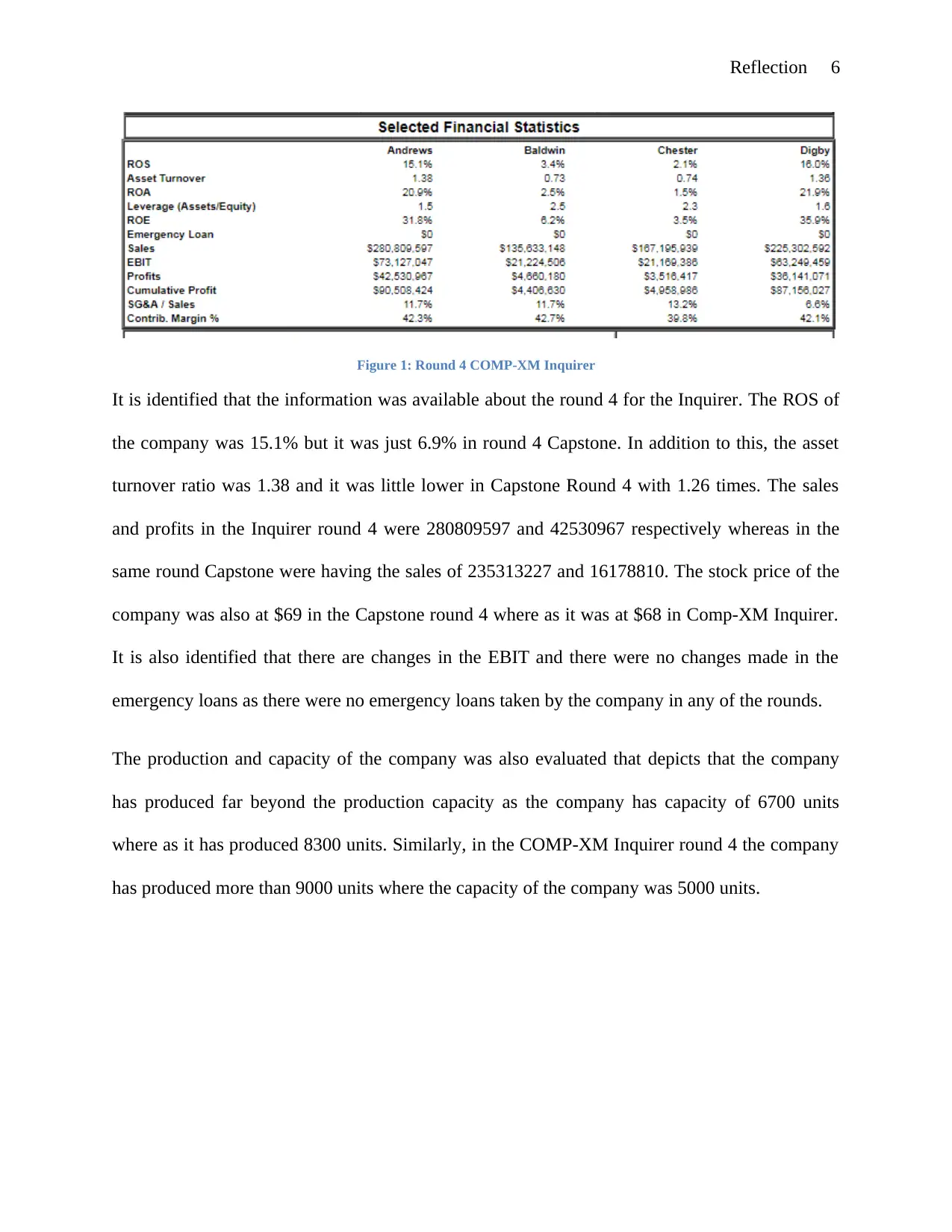
Figure 1: Round 4 COMP-XM Inquirer
It is identified that the information was available about the round 4 for the Inquirer. The ROS of
the company was 15.1% but it was just 6.9% in round 4 Capstone. In addition to this, the asset
turnover ratio was 1.38 and it was little lower in Capstone Round 4 with 1.26 times. The sales
and profits in the Inquirer round 4 were 280809597 and 42530967 respectively whereas in the
same round Capstone were having the sales of 235313227 and 16178810. The stock price of the
company was also at $69 in the Capstone round 4 where as it was at $68 in Comp-XM Inquirer.
It is also identified that there are changes in the EBIT and there were no changes made in the
emergency loans as there were no emergency loans taken by the company in any of the rounds.
The production and capacity of the company was also evaluated that depicts that the company
has produced far beyond the production capacity as the company has capacity of 6700 units
where as it has produced 8300 units. Similarly, in the COMP-XM Inquirer round 4 the company
has produced more than 9000 units where the capacity of the company was 5000 units.
Figure 1: Round 4 COMP-XM Inquirer
It is identified that the information was available about the round 4 for the Inquirer. The ROS of
the company was 15.1% but it was just 6.9% in round 4 Capstone. In addition to this, the asset
turnover ratio was 1.38 and it was little lower in Capstone Round 4 with 1.26 times. The sales
and profits in the Inquirer round 4 were 280809597 and 42530967 respectively whereas in the
same round Capstone were having the sales of 235313227 and 16178810. The stock price of the
company was also at $69 in the Capstone round 4 where as it was at $68 in Comp-XM Inquirer.
It is also identified that there are changes in the EBIT and there were no changes made in the
emergency loans as there were no emergency loans taken by the company in any of the rounds.
The production and capacity of the company was also evaluated that depicts that the company
has produced far beyond the production capacity as the company has capacity of 6700 units
where as it has produced 8300 units. Similarly, in the COMP-XM Inquirer round 4 the company
has produced more than 9000 units where the capacity of the company was 5000 units.
⊘ This is a preview!⊘
Do you want full access?
Subscribe today to unlock all pages.
Trusted by 1+ million students worldwide
Reflection 7
Section 2: Reflection on lessons from Business-Decision-Making
Business decision making strengths and weaknesses
It is not an easy task to take decisions in the changing business environment. I have identified
that the decision making on the various situations in the simulation exercise has become complex
with the further processing on the rounds. During the Comp XM activity, I have to go through
the in-depth study of the statements so that to gain maximum familiarity with the market and the
support the company to take decisions for the purpose of maximized profits and increased sales
(Sullivan and Perry, 2013). In addition to this, I was also supposed to review the current
performance of the round 1. I have faced challenges at the time of the query by the Board this
indicates that I have to work more on the analytical skills and understanding the interpretations
of the various financial decisions that are taken in the companies (Buckley and Ghauri, 2015).
The decisions might be related to the stock prices, increasing the profits, leverage associated with
the financial decision making. At the same time, I have to take decisions for the international
business process and customer related issues similarly there were some decisions that were taken
regarding the learning and growth of the employees and the processes at the organization
(Morato, 2013).
I have also identified that the decision making skills for the activities that are carried out in the
decision scores are comparatively better as the simulation exercise progressed at the later stages.
This indicates the weakness to take quick decisions and analyzing the information for making
specific decision as required. I have also identified some difficulty in communicating with the
team members and at the time of answering the questions relating to the core decisions and
Section 2: Reflection on lessons from Business-Decision-Making
Business decision making strengths and weaknesses
It is not an easy task to take decisions in the changing business environment. I have identified
that the decision making on the various situations in the simulation exercise has become complex
with the further processing on the rounds. During the Comp XM activity, I have to go through
the in-depth study of the statements so that to gain maximum familiarity with the market and the
support the company to take decisions for the purpose of maximized profits and increased sales
(Sullivan and Perry, 2013). In addition to this, I was also supposed to review the current
performance of the round 1. I have faced challenges at the time of the query by the Board this
indicates that I have to work more on the analytical skills and understanding the interpretations
of the various financial decisions that are taken in the companies (Buckley and Ghauri, 2015).
The decisions might be related to the stock prices, increasing the profits, leverage associated with
the financial decision making. At the same time, I have to take decisions for the international
business process and customer related issues similarly there were some decisions that were taken
regarding the learning and growth of the employees and the processes at the organization
(Morato, 2013).
I have also identified that the decision making skills for the activities that are carried out in the
decision scores are comparatively better as the simulation exercise progressed at the later stages.
This indicates the weakness to take quick decisions and analyzing the information for making
specific decision as required. I have also identified some difficulty in communicating with the
team members and at the time of answering the questions relating to the core decisions and
Paraphrase This Document
Need a fresh take? Get an instant paraphrase of this document with our AI Paraphraser
Reflection 8
internal strategic decisions of the company (Braun, Gill, Teal, and Morrison, 2013). I have also
come to know that there is need to analyze the various problems asked by the board members
relating to the policies of HR, customer awareness, and connect them with the performance of
the company for valuable output (CAPSIM, 2018). One more weakness is the problem in
understanding the business environment due to lack of practical exposure and experiencing such
kind of issue for the first time (Morato, 2013). It has lead to identify my strengths relating to
problem solving and analytical skills were enhanced during the simulation exercise as there were
exercises relating to the deep knowledge of the various financial activities from the financial
accounts (CAPSIM, 2018). There was a need to evaluate the profit and loss account, balance-
sheet and cash flows statements. This simulation exercise also help to improve my confidence
which is one of my strength that has lead me to score and perform to such an extent (Braun, et
al., 2013). As per the review of the performance in the various rounds, I observed the
performance at the various heads and tried to develop understanding on the associated heads to
improve the results in the next rounds to overcome the issues and failures in the practice rounds.
The improvements after analyzing the balance score card were identified in the financial fields in
comparison to the Comp XM activity. At the practice rounds the stock price of Andrews was
lower in the first two rounds and it had performed well in the later rounds and was at the top
position in the last 4 rounds. Similarly, in the same trend appears in the stock price and the prices
were improved consistently (Hardoon and Shmueli, 2013). At the same time, the profits of the
company have increase in first two years but decline in the next round the same pattern was
identified at the Comp XM activity where the profits were declined in the round 2 and there were
having continuous improvements in the later years. The analysis of the leverage position of the
internal strategic decisions of the company (Braun, Gill, Teal, and Morrison, 2013). I have also
come to know that there is need to analyze the various problems asked by the board members
relating to the policies of HR, customer awareness, and connect them with the performance of
the company for valuable output (CAPSIM, 2018). One more weakness is the problem in
understanding the business environment due to lack of practical exposure and experiencing such
kind of issue for the first time (Morato, 2013). It has lead to identify my strengths relating to
problem solving and analytical skills were enhanced during the simulation exercise as there were
exercises relating to the deep knowledge of the various financial activities from the financial
accounts (CAPSIM, 2018). There was a need to evaluate the profit and loss account, balance-
sheet and cash flows statements. This simulation exercise also help to improve my confidence
which is one of my strength that has lead me to score and perform to such an extent (Braun, et
al., 2013). As per the review of the performance in the various rounds, I observed the
performance at the various heads and tried to develop understanding on the associated heads to
improve the results in the next rounds to overcome the issues and failures in the practice rounds.
The improvements after analyzing the balance score card were identified in the financial fields in
comparison to the Comp XM activity. At the practice rounds the stock price of Andrews was
lower in the first two rounds and it had performed well in the later rounds and was at the top
position in the last 4 rounds. Similarly, in the same trend appears in the stock price and the prices
were improved consistently (Hardoon and Shmueli, 2013). At the same time, the profits of the
company have increase in first two years but decline in the next round the same pattern was
identified at the Comp XM activity where the profits were declined in the round 2 and there were
having continuous improvements in the later years. The analysis of the leverage position of the
Reflection 9
company indicates that the company has never taken emergency loan and the performance of the
company was consistent indicating the improved performance in Comp XM activity.
Personal, organizational and task management skills
At the time of carrying out the practice rounds and Comp XM activity I have come to know
about the understanding of the importance of time management and planning skills. It is also
needed to understands and evaluate the strategies that are applied by the other competitors for
improvement in the performance. I have identified the importance of financial information and
its interpretation that is useful for various decision making processes (Buckley, and Ghauri,
2015). The use of the analytical skills was important for the purpose of evaluating the internal
business process which includes the identification of the performance as per the cost accounting
and financial accounting (Jones and Alinier, 2015). The profit margins, capacity of the plant and
carrying costs are the important factors that have helped to evaluate the internal manufacturing
capacity and the performance of the organization to utilize the available resources in a significant
manner.
At the same time, for the analysis of the customer segment it will be a need to evaluate the needs
and demands of the customers. In the initial rounds I have faced the issue in understanding the
customer buying criteria, customer awareness, Customer accessibility, SG&A Expense. The
skills required for the accessing the market needs and customers are observation and data
interpretation of the data collected with the help of excel tool that has improved the
understanding and decision making (CAPSTONE, 2018). There is also need of problem solving
skills and these skills were also nourished at the time of dealing with variety of the activities at
single point of time. I have also analyzed the turnover rate of the company, employee
productivity and TQM at the time of carrying out these activities I have to face challenge of
company indicates that the company has never taken emergency loan and the performance of the
company was consistent indicating the improved performance in Comp XM activity.
Personal, organizational and task management skills
At the time of carrying out the practice rounds and Comp XM activity I have come to know
about the understanding of the importance of time management and planning skills. It is also
needed to understands and evaluate the strategies that are applied by the other competitors for
improvement in the performance. I have identified the importance of financial information and
its interpretation that is useful for various decision making processes (Buckley, and Ghauri,
2015). The use of the analytical skills was important for the purpose of evaluating the internal
business process which includes the identification of the performance as per the cost accounting
and financial accounting (Jones and Alinier, 2015). The profit margins, capacity of the plant and
carrying costs are the important factors that have helped to evaluate the internal manufacturing
capacity and the performance of the organization to utilize the available resources in a significant
manner.
At the same time, for the analysis of the customer segment it will be a need to evaluate the needs
and demands of the customers. In the initial rounds I have faced the issue in understanding the
customer buying criteria, customer awareness, Customer accessibility, SG&A Expense. The
skills required for the accessing the market needs and customers are observation and data
interpretation of the data collected with the help of excel tool that has improved the
understanding and decision making (CAPSTONE, 2018). There is also need of problem solving
skills and these skills were also nourished at the time of dealing with variety of the activities at
single point of time. I have also analyzed the turnover rate of the company, employee
productivity and TQM at the time of carrying out these activities I have to face challenge of
⊘ This is a preview!⊘
Do you want full access?
Subscribe today to unlock all pages.
Trusted by 1+ million students worldwide
Reflection 10
understanding the relationship between the employee turnover and employee productivity
(CAPSIM, 2018).
There are issues relating to the analytical skills which remained as issue for me during the entire
simulation exercise and I have faced the challenge to manage the time. The main concern during
the entire exercise was time management there were certain problems that I have failed to
resolve within the time. At the time of working in teams it was easy and comfortable for me deal
with the various situations (Buckley, and Ghauri, 2015). I have also come to know about the
importance of the proper communication and communication skills. For the completion of the
exercises and other activities it was needed to apply management skills and it has resulted to
improve efficiency and effectiveness of working (CAPSIM, 2018). So this simulation exercise
provided me with the practical exposure like dealing with a real life situation and working at
management position. The final round has resulted bring the learning’s about the importance of
the presentation skills and connecting the information gathered from the various events in the
balance scorecard. The skills that were learned during the entire exercise helped will possibly
improve the time management and leadership functions which may be fruitful in the future while
working as an entrepreneur or professional. Besides this, the activity helped me to become
confident to deal with the management related aspects and it has also supported to enhance the
exiting knowledge that I have gained from the books. The exercise has a positive impact on me
as I have scored well and this has resulted to bring confidence and utilization of the skills at the
various circumstances whether it is a simulation exercise or to handle a real life situation in
efficient and effective manner.
understanding the relationship between the employee turnover and employee productivity
(CAPSIM, 2018).
There are issues relating to the analytical skills which remained as issue for me during the entire
simulation exercise and I have faced the challenge to manage the time. The main concern during
the entire exercise was time management there were certain problems that I have failed to
resolve within the time. At the time of working in teams it was easy and comfortable for me deal
with the various situations (Buckley, and Ghauri, 2015). I have also come to know about the
importance of the proper communication and communication skills. For the completion of the
exercises and other activities it was needed to apply management skills and it has resulted to
improve efficiency and effectiveness of working (CAPSIM, 2018). So this simulation exercise
provided me with the practical exposure like dealing with a real life situation and working at
management position. The final round has resulted bring the learning’s about the importance of
the presentation skills and connecting the information gathered from the various events in the
balance scorecard. The skills that were learned during the entire exercise helped will possibly
improve the time management and leadership functions which may be fruitful in the future while
working as an entrepreneur or professional. Besides this, the activity helped me to become
confident to deal with the management related aspects and it has also supported to enhance the
exiting knowledge that I have gained from the books. The exercise has a positive impact on me
as I have scored well and this has resulted to bring confidence and utilization of the skills at the
various circumstances whether it is a simulation exercise or to handle a real life situation in
efficient and effective manner.
Paraphrase This Document
Need a fresh take? Get an instant paraphrase of this document with our AI Paraphraser
Reflection 11
References
Braun, U. K., Gill, A. C., Teal, C. R., and Morrison, L. J. (2013) The utility of reflective writing
after a palliative care experience: can we assess medical students' professionalism?, Journal of
palliative medicine, 16(11), pp. 1342-1349.
Buckley, P.J. and Ghauri, P. (2015) International Business Strategy: Theory and Practice. UK:
Routledge.
CAPSIM, (2018) COMP-XM. [Online]. Available at:
http://ww2.capsim.com/compxm/studentexam/index.cfm?
menuItem=9&PageDescription=StudentRoundReports_new&navigation=SectionNav1&round=2
&contentpage=StudentRoundReportsView_new&compXMExamTemplateKey=14753&studentk
ey=1673796 [Accessed: 11 October 2018].
CAPSTONE, (2018) Performance Analysis. [Online]. Available at:
http://ww3.capsim.com/student/portal/index.cfm?
template=reports.reports.courier_frame_2004&round=0&simid=C99794_161 [Accessed: 11
October 2018].
Ehrenberg, R.G. and Smith, R.S. (2016) Modern labor economics: Theory and public policy.
UK: Routledge.
Filho, M.M., Wanke, P.F. and Correa, H.L. (2016) Fuzzy logic in production sequencing: the
case of a cosmetics manufacturer in Brazil, International Journal of Business Intelligence and
Systems Engineering, 1(1), pp.2-31.
References
Braun, U. K., Gill, A. C., Teal, C. R., and Morrison, L. J. (2013) The utility of reflective writing
after a palliative care experience: can we assess medical students' professionalism?, Journal of
palliative medicine, 16(11), pp. 1342-1349.
Buckley, P.J. and Ghauri, P. (2015) International Business Strategy: Theory and Practice. UK:
Routledge.
CAPSIM, (2018) COMP-XM. [Online]. Available at:
http://ww2.capsim.com/compxm/studentexam/index.cfm?
menuItem=9&PageDescription=StudentRoundReports_new&navigation=SectionNav1&round=2
&contentpage=StudentRoundReportsView_new&compXMExamTemplateKey=14753&studentk
ey=1673796 [Accessed: 11 October 2018].
CAPSTONE, (2018) Performance Analysis. [Online]. Available at:
http://ww3.capsim.com/student/portal/index.cfm?
template=reports.reports.courier_frame_2004&round=0&simid=C99794_161 [Accessed: 11
October 2018].
Ehrenberg, R.G. and Smith, R.S. (2016) Modern labor economics: Theory and public policy.
UK: Routledge.
Filho, M.M., Wanke, P.F. and Correa, H.L. (2016) Fuzzy logic in production sequencing: the
case of a cosmetics manufacturer in Brazil, International Journal of Business Intelligence and
Systems Engineering, 1(1), pp.2-31.
Reflection 12
Hardoon, D. R. and Shmueli, G. (2013) Getting Started with Business Analytics: Insightful
Decision-Making. USA: CRC Press.
Jones, I., and Alinier, G. (2015) Supporting students' learning experiences through a pocket size
cue card designed around a reflective simulation framework, Clinical Simulation in
Nursing, 11(7), pp. 325-334.
Laudon, K.C. and Laudon, J.P. (2015) Management information systems. UK: Prentice Hall.
Means, G. (2017) The modern corporation and private property. UK: Routledge.
Morato, E. A. (2013) Business Decision Making. UK: eBookIt.com.
Sullivan, D. and Perry, G. (2013) Spatial Simulation: Exploring Pattern and Process. USA: John
Wiley and Sons.
Wild, T. (2017) Best practice in inventory management. UK: Routledge.
Hardoon, D. R. and Shmueli, G. (2013) Getting Started with Business Analytics: Insightful
Decision-Making. USA: CRC Press.
Jones, I., and Alinier, G. (2015) Supporting students' learning experiences through a pocket size
cue card designed around a reflective simulation framework, Clinical Simulation in
Nursing, 11(7), pp. 325-334.
Laudon, K.C. and Laudon, J.P. (2015) Management information systems. UK: Prentice Hall.
Means, G. (2017) The modern corporation and private property. UK: Routledge.
Morato, E. A. (2013) Business Decision Making. UK: eBookIt.com.
Sullivan, D. and Perry, G. (2013) Spatial Simulation: Exploring Pattern and Process. USA: John
Wiley and Sons.
Wild, T. (2017) Best practice in inventory management. UK: Routledge.
⊘ This is a preview!⊘
Do you want full access?
Subscribe today to unlock all pages.
Trusted by 1+ million students worldwide

1 out of 15


Related Documents


Your All-in-One AI-Powered Toolkit for Academic Success.
+13062052269
info@desklib.com
Available 24*7 on WhatsApp / Email
![[object Object]](/_next/static/media/star-bottom.7253800d.svg)
Unlock your academic potential
Copyright © 2020–2026 A2Z Services. All Rights Reserved. Developed and managed by ZUCOL.