BMGT 306: Mitre 10 Business Strategy Analysis and Evaluation
VerifiedAdded on 2023/01/16
|16
|4521
|28
Report
AI Summary
This report provides a comprehensive analysis of Mitre 10, a home improvement firm in New Zealand, examining its business strategies within the context of its industry. The report begins with an introduction to Mitre 10, its product offerings, and its competitive landscape, including key competitors like Bunnings. An industrial analysis is conducted at both macro and micro levels, utilizing PESTEL and SWOT analyses to assess the external and internal environments. The PESTEL analysis evaluates political, economic, social, technological, environmental, and legal factors influencing Mitre 10's operations. The SWOT analysis identifies the company's strengths, weaknesses, opportunities, and challenges. The report then delves into Mitre 10's strategic approaches, focusing on integration and differentiation strategies. The integration strategy, particularly forward integration, and the differentiation strategy are explained, highlighting how Mitre 10 aims to gain a competitive advantage. Finally, the report analyzes the company's performance, discusses its successes, and considers potential future strategies, supported by relevant figures and references, and concludes with a summary of key findings and recommendations.
Business strategy
(Mitre 10 New Zealand)
(Mitre 10 New Zealand)

Paraphrase This Document
Need a fresh take? Get an instant paraphrase of this document with our AI Paraphraser
Table of Contents
INTRODUCTION......................................................................................................................1
Industrial analysis.......................................................................................................................1
Macro analysis.......................................................................................................................1
Micro analysis........................................................................................................................3
Strategies....................................................................................................................................4
Integration:.............................................................................................................................4
Differentiation strategy..........................................................................................................5
Analysis and Discussion............................................................................................................6
Conclusion..................................................................................................................................8
References................................................................................................................................10
Appendix..................................................................................................................................13
INTRODUCTION......................................................................................................................1
Industrial analysis.......................................................................................................................1
Macro analysis.......................................................................................................................1
Micro analysis........................................................................................................................3
Strategies....................................................................................................................................4
Integration:.............................................................................................................................4
Differentiation strategy..........................................................................................................5
Analysis and Discussion............................................................................................................6
Conclusion..................................................................................................................................8
References................................................................................................................................10
Appendix..................................................................................................................................13
List of figures
Figure 1: Sales of company in NZ.............................................................................................4
Figure 2: Sales of Mitre 10.........................................................................................................9
Figure 3: Integration business strategy......................................................................................9
Figure 1: Sales of company in NZ.............................................................................................4
Figure 2: Sales of Mitre 10.........................................................................................................9
Figure 3: Integration business strategy......................................................................................9
⊘ This is a preview!⊘
Do you want full access?
Subscribe today to unlock all pages.

Trusted by 1+ million students worldwide
INTRODUCTION
The formation of business strategies is a core function of every company to make
tactical decisions which can aid in surviving competition. There can be various strategies for
each task which is required to be structured in well manner so as to get outcomes. The current
report is based on discussing business strategies for which a company has been selected as
well. The Mitre 10 is a home improvement firm based in New Zealand providing its services
since 1974. The products like hardware, flooring and tiling materials, paints and decoration,
kitchen appliances furniture etc. are available in its outlets and online stores. The said
business ownership has more than 80 stores that are run by local operators as a co-operative
store (Bocken & et.al., 2016). The concept of this company was originally evolved in
Melbourne, Australia where team of 8 members pooled their varied resources for promotions
and advertisements. Gradually, separate ownerships formed and in 1964, it attained its
existence as fully licensed enterprise. Through its excellent services, the organisation has
been awarded as the most trusted brand as well.
The Mitre 10 operates in a competitive environment where it holds the market leader
position with 164 stores. The major competitor Bunnings gives a tough competition to the
brand and has various future plans to beat it in the market. The entity has made record sales
of $1.04 billion in 2015 which shows its smooth financial position (Strang, 2015). Moreover,
the products of home improvement and garden retails help in makeover of the houses. The
present report will make an industry analysis on both macro and micro level. Besides this, the
foremost strategies of integration and cost leadership which acts as a competitive advantage
for organisation will be discussed. Based on this, the analysis of firm’s position will be
discussed and future strategies can be looked upon.
Industrial analysis
Macro analysis
The macro analysis of any industry can be executed by applying various models like
Pestel analysis, Porter’s five force model etc.( Baumgartner & Ebner, 2010). In context of
Mitre 10, the PESTEL analysis will help to examine the overall business environment of New
Zealand where it operates.
1
The formation of business strategies is a core function of every company to make
tactical decisions which can aid in surviving competition. There can be various strategies for
each task which is required to be structured in well manner so as to get outcomes. The current
report is based on discussing business strategies for which a company has been selected as
well. The Mitre 10 is a home improvement firm based in New Zealand providing its services
since 1974. The products like hardware, flooring and tiling materials, paints and decoration,
kitchen appliances furniture etc. are available in its outlets and online stores. The said
business ownership has more than 80 stores that are run by local operators as a co-operative
store (Bocken & et.al., 2016). The concept of this company was originally evolved in
Melbourne, Australia where team of 8 members pooled their varied resources for promotions
and advertisements. Gradually, separate ownerships formed and in 1964, it attained its
existence as fully licensed enterprise. Through its excellent services, the organisation has
been awarded as the most trusted brand as well.
The Mitre 10 operates in a competitive environment where it holds the market leader
position with 164 stores. The major competitor Bunnings gives a tough competition to the
brand and has various future plans to beat it in the market. The entity has made record sales
of $1.04 billion in 2015 which shows its smooth financial position (Strang, 2015). Moreover,
the products of home improvement and garden retails help in makeover of the houses. The
present report will make an industry analysis on both macro and micro level. Besides this, the
foremost strategies of integration and cost leadership which acts as a competitive advantage
for organisation will be discussed. Based on this, the analysis of firm’s position will be
discussed and future strategies can be looked upon.
Industrial analysis
Macro analysis
The macro analysis of any industry can be executed by applying various models like
Pestel analysis, Porter’s five force model etc.( Baumgartner & Ebner, 2010). In context of
Mitre 10, the PESTEL analysis will help to examine the overall business environment of New
Zealand where it operates.
1
Paraphrase This Document
Need a fresh take? Get an instant paraphrase of this document with our AI Paraphraser
Political factor: The political environment of New Zealand is quite stable where
government changes after every 3 years. The lending rates of the country are higher
which results in greater payment of taxes to the government. Besides this, the
government allows business freedom to the companies which make it easier to
establish business in the country (Smith, Binns & Tushman, 2010). Therefore,
competition for the organisations becomes more intense for Mitre 10. Said business
has to pay large amount of taxes which makes the profit ratio comparatively low in
the country. However, the stability in the political atmosphere helps in running
business without any pressures.
Economical: The economical situation of the country is very sound which states its
high per capita income. Due to this, the purchasing power of people is higher in the
nation which simultaneously states their higher standard of living (Song, Sun, & Jin,
2017). Besides this, many people like to spend their money on decorating their homes
and purchasing various kinds of stuff for their homes occasionally. Thus, the said
organisation can effectively target their customers to buy various home wares,
furniture and other supplies to get volume sales.
Social factors: The social environment of the country is highly attractive where issues
like unemployment, low literacy rate and other social issues do not exist (Yüksel,
2012). Besides this, a large amount of population resides in the urban areas because of
which the access of various supplies becomes easier for them. The people living in
urban areas mostly require hardware products like furniture, kitchen appliances, paints
and garden retails etc. which can be easily channelled to the customers. Thus, the
Mitre 10 can serve a large amount of customer segment in the country (Issa, Chang &
Issa, 2010).
Technological factors: The technological development in the New Zealand is
commendable. The introduction of internet and IT techniques are excessive in both
urban and rural areas because of which the access of various internet services is high.
Literacy rate is also 100% which has made it easier for people to access the internet
service. The mentioned enterprise sells its products online as well as through physical
outlets. This make easier for the consumers to access various services of the firm
online (Kauškale & Geipele, 2017).
Environmental factors: The country is highly concerned for the issues of environment
like pollution, deforestation, global warming etc. Therefore, it is required by the
2
government changes after every 3 years. The lending rates of the country are higher
which results in greater payment of taxes to the government. Besides this, the
government allows business freedom to the companies which make it easier to
establish business in the country (Smith, Binns & Tushman, 2010). Therefore,
competition for the organisations becomes more intense for Mitre 10. Said business
has to pay large amount of taxes which makes the profit ratio comparatively low in
the country. However, the stability in the political atmosphere helps in running
business without any pressures.
Economical: The economical situation of the country is very sound which states its
high per capita income. Due to this, the purchasing power of people is higher in the
nation which simultaneously states their higher standard of living (Song, Sun, & Jin,
2017). Besides this, many people like to spend their money on decorating their homes
and purchasing various kinds of stuff for their homes occasionally. Thus, the said
organisation can effectively target their customers to buy various home wares,
furniture and other supplies to get volume sales.
Social factors: The social environment of the country is highly attractive where issues
like unemployment, low literacy rate and other social issues do not exist (Yüksel,
2012). Besides this, a large amount of population resides in the urban areas because of
which the access of various supplies becomes easier for them. The people living in
urban areas mostly require hardware products like furniture, kitchen appliances, paints
and garden retails etc. which can be easily channelled to the customers. Thus, the
Mitre 10 can serve a large amount of customer segment in the country (Issa, Chang &
Issa, 2010).
Technological factors: The technological development in the New Zealand is
commendable. The introduction of internet and IT techniques are excessive in both
urban and rural areas because of which the access of various internet services is high.
Literacy rate is also 100% which has made it easier for people to access the internet
service. The mentioned enterprise sells its products online as well as through physical
outlets. This make easier for the consumers to access various services of the firm
online (Kauškale & Geipele, 2017).
Environmental factors: The country is highly concerned for the issues of environment
like pollution, deforestation, global warming etc. Therefore, it is required by the
2
aforesaid company to follow all the required principles regarding environment
protection to safeguard the laws related to environment while doing business.
Legal factors: The international companies have the advantageous position in the
country who are welcomed here to do the business (E. Dobbs, 2014). It strikes a tough
competition for Mitre 10 as many organisations based on hardware and building
supplies are going to establish here. Further, the legal compliances and norms of the
country are strict which should be followed by every company.
Micro analysis
The Micro analysis of the industry can be carried out in the form of SWOT analysis
which is as follows:
Strength: The Mitre 10 holds a strong position in the market through its extensive
services which has made it the most trusted brand of the country. This allows a highly
strong position of the firm in the sector of home ware and building supplies because
of which it becomes difficult for the rival firms to enter in the industry (Mihet, 2013).
Moreover, the cost leadership strategy gives competitive advantage to the enterprise
which has its positive impact on sales volume and financial figures.
Weaknesses: The said organisation works as a cooperative store within New Zealand
with more than 80 stores. The company does not have its wide operations in other
countries which make its market share concentrated in the single nation. Therefore,
firm needs to expand its operations to face the fierce competition in the sector
properly (Issa, Chang & Issa, 2010).
Opportunities: The Mitre 10 has flourishing opportunities to expand its operations in
diverse countries because it has been recognised as a most trusted brand in New
Zealand. Hence to expand its operations in other countries will be a highly attractive
opportunity to develop business.
Challenges: Due to increasing trend of online shopping among consumers, the stated
venture has to face a challenging situation in meeting their needs (Yüksel, 2012).
Further, consumers are usually not ready to buy building supplies and home
improvement products without seeing it on stores first. Therefore, there are various
challenges in front of Mitre 10 to meet diverse needs of the users
3
protection to safeguard the laws related to environment while doing business.
Legal factors: The international companies have the advantageous position in the
country who are welcomed here to do the business (E. Dobbs, 2014). It strikes a tough
competition for Mitre 10 as many organisations based on hardware and building
supplies are going to establish here. Further, the legal compliances and norms of the
country are strict which should be followed by every company.
Micro analysis
The Micro analysis of the industry can be carried out in the form of SWOT analysis
which is as follows:
Strength: The Mitre 10 holds a strong position in the market through its extensive
services which has made it the most trusted brand of the country. This allows a highly
strong position of the firm in the sector of home ware and building supplies because
of which it becomes difficult for the rival firms to enter in the industry (Mihet, 2013).
Moreover, the cost leadership strategy gives competitive advantage to the enterprise
which has its positive impact on sales volume and financial figures.
Weaknesses: The said organisation works as a cooperative store within New Zealand
with more than 80 stores. The company does not have its wide operations in other
countries which make its market share concentrated in the single nation. Therefore,
firm needs to expand its operations to face the fierce competition in the sector
properly (Issa, Chang & Issa, 2010).
Opportunities: The Mitre 10 has flourishing opportunities to expand its operations in
diverse countries because it has been recognised as a most trusted brand in New
Zealand. Hence to expand its operations in other countries will be a highly attractive
opportunity to develop business.
Challenges: Due to increasing trend of online shopping among consumers, the stated
venture has to face a challenging situation in meeting their needs (Yüksel, 2012).
Further, consumers are usually not ready to buy building supplies and home
improvement products without seeing it on stores first. Therefore, there are various
challenges in front of Mitre 10 to meet diverse needs of the users
3
⊘ This is a preview!⊘
Do you want full access?
Subscribe today to unlock all pages.
Trusted by 1+ million students worldwide
Strategies
The business strategies of an organization havea direct impact on the business
outcome and performance in the market. Mitre 10 is leading retail and building supplier of
New Zealand that offering high-quality products and services to the customer. To gain a
competitive advantage and maintain the growth of the business, the management of Mitre 10
has adopted the following strategies:
Integration:
The growth strategy of Mitre 10 is based on vertical integration that helping the
management to focus on both the current needs of the customer and future demand. The value
networking and proper analysis of market factors are having a positive impact on the business
of Mitre 10 and allowing the organization to manage the operational activities as per the
internal capabilities and availability of the resources. As per the analysis, Mitre 10
management is giving preference to the forward integration strategy for growth and
management of the operations. The forward integration is helping the organization to
concentrate on the outcome and demand of the customer in the current market and
distributing the products accordingly (Thompson, Strickland, & Gamble, 2015). However,
this strategic move requires prior forecasting of the demand for products and expectations of
the customer. The management of Mitre 10 is good at analyzing the demand and features that
could help to influence the decisions of the customers. Therefore, a growth strategy that is
followed by the Mitre 10 is good and helping to manage the present and future outputs.
In addition to this, the implementation of vertical integration strategy is allowing the
organization to improve understanding of the needs and expectation of local and international
customers and design and development of products and services by focusing on the needs and
wants of the customer from different locations. To understand the customer needs, the
management is conducting a market survey, collecting feedback from customers who visit the
stores and interact through the website or other online methods (Akter et al., 2016). This kind
of approach is helping the organization to improve the value proposition, maintain the
balance in international and domestic choices of the customer. Apart from that, by developing
the long term contracts with the suppliers and distributors from the local and international
market, the Mitre 10 management is maintaining the growth in the competitive market (Cox,
2016). The strategic operation of Mitre 10 is also helping to become successful as
management has a flexible approach in production to respond to the demand of the
4
The business strategies of an organization havea direct impact on the business
outcome and performance in the market. Mitre 10 is leading retail and building supplier of
New Zealand that offering high-quality products and services to the customer. To gain a
competitive advantage and maintain the growth of the business, the management of Mitre 10
has adopted the following strategies:
Integration:
The growth strategy of Mitre 10 is based on vertical integration that helping the
management to focus on both the current needs of the customer and future demand. The value
networking and proper analysis of market factors are having a positive impact on the business
of Mitre 10 and allowing the organization to manage the operational activities as per the
internal capabilities and availability of the resources. As per the analysis, Mitre 10
management is giving preference to the forward integration strategy for growth and
management of the operations. The forward integration is helping the organization to
concentrate on the outcome and demand of the customer in the current market and
distributing the products accordingly (Thompson, Strickland, & Gamble, 2015). However,
this strategic move requires prior forecasting of the demand for products and expectations of
the customer. The management of Mitre 10 is good at analyzing the demand and features that
could help to influence the decisions of the customers. Therefore, a growth strategy that is
followed by the Mitre 10 is good and helping to manage the present and future outputs.
In addition to this, the implementation of vertical integration strategy is allowing the
organization to improve understanding of the needs and expectation of local and international
customers and design and development of products and services by focusing on the needs and
wants of the customer from different locations. To understand the customer needs, the
management is conducting a market survey, collecting feedback from customers who visit the
stores and interact through the website or other online methods (Akter et al., 2016). This kind
of approach is helping the organization to improve the value proposition, maintain the
balance in international and domestic choices of the customer. Apart from that, by developing
the long term contracts with the suppliers and distributors from the local and international
market, the Mitre 10 management is maintaining the growth in the competitive market (Cox,
2016). The strategic operation of Mitre 10 is also helping to become successful as
management has a flexible approach in production to respond to the demand of the
4
Paraphrase This Document
Need a fresh take? Get an instant paraphrase of this document with our AI Paraphraser
customers. According to analysis, the Mitre 10 is maintaining a flexible approach that helping
reduce the lead time, adopt the changes related to prices and quality of the products. In
addition to this, the customization of services is also helping the organization to gain
competitive advantage (Higgins,Omer, & Phillips, 2015).
Differentiation strategy
For a retail organization, it is essential to differentiate the products and services from
other similar products offered by the competitors. Mitre 10 is offering retail and building
supply services that are also offered by the competitors in the market of New Zealand. By
implementing the differentiation strategy, the management of the company is trying to offer
values to the customers (Davcik, & Sharma, 2015). The basic changes that made by the
company in products and services through this strategy involve design and marketing of the
products, changes in the prices of the products and services and set a positive brand image by
publishing the reviews of the customers and suppliers (Razak et al., 2016). The product
differentiation is allowing the organization to get the edge over the competitors as Mitre 10 is
offering innovative products to its customer by developing the advanced kitchen and
bathroom product. For example, the hand and power tools of the company are having touch
sensing functions that help the users to use it more comfortably without risks. In addition to
this, the heater with Wi-Fi functions is also differentiating the organization from the
competitors and supporting to engage the customers and gain the competitive advantage
(Zehir, Can, & Karaboga, 2015).
According to analysis, the financial aspect of Mitre 10 is very strong and having a
positive impact on strategic planning and implementation of immediate changes in the
products and services in a specific location. This resource is helping the organization to
establish equipment, customer relationship system and ensuring that demand of the market
can be satisfied effectively. In addition to this, the prior identification of resources to meet the
requirements, current strategic positioning of the company in a specific market like New
Zealand through the identification of opportunities is also helping to implement the changes
in prices of the products to gain competitive advantage. The cost minimization in production
is also helping to eliminate the extra cost and set the lower prices of the products and services
to compare to the other organization (Yuliansyah, Gurd, & Mohamed, 2017). The economic
scale plays a critical role in planning and earning a higher profit in the competitive market
like New Zealand. By implementing the differentiation strategy that involves minimization of
5
reduce the lead time, adopt the changes related to prices and quality of the products. In
addition to this, the customization of services is also helping the organization to gain
competitive advantage (Higgins,Omer, & Phillips, 2015).
Differentiation strategy
For a retail organization, it is essential to differentiate the products and services from
other similar products offered by the competitors. Mitre 10 is offering retail and building
supply services that are also offered by the competitors in the market of New Zealand. By
implementing the differentiation strategy, the management of the company is trying to offer
values to the customers (Davcik, & Sharma, 2015). The basic changes that made by the
company in products and services through this strategy involve design and marketing of the
products, changes in the prices of the products and services and set a positive brand image by
publishing the reviews of the customers and suppliers (Razak et al., 2016). The product
differentiation is allowing the organization to get the edge over the competitors as Mitre 10 is
offering innovative products to its customer by developing the advanced kitchen and
bathroom product. For example, the hand and power tools of the company are having touch
sensing functions that help the users to use it more comfortably without risks. In addition to
this, the heater with Wi-Fi functions is also differentiating the organization from the
competitors and supporting to engage the customers and gain the competitive advantage
(Zehir, Can, & Karaboga, 2015).
According to analysis, the financial aspect of Mitre 10 is very strong and having a
positive impact on strategic planning and implementation of immediate changes in the
products and services in a specific location. This resource is helping the organization to
establish equipment, customer relationship system and ensuring that demand of the market
can be satisfied effectively. In addition to this, the prior identification of resources to meet the
requirements, current strategic positioning of the company in a specific market like New
Zealand through the identification of opportunities is also helping to implement the changes
in prices of the products to gain competitive advantage. The cost minimization in production
is also helping to eliminate the extra cost and set the lower prices of the products and services
to compare to the other organization (Yuliansyah, Gurd, & Mohamed, 2017). The economic
scale plays a critical role in planning and earning a higher profit in the competitive market
like New Zealand. By implementing the differentiation strategy that involves minimization of
5
operating cost by controlling the cost of raw material, production, transportation and
distribution to the stores Mitre 10 maintain the growth in the industry. The management is
outsourcing and assembling the product considering the quality standards of different
locations that also allows the organization to set differentiates prices of the products
(Leonidou et al., 2015). This kind of approach is helping Mitre 10 to maintain low cost that
supports the improvement of profit.
Analysis and Discussion
The business of Mitre 10 New Zealand is good and management is earning good
profit by implementing changes in the product and strategies at the right time. According to
the analysis of the current business approach of the company, it is carried out that dual
investment strategy of the company brings growth for Mitre 10. The organizational
performance in New Zealand is strong as the group has generated revenue of $1.364 billion
which was 9.8% higher than the 2016 (Parsons, & Wilkinson, 2015). The positive results of
the company reflect that customers are giving preference to products and services of Mitre 10
after the decline in the economic growth of the country. The dual investment approach of
business that offering opportunity for the customer to purchase and trade through an online
platform to earn a profit is helping to maintain the long-term relationship with the customers.
The existing members of the company are continuously investing in their stores and
management is helping them to create value through investment (Mitre 10 Post 38% gain in
profit, 2018). Apart from that, the customer-centric products and services are increasing the
in-store experience of the customers in contributing to the growth of the organization.
Mitre 10’s online sales grew 48% compared to last year and the company has added
7000 unities to the stock toimprove the range of online products. The online business process
of the company is also helping to maintain a relationship with the customers as they can share
their ideas and provide feedback for lacking in the services, quality and delivery of the
products and services. For example, the kitchen showroom rollout has increased the sales of
the company in 2017 and now the organization is planning to rollout the bathroom
showrooms.According to analysis, it is also considered that building supplies are one of the
major contributorsto Mitre 10’s growth and support to increase the financial growth of the
organization. The concept of direct-to-site sales is influencing the decision of customers and
enhancing the demand for Mitre 10's products in the construction sector. In addition to this,
the market growth of the company in the Q4 of 2017 was 38% as the demand for the seasonal
6
distribution to the stores Mitre 10 maintain the growth in the industry. The management is
outsourcing and assembling the product considering the quality standards of different
locations that also allows the organization to set differentiates prices of the products
(Leonidou et al., 2015). This kind of approach is helping Mitre 10 to maintain low cost that
supports the improvement of profit.
Analysis and Discussion
The business of Mitre 10 New Zealand is good and management is earning good
profit by implementing changes in the product and strategies at the right time. According to
the analysis of the current business approach of the company, it is carried out that dual
investment strategy of the company brings growth for Mitre 10. The organizational
performance in New Zealand is strong as the group has generated revenue of $1.364 billion
which was 9.8% higher than the 2016 (Parsons, & Wilkinson, 2015). The positive results of
the company reflect that customers are giving preference to products and services of Mitre 10
after the decline in the economic growth of the country. The dual investment approach of
business that offering opportunity for the customer to purchase and trade through an online
platform to earn a profit is helping to maintain the long-term relationship with the customers.
The existing members of the company are continuously investing in their stores and
management is helping them to create value through investment (Mitre 10 Post 38% gain in
profit, 2018). Apart from that, the customer-centric products and services are increasing the
in-store experience of the customers in contributing to the growth of the organization.
Mitre 10’s online sales grew 48% compared to last year and the company has added
7000 unities to the stock toimprove the range of online products. The online business process
of the company is also helping to maintain a relationship with the customers as they can share
their ideas and provide feedback for lacking in the services, quality and delivery of the
products and services. For example, the kitchen showroom rollout has increased the sales of
the company in 2017 and now the organization is planning to rollout the bathroom
showrooms.According to analysis, it is also considered that building supplies are one of the
major contributorsto Mitre 10’s growth and support to increase the financial growth of the
organization. The concept of direct-to-site sales is influencing the decision of customers and
enhancing the demand for Mitre 10's products in the construction sector. In addition to this,
the market growth of the company in the Q4 of 2017 was 38% as the demand for the seasonal
6
⊘ This is a preview!⊘
Do you want full access?
Subscribe today to unlock all pages.
Trusted by 1+ million students worldwide
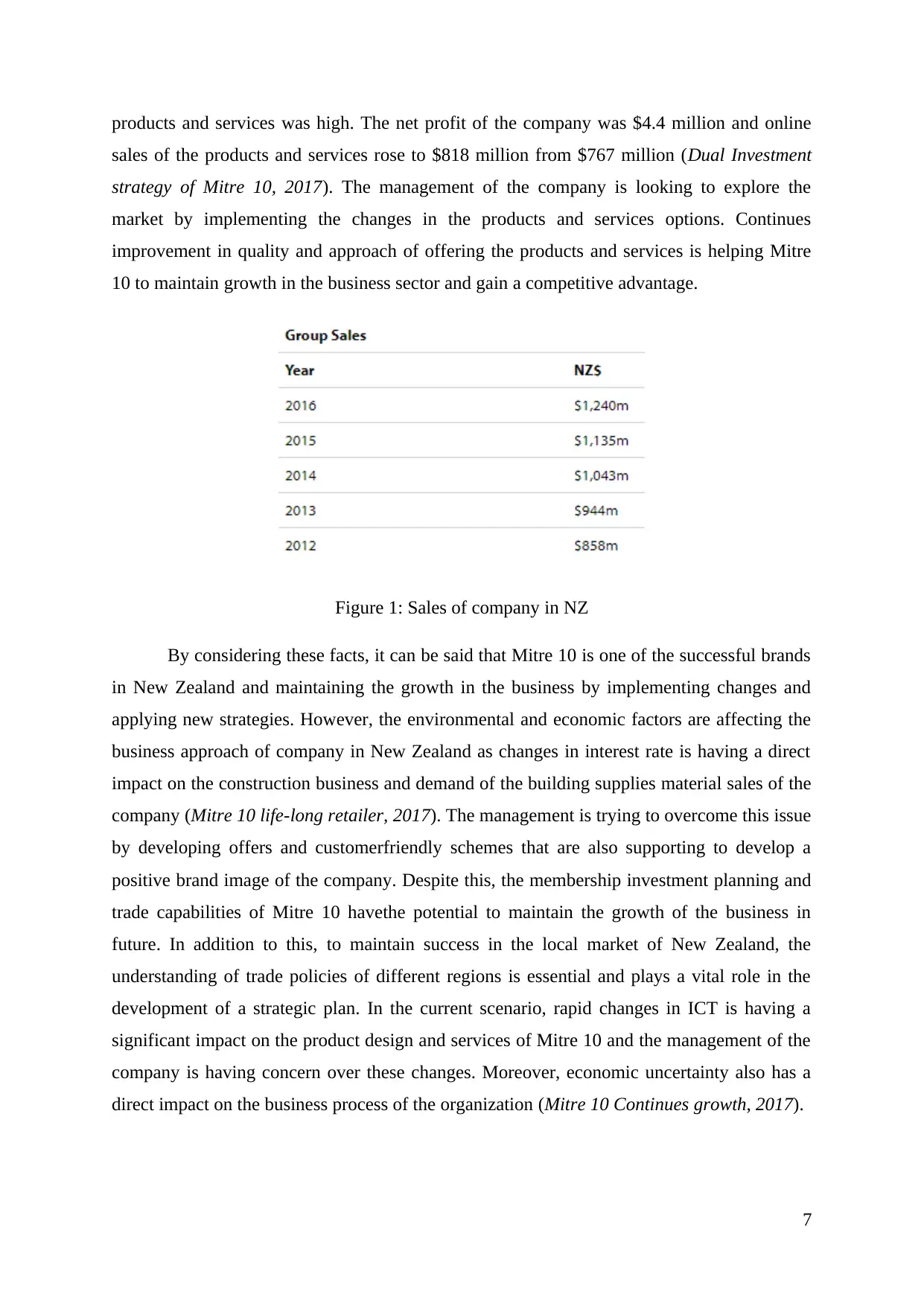
products and services was high. The net profit of the company was $4.4 million and online
sales of the products and services rose to $818 million from $767 million (Dual Investment
strategy of Mitre 10, 2017). The management of the company is looking to explore the
market by implementing the changes in the products and services options. Continues
improvement in quality and approach of offering the products and services is helping Mitre
10 to maintain growth in the business sector and gain a competitive advantage.
Figure 1: Sales of company in NZ
By considering these facts, it can be said that Mitre 10 is one of the successful brands
in New Zealand and maintaining the growth in the business by implementing changes and
applying new strategies. However, the environmental and economic factors are affecting the
business approach of company in New Zealand as changes in interest rate is having a direct
impact on the construction business and demand of the building supplies material sales of the
company (Mitre 10 life-long retailer, 2017). The management is trying to overcome this issue
by developing offers and customerfriendly schemes that are also supporting to develop a
positive brand image of the company. Despite this, the membership investment planning and
trade capabilities of Mitre 10 havethe potential to maintain the growth of the business in
future. In addition to this, to maintain success in the local market of New Zealand, the
understanding of trade policies of different regions is essential and plays a vital role in the
development of a strategic plan. In the current scenario, rapid changes in ICT is having a
significant impact on the product design and services of Mitre 10 and the management of the
company is having concern over these changes. Moreover, economic uncertainty also has a
direct impact on the business process of the organization (Mitre 10 Continues growth, 2017).
7
sales of the products and services rose to $818 million from $767 million (Dual Investment
strategy of Mitre 10, 2017). The management of the company is looking to explore the
market by implementing the changes in the products and services options. Continues
improvement in quality and approach of offering the products and services is helping Mitre
10 to maintain growth in the business sector and gain a competitive advantage.
Figure 1: Sales of company in NZ
By considering these facts, it can be said that Mitre 10 is one of the successful brands
in New Zealand and maintaining the growth in the business by implementing changes and
applying new strategies. However, the environmental and economic factors are affecting the
business approach of company in New Zealand as changes in interest rate is having a direct
impact on the construction business and demand of the building supplies material sales of the
company (Mitre 10 life-long retailer, 2017). The management is trying to overcome this issue
by developing offers and customerfriendly schemes that are also supporting to develop a
positive brand image of the company. Despite this, the membership investment planning and
trade capabilities of Mitre 10 havethe potential to maintain the growth of the business in
future. In addition to this, to maintain success in the local market of New Zealand, the
understanding of trade policies of different regions is essential and plays a vital role in the
development of a strategic plan. In the current scenario, rapid changes in ICT is having a
significant impact on the product design and services of Mitre 10 and the management of the
company is having concern over these changes. Moreover, economic uncertainty also has a
direct impact on the business process of the organization (Mitre 10 Continues growth, 2017).
7
Paraphrase This Document
Need a fresh take? Get an instant paraphrase of this document with our AI Paraphraser
The critical analysis of organizational business and approach to maintaining success is
lacking in the sustainable approach that could give long-term profitability for Mitre 10. The
company is not increasing numbers of stores across the country and making high concern
over the online business which is less effective and will have a negative impact in terms of
lack of customer interaction. The competitors are taking more initiatives towardsphysical
appearance and direct marketing to customer related to building material products. This kind
of business approach will influence the existing customer base of the Mitre 10 and hinder the
market sales opportunities (Reiners et al., 2015). The marketing and online promotion will
not work for the company as a product offering and policies of the competitor organizations
are involving the digital function along with the development of the physical stores in New
Zealand.
Now, it can be considered through analysis of current approach and management
planning of Mitre 10 that company is heavily relying on the online performance after 2016
and looking to engage the customer through website, email and video streaming. Thesekinds
of business development strategic approaches are helping to create awareness in the market
of New Zealand. The strategic operation of Mitre 10 is also helping to become successful as
management has a flexible approach in production to respond to the demand of the
customers. According to analysis, the Mitre 10 is maintaining a flexible approach that helping
reduce the lead time, adopt the changes related to prices and quality of the products. In
addition to this, the customization of services is also helping the organization to gain
competitive advantage.
Conclusion
The report has analyzed the business strategies used by the management of Mitre 10
that involve consideration of vertical integration in market, products and price differentiation.
These strategies are helping the organization to gain competitive advantage and meet the
business objectives more comprehensive manner. Moreover, the report has analysed the
current business approach and performance of Mitre 10 and provided a critical discussion
over the success of the company in the competitive market of New Zealand. The PESTEL
analysis of the said business reveals that New Zealand has a favourable environment for
Mitre 10 which provides lots of opportunities to reap good profits. However, the competition
is expected to be high due to favourable environment to do business in the country. Besides
this, the SWOT analysis states that there are opportunities to develop business in other
8
lacking in the sustainable approach that could give long-term profitability for Mitre 10. The
company is not increasing numbers of stores across the country and making high concern
over the online business which is less effective and will have a negative impact in terms of
lack of customer interaction. The competitors are taking more initiatives towardsphysical
appearance and direct marketing to customer related to building material products. This kind
of business approach will influence the existing customer base of the Mitre 10 and hinder the
market sales opportunities (Reiners et al., 2015). The marketing and online promotion will
not work for the company as a product offering and policies of the competitor organizations
are involving the digital function along with the development of the physical stores in New
Zealand.
Now, it can be considered through analysis of current approach and management
planning of Mitre 10 that company is heavily relying on the online performance after 2016
and looking to engage the customer through website, email and video streaming. Thesekinds
of business development strategic approaches are helping to create awareness in the market
of New Zealand. The strategic operation of Mitre 10 is also helping to become successful as
management has a flexible approach in production to respond to the demand of the
customers. According to analysis, the Mitre 10 is maintaining a flexible approach that helping
reduce the lead time, adopt the changes related to prices and quality of the products. In
addition to this, the customization of services is also helping the organization to gain
competitive advantage.
Conclusion
The report has analyzed the business strategies used by the management of Mitre 10
that involve consideration of vertical integration in market, products and price differentiation.
These strategies are helping the organization to gain competitive advantage and meet the
business objectives more comprehensive manner. Moreover, the report has analysed the
current business approach and performance of Mitre 10 and provided a critical discussion
over the success of the company in the competitive market of New Zealand. The PESTEL
analysis of the said business reveals that New Zealand has a favourable environment for
Mitre 10 which provides lots of opportunities to reap good profits. However, the competition
is expected to be high due to favourable environment to do business in the country. Besides
this, the SWOT analysis states that there are opportunities to develop business in other
8
countries as well. The major threat can be posed by the competitors at global level which can
be faced through competitive advantage acquired by firm through its pricing strategies.
9
be faced through competitive advantage acquired by firm through its pricing strategies.
9
⊘ This is a preview!⊘
Do you want full access?
Subscribe today to unlock all pages.
Trusted by 1+ million students worldwide

1 out of 16


Related Documents


Your All-in-One AI-Powered Toolkit for Academic Success.
+13062052269
info@desklib.com
Available 24*7 on WhatsApp / Email
![[object Object]](/_next/static/media/star-bottom.7253800d.svg)
Unlock your academic potential
Copyright © 2020–2026 A2Z Services. All Rights Reserved. Developed and managed by ZUCOL.