Exploring Challenges of Reliable Information for Decision Making

Verified

Added on  2024/05/20

|7
|1777
|151
Essay
AI Summary
This essay critically analyzes the challenges of obtaining reliable information for international decision-making, focusing on the context of emerging markets like Indonesia. It discusses issues related to the reliability of primary and secondary data, highlighting the risks associated with using inaccurate information for business decisions. The essay also addresses the cost variations in conducting research and suggests risk mitigation strategies to improve data reliability and reduce potential negative impacts on international business ventures. The paper concludes by emphasizing the importance of accurate statistical figures for attracting international business opportunities and promoting economic development in emerging economies. Desklib offers a variety of resources, including past papers and solved assignments, to aid students in their studies.

Document Page
Assignment 1 – Challenges of reliable information for international decision making
1
tabler-icon-diamond-filled.svg

Paraphrase This Document

Need a fresh take? Get an instant paraphrase of this document with our AI Paraphraser
Document Page
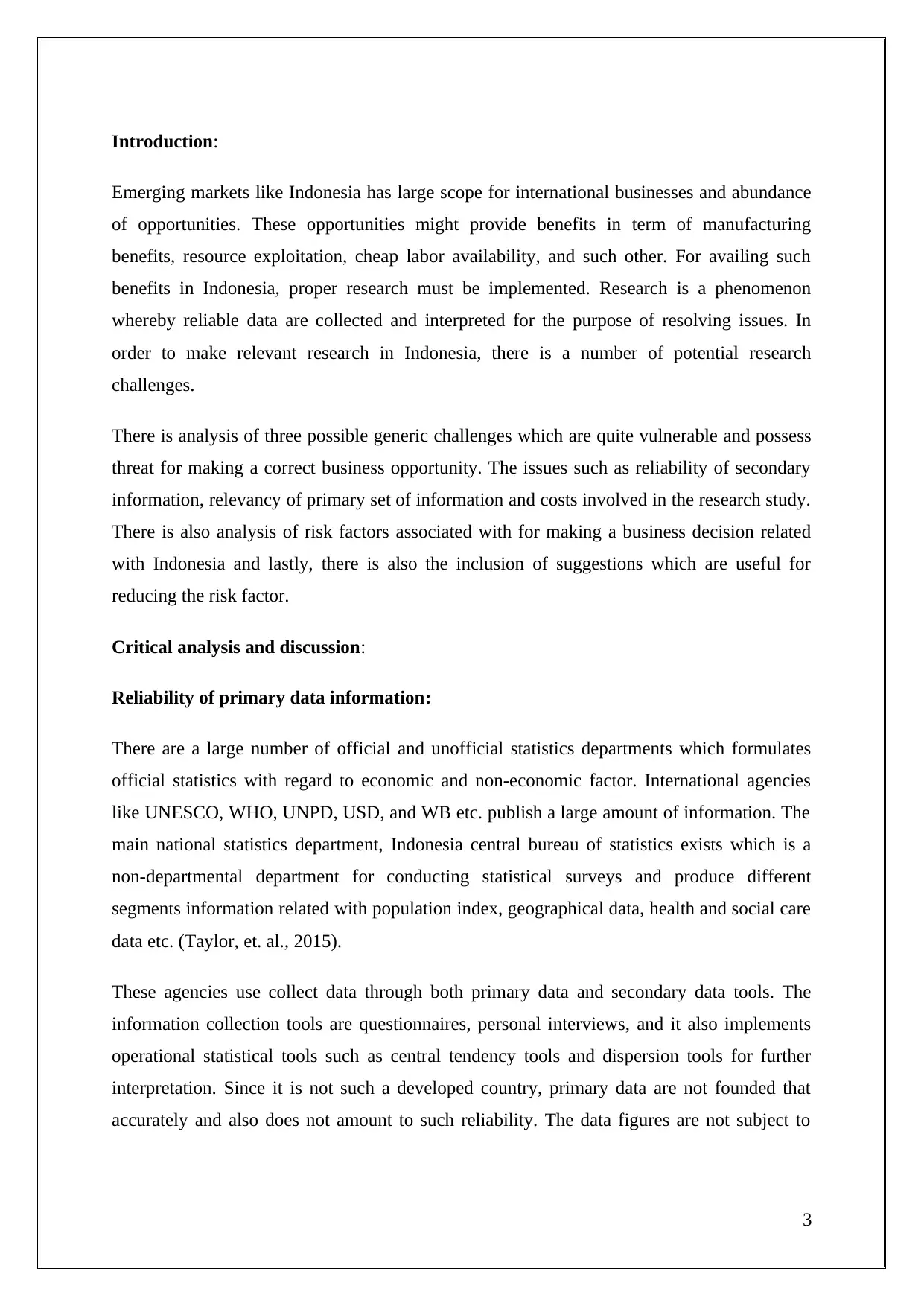
Contents
Introduction................................................................................................................................3
Critical analysis and discussion.................................................................................................3
Reliability of primary data information.................................................................................3
Lack of reliability in secondary data......................................................................................4
Costs variations......................................................................................................................5
Conclusion..................................................................................................................................6
Reference....................................................................................................................................7
2
Document Page
Introduction:
Emerging markets like Indonesia has large scope for international businesses and abundance
of opportunities. These opportunities might provide benefits in term of manufacturing
benefits, resource exploitation, cheap labor availability, and such other. For availing such
benefits in Indonesia, proper research must be implemented. Research is a phenomenon
whereby reliable data are collected and interpreted for the purpose of resolving issues. In
order to make relevant research in Indonesia, there is a number of potential research
challenges.
There is analysis of three possible generic challenges which are quite vulnerable and possess
threat for making a correct business opportunity. The issues such as reliability of secondary
information, relevancy of primary set of information and costs involved in the research study.
There is also analysis of risk factors associated with for making a business decision related
with Indonesia and lastly, there is also the inclusion of suggestions which are useful for
reducing the risk factor.
Critical analysis and discussion:
Reliability of primary data information:
There are a large number of official and unofficial statistics departments which formulates
official statistics with regard to economic and non-economic factor. International agencies
like UNESCO, WHO, UNPD, USD, and WB etc. publish a large amount of information. The
main national statistics department, Indonesia central bureau of statistics exists which is a
non-departmental department for conducting statistical surveys and produce different
segments information related with population index, geographical data, health and social care
data etc. (Taylor, et. al., 2015).
These agencies use collect data through both primary data and secondary data tools. The
information collection tools are questionnaires, personal interviews, and it also implements
operational statistical tools such as central tendency tools and dispersion tools for further
interpretation. Since it is not such a developed country, primary data are not founded that
accurately and also does not amount to such reliability. The data figures are not subject to
3
Document Page
reliability and relevancy and there lacks effectiveness in presenting primary data (Taylor, et.
al., 2015).
The risk related to the issue is that lack of proper investigation and data collected on the basis
of past trends makes the data less reliable and irrelevant. The biggest risk related to it is that it
leads international transaction risk such as foreign transactions and event risk, operational
risk, productivity risk etc. The less reliable publicised makes a wrong interpretation of the
country and does not provide enough business opportunities. The mitigation of risk must be
done. The international risk hampers the country’s productivity and unreliable statistics does
not provide much to the country (Neuman, 2013).
The risk associated with the option must be surely mitigated. Risk mitigation is a process
whereby appropriate actions are taken for reducing the risk for the actions concerned. It can
be mitigated through risk mitigation strategy. The strategy includes five options namely,
acceptance, avoidance, control, transfer, and monitoring (Neuman, 2013).
Firstly, there is a need to accept the level of risk which occurs due to the unreliability of the
primary data, this is that portion of risk which let go the opportunity available for the country.
Second is avoidance factor which means that the risk which does not hamper much must be
avoided. Thirdly, there is need to control risk factor by stressing true and fair primary data
and then, transferring the risk factor and finally, monitoring the data by reconciling the
primary data through different techniques (Neuman, 2013).
Lack of reliability of secondary data:
The varied international and national agencies publish data which are mostly based on the old
and traditional basis and the focus on the actual and current position of the country factors are
not measured. Since Indonesia belongs to an EDMA group and is an emerging economy; the
country is progressively moving towards getting good economic factors such as GDP,
employment numbers, resource extraction and exploitation and therefore, is utilizing its
current economic situation. There are a number of measures which are changing and require
proper research techniques and tools to be true and fair representation. But the secondary
information is quite outdated and old and there is a high need for continuous research
methods for actual picture presentation and for attraction by international businesses. Many
businesses and organizations use the outdated data for the purpose of making concern of its
organizational business into the country (Bryman, and Bell, 2015).
4
tabler-icon-diamond-filled.svg

Paraphrase This Document

Need a fresh take? Get an instant paraphrase of this document with our AI Paraphraser
Document Page
The outdated data leads to lack of overseas business investments which would otherwise
provide ample amount of development and job opportunities to the country. With the trend of
globalization, overseas investment provides market development and a larger scope for both
producers and consumers and thus, aids in progressing development, economic development,
employability etc. But most of the international organizations go over secondary statistics as
published by agencies and are not able to make uniform choices about the investment purpose
and the country loses ample amount of opportunities (Bryman, and Bell, 2015).
The risk of unreliable secondary publications can be changed by carrying on varied accurate
primary data about the manufacturing number, GDP, healthcare sector, tertiary sector, export
and import data etc. and exact data must be publicised. The primary and secondary data must
be made reliable through cross-examining and cross verifying the data. Secondary data
published by international agencies are highly relevant and considered at international level
also. Hence, reliable primary data figures published by statistician’s officers would aid in
international agencies to present a true picture of Indonesia in front of all.
Risk factor would also get reduced and international businesses who actually want to
establish businesses in emerging economies would make investments. The national statistics
of Indonesia which is mainly responsible for developing secondary data must be careful and
analytical towards primary data. The agency publishes data regarding Indonesia’s geographic
and health care and other economic and strategic sector. All these information must be
accurately researched and must be applied for better results (Bryman, and Bell, 2015).
Costs variations:
Conducting research takes up a lot of costs and other monetary compensation, all the costs
are variable and can be changed over various dimensions and hence, research measures takes
up a large amount of monetary compensation. A research cost is one which is incurred for the
purpose of investigation and making analysis for all the research part. The different
examples of costs are advertisements costs, questionnaire costs, research technique costs,
expertise costs, costs of books, journals etc. The costs which are made on research also do not
lead to any direct benefits but provides indirect benefits to the country and its natives.
International agencies usually spend such high amount of money towards developed
economies and produce big reports for them and do not make large expenditures over
5
Document Page
emerging economies and hence, these cost variations does not lead to the accurate and
reliable presentation of secondary data (Zikmund, et. al., 2013).
As far as the national agencies are concerned, these agencies do not have the high-cost scope
and do not make such expenditures for the organization. National organizations are provided
with limited costs which are supposedly less for conducting primary and secondary
researchers. Every research which is made requires a considerable amount of money for
analyzing objective, making field operations and working over possibilities for arriving at
conclusion. The risk that lies over it is of lack of development of the country. Indonesia is an
emerging economy and its natives require economic growth which can be achieved through
the implementation of research studies and costs. The risk associated with it can be reduced
through proper implementation of funds through international agencies and official
government funding for making a thorough research and carrying out the useful economic
factors of the country. Big research projects would provide large data, which can be used for
developing reports and aids in presenting country’s true picture (Zikmund, et. al., 2013).
Conclusion:
With this, it can be concluded that emerging economies requires a larger portion of attention
for conducting researchers and displaying actual statistical figures for the country. Precise
statistical figures would aid in exploring vulnerable and large international business
opportunities for the country. The international business provides a large number of benefits
such as it provide export, foreign currency, foreign reserves, employment opportunities,
competitive market, exploit resources and such other. But the establishment of such business
ventures requires proper research investigation and research methods which provide the
changed data and the actual situation of the country as well. But the barriers which are
currently faced by the country are non-reliability over primary and secondary data, research
cost and variations. These relate to risks such as loss of international business ventures, loss
of funds and economic development of the country. Proper measures such as risk strategies
must be adopted for ensuring mitigation of risk.
6
Document Page
Reference:
Bryman, A. and Bell, E., 2015, Business research methods, Oxford University Press,
USA.
Neuman, W.L., 2013, Social research methods: Qualitative and quantitative
approaches, Pearson education.
Taylor, S.J., Bogdan, R. and DeVault, M., 2015, Introduction to qualitative research
methods: A guidebook and resource, John Wiley & Sons.
Zikmund, W.G., Babin, B.J., Carr, J.C. and Griffin, M., 2013, Business research
methods. Cengage Learning.
7
chevron_up_icon
1 out of 7
circle_padding
hide_on_mobile
zoom_out_icon
[object Object]