Database Systems Report: Database Concepts for EasyTravel Group

Verified

Added on  2022/08/09

|7
|1068
|231
Report
AI Summary
This report provides a comprehensive overview of database systems, focusing on key concepts such as normalization, entity-relationship diagrams (ERDs), and the comparison between hierarchical and relational database management systems (DBMS). It explains the concept of normalization, detailing different normal forms (1NF, 2NF, 3NF, BCNF, 4NF) and their significance in eliminating data redundancy and ensuring data integrity. The report also explores data and functional dependencies within a DBMS context. Furthermore, it offers a comparison between hierarchical and relational database models, highlighting their respective strengths and weaknesses. Finally, the report discusses the use of ERDs in database design, emphasizing their role in representing real-world objects, their attributes, and the relationships between them. This report is designed to provide a solid understanding of fundamental database concepts and their practical applications.
Document Page
Running head: DATABASE SYSTEMS
DATABASE SYSTEMS
Name of the Student
Name of the University
Author Note
tabler-icon-diamond-filled.svg

Paraphrase This Document

Need a fresh take? Get an instant paraphrase of this document with our AI Paraphraser
Document Page
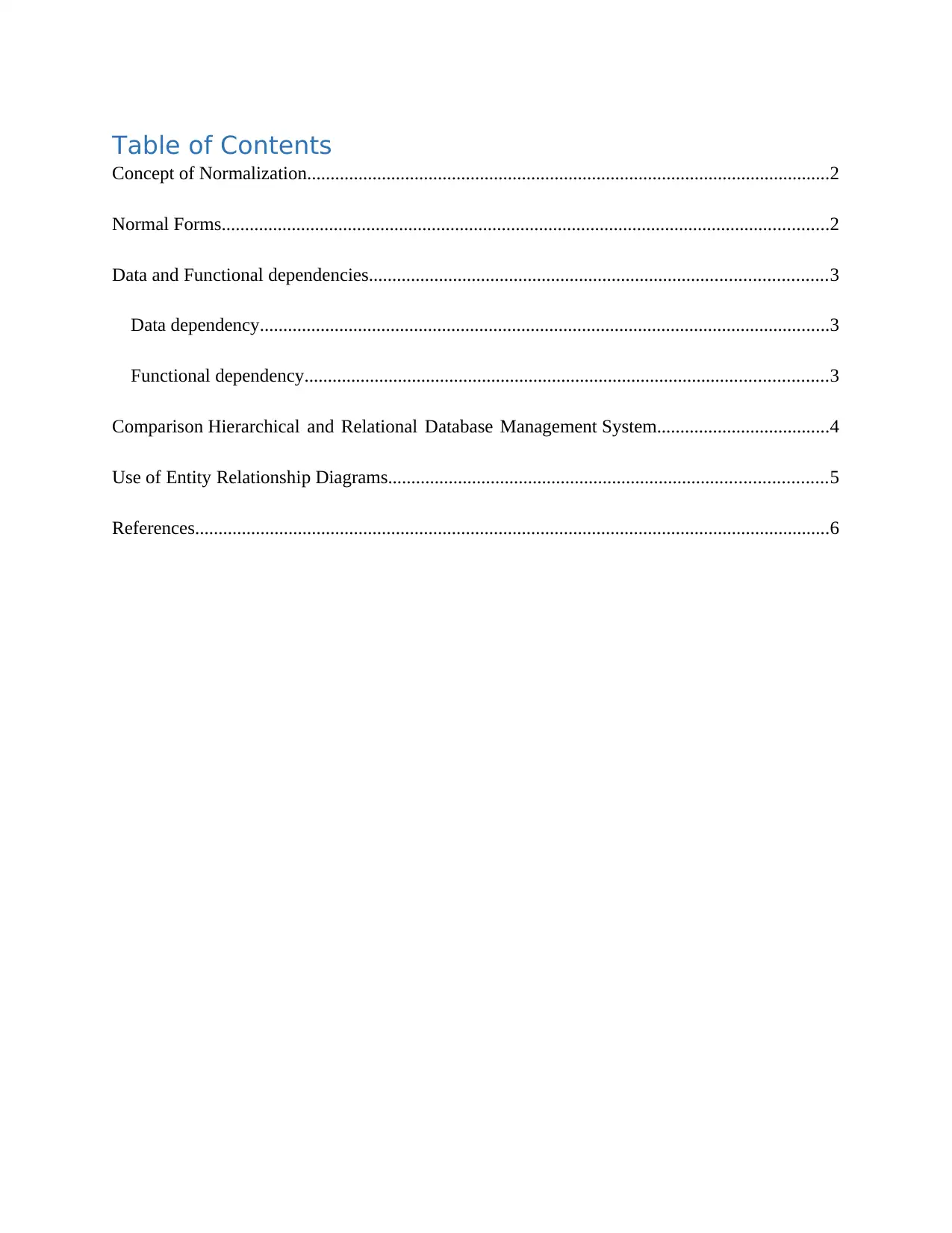
Table of Contents
Concept of Normalization................................................................................................................2
Normal Forms..................................................................................................................................2
Data and Functional dependencies..................................................................................................3
Data dependency..........................................................................................................................3
Functional dependency................................................................................................................3
Comparison Hierarchical and Relational Database Management System.....................................4
Use of Entity Relationship Diagrams..............................................................................................5
References........................................................................................................................................6
Document Page
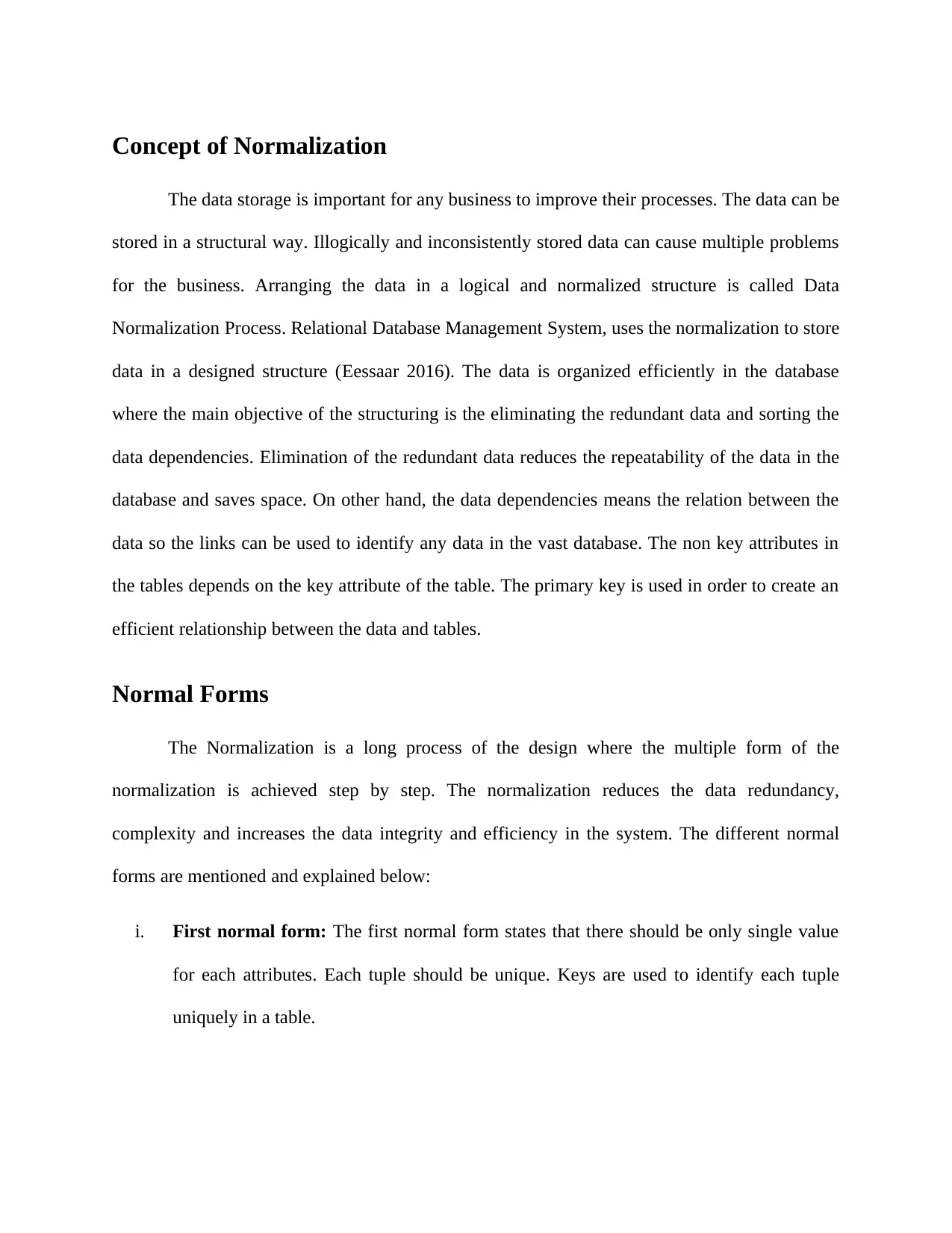
Concept of Normalization
The data storage is important for any business to improve their processes. The data can be
stored in a structural way. Illogically and inconsistently stored data can cause multiple problems
for the business. Arranging the data in a logical and normalized structure is called Data
Normalization Process. Relational Database Management System, uses the normalization to store
data in a designed structure (Eessaar 2016). The data is organized efficiently in the database
where the main objective of the structuring is the eliminating the redundant data and sorting the
data dependencies. Elimination of the redundant data reduces the repeatability of the data in the
database and saves space. On other hand, the data dependencies means the relation between the
data so the links can be used to identify any data in the vast database. The non key attributes in
the tables depends on the key attribute of the table. The primary key is used in order to create an
efficient relationship between the data and tables.
Normal Forms
The Normalization is a long process of the design where the multiple form of the
normalization is achieved step by step. The normalization reduces the data redundancy,
complexity and increases the data integrity and efficiency in the system. The different normal
forms are mentioned and explained below:
i. First normal form: The first normal form states that there should be only single value
for each attributes. Each tuple should be unique. Keys are used to identify each tuple
uniquely in a table.
Document Page
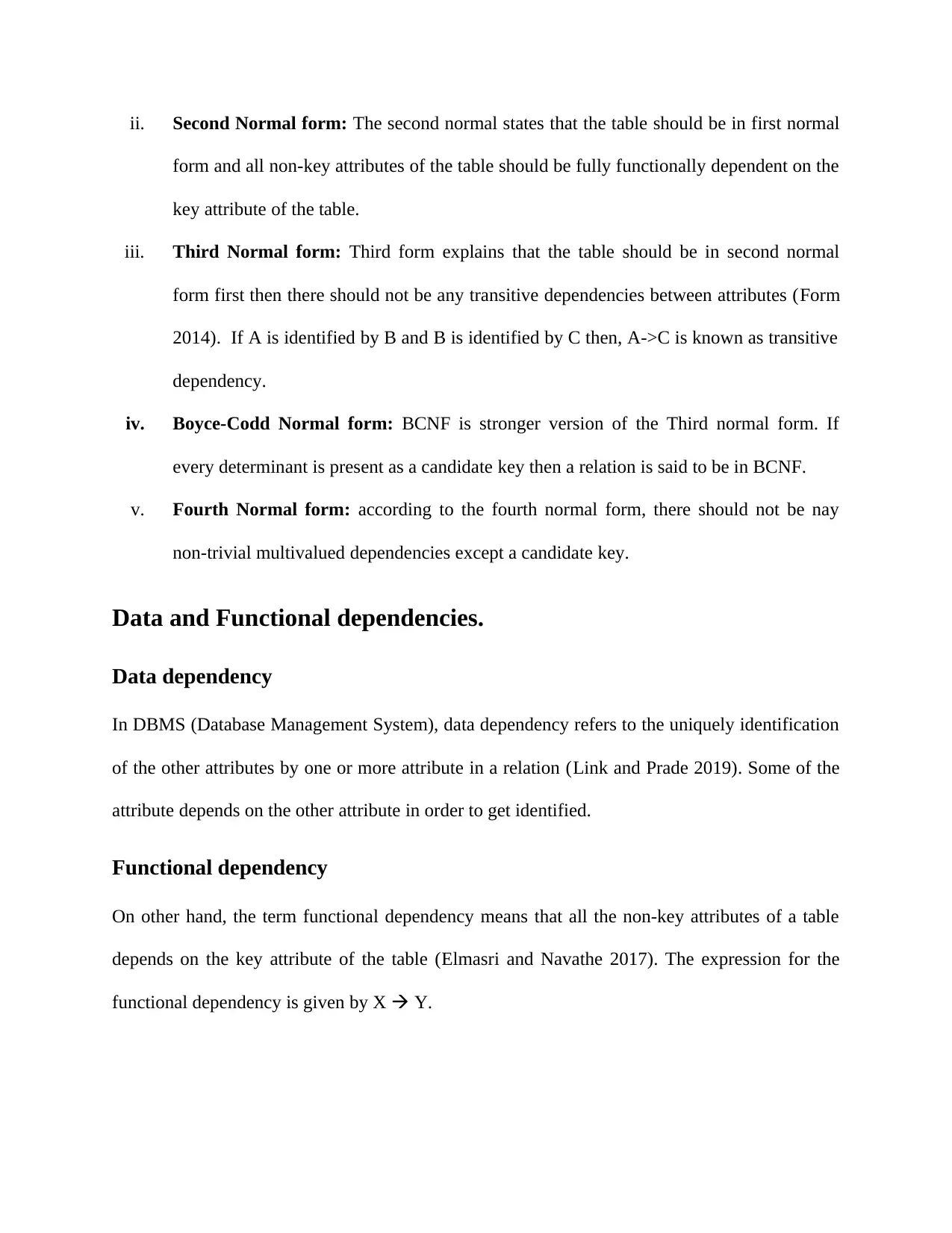
ii. Second Normal form: The second normal states that the table should be in first normal
form and all non-key attributes of the table should be fully functionally dependent on the
key attribute of the table.
iii. Third Normal form: Third form explains that the table should be in second normal
form first then there should not be any transitive dependencies between attributes (Form
2014). If A is identified by B and B is identified by C then, A->C is known as transitive
dependency.
iv. Boyce-Codd Normal form: BCNF is stronger version of the Third normal form. If
every determinant is present as a candidate key then a relation is said to be in BCNF.
v. Fourth Normal form: according to the fourth normal form, there should not be nay
non-trivial multivalued dependencies except a candidate key.
Data and Functional dependencies.
Data dependency
In DBMS (Database Management System), data dependency refers to the uniquely identification
of the other attributes by one or more attribute in a relation (Link and Prade 2019). Some of the
attribute depends on the other attribute in order to get identified.
Functional dependency
On other hand, the term functional dependency means that all the non-key attributes of a table
depends on the key attribute of the table (Elmasri and Navathe 2017). The expression for the
functional dependency is given by X  Y.
tabler-icon-diamond-filled.svg

Paraphrase This Document

Need a fresh take? Get an instant paraphrase of this document with our AI Paraphraser
Document Page
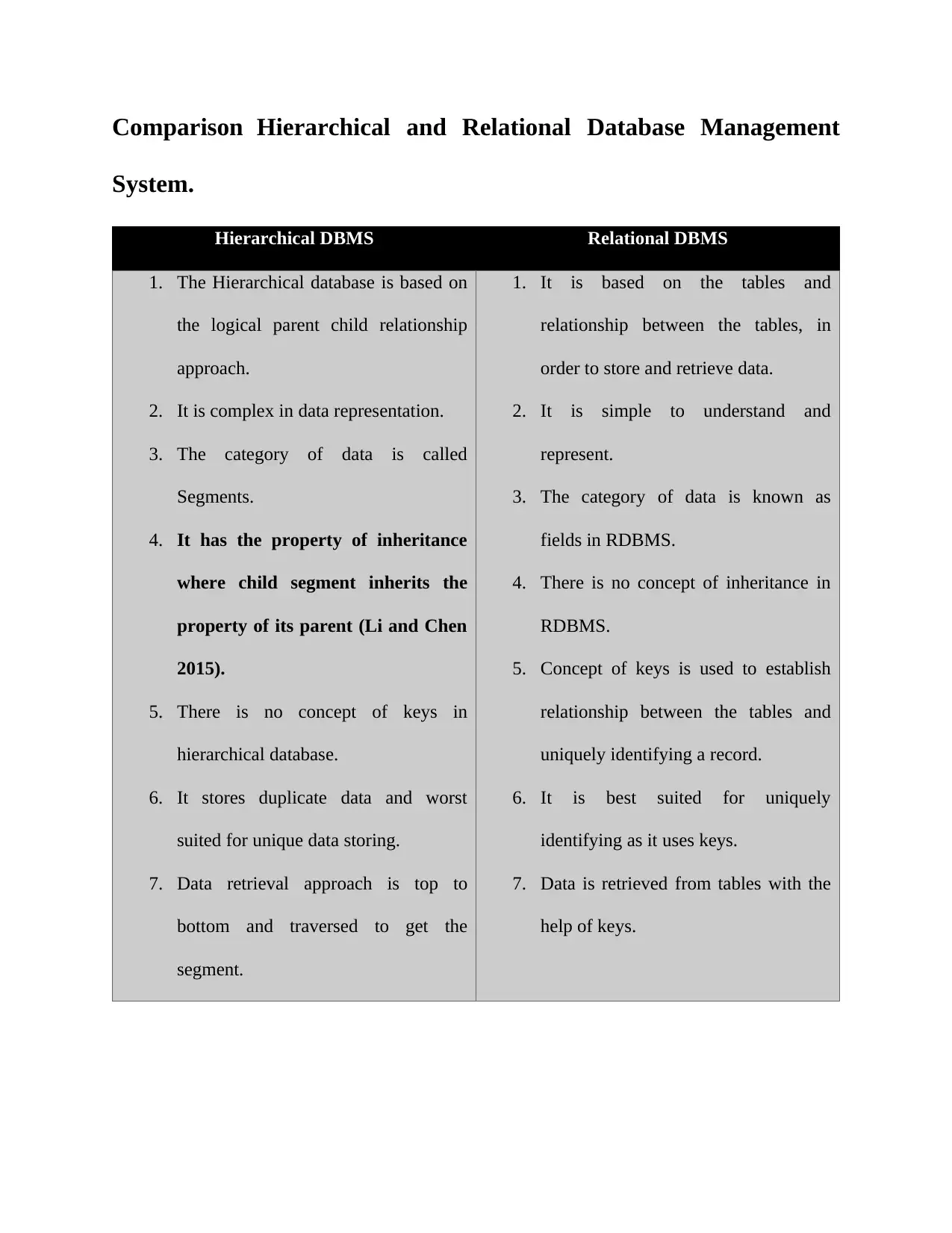
Comparison Hierarchical and Relational Database Management
System.
Hierarchical DBMS Relational DBMS
1. The Hierarchical database is based on
the logical parent child relationship
approach.
2. It is complex in data representation.
3. The category of data is called
Segments.
4. It has the property of inheritance
where child segment inherits the
property of its parent (Li and Chen
2015).
5. There is no concept of keys in
hierarchical database.
6. It stores duplicate data and worst
suited for unique data storing.
7. Data retrieval approach is top to
bottom and traversed to get the
segment.
1. It is based on the tables and
relationship between the tables, in
order to store and retrieve data.
2. It is simple to understand and
represent.
3. The category of data is known as
fields in RDBMS.
4. There is no concept of inheritance in
RDBMS.
5. Concept of keys is used to establish
relationship between the tables and
uniquely identifying a record.
6. It is best suited for uniquely
identifying as it uses keys.
7. Data is retrieved from tables with the
help of keys.
Document Page
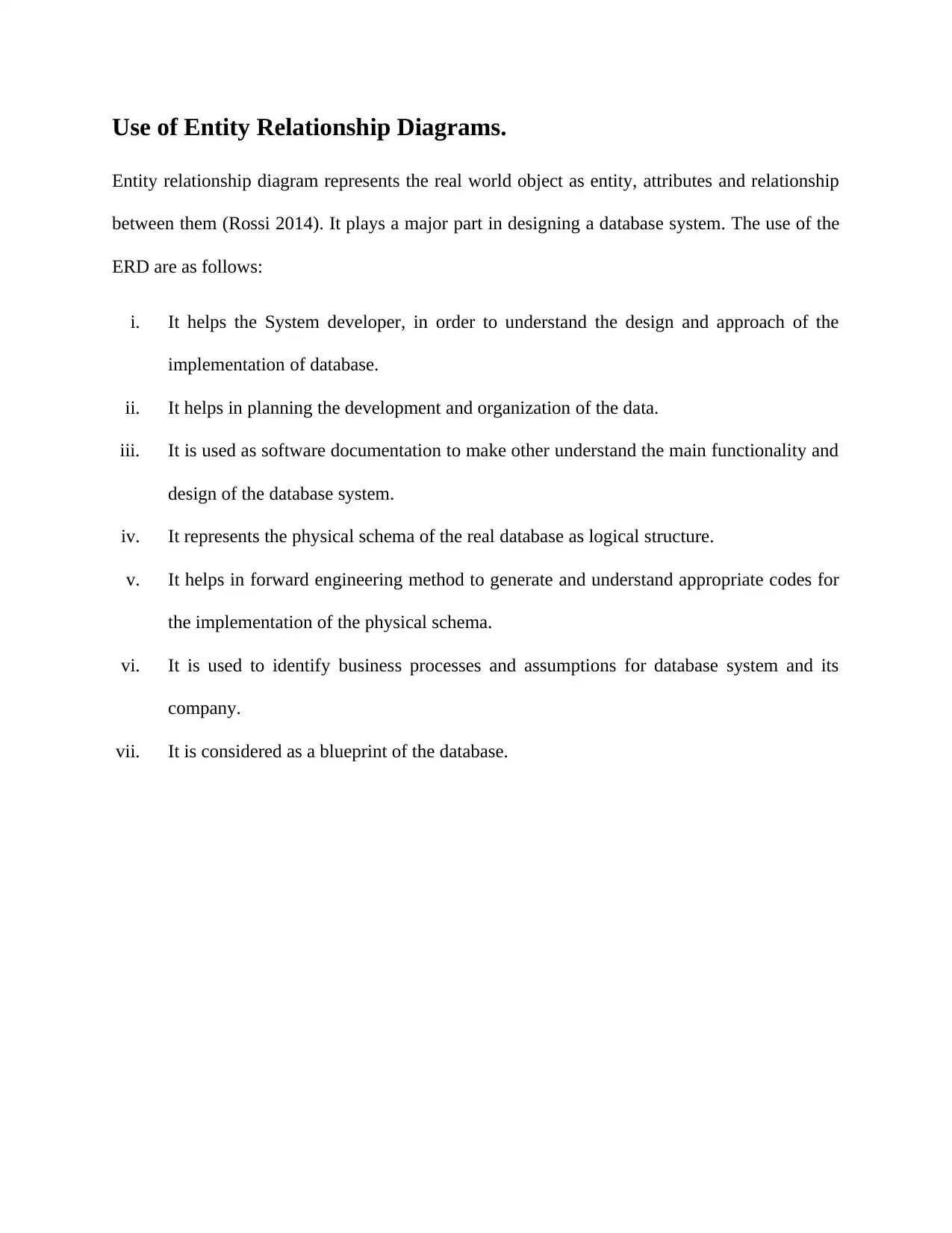
Use of Entity Relationship Diagrams.
Entity relationship diagram represents the real world object as entity, attributes and relationship
between them (Rossi 2014). It plays a major part in designing a database system. The use of the
ERD are as follows:
i. It helps the System developer, in order to understand the design and approach of the
implementation of database.
ii. It helps in planning the development and organization of the data.
iii. It is used as software documentation to make other understand the main functionality and
design of the database system.
iv. It represents the physical schema of the real database as logical structure.
v. It helps in forward engineering method to generate and understand appropriate codes for
the implementation of the physical schema.
vi. It is used to identify business processes and assumptions for database system and its
company.
vii. It is considered as a blueprint of the database.
Document Page
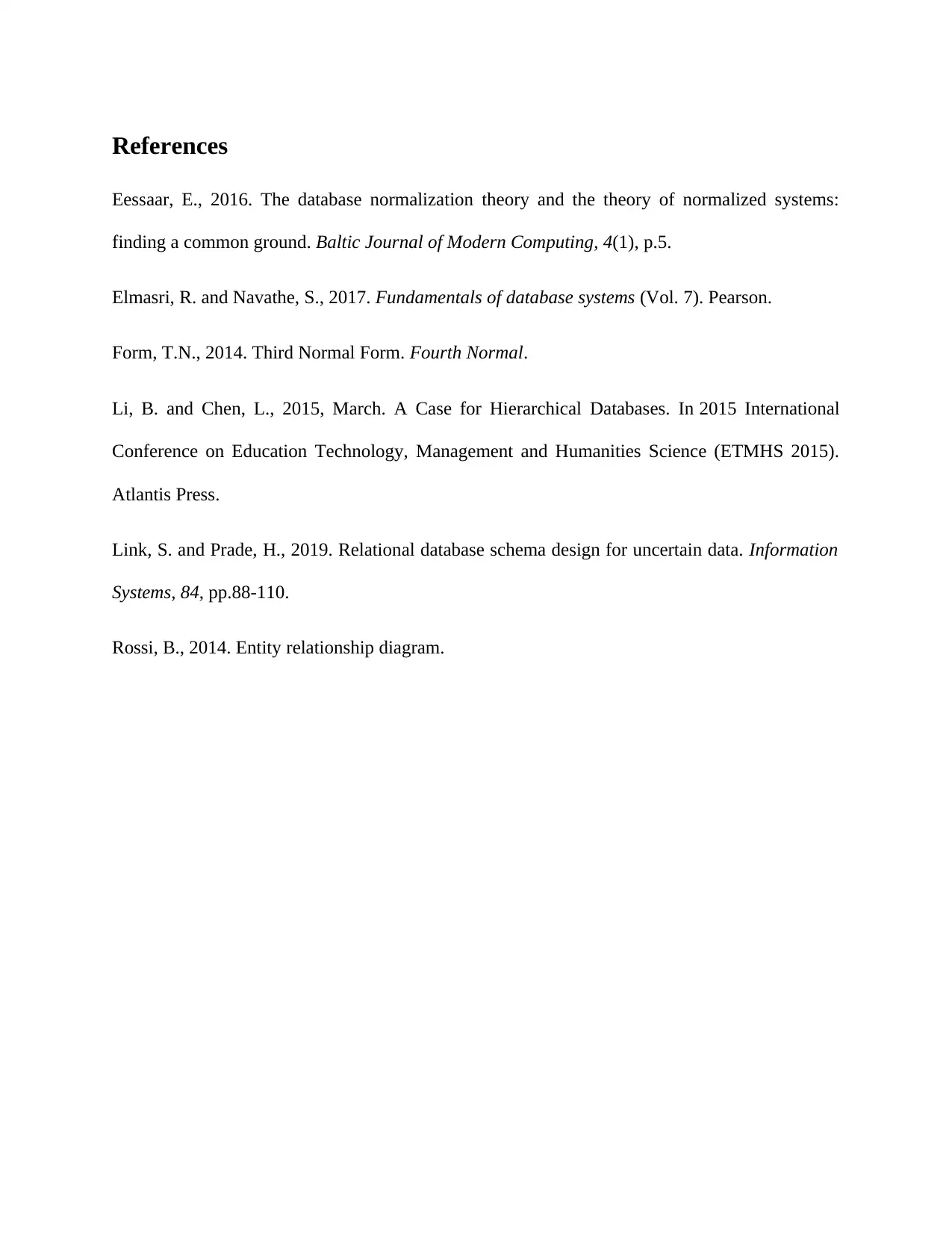
References
Eessaar, E., 2016. The database normalization theory and the theory of normalized systems:
finding a common ground. Baltic Journal of Modern Computing, 4(1), p.5.
Elmasri, R. and Navathe, S., 2017. Fundamentals of database systems (Vol. 7). Pearson.
Form, T.N., 2014. Third Normal Form. Fourth Normal.
Li, B. and Chen, L., 2015, March. A Case for Hierarchical Databases. In 2015 International
Conference on Education Technology, Management and Humanities Science (ETMHS 2015).
Atlantis Press.
Link, S. and Prade, H., 2019. Relational database schema design for uncertain data. Information
Systems, 84, pp.88-110.
Rossi, B., 2014. Entity relationship diagram.
chevron_up_icon
1 out of 7
circle_padding
hide_on_mobile
zoom_out_icon
[object Object]