Math 101 Assignment: Rolle's Theorem and Derivative Analysis

Verified

Added on  2023/04/22

|2
|565
|180
Homework Assignment
AI Summary
This assignment delves into the application of Rolle's Theorem in calculus, focusing on how it relates to the derivative of a function and the determination of its monotonicity. The solution begins by referencing the First Derivative Test for Local Extrema, highlighting the relationship between the derivative's sign and the function's behavior. It then provides a proof of a technical lemma to support the understanding of how the derivative influences the function's values. Furthermore, the assignment tackles Rolle's Theorem directly, exploring its implications on finding the zeros of a function's derivative. The core of the assignment involves proving, by contradiction, that between two successive distinct zeros of the derivative, there can be at most one zero of the original function. This demonstrates a strong understanding of calculus principles and provides a detailed, step-by-step solution to a complex problem.
Document Page
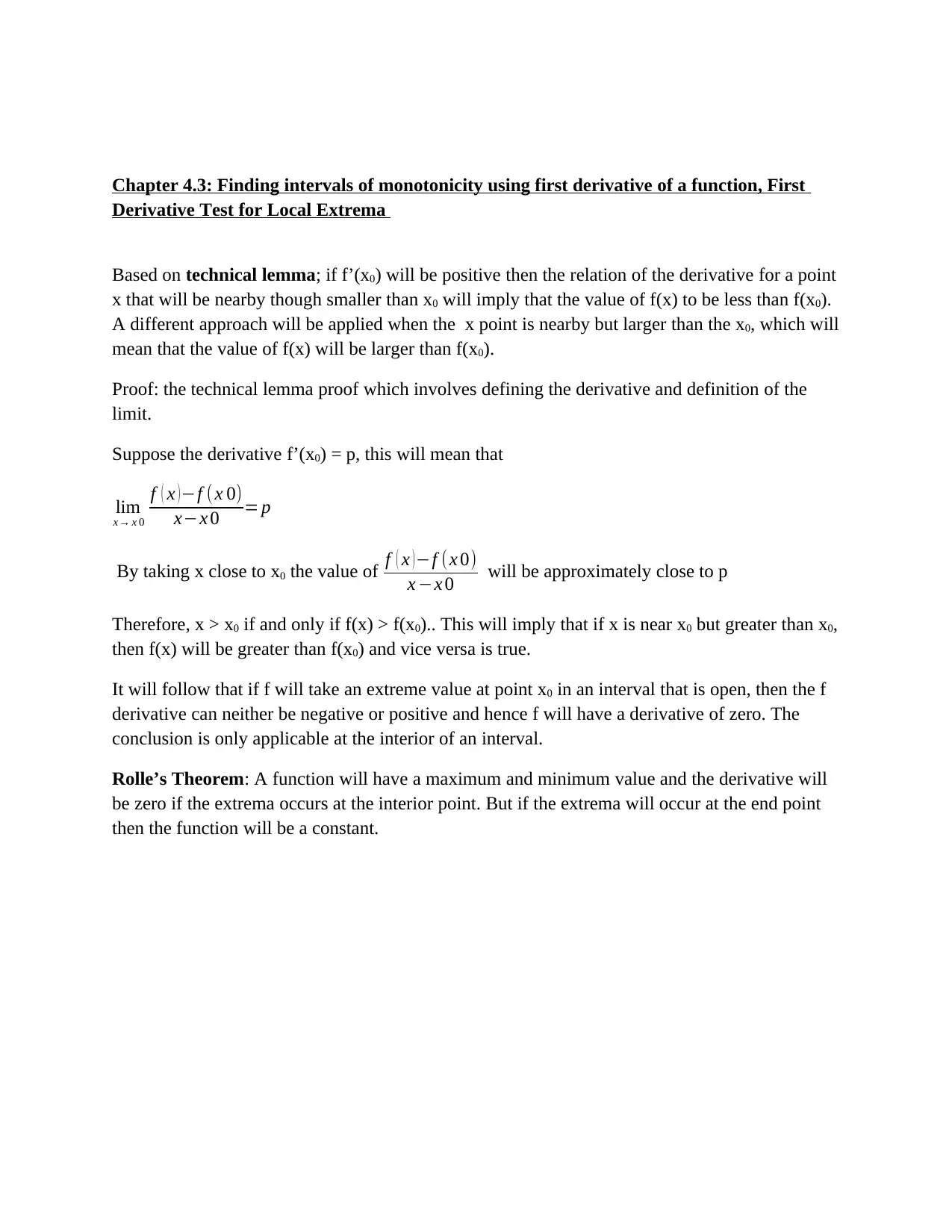
Chapter 4.3: Finding intervals of monotonicity using first derivative of a function, First
Derivative Test for Local Extrema
Based on technical lemma; if f’(x0) will be positive then the relation of the derivative for a point
x that will be nearby though smaller than x0 will imply that the value of f(x) to be less than f(x0).
A different approach will be applied when the x point is nearby but larger than the x0, which will
mean that the value of f(x) will be larger than f(x0).
Proof: the technical lemma proof which involves defining the derivative and definition of the
limit.
Suppose the derivative f’(x0) = p, this will mean that
lim
x x 0
f ( x ) f ( x 0)
xx 0 = p
By taking x close to x0 the value of f ( x )f (x 0)
x x 0 will be approximately close to p
Therefore, x > x0 if and only if f(x) > f(x0).. This will imply that if x is near x0 but greater than x0,
then f(x) will be greater than f(x0) and vice versa is true.
It will follow that if f will take an extreme value at point x0 in an interval that is open, then the f
derivative can neither be negative or positive and hence f will have a derivative of zero. The
conclusion is only applicable at the interior of an interval.
Rolle’s Theorem: A function will have a maximum and minimum value and the derivative will
be zero if the extrema occurs at the interior point. But if the extrema will occur at the end point
then the function will be a constant.
tabler-icon-diamond-filled.svg

Paraphrase This Document

Need a fresh take? Get an instant paraphrase of this document with our AI Paraphraser
Document Page
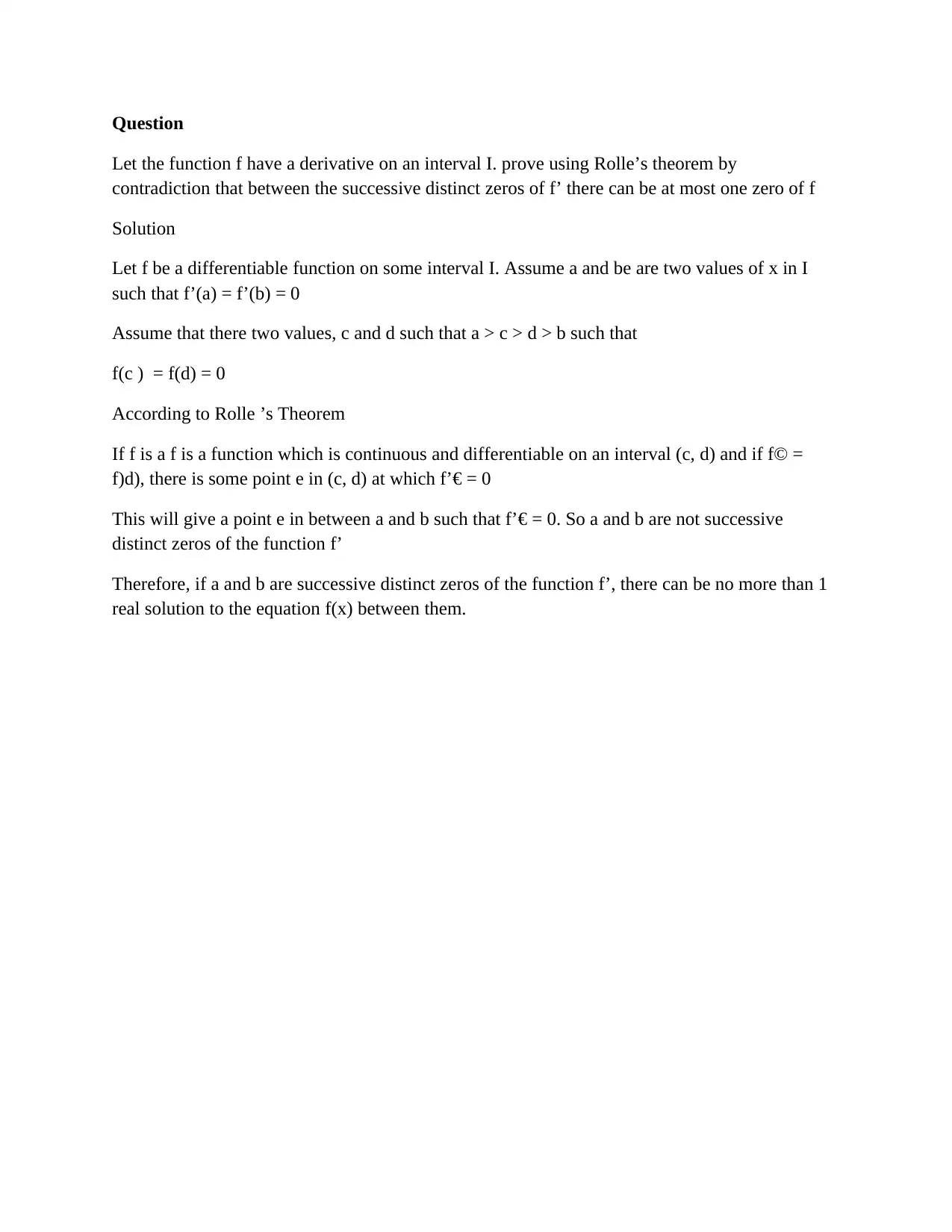
Question
Let the function f have a derivative on an interval I. prove using Rolle’s theorem by
contradiction that between the successive distinct zeros of f’ there can be at most one zero of f
Solution
Let f be a differentiable function on some interval I. Assume a and be are two values of x in I
such that f’(a) = f’(b) = 0
Assume that there two values, c and d such that a > c > d > b such that
f(c ) = f(d) = 0
According to Rolle ’s Theorem
If f is a f is a function which is continuous and differentiable on an interval (c, d) and if f© =
f)d), there is some point e in (c, d) at which f’€ = 0
This will give a point e in between a and b such that f’€ = 0. So a and b are not successive
distinct zeros of the function f’
Therefore, if a and b are successive distinct zeros of the function f’, there can be no more than 1
real solution to the equation f(x) between them.
chevron_up_icon
1 out of 2
circle_padding
hide_on_mobile
zoom_out_icon
[object Object]