Taxation Law: Fringe Benefit Tax Analysis for 2017 - Shine Homes
VerifiedAdded on 2020/04/07
|9
|2523
|36
Report
AI Summary
This report provides a comprehensive analysis of fringe benefit tax (FBT) implications for Shine Homes Pty Ltd and its employee, Charlie, for the income year 2017. The assignment covers various aspects of FBT, including car fringe benefits, expense-related fringe benefits, and car parking fringe benefits. It details the relevant laws, including the Fringe Benefits Tax Assessment Act 1986 (Cth), and provides step-by-step calculations for determining taxable values and FBT payable by the employer. The report examines the statutory formula method and operating cost method for car fringe benefits, considering factors like car base value, statutory percentage, and private usage days. It also addresses expense-related benefits, such as expenses related to Charlie's marriage and honeymoon, and car parking benefits, including the market value approach. The report concludes with a summary of the FBT liabilities for Shine Homes, offering valuable insights for understanding and complying with FBT regulations.
TAXATION LAW
Fringe Benefit Tax
STUDENT ID:
[Pick the date]
Fringe Benefit Tax
STUDENT ID:
[Pick the date]

Paraphrase This Document
Need a fresh take? Get an instant paraphrase of this document with our AI Paraphraser
TAXATION
Issue
The central issue in the present case is to offer an advice to employee Charlie and employer
Shine Homes Pty Ltd (Shiny Homes) for the fringe benefits consequences for the given events
for the income year 2017.
Law
Fringe benefits are the non- cashable benefits (for personal use) which are extended on the part
of the employer to their employee during their employment with the company. These types of
benefits result fringe benefit tax liability on the employer. The various fringe benefits are
highlighted in the Fringe Benefits Tax Assessment Act 1986 (Cth) “FBTAA86.” The various
relevant fringe benefits and their respective FBT computation is discussed below.
Car Fringe Benefit
When an employer has provided car to the employee for his/her own personal usage, then it is
termed as car fringe benefit. Tax Ruling TR 96/26 indicates the various aspects related to the Car
Fringe Benefit and the computation of the Fringe Benefit Tax (FBT) liability on the part of
employer (CCH, 2013). The necessary steps related to the computation of fringe benefit tax
liability are highlighted below.
(1) Total duration of utilization of private use of car in the assessment year
It is essential to find the actual date on which the car is available for the personal usage of
employee. According to section 7 of FBTAA86, the private usage of car is assumed in any of
the following two circumstances (Woellner, 2014).
Actual car use for personal work by the employee
The date on which the car has been offered to employee for personal utilization. In this case,
the date on which car is offered would be taken into consideration irrespective of the fact that
whether the employee has started using car for personal purposes or not.
1
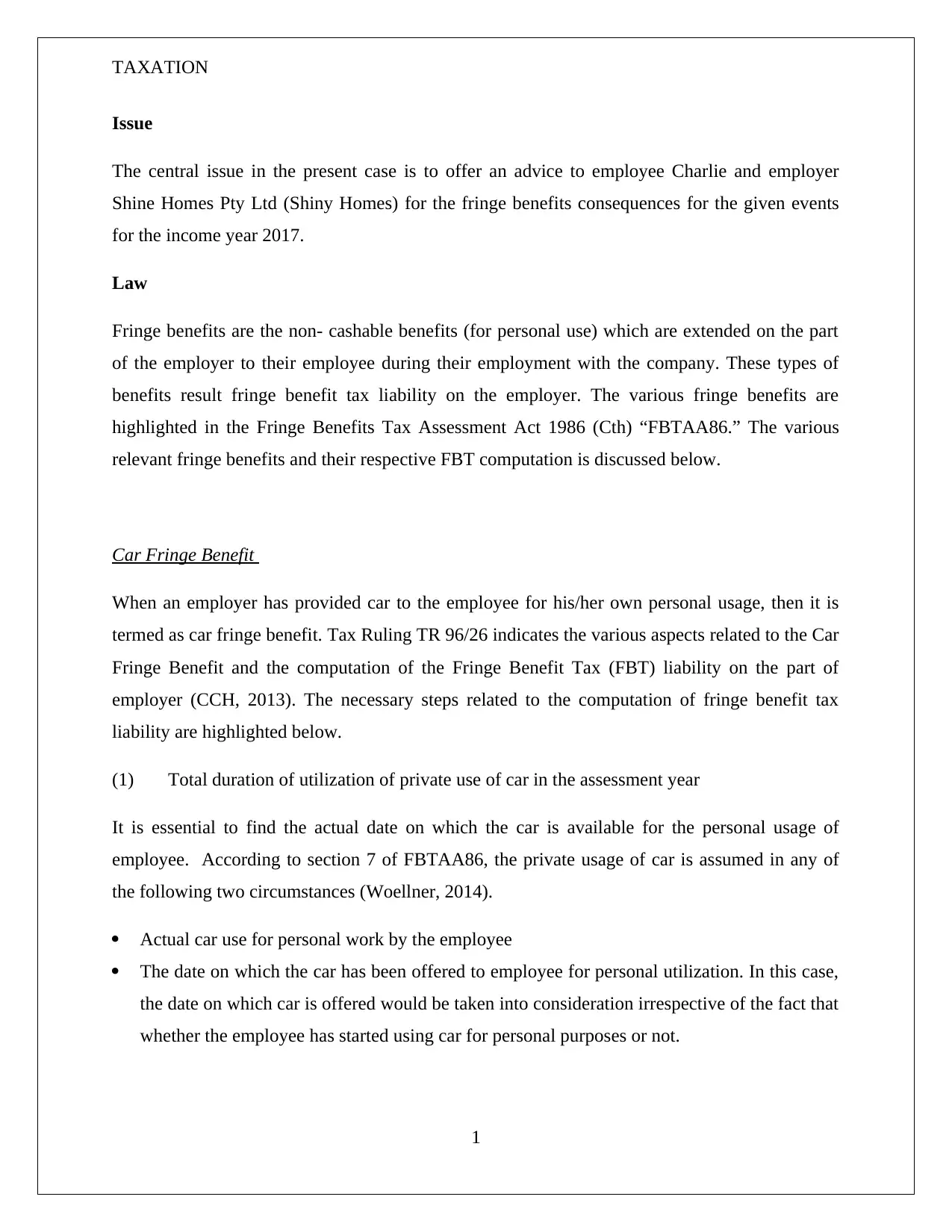
Issue
The central issue in the present case is to offer an advice to employee Charlie and employer
Shine Homes Pty Ltd (Shiny Homes) for the fringe benefits consequences for the given events
for the income year 2017.
Law
Fringe benefits are the non- cashable benefits (for personal use) which are extended on the part
of the employer to their employee during their employment with the company. These types of
benefits result fringe benefit tax liability on the employer. The various fringe benefits are
highlighted in the Fringe Benefits Tax Assessment Act 1986 (Cth) “FBTAA86.” The various
relevant fringe benefits and their respective FBT computation is discussed below.
Car Fringe Benefit
When an employer has provided car to the employee for his/her own personal usage, then it is
termed as car fringe benefit. Tax Ruling TR 96/26 indicates the various aspects related to the Car
Fringe Benefit and the computation of the Fringe Benefit Tax (FBT) liability on the part of
employer (CCH, 2013). The necessary steps related to the computation of fringe benefit tax
liability are highlighted below.
(1) Total duration of utilization of private use of car in the assessment year
It is essential to find the actual date on which the car is available for the personal usage of
employee. According to section 7 of FBTAA86, the private usage of car is assumed in any of
the following two circumstances (Woellner, 2014).
Actual car use for personal work by the employee
The date on which the car has been offered to employee for personal utilization. In this case,
the date on which car is offered would be taken into consideration irrespective of the fact that
whether the employee has started using car for personal purposes or not.
1
TAXATION
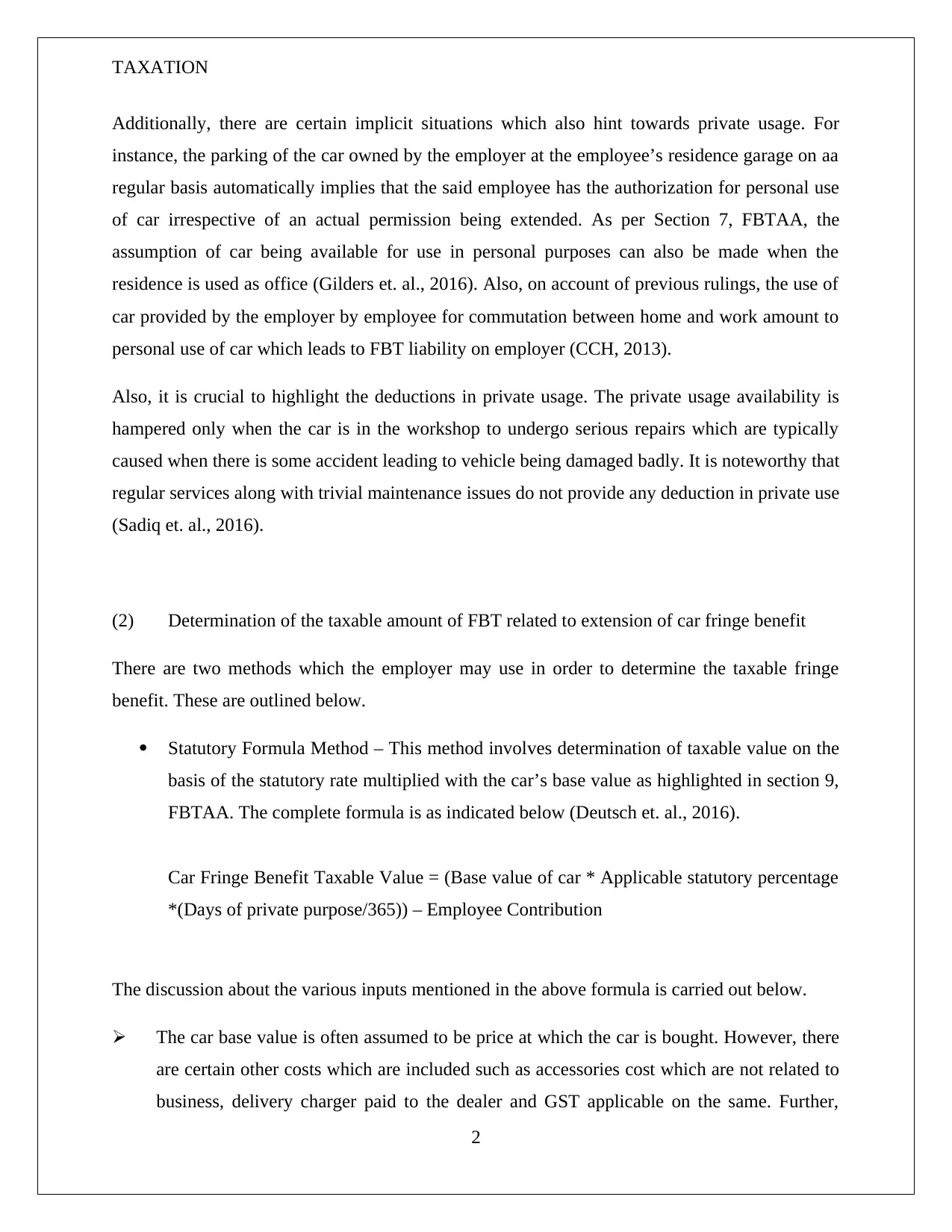
Additionally, there are certain implicit situations which also hint towards private usage. For
instance, the parking of the car owned by the employer at the employee’s residence garage on aa
regular basis automatically implies that the said employee has the authorization for personal use
of car irrespective of an actual permission being extended. As per Section 7, FBTAA, the
assumption of car being available for use in personal purposes can also be made when the
residence is used as office (Gilders et. al., 2016). Also, on account of previous rulings, the use of
car provided by the employer by employee for commutation between home and work amount to
personal use of car which leads to FBT liability on employer (CCH, 2013).
Also, it is crucial to highlight the deductions in private usage. The private usage availability is
hampered only when the car is in the workshop to undergo serious repairs which are typically
caused when there is some accident leading to vehicle being damaged badly. It is noteworthy that
regular services along with trivial maintenance issues do not provide any deduction in private use
(Sadiq et. al., 2016).
(2) Determination of the taxable amount of FBT related to extension of car fringe benefit
There are two methods which the employer may use in order to determine the taxable fringe
benefit. These are outlined below.
Statutory Formula Method – This method involves determination of taxable value on the
basis of the statutory rate multiplied with the car’s base value as highlighted in section 9,
FBTAA. The complete formula is as indicated below (Deutsch et. al., 2016).
Car Fringe Benefit Taxable Value = (Base value of car * Applicable statutory percentage
*(Days of private purpose/365)) – Employee Contribution
The discussion about the various inputs mentioned in the above formula is carried out below.
The car base value is often assumed to be price at which the car is bought. However, there
are certain other costs which are included such as accessories cost which are not related to
business, delivery charger paid to the dealer and GST applicable on the same. Further,
2
Additionally, there are certain implicit situations which also hint towards private usage. For
instance, the parking of the car owned by the employer at the employee’s residence garage on aa
regular basis automatically implies that the said employee has the authorization for personal use
of car irrespective of an actual permission being extended. As per Section 7, FBTAA, the
assumption of car being available for use in personal purposes can also be made when the
residence is used as office (Gilders et. al., 2016). Also, on account of previous rulings, the use of
car provided by the employer by employee for commutation between home and work amount to
personal use of car which leads to FBT liability on employer (CCH, 2013).
Also, it is crucial to highlight the deductions in private usage. The private usage availability is
hampered only when the car is in the workshop to undergo serious repairs which are typically
caused when there is some accident leading to vehicle being damaged badly. It is noteworthy that
regular services along with trivial maintenance issues do not provide any deduction in private use
(Sadiq et. al., 2016).
(2) Determination of the taxable amount of FBT related to extension of car fringe benefit
There are two methods which the employer may use in order to determine the taxable fringe
benefit. These are outlined below.
Statutory Formula Method – This method involves determination of taxable value on the
basis of the statutory rate multiplied with the car’s base value as highlighted in section 9,
FBTAA. The complete formula is as indicated below (Deutsch et. al., 2016).
Car Fringe Benefit Taxable Value = (Base value of car * Applicable statutory percentage
*(Days of private purpose/365)) – Employee Contribution
The discussion about the various inputs mentioned in the above formula is carried out below.
The car base value is often assumed to be price at which the car is bought. However, there
are certain other costs which are included such as accessories cost which are not related to
business, delivery charger paid to the dealer and GST applicable on the same. Further,
2
⊘ This is a preview!⊘
Do you want full access?
Subscribe today to unlock all pages.

Trusted by 1+ million students worldwide
TAXATION
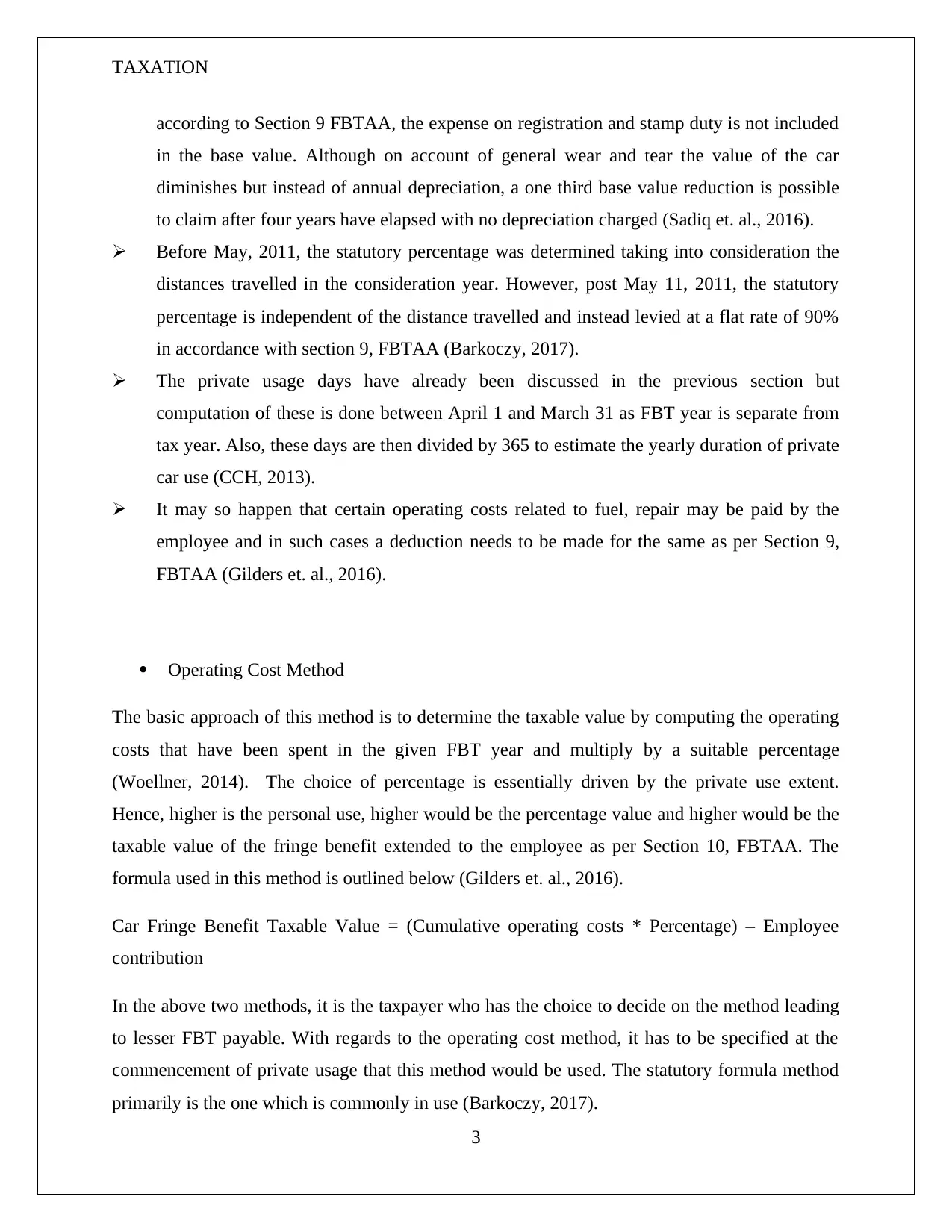
according to Section 9 FBTAA, the expense on registration and stamp duty is not included
in the base value. Although on account of general wear and tear the value of the car
diminishes but instead of annual depreciation, a one third base value reduction is possible
to claim after four years have elapsed with no depreciation charged (Sadiq et. al., 2016).
Before May, 2011, the statutory percentage was determined taking into consideration the
distances travelled in the consideration year. However, post May 11, 2011, the statutory
percentage is independent of the distance travelled and instead levied at a flat rate of 90%
in accordance with section 9, FBTAA (Barkoczy, 2017).
The private usage days have already been discussed in the previous section but
computation of these is done between April 1 and March 31 as FBT year is separate from
tax year. Also, these days are then divided by 365 to estimate the yearly duration of private
car use (CCH, 2013).
It may so happen that certain operating costs related to fuel, repair may be paid by the
employee and in such cases a deduction needs to be made for the same as per Section 9,
FBTAA (Gilders et. al., 2016).
Operating Cost Method
The basic approach of this method is to determine the taxable value by computing the operating
costs that have been spent in the given FBT year and multiply by a suitable percentage
(Woellner, 2014). The choice of percentage is essentially driven by the private use extent.
Hence, higher is the personal use, higher would be the percentage value and higher would be the
taxable value of the fringe benefit extended to the employee as per Section 10, FBTAA. The
formula used in this method is outlined below (Gilders et. al., 2016).
Car Fringe Benefit Taxable Value = (Cumulative operating costs * Percentage) – Employee
contribution
In the above two methods, it is the taxpayer who has the choice to decide on the method leading
to lesser FBT payable. With regards to the operating cost method, it has to be specified at the
commencement of private usage that this method would be used. The statutory formula method
primarily is the one which is commonly in use (Barkoczy, 2017).
3
according to Section 9 FBTAA, the expense on registration and stamp duty is not included
in the base value. Although on account of general wear and tear the value of the car
diminishes but instead of annual depreciation, a one third base value reduction is possible
to claim after four years have elapsed with no depreciation charged (Sadiq et. al., 2016).
Before May, 2011, the statutory percentage was determined taking into consideration the
distances travelled in the consideration year. However, post May 11, 2011, the statutory
percentage is independent of the distance travelled and instead levied at a flat rate of 90%
in accordance with section 9, FBTAA (Barkoczy, 2017).
The private usage days have already been discussed in the previous section but
computation of these is done between April 1 and March 31 as FBT year is separate from
tax year. Also, these days are then divided by 365 to estimate the yearly duration of private
car use (CCH, 2013).
It may so happen that certain operating costs related to fuel, repair may be paid by the
employee and in such cases a deduction needs to be made for the same as per Section 9,
FBTAA (Gilders et. al., 2016).
Operating Cost Method
The basic approach of this method is to determine the taxable value by computing the operating
costs that have been spent in the given FBT year and multiply by a suitable percentage
(Woellner, 2014). The choice of percentage is essentially driven by the private use extent.
Hence, higher is the personal use, higher would be the percentage value and higher would be the
taxable value of the fringe benefit extended to the employee as per Section 10, FBTAA. The
formula used in this method is outlined below (Gilders et. al., 2016).
Car Fringe Benefit Taxable Value = (Cumulative operating costs * Percentage) – Employee
contribution
In the above two methods, it is the taxpayer who has the choice to decide on the method leading
to lesser FBT payable. With regards to the operating cost method, it has to be specified at the
commencement of private usage that this method would be used. The statutory formula method
primarily is the one which is commonly in use (Barkoczy, 2017).
3
Paraphrase This Document
Need a fresh take? Get an instant paraphrase of this document with our AI Paraphraser
TAXATION
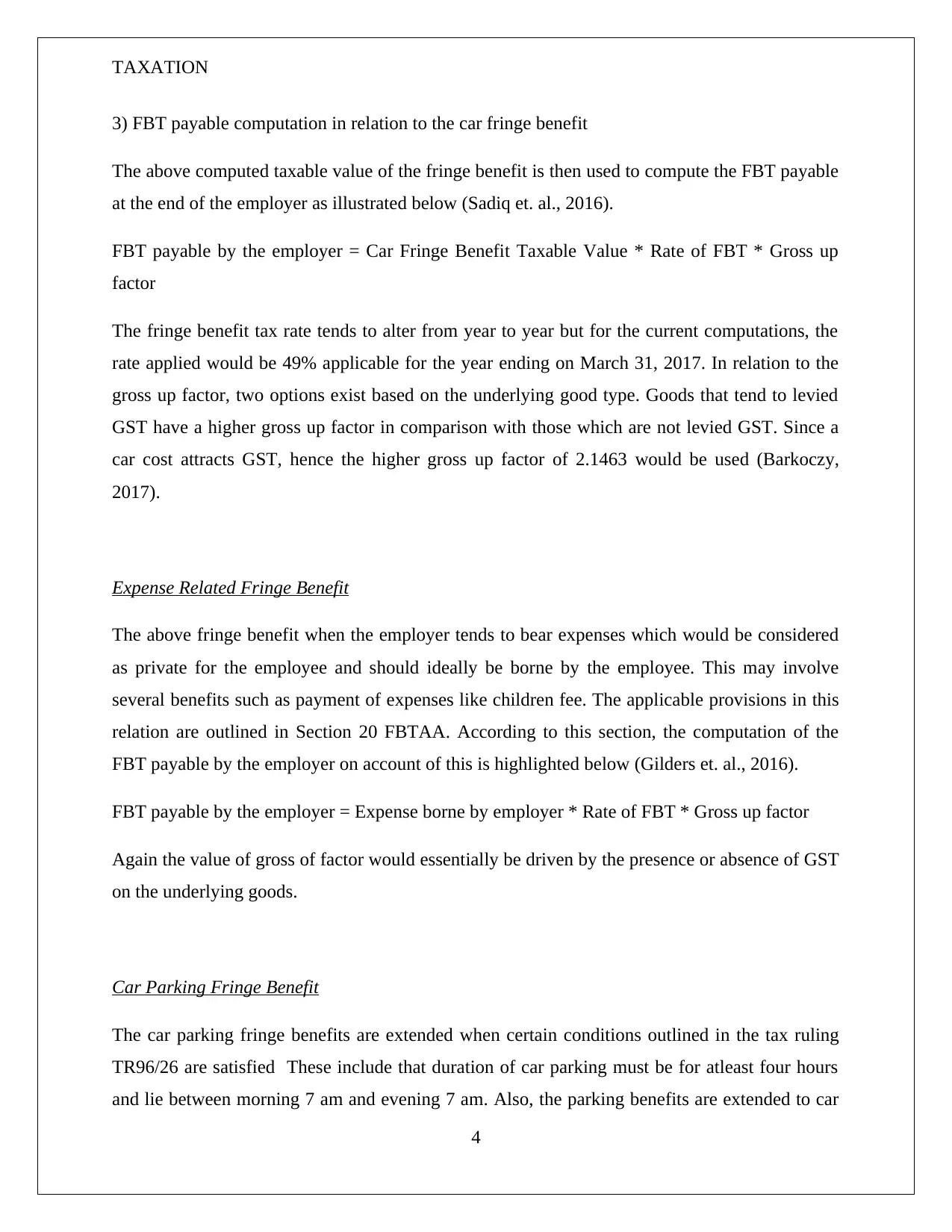
3) FBT payable computation in relation to the car fringe benefit
The above computed taxable value of the fringe benefit is then used to compute the FBT payable
at the end of the employer as illustrated below (Sadiq et. al., 2016).
FBT payable by the employer = Car Fringe Benefit Taxable Value * Rate of FBT * Gross up
factor
The fringe benefit tax rate tends to alter from year to year but for the current computations, the
rate applied would be 49% applicable for the year ending on March 31, 2017. In relation to the
gross up factor, two options exist based on the underlying good type. Goods that tend to levied
GST have a higher gross up factor in comparison with those which are not levied GST. Since a
car cost attracts GST, hence the higher gross up factor of 2.1463 would be used (Barkoczy,
2017).
Expense Related Fringe Benefit
The above fringe benefit when the employer tends to bear expenses which would be considered
as private for the employee and should ideally be borne by the employee. This may involve
several benefits such as payment of expenses like children fee. The applicable provisions in this
relation are outlined in Section 20 FBTAA. According to this section, the computation of the
FBT payable by the employer on account of this is highlighted below (Gilders et. al., 2016).
FBT payable by the employer = Expense borne by employer * Rate of FBT * Gross up factor
Again the value of gross of factor would essentially be driven by the presence or absence of GST
on the underlying goods.
Car Parking Fringe Benefit
The car parking fringe benefits are extended when certain conditions outlined in the tax ruling
TR96/26 are satisfied These include that duration of car parking must be for atleast four hours
and lie between morning 7 am and evening 7 am. Also, the parking benefits are extended to car
4
3) FBT payable computation in relation to the car fringe benefit
The above computed taxable value of the fringe benefit is then used to compute the FBT payable
at the end of the employer as illustrated below (Sadiq et. al., 2016).
FBT payable by the employer = Car Fringe Benefit Taxable Value * Rate of FBT * Gross up
factor
The fringe benefit tax rate tends to alter from year to year but for the current computations, the
rate applied would be 49% applicable for the year ending on March 31, 2017. In relation to the
gross up factor, two options exist based on the underlying good type. Goods that tend to levied
GST have a higher gross up factor in comparison with those which are not levied GST. Since a
car cost attracts GST, hence the higher gross up factor of 2.1463 would be used (Barkoczy,
2017).
Expense Related Fringe Benefit
The above fringe benefit when the employer tends to bear expenses which would be considered
as private for the employee and should ideally be borne by the employee. This may involve
several benefits such as payment of expenses like children fee. The applicable provisions in this
relation are outlined in Section 20 FBTAA. According to this section, the computation of the
FBT payable by the employer on account of this is highlighted below (Gilders et. al., 2016).
FBT payable by the employer = Expense borne by employer * Rate of FBT * Gross up factor
Again the value of gross of factor would essentially be driven by the presence or absence of GST
on the underlying goods.
Car Parking Fringe Benefit
The car parking fringe benefits are extended when certain conditions outlined in the tax ruling
TR96/26 are satisfied These include that duration of car parking must be for atleast four hours
and lie between morning 7 am and evening 7 am. Also, the parking benefits are extended to car
4
TAXATION
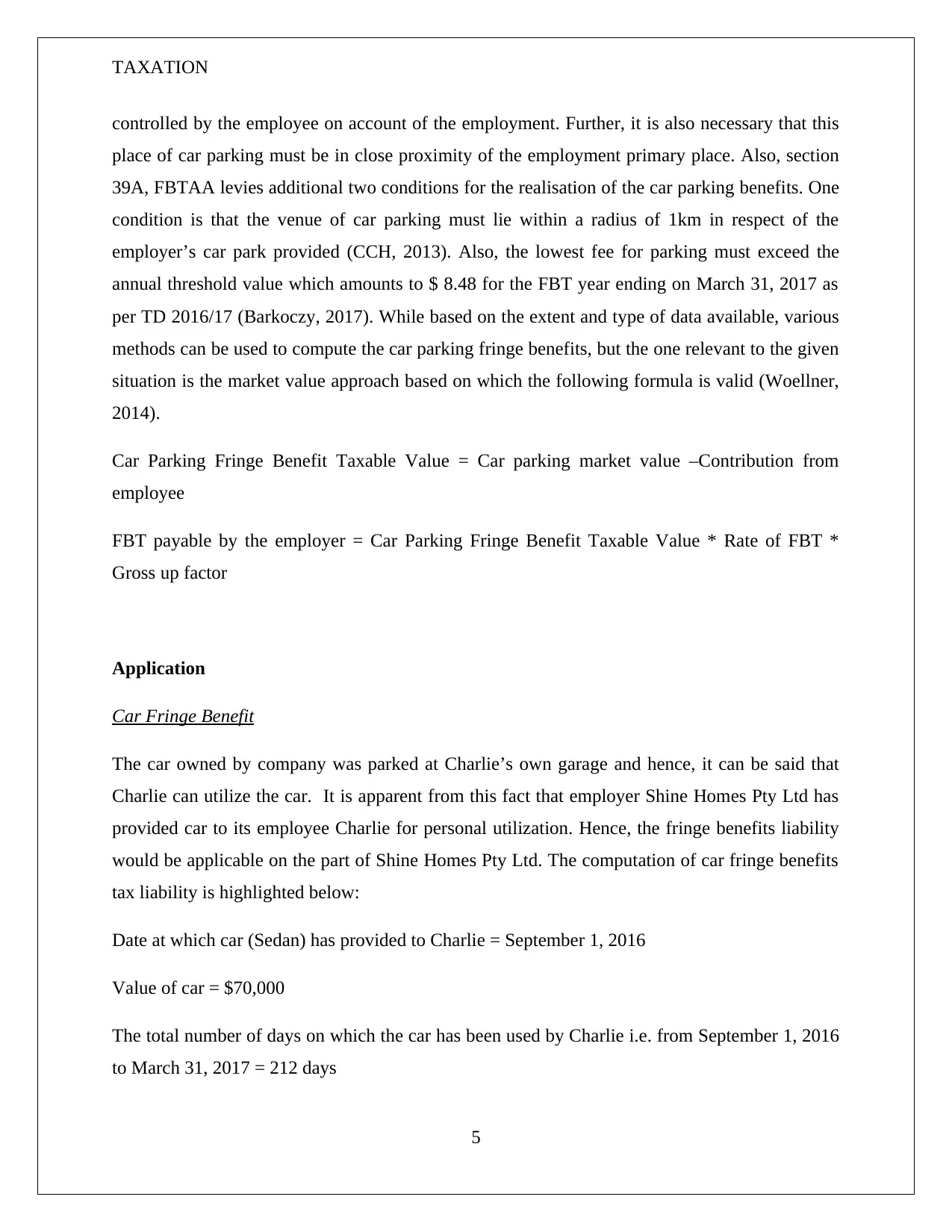
controlled by the employee on account of the employment. Further, it is also necessary that this
place of car parking must be in close proximity of the employment primary place. Also, section
39A, FBTAA levies additional two conditions for the realisation of the car parking benefits. One
condition is that the venue of car parking must lie within a radius of 1km in respect of the
employer’s car park provided (CCH, 2013). Also, the lowest fee for parking must exceed the
annual threshold value which amounts to $ 8.48 for the FBT year ending on March 31, 2017 as
per TD 2016/17 (Barkoczy, 2017). While based on the extent and type of data available, various
methods can be used to compute the car parking fringe benefits, but the one relevant to the given
situation is the market value approach based on which the following formula is valid (Woellner,
2014).
Car Parking Fringe Benefit Taxable Value = Car parking market value –Contribution from
employee
FBT payable by the employer = Car Parking Fringe Benefit Taxable Value * Rate of FBT *
Gross up factor
Application
Car Fringe Benefit
The car owned by company was parked at Charlie’s own garage and hence, it can be said that
Charlie can utilize the car. It is apparent from this fact that employer Shine Homes Pty Ltd has
provided car to its employee Charlie for personal utilization. Hence, the fringe benefits liability
would be applicable on the part of Shine Homes Pty Ltd. The computation of car fringe benefits
tax liability is highlighted below:
Date at which car (Sedan) has provided to Charlie = September 1, 2016
Value of car = $70,000
The total number of days on which the car has been used by Charlie i.e. from September 1, 2016
to March 31, 2017 = 212 days
5
controlled by the employee on account of the employment. Further, it is also necessary that this
place of car parking must be in close proximity of the employment primary place. Also, section
39A, FBTAA levies additional two conditions for the realisation of the car parking benefits. One
condition is that the venue of car parking must lie within a radius of 1km in respect of the
employer’s car park provided (CCH, 2013). Also, the lowest fee for parking must exceed the
annual threshold value which amounts to $ 8.48 for the FBT year ending on March 31, 2017 as
per TD 2016/17 (Barkoczy, 2017). While based on the extent and type of data available, various
methods can be used to compute the car parking fringe benefits, but the one relevant to the given
situation is the market value approach based on which the following formula is valid (Woellner,
2014).
Car Parking Fringe Benefit Taxable Value = Car parking market value –Contribution from
employee
FBT payable by the employer = Car Parking Fringe Benefit Taxable Value * Rate of FBT *
Gross up factor
Application
Car Fringe Benefit
The car owned by company was parked at Charlie’s own garage and hence, it can be said that
Charlie can utilize the car. It is apparent from this fact that employer Shine Homes Pty Ltd has
provided car to its employee Charlie for personal utilization. Hence, the fringe benefits liability
would be applicable on the part of Shine Homes Pty Ltd. The computation of car fringe benefits
tax liability is highlighted below:
Date at which car (Sedan) has provided to Charlie = September 1, 2016
Value of car = $70,000
The total number of days on which the car has been used by Charlie i.e. from September 1, 2016
to March 31, 2017 = 212 days
5
⊘ This is a preview!⊘
Do you want full access?
Subscribe today to unlock all pages.
Trusted by 1+ million students worldwide
TAXATION
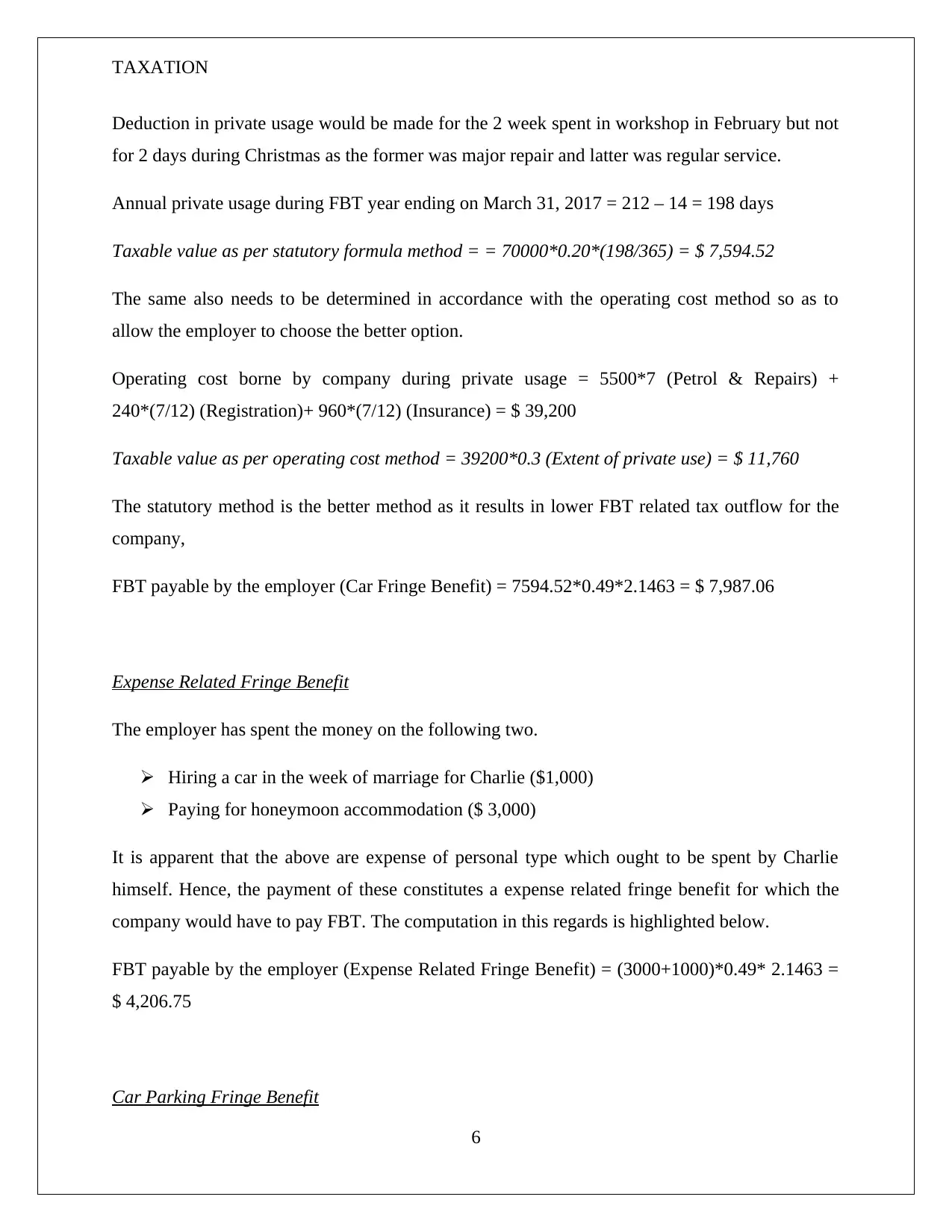
Deduction in private usage would be made for the 2 week spent in workshop in February but not
for 2 days during Christmas as the former was major repair and latter was regular service.
Annual private usage during FBT year ending on March 31, 2017 = 212 – 14 = 198 days
Taxable value as per statutory formula method = = 70000*0.20*(198/365) = $ 7,594.52
The same also needs to be determined in accordance with the operating cost method so as to
allow the employer to choose the better option.
Operating cost borne by company during private usage = 5500*7 (Petrol & Repairs) +
240*(7/12) (Registration)+ 960*(7/12) (Insurance) = $ 39,200
Taxable value as per operating cost method = 39200*0.3 (Extent of private use) = $ 11,760
The statutory method is the better method as it results in lower FBT related tax outflow for the
company,
FBT payable by the employer (Car Fringe Benefit) = 7594.52*0.49*2.1463 = $ 7,987.06
Expense Related Fringe Benefit
The employer has spent the money on the following two.
Hiring a car in the week of marriage for Charlie ($1,000)
Paying for honeymoon accommodation ($ 3,000)
It is apparent that the above are expense of personal type which ought to be spent by Charlie
himself. Hence, the payment of these constitutes a expense related fringe benefit for which the
company would have to pay FBT. The computation in this regards is highlighted below.
FBT payable by the employer (Expense Related Fringe Benefit) = (3000+1000)*0.49* 2.1463 =
$ 4,206.75
Car Parking Fringe Benefit
6
Deduction in private usage would be made for the 2 week spent in workshop in February but not
for 2 days during Christmas as the former was major repair and latter was regular service.
Annual private usage during FBT year ending on March 31, 2017 = 212 – 14 = 198 days
Taxable value as per statutory formula method = = 70000*0.20*(198/365) = $ 7,594.52
The same also needs to be determined in accordance with the operating cost method so as to
allow the employer to choose the better option.
Operating cost borne by company during private usage = 5500*7 (Petrol & Repairs) +
240*(7/12) (Registration)+ 960*(7/12) (Insurance) = $ 39,200
Taxable value as per operating cost method = 39200*0.3 (Extent of private use) = $ 11,760
The statutory method is the better method as it results in lower FBT related tax outflow for the
company,
FBT payable by the employer (Car Fringe Benefit) = 7594.52*0.49*2.1463 = $ 7,987.06
Expense Related Fringe Benefit
The employer has spent the money on the following two.
Hiring a car in the week of marriage for Charlie ($1,000)
Paying for honeymoon accommodation ($ 3,000)
It is apparent that the above are expense of personal type which ought to be spent by Charlie
himself. Hence, the payment of these constitutes a expense related fringe benefit for which the
company would have to pay FBT. The computation in this regards is highlighted below.
FBT payable by the employer (Expense Related Fringe Benefit) = (3000+1000)*0.49* 2.1463 =
$ 4,206.75
Car Parking Fringe Benefit
6
Paraphrase This Document
Need a fresh take? Get an instant paraphrase of this document with our AI Paraphraser
TAXATION
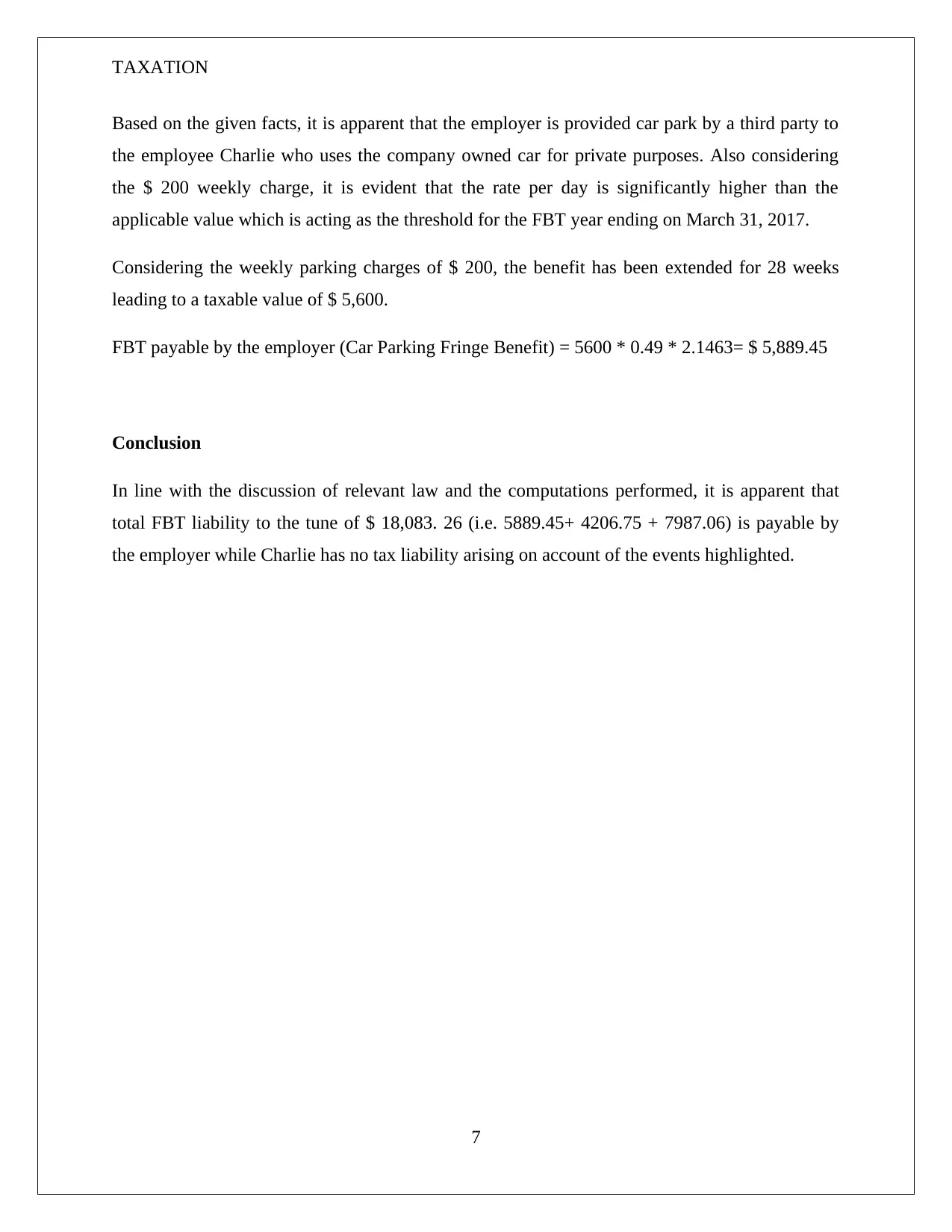
Based on the given facts, it is apparent that the employer is provided car park by a third party to
the employee Charlie who uses the company owned car for private purposes. Also considering
the $ 200 weekly charge, it is evident that the rate per day is significantly higher than the
applicable value which is acting as the threshold for the FBT year ending on March 31, 2017.
Considering the weekly parking charges of $ 200, the benefit has been extended for 28 weeks
leading to a taxable value of $ 5,600.
FBT payable by the employer (Car Parking Fringe Benefit) = 5600 * 0.49 * 2.1463= $ 5,889.45
Conclusion
In line with the discussion of relevant law and the computations performed, it is apparent that
total FBT liability to the tune of $ 18,083. 26 (i.e. 5889.45+ 4206.75 + 7987.06) is payable by
the employer while Charlie has no tax liability arising on account of the events highlighted.
7
Based on the given facts, it is apparent that the employer is provided car park by a third party to
the employee Charlie who uses the company owned car for private purposes. Also considering
the $ 200 weekly charge, it is evident that the rate per day is significantly higher than the
applicable value which is acting as the threshold for the FBT year ending on March 31, 2017.
Considering the weekly parking charges of $ 200, the benefit has been extended for 28 weeks
leading to a taxable value of $ 5,600.
FBT payable by the employer (Car Parking Fringe Benefit) = 5600 * 0.49 * 2.1463= $ 5,889.45
Conclusion
In line with the discussion of relevant law and the computations performed, it is apparent that
total FBT liability to the tune of $ 18,083. 26 (i.e. 5889.45+ 4206.75 + 7987.06) is payable by
the employer while Charlie has no tax liability arising on account of the events highlighted.
7
TAXATION
References
Statutes & Tax Rulings
Fringe Benefit Tax Assessment Act, 1986 (Cth)
TR 96/26
TD 2016/17
Books
Barkoczy, S. (2017), Foundation of Taxation Law 2017 (9thedition), North Ryde: CCH
Publications
CCH (2013), Australian Master Tax Guide 2013 (51st edition), Sydney: Wolters Kluwer
Deutsch, R., Freizer, M., Fullerton, I., Hanley, P., and Snape, T. (2016), Australian tax handbook
(8th edition), Pymont: Thomson Reuters,
Gilders, F., Taylor, J., Walpole, M., Burton, M. and Ciro, T. (2016), Understanding taxation law
2016 (9th edition), Sydney: LexisNexis/Butterworths.
Sadiq, K, Coleman, C, Hanegbi, R, Jogarajan, S, Krever, R, Obst, W, and Ting, A
(2016) , Principles of Taxation Law 2016 (8th edition), Pymont: Thomson Reuters
Woellner, R (2014), Australian taxation law 2014 (7th edition), North Ryde: CCH Australia
8
References
Statutes & Tax Rulings
Fringe Benefit Tax Assessment Act, 1986 (Cth)
TR 96/26
TD 2016/17
Books
Barkoczy, S. (2017), Foundation of Taxation Law 2017 (9thedition), North Ryde: CCH
Publications
CCH (2013), Australian Master Tax Guide 2013 (51st edition), Sydney: Wolters Kluwer
Deutsch, R., Freizer, M., Fullerton, I., Hanley, P., and Snape, T. (2016), Australian tax handbook
(8th edition), Pymont: Thomson Reuters,
Gilders, F., Taylor, J., Walpole, M., Burton, M. and Ciro, T. (2016), Understanding taxation law
2016 (9th edition), Sydney: LexisNexis/Butterworths.
Sadiq, K, Coleman, C, Hanegbi, R, Jogarajan, S, Krever, R, Obst, W, and Ting, A
(2016) , Principles of Taxation Law 2016 (8th edition), Pymont: Thomson Reuters
Woellner, R (2014), Australian taxation law 2014 (7th edition), North Ryde: CCH Australia
8
⊘ This is a preview!⊘
Do you want full access?
Subscribe today to unlock all pages.
Trusted by 1+ million students worldwide

1 out of 9


Related Documents


Your All-in-One AI-Powered Toolkit for Academic Success.
+13062052269
info@desklib.com
Available 24*7 on WhatsApp / Email
![[object Object]](/_next/static/media/star-bottom.7253800d.svg)
Unlock your academic potential
Copyright © 2020–2026 A2Z Services. All Rights Reserved. Developed and managed by ZUCOL.