Global Business Environment: Market Analysis and Legal Structures
VerifiedAdded on 2023/06/14
|10
|2201
|115
Report
AI Summary
This report provides an analysis of the global business environment, focusing on industrial structures and lifecycle models. It examines different market structures, including perfect competition, monopolistic competition, oligopoly, and monopoly, and their impact on businesses. The report also discusses the advantages and disadvantages of various legal structures for businesses, using Porter's Five Forces to evaluate competitive dynamics. It concludes that businesses must adapt to globalization and choose the right organizational structure to succeed, highlighting the importance of understanding market competitiveness and legal implications. This document is available on Desklib, a platform offering a range of study resources for students.
Global Business
Environment
1
Environment
1

Paraphrase This Document
Need a fresh take? Get an instant paraphrase of this document with our AI Paraphraser
Contents
Global Business Environment..........................................................................................................1
Contents...........................................................................................................................................2
2A.....................................................................................................................................................3
“Global Business Environment”.....................................................................................................3
Industrial Structure...........................................................................................................................4
Life cycle Model..............................................................................................................................3
2B.....................................................................................................................................................6
INTRODUCTON.............................................................................................................................6
Email message to a friend................................................................................................................6
CONCLUSION................................................................................................................................8
REFERENCES................................................................................................................................9
Books and journals......................................................................................................................9
2
Global Business Environment..........................................................................................................1
Contents...........................................................................................................................................2
2A.....................................................................................................................................................3
“Global Business Environment”.....................................................................................................3
Industrial Structure...........................................................................................................................4
Life cycle Model..............................................................................................................................3
2B.....................................................................................................................................................6
INTRODUCTON.............................................................................................................................6
Email message to a friend................................................................................................................6
CONCLUSION................................................................................................................................8
REFERENCES................................................................................................................................9
Books and journals......................................................................................................................9
2

2A.
3
3
⊘ This is a preview!⊘
Do you want full access?
Subscribe today to unlock all pages.

Trusted by 1+ million students worldwide
“Global Business
Environment”
This magazine article depicts the companies that
give services to clients all over the world.
Introduction
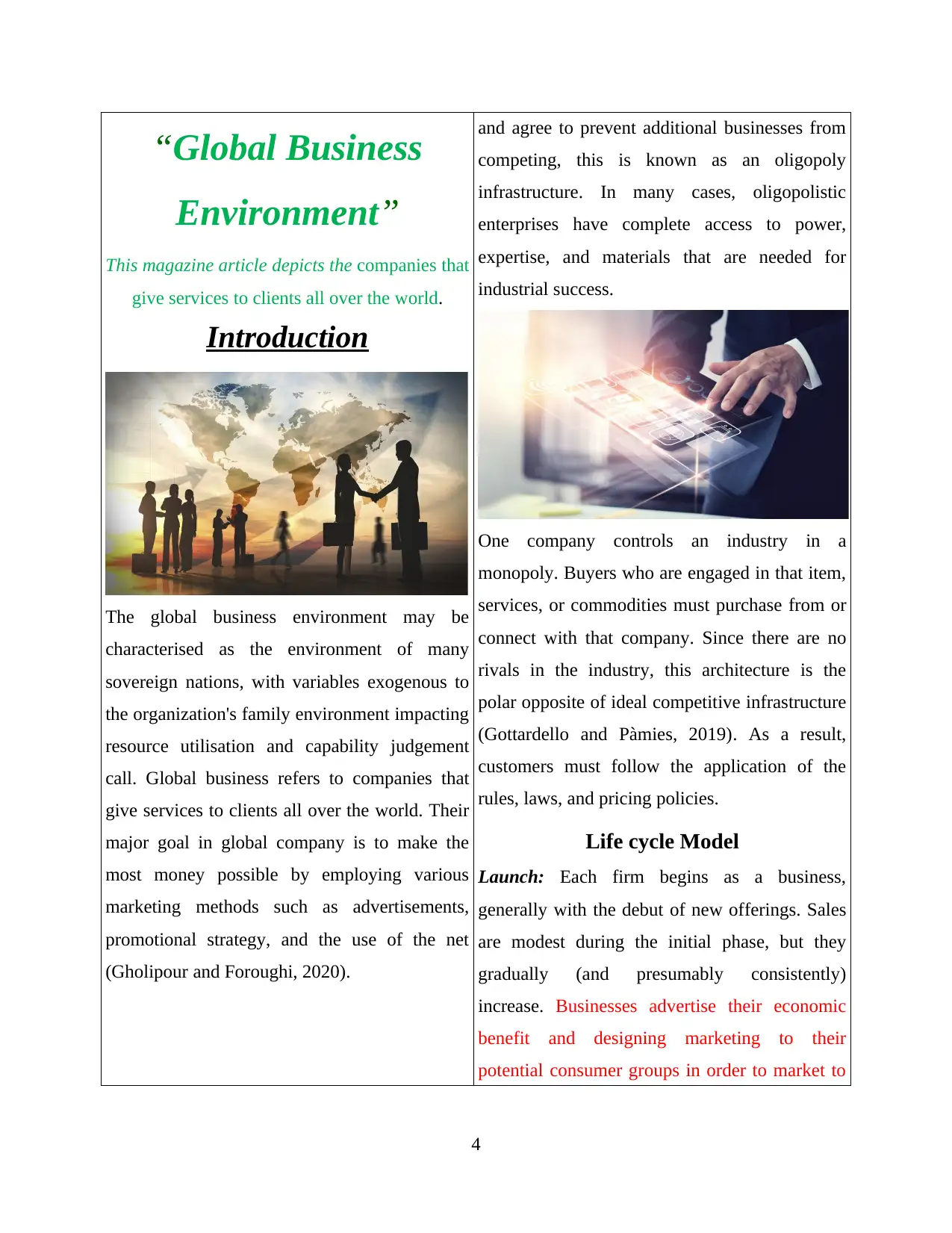
The global business environment may be
characterised as the environment of many
sovereign nations, with variables exogenous to
the organization's family environment impacting
resource utilisation and capability judgement
call. Global business refers to companies that
give services to clients all over the world. Their
major goal in global company is to make the
most money possible by employing various
marketing methods such as advertisements,
promotional strategy, and the use of the net
(Gholipour and Foroughi, 2020).
and agree to prevent additional businesses from
competing, this is known as an oligopoly
infrastructure. In many cases, oligopolistic
enterprises have complete access to power,
expertise, and materials that are needed for
industrial success.
One company controls an industry in a
monopoly. Buyers who are engaged in that item,
services, or commodities must purchase from or
connect with that company. Since there are no
rivals in the industry, this architecture is the
polar opposite of ideal competitive infrastructure
(Gottardello and Pàmies, 2019). As a result,
customers must follow the application of the
rules, laws, and pricing policies.
Life cycle Model
Launch: Each firm begins as a business,
generally with the debut of new offerings. Sales
are modest during the initial phase, but they
gradually (and presumably consistently)
increase. Businesses advertise their economic
benefit and designing marketing to their
potential consumer groups in order to market to
4
Environment”
This magazine article depicts the companies that
give services to clients all over the world.
Introduction
The global business environment may be
characterised as the environment of many
sovereign nations, with variables exogenous to
the organization's family environment impacting
resource utilisation and capability judgement
call. Global business refers to companies that
give services to clients all over the world. Their
major goal in global company is to make the
most money possible by employing various
marketing methods such as advertisements,
promotional strategy, and the use of the net
(Gholipour and Foroughi, 2020).
and agree to prevent additional businesses from
competing, this is known as an oligopoly
infrastructure. In many cases, oligopolistic
enterprises have complete access to power,
expertise, and materials that are needed for
industrial success.
One company controls an industry in a
monopoly. Buyers who are engaged in that item,
services, or commodities must purchase from or
connect with that company. Since there are no
rivals in the industry, this architecture is the
polar opposite of ideal competitive infrastructure
(Gottardello and Pàmies, 2019). As a result,
customers must follow the application of the
rules, laws, and pricing policies.
Life cycle Model
Launch: Each firm begins as a business,
generally with the debut of new offerings. Sales
are modest during the initial phase, but they
gradually (and presumably consistently)
increase. Businesses advertise their economic
benefit and designing marketing to their
potential consumer groups in order to market to
4
Paraphrase This Document
Need a fresh take? Get an instant paraphrase of this document with our AI Paraphraser
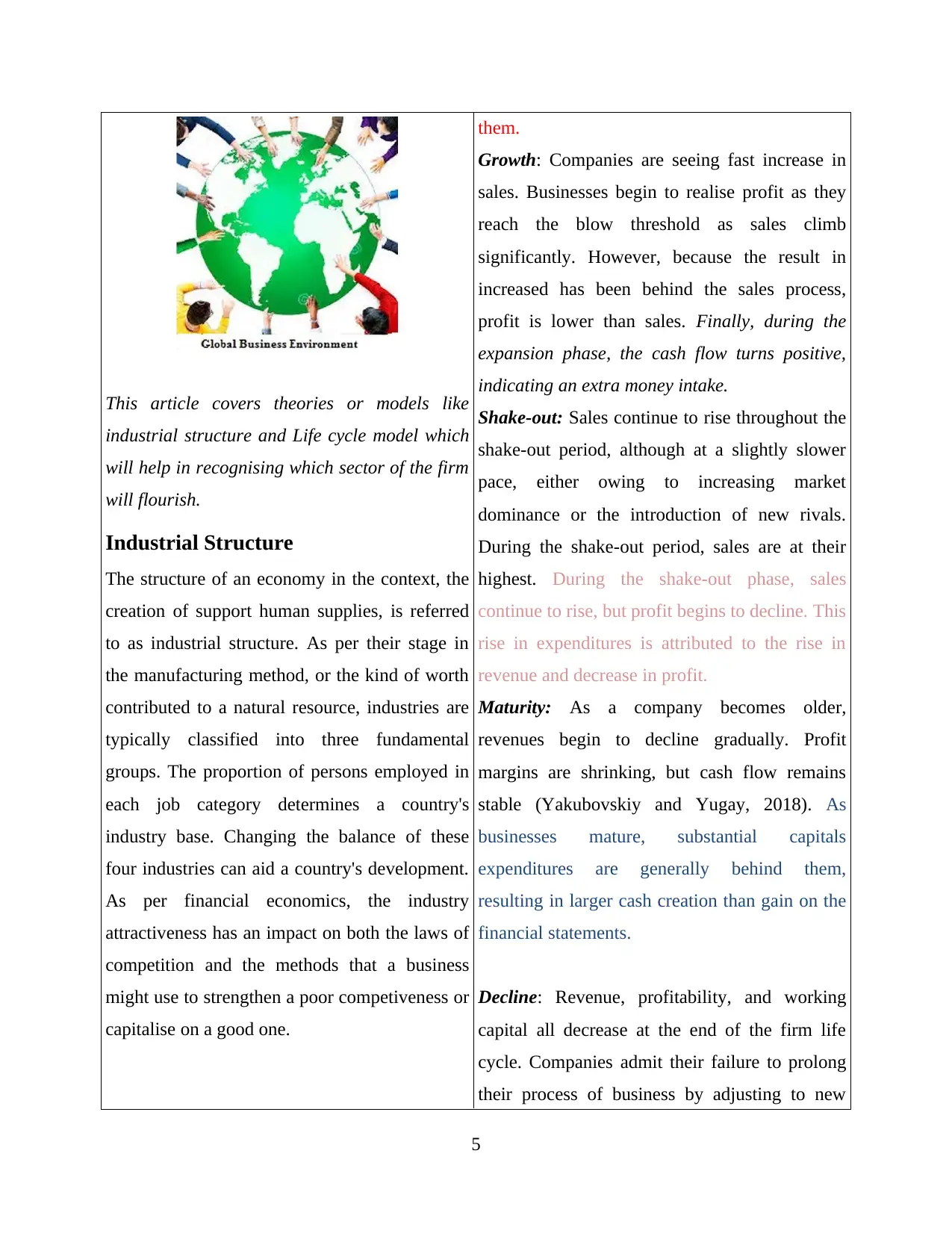
This article covers theories or models like
industrial structure and Life cycle model which
will help in recognising which sector of the firm
will flourish.
Industrial Structure
The structure of an economy in the context, the
creation of support human supplies, is referred
to as industrial structure. As per their stage in
the manufacturing method, or the kind of worth
contributed to a natural resource, industries are
typically classified into three fundamental
groups. The proportion of persons employed in
each job category determines a country's
industry base. Changing the balance of these
four industries can aid a country's development.
As per financial economics, the industry
attractiveness has an impact on both the laws of
competition and the methods that a business
might use to strengthen a poor competiveness or
capitalise on a good one.
them.
Growth: Companies are seeing fast increase in
sales. Businesses begin to realise profit as they
reach the blow threshold as sales climb
significantly. However, because the result in
increased has been behind the sales process,
profit is lower than sales. Finally, during the
expansion phase, the cash flow turns positive,
indicating an extra money intake.
Shake-out: Sales continue to rise throughout the
shake-out period, although at a slightly slower
pace, either owing to increasing market
dominance or the introduction of new rivals.
During the shake-out period, sales are at their
highest. During the shake-out phase, sales
continue to rise, but profit begins to decline. This
rise in expenditures is attributed to the rise in
revenue and decrease in profit.
Maturity: As a company becomes older,
revenues begin to decline gradually. Profit
margins are shrinking, but cash flow remains
stable (Yakubovskiy and Yugay, 2018). As
businesses mature, substantial capitals
expenditures are generally behind them,
resulting in larger cash creation than gain on the
financial statements.
Decline: Revenue, profitability, and working
capital all decrease at the end of the firm life
cycle. Companies admit their failure to prolong
their process of business by adjusting to new
5
industrial structure and Life cycle model which
will help in recognising which sector of the firm
will flourish.
Industrial Structure
The structure of an economy in the context, the
creation of support human supplies, is referred
to as industrial structure. As per their stage in
the manufacturing method, or the kind of worth
contributed to a natural resource, industries are
typically classified into three fundamental
groups. The proportion of persons employed in
each job category determines a country's
industry base. Changing the balance of these
four industries can aid a country's development.
As per financial economics, the industry
attractiveness has an impact on both the laws of
competition and the methods that a business
might use to strengthen a poor competiveness or
capitalise on a good one.
them.
Growth: Companies are seeing fast increase in
sales. Businesses begin to realise profit as they
reach the blow threshold as sales climb
significantly. However, because the result in
increased has been behind the sales process,
profit is lower than sales. Finally, during the
expansion phase, the cash flow turns positive,
indicating an extra money intake.
Shake-out: Sales continue to rise throughout the
shake-out period, although at a slightly slower
pace, either owing to increasing market
dominance or the introduction of new rivals.
During the shake-out period, sales are at their
highest. During the shake-out phase, sales
continue to rise, but profit begins to decline. This
rise in expenditures is attributed to the rise in
revenue and decrease in profit.
Maturity: As a company becomes older,
revenues begin to decline gradually. Profit
margins are shrinking, but cash flow remains
stable (Yakubovskiy and Yugay, 2018). As
businesses mature, substantial capitals
expenditures are generally behind them,
resulting in larger cash creation than gain on the
financial statements.
Decline: Revenue, profitability, and working
capital all decrease at the end of the firm life
cycle. Companies admit their failure to prolong
their process of business by adjusting to new
5
Businesses are impacted by a variety of
exogenous factors, including the status of the
market, evolving customer patterns, and even
natural calamities. Every sector has facilities
that can influence a firm's successes and
failures. There are four kinds of industrial
structures as Perfect competition, monopolistic
competence, oligopoly and monopoly.
In perfect competition, many firms sell identical
products, commodities, and services and battle
for the same potential customers in a perfectly
competitive infrastructure. There is no single
corporation that has a monopoly on the market.
Because competing firms must provide enticing
prices in order to earn a profit, this sort of
competition guarantees that customers have a
wide range of pricing alternatives.
Many firms sell products that are identical yet
differ somewhat in a monopolistic competition
framework. As a consequence of these
distinctions, some of these firms are able to gain
a competitive edge that enables them to be more
lucrative than their competitors.
When a few tiny enterprises control an industry
business environments at this phase. Companies
eventually lose their comparative benefit and
quit the market.
From price and advertising through development
and price, the manufacturing process idea aids
business decision (Kirikkaleli and Ozun, 2019).
Earlier, less profitable items are pushed out of
the marketplace by newer, more fortunate
entrepreneurs.
Conclusion
It is concluded from the above report is that
Companies will be impacted by commercial
globalisation. Not only will people buy things
made in other nations, but they will very
certainly encounter and work with people from
different cultural groups as clients, suppliers, co-
workers, workers, or supervisors. The final truth
is that the globalisation of world trade affects
everyone.
6
exogenous factors, including the status of the
market, evolving customer patterns, and even
natural calamities. Every sector has facilities
that can influence a firm's successes and
failures. There are four kinds of industrial
structures as Perfect competition, monopolistic
competence, oligopoly and monopoly.
In perfect competition, many firms sell identical
products, commodities, and services and battle
for the same potential customers in a perfectly
competitive infrastructure. There is no single
corporation that has a monopoly on the market.
Because competing firms must provide enticing
prices in order to earn a profit, this sort of
competition guarantees that customers have a
wide range of pricing alternatives.
Many firms sell products that are identical yet
differ somewhat in a monopolistic competition
framework. As a consequence of these
distinctions, some of these firms are able to gain
a competitive edge that enables them to be more
lucrative than their competitors.
When a few tiny enterprises control an industry
business environments at this phase. Companies
eventually lose their comparative benefit and
quit the market.
From price and advertising through development
and price, the manufacturing process idea aids
business decision (Kirikkaleli and Ozun, 2019).
Earlier, less profitable items are pushed out of
the marketplace by newer, more fortunate
entrepreneurs.
Conclusion
It is concluded from the above report is that
Companies will be impacted by commercial
globalisation. Not only will people buy things
made in other nations, but they will very
certainly encounter and work with people from
different cultural groups as clients, suppliers, co-
workers, workers, or supervisors. The final truth
is that the globalisation of world trade affects
everyone.
6
⊘ This is a preview!⊘
Do you want full access?
Subscribe today to unlock all pages.
Trusted by 1+ million students worldwide
2B.
INTRODUCTON
The epidemic has resulted in the greatest and quickest drop in international flows in modern
history, including commerce, overseas investment, and tourism industry. While these figures
indicate a significant reversal of recent globalisation achievements, they do not necessarily
indicate a fundamental breakdown in international market integration. The epidemic has inspired
a fresh round of globalisation obituaries, but the most recent statistics and projections suggest
that executives should prepare for and create a future in which both globalisation and anti-
globalization impulses are permanent elements of the corporate landscape (Baba, Makhdoomi
and Siddiqi, 2021). This file covers advantages and disadvantages of various legal structures and
the competence of the structure of a marketplace.
Email message to a friend
From ABC,
Subject: To start a new business
The legal form of an organisation determines what activities it may engage in, such as raising
cash. In a business plan, the legal basis of organisation is used to determine how the company
will operate, how responsibilities will be organised and given, and how connections will
function. These organisational measures should be taken right at the start of a company's
establishment. A sole proprietor or an LLC may be the best option for user if they desire sole or
principal control over your firm and its operations. Control can also be negotiated in a
memorandum of understanding. A business is designed to have an executive board that
determines the company's crucial choices. In case of their initial idea of cheap mobile from
Taiwan or china and then to selling them to rural investors to grow their firm, legal structure
have various pros and cons.
The tax and economic reality of the company's day-to-day upkeep and management will be
profoundly influenced by its formal document. Everything from the documents business must
retain to the quality and number of tax business must collect will be affected. It protects big
businesses from personally liable while also lowering company's tax obligations (Amankwah-
7
INTRODUCTON
The epidemic has resulted in the greatest and quickest drop in international flows in modern
history, including commerce, overseas investment, and tourism industry. While these figures
indicate a significant reversal of recent globalisation achievements, they do not necessarily
indicate a fundamental breakdown in international market integration. The epidemic has inspired
a fresh round of globalisation obituaries, but the most recent statistics and projections suggest
that executives should prepare for and create a future in which both globalisation and anti-
globalization impulses are permanent elements of the corporate landscape (Baba, Makhdoomi
and Siddiqi, 2021). This file covers advantages and disadvantages of various legal structures and
the competence of the structure of a marketplace.
Email message to a friend
From ABC,
Subject: To start a new business
The legal form of an organisation determines what activities it may engage in, such as raising
cash. In a business plan, the legal basis of organisation is used to determine how the company
will operate, how responsibilities will be organised and given, and how connections will
function. These organisational measures should be taken right at the start of a company's
establishment. A sole proprietor or an LLC may be the best option for user if they desire sole or
principal control over your firm and its operations. Control can also be negotiated in a
memorandum of understanding. A business is designed to have an executive board that
determines the company's crucial choices. In case of their initial idea of cheap mobile from
Taiwan or china and then to selling them to rural investors to grow their firm, legal structure
have various pros and cons.
The tax and economic reality of the company's day-to-day upkeep and management will be
profoundly influenced by its formal document. Everything from the documents business must
retain to the quality and number of tax business must collect will be affected. It protects big
businesses from personally liable while also lowering company's tax obligations (Amankwah-
7
Paraphrase This Document
Need a fresh take? Get an instant paraphrase of this document with our AI Paraphraser
Amoah and Adomako, 2019). The earnings and liabilities of the firm are distributed to the
shareholders, who are expected to submit a part of the proceeds and deficits on their tax filings.
A company's incorporation is a lengthy and complicated legal procedure that takes a lot of time
and resources. These complicated processes have been put in place to deter folks who aren't
genuine or enthusiastic about someone doing trade. Many incorporated businesses have billion-
dollar net worth and so employment citizens. An established firm must also pay federal taxes at a
given price on all of its earnings, while other businesses are taxed at a progressive or slab level.
Porter's Five Forces analysis was created to assist firms in evaluating the competition factors at
work in their sector and engaging in strategy development that takes into consideration the
unique characteristics of their market structures as well as the potential importance of sellers and
consumers.
Competitive Rivalry: This is where users assess the competitiveness in particular sector depend
on the amount of rivals and their relative merits (Uchehara, 2019). In case of importing cheap
mobile phones businesses have a pressure to reduce costs and invest substantial sums of money
on advertising in effort to keep competiveness if they have a high number of additional rivals.
Supplier Power: It's simpler to keep company prices down if they have a lot of good suppliers.
In context of importing cheap mobile phones, requiring small providers to select from, on the
other hand, reduces overall authority and reduces their possibility of getting a lengthy reduced
source.
Bargaining Power: Buyer ability to negotiate has a significant impact on the pricing at which
user may sell. The strength of potential consumers grows when they only engage with a few
purchasers (White, 2018). In relation to import cheap mobile phones, users have more option to
establish their business conditions and retain earnings if they have a large customer base.
Threat of substitution: The danger of replacement refers to the many options and solutions that
consumers may employ in order to duplicate their services. In case of importing cheap mobile
phones, if some other goods or services can easily be substituted for it as well, company profit
may decrease.
Threat of new entry: If charges are cheap and knowledge is simple to get by, an entrant can
swiftly fundamentally alter the competition of any business.
Thanks,
ABC
8
shareholders, who are expected to submit a part of the proceeds and deficits on their tax filings.
A company's incorporation is a lengthy and complicated legal procedure that takes a lot of time
and resources. These complicated processes have been put in place to deter folks who aren't
genuine or enthusiastic about someone doing trade. Many incorporated businesses have billion-
dollar net worth and so employment citizens. An established firm must also pay federal taxes at a
given price on all of its earnings, while other businesses are taxed at a progressive or slab level.
Porter's Five Forces analysis was created to assist firms in evaluating the competition factors at
work in their sector and engaging in strategy development that takes into consideration the
unique characteristics of their market structures as well as the potential importance of sellers and
consumers.
Competitive Rivalry: This is where users assess the competitiveness in particular sector depend
on the amount of rivals and their relative merits (Uchehara, 2019). In case of importing cheap
mobile phones businesses have a pressure to reduce costs and invest substantial sums of money
on advertising in effort to keep competiveness if they have a high number of additional rivals.
Supplier Power: It's simpler to keep company prices down if they have a lot of good suppliers.
In context of importing cheap mobile phones, requiring small providers to select from, on the
other hand, reduces overall authority and reduces their possibility of getting a lengthy reduced
source.
Bargaining Power: Buyer ability to negotiate has a significant impact on the pricing at which
user may sell. The strength of potential consumers grows when they only engage with a few
purchasers (White, 2018). In relation to import cheap mobile phones, users have more option to
establish their business conditions and retain earnings if they have a large customer base.
Threat of substitution: The danger of replacement refers to the many options and solutions that
consumers may employ in order to duplicate their services. In case of importing cheap mobile
phones, if some other goods or services can easily be substituted for it as well, company profit
may decrease.
Threat of new entry: If charges are cheap and knowledge is simple to get by, an entrant can
swiftly fundamentally alter the competition of any business.
Thanks,
ABC
8
CONCLUSION
It is concluded from the above report is that choosing the right sort of trade organization for the
firm is among the first and most significant choices they will make as a business person. Because
the structure they pick might have long-term financial and potential repercussions, it's critical to
do it properly. Porter's Five Forces model is more suitable for determining the most relevant
competitiveness at employee in a particular business. This can help elucidate the desirability of a
market and identifying areas where company approach can be tweaked to boost profits.
9
It is concluded from the above report is that choosing the right sort of trade organization for the
firm is among the first and most significant choices they will make as a business person. Because
the structure they pick might have long-term financial and potential repercussions, it's critical to
do it properly. Porter's Five Forces model is more suitable for determining the most relevant
competitiveness at employee in a particular business. This can help elucidate the desirability of a
market and identifying areas where company approach can be tweaked to boost profits.
9
⊘ This is a preview!⊘
Do you want full access?
Subscribe today to unlock all pages.
Trusted by 1+ million students worldwide
REFERENCES
Books and journals
Gholipour, H.F. and Foroughi, B., 2020. Corruption and outbound business travels. Tourism
Economics, 26(7), pp.1266-1281.
Gottardello, D. and Pàmies, M.D.M., 2019. Business school professors’ perception of ethics in
education in Europe. Sustainability, 11(3), p.608.
Yakubovskiy, S.A. and Yugay, K.S., 2018. Modern dominants of the transnationalization of
international business. Вісник Одеського національного університету. Серія:
Економіка, (23, Вип. 1), pp.12-16.
Kirikkaleli, D. and Ozun, A., 2019. Innovation capacity, business sophistication and
macroeconomic stability: Empirical evidence from OECD countries. Journal of Business
Economics and Management, 20(2), pp.351-367.
Baba, M.M., Makhdoomi, U.M. and Siddiqi, M.A., 2021. Emotional intelligence and
transformational leadership among academic leaders in institutions of higher
learning. Global Business Review, 22(4), pp.1070-1096.
Amankwah-Amoah, J. and Adomako, S., 2019. Big data analytics and business failures in data-
Rich environments: An organizing framework. Computers in Industry, 105, pp.204-212.
Uchehara, F.O., 2019. Building a Corporate Competitiveness through Corporate Social
Responsibility Drives. International Journal of Academic Research Business and Social
Sciences, 9(5), pp.531-541.
White, S., 2018. Creating better business environments for micro and small enterprises.
Technical Report, Donor Committee for Enterprise Development. Cambridge, 55.
10
Books and journals
Gholipour, H.F. and Foroughi, B., 2020. Corruption and outbound business travels. Tourism
Economics, 26(7), pp.1266-1281.
Gottardello, D. and Pàmies, M.D.M., 2019. Business school professors’ perception of ethics in
education in Europe. Sustainability, 11(3), p.608.
Yakubovskiy, S.A. and Yugay, K.S., 2018. Modern dominants of the transnationalization of
international business. Вісник Одеського національного університету. Серія:
Економіка, (23, Вип. 1), pp.12-16.
Kirikkaleli, D. and Ozun, A., 2019. Innovation capacity, business sophistication and
macroeconomic stability: Empirical evidence from OECD countries. Journal of Business
Economics and Management, 20(2), pp.351-367.
Baba, M.M., Makhdoomi, U.M. and Siddiqi, M.A., 2021. Emotional intelligence and
transformational leadership among academic leaders in institutions of higher
learning. Global Business Review, 22(4), pp.1070-1096.
Amankwah-Amoah, J. and Adomako, S., 2019. Big data analytics and business failures in data-
Rich environments: An organizing framework. Computers in Industry, 105, pp.204-212.
Uchehara, F.O., 2019. Building a Corporate Competitiveness through Corporate Social
Responsibility Drives. International Journal of Academic Research Business and Social
Sciences, 9(5), pp.531-541.
White, S., 2018. Creating better business environments for micro and small enterprises.
Technical Report, Donor Committee for Enterprise Development. Cambridge, 55.
10

1 out of 10


Related Documents


Your All-in-One AI-Powered Toolkit for Academic Success.
+13062052269
info@desklib.com
Available 24*7 on WhatsApp / Email
![[object Object]](/_next/static/media/star-bottom.7253800d.svg)
Unlock your academic potential
Copyright © 2020–2026 A2Z Services. All Rights Reserved. Developed and managed by ZUCOL.