Global Business Environment: Key Factors, Strategies, and Influences
VerifiedAdded on 2024/05/23
|25
|5351
|260
Report
AI Summary
This report provides a comprehensive analysis of the global business environment, focusing on the key factors driving globalization, such as cost, environment, market, and competition, and their impact on organizations like Marks and Spencer. It examines the strategic complexities associated with operating in a global environment, including economic fluctuations, flawed execution of new selling channels, and loss of customer engagement. The report also includes a PESTLE and SWOT analysis to assess the external factors and internal strengths and weaknesses of global businesses. Furthermore, it evaluates the influence of globalization on organizational structure, culture, and functions using McKinsey’s 7S model and Hofstede's cultural dimensions, and explores its impact on decision-making and strategy adoption processes. The report concludes by highlighting the challenges and opportunities that globalization presents to businesses operating in the international market.
GLOBAL BUSINESS ENVIRONMENT
1
1

Paraphrase This Document
Need a fresh take? Get an instant paraphrase of this document with our AI Paraphraser
Table of Contents
Introduction......................................................................................................................................3
LO1: Analyze the key factors which drive globalization................................................................3
Question 1: Analysis and discussion of key factors driving global trade and commerce...............3
LO2: Determine the strategic complexities associated with operating in a global environment.. . .4
Question 2: Explaining the strategic complexities associated with operations in a global
environment.................................................................................................................................4
Question 3: PESTLE and SWOT analysis...................................................................................6
LO3: Evaluate how operating in global market influences an organization’s structure, culture and
functions..........................................................................................................................................8
Question 4: Influences of globalisation in organization’s structure, culture and functions.........8
McKinsey’s 7S model..................................................................................................................8
Table 2: McKinsey’s 7S model....................................................................................................9
Figure 2: McKinsey’s 7S model..................................................................................................9
Figure 3: Hofstadter’s Dimensions............................................................................................15
LO4: Evaluate the influence of globalization on organizational decision making and strategy.. .16
Question 5: Influence of globalization on organizational decision making and strategy..........16
Question 6: Researching on the strategy adoption process........................................................18
Conclusion.....................................................................................................................................19
References......................................................................................................................................20
2
Introduction......................................................................................................................................3
LO1: Analyze the key factors which drive globalization................................................................3
Question 1: Analysis and discussion of key factors driving global trade and commerce...............3
LO2: Determine the strategic complexities associated with operating in a global environment.. . .4
Question 2: Explaining the strategic complexities associated with operations in a global
environment.................................................................................................................................4
Question 3: PESTLE and SWOT analysis...................................................................................6
LO3: Evaluate how operating in global market influences an organization’s structure, culture and
functions..........................................................................................................................................8
Question 4: Influences of globalisation in organization’s structure, culture and functions.........8
McKinsey’s 7S model..................................................................................................................8
Table 2: McKinsey’s 7S model....................................................................................................9
Figure 2: McKinsey’s 7S model..................................................................................................9
Figure 3: Hofstadter’s Dimensions............................................................................................15
LO4: Evaluate the influence of globalization on organizational decision making and strategy.. .16
Question 5: Influence of globalization on organizational decision making and strategy..........16
Question 6: Researching on the strategy adoption process........................................................18
Conclusion.....................................................................................................................................19
References......................................................................................................................................20
2
Introduction
Global market influences the structure, function and culture of the organisation. This paper
describes the influence of decision-making process towards the formulation of organisation
strategies. Marks and Spencer is one of the largest retail stores in the UK which provides high-
quality food, branded clothes and home products to the international consumers. The
commitment of the company towards providing branded and better quality brands differentiate
the company from their competitors. This company generally deliveries the food materials and
grocery items for the consumers. The business of Marks and Spencer’s is built up through strong
values of inspiration, innovation and integrity. These values helped the organisation to stand
upright among the competitors.
LO1: Analyze the key factors which drive globalization
Question 1: Analysis and discussion of key factors driving global trade and commerce
In recent years success of globalisation provided an evidence of increased foreign trade,
acceleration of growth rates, capital flows and rising of per capita GDP to the developed
countries. Countries In global has opened up individual's economy to rest of the world through
following a closed economy model. Variety of factors is contributed to the globalisation process
and among which four basic influential factors are listed below.
I. Cost
As per Glavina (2015), maximising investment is the key motivator for efficiency development
in the global company. Marks and Spencer’s are investing in several costs while expanding the
business in UAE. The company is using promotion and advertising strategy to sense the products
to the consumers. Transportation cost is another existing key factor in the business flow. In this
case, the global opportunity has created a tough decision for the marketing department to pursue
the price leadership.
II. Environment
Increasing consumer’s mobility and wealth brought rapid transformation in the purchasing
behaviour. In order to expand the business, the company seeks more positive environment. The
environment of the demand of customers forecasts the organization's future. In UAE the demand
3
Global market influences the structure, function and culture of the organisation. This paper
describes the influence of decision-making process towards the formulation of organisation
strategies. Marks and Spencer is one of the largest retail stores in the UK which provides high-
quality food, branded clothes and home products to the international consumers. The
commitment of the company towards providing branded and better quality brands differentiate
the company from their competitors. This company generally deliveries the food materials and
grocery items for the consumers. The business of Marks and Spencer’s is built up through strong
values of inspiration, innovation and integrity. These values helped the organisation to stand
upright among the competitors.
LO1: Analyze the key factors which drive globalization
Question 1: Analysis and discussion of key factors driving global trade and commerce
In recent years success of globalisation provided an evidence of increased foreign trade,
acceleration of growth rates, capital flows and rising of per capita GDP to the developed
countries. Countries In global has opened up individual's economy to rest of the world through
following a closed economy model. Variety of factors is contributed to the globalisation process
and among which four basic influential factors are listed below.
I. Cost
As per Glavina (2015), maximising investment is the key motivator for efficiency development
in the global company. Marks and Spencer’s are investing in several costs while expanding the
business in UAE. The company is using promotion and advertising strategy to sense the products
to the consumers. Transportation cost is another existing key factor in the business flow. In this
case, the global opportunity has created a tough decision for the marketing department to pursue
the price leadership.
II. Environment
Increasing consumer’s mobility and wealth brought rapid transformation in the purchasing
behaviour. In order to expand the business, the company seeks more positive environment. The
environment of the demand of customers forecasts the organization's future. In UAE the demand
3
⊘ This is a preview!⊘
Do you want full access?
Subscribe today to unlock all pages.

Trusted by 1+ million students worldwide
for retail stores is very high. The technological revolution in UAE is very good which makes
easier payment and smooth flow in purchasing procedures for consumers. The newly emerging
market, Marks and Spencer gains benefit from the advanced communications.
III. Market
Consumers in the advanced economies are more similar in terms of income, aspirations, lifestyle,
education and leisure time (Hu et al. 2016). Marketers of Marks and Spencer’s are made certain
products ready for the buyers in UAE with well-developed infrastructure and high purchasing
power.
IV. Competition
According to Zheng (2017), in order to remain competitive, the global rival companies need to
identify their competitors. The competitors can be of two types direct and indirect. The direct
competitors are those which are having same business areas, whereas the indirect competitors
differ from the business area. The competitive companies of Marks and Spencers introduce,
distribute and upgrade the new products available within the market at a faster pace. As stated by
Dodson (2015), the companies that do not remain ahead will face the competition risk by the
global players. There is no structural reason for why the specific products are more attractive to
the consumers compared to rest of the others. Most of the products of Spencer's are sold in the
UAE in huge quantity. The competition in UAE for retail products is very high and this in term
helps the organisation to introduce more varieties of brands.
Discussing the critical impact of these key factors
The key factor of the market helped Marks and Spencer to pick up the regions for opening the
store and expand the business. The regional grouping has helped to follow the organisational
structure for existing management. The key factors of globalisation helped to find the alternative
strategy for Marks and Spencer to expand in UAE. Balancing the cost differentiation and
leadership helped the company to make mass customisation.
Benefits faced by the Marks and Spencer’s
Similar behavioural traits and demographic status helped the organisation to find the key
business interest of the consumer. The goal has been set to achieve the mileage from the
investment cost in UAE. The key factors of globalisation helped Marks and Spencer’s to make
product differentiation. The marketers of the company can be able to take advantage of value
4
easier payment and smooth flow in purchasing procedures for consumers. The newly emerging
market, Marks and Spencer gains benefit from the advanced communications.
III. Market
Consumers in the advanced economies are more similar in terms of income, aspirations, lifestyle,
education and leisure time (Hu et al. 2016). Marketers of Marks and Spencer’s are made certain
products ready for the buyers in UAE with well-developed infrastructure and high purchasing
power.
IV. Competition
According to Zheng (2017), in order to remain competitive, the global rival companies need to
identify their competitors. The competitors can be of two types direct and indirect. The direct
competitors are those which are having same business areas, whereas the indirect competitors
differ from the business area. The competitive companies of Marks and Spencers introduce,
distribute and upgrade the new products available within the market at a faster pace. As stated by
Dodson (2015), the companies that do not remain ahead will face the competition risk by the
global players. There is no structural reason for why the specific products are more attractive to
the consumers compared to rest of the others. Most of the products of Spencer's are sold in the
UAE in huge quantity. The competition in UAE for retail products is very high and this in term
helps the organisation to introduce more varieties of brands.
Discussing the critical impact of these key factors
The key factor of the market helped Marks and Spencer to pick up the regions for opening the
store and expand the business. The regional grouping has helped to follow the organisational
structure for existing management. The key factors of globalisation helped to find the alternative
strategy for Marks and Spencer to expand in UAE. Balancing the cost differentiation and
leadership helped the company to make mass customisation.
Benefits faced by the Marks and Spencer’s
Similar behavioural traits and demographic status helped the organisation to find the key
business interest of the consumer. The goal has been set to achieve the mileage from the
investment cost in UAE. The key factors of globalisation helped Marks and Spencer’s to make
product differentiation. The marketers of the company can be able to take advantage of value
4
Paraphrase This Document
Need a fresh take? Get an instant paraphrase of this document with our AI Paraphraser
elements like technical support and design (Quan and Lin, 2017). This organisation gets helped
by the perceived or real superiorities.
Challenges faced by the Marks and Spencer
During the dramatic changes in the marketplace, Marks and Spencer have faced greatest
challenges to accommodate cost to various stores in UAE. The market is not large enough to face
the competitors in the target country. Marks and Spencer have faced the tough challenge of
making a decision about customer segment, markets, product positioning and to focus on the
appropriate strategies. Investing in controlling costs and scale economies leads to overhead
issues (Hossain and Zakaria, 2017). The logistic, research and development of the company gets
affected.
LO2: Determine the strategic complexities associated with operating in a global
environment.
Question 2: Explaining the strategic complexities associated with operations in a global
environment
In any kind of the business, the strategic complexities are associated with the global
environmental infrastructure. One of the main challenges faced by the organisations is related to
the compliance and regulation, environmental impact, language, culture, communication and
technology. Being the UK originated company the Marks and Spencer have been facing the
strategic challenges based on executing the business process smoothly in hub country.
Strategic challenges in the context of risk and diversification strategies
Diversification pays off for the Marks and Spencer business operation (Schotter et al. 2017). In
the context of risk, the strategic challenges faced by the Marks and Spencer are mainly classified
into three types which are listed below.
I. The economy
Marks and Spencer are mainly dependent on the consumers market of UK where the global
market gain achieved is only 11%. In the recent year, the economy of UK is fluctuating this in
term impacting the business economy. This is one of the serious issues faced by the organisation
in strategic terms. The British consumers are running very tough time.
II. Flawed execution of new selling channels
5
by the perceived or real superiorities.
Challenges faced by the Marks and Spencer
During the dramatic changes in the marketplace, Marks and Spencer have faced greatest
challenges to accommodate cost to various stores in UAE. The market is not large enough to face
the competitors in the target country. Marks and Spencer have faced the tough challenge of
making a decision about customer segment, markets, product positioning and to focus on the
appropriate strategies. Investing in controlling costs and scale economies leads to overhead
issues (Hossain and Zakaria, 2017). The logistic, research and development of the company gets
affected.
LO2: Determine the strategic complexities associated with operating in a global
environment.
Question 2: Explaining the strategic complexities associated with operations in a global
environment
In any kind of the business, the strategic complexities are associated with the global
environmental infrastructure. One of the main challenges faced by the organisations is related to
the compliance and regulation, environmental impact, language, culture, communication and
technology. Being the UK originated company the Marks and Spencer have been facing the
strategic challenges based on executing the business process smoothly in hub country.
Strategic challenges in the context of risk and diversification strategies
Diversification pays off for the Marks and Spencer business operation (Schotter et al. 2017). In
the context of risk, the strategic challenges faced by the Marks and Spencer are mainly classified
into three types which are listed below.
I. The economy
Marks and Spencer are mainly dependent on the consumers market of UK where the global
market gain achieved is only 11%. In the recent year, the economy of UK is fluctuating this in
term impacting the business economy. This is one of the serious issues faced by the organisation
in strategic terms. The British consumers are running very tough time.
II. Flawed execution of new selling channels
5
The biggest challenge faced by the Marks and Spencer is related to the logistics. There is a fall of
3.8% in the sales volume in a recent year. The modernising measuring steps taken from the end
of the Spencer are not effective. The logistic and flawed execution of policies and procedures
causes problems to the suppliers. The automated warehouse introduction move in the big logistic
has created the issue in supplying goods globally.
III. Loss of engagement with the potential and core customers
Spencer is failing to maintain the desired communication with its potential customers. It has been
observed from the operation sector of the company that most of the customers are not
recommended to provide feedback regarding the available services and products. People are also
flaws in the company's operation as poor products are rumoured and highlighted by the
consumers in a bigger manner. In order to avoid the issue, the organization must communicate
better manner with its customers.
Supply chain flow of Marks and Spencer
Supply chain management is one of the crucial issues for the international companies. The
profitability and the company growth of Marks and Spencer are mainly dependent on the
efficient supply chain management. This in term helps the organisation to achieve the brand
loyalty, profit growth, customer satisfaction and market growth. Marks and Spencer is one of the
leading retail stores operating in UAE with over 10 million consumers visit the store in a week.
The supply chain flow of the Marks and Spencer includes the wide range of products, consumers
and the suppliers. There are more than 2000 suppliers available around the globe among them
2000 people are working in UAE stores. The core features of Value, Quality, Service, trust and
innovation are important factors of the supply chain.
Marks and Spencer are having a large number of supply chain partners all over the globe. This
company is using the technology to cut the costs. One of the unique ways used by the Spencer in
the supply chain is related to the usage of international information technology. This company
improving the customer's service and convenience through newly launched app named as ‘Shop
Your Way' (corporate.marksandspencer.com, 2018). It has targeted to achieve the productivity of
5000 million pounds by the end of 2020. This company has committed to building world-class
retailers through driving operational excellence in the current business. Multichannel building
capability helped the organisation to gain the international portfolio (Kim and Chai, 2017).
Complexities associated with Supply chain flow
6
3.8% in the sales volume in a recent year. The modernising measuring steps taken from the end
of the Spencer are not effective. The logistic and flawed execution of policies and procedures
causes problems to the suppliers. The automated warehouse introduction move in the big logistic
has created the issue in supplying goods globally.
III. Loss of engagement with the potential and core customers
Spencer is failing to maintain the desired communication with its potential customers. It has been
observed from the operation sector of the company that most of the customers are not
recommended to provide feedback regarding the available services and products. People are also
flaws in the company's operation as poor products are rumoured and highlighted by the
consumers in a bigger manner. In order to avoid the issue, the organization must communicate
better manner with its customers.
Supply chain flow of Marks and Spencer
Supply chain management is one of the crucial issues for the international companies. The
profitability and the company growth of Marks and Spencer are mainly dependent on the
efficient supply chain management. This in term helps the organisation to achieve the brand
loyalty, profit growth, customer satisfaction and market growth. Marks and Spencer is one of the
leading retail stores operating in UAE with over 10 million consumers visit the store in a week.
The supply chain flow of the Marks and Spencer includes the wide range of products, consumers
and the suppliers. There are more than 2000 suppliers available around the globe among them
2000 people are working in UAE stores. The core features of Value, Quality, Service, trust and
innovation are important factors of the supply chain.
Marks and Spencer are having a large number of supply chain partners all over the globe. This
company is using the technology to cut the costs. One of the unique ways used by the Spencer in
the supply chain is related to the usage of international information technology. This company
improving the customer's service and convenience through newly launched app named as ‘Shop
Your Way' (corporate.marksandspencer.com, 2018). It has targeted to achieve the productivity of
5000 million pounds by the end of 2020. This company has committed to building world-class
retailers through driving operational excellence in the current business. Multichannel building
capability helped the organisation to gain the international portfolio (Kim and Chai, 2017).
Complexities associated with Supply chain flow
6
⊘ This is a preview!⊘
Do you want full access?
Subscribe today to unlock all pages.
Trusted by 1+ million students worldwide
Marks and Spencer are facing the serious issue in the supply chain of the clothing industry. It has
been observed from the recent annual reports that the bargaining power in the clothing industry
is very low. In case of buying and purchasing of retail clothing, this company has shown poor
performance. One of the best examples can be provided in this scenario is related to the suppliers
of the clothing industry. Marks and Spencer generally have a large number of suppliers in
Britain. The British suppliers generally attain the good quality products and clothes to the market
(Andresen and Bergdolt, 2017). This company has attained good quality in clothing, however
when the clothes are decided to outsource globally then it is facing the cost variance issue. It has
decided to lower the cost in terms of suppliers cost related to clothing industry and due to this
reason the bargaining power has drastically lowered.
Question 3: PESTLE and SWOT analysis
Based on the strategic complexity, key factors, diversification strategies and risks the global
business environment has analysed through the SWOT and PESTEL analysis.
PESTEL analysis
PESTEL analysis framework is used by the market researcher to monitor and analyse the macro
environmental factors of the business (Yüksel, 2012). These are also known as external
marketing environment factors which are having the greater impact on the organisation. This
framework helps in identifying the weakness and threats of the organisation. The market analysis
of Marks and Spencer is listed below.
Political factors:
Political factors include the legal issues and government regulations. For an internationally
expanding business, the impact of a political factor has observed through changing employment
laws, political stability, organisational tax policies, and tariff change and trade restrictions. The
competitors of Marks and Spencer have taken advantage of higher market share and cost
structure. Free flow of trade in European Union has one of the advantage factors for Marks and
Spencer.
Economical factors:
The competitors of Marks and Spencer are specialised in the niche market and this in term
helped the organisation to focus more on the consumer's satisfaction. The products of the
company are imported from abroad and this in terms helps the organisation to perceive higher
quality.
7
been observed from the recent annual reports that the bargaining power in the clothing industry
is very low. In case of buying and purchasing of retail clothing, this company has shown poor
performance. One of the best examples can be provided in this scenario is related to the suppliers
of the clothing industry. Marks and Spencer generally have a large number of suppliers in
Britain. The British suppliers generally attain the good quality products and clothes to the market
(Andresen and Bergdolt, 2017). This company has attained good quality in clothing, however
when the clothes are decided to outsource globally then it is facing the cost variance issue. It has
decided to lower the cost in terms of suppliers cost related to clothing industry and due to this
reason the bargaining power has drastically lowered.
Question 3: PESTLE and SWOT analysis
Based on the strategic complexity, key factors, diversification strategies and risks the global
business environment has analysed through the SWOT and PESTEL analysis.
PESTEL analysis
PESTEL analysis framework is used by the market researcher to monitor and analyse the macro
environmental factors of the business (Yüksel, 2012). These are also known as external
marketing environment factors which are having the greater impact on the organisation. This
framework helps in identifying the weakness and threats of the organisation. The market analysis
of Marks and Spencer is listed below.
Political factors:
Political factors include the legal issues and government regulations. For an internationally
expanding business, the impact of a political factor has observed through changing employment
laws, political stability, organisational tax policies, and tariff change and trade restrictions. The
competitors of Marks and Spencer have taken advantage of higher market share and cost
structure. Free flow of trade in European Union has one of the advantage factors for Marks and
Spencer.
Economical factors:
The competitors of Marks and Spencer are specialised in the niche market and this in term
helped the organisation to focus more on the consumer's satisfaction. The products of the
company are imported from abroad and this in terms helps the organisation to perceive higher
quality.
7
Paraphrase This Document
Need a fresh take? Get an instant paraphrase of this document with our AI Paraphraser
Social factors:
It includes consumer’s economical position, education level, population size and ethnic origin.
There is an advantage of expanding the business in Gulf countries like UAE. The currency rate is
very high and Marks and Spencer will get most of the potential customers into the business.
Online shopping introduction has brought greater profit to the Gulf countries.
Technological factors:
Technological implementation is quite good in marks and Spencer; however, some of the other
technology adoptions are yet to be developed in the operational sector. The credit swapping did
not work in the retail stores.
Environmental factors:
This process is directly impacting the business operation. The environmental factors like
droughts and natural disaster are having the severe impact on the business operation. The adverse
impact of an environmental factor is quite low in gulf countries.
Legal factors:
The legal factor analysis has done on the destined countries work safety laws, wage laws and
union law. Environmental protection laws are having the severe impact on the business process
of Marks and Spencer. As the company is working internationally, the impact of legal factors is
having a severe impact on the business productivity and revenue generation.
8
It includes consumer’s economical position, education level, population size and ethnic origin.
There is an advantage of expanding the business in Gulf countries like UAE. The currency rate is
very high and Marks and Spencer will get most of the potential customers into the business.
Online shopping introduction has brought greater profit to the Gulf countries.
Technological factors:
Technological implementation is quite good in marks and Spencer; however, some of the other
technology adoptions are yet to be developed in the operational sector. The credit swapping did
not work in the retail stores.
Environmental factors:
This process is directly impacting the business operation. The environmental factors like
droughts and natural disaster are having the severe impact on the business operation. The adverse
impact of an environmental factor is quite low in gulf countries.
Legal factors:
The legal factor analysis has done on the destined countries work safety laws, wage laws and
union law. Environmental protection laws are having the severe impact on the business process
of Marks and Spencer. As the company is working internationally, the impact of legal factors is
having a severe impact on the business productivity and revenue generation.
8
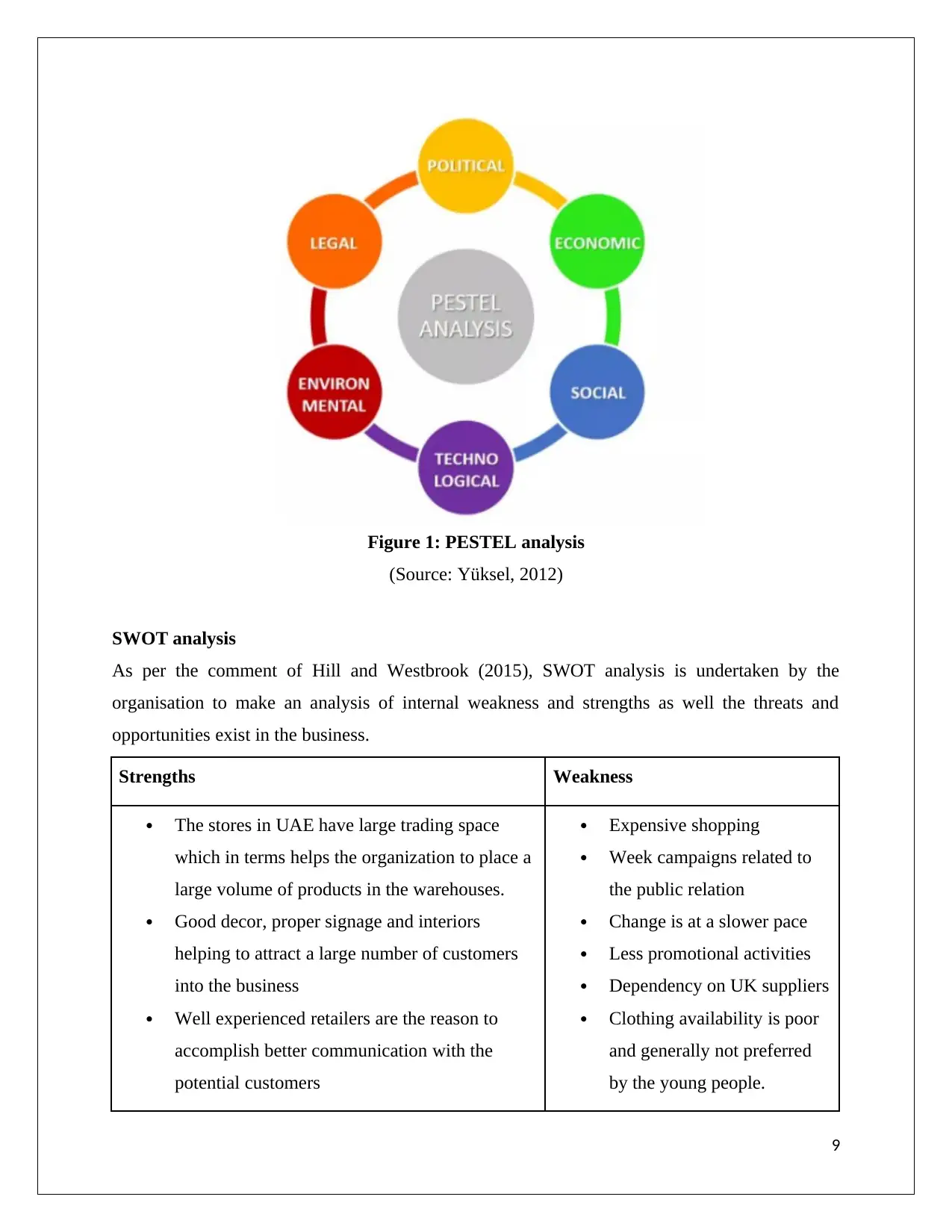
Figure 1: PESTEL analysis
(Source: Yüksel, 2012)
SWOT analysis
As per the comment of Hill and Westbrook (2015), SWOT analysis is undertaken by the
organisation to make an analysis of internal weakness and strengths as well the threats and
opportunities exist in the business.
Strengths Weakness
The stores in UAE have large trading space
which in terms helps the organization to place a
large volume of products in the warehouses.
Good decor, proper signage and interiors
helping to attract a large number of customers
into the business
Well experienced retailers are the reason to
accomplish better communication with the
potential customers
Expensive shopping
Week campaigns related to
the public relation
Change is at a slower pace
Less promotional activities
Dependency on UK suppliers
Clothing availability is poor
and generally not preferred
by the young people.
9
(Source: Yüksel, 2012)
SWOT analysis
As per the comment of Hill and Westbrook (2015), SWOT analysis is undertaken by the
organisation to make an analysis of internal weakness and strengths as well the threats and
opportunities exist in the business.
Strengths Weakness
The stores in UAE have large trading space
which in terms helps the organization to place a
large volume of products in the warehouses.
Good decor, proper signage and interiors
helping to attract a large number of customers
into the business
Well experienced retailers are the reason to
accomplish better communication with the
potential customers
Expensive shopping
Week campaigns related to
the public relation
Change is at a slower pace
Less promotional activities
Dependency on UK suppliers
Clothing availability is poor
and generally not preferred
by the young people.
9
⊘ This is a preview!⊘
Do you want full access?
Subscribe today to unlock all pages.
Trusted by 1+ million students worldwide
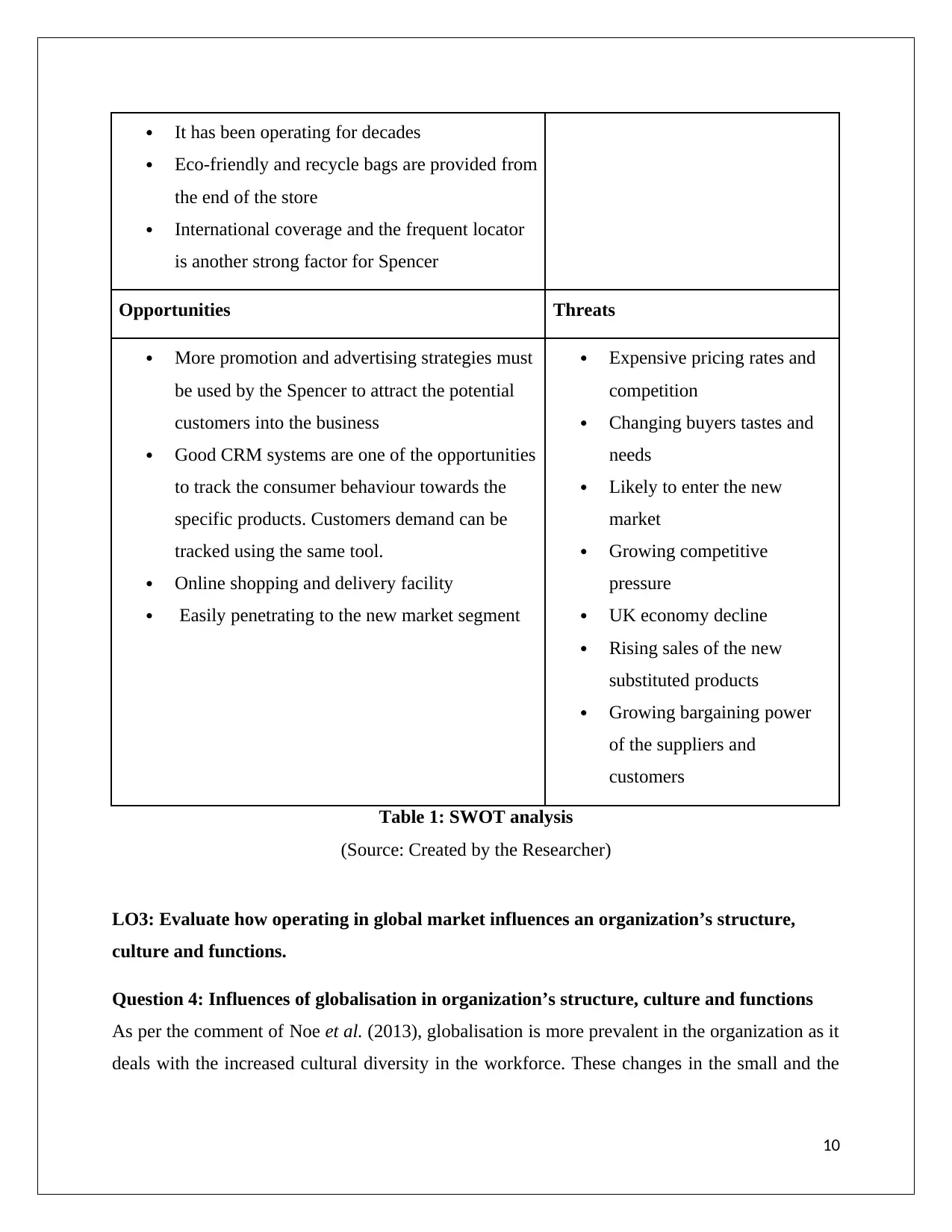
It has been operating for decades
Eco-friendly and recycle bags are provided from
the end of the store
International coverage and the frequent locator
is another strong factor for Spencer
Opportunities Threats
More promotion and advertising strategies must
be used by the Spencer to attract the potential
customers into the business
Good CRM systems are one of the opportunities
to track the consumer behaviour towards the
specific products. Customers demand can be
tracked using the same tool.
Online shopping and delivery facility
Easily penetrating to the new market segment
Expensive pricing rates and
competition
Changing buyers tastes and
needs
Likely to enter the new
market
Growing competitive
pressure
UK economy decline
Rising sales of the new
substituted products
Growing bargaining power
of the suppliers and
customers
Table 1: SWOT analysis
(Source: Created by the Researcher)
LO3: Evaluate how operating in global market influences an organization’s structure,
culture and functions.
Question 4: Influences of globalisation in organization’s structure, culture and functions
As per the comment of Noe et al. (2013), globalisation is more prevalent in the organization as it
deals with the increased cultural diversity in the workforce. These changes in the small and the
10
Eco-friendly and recycle bags are provided from
the end of the store
International coverage and the frequent locator
is another strong factor for Spencer
Opportunities Threats
More promotion and advertising strategies must
be used by the Spencer to attract the potential
customers into the business
Good CRM systems are one of the opportunities
to track the consumer behaviour towards the
specific products. Customers demand can be
tracked using the same tool.
Online shopping and delivery facility
Easily penetrating to the new market segment
Expensive pricing rates and
competition
Changing buyers tastes and
needs
Likely to enter the new
market
Growing competitive
pressure
UK economy decline
Rising sales of the new
substituted products
Growing bargaining power
of the suppliers and
customers
Table 1: SWOT analysis
(Source: Created by the Researcher)
LO3: Evaluate how operating in global market influences an organization’s structure,
culture and functions.
Question 4: Influences of globalisation in organization’s structure, culture and functions
As per the comment of Noe et al. (2013), globalisation is more prevalent in the organization as it
deals with the increased cultural diversity in the workforce. These changes in the small and the
10
Paraphrase This Document
Need a fresh take? Get an instant paraphrase of this document with our AI Paraphraser
large organisation help to deal with the diversity. In order to overcome the diversity issue, the
organization must introduce new policies and procedures in its internal operations.
Globalisation helped the organization to integrate cultural, religious and ethnic differences. In
order to analyse deeper into the influence of globalisation in organisational function, structure
and culture, two of the following models has analysed.
Ethical and sustainable factors
Social responsibility and corporate ethics have intervened the ongoing attempt to make
sustainability in the organisation. The sustainability of the business firm is mainly encouraged
through monitoring and reporting the ethics of the company's. Assuring practices and self-
monitoring procedures must be followed in the global market.
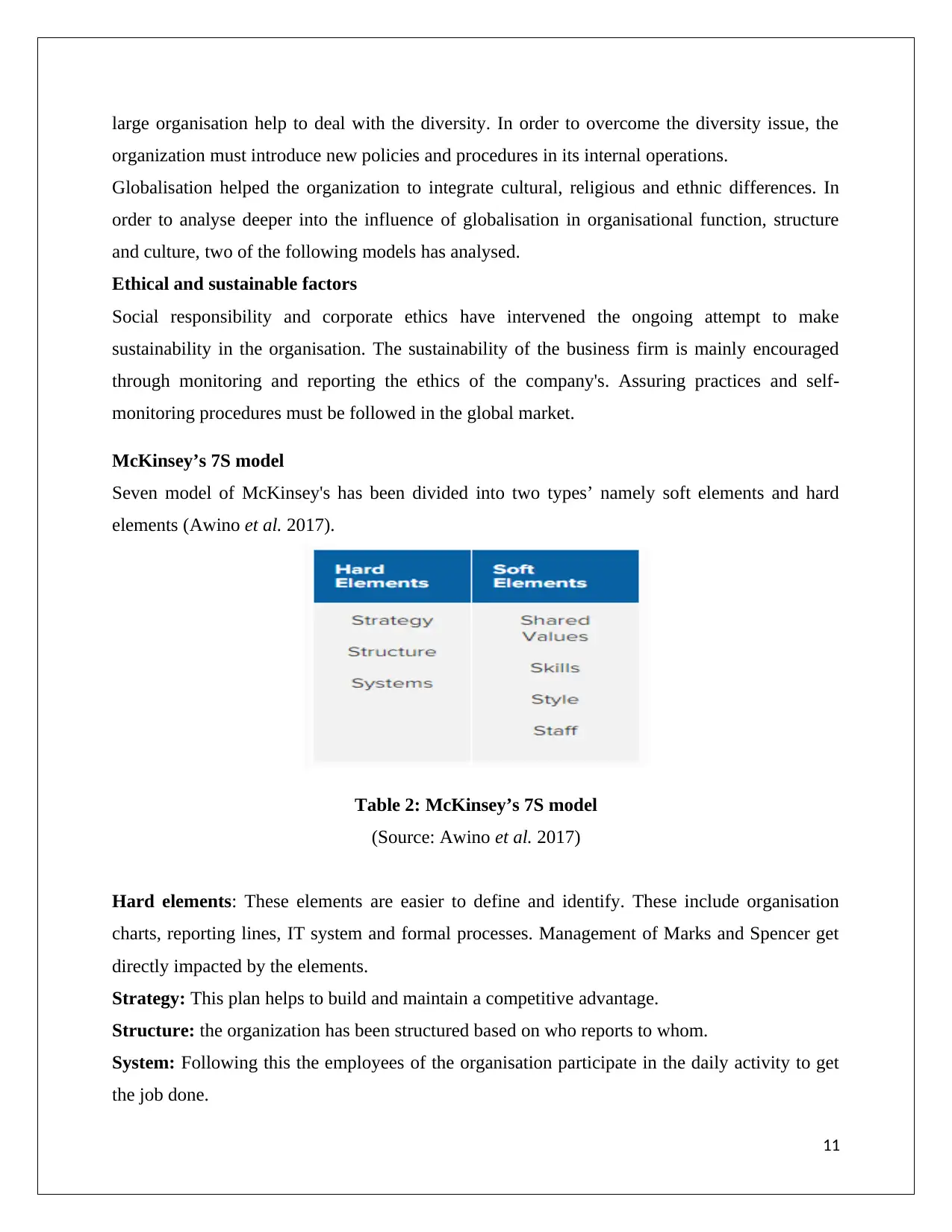
McKinsey’s 7S model
Seven model of McKinsey's has been divided into two types’ namely soft elements and hard
elements (Awino et al. 2017).
Table 2: McKinsey’s 7S model
(Source: Awino et al. 2017)
Hard elements: These elements are easier to define and identify. These include organisation
charts, reporting lines, IT system and formal processes. Management of Marks and Spencer get
directly impacted by the elements.
Strategy: This plan helps to build and maintain a competitive advantage.
Structure: the organization has been structured based on who reports to whom.
System: Following this the employees of the organisation participate in the daily activity to get
the job done.
11
organization must introduce new policies and procedures in its internal operations.
Globalisation helped the organization to integrate cultural, religious and ethnic differences. In
order to analyse deeper into the influence of globalisation in organisational function, structure
and culture, two of the following models has analysed.
Ethical and sustainable factors
Social responsibility and corporate ethics have intervened the ongoing attempt to make
sustainability in the organisation. The sustainability of the business firm is mainly encouraged
through monitoring and reporting the ethics of the company's. Assuring practices and self-
monitoring procedures must be followed in the global market.
McKinsey’s 7S model
Seven model of McKinsey's has been divided into two types’ namely soft elements and hard
elements (Awino et al. 2017).
Table 2: McKinsey’s 7S model
(Source: Awino et al. 2017)
Hard elements: These elements are easier to define and identify. These include organisation
charts, reporting lines, IT system and formal processes. Management of Marks and Spencer get
directly impacted by the elements.
Strategy: This plan helps to build and maintain a competitive advantage.
Structure: the organization has been structured based on who reports to whom.
System: Following this the employees of the organisation participate in the daily activity to get
the job done.
11
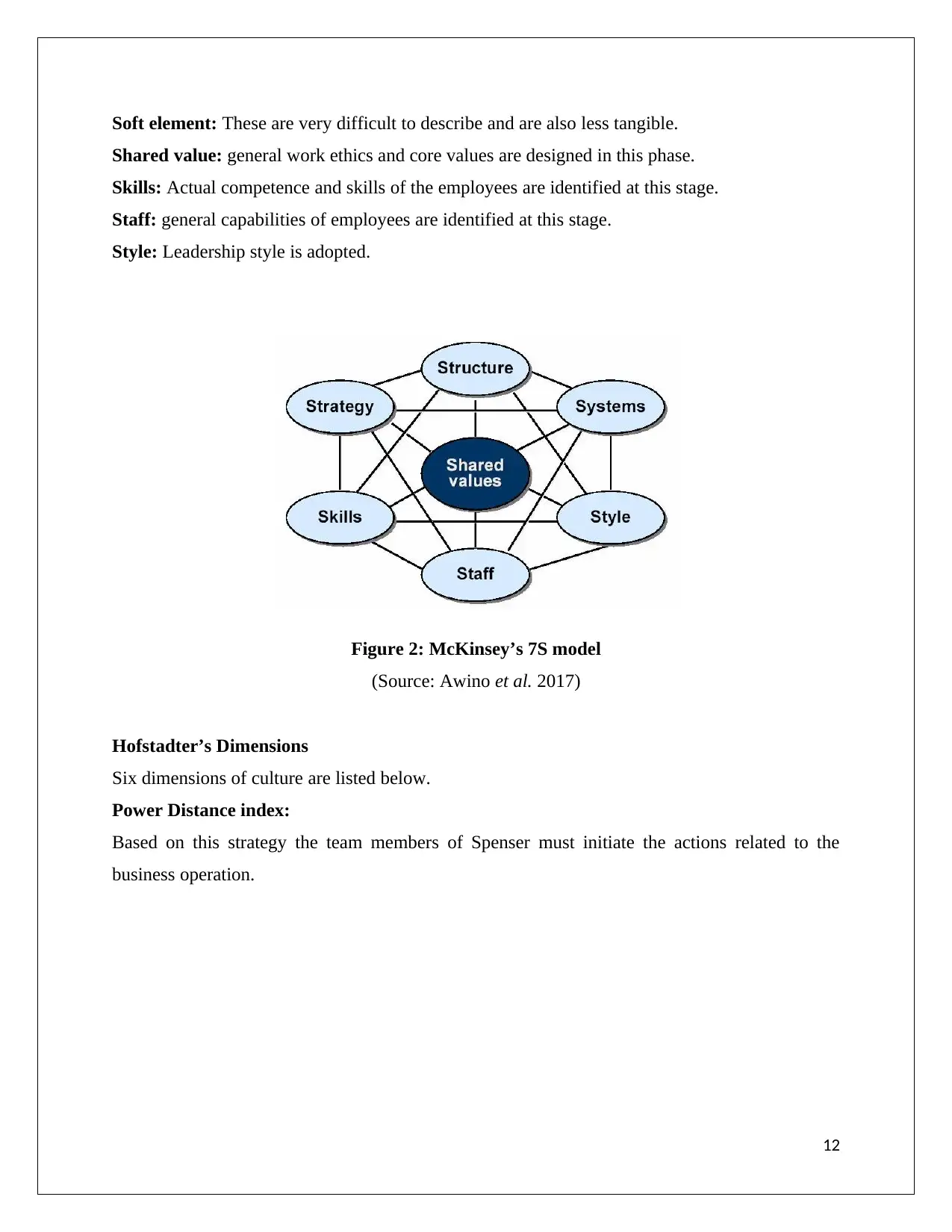
Soft element: These are very difficult to describe and are also less tangible.
Shared value: general work ethics and core values are designed in this phase.
Skills: Actual competence and skills of the employees are identified at this stage.
Staff: general capabilities of employees are identified at this stage.
Style: Leadership style is adopted.
Figure 2: McKinsey’s 7S model
(Source: Awino et al. 2017)
Hofstadter’s Dimensions
Six dimensions of culture are listed below.
Power Distance index:
Based on this strategy the team members of Spenser must initiate the actions related to the
business operation.
12
Shared value: general work ethics and core values are designed in this phase.
Skills: Actual competence and skills of the employees are identified at this stage.
Staff: general capabilities of employees are identified at this stage.
Style: Leadership style is adopted.
Figure 2: McKinsey’s 7S model
(Source: Awino et al. 2017)
Hofstadter’s Dimensions
Six dimensions of culture are listed below.
Power Distance index:
Based on this strategy the team members of Spenser must initiate the actions related to the
business operation.
12
⊘ This is a preview!⊘
Do you want full access?
Subscribe today to unlock all pages.
Trusted by 1+ million students worldwide

1 out of 25


Related Documents


Your All-in-One AI-Powered Toolkit for Academic Success.
+13062052269
info@desklib.com
Available 24*7 on WhatsApp / Email
![[object Object]](/_next/static/media/star-bottom.7253800d.svg)
Unlock your academic potential
Copyright © 2020–2026 A2Z Services. All Rights Reserved. Developed and managed by ZUCOL.