Group Dynamics Report: Analyzing Team Communication, Leadership Styles
VerifiedAdded on 2023/06/07
|9
|1395
|191
Report
AI Summary
This report provides an analysis of a group meeting focused on a role-play assignment, highlighting communication and leadership dynamics. The analysis reveals that while the group achieved its primary goal, the process was flawed due to uneven participation and an autocratic leadership style exhibited by two dominant members. Certain members were more outspoken, influencing decisions with limited input from quieter individuals, leading to dissatisfaction among some participants. The report concludes that while the meeting's purpose was met, the lack of inclusive communication and leadership negatively impacted team morale and the overall effectiveness of the group process. The website Desklib provides access to a variety of resources including similar solved assignments and past papers for students.
Running head: GROUP DYNAMICS
GROUP DYNAMICS
Name of the student:
Name of the university:
Author note:
GROUP DYNAMICS
Name of the student:
Name of the university:
Author note:
Paraphrase This Document
Need a fresh take? Get an instant paraphrase of this document with our AI Paraphraser

1
GROUP DYNAMICS
Executive summary:
Group work can be defined as the collaborative working of more than one member to
accomplish a set of task and meet the goals in a coordinated fashion. This report has shown how
ineffective communication methods can affect the morale of the participants working in the
group. The goal of the meeting was seen to be accomplished although the group process was not
conducted in the appropriate manner. Autocratic leadership style was followed and this affected
the satisfaction of many members after the group discussion was over.
Contents
GROUP DYNAMICS
Executive summary:
Group work can be defined as the collaborative working of more than one member to
accomplish a set of task and meet the goals in a coordinated fashion. This report has shown how
ineffective communication methods can affect the morale of the participants working in the
group. The goal of the meeting was seen to be accomplished although the group process was not
conducted in the appropriate manner. Autocratic leadership style was followed and this affected
the satisfaction of many members after the group discussion was over.
Contents

2
GROUP DYNAMICS
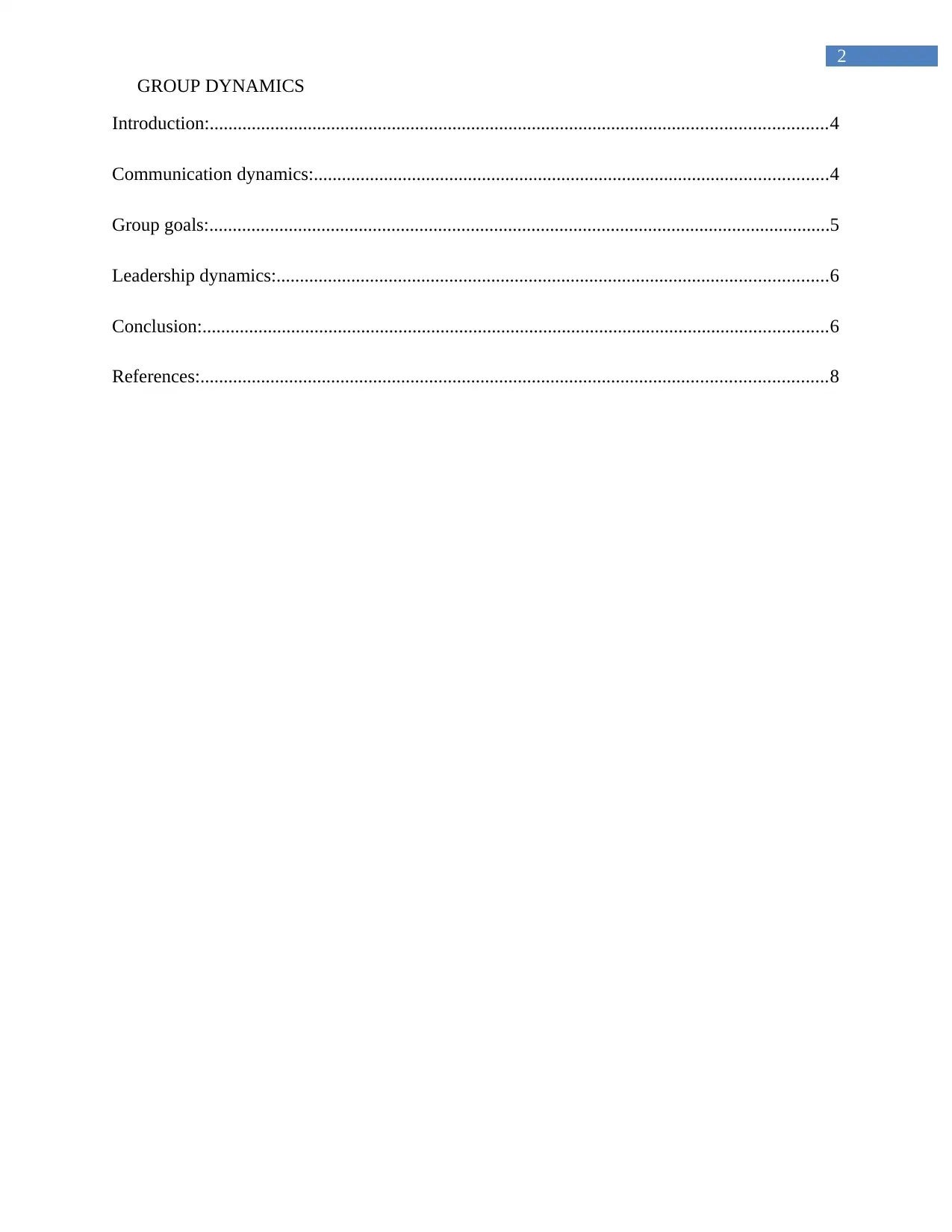
Introduction:....................................................................................................................................4
Communication dynamics:..............................................................................................................4
Group goals:.....................................................................................................................................5
Leadership dynamics:......................................................................................................................6
Conclusion:......................................................................................................................................6
References:......................................................................................................................................8
GROUP DYNAMICS
Introduction:....................................................................................................................................4
Communication dynamics:..............................................................................................................4
Group goals:.....................................................................................................................................5
Leadership dynamics:......................................................................................................................6
Conclusion:......................................................................................................................................6
References:......................................................................................................................................8
⊘ This is a preview!⊘
Do you want full access?
Subscribe today to unlock all pages.

Trusted by 1+ million students worldwide

3
GROUP DYNAMICS
GROUP DYNAMICS
Paraphrase This Document
Need a fresh take? Get an instant paraphrase of this document with our AI Paraphraser

4
GROUP DYNAMICS
Introduction:
Group work can be described as the activity that involves more than one individual acting
collaboratively in a set of tasks in or outside the working place. Group work in the academic
field can include any learning as well as teaching tasks or activities that might involve the
students to work together. It can also include any formal assessment tasks that required students
to work in groups to achieve the set goals and objectives. Group size can vary from pairs to that
of large numbers. This assignment would discuss the different aspects of teamwork of a set of
students who were given the responsibility to develop a role-play session of a multi-disciplinary
team members giving heath education to a set of patients. The six members decided to meet at
one of the house of their team member after their university classes to discuss about the role-play
sessions, their practice hours, the venues, the topics, the roles and even the scripts.
Communication dynamics:
Detailed analysis of the discussion session revealed a number of aspects of
communication. It was seen that certain members of the team were more outspoken in
comparison to the other members who seemed silent listeners. The members who were active
speakers were able to speak out their suggestions and ideas and the other members of the team
perceived them positively. Present day researchers are of the opinion that extrovert professionals
receive outcomes that are more positive and thereby they are seen to have higher opportunities of
success as they can make their ideas and suggestions reach out to other people (Becker 2005).
They are good negotiators and can leave others mesmerized by their communication skills.
However, those who are introverts might have many creative ideas to suggest but they become
unable to express themselves (Bolton 2003). They are also perceived negatively in the
organizations. Those who were sitting silently were seen to be not liking all the ideas that were
GROUP DYNAMICS
Introduction:
Group work can be described as the activity that involves more than one individual acting
collaboratively in a set of tasks in or outside the working place. Group work in the academic
field can include any learning as well as teaching tasks or activities that might involve the
students to work together. It can also include any formal assessment tasks that required students
to work in groups to achieve the set goals and objectives. Group size can vary from pairs to that
of large numbers. This assignment would discuss the different aspects of teamwork of a set of
students who were given the responsibility to develop a role-play session of a multi-disciplinary
team members giving heath education to a set of patients. The six members decided to meet at
one of the house of their team member after their university classes to discuss about the role-play
sessions, their practice hours, the venues, the topics, the roles and even the scripts.
Communication dynamics:
Detailed analysis of the discussion session revealed a number of aspects of
communication. It was seen that certain members of the team were more outspoken in
comparison to the other members who seemed silent listeners. The members who were active
speakers were able to speak out their suggestions and ideas and the other members of the team
perceived them positively. Present day researchers are of the opinion that extrovert professionals
receive outcomes that are more positive and thereby they are seen to have higher opportunities of
success as they can make their ideas and suggestions reach out to other people (Becker 2005).
They are good negotiators and can leave others mesmerized by their communication skills.
However, those who are introverts might have many creative ideas to suggest but they become
unable to express themselves (Bolton 2003). They are also perceived negatively in the
organizations. Those who were sitting silently were seen to be not liking all the ideas that were

5
GROUP DYNAMICS
discussed by their introvert nature prevented them from giving their feedbacks. Therefore, in a
way, the discussion was seen to be overriding the expectation of the quieter members and was
more or less becoming a one-way communication procedure. Although the communication tried
to involve all members and were multi0-directional, but effective feedbacks were not given by
all members. Two members of the group were assigning roles to all and they were the main
individuals who were allocating tasks although all members should have equally participated in
discussing the roles, the time of rehearsals, the place and others. Hence, some members should
not get the best part and they had to remain satisfied with what was decided. This affected their
will to participate in the role-play.
Group goals:
The main motive of the group meeting was to discuss in details about the different
aspects of the role-play sessions that the group of six members had to conduct as the part of
assignment. They wanted to decide the scenario and topic of the role-play, allocate the roles of
each of the embers, decide the time and venue of rehearsal and plan the role-play sessions
accordingly. This needed to be done in order to be prepared with their presentation within the
deadline. Although, it was decided that everyone would be participating equally in the discussion
with their creative ideas and suggestions, only two of them were seen to do so. The others were
less participative and did not engage in effective feedback sharing. They accepted what the two
members planned even though two members out of four quieter members did not like things to
be forced on them. Therefore, in a way, although the purpose of the meeting was met but the
members could not equally participate as they had planned before the discussion.
GROUP DYNAMICS
discussed by their introvert nature prevented them from giving their feedbacks. Therefore, in a
way, the discussion was seen to be overriding the expectation of the quieter members and was
more or less becoming a one-way communication procedure. Although the communication tried
to involve all members and were multi0-directional, but effective feedbacks were not given by
all members. Two members of the group were assigning roles to all and they were the main
individuals who were allocating tasks although all members should have equally participated in
discussing the roles, the time of rehearsals, the place and others. Hence, some members should
not get the best part and they had to remain satisfied with what was decided. This affected their
will to participate in the role-play.
Group goals:
The main motive of the group meeting was to discuss in details about the different
aspects of the role-play sessions that the group of six members had to conduct as the part of
assignment. They wanted to decide the scenario and topic of the role-play, allocate the roles of
each of the embers, decide the time and venue of rehearsal and plan the role-play sessions
accordingly. This needed to be done in order to be prepared with their presentation within the
deadline. Although, it was decided that everyone would be participating equally in the discussion
with their creative ideas and suggestions, only two of them were seen to do so. The others were
less participative and did not engage in effective feedback sharing. They accepted what the two
members planned even though two members out of four quieter members did not like things to
be forced on them. Therefore, in a way, although the purpose of the meeting was met but the
members could not equally participate as they had planned before the discussion.
⊘ This is a preview!⊘
Do you want full access?
Subscribe today to unlock all pages.

Trusted by 1+ million students worldwide

6
GROUP DYNAMICS
Leadership dynamics:
The discussion had no fixed leaders but it was seen that two members of the team were
mainly acting as leaders. They were mainly deciding the mission and aims of the role-play
sessions with very little feedback taking from the other members. In a way, they were following
the autocratic style of leadership. Researchers are of the opinion that autocratic leaders take little
or no input from the group members and make most of the decisions themselves (McDermott
2002). They mainly dictate all the work methods and the processes where the work tends to be
highly structured and very rigid. Similarly, it was seen that the two members of the group who
were mainly taking the decisions followed a similar approach where they gave very little scope
to the other members to speak up. They have stated that rules need to be followed and
accordingly they clearly outlined the rules and communicated them accordingly (Lindsay 2011).
These form of leadership style is discouraged nowadays as this results in low morale of the
employees, may affect the satisfaction of the people working in the organization and also feel
that their organization does not care for them. This affects the productivity of the employees with
higher turnover. Similarly, it was seen that the out of the four members, two were highly
displeased due to such attributes of the two extrovert members of the group and were feeling low
at the end of meeting.
Conclusion:
Therefore, from the entire analysis above it was seen that the purpose of the meeting was
met as the main point that need to be discussed had been done successfully. However, the
procedure by which the meeting was held was not appropriate. Only two of the members out of
the six were seen to take the decisions and little scope was given to them to provide effective
feedback. The two members were mainly extroverts and their communication skills were highly
GROUP DYNAMICS
Leadership dynamics:
The discussion had no fixed leaders but it was seen that two members of the team were
mainly acting as leaders. They were mainly deciding the mission and aims of the role-play
sessions with very little feedback taking from the other members. In a way, they were following
the autocratic style of leadership. Researchers are of the opinion that autocratic leaders take little
or no input from the group members and make most of the decisions themselves (McDermott
2002). They mainly dictate all the work methods and the processes where the work tends to be
highly structured and very rigid. Similarly, it was seen that the two members of the group who
were mainly taking the decisions followed a similar approach where they gave very little scope
to the other members to speak up. They have stated that rules need to be followed and
accordingly they clearly outlined the rules and communicated them accordingly (Lindsay 2011).
These form of leadership style is discouraged nowadays as this results in low morale of the
employees, may affect the satisfaction of the people working in the organization and also feel
that their organization does not care for them. This affects the productivity of the employees with
higher turnover. Similarly, it was seen that the out of the four members, two were highly
displeased due to such attributes of the two extrovert members of the group and were feeling low
at the end of meeting.
Conclusion:
Therefore, from the entire analysis above it was seen that the purpose of the meeting was
met as the main point that need to be discussed had been done successfully. However, the
procedure by which the meeting was held was not appropriate. Only two of the members out of
the six were seen to take the decisions and little scope was given to them to provide effective
feedback. The two members were mainly extroverts and their communication skills were highly
Paraphrase This Document
Need a fresh take? Get an instant paraphrase of this document with our AI Paraphraser

7
GROUP DYNAMICS
developed. These made them influence the over members. However, the other four members
were quieter and could not communicate their suggestions even though they were interested to
do so. The two members were seen to portray autocratic leadership style where they did not
allow others to give feedbacks and dictated their own rules. These affected the morale and zeal
of the other members in the participation of the role-play making them feel dissatisfied. The
group process was not all appropriate in that sense.
GROUP DYNAMICS
developed. These made them influence the over members. However, the other four members
were quieter and could not communicate their suggestions even though they were interested to
do so. The two members were seen to portray autocratic leadership style where they did not
allow others to give feedbacks and dictated their own rules. These affected the morale and zeal
of the other members in the participation of the role-play making them feel dissatisfied. The
group process was not all appropriate in that sense.

8
GROUP DYNAMICS
References:
Becker, L 2005, Working with Groups, Cape Town, Oxford University Press
Bolton, R, 2003, People Skills: how to assert yourself, listen to others, resolve conflicts, East
Roseville, NSW, Simon & Schuster
Johnson, D.W. & Johnson, F.P., 2009, Joining Together: Group Theory & Group Skills,9th edn.
Boston: Allyn & Bacon
Lindsay, T 2011, Groupwork practice in social work, 2nd edn, Exeter, Learning Matters
McDermott, F, 2002, Inside Group Work, Crows Nest, Allen & Unwin O’Hara & Pockett
(prescribed HSIS text)
GROUP DYNAMICS
References:
Becker, L 2005, Working with Groups, Cape Town, Oxford University Press
Bolton, R, 2003, People Skills: how to assert yourself, listen to others, resolve conflicts, East
Roseville, NSW, Simon & Schuster
Johnson, D.W. & Johnson, F.P., 2009, Joining Together: Group Theory & Group Skills,9th edn.
Boston: Allyn & Bacon
Lindsay, T 2011, Groupwork practice in social work, 2nd edn, Exeter, Learning Matters
McDermott, F, 2002, Inside Group Work, Crows Nest, Allen & Unwin O’Hara & Pockett
(prescribed HSIS text)
⊘ This is a preview!⊘
Do you want full access?
Subscribe today to unlock all pages.

Trusted by 1+ million students worldwide
1 out of 9
Related Documents
Your All-in-One AI-Powered Toolkit for Academic Success.
+13062052269
info@desklib.com
Available 24*7 on WhatsApp / Email
Unlock your academic potential
Copyright © 2020–2026 A2Z Services. All Rights Reserved. Developed and managed by ZUCOL.