Health Care Funding and Financial Management Report - Semester 1
VerifiedAdded on 2020/03/23
|8
|1595
|68
Report
AI Summary
This report provides an in-depth analysis of health care funding and financial management, focusing on the Australian context. It begins by defining Medicare as a primary funder and discusses its challenges, suggesting an earlier age for coverage eligibility and promoting bundled payment methods. The report then contrasts revenue and expenditure in the health care industry, highlighting the imbalance and increasing costs. It explores activity-based funding in NSW as a method for managing public health care funds and examines the case mix classification system, including DRG, as a tool for assessing hospital performance and improving efficiency. The report concludes with a comprehensive list of references.
Running head: HEALTH CARE FUNDING AND FINANCIAL MANAGEMENT
Health care funding and financial management
Name of the student:
Name of the university:
Author note:
Health care funding and financial management
Name of the student:
Name of the university:
Author note:
Paraphrase This Document
Need a fresh take? Get an instant paraphrase of this document with our AI Paraphraser

1HEALTH CARE FUNDING AND FINANCIAL MANAGEMENT
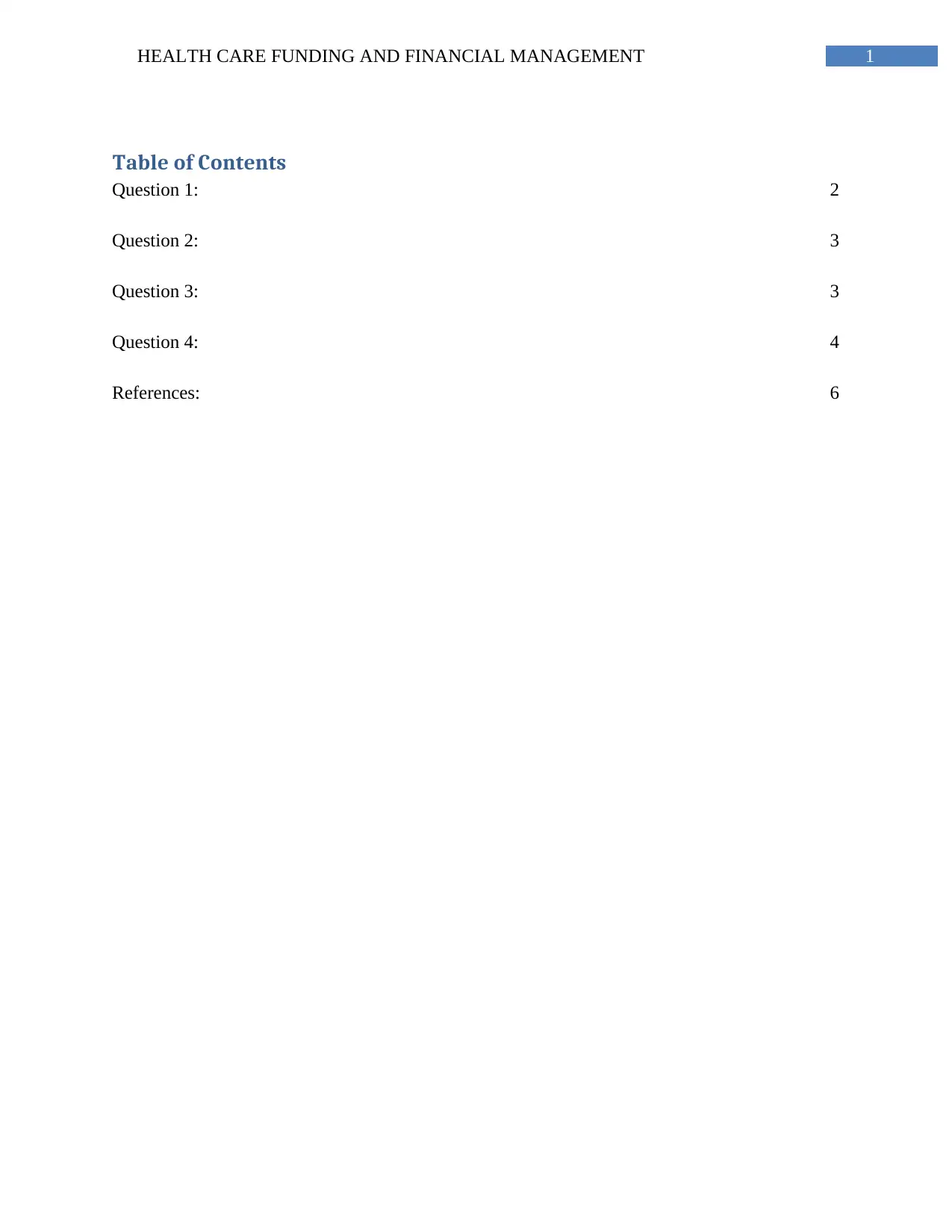
Table of Contents
Question 1: 2
Question 2: 3
Question 3: 3
Question 4: 4
References: 6
Table of Contents
Question 1: 2
Question 2: 3
Question 3: 3
Question 4: 4
References: 6

2HEALTH CARE FUNDING AND FINANCIAL MANAGEMENT
Question 1:
Medicare can be described as a publicly funded universal health care system, operated in
Australia by the collaborative management of Department of the health services and public
funding. According to recent statistics, Medicare is undoubtedly the primary funder for heath
care both in Australia and all across the globe, and hence Medicare has had a significant role in
the improvements of health care and enhanced availability of it throughout all sectors of the
society (Marmor, 2017). However, there certainly are some challenges to successful financial
management provided to all the socioeconomic sectors of the society and there is room for many
improvements in the Medicare sector.
For instance, considering the seniority coverage, the benefits for Medicare starts only after
the age of 65; whereas, in the current age, the health care complexities do not always start past
65, most of the common health concerns arrive with the onset of middle age, around 50 and
above. Hence in order to improve the relevance and benefits of the Medicare covers, the
seniority cover age bar should rather start from the age of 50, so that the unnecessary burden on
the taxpayers does not escalate (Munyisia, Reid & Yu, 2017).
According to emerging research the most of the common health priorities and concerns can
be prevented with adequate precautionary and promotional program linked to the Medicare
coverage, so that the public health services provided can improve its efficiency and
effectiveness, enhancing life expectancy and health across all age groups. Along with that
improvising and promoting the bundled payment method to facilitate direct payment to packaged
or organized systems of care could positively extend the incentives to the health care providers
Question 1:
Medicare can be described as a publicly funded universal health care system, operated in
Australia by the collaborative management of Department of the health services and public
funding. According to recent statistics, Medicare is undoubtedly the primary funder for heath
care both in Australia and all across the globe, and hence Medicare has had a significant role in
the improvements of health care and enhanced availability of it throughout all sectors of the
society (Marmor, 2017). However, there certainly are some challenges to successful financial
management provided to all the socioeconomic sectors of the society and there is room for many
improvements in the Medicare sector.
For instance, considering the seniority coverage, the benefits for Medicare starts only after
the age of 65; whereas, in the current age, the health care complexities do not always start past
65, most of the common health concerns arrive with the onset of middle age, around 50 and
above. Hence in order to improve the relevance and benefits of the Medicare covers, the
seniority cover age bar should rather start from the age of 50, so that the unnecessary burden on
the taxpayers does not escalate (Munyisia, Reid & Yu, 2017).
According to emerging research the most of the common health priorities and concerns can
be prevented with adequate precautionary and promotional program linked to the Medicare
coverage, so that the public health services provided can improve its efficiency and
effectiveness, enhancing life expectancy and health across all age groups. Along with that
improvising and promoting the bundled payment method to facilitate direct payment to packaged
or organized systems of care could positively extend the incentives to the health care providers
⊘ This is a preview!⊘
Do you want full access?
Subscribe today to unlock all pages.

Trusted by 1+ million students worldwide

3HEALTH CARE FUNDING AND FINANCIAL MANAGEMENT
and improving the quality of care provided, at the same time minimizing the amount of extra
money paid by the citizens for different sectors of care needed (Raghu et al., 2014).
Question 2:
In simple terms revenue can be defined as the total income by an organization in an annual
basis, and expenditure can be defined as the annual amount of spending in the organizations. The
difference between revenue and expenditure can be described as total opposites of one another;
however, the clear lines of demarcation between both terms can become a little blurred when
applied to the context of health care. In case of the health care industry, the entire revenue
generation depends on the funding, whether it comes from government subsidization, insurance
companies or privately from the public availing the health care (Marmor, 2017). However, with
the bundled payment format and pay for package system in place in the healthcare sector, the
annual profits of the health care sector has taken severe blows;
Now, considering the expenditure in health care, the entire costing for the advanced health
care services has increased at an alarming rate. The drug prices continue to increase and
legislative guidelines like the Affordable Care Act on the other hand is not helping the privatized
health care units as well (Reeves et al., 2015). Moreover, the growing consumerism, the
insurance companies continue to pressurize the health care facilities to improve the quality
benchmark of the care provided, and in order to meet the benchmark, the expenditure increases
further. Hence, there is a great imbalance between the revenue and expenditure in health care at
the moment and there is need for standardizing the differences between both areas so that a state
of equilibrium can be facilitated (Cleverley & Cleverley, 2017).
and improving the quality of care provided, at the same time minimizing the amount of extra
money paid by the citizens for different sectors of care needed (Raghu et al., 2014).
Question 2:
In simple terms revenue can be defined as the total income by an organization in an annual
basis, and expenditure can be defined as the annual amount of spending in the organizations. The
difference between revenue and expenditure can be described as total opposites of one another;
however, the clear lines of demarcation between both terms can become a little blurred when
applied to the context of health care. In case of the health care industry, the entire revenue
generation depends on the funding, whether it comes from government subsidization, insurance
companies or privately from the public availing the health care (Marmor, 2017). However, with
the bundled payment format and pay for package system in place in the healthcare sector, the
annual profits of the health care sector has taken severe blows;
Now, considering the expenditure in health care, the entire costing for the advanced health
care services has increased at an alarming rate. The drug prices continue to increase and
legislative guidelines like the Affordable Care Act on the other hand is not helping the privatized
health care units as well (Reeves et al., 2015). Moreover, the growing consumerism, the
insurance companies continue to pressurize the health care facilities to improve the quality
benchmark of the care provided, and in order to meet the benchmark, the expenditure increases
further. Hence, there is a great imbalance between the revenue and expenditure in health care at
the moment and there is need for standardizing the differences between both areas so that a state
of equilibrium can be facilitated (Cleverley & Cleverley, 2017).
Paraphrase This Document
Need a fresh take? Get an instant paraphrase of this document with our AI Paraphraser

4HEALTH CARE FUNDING AND FINANCIAL MANAGEMENT
Question 3:
One of the greatest challenges in health care at the moment is the optimal and justifiable
utilization of public funding in order to make the best use of the hard earned tax money paid by
the citizen, to provide optimal care quality to the people of Australia (Gillett, Houlihan &
Williams, 2015). Activity based funding is considered to be one method of funding and
managing public health care in a manner that payment is circulated efficiently between different
sectors of health care, so that the patients pay for every health care activity they avail depending
on the severity of their medical condition into account.
In case of NSW, the funding and budget allocation is carried out critically and succinctly to
ensure optimal yet justified utilization of the funds. The national funding framework in place for
the NSW is NHRA or National Health Reform Agreement; the health budget for the NSW is
allocated from the consolidated funds by the authority of the ministry, LHDs, and specialty
networks. The outside funding and budget allocation is influenced by the direct recommendation
of the director general as well. The expenditure is managed and monitored quarterly by the
expenditure review committee (Hjermstad et al., 2016).
Question 4:
Case mix can be defined as the assessment or measurement system for assessing the
performance of the health care facilities or hospitals; along with the assessment this auditing
framework also aims to reward the initiatives that attempt to increase the efficiency of health
care workforce and facility along with improving the quality of care. Its also serves as a
information tool, classifying different health care facilities into different categories. The case mix
classification system involves activity based costing as a parameter to the profession of health. It
Question 3:
One of the greatest challenges in health care at the moment is the optimal and justifiable
utilization of public funding in order to make the best use of the hard earned tax money paid by
the citizen, to provide optimal care quality to the people of Australia (Gillett, Houlihan &
Williams, 2015). Activity based funding is considered to be one method of funding and
managing public health care in a manner that payment is circulated efficiently between different
sectors of health care, so that the patients pay for every health care activity they avail depending
on the severity of their medical condition into account.
In case of NSW, the funding and budget allocation is carried out critically and succinctly to
ensure optimal yet justified utilization of the funds. The national funding framework in place for
the NSW is NHRA or National Health Reform Agreement; the health budget for the NSW is
allocated from the consolidated funds by the authority of the ministry, LHDs, and specialty
networks. The outside funding and budget allocation is influenced by the direct recommendation
of the director general as well. The expenditure is managed and monitored quarterly by the
expenditure review committee (Hjermstad et al., 2016).
Question 4:
Case mix can be defined as the assessment or measurement system for assessing the
performance of the health care facilities or hospitals; along with the assessment this auditing
framework also aims to reward the initiatives that attempt to increase the efficiency of health
care workforce and facility along with improving the quality of care. Its also serves as a
information tool, classifying different health care facilities into different categories. The case mix
classification system involves activity based costing as a parameter to the profession of health. It

5HEALTH CARE FUNDING AND FINANCIAL MANAGEMENT
swiftly and effectively links billable activities directly to the international standards like ICD-10.
It will eventually help the billing process to align the classification system with the concept of
electronic patient records (Jackson et al., 2015).
Another very popular classification system in place in Australia is diagnosis related group
classification. This classification system has 7 key groups and the hospital cases are grouped
under these categories based on the type of heath care facility that the patient is availing. The
Australian version of DRG is a bit more complicated and detailed and is known as the Australian
refined DRG classification system, have ICD10-AM groups. The Australian DRG system has
had different versions being utilized and the recent version under use is the version 8.
The Australian DRG classification system is monitored and refined by the DRG technical groups
established for the sole purpose of monitoring the effectiveness and efficiency of the
classification system (Polyzos et al., 2013).
swiftly and effectively links billable activities directly to the international standards like ICD-10.
It will eventually help the billing process to align the classification system with the concept of
electronic patient records (Jackson et al., 2015).
Another very popular classification system in place in Australia is diagnosis related group
classification. This classification system has 7 key groups and the hospital cases are grouped
under these categories based on the type of heath care facility that the patient is availing. The
Australian version of DRG is a bit more complicated and detailed and is known as the Australian
refined DRG classification system, have ICD10-AM groups. The Australian DRG system has
had different versions being utilized and the recent version under use is the version 8.
The Australian DRG classification system is monitored and refined by the DRG technical groups
established for the sole purpose of monitoring the effectiveness and efficiency of the
classification system (Polyzos et al., 2013).
⊘ This is a preview!⊘
Do you want full access?
Subscribe today to unlock all pages.

Trusted by 1+ million students worldwide

6HEALTH CARE FUNDING AND FINANCIAL MANAGEMENT
References:
Cleverley, W. O., & Cleverley, J. O. (2017). Essentials of health care finance. Jones & Bartlett
Learning.
Gillett, S., Houlihan, K., & Williams, W. (2015). Investigating the predictors of chronic care
annual funding requirements under activity-based funding. BMC health services research,
15(8).
Hjermstad, M. J., Aass, N., Aielli, F., Bennett, M., Brunelli, C., Caraceni, A., ... & Jakobsen, G.
(2016). Characteristics of the case mix, organisation and delivery in cancer palliative
care: a challenge for good-quality research. BMJ supportive & palliative care, bmjspcare-
2015.
Jackson, T., Dimitropoulos, V., Madden, R., & Gillett, S. (2015). Australian diagnosis related
groups: Drivers of complexity adjustment. Health Policy, 119(11), 1433-1441.
Marmor, T. R. (2017). The politics of Medicare. Routledge.
Munyisia, E. N., Reid, D., & Yu, P. (2017). Accuracy of outpatient service data for activity-
based funding in New South Wales, Australia. Health Information Management Journal,
46(2), 78-86.
Polyzos, N., Karanikas, H., Thireos, E., Kastanioti, C., & Kontodimopoulos, N. (2013).
Reforming reimbursement of public hospitals in Greece during the economic crisis:
implementation of a DRG system. Health policy, 109(1), 14-22.
Raghu, G., Chen, S. Y., Yeh, W. S., Maroni, B., Li, Q., Lee, Y. C., & Collard, H. R. (2014).
Idiopathic pulmonary fibrosis in US Medicare beneficiaries aged 65 years and older:
References:
Cleverley, W. O., & Cleverley, J. O. (2017). Essentials of health care finance. Jones & Bartlett
Learning.
Gillett, S., Houlihan, K., & Williams, W. (2015). Investigating the predictors of chronic care
annual funding requirements under activity-based funding. BMC health services research,
15(8).
Hjermstad, M. J., Aass, N., Aielli, F., Bennett, M., Brunelli, C., Caraceni, A., ... & Jakobsen, G.
(2016). Characteristics of the case mix, organisation and delivery in cancer palliative
care: a challenge for good-quality research. BMJ supportive & palliative care, bmjspcare-
2015.
Jackson, T., Dimitropoulos, V., Madden, R., & Gillett, S. (2015). Australian diagnosis related
groups: Drivers of complexity adjustment. Health Policy, 119(11), 1433-1441.
Marmor, T. R. (2017). The politics of Medicare. Routledge.
Munyisia, E. N., Reid, D., & Yu, P. (2017). Accuracy of outpatient service data for activity-
based funding in New South Wales, Australia. Health Information Management Journal,
46(2), 78-86.
Polyzos, N., Karanikas, H., Thireos, E., Kastanioti, C., & Kontodimopoulos, N. (2013).
Reforming reimbursement of public hospitals in Greece during the economic crisis:
implementation of a DRG system. Health policy, 109(1), 14-22.
Raghu, G., Chen, S. Y., Yeh, W. S., Maroni, B., Li, Q., Lee, Y. C., & Collard, H. R. (2014).
Idiopathic pulmonary fibrosis in US Medicare beneficiaries aged 65 years and older:
Paraphrase This Document
Need a fresh take? Get an instant paraphrase of this document with our AI Paraphraser

7HEALTH CARE FUNDING AND FINANCIAL MANAGEMENT
incidence, prevalence, and survival, 2001–11. The lancet Respiratory medicine, 2(7),
566-572.
Reeves, A., Gourtsoyannis, Y., Basu, S., McCoy, D., McKee, M., & Stuckler, D. (2015).
Financing universal health coverage—effects of alternative tax structures on public health
systems: cross-national modelling in 89 low-income and middle-income countries. The
Lancet, 386(9990), 274-280.
incidence, prevalence, and survival, 2001–11. The lancet Respiratory medicine, 2(7),
566-572.
Reeves, A., Gourtsoyannis, Y., Basu, S., McCoy, D., McKee, M., & Stuckler, D. (2015).
Financing universal health coverage—effects of alternative tax structures on public health
systems: cross-national modelling in 89 low-income and middle-income countries. The
Lancet, 386(9990), 274-280.
1 out of 8
Related Documents
Your All-in-One AI-Powered Toolkit for Academic Success.
+13062052269
info@desklib.com
Available 24*7 on WhatsApp / Email
Unlock your academic potential
Copyright © 2020–2026 A2Z Services. All Rights Reserved. Developed and managed by ZUCOL.