University Public Health Report: Leadership Approaches and Analysis

Verified

Added on  2020/03/02

|11
|1884
|74
Report
AI Summary
This report delves into leadership approaches within the realm of public health, with a specific emphasis on the contingency model. The study explores the application of this model in a healthcare setting, particularly in the care of elderly patients, highlighting its effectiveness in adapting to situational variables and fostering better patient care. It also discusses the ethical implications associated with the model, such as potential conflicts and the importance of clear guidelines. Furthermore, the report evaluates alternative leadership approaches, such as the laissez-faire model, and their potential benefits and drawbacks. The analysis includes the evaluation of various factors, such as task structure, leader-follower relationships, and ethical considerations within the public health context. The report concludes by summarizing the effectiveness of the contingency model in providing flexibility and adaptability within an organization and emphasizes the importance of clear communication and employee participation for successful implementation.
Document Page
Running head: PUBLIC HEALTH
Public Health
Name of the student
University name
Author’s name
tabler-icon-diamond-filled.svg

Paraphrase This Document

Need a fresh take? Get an instant paraphrase of this document with our AI Paraphraser
Document Page
1PUBLIC HEALTH
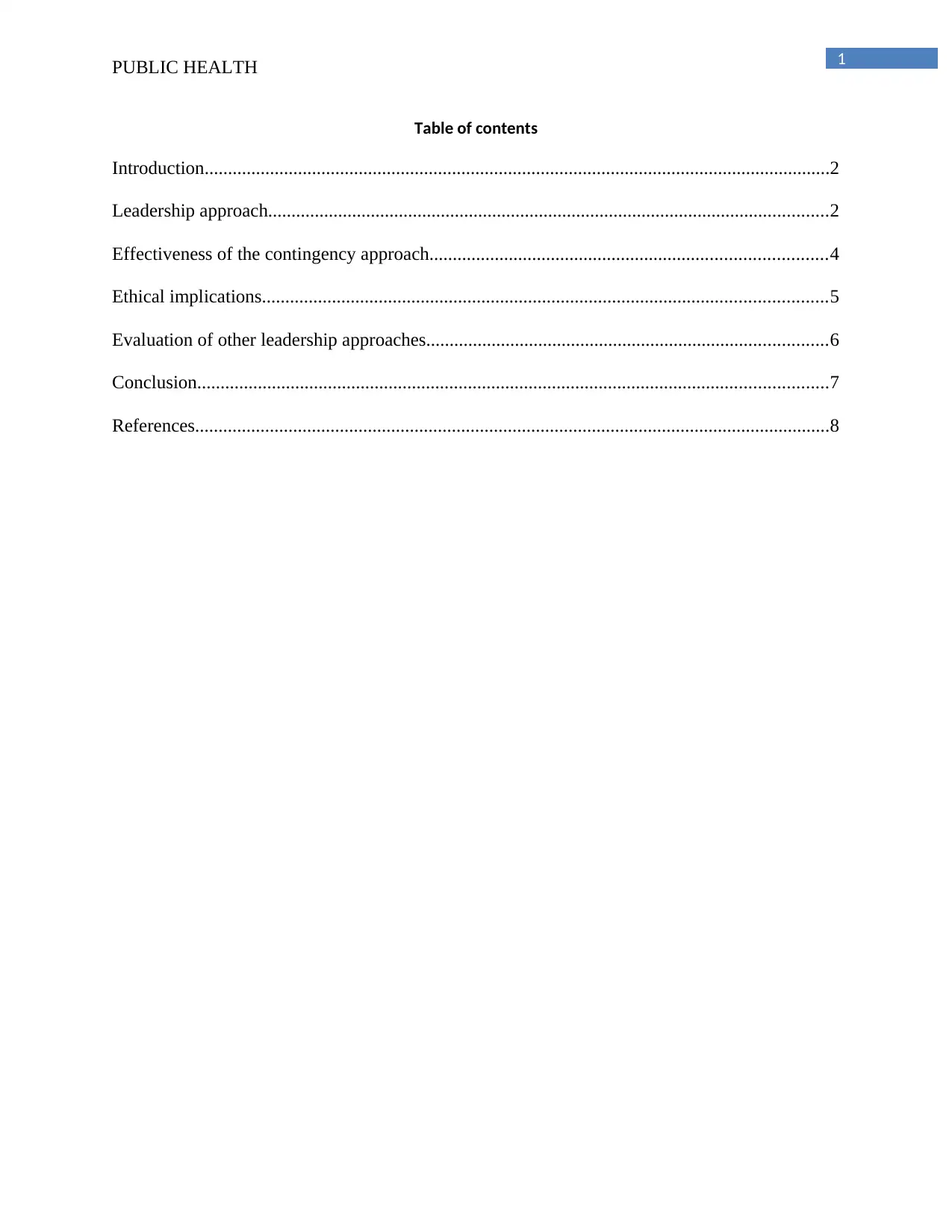
Table of contents
Introduction......................................................................................................................................2
Leadership approach........................................................................................................................2
Effectiveness of the contingency approach.....................................................................................4
Ethical implications.........................................................................................................................5
Evaluation of other leadership approaches......................................................................................6
Conclusion.......................................................................................................................................7
References........................................................................................................................................8
Document Page
2PUBLIC HEALTH
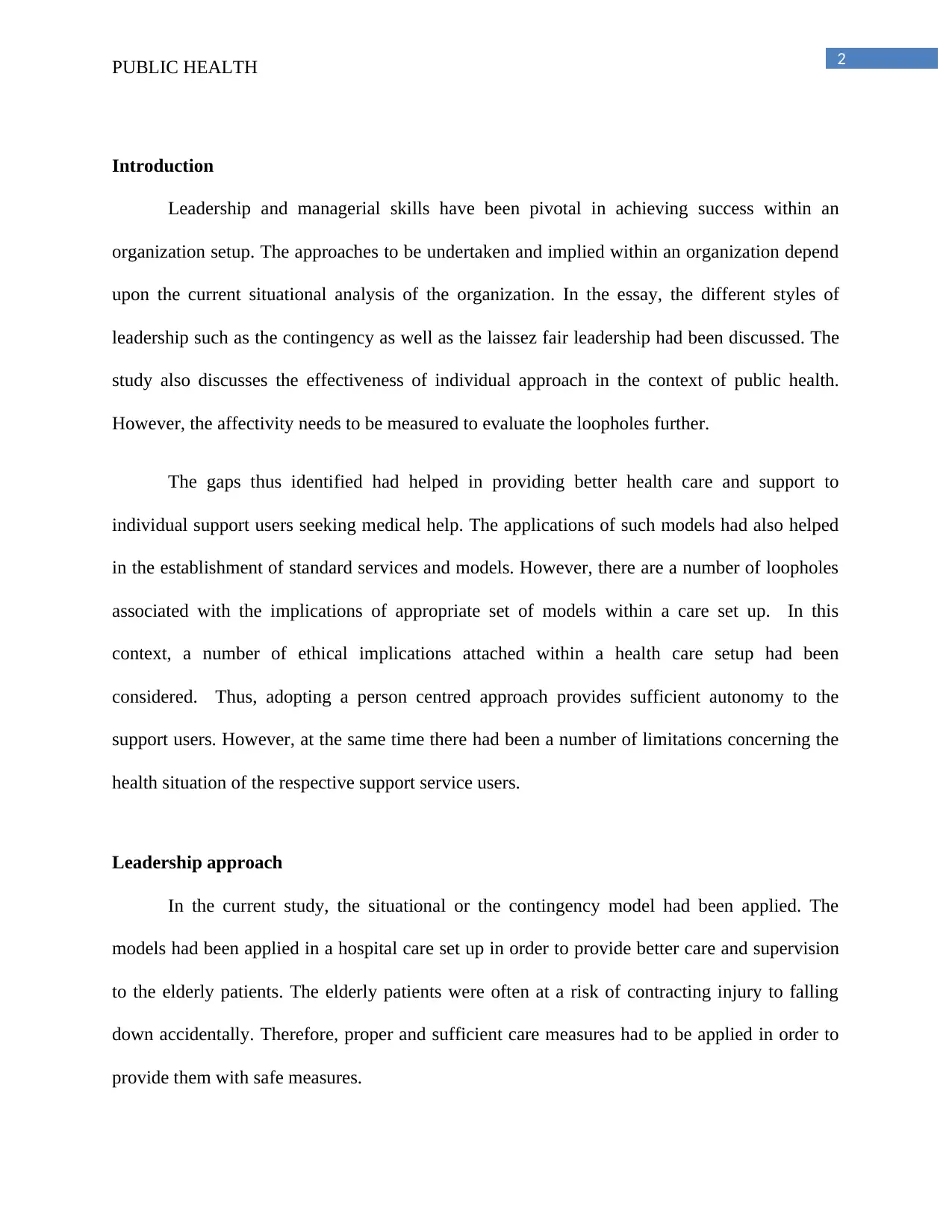
Introduction
Leadership and managerial skills have been pivotal in achieving success within an
organization setup. The approaches to be undertaken and implied within an organization depend
upon the current situational analysis of the organization. In the essay, the different styles of
leadership such as the contingency as well as the laissez fair leadership had been discussed. The
study also discusses the effectiveness of individual approach in the context of public health.
However, the affectivity needs to be measured to evaluate the loopholes further.
The gaps thus identified had helped in providing better health care and support to
individual support users seeking medical help. The applications of such models had also helped
in the establishment of standard services and models. However, there are a number of loopholes
associated with the implications of appropriate set of models within a care set up. In this
context, a number of ethical implications attached within a health care setup had been
considered. Thus, adopting a person centred approach provides sufficient autonomy to the
support users. However, at the same time there had been a number of limitations concerning the
health situation of the respective support service users.
Leadership approach
In the current study, the situational or the contingency model had been applied. The
models had been applied in a hospital care set up in order to provide better care and supervision
to the elderly patients. The elderly patients were often at a risk of contracting injury to falling
down accidentally. Therefore, proper and sufficient care measures had to be applied in order to
provide them with safe measures.
Document Page
3PUBLIC HEALTH
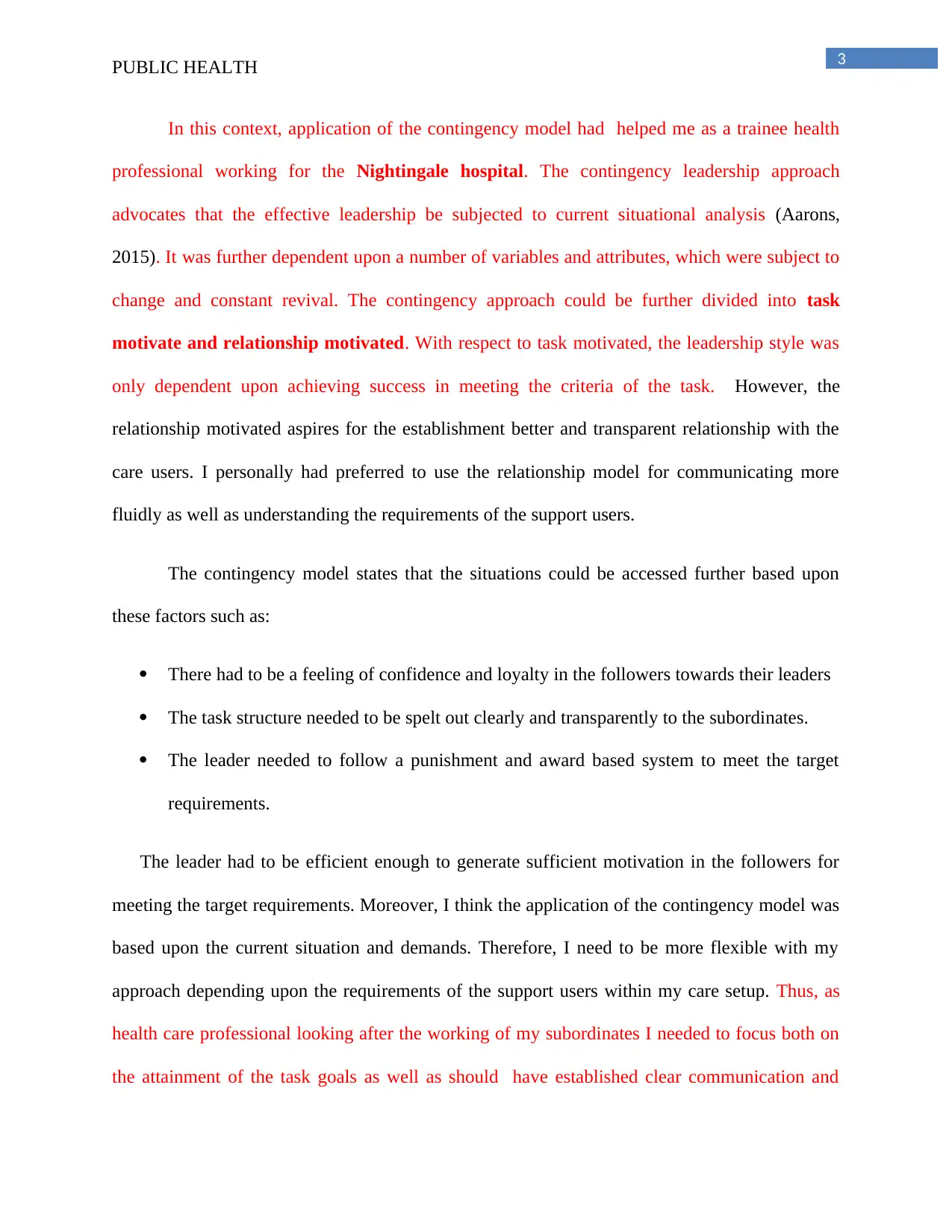
In this context, application of the contingency model had helped me as a trainee health
professional working for the Nightingale hospital. The contingency leadership approach
advocates that the effective leadership be subjected to current situational analysis (Aarons,
2015). It was further dependent upon a number of variables and attributes, which were subject to
change and constant revival. The contingency approach could be further divided into task
motivate and relationship motivated. With respect to task motivated, the leadership style was
only dependent upon achieving success in meeting the criteria of the task. However, the
relationship motivated aspires for the establishment better and transparent relationship with the
care users. I personally had preferred to use the relationship model for communicating more
fluidly as well as understanding the requirements of the support users.
The contingency model states that the situations could be accessed further based upon
these factors such as:
There had to be a feeling of confidence and loyalty in the followers towards their leaders
The task structure needed to be spelt out clearly and transparently to the subordinates.
The leader needed to follow a punishment and award based system to meet the target
requirements.
The leader had to be efficient enough to generate sufficient motivation in the followers for
meeting the target requirements. Moreover, I think the application of the contingency model was
based upon the current situation and demands. Therefore, I need to be more flexible with my
approach depending upon the requirements of the support users within my care setup. Thus, as
health care professional looking after the working of my subordinates I needed to focus both on
the attainment of the task goals as well as should have established clear communication and
tabler-icon-diamond-filled.svg

Paraphrase This Document

Need a fresh take? Get an instant paraphrase of this document with our AI Paraphraser
Document Page
4PUBLIC HEALTH
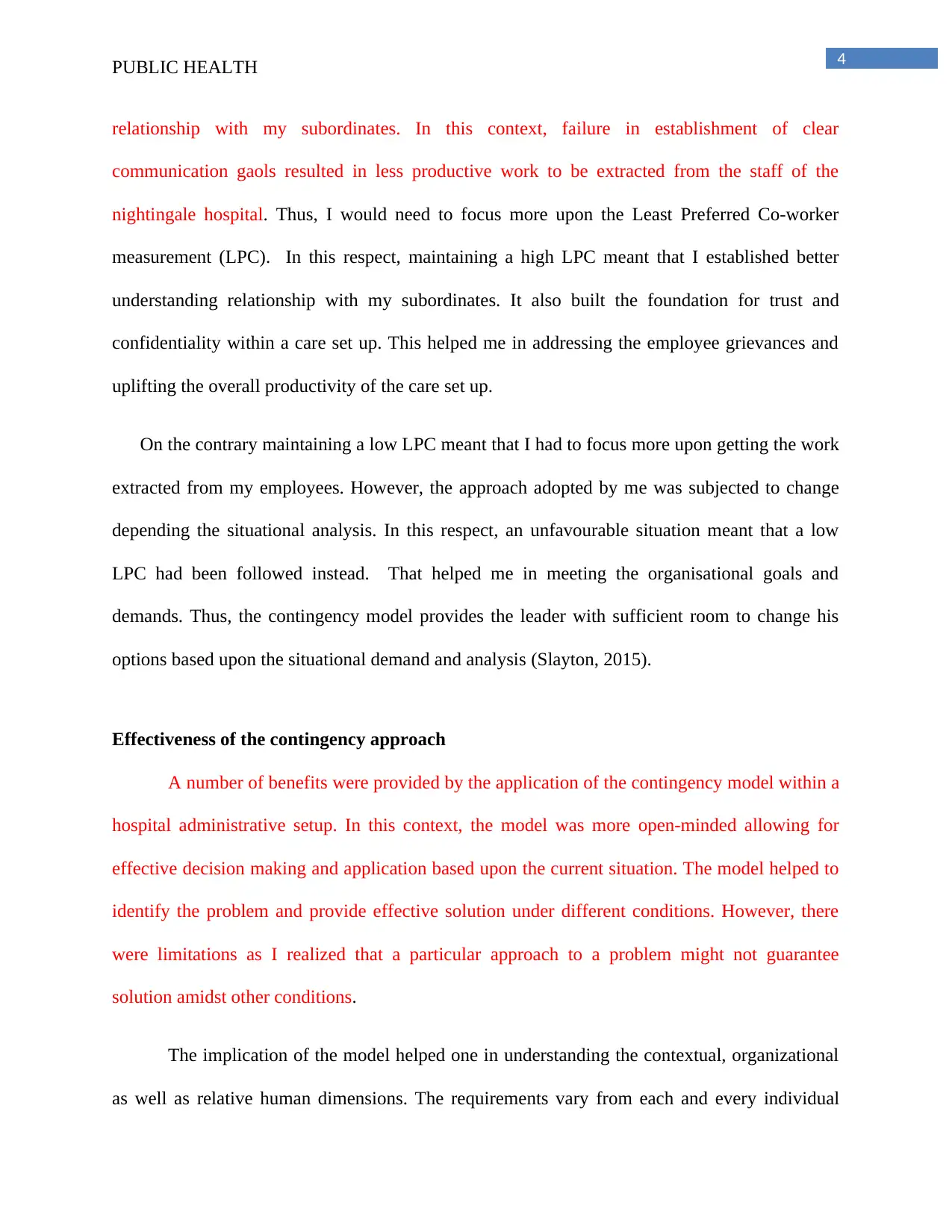
relationship with my subordinates. In this context, failure in establishment of clear
communication gaols resulted in less productive work to be extracted from the staff of the
nightingale hospital. Thus, I would need to focus more upon the Least Preferred Co-worker
measurement (LPC). In this respect, maintaining a high LPC meant that I established better
understanding relationship with my subordinates. It also built the foundation for trust and
confidentiality within a care set up. This helped me in addressing the employee grievances and
uplifting the overall productivity of the care set up.
On the contrary maintaining a low LPC meant that I had to focus more upon getting the work
extracted from my employees. However, the approach adopted by me was subjected to change
depending the situational analysis. In this respect, an unfavourable situation meant that a low
LPC had been followed instead. That helped me in meeting the organisational goals and
demands. Thus, the contingency model provides the leader with sufficient room to change his
options based upon the situational demand and analysis (Slayton, 2015).
Effectiveness of the contingency approach
A number of benefits were provided by the application of the contingency model within a
hospital administrative setup. In this context, the model was more open-minded allowing for
effective decision making and application based upon the current situation. The model helped to
identify the problem and provide effective solution under different conditions. However, there
were limitations as I realized that a particular approach to a problem might not guarantee
solution amidst other conditions.
The implication of the model helped one in understanding the contextual, organizational
as well as relative human dimensions. The requirements vary from each and every individual
Document Page
5PUBLIC HEALTH
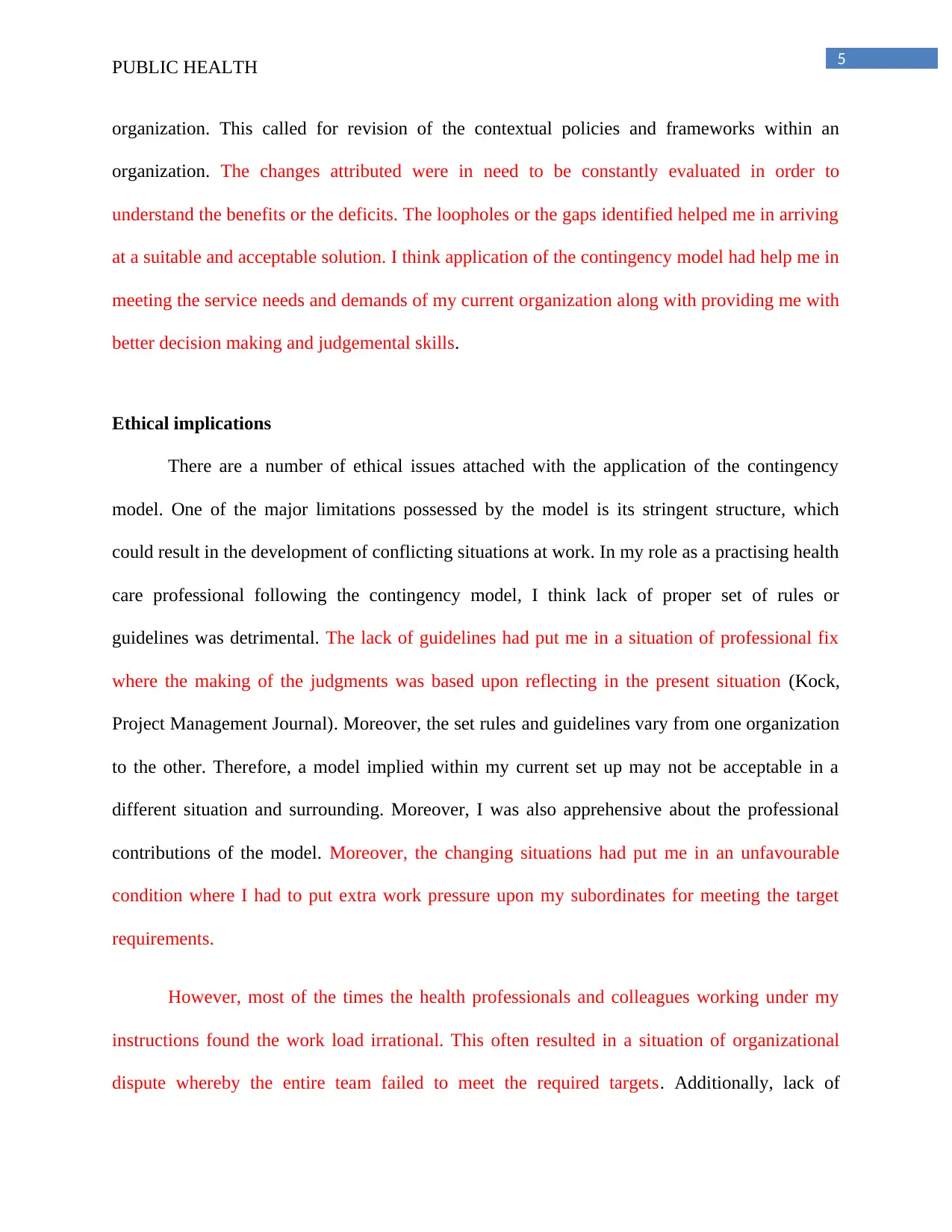
organization. This called for revision of the contextual policies and frameworks within an
organization. The changes attributed were in need to be constantly evaluated in order to
understand the benefits or the deficits. The loopholes or the gaps identified helped me in arriving
at a suitable and acceptable solution. I think application of the contingency model had help me in
meeting the service needs and demands of my current organization along with providing me with
better decision making and judgemental skills.
Ethical implications
There are a number of ethical issues attached with the application of the contingency
model. One of the major limitations possessed by the model is its stringent structure, which
could result in the development of conflicting situations at work. In my role as a practising health
care professional following the contingency model, I think lack of proper set of rules or
guidelines was detrimental. The lack of guidelines had put me in a situation of professional fix
where the making of the judgments was based upon reflecting in the present situation (Kock,
Project Management Journal). Moreover, the set rules and guidelines vary from one organization
to the other. Therefore, a model implied within my current set up may not be acceptable in a
different situation and surrounding. Moreover, I was also apprehensive about the professional
contributions of the model. Moreover, the changing situations had put me in an unfavourable
condition where I had to put extra work pressure upon my subordinates for meeting the target
requirements.
However, most of the times the health professionals and colleagues working under my
instructions found the work load irrational. This often resulted in a situation of organizational
dispute whereby the entire team failed to meet the required targets. Additionally, lack of
Document Page
6PUBLIC HEALTH
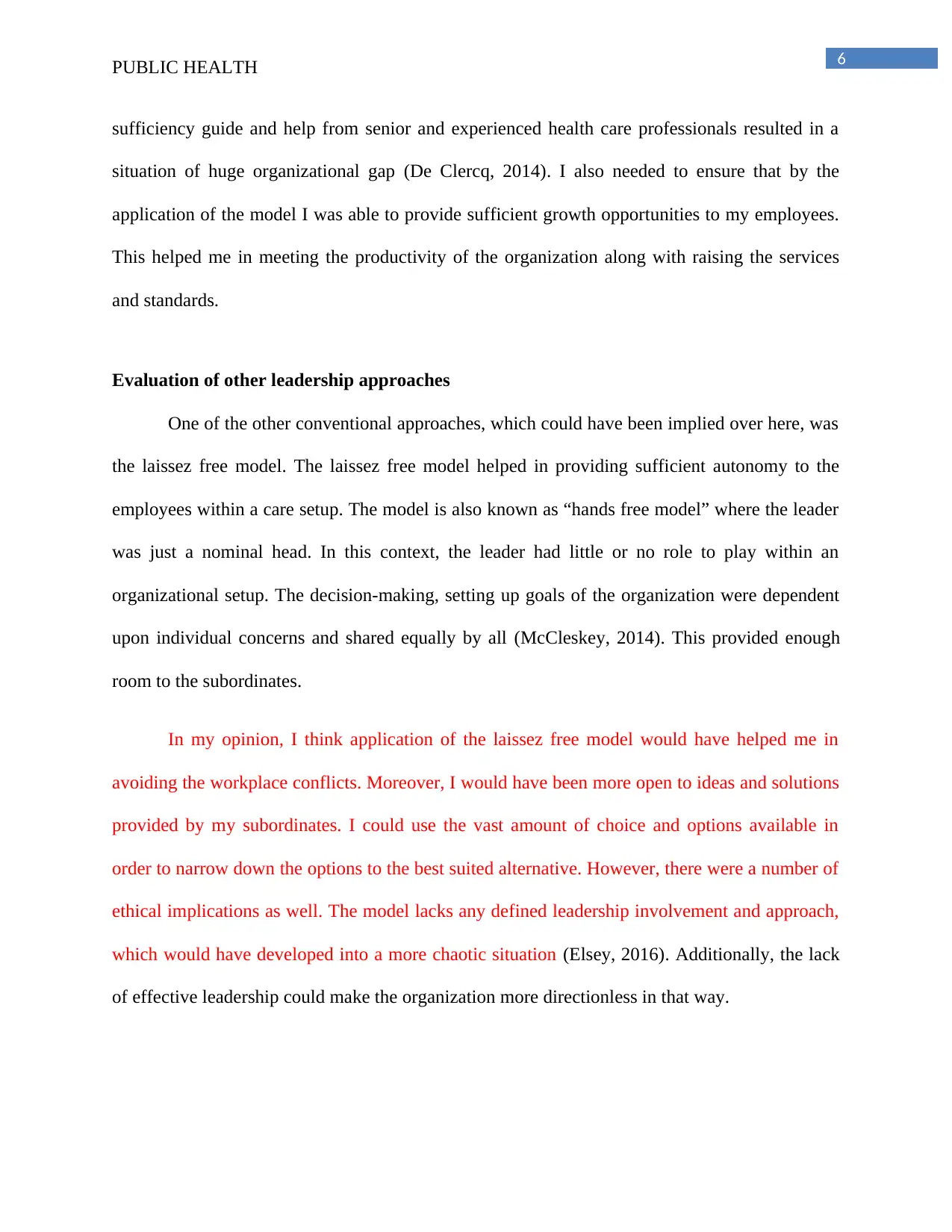
sufficiency guide and help from senior and experienced health care professionals resulted in a
situation of huge organizational gap (De Clercq, 2014). I also needed to ensure that by the
application of the model I was able to provide sufficient growth opportunities to my employees.
This helped me in meeting the productivity of the organization along with raising the services
and standards.
Evaluation of other leadership approaches
One of the other conventional approaches, which could have been implied over here, was
the laissez free model. The laissez free model helped in providing sufficient autonomy to the
employees within a care setup. The model is also known as “hands free model” where the leader
was just a nominal head. In this context, the leader had little or no role to play within an
organizational setup. The decision-making, setting up goals of the organization were dependent
upon individual concerns and shared equally by all (McCleskey, 2014). This provided enough
room to the subordinates.
In my opinion, I think application of the laissez free model would have helped me in
avoiding the workplace conflicts. Moreover, I would have been more open to ideas and solutions
provided by my subordinates. I could use the vast amount of choice and options available in
order to narrow down the options to the best suited alternative. However, there were a number of
ethical implications as well. The model lacks any defined leadership involvement and approach,
which would have developed into a more chaotic situation (Elsey, 2016). Additionally, the lack
of effective leadership could make the organization more directionless in that way.
tabler-icon-diamond-filled.svg

Paraphrase This Document

Need a fresh take? Get an instant paraphrase of this document with our AI Paraphraser
Document Page
7PUBLIC HEALTH
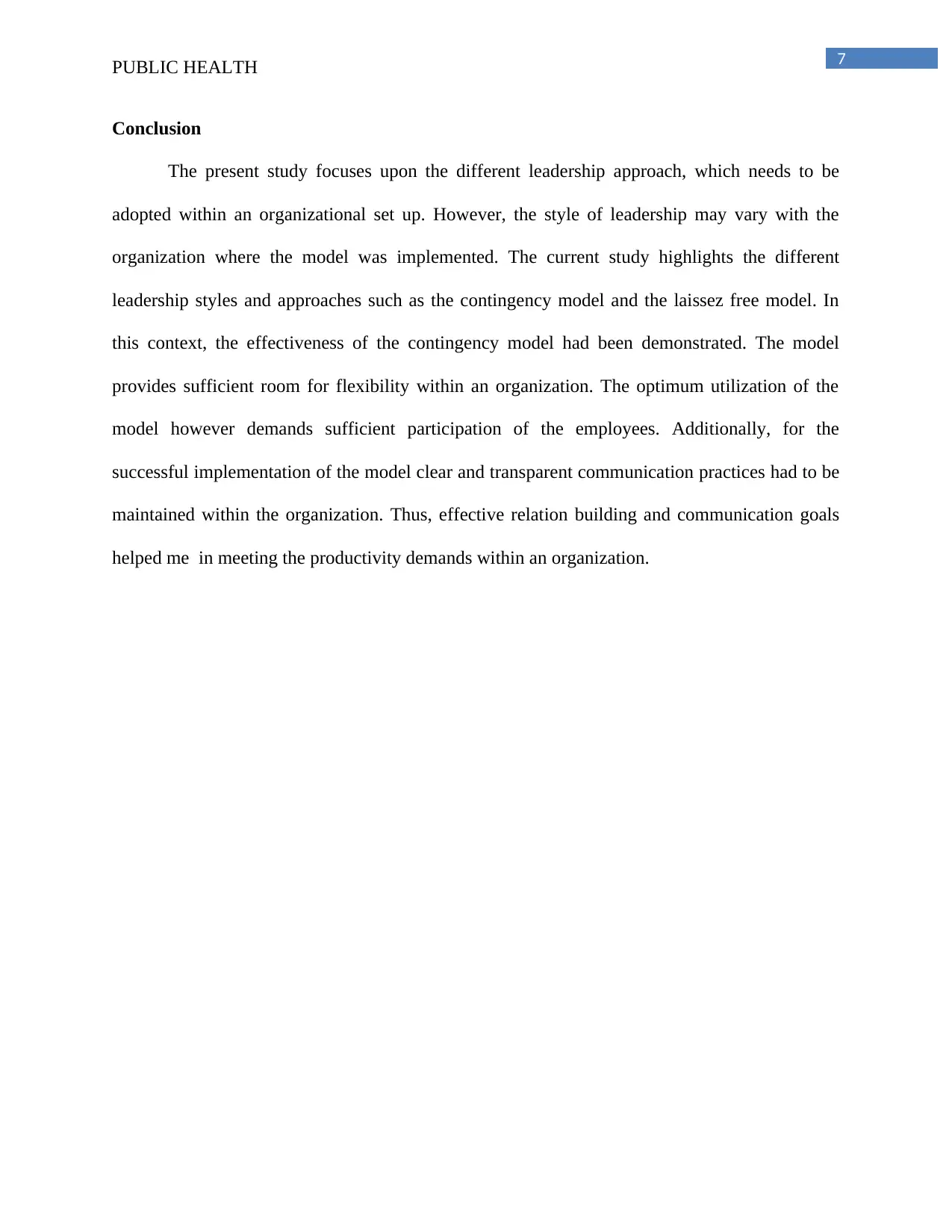
Conclusion
The present study focuses upon the different leadership approach, which needs to be
adopted within an organizational set up. However, the style of leadership may vary with the
organization where the model was implemented. The current study highlights the different
leadership styles and approaches such as the contingency model and the laissez free model. In
this context, the effectiveness of the contingency model had been demonstrated. The model
provides sufficient room for flexibility within an organization. The optimum utilization of the
model however demands sufficient participation of the employees. Additionally, for the
successful implementation of the model clear and transparent communication practices had to be
maintained within the organization. Thus, effective relation building and communication goals
helped me in meeting the productivity demands within an organization.
Document Page
8PUBLIC HEALTH
Document Page
9PUBLIC HEALTH
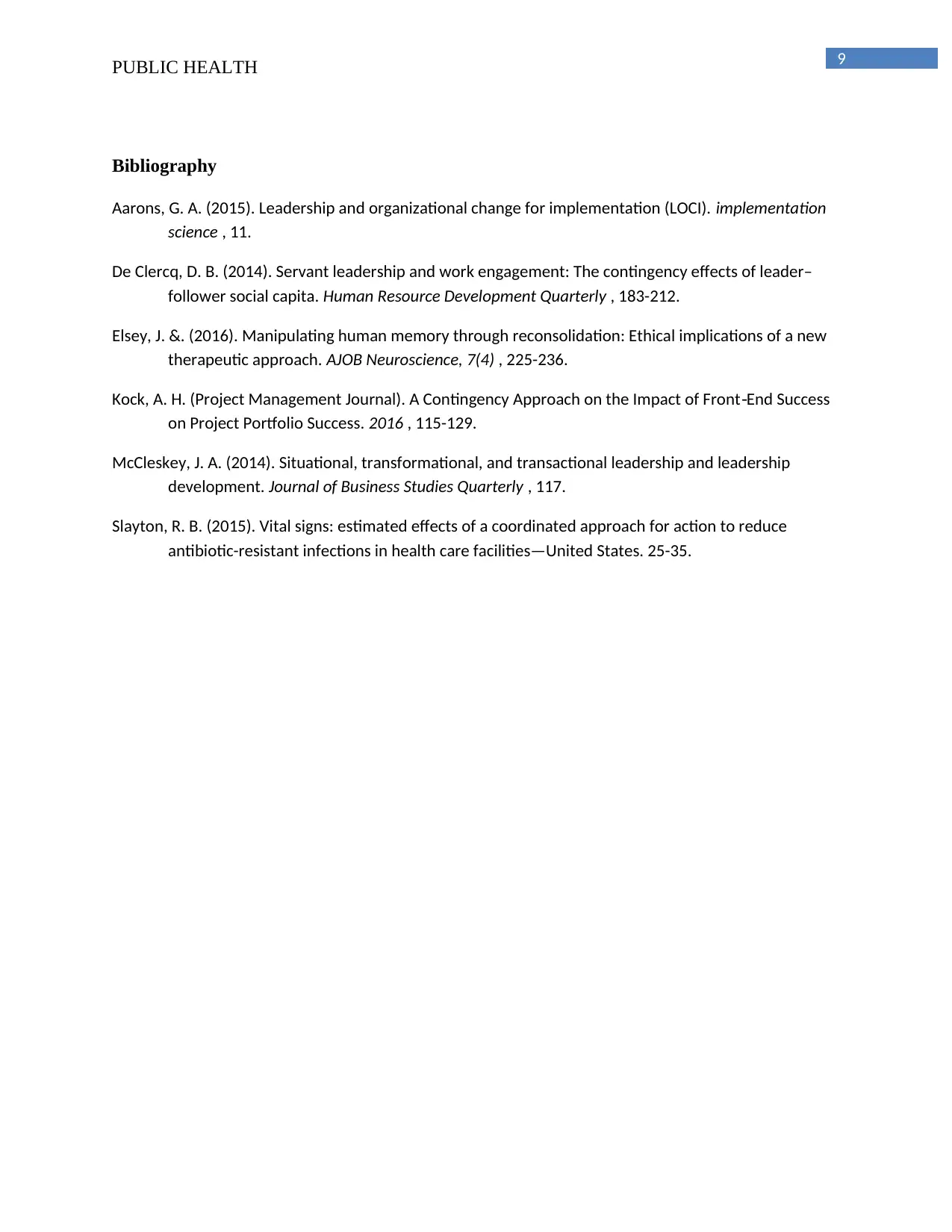
Bibliography
Aarons, G. A. (2015). Leadership and organizational change for implementation (LOCI). implementation
science , 11.
De Clercq, D. B. (2014). Servant leadership and work engagement: The contingency effects of leader–
follower social capita. Human Resource Development Quarterly , 183-212.
Elsey, J. &. (2016). Manipulating human memory through reconsolidation: Ethical implications of a new
therapeutic approach. AJOB Neuroscience, 7(4) , 225-236.
Kock, A. H. (Project Management Journal). A Contingency Approach on the Impact of Front End Success
on Project Portfolio Success. 2016 , 115-129.
McCleskey, J. A. (2014). Situational, transformational, and transactional leadership and leadership
development. Journal of Business Studies Quarterly , 117.
Slayton, R. B. (2015). Vital signs: estimated effects of a coordinated approach for action to reduce
antibiotic-resistant infections in health care facilities—United States. 25-35.
tabler-icon-diamond-filled.svg

Paraphrase This Document

Need a fresh take? Get an instant paraphrase of this document with our AI Paraphraser
Document Page
10PUBLIC HEALTH
chevron_up_icon
1 out of 11
circle_padding
hide_on_mobile
zoom_out_icon
[object Object]