Personal Reflection: The House on Mango Street Diary Entry

Verified

Added on  2021/04/24

|5
|1014
|239
Journal and Reflective Writing
AI Summary
This diary entry, written from the perspective of a student named Esperanza Cordero, reflects on the themes of community, identity, and the challenges faced by Latino immigrants in the House on Mango Street. The entry discusses the significance of family, the impact of the neighborhood on personal development, and the struggles with poverty and gender roles. Esperanza's reflections touch upon her interactions with various characters, her aspirations for a better future, and the importance of education and language in shaping her experiences. The diary entry highlights the close-knit community, the importance of finding a sense of belonging, and the complexities of relationships within the neighborhood, including both positive and negative experiences. The entry references key themes of identity, family and community and also references the works of other authors.
Document Page
House on the mango street
House on a Mango Tree
Diary Entry
tabler-icon-diamond-filled.svg

Paraphrase This Document

Need a fresh take? Get an instant paraphrase of this document with our AI Paraphraser
Document Page
House on the mango street
Date: Tuesday 3 April 2017
Time: 8.00 am
Dear Diary,
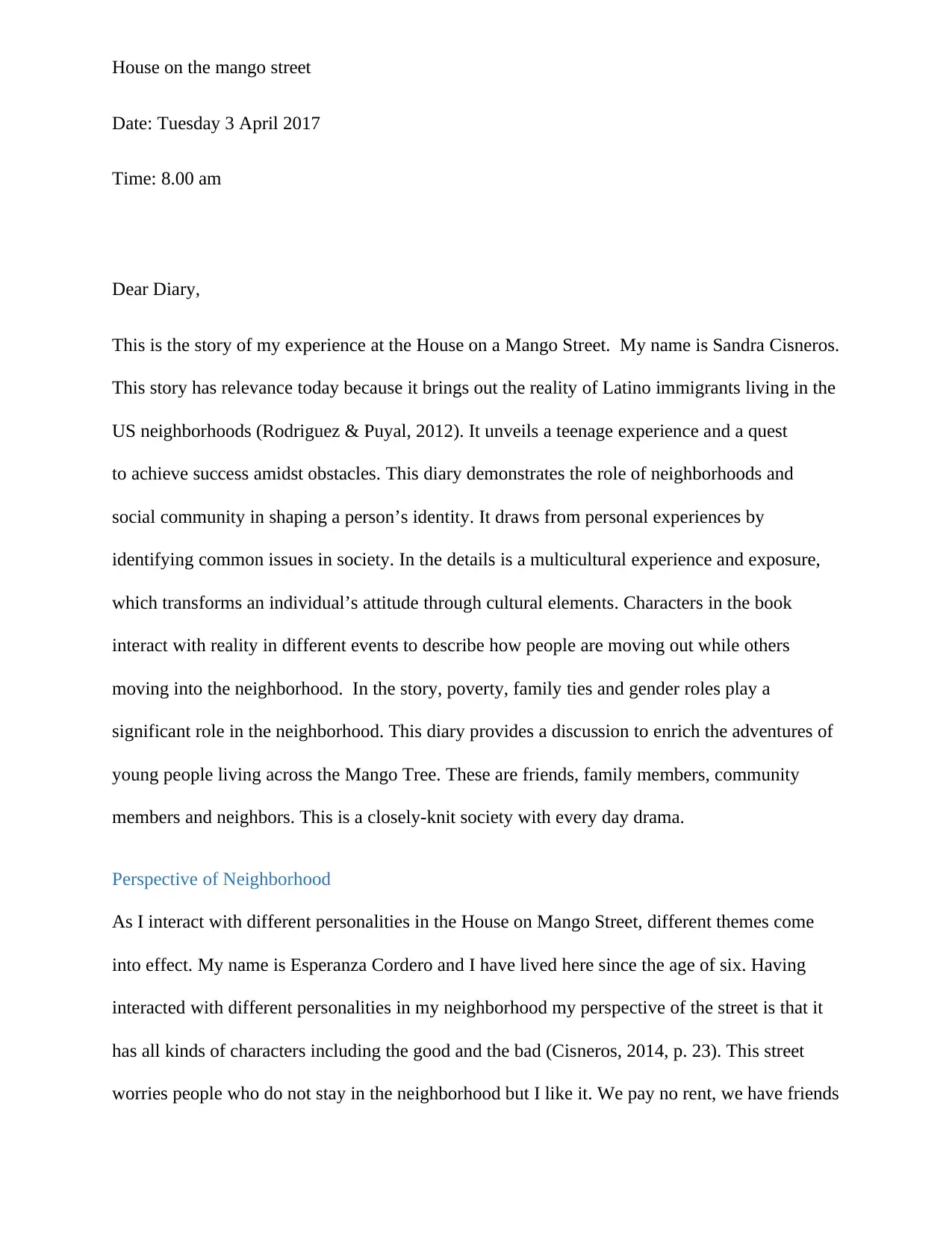
This is the story of my experience at the House on a Mango Street. My name is Sandra Cisneros.
This story has relevance today because it brings out the reality of Latino immigrants living in the
US neighborhoods (Rodriguez & Puyal, 2012). It unveils a teenage experience and a quest
to achieve success amidst obstacles. This diary demonstrates the role of neighborhoods and
social community in shaping a person’s identity. It draws from personal experiences by
identifying common issues in society. In the details is a multicultural experience and exposure,
which transforms an individual’s attitude through cultural elements. Characters in the book
interact with reality in different events to describe how people are moving out while others
moving into the neighborhood. In the story, poverty, family ties and gender roles play a
significant role in the neighborhood. This diary provides a discussion to enrich the adventures of
young people living across the Mango Tree. These are friends, family members, community
members and neighbors. This is a closely-knit society with every day drama.
Perspective of Neighborhood
As I interact with different personalities in the House on Mango Street, different themes come
into effect. My name is Esperanza Cordero and I have lived here since the age of six. Having
interacted with different personalities in my neighborhood my perspective of the street is that it
has all kinds of characters including the good and the bad (Cisneros, 2014, p. 23). This street
worries people who do not stay in the neighborhood but I like it. We pay no rent, we have friends
Document Page
House on the mango street
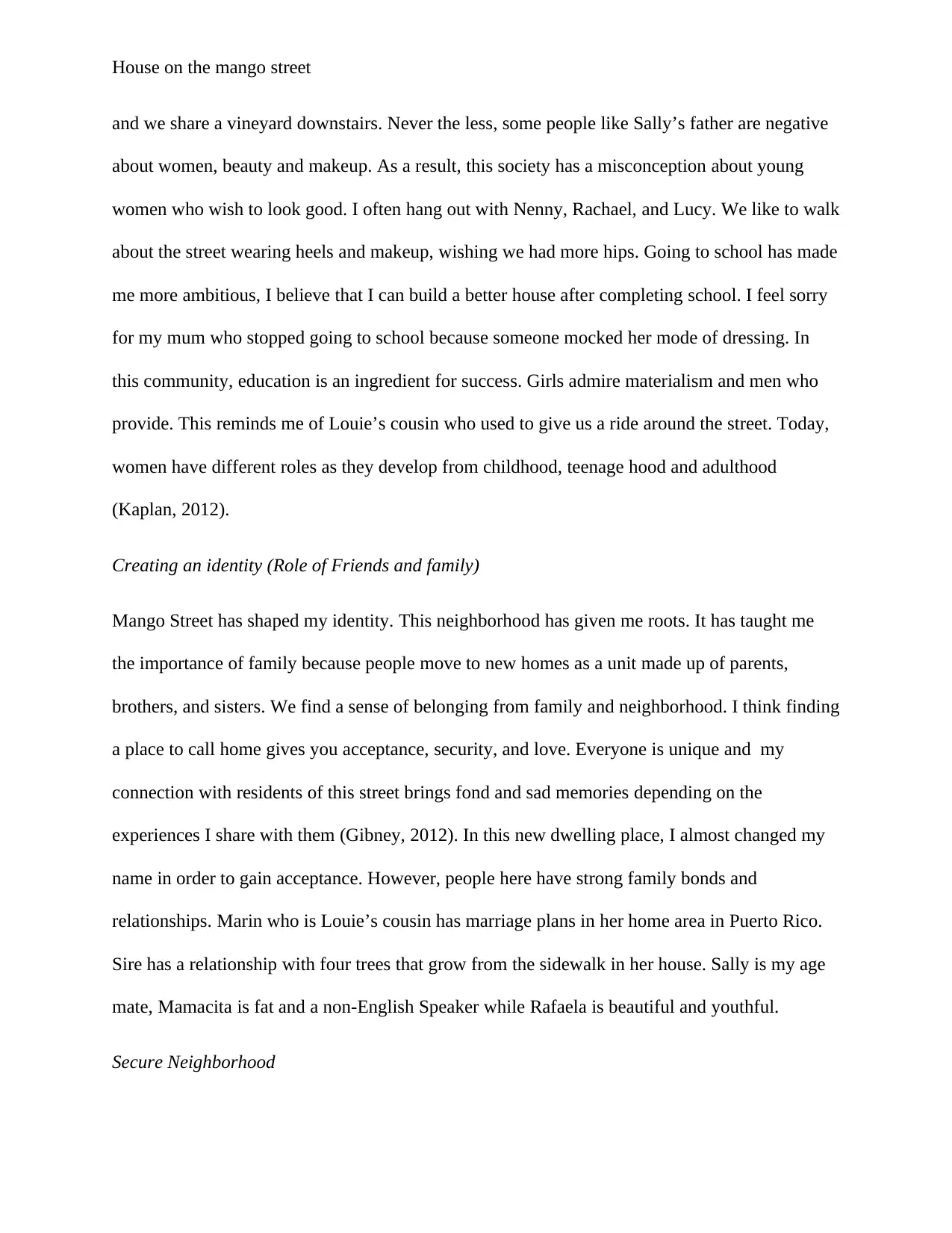
and we share a vineyard downstairs. Never the less, some people like Sally’s father are negative
about women, beauty and makeup. As a result, this society has a misconception about young
women who wish to look good. I often hang out with Nenny, Rachael, and Lucy. We like to walk
about the street wearing heels and makeup, wishing we had more hips. Going to school has made
me more ambitious, I believe that I can build a better house after completing school. I feel sorry
for my mum who stopped going to school because someone mocked her mode of dressing. In
this community, education is an ingredient for success. Girls admire materialism and men who
provide. This reminds me of Louie’s cousin who used to give us a ride around the street. Today,
women have different roles as they develop from childhood, teenage hood and adulthood
(Kaplan, 2012).
Creating an identity (Role of Friends and family)
Mango Street has shaped my identity. This neighborhood has given me roots. It has taught me
the importance of family because people move to new homes as a unit made up of parents,
brothers, and sisters. We find a sense of belonging from family and neighborhood. I think finding
a place to call home gives you acceptance, security, and love. Everyone is unique and my
connection with residents of this street brings fond and sad memories depending on the
experiences I share with them (Gibney, 2012). In this new dwelling place, I almost changed my
name in order to gain acceptance. However, people here have strong family bonds and
relationships. Marin who is Louie’s cousin has marriage plans in her home area in Puerto Rico.
Sire has a relationship with four trees that grow from the sidewalk in her house. Sally is my age
mate, Mamacita is fat and a non-English Speaker while Rafaela is beautiful and youthful.
Secure Neighborhood
Document Page
House on the mango street
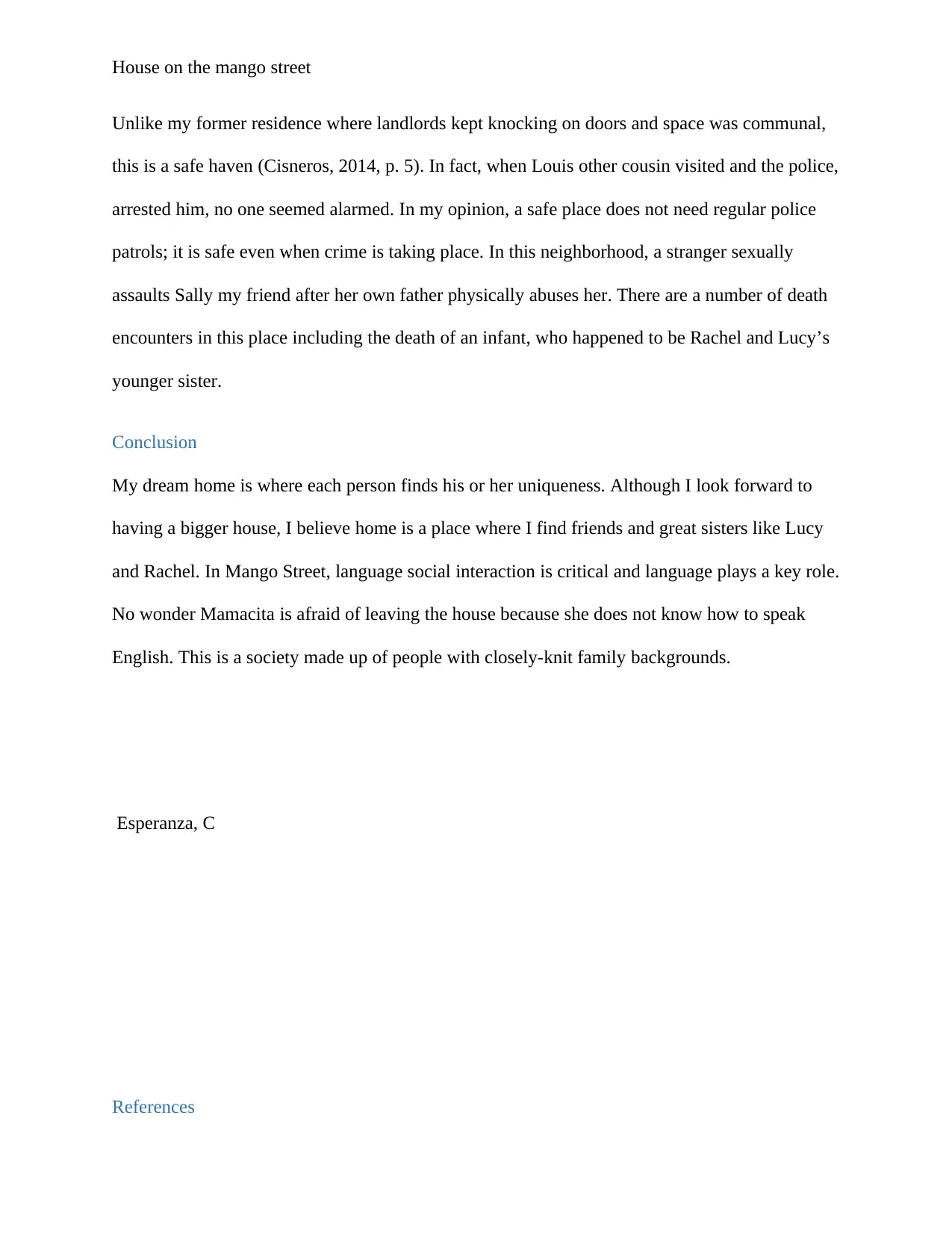
Unlike my former residence where landlords kept knocking on doors and space was communal,
this is a safe haven (Cisneros, 2014, p. 5). In fact, when Louis other cousin visited and the police,
arrested him, no one seemed alarmed. In my opinion, a safe place does not need regular police
patrols; it is safe even when crime is taking place. In this neighborhood, a stranger sexually
assaults Sally my friend after her own father physically abuses her. There are a number of death
encounters in this place including the death of an infant, who happened to be Rachel and Lucy’s
younger sister.
Conclusion
My dream home is where each person finds his or her uniqueness. Although I look forward to
having a bigger house, I believe home is a place where I find friends and great sisters like Lucy
and Rachel. In Mango Street, language social interaction is critical and language plays a key role.
No wonder Mamacita is afraid of leaving the house because she does not know how to speak
English. This is a society made up of people with closely-knit family backgrounds.
Esperanza, C
References
tabler-icon-diamond-filled.svg

Paraphrase This Document

Need a fresh take? Get an instant paraphrase of this document with our AI Paraphraser
Document Page
House on the mango street
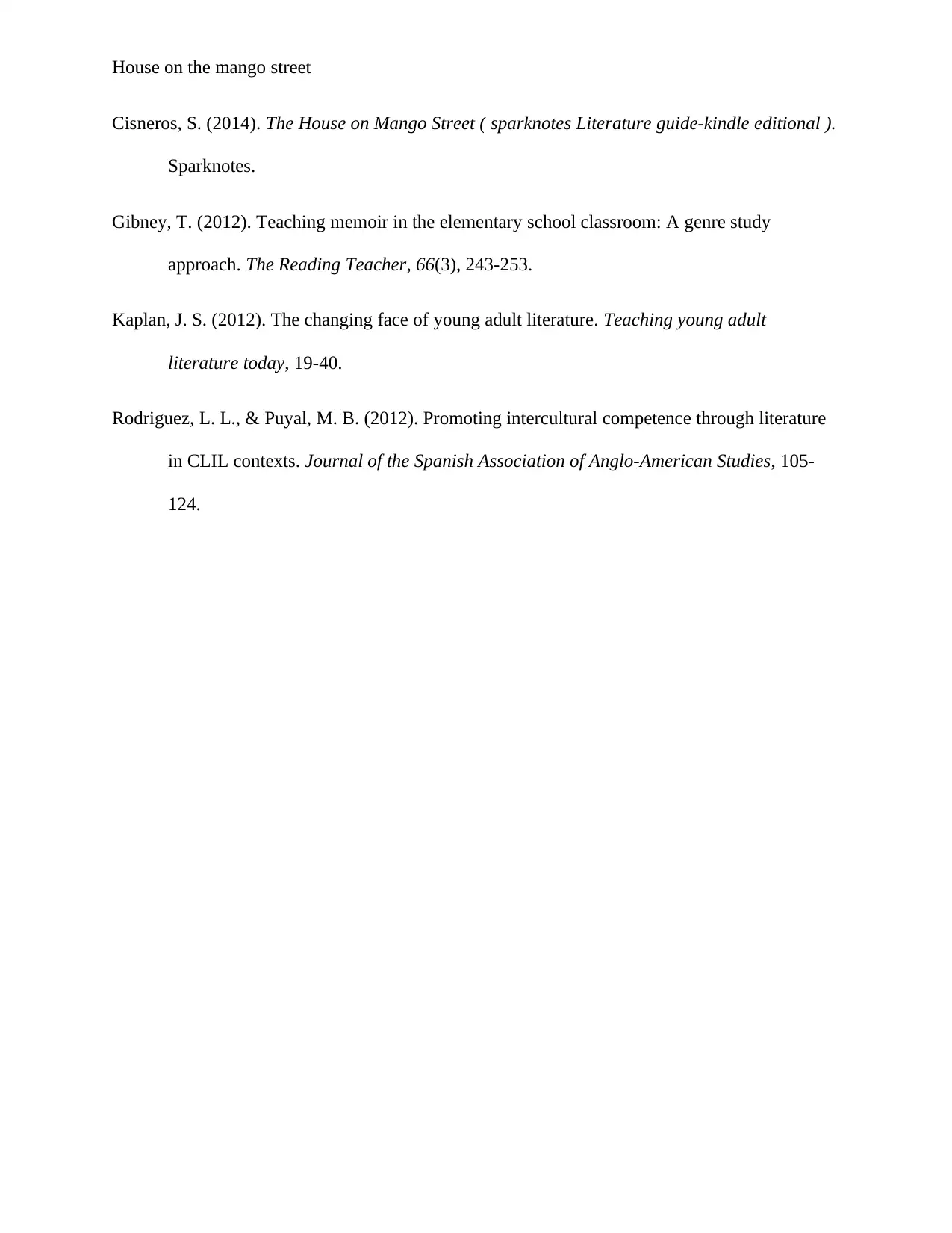
Cisneros, S. (2014). The House on Mango Street ( sparknotes Literature guide-kindle editional ).
Sparknotes.
Gibney, T. (2012). Teaching memoir in the elementary school classroom: A genre study
approach. The Reading Teacher, 66(3), 243-253.
Kaplan, J. S. (2012). The changing face of young adult literature. Teaching young adult
literature today, 19-40.
Rodriguez, L. L., & Puyal, M. B. (2012). Promoting intercultural competence through literature
in CLIL contexts. Journal of the Spanish Association of Anglo-American Studies, 105-
124.
chevron_up_icon
1 out of 5
circle_padding
hide_on_mobile
zoom_out_icon
[object Object]