Human Resource Management: Reward, Motivation, Expatriates & Absence
VerifiedAdded on 2024/06/07
|26
|8546
|385
Homework Assignment
AI Summary
This assignment delves into various aspects of Human Resource Management, focusing on reward management, employee motivation, expatriate management, and absence management. It includes exercises that require analyzing personal reward values, considering the introduction of individual performance-related pay, and identifying performance measurement methods for different job roles such as university lecturers, sales representatives, and restaurant managers. The assignment also addresses the advantages and disadvantages of paying employees during absence, explores the rationale behind differences in absence levels between the public and private sectors, and evaluates different methods for reducing absence. Furthermore, it examines key considerations for international HRM, specifically concerning expatriates and overseas management, covering topics such as selection criteria, training, performance management, and repatriation challenges. The document is available on Desklib, a platform offering AI-based study tools and solved assignments for students.
Human Resource Management
1
1

Paraphrase This Document
Need a fresh take? Get an instant paraphrase of this document with our AI Paraphraser
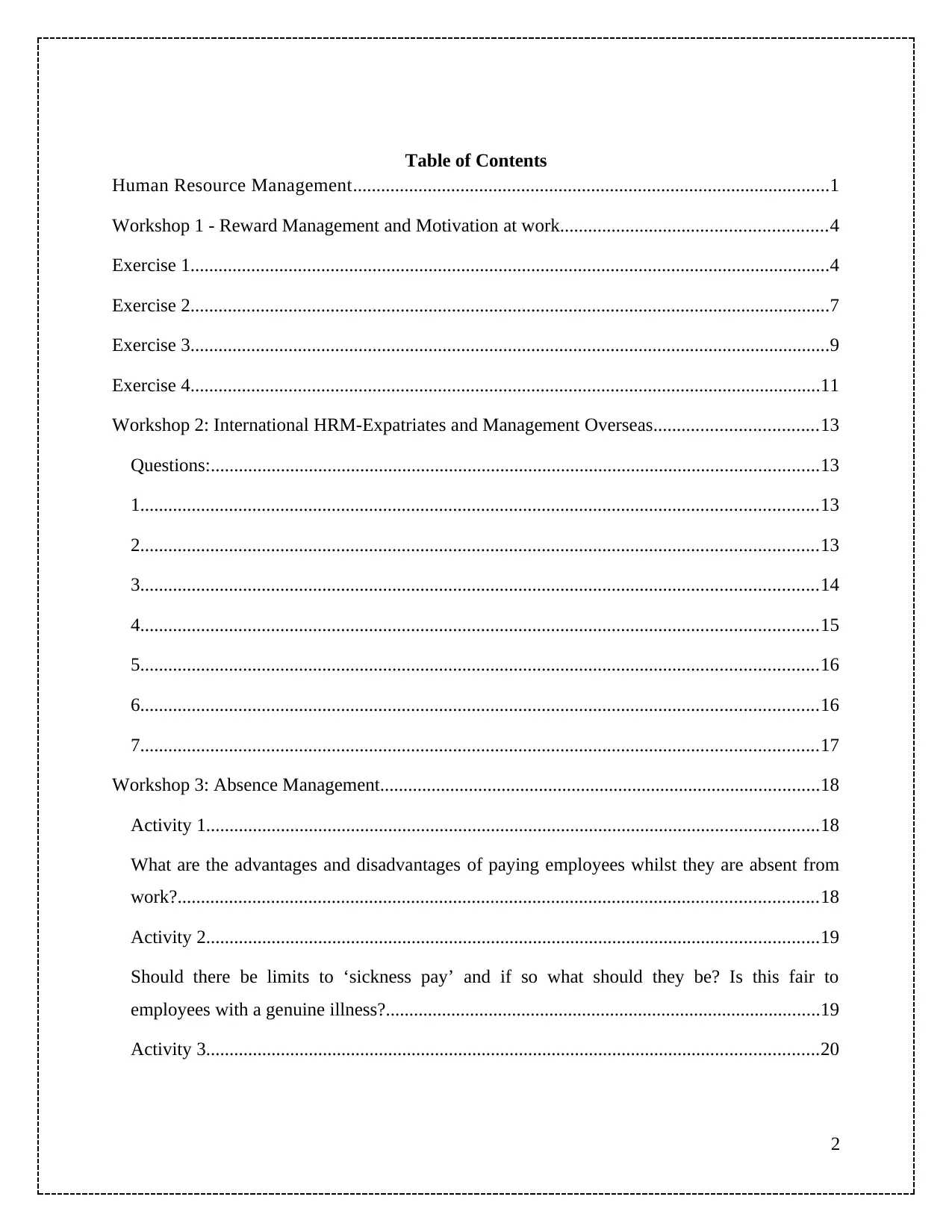
Table of Contents
Human Resource Management......................................................................................................1
Workshop 1 - Reward Management and Motivation at work.........................................................4
Exercise 1.........................................................................................................................................4
Exercise 2.........................................................................................................................................7
Exercise 3.........................................................................................................................................9
Exercise 4.......................................................................................................................................11
Workshop 2: International HRM-Expatriates and Management Overseas...................................13
Questions:..................................................................................................................................13
1.................................................................................................................................................13
2.................................................................................................................................................13
3.................................................................................................................................................14
4.................................................................................................................................................15
5.................................................................................................................................................16
6.................................................................................................................................................16
7.................................................................................................................................................17
Workshop 3: Absence Management..............................................................................................18
Activity 1...................................................................................................................................18
What are the advantages and disadvantages of paying employees whilst they are absent from
work?.........................................................................................................................................18
Activity 2...................................................................................................................................19
Should there be limits to ‘sickness pay’ and if so what should they be? Is this fair to
employees with a genuine illness?.............................................................................................19
Activity 3...................................................................................................................................20
2
Human Resource Management......................................................................................................1
Workshop 1 - Reward Management and Motivation at work.........................................................4
Exercise 1.........................................................................................................................................4
Exercise 2.........................................................................................................................................7
Exercise 3.........................................................................................................................................9
Exercise 4.......................................................................................................................................11
Workshop 2: International HRM-Expatriates and Management Overseas...................................13
Questions:..................................................................................................................................13
1.................................................................................................................................................13
2.................................................................................................................................................13
3.................................................................................................................................................14
4.................................................................................................................................................15
5.................................................................................................................................................16
6.................................................................................................................................................16
7.................................................................................................................................................17
Workshop 3: Absence Management..............................................................................................18
Activity 1...................................................................................................................................18
What are the advantages and disadvantages of paying employees whilst they are absent from
work?.........................................................................................................................................18
Activity 2...................................................................................................................................19
Should there be limits to ‘sickness pay’ and if so what should they be? Is this fair to
employees with a genuine illness?.............................................................................................19
Activity 3...................................................................................................................................20
2
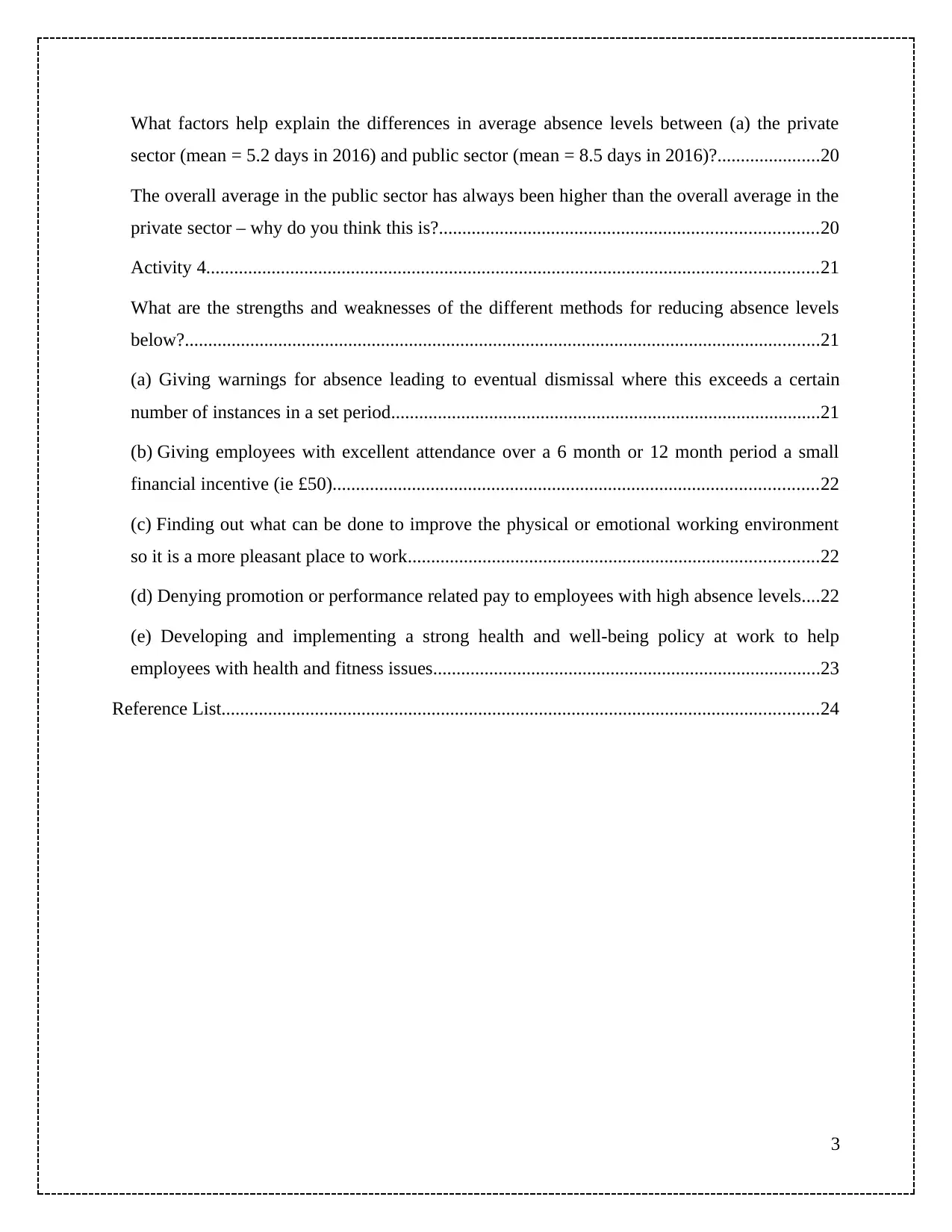
What factors help explain the differences in average absence levels between (a) the private
sector (mean = 5.2 days in 2016) and public sector (mean = 8.5 days in 2016)?......................20
The overall average in the public sector has always been higher than the overall average in the
private sector – why do you think this is?.................................................................................20
Activity 4...................................................................................................................................21
What are the strengths and weaknesses of the different methods for reducing absence levels
below?........................................................................................................................................21
(a) Giving warnings for absence leading to eventual dismissal where this exceeds a certain
number of instances in a set period............................................................................................21
(b) Giving employees with excellent attendance over a 6 month or 12 month period a small
financial incentive (ie £50)........................................................................................................22
(c) Finding out what can be done to improve the physical or emotional working environment
so it is a more pleasant place to work........................................................................................22
(d) Denying promotion or performance related pay to employees with high absence levels....22
(e) Developing and implementing a strong health and well-being policy at work to help
employees with health and fitness issues...................................................................................23
Reference List................................................................................................................................24
3
sector (mean = 5.2 days in 2016) and public sector (mean = 8.5 days in 2016)?......................20
The overall average in the public sector has always been higher than the overall average in the
private sector – why do you think this is?.................................................................................20
Activity 4...................................................................................................................................21
What are the strengths and weaknesses of the different methods for reducing absence levels
below?........................................................................................................................................21
(a) Giving warnings for absence leading to eventual dismissal where this exceeds a certain
number of instances in a set period............................................................................................21
(b) Giving employees with excellent attendance over a 6 month or 12 month period a small
financial incentive (ie £50)........................................................................................................22
(c) Finding out what can be done to improve the physical or emotional working environment
so it is a more pleasant place to work........................................................................................22
(d) Denying promotion or performance related pay to employees with high absence levels....22
(e) Developing and implementing a strong health and well-being policy at work to help
employees with health and fitness issues...................................................................................23
Reference List................................................................................................................................24
3
⊘ This is a preview!⊘
Do you want full access?
Subscribe today to unlock all pages.

Trusted by 1+ million students worldwide
Workshop 1 - Reward Management and Motivation at work
Exercise 1
Complete the questionnaire placed on NILE entitled 'What Rewards do you most Value?’ for 3
different people: Yourself, an older person (such as one of your parents) and a close personal
friend. Tick what you think are the 3 most important rewards for each person and then spend a
little time reflecting on your answers and what they can mean for organisations wanting to
ensure their employees are rewarded.
Once you have completed this task consider the following –
Should organisations try to find out what employees most value from work? Should they try to
partly plan their reward strategies around this or is that too difficult to do?
Should they continue to treat everyone the same when it comes to non-financial rewards or
should managers find out what rewards employees prefer and use this to motivate them more?
We will be discussing these and other issues in our first Workshop.
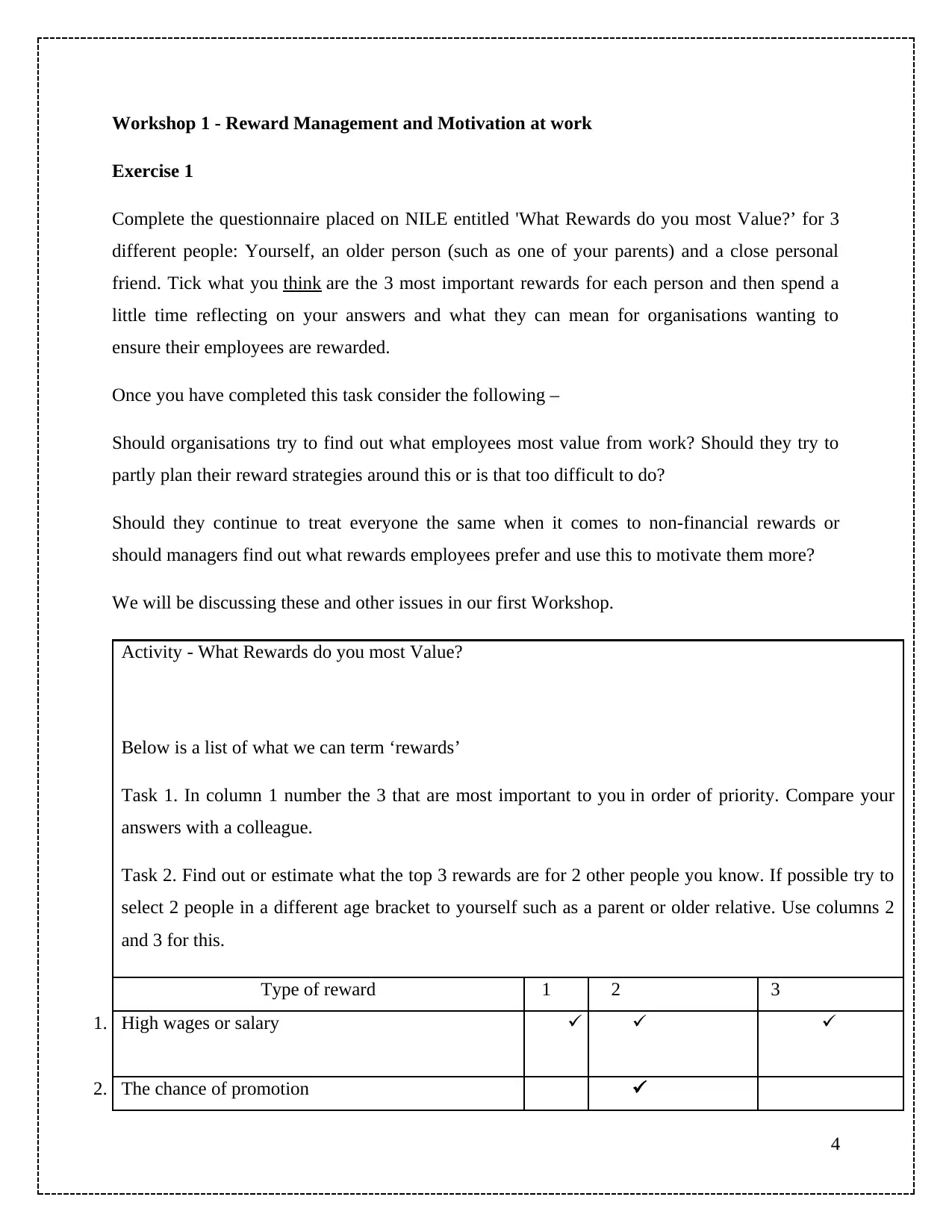
Activity - What Rewards do you most Value?
Below is a list of what we can term ‘rewards’
Task 1. In column 1 number the 3 that are most important to you in order of priority. Compare your
answers with a colleague.
Task 2. Find out or estimate what the top 3 rewards are for 2 other people you know. If possible try to
select 2 people in a different age bracket to yourself such as a parent or older relative. Use columns 2
and 3 for this.
Type of reward 1 2 3
1. High wages or salary
2. The chance of promotion
4
Exercise 1
Complete the questionnaire placed on NILE entitled 'What Rewards do you most Value?’ for 3
different people: Yourself, an older person (such as one of your parents) and a close personal
friend. Tick what you think are the 3 most important rewards for each person and then spend a
little time reflecting on your answers and what they can mean for organisations wanting to
ensure their employees are rewarded.
Once you have completed this task consider the following –
Should organisations try to find out what employees most value from work? Should they try to
partly plan their reward strategies around this or is that too difficult to do?
Should they continue to treat everyone the same when it comes to non-financial rewards or
should managers find out what rewards employees prefer and use this to motivate them more?
We will be discussing these and other issues in our first Workshop.
Activity - What Rewards do you most Value?
Below is a list of what we can term ‘rewards’
Task 1. In column 1 number the 3 that are most important to you in order of priority. Compare your
answers with a colleague.
Task 2. Find out or estimate what the top 3 rewards are for 2 other people you know. If possible try to
select 2 people in a different age bracket to yourself such as a parent or older relative. Use columns 2
and 3 for this.
Type of reward 1 2 3
1. High wages or salary
2. The chance of promotion
4
Paraphrase This Document
Need a fresh take? Get an instant paraphrase of this document with our AI Paraphraser
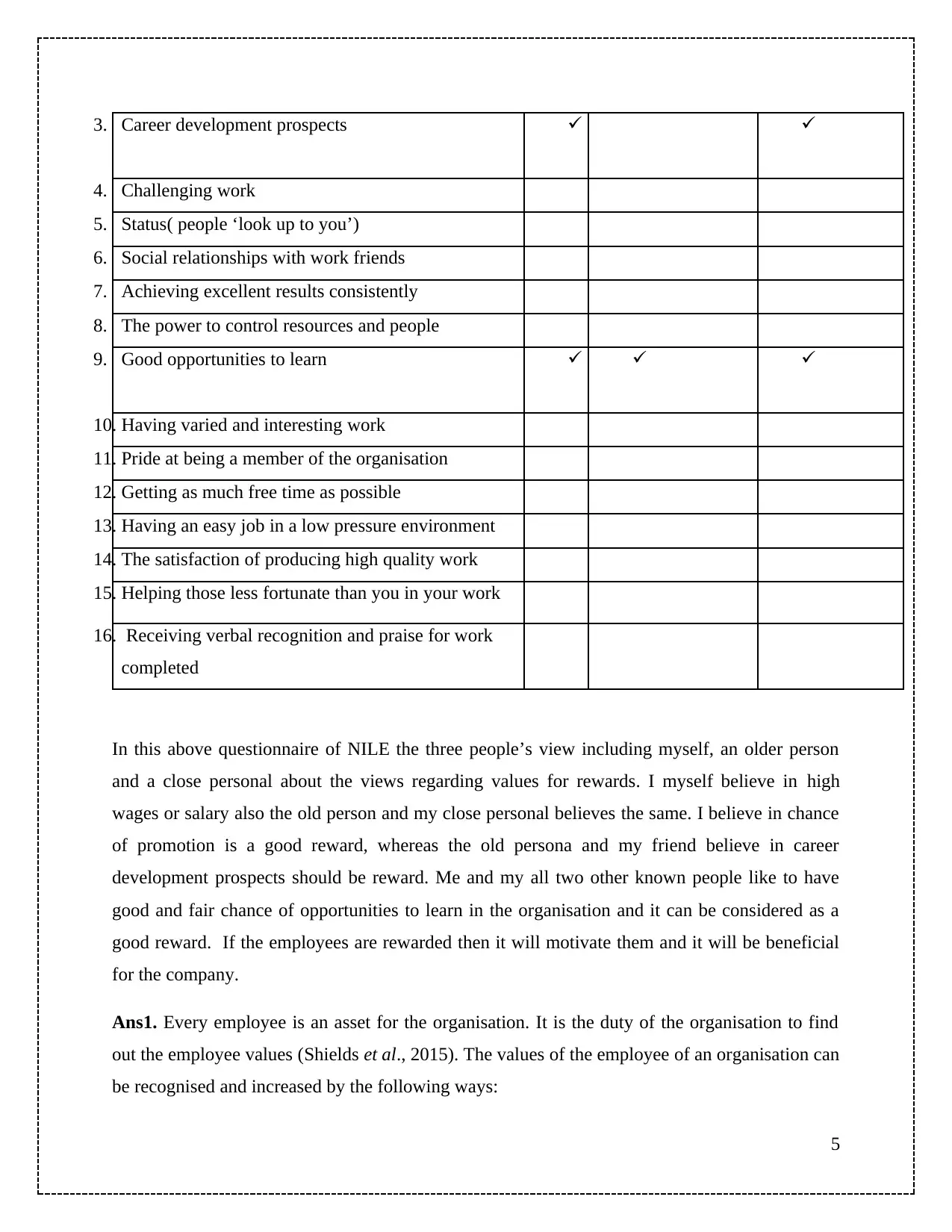
3. Career development prospects
4. Challenging work
5. Status( people ‘look up to you’)
6. Social relationships with work friends
7. Achieving excellent results consistently
8. The power to control resources and people
9. Good opportunities to learn
10. Having varied and interesting work
11. Pride at being a member of the organisation
12. Getting as much free time as possible
13. Having an easy job in a low pressure environment
14. The satisfaction of producing high quality work
15. Helping those less fortunate than you in your work
16. Receiving verbal recognition and praise for work
completed
In this above questionnaire of NILE the three people’s view including myself, an older person
and a close personal about the views regarding values for rewards. I myself believe in high
wages or salary also the old person and my close personal believes the same. I believe in chance
of promotion is a good reward, whereas the old persona and my friend believe in career
development prospects should be reward. Me and my all two other known people like to have
good and fair chance of opportunities to learn in the organisation and it can be considered as a
good reward. If the employees are rewarded then it will motivate them and it will be beneficial
for the company.
Ans1. Every employee is an asset for the organisation. It is the duty of the organisation to find
out the employee values (Shields et al., 2015). The values of the employee of an organisation can
be recognised and increased by the following ways:
5
4. Challenging work
5. Status( people ‘look up to you’)
6. Social relationships with work friends
7. Achieving excellent results consistently
8. The power to control resources and people
9. Good opportunities to learn
10. Having varied and interesting work
11. Pride at being a member of the organisation
12. Getting as much free time as possible
13. Having an easy job in a low pressure environment
14. The satisfaction of producing high quality work
15. Helping those less fortunate than you in your work
16. Receiving verbal recognition and praise for work
completed
In this above questionnaire of NILE the three people’s view including myself, an older person
and a close personal about the views regarding values for rewards. I myself believe in high
wages or salary also the old person and my close personal believes the same. I believe in chance
of promotion is a good reward, whereas the old persona and my friend believe in career
development prospects should be reward. Me and my all two other known people like to have
good and fair chance of opportunities to learn in the organisation and it can be considered as a
good reward. If the employees are rewarded then it will motivate them and it will be beneficial
for the company.
Ans1. Every employee is an asset for the organisation. It is the duty of the organisation to find
out the employee values (Shields et al., 2015). The values of the employee of an organisation can
be recognised and increased by the following ways:
5
Good communication can help to provide values to the employee by making them clear about the
goal and objective of the organisation
Providing opportunities by means of promotion
Value can be increased by means of learning opportunities
Value of the employee can be increased by means of rewards, incentives and appreciation
(Ismail et al., 2016)
It is also necessary to empower the employee by seeking for suggestion, when required as it
motivates the employee
Ans2. Reward is the best way to get the employee motivated in the organisation and there should
be proper strategies in the organisation for rewards and incentives. There should be rewards in
accordance to market competition. The reward strategies are discussed below:
There should be incentive based on performance. It can be achieved by motivating the employee
towards their goals, which will forward then to achieve the incentive. It includes yearly bonus,
quarterly incentive plan, incentive based on monthly performance. This will help to boost the
mind and energy of the employee.
Recognition of employee is very important to making the strategies of rewards. Employee
recognition meets the psychological requirements of the employees, such as employees of the
month or the year
Ans3. There are two types of reward that the organisation should follow to provide incentives
and rewards to the employee of the organisation for motivation. The rewards are stated below:
Financial reward: Financial rewards are provided to the employees to measure the
performance of the employee with the help of money (Stikeleather 2016). This involves profit
sharing for suggesting plans, bonuses, cash reward. It may also include other type of monetary
awards it may be quarterly, yearly etc.
Non financial rewards: It can be provided with awards without money by giving opportunities.
It can be flexible working atmosphere, training and learning (Malik et al., 2015). It can be
provided by offering leadership to certain project or task, giving sudden party to the employees,
giving recognition to the employee by appreciation and by giving awards.
6
goal and objective of the organisation
Providing opportunities by means of promotion
Value can be increased by means of learning opportunities
Value of the employee can be increased by means of rewards, incentives and appreciation
(Ismail et al., 2016)
It is also necessary to empower the employee by seeking for suggestion, when required as it
motivates the employee
Ans2. Reward is the best way to get the employee motivated in the organisation and there should
be proper strategies in the organisation for rewards and incentives. There should be rewards in
accordance to market competition. The reward strategies are discussed below:
There should be incentive based on performance. It can be achieved by motivating the employee
towards their goals, which will forward then to achieve the incentive. It includes yearly bonus,
quarterly incentive plan, incentive based on monthly performance. This will help to boost the
mind and energy of the employee.
Recognition of employee is very important to making the strategies of rewards. Employee
recognition meets the psychological requirements of the employees, such as employees of the
month or the year
Ans3. There are two types of reward that the organisation should follow to provide incentives
and rewards to the employee of the organisation for motivation. The rewards are stated below:
Financial reward: Financial rewards are provided to the employees to measure the
performance of the employee with the help of money (Stikeleather 2016). This involves profit
sharing for suggesting plans, bonuses, cash reward. It may also include other type of monetary
awards it may be quarterly, yearly etc.
Non financial rewards: It can be provided with awards without money by giving opportunities.
It can be flexible working atmosphere, training and learning (Malik et al., 2015). It can be
provided by offering leadership to certain project or task, giving sudden party to the employees,
giving recognition to the employee by appreciation and by giving awards.
6
⊘ This is a preview!⊘
Do you want full access?
Subscribe today to unlock all pages.
Trusted by 1+ million students worldwide
Exercise 2
Draw up a list of questions that a team of managers in an organization would need to
carefully consider before deciding whether or not to introduce individual performance
related pay. An example could be ‘How hard or easy will it be to measure performance in
each job role?’
1. What are the extent that can influence the attitudes and behaviour through the way of design
rewards? For example if the behaviour of a person is good in the organisation the person can be
rewarded as it impacts the overall growth of the organisation.
2. What types of pay and non pay rewards will work best in achieving high performance and / or
other business goals? For example a person is not eligible for monetary award rather there is
requirement of appreciation or recognition so the individual has to be awarded by taking the case
in consideration.
3. How will the way of rewarding the employees affect recruitment, motivation, retention and
our costs? For example if a employee is rewarded by means of performance as all the parameters
are met, whereas on the other hand one employee has not received any incentive. Then the
employee will not be motivated and would not work.
4. What are the ways through which the managers and the supervisors to motivate the
employees? For example if the employees are not motivated towards their work they will not be
able to achieve the goals and thus it will not be beneficial for the organisation. There should be
motivation and inspiration to the employees.
5. What are the eligibility criteria for incentives and rewards in the organization? It is important
to be clarified both to the managers and to the employees so that there is no confusion and
conflict after someone receives and someone does not receive the rewards.
7
Draw up a list of questions that a team of managers in an organization would need to
carefully consider before deciding whether or not to introduce individual performance
related pay. An example could be ‘How hard or easy will it be to measure performance in
each job role?’
1. What are the extent that can influence the attitudes and behaviour through the way of design
rewards? For example if the behaviour of a person is good in the organisation the person can be
rewarded as it impacts the overall growth of the organisation.
2. What types of pay and non pay rewards will work best in achieving high performance and / or
other business goals? For example a person is not eligible for monetary award rather there is
requirement of appreciation or recognition so the individual has to be awarded by taking the case
in consideration.
3. How will the way of rewarding the employees affect recruitment, motivation, retention and
our costs? For example if a employee is rewarded by means of performance as all the parameters
are met, whereas on the other hand one employee has not received any incentive. Then the
employee will not be motivated and would not work.
4. What are the ways through which the managers and the supervisors to motivate the
employees? For example if the employees are not motivated towards their work they will not be
able to achieve the goals and thus it will not be beneficial for the organisation. There should be
motivation and inspiration to the employees.
5. What are the eligibility criteria for incentives and rewards in the organization? It is important
to be clarified both to the managers and to the employees so that there is no confusion and
conflict after someone receives and someone does not receive the rewards.
7
Paraphrase This Document
Need a fresh take? Get an instant paraphrase of this document with our AI Paraphraser
6. What is the profit margin of the organization if the reward is being provided to the employee
of the organisation?
7. What kind of rewards is being provided to the employee?
8. What will be the reward payout and its frequency? Whether it can be monthly, quarterly, half
yearly and yearly?
9. Is it necessary to pay to the experienced and long term associates of the employee? It will
create a good image of the employer and the organization?
10. What are the performance parameters for individual employee in the organisation?
11. How the performances of individual employee of an organisation are measured?
12. What are the goals and the objectives that need to be clarified to the employee of the
organisation to provide rewards to the employee?
8
of the organisation?
7. What kind of rewards is being provided to the employee?
8. What will be the reward payout and its frequency? Whether it can be monthly, quarterly, half
yearly and yearly?
9. Is it necessary to pay to the experienced and long term associates of the employee? It will
create a good image of the employer and the organization?
10. What are the performance parameters for individual employee in the organisation?
11. How the performances of individual employee of an organisation are measured?
12. What are the goals and the objectives that need to be clarified to the employee of the
organisation to provide rewards to the employee?
8
Exercise 3
List 5 ways of measuring performance for each job below. These would be the basis of
Individual Performance Related pay:
- University Lecturer
- A sales representative who has to find and visit existing customers and potential new
customers within a medium sized geographical area
- A Restaurant Manager
University Lecturer: Performance plays a vital role in any sector in case of University Lecturer
effective way of teaching is necessary to make the students understand (Morrow et al., 2015) .
The basis component for measuring the performance of the lecturer is stated below:
Expert in the content, it means the lecturer should have knowledge and provide correct
information to the student
The skill of the instruction is designed in a very unique way
The lecture should deliver the skills with all the instruction
The lecturer should have managerial skill of the course provided
The lecturer should be good communication and relation to the students
It involves assessment of the performance and all the information should be gathered from the
above five elements. It might include the students’ understanding, course and assessment
procedure, data collection from the peers, information from the departmental head, feedback
received from the students.
9
List 5 ways of measuring performance for each job below. These would be the basis of
Individual Performance Related pay:
- University Lecturer
- A sales representative who has to find and visit existing customers and potential new
customers within a medium sized geographical area
- A Restaurant Manager
University Lecturer: Performance plays a vital role in any sector in case of University Lecturer
effective way of teaching is necessary to make the students understand (Morrow et al., 2015) .
The basis component for measuring the performance of the lecturer is stated below:
Expert in the content, it means the lecturer should have knowledge and provide correct
information to the student
The skill of the instruction is designed in a very unique way
The lecture should deliver the skills with all the instruction
The lecturer should have managerial skill of the course provided
The lecturer should be good communication and relation to the students
It involves assessment of the performance and all the information should be gathered from the
above five elements. It might include the students’ understanding, course and assessment
procedure, data collection from the peers, information from the departmental head, feedback
received from the students.
9
⊘ This is a preview!⊘
Do you want full access?
Subscribe today to unlock all pages.
Trusted by 1+ million students worldwide
Sales Representative: The 5 ways through, which the job of sales representative can be
measured, are stated below:
Effectiveness of the call: It is necessary for the representative to garb the opportunity. If the sales
person is receiving any call for sales should take the opportunity
Grip: It is very difficult to know that how many requirements are there for meetings. It is
necessary to hold or grip the moment and to utilise the situation (Katsikeas et al., 2016)
Velocity: It is necessary in terms of measuring performance of the sales representative. It helps
in improving the business
Quality: One of the problems of the sales representative is that overlooking the qualifying areas.
Win rate change: It is necessary to measure win rate. To measure the change in the win rates the
progress can be found. The best metrics are the quality of data.
Restaurant manager: The performance of the manager of the restaurant can be measured by
the following 5 ways:
It is necessary to check the number of tables that the restaurant covered and it can be performed
by monitoring the activities of the staff
It is also necessary to see that the training data of the employee, who are serving alcohol and the
employee have to be up-to-date about it as serving alcohol is under jurisdiction rule. It requires
certification for those employee and the for the restaurant (Kim et al., 2016)
Customer survey plays a vital role in measuring the performance of the restaurant manager. It
also include the quality of food, drinks behaviour of the staffs, environment of the restaurant
Calculation the turnover of the restaurant. It has been observed that a good manager always
reduces the turnover of the restaurant. The manger strength the relationship with the employee
By looking at the laws for food services and it is necessary to compare with the food and health
safety quality of the restaurant. The state certifies the quality of the food and its safety.
10
measured, are stated below:
Effectiveness of the call: It is necessary for the representative to garb the opportunity. If the sales
person is receiving any call for sales should take the opportunity
Grip: It is very difficult to know that how many requirements are there for meetings. It is
necessary to hold or grip the moment and to utilise the situation (Katsikeas et al., 2016)
Velocity: It is necessary in terms of measuring performance of the sales representative. It helps
in improving the business
Quality: One of the problems of the sales representative is that overlooking the qualifying areas.
Win rate change: It is necessary to measure win rate. To measure the change in the win rates the
progress can be found. The best metrics are the quality of data.
Restaurant manager: The performance of the manager of the restaurant can be measured by
the following 5 ways:
It is necessary to check the number of tables that the restaurant covered and it can be performed
by monitoring the activities of the staff
It is also necessary to see that the training data of the employee, who are serving alcohol and the
employee have to be up-to-date about it as serving alcohol is under jurisdiction rule. It requires
certification for those employee and the for the restaurant (Kim et al., 2016)
Customer survey plays a vital role in measuring the performance of the restaurant manager. It
also include the quality of food, drinks behaviour of the staffs, environment of the restaurant
Calculation the turnover of the restaurant. It has been observed that a good manager always
reduces the turnover of the restaurant. The manger strength the relationship with the employee
By looking at the laws for food services and it is necessary to compare with the food and health
safety quality of the restaurant. The state certifies the quality of the food and its safety.
10
Paraphrase This Document
Need a fresh take? Get an instant paraphrase of this document with our AI Paraphraser
Exercise 4
Happy Travel is a Travel company that survives and prospers by finding and selling holiday
packages to customers by face to face, online and telephone contact. They have city centre branches
in 10 different locations throughout the UK. Most branches employ 5 full time and part time members
of staff whose main role is to discuss with customers different holiday packages and prices and try to
make bookings. The company is not doing as well as it used to and sales are down by 15% in the past
year. Staff turnover is high with over half the staff in most branches leaving and having to be replaced
each year. The company has a Team Performance Related Pay system based on the sales value
achieved by each branch each month. Staff can earn a bonus each month based on what the total sales
value of the whole branch is. This is up to an extra 25% of the monthly salary. The monthly salary
itself is about average for the industry and type of job. The Board believe their bonus scheme is quite
generous but are aware that they do not offer any other financial or non financial incentives for staff
and do not have a lot of funds to do so mainly because of the fall in sales.
Considering the type of jobs, industry and circumstances mentioned above (ie the context):
(a) What other rewards or incentives - financial and non financial - could the next Board meeting
consider and discuss?
(b) What are the pro's and con's of each of these rewards and incentives?
(c) How could they redesign the current financial bonus system to try and increase its motivational
value?
(d) Look up the meaning of the term ' Cafeteria Benefits'. If Happy Travel had such a scheme suggest
6 different 'benefits' that could be offered.
(a) In this context, the organisation of Happy Travel has decided to provide one financial and one
non-financial reward or incentives to the employee for motivation and inspiration. Gift voucher to
11
Happy Travel is a Travel company that survives and prospers by finding and selling holiday
packages to customers by face to face, online and telephone contact. They have city centre branches
in 10 different locations throughout the UK. Most branches employ 5 full time and part time members
of staff whose main role is to discuss with customers different holiday packages and prices and try to
make bookings. The company is not doing as well as it used to and sales are down by 15% in the past
year. Staff turnover is high with over half the staff in most branches leaving and having to be replaced
each year. The company has a Team Performance Related Pay system based on the sales value
achieved by each branch each month. Staff can earn a bonus each month based on what the total sales
value of the whole branch is. This is up to an extra 25% of the monthly salary. The monthly salary
itself is about average for the industry and type of job. The Board believe their bonus scheme is quite
generous but are aware that they do not offer any other financial or non financial incentives for staff
and do not have a lot of funds to do so mainly because of the fall in sales.
Considering the type of jobs, industry and circumstances mentioned above (ie the context):
(a) What other rewards or incentives - financial and non financial - could the next Board meeting
consider and discuss?
(b) What are the pro's and con's of each of these rewards and incentives?
(c) How could they redesign the current financial bonus system to try and increase its motivational
value?
(d) Look up the meaning of the term ' Cafeteria Benefits'. If Happy Travel had such a scheme suggest
6 different 'benefits' that could be offered.
(a) In this context, the organisation of Happy Travel has decided to provide one financial and one
non-financial reward or incentives to the employee for motivation and inspiration. Gift voucher to
11
the employee can be the financial reward and appreciation or recognition can be the non-financial
reward.
Gift voucher motivates the employee of the organisation and also boost the energy of the employee
and thus help in reduction of employee retention. Appreciation and recognition by means of employee
of the year highlight the name of the employee and gives exposure.
(b) Pro’s of gift voucher:
Gift voucher can be redeemed everywhere, and it can be utilized to buy the desired product given as a
reward from the organisation (Bradler et al., 2016). It is hassle free voucher, where there is no need of
exchange.
Con’s of gift voucher:
There is expiry date for the gift voucher and it has to be redeemed within the specified date. It very
easy to get the voucher lost anywhere.
(c) The current financial bonus system of Happy Travel can be redesigned by means of providing
extra to the best performer. It can be divided in such a way that each of the employees is benefitted
without much loss of the organisation. The bonus scheme has to be divided into three parts NI, MET,
MI. In the first category the of NI if the person fails to qualify in any one parameters like target
meeting, over time, sales and attendance then there will be bonus of 10% on salary. If the any
individual meets any two parameters as mentioned above then receives 15% bonus on salary. If any
person qualifies in any three parameters then receives 25% of bonus on salary. In this way the
company can motivate the employee and it will create a sense of competition among.
(d) Cafeteria Benefits: It is benefit plan to the employee of an organisation receives money from the
manager or the employee to acquire specific of some plans. It also helps the employee to get the
benefits such as health insurance. It allows the employee to hold their salary for pre-tax (Ambrus and
12
reward.
Gift voucher motivates the employee of the organisation and also boost the energy of the employee
and thus help in reduction of employee retention. Appreciation and recognition by means of employee
of the year highlight the name of the employee and gives exposure.
(b) Pro’s of gift voucher:
Gift voucher can be redeemed everywhere, and it can be utilized to buy the desired product given as a
reward from the organisation (Bradler et al., 2016). It is hassle free voucher, where there is no need of
exchange.
Con’s of gift voucher:
There is expiry date for the gift voucher and it has to be redeemed within the specified date. It very
easy to get the voucher lost anywhere.
(c) The current financial bonus system of Happy Travel can be redesigned by means of providing
extra to the best performer. It can be divided in such a way that each of the employees is benefitted
without much loss of the organisation. The bonus scheme has to be divided into three parts NI, MET,
MI. In the first category the of NI if the person fails to qualify in any one parameters like target
meeting, over time, sales and attendance then there will be bonus of 10% on salary. If the any
individual meets any two parameters as mentioned above then receives 15% bonus on salary. If any
person qualifies in any three parameters then receives 25% of bonus on salary. In this way the
company can motivate the employee and it will create a sense of competition among.
(d) Cafeteria Benefits: It is benefit plan to the employee of an organisation receives money from the
manager or the employee to acquire specific of some plans. It also helps the employee to get the
benefits such as health insurance. It allows the employee to hold their salary for pre-tax (Ambrus and
12
⊘ This is a preview!⊘
Do you want full access?
Subscribe today to unlock all pages.
Trusted by 1+ million students worldwide

1 out of 26


Related Documents


Your All-in-One AI-Powered Toolkit for Academic Success.
+13062052269
info@desklib.com
Available 24*7 on WhatsApp / Email
![[object Object]](/_next/static/media/star-bottom.7253800d.svg)
Unlock your academic potential
Copyright © 2020–2026 A2Z Services. All Rights Reserved. Developed and managed by ZUCOL.