A Detailed Report on Innovation Process Models (University Name)
VerifiedAdded on 2023/01/19
|8
|2551
|97
Report
AI Summary
This report provides a comprehensive analysis of innovation process models, outlining the six generations and their respective characteristics, strengths, and limitations. It begins with the first generation, which is characterized by a linear sequential procedure, and progresses through the market pull model, coupling model, interactive approach, network model, and finally, the open innovation model. The report also explores the consequences of a partial understanding of these models, highlighting limitations and their implications for managing innovations. It emphasizes the importance of understanding the evolution of these models to effectively launch new products, increase creative power, and gain a competitive advantage in the market. The report concludes with recommendations for future innovation, including the need for increased speed and communication of ideas for the seventh generation model.

Running head: INNOVATION PROCESS MODELS
Innovation Process Models
Name of the Student
Name of the University
Author’s Note:
Innovation Process Models
Name of the Student
Name of the University
Author’s Note:

Paraphrase This Document
Need a fresh take? Get an instant paraphrase of this document with our AI Paraphraser
1
INNOVATION PROCESS MODELS
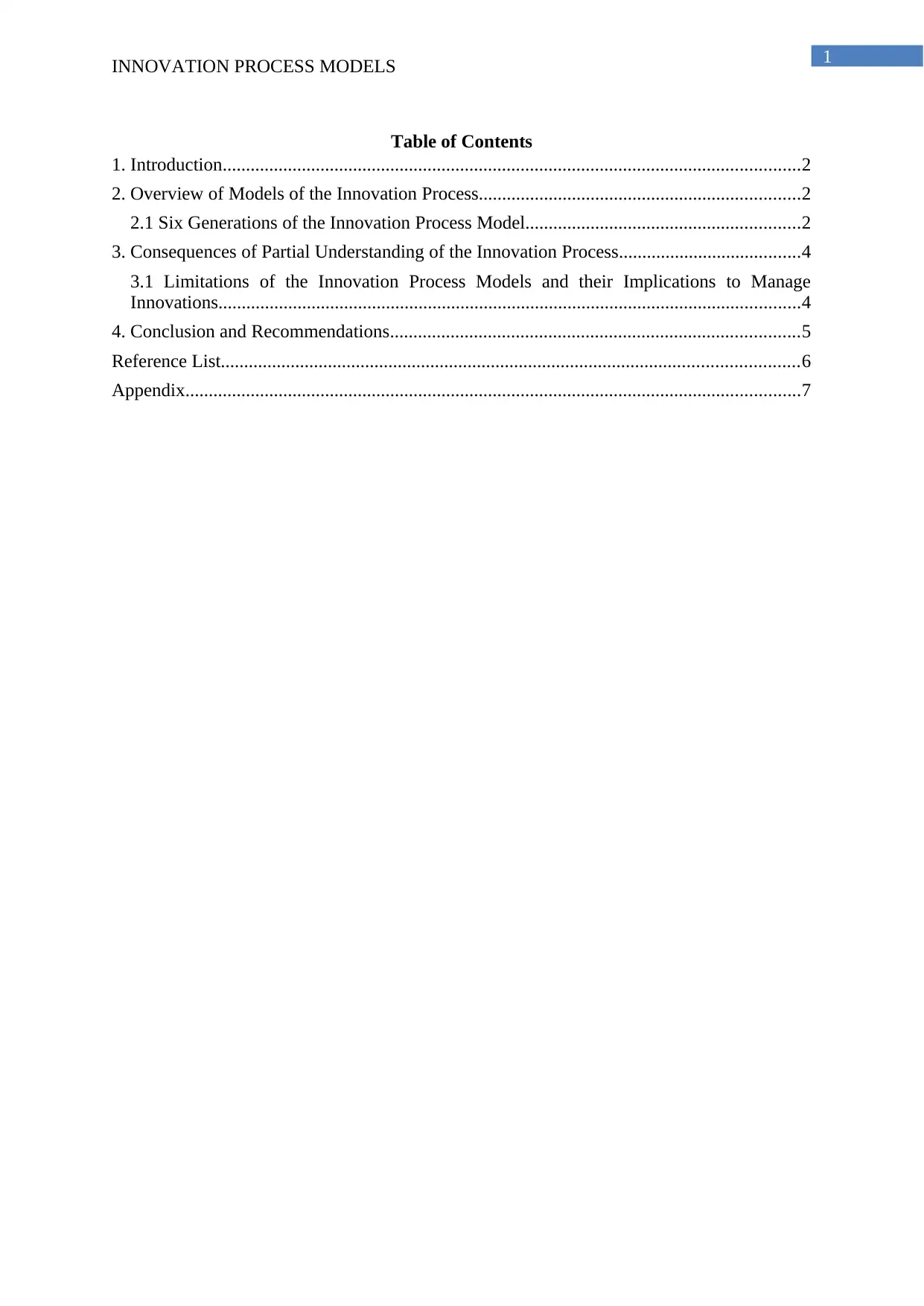
Table of Contents
1. Introduction............................................................................................................................2
2. Overview of Models of the Innovation Process.....................................................................2
2.1 Six Generations of the Innovation Process Model...........................................................2
3. Consequences of Partial Understanding of the Innovation Process.......................................4
3.1 Limitations of the Innovation Process Models and their Implications to Manage
Innovations.............................................................................................................................4
4. Conclusion and Recommendations........................................................................................5
Reference List............................................................................................................................6
Appendix....................................................................................................................................7
INNOVATION PROCESS MODELS
Table of Contents
1. Introduction............................................................................................................................2
2. Overview of Models of the Innovation Process.....................................................................2
2.1 Six Generations of the Innovation Process Model...........................................................2
3. Consequences of Partial Understanding of the Innovation Process.......................................4
3.1 Limitations of the Innovation Process Models and their Implications to Manage
Innovations.............................................................................................................................4
4. Conclusion and Recommendations........................................................................................5
Reference List............................................................................................................................6
Appendix....................................................................................................................................7
2
INNOVATION PROCESS MODELS
1. Introduction
Innovation refers to the introduction of any new idea and creative thought or new
imagination in respect to a method or device. It is being viewed as the major application for
meeting the new requirements, existing market needs and unarticulated needs (Frankenberger
et al. 2013). This type of innovation occurs through better provision of business models,
processes, technologies, effective services and products, which could be made available in
society, governments and markets. Innovation process model is being utilized for launching
of new products and hence it becomes quite easy to increase creative power (Massa and
Tucci 2013). Moreover, these models are on the basis of different techniques like integrated
and parallel technology, integrated model, coupling technologies and demand pull and push
technologies. Innovation process model is extremely helpful to create as well as manage
subsequent innovation space that is utilized to share ideas and for working as a teamwork.
Moreover, this particular model is also helpful for gaining a better position in the respective
market place (Hogan and Coote 2014). After invention of process model, there is a high
chance that the risk is getting reduced effectively, thus demands are being fulfilled for a
better project. The following report outlines a brief discussion on six generations of
innovation process model with subsequent consequences of the innovation process after
highlighting main characteristics, strengths and limitations.
2. Overview of Models of the Innovation Process
2.1 Six Generations of the Innovation Process Model
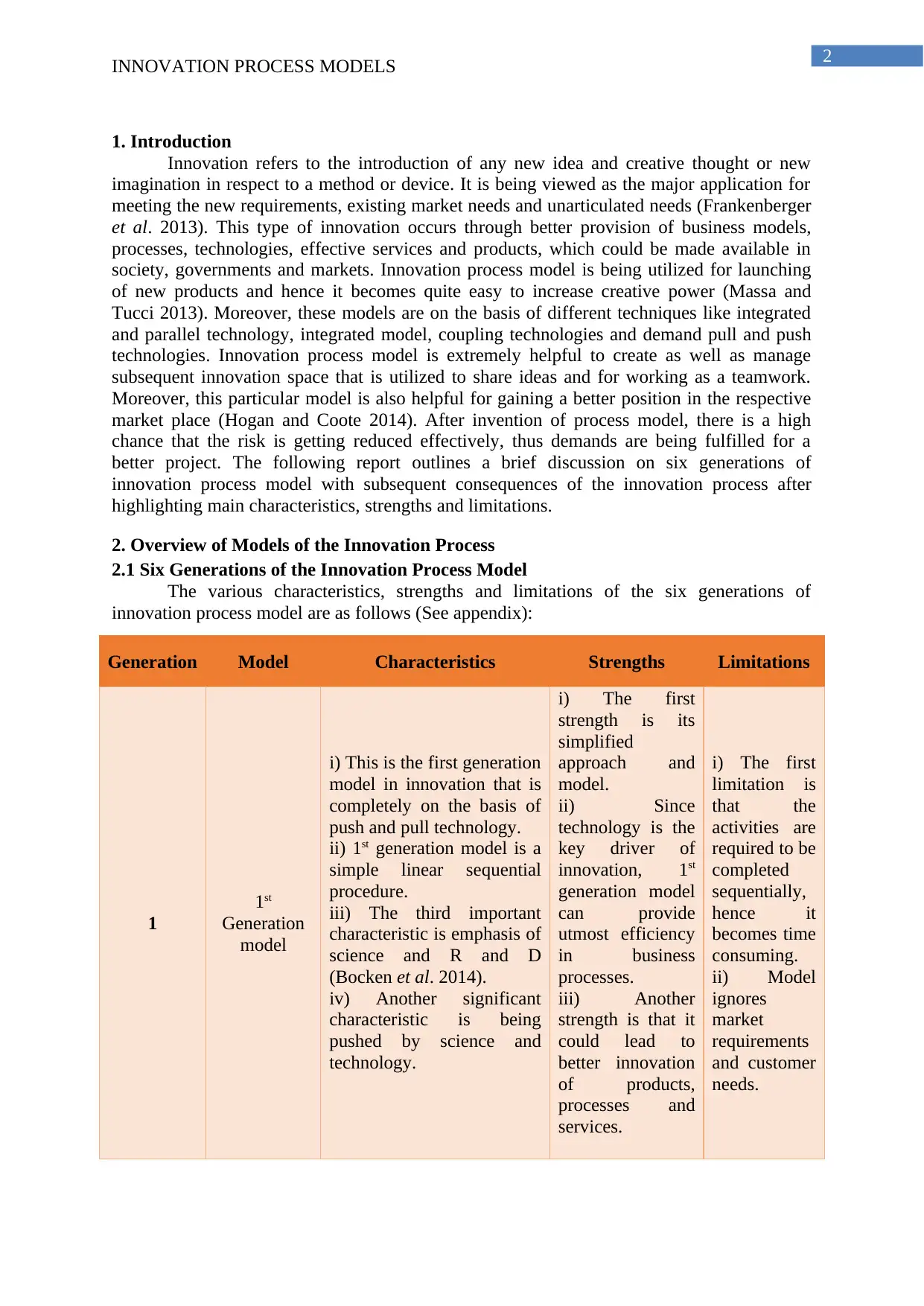
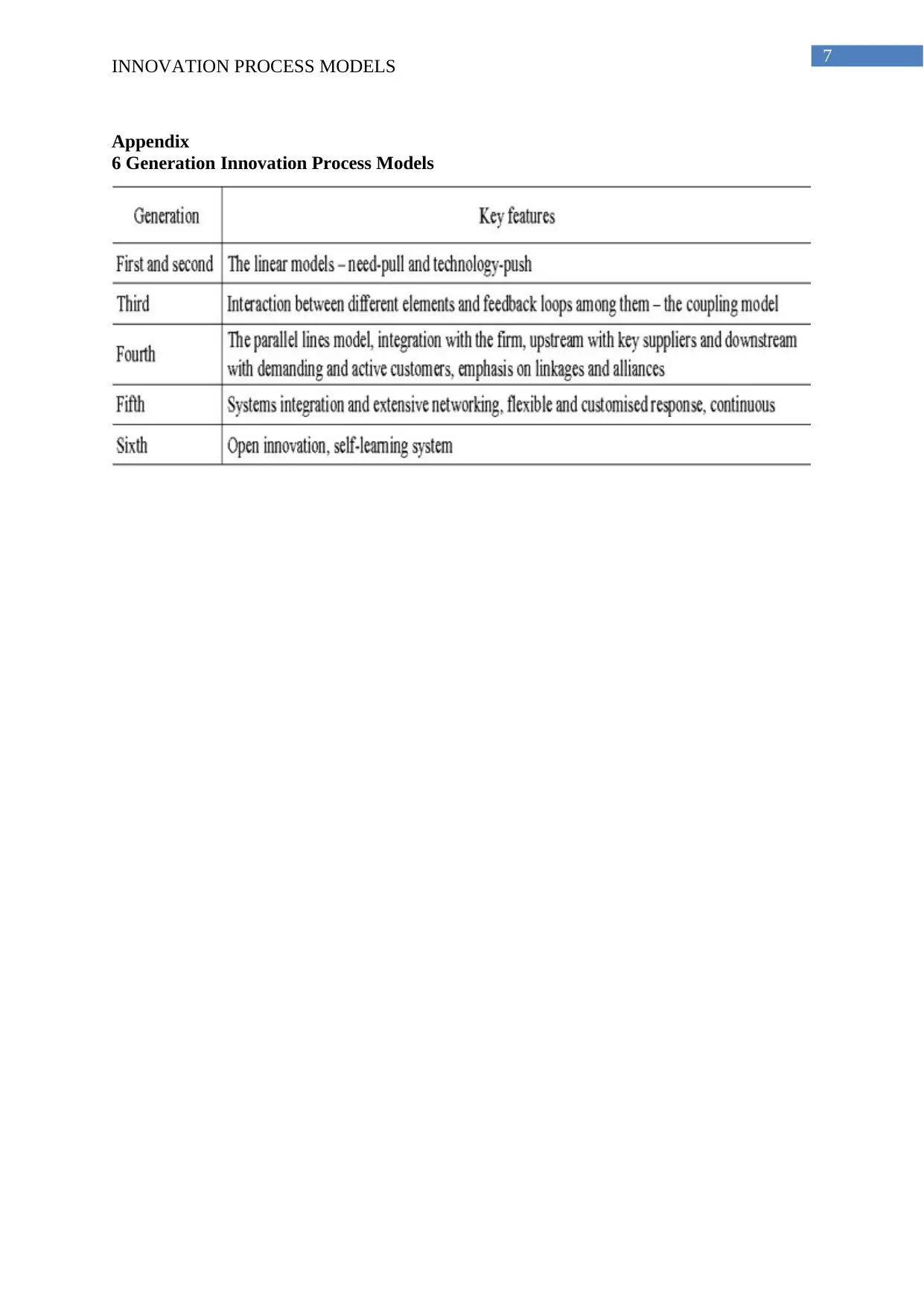
The various characteristics, strengths and limitations of the six generations of
innovation process model are as follows (See appendix):
Generation Model Characteristics Strengths Limitations
1
1st
Generation
model
i) This is the first generation
model in innovation that is
completely on the basis of
push and pull technology.
ii) 1st generation model is a
simple linear sequential
procedure.
iii) The third important
characteristic is emphasis of
science and R and D
(Bocken et al. 2014).
iv) Another significant
characteristic is being
pushed by science and
technology.
i) The first
strength is its
simplified
approach and
model.
ii) Since
technology is the
key driver of
innovation, 1st
generation model
can provide
utmost efficiency
in business
processes.
iii) Another
strength is that it
could lead to
better innovation
of products,
processes and
services.
i) The first
limitation is
that the
activities are
required to be
completed
sequentially,
hence it
becomes time
consuming.
ii) Model
ignores
market
requirements
and customer
needs.
INNOVATION PROCESS MODELS
1. Introduction
Innovation refers to the introduction of any new idea and creative thought or new
imagination in respect to a method or device. It is being viewed as the major application for
meeting the new requirements, existing market needs and unarticulated needs (Frankenberger
et al. 2013). This type of innovation occurs through better provision of business models,
processes, technologies, effective services and products, which could be made available in
society, governments and markets. Innovation process model is being utilized for launching
of new products and hence it becomes quite easy to increase creative power (Massa and
Tucci 2013). Moreover, these models are on the basis of different techniques like integrated
and parallel technology, integrated model, coupling technologies and demand pull and push
technologies. Innovation process model is extremely helpful to create as well as manage
subsequent innovation space that is utilized to share ideas and for working as a teamwork.
Moreover, this particular model is also helpful for gaining a better position in the respective
market place (Hogan and Coote 2014). After invention of process model, there is a high
chance that the risk is getting reduced effectively, thus demands are being fulfilled for a
better project. The following report outlines a brief discussion on six generations of
innovation process model with subsequent consequences of the innovation process after
highlighting main characteristics, strengths and limitations.
2. Overview of Models of the Innovation Process
2.1 Six Generations of the Innovation Process Model
The various characteristics, strengths and limitations of the six generations of
innovation process model are as follows (See appendix):
Generation Model Characteristics Strengths Limitations
1
1st
Generation
model
i) This is the first generation
model in innovation that is
completely on the basis of
push and pull technology.
ii) 1st generation model is a
simple linear sequential
procedure.
iii) The third important
characteristic is emphasis of
science and R and D
(Bocken et al. 2014).
iv) Another significant
characteristic is being
pushed by science and
technology.
i) The first
strength is its
simplified
approach and
model.
ii) Since
technology is the
key driver of
innovation, 1st
generation model
can provide
utmost efficiency
in business
processes.
iii) Another
strength is that it
could lead to
better innovation
of products,
processes and
services.
i) The first
limitation is
that the
activities are
required to be
completed
sequentially,
hence it
becomes time
consuming.
ii) Model
ignores
market
requirements
and customer
needs.
⊘ This is a preview!⊘
Do you want full access?
Subscribe today to unlock all pages.

Trusted by 1+ million students worldwide
3
INNOVATION PROCESS MODELS
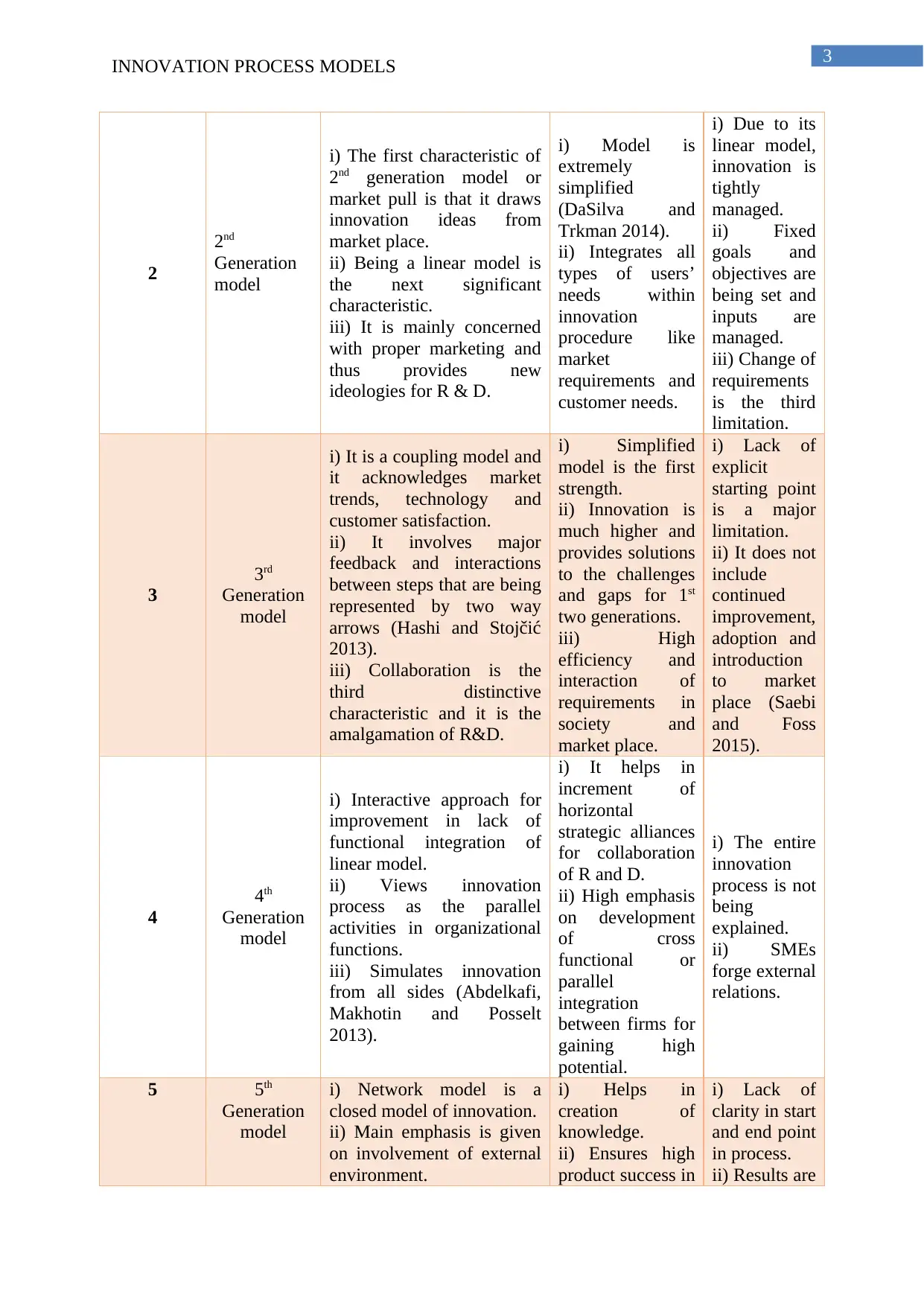
2
2nd
Generation
model
i) The first characteristic of
2nd generation model or
market pull is that it draws
innovation ideas from
market place.
ii) Being a linear model is
the next significant
characteristic.
iii) It is mainly concerned
with proper marketing and
thus provides new
ideologies for R & D.
i) Model is
extremely
simplified
(DaSilva and
Trkman 2014).
ii) Integrates all
types of users’
needs within
innovation
procedure like
market
requirements and
customer needs.
i) Due to its
linear model,
innovation is
tightly
managed.
ii) Fixed
goals and
objectives are
being set and
inputs are
managed.
iii) Change of
requirements
is the third
limitation.
3
3rd
Generation
model
i) It is a coupling model and
it acknowledges market
trends, technology and
customer satisfaction.
ii) It involves major
feedback and interactions
between steps that are being
represented by two way
arrows (Hashi and Stojčić
2013).
iii) Collaboration is the
third distinctive
characteristic and it is the
amalgamation of R&D.
i) Simplified
model is the first
strength.
ii) Innovation is
much higher and
provides solutions
to the challenges
and gaps for 1st
two generations.
iii) High
efficiency and
interaction of
requirements in
society and
market place.
i) Lack of
explicit
starting point
is a major
limitation.
ii) It does not
include
continued
improvement,
adoption and
introduction
to market
place (Saebi
and Foss
2015).
4
4th
Generation
model
i) Interactive approach for
improvement in lack of
functional integration of
linear model.
ii) Views innovation
process as the parallel
activities in organizational
functions.
iii) Simulates innovation
from all sides (Abdelkafi,
Makhotin and Posselt
2013).
i) It helps in
increment of
horizontal
strategic alliances
for collaboration
of R and D.
ii) High emphasis
on development
of cross
functional or
parallel
integration
between firms for
gaining high
potential.
i) The entire
innovation
process is not
being
explained.
ii) SMEs
forge external
relations.
5 5th
Generation
model
i) Network model is a
closed model of innovation.
ii) Main emphasis is given
on involvement of external
environment.
i) Helps in
creation of
knowledge.
ii) Ensures high
product success in
i) Lack of
clarity in start
and end point
in process.
ii) Results are
INNOVATION PROCESS MODELS
2
2nd
Generation
model
i) The first characteristic of
2nd generation model or
market pull is that it draws
innovation ideas from
market place.
ii) Being a linear model is
the next significant
characteristic.
iii) It is mainly concerned
with proper marketing and
thus provides new
ideologies for R & D.
i) Model is
extremely
simplified
(DaSilva and
Trkman 2014).
ii) Integrates all
types of users’
needs within
innovation
procedure like
market
requirements and
customer needs.
i) Due to its
linear model,
innovation is
tightly
managed.
ii) Fixed
goals and
objectives are
being set and
inputs are
managed.
iii) Change of
requirements
is the third
limitation.
3
3rd
Generation
model
i) It is a coupling model and
it acknowledges market
trends, technology and
customer satisfaction.
ii) It involves major
feedback and interactions
between steps that are being
represented by two way
arrows (Hashi and Stojčić
2013).
iii) Collaboration is the
third distinctive
characteristic and it is the
amalgamation of R&D.
i) Simplified
model is the first
strength.
ii) Innovation is
much higher and
provides solutions
to the challenges
and gaps for 1st
two generations.
iii) High
efficiency and
interaction of
requirements in
society and
market place.
i) Lack of
explicit
starting point
is a major
limitation.
ii) It does not
include
continued
improvement,
adoption and
introduction
to market
place (Saebi
and Foss
2015).
4
4th
Generation
model
i) Interactive approach for
improvement in lack of
functional integration of
linear model.
ii) Views innovation
process as the parallel
activities in organizational
functions.
iii) Simulates innovation
from all sides (Abdelkafi,
Makhotin and Posselt
2013).
i) It helps in
increment of
horizontal
strategic alliances
for collaboration
of R and D.
ii) High emphasis
on development
of cross
functional or
parallel
integration
between firms for
gaining high
potential.
i) The entire
innovation
process is not
being
explained.
ii) SMEs
forge external
relations.
5 5th
Generation
model
i) Network model is a
closed model of innovation.
ii) Main emphasis is given
on involvement of external
environment.
i) Helps in
creation of
knowledge.
ii) Ensures high
product success in
i) Lack of
clarity in start
and end point
in process.
ii) Results are
Paraphrase This Document
Need a fresh take? Get an instant paraphrase of this document with our AI Paraphraser
4
INNOVATION PROCESS MODELS
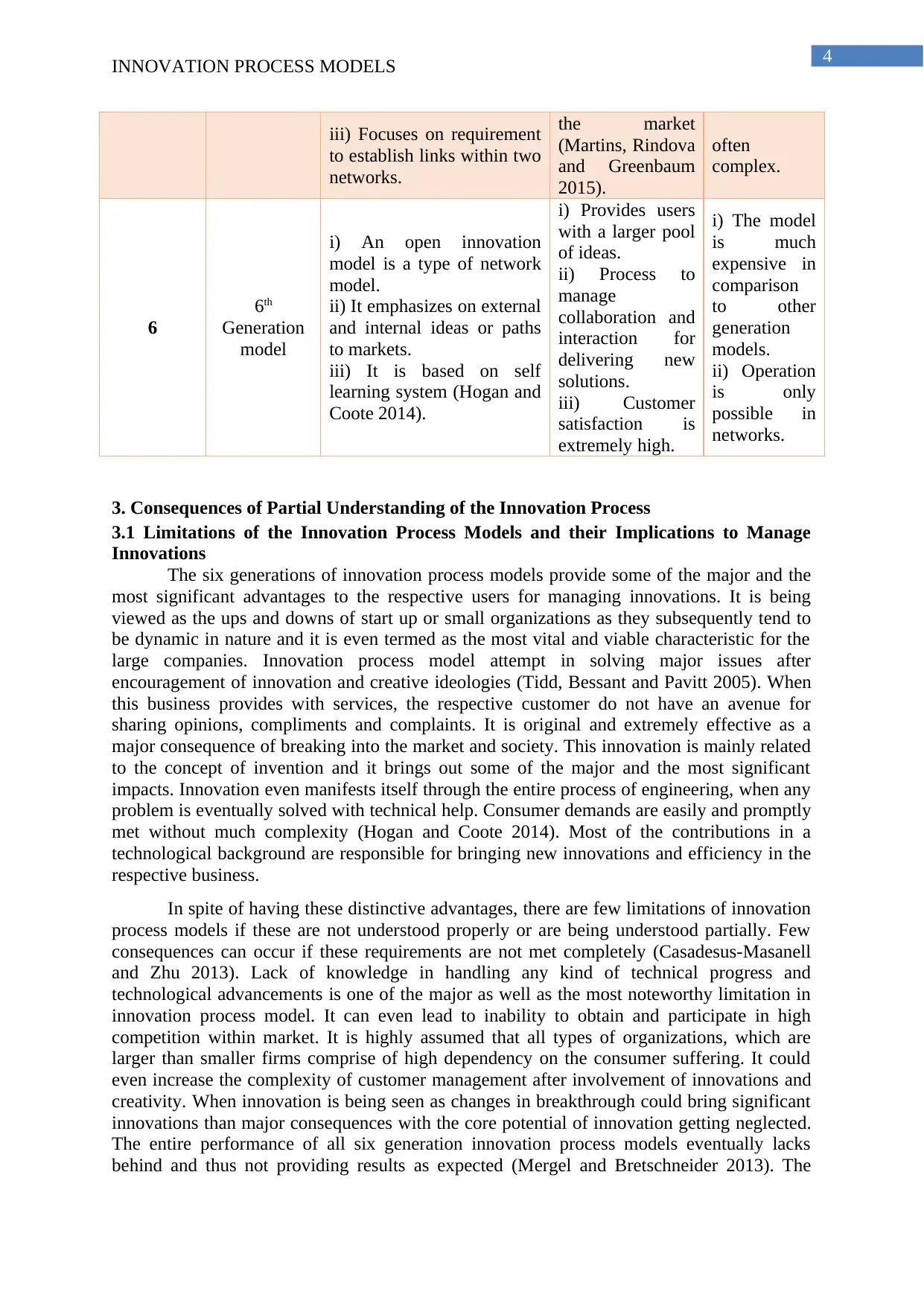
iii) Focuses on requirement
to establish links within two
networks.
the market
(Martins, Rindova
and Greenbaum
2015).
often
complex.
6
6th
Generation
model
i) An open innovation
model is a type of network
model.
ii) It emphasizes on external
and internal ideas or paths
to markets.
iii) It is based on self
learning system (Hogan and
Coote 2014).
i) Provides users
with a larger pool
of ideas.
ii) Process to
manage
collaboration and
interaction for
delivering new
solutions.
iii) Customer
satisfaction is
extremely high.
i) The model
is much
expensive in
comparison
to other
generation
models.
ii) Operation
is only
possible in
networks.
3. Consequences of Partial Understanding of the Innovation Process
3.1 Limitations of the Innovation Process Models and their Implications to Manage
Innovations
The six generations of innovation process models provide some of the major and the
most significant advantages to the respective users for managing innovations. It is being
viewed as the ups and downs of start up or small organizations as they subsequently tend to
be dynamic in nature and it is even termed as the most vital and viable characteristic for the
large companies. Innovation process model attempt in solving major issues after
encouragement of innovation and creative ideologies (Tidd, Bessant and Pavitt 2005). When
this business provides with services, the respective customer do not have an avenue for
sharing opinions, compliments and complaints. It is original and extremely effective as a
major consequence of breaking into the market and society. This innovation is mainly related
to the concept of invention and it brings out some of the major and the most significant
impacts. Innovation even manifests itself through the entire process of engineering, when any
problem is eventually solved with technical help. Consumer demands are easily and promptly
met without much complexity (Hogan and Coote 2014). Most of the contributions in a
technological background are responsible for bringing new innovations and efficiency in the
respective business.
In spite of having these distinctive advantages, there are few limitations of innovation
process models if these are not understood properly or are being understood partially. Few
consequences can occur if these requirements are not met completely (Casadesus‐Masanell
and Zhu 2013). Lack of knowledge in handling any kind of technical progress and
technological advancements is one of the major as well as the most noteworthy limitation in
innovation process model. It can even lead to inability to obtain and participate in high
competition within market. It is highly assumed that all types of organizations, which are
larger than smaller firms comprise of high dependency on the consumer suffering. It could
even increase the complexity of customer management after involvement of innovations and
creativity. When innovation is being seen as changes in breakthrough could bring significant
innovations than major consequences with the core potential of innovation getting neglected.
The entire performance of all six generation innovation process models eventually lacks
behind and thus not providing results as expected (Mergel and Bretschneider 2013). The
INNOVATION PROCESS MODELS
iii) Focuses on requirement
to establish links within two
networks.
the market
(Martins, Rindova
and Greenbaum
2015).
often
complex.
6
6th
Generation
model
i) An open innovation
model is a type of network
model.
ii) It emphasizes on external
and internal ideas or paths
to markets.
iii) It is based on self
learning system (Hogan and
Coote 2014).
i) Provides users
with a larger pool
of ideas.
ii) Process to
manage
collaboration and
interaction for
delivering new
solutions.
iii) Customer
satisfaction is
extremely high.
i) The model
is much
expensive in
comparison
to other
generation
models.
ii) Operation
is only
possible in
networks.
3. Consequences of Partial Understanding of the Innovation Process
3.1 Limitations of the Innovation Process Models and their Implications to Manage
Innovations
The six generations of innovation process models provide some of the major and the
most significant advantages to the respective users for managing innovations. It is being
viewed as the ups and downs of start up or small organizations as they subsequently tend to
be dynamic in nature and it is even termed as the most vital and viable characteristic for the
large companies. Innovation process model attempt in solving major issues after
encouragement of innovation and creative ideologies (Tidd, Bessant and Pavitt 2005). When
this business provides with services, the respective customer do not have an avenue for
sharing opinions, compliments and complaints. It is original and extremely effective as a
major consequence of breaking into the market and society. This innovation is mainly related
to the concept of invention and it brings out some of the major and the most significant
impacts. Innovation even manifests itself through the entire process of engineering, when any
problem is eventually solved with technical help. Consumer demands are easily and promptly
met without much complexity (Hogan and Coote 2014). Most of the contributions in a
technological background are responsible for bringing new innovations and efficiency in the
respective business.
In spite of having these distinctive advantages, there are few limitations of innovation
process models if these are not understood properly or are being understood partially. Few
consequences can occur if these requirements are not met completely (Casadesus‐Masanell
and Zhu 2013). Lack of knowledge in handling any kind of technical progress and
technological advancements is one of the major as well as the most noteworthy limitation in
innovation process model. It can even lead to inability to obtain and participate in high
competition within market. It is highly assumed that all types of organizations, which are
larger than smaller firms comprise of high dependency on the consumer suffering. It could
even increase the complexity of customer management after involvement of innovations and
creativity. When innovation is being seen as changes in breakthrough could bring significant
innovations than major consequences with the core potential of innovation getting neglected.
The entire performance of all six generation innovation process models eventually lacks
behind and thus not providing results as expected (Mergel and Bretschneider 2013). The
5
INNOVATION PROCESS MODELS
distinctive consequences of partial understanding of innovation process model could occur in
some of the major forms, hence becoming extremely desirable, undesirable and indirect or
direct. Such forms are also responsible for bringing technological failure, market failure, loss
of financial support as well as organizational risks or threats.
The first and the foremost consequence of partial understanding of innovation process
model is technological failure. Lack of acceptance of technology in market is referred to as a
major risk, which is being undertaken by any specific business and for the core and important
method to eradicate the risk, innovation or launching of new product should be done in a
small area to test all types of required adjustments (Biemans 2018). The second distinctive
consequence of partial understanding of innovation process model is market failure, in which
due to the high rise in innovations within products, the customers often remain dissatisfied to
a high level. Due to such consequence, it is needed to analyse the innovation process model
effectively. Loss of financial support is the next distinctive consequence of partial
understanding of innovation process model. Due to higher production of any kind of
innovation procedure, it is extremely important to invest a huge amount that tend in draining
organizational resources to a high level. Investment in this case is considered to be wasted
completely and organization might face issues (Schneider and Spieth 2013). Another popular
and important consequence of partial understanding of innovation process model is
organizational risk. It is mainly associated with all types of organizational standards and due
to discontinuous method of change implementation, it is quite common that innovation might
backfire and the entire project would fail. Hence, it is extremely important to gain a proper
understanding of innovation process model for avoiding such consequences.
4. Conclusion and Recommendations
Therefore, from the above discussion, it can be concluded that innovation refers to
better improvement of an existing concept and idea with the help of a step wise or sequential
procedure for effective creation of a commercial viable product and service. Various
significant management techniques should be undertaken and the trust between customer and
supplier gets increased. It eventually generates a positive relationship for development of
potential partnerships with the other companies. The six generations of innovation process
models are responsible for incrementing more efficiency. The first generation is a simple
linear model and it has led to complex interactive models.
It is highly recommended to identify the challenges and gaps in six generations of
innovation process models with the major purpose of helping organizations to achieve several
benefits. This type of innovation requires to be created for better effectiveness in the seventh
generation process model. The speed is needed to be increased and ideas are required to be
communicated without much complexity.
INNOVATION PROCESS MODELS
distinctive consequences of partial understanding of innovation process model could occur in
some of the major forms, hence becoming extremely desirable, undesirable and indirect or
direct. Such forms are also responsible for bringing technological failure, market failure, loss
of financial support as well as organizational risks or threats.
The first and the foremost consequence of partial understanding of innovation process
model is technological failure. Lack of acceptance of technology in market is referred to as a
major risk, which is being undertaken by any specific business and for the core and important
method to eradicate the risk, innovation or launching of new product should be done in a
small area to test all types of required adjustments (Biemans 2018). The second distinctive
consequence of partial understanding of innovation process model is market failure, in which
due to the high rise in innovations within products, the customers often remain dissatisfied to
a high level. Due to such consequence, it is needed to analyse the innovation process model
effectively. Loss of financial support is the next distinctive consequence of partial
understanding of innovation process model. Due to higher production of any kind of
innovation procedure, it is extremely important to invest a huge amount that tend in draining
organizational resources to a high level. Investment in this case is considered to be wasted
completely and organization might face issues (Schneider and Spieth 2013). Another popular
and important consequence of partial understanding of innovation process model is
organizational risk. It is mainly associated with all types of organizational standards and due
to discontinuous method of change implementation, it is quite common that innovation might
backfire and the entire project would fail. Hence, it is extremely important to gain a proper
understanding of innovation process model for avoiding such consequences.
4. Conclusion and Recommendations
Therefore, from the above discussion, it can be concluded that innovation refers to
better improvement of an existing concept and idea with the help of a step wise or sequential
procedure for effective creation of a commercial viable product and service. Various
significant management techniques should be undertaken and the trust between customer and
supplier gets increased. It eventually generates a positive relationship for development of
potential partnerships with the other companies. The six generations of innovation process
models are responsible for incrementing more efficiency. The first generation is a simple
linear model and it has led to complex interactive models.
It is highly recommended to identify the challenges and gaps in six generations of
innovation process models with the major purpose of helping organizations to achieve several
benefits. This type of innovation requires to be created for better effectiveness in the seventh
generation process model. The speed is needed to be increased and ideas are required to be
communicated without much complexity.
⊘ This is a preview!⊘
Do you want full access?
Subscribe today to unlock all pages.
Trusted by 1+ million students worldwide
6
INNOVATION PROCESS MODELS
Reference List
Abdelkafi, N., Makhotin, S. and Posselt, T., 2013. Business model innovations for electric
mobility—what can be learned from existing business model patterns?. International Journal
of Innovation Management, 17(01), p.1340003.
Biemans, W., 2018. Managing innovation within networks. Routledge.
Bocken, N.M., Short, S.W., Rana, P. and Evans, S., 2014. A literature and practice review to
develop sustainable business model archetypes. Journal of cleaner production, 65, pp.42-56.
Casadesus‐Masanell, R. and Zhu, F., 2013. Business model innovation and competitive
imitation: The case of sponsor‐based business models. Strategic management journal, 34(4),
pp.464-482.
DaSilva, C.M. and Trkman, P., 2014. Business model: What it is and what it is not. Long
range planning, 47(6), pp.379-389.
Frankenberger, K., Weiblen, T., Csik, M. and Gassmann, O., 2013. The 4I-framework of
business model innovation: A structured view on process phases and
challenges. International Journal of Product Development, 18(3/4), pp.249-273.
Hashi, I. and Stojčić, N., 2013. The impact of innovation activities on firm performance using
a multi-stage model: Evidence from the Community Innovation Survey 4. Research
Policy, 42(2), pp.353-366.
Hogan, S.J. and Coote, L.V., 2014. Organizational culture, innovation, and performance: A
test of Schein's model. Journal of Business Research, 67(8), pp.1609-1621.
Martins, L.L., Rindova, V.P. and Greenbaum, B.E., 2015. Unlocking the hidden value of
concepts: a cognitive approach to business model innovation. Strategic Entrepreneurship
Journal, 9(1), pp.99-117.
Massa, L. and Tucci, C.L., 2013. Business model innovation. The Oxford handbook of
innovation management, 20(18), pp.420-441.
Mergel, I. and Bretschneider, S.I., 2013. A three‐stage adoption process for social media use
in government. Public administration review, 73(3), pp.390-400.
Saebi, T. and Foss, N.J., 2015. Business models for open innovation: Matching
heterogeneous open innovation strategies with business model dimensions. European
Management Journal, 33(3), pp.201-213.
Schneider, S. and Spieth, P., 2013. Business model innovation: Towards an integrated future
research agenda. International Journal of Innovation Management, 17(01), p.1340001.
Tidd, J., Bessant, J. and Pavitt, K. 2005. Managing Innovation: Integrating technological,
market and organizational change, Third edition, Wiley.
INNOVATION PROCESS MODELS
Reference List
Abdelkafi, N., Makhotin, S. and Posselt, T., 2013. Business model innovations for electric
mobility—what can be learned from existing business model patterns?. International Journal
of Innovation Management, 17(01), p.1340003.
Biemans, W., 2018. Managing innovation within networks. Routledge.
Bocken, N.M., Short, S.W., Rana, P. and Evans, S., 2014. A literature and practice review to
develop sustainable business model archetypes. Journal of cleaner production, 65, pp.42-56.
Casadesus‐Masanell, R. and Zhu, F., 2013. Business model innovation and competitive
imitation: The case of sponsor‐based business models. Strategic management journal, 34(4),
pp.464-482.
DaSilva, C.M. and Trkman, P., 2014. Business model: What it is and what it is not. Long
range planning, 47(6), pp.379-389.
Frankenberger, K., Weiblen, T., Csik, M. and Gassmann, O., 2013. The 4I-framework of
business model innovation: A structured view on process phases and
challenges. International Journal of Product Development, 18(3/4), pp.249-273.
Hashi, I. and Stojčić, N., 2013. The impact of innovation activities on firm performance using
a multi-stage model: Evidence from the Community Innovation Survey 4. Research
Policy, 42(2), pp.353-366.
Hogan, S.J. and Coote, L.V., 2014. Organizational culture, innovation, and performance: A
test of Schein's model. Journal of Business Research, 67(8), pp.1609-1621.
Martins, L.L., Rindova, V.P. and Greenbaum, B.E., 2015. Unlocking the hidden value of
concepts: a cognitive approach to business model innovation. Strategic Entrepreneurship
Journal, 9(1), pp.99-117.
Massa, L. and Tucci, C.L., 2013. Business model innovation. The Oxford handbook of
innovation management, 20(18), pp.420-441.
Mergel, I. and Bretschneider, S.I., 2013. A three‐stage adoption process for social media use
in government. Public administration review, 73(3), pp.390-400.
Saebi, T. and Foss, N.J., 2015. Business models for open innovation: Matching
heterogeneous open innovation strategies with business model dimensions. European
Management Journal, 33(3), pp.201-213.
Schneider, S. and Spieth, P., 2013. Business model innovation: Towards an integrated future
research agenda. International Journal of Innovation Management, 17(01), p.1340001.
Tidd, J., Bessant, J. and Pavitt, K. 2005. Managing Innovation: Integrating technological,
market and organizational change, Third edition, Wiley.
Paraphrase This Document
Need a fresh take? Get an instant paraphrase of this document with our AI Paraphraser
7
INNOVATION PROCESS MODELS
Appendix
6 Generation Innovation Process Models
INNOVATION PROCESS MODELS
Appendix
6 Generation Innovation Process Models

1 out of 8


Related Documents


Your All-in-One AI-Powered Toolkit for Academic Success.
+13062052269
info@desklib.com
Available 24*7 on WhatsApp / Email
![[object Object]](/_next/static/media/star-bottom.7253800d.svg)
Unlock your academic potential
Copyright © 2020–2026 A2Z Services. All Rights Reserved. Developed and managed by ZUCOL.