Effective Leadership Behaviors for Managing People: An Essay
VerifiedAdded on 2020/02/18
|8
|1828
|46
Essay
AI Summary
This essay delves into the crucial behaviors of successful leaders, emphasizing self-management, strategic thinking, effective communication, accountability, and goal setting. It highlights how leaders must manage themselves, think strategically, communicate effectively, and take responsibility for their actions. The essay explores the pros and cons of these leadership behaviors, acknowledging that while effective leadership can guide and motivate, strict approaches may not suit all individuals. It recommends setting clear goals and a willingness to learn and practice, emphasizing that successful leaders are not necessarily born but are nurtured through continuous learning, consistent practice, and feedback. The essay concludes by stressing the importance of these behaviors for achieving desired outcomes in organizations and teams.

Student’s Last Name1
Managing People
By (Name)
Course
Professor
University
Date
Managing People
By (Name)
Course
Professor
University
Date
Paraphrase This Document
Need a fresh take? Get an instant paraphrase of this document with our AI Paraphraser

Student’s Last Name2
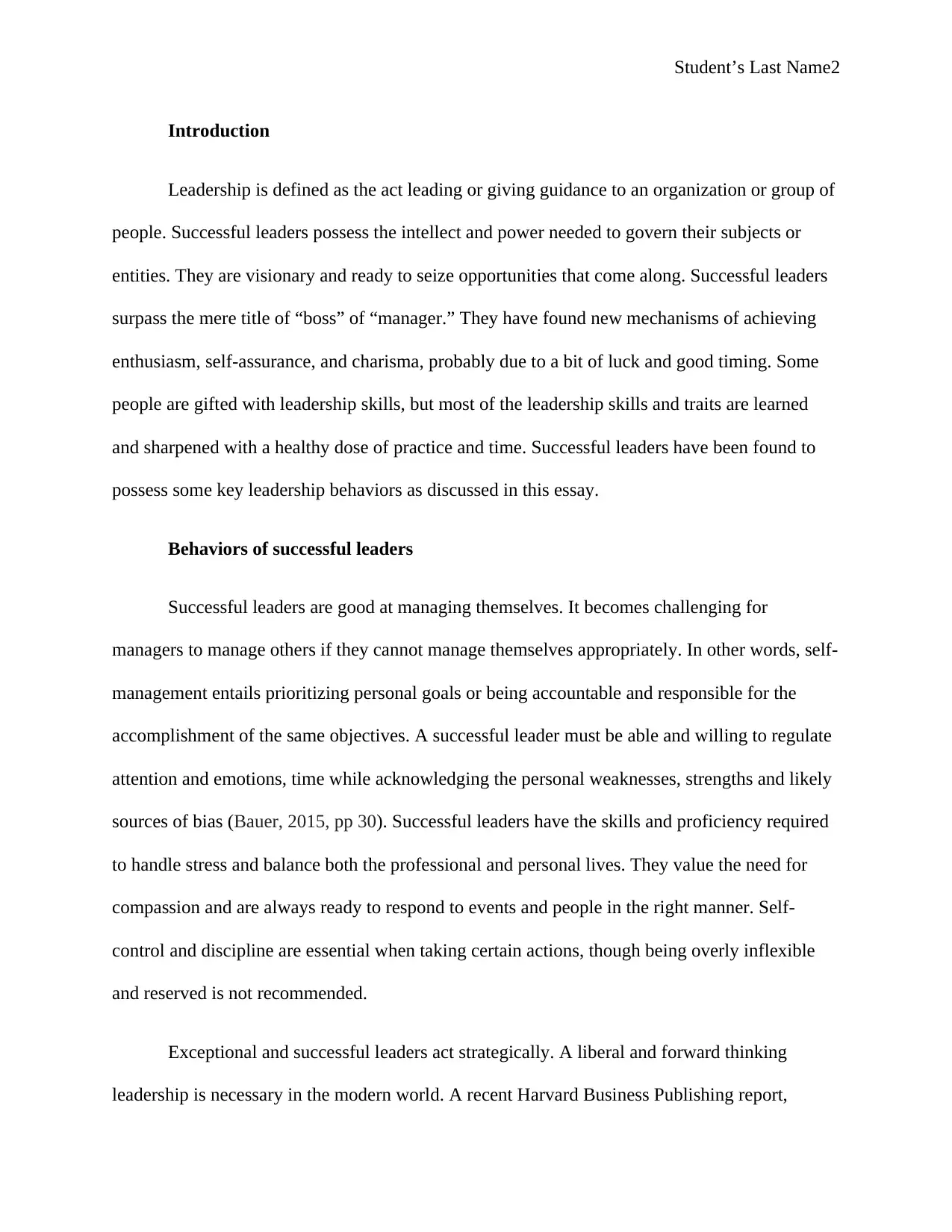
Introduction
Leadership is defined as the act leading or giving guidance to an organization or group of
people. Successful leaders possess the intellect and power needed to govern their subjects or
entities. They are visionary and ready to seize opportunities that come along. Successful leaders
surpass the mere title of “boss” of “manager.” They have found new mechanisms of achieving
enthusiasm, self-assurance, and charisma, probably due to a bit of luck and good timing. Some
people are gifted with leadership skills, but most of the leadership skills and traits are learned
and sharpened with a healthy dose of practice and time. Successful leaders have been found to
possess some key leadership behaviors as discussed in this essay.
Behaviors of successful leaders
Successful leaders are good at managing themselves. It becomes challenging for
managers to manage others if they cannot manage themselves appropriately. In other words, self-
management entails prioritizing personal goals or being accountable and responsible for the
accomplishment of the same objectives. A successful leader must be able and willing to regulate
attention and emotions, time while acknowledging the personal weaknesses, strengths and likely
sources of bias (Bauer, 2015, pp 30). Successful leaders have the skills and proficiency required
to handle stress and balance both the professional and personal lives. They value the need for
compassion and are always ready to respond to events and people in the right manner. Self-
control and discipline are essential when taking certain actions, though being overly inflexible
and reserved is not recommended.
Exceptional and successful leaders act strategically. A liberal and forward thinking
leadership is necessary in the modern world. A recent Harvard Business Publishing report,
Introduction
Leadership is defined as the act leading or giving guidance to an organization or group of
people. Successful leaders possess the intellect and power needed to govern their subjects or
entities. They are visionary and ready to seize opportunities that come along. Successful leaders
surpass the mere title of “boss” of “manager.” They have found new mechanisms of achieving
enthusiasm, self-assurance, and charisma, probably due to a bit of luck and good timing. Some
people are gifted with leadership skills, but most of the leadership skills and traits are learned
and sharpened with a healthy dose of practice and time. Successful leaders have been found to
possess some key leadership behaviors as discussed in this essay.
Behaviors of successful leaders
Successful leaders are good at managing themselves. It becomes challenging for
managers to manage others if they cannot manage themselves appropriately. In other words, self-
management entails prioritizing personal goals or being accountable and responsible for the
accomplishment of the same objectives. A successful leader must be able and willing to regulate
attention and emotions, time while acknowledging the personal weaknesses, strengths and likely
sources of bias (Bauer, 2015, pp 30). Successful leaders have the skills and proficiency required
to handle stress and balance both the professional and personal lives. They value the need for
compassion and are always ready to respond to events and people in the right manner. Self-
control and discipline are essential when taking certain actions, though being overly inflexible
and reserved is not recommended.
Exceptional and successful leaders act strategically. A liberal and forward thinking
leadership is necessary in the modern world. A recent Harvard Business Publishing report,

Student’s Last Name3
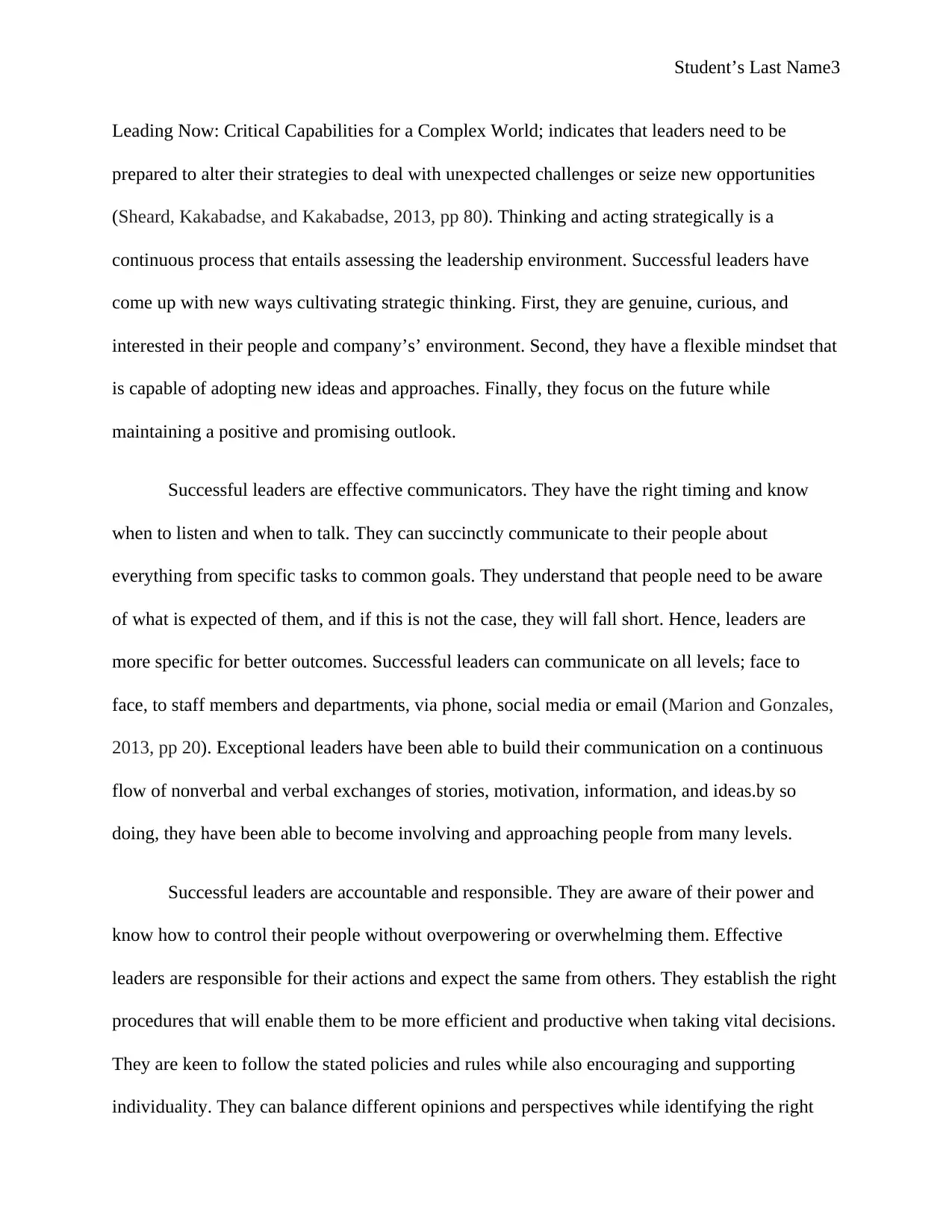
Leading Now: Critical Capabilities for a Complex World; indicates that leaders need to be
prepared to alter their strategies to deal with unexpected challenges or seize new opportunities
(Sheard, Kakabadse, and Kakabadse, 2013, pp 80). Thinking and acting strategically is a
continuous process that entails assessing the leadership environment. Successful leaders have
come up with new ways cultivating strategic thinking. First, they are genuine, curious, and
interested in their people and company’s’ environment. Second, they have a flexible mindset that
is capable of adopting new ideas and approaches. Finally, they focus on the future while
maintaining a positive and promising outlook.
Successful leaders are effective communicators. They have the right timing and know
when to listen and when to talk. They can succinctly communicate to their people about
everything from specific tasks to common goals. They understand that people need to be aware
of what is expected of them, and if this is not the case, they will fall short. Hence, leaders are
more specific for better outcomes. Successful leaders can communicate on all levels; face to
face, to staff members and departments, via phone, social media or email (Marion and Gonzales,
2013, pp 20). Exceptional leaders have been able to build their communication on a continuous
flow of nonverbal and verbal exchanges of stories, motivation, information, and ideas.by so
doing, they have been able to become involving and approaching people from many levels.
Successful leaders are accountable and responsible. They are aware of their power and
know how to control their people without overpowering or overwhelming them. Effective
leaders are responsible for their actions and expect the same from others. They establish the right
procedures that will enable them to be more efficient and productive when taking vital decisions.
They are keen to follow the stated policies and rules while also encouraging and supporting
individuality. They can balance different opinions and perspectives while identifying the right
Leading Now: Critical Capabilities for a Complex World; indicates that leaders need to be
prepared to alter their strategies to deal with unexpected challenges or seize new opportunities
(Sheard, Kakabadse, and Kakabadse, 2013, pp 80). Thinking and acting strategically is a
continuous process that entails assessing the leadership environment. Successful leaders have
come up with new ways cultivating strategic thinking. First, they are genuine, curious, and
interested in their people and company’s’ environment. Second, they have a flexible mindset that
is capable of adopting new ideas and approaches. Finally, they focus on the future while
maintaining a positive and promising outlook.
Successful leaders are effective communicators. They have the right timing and know
when to listen and when to talk. They can succinctly communicate to their people about
everything from specific tasks to common goals. They understand that people need to be aware
of what is expected of them, and if this is not the case, they will fall short. Hence, leaders are
more specific for better outcomes. Successful leaders can communicate on all levels; face to
face, to staff members and departments, via phone, social media or email (Marion and Gonzales,
2013, pp 20). Exceptional leaders have been able to build their communication on a continuous
flow of nonverbal and verbal exchanges of stories, motivation, information, and ideas.by so
doing, they have been able to become involving and approaching people from many levels.
Successful leaders are accountable and responsible. They are aware of their power and
know how to control their people without overpowering or overwhelming them. Effective
leaders are responsible for their actions and expect the same from others. They establish the right
procedures that will enable them to be more efficient and productive when taking vital decisions.
They are keen to follow the stated policies and rules while also encouraging and supporting
individuality. They can balance different opinions and perspectives while identifying the right
⊘ This is a preview!⊘
Do you want full access?
Subscribe today to unlock all pages.

Trusted by 1+ million students worldwide

Student’s Last Name4
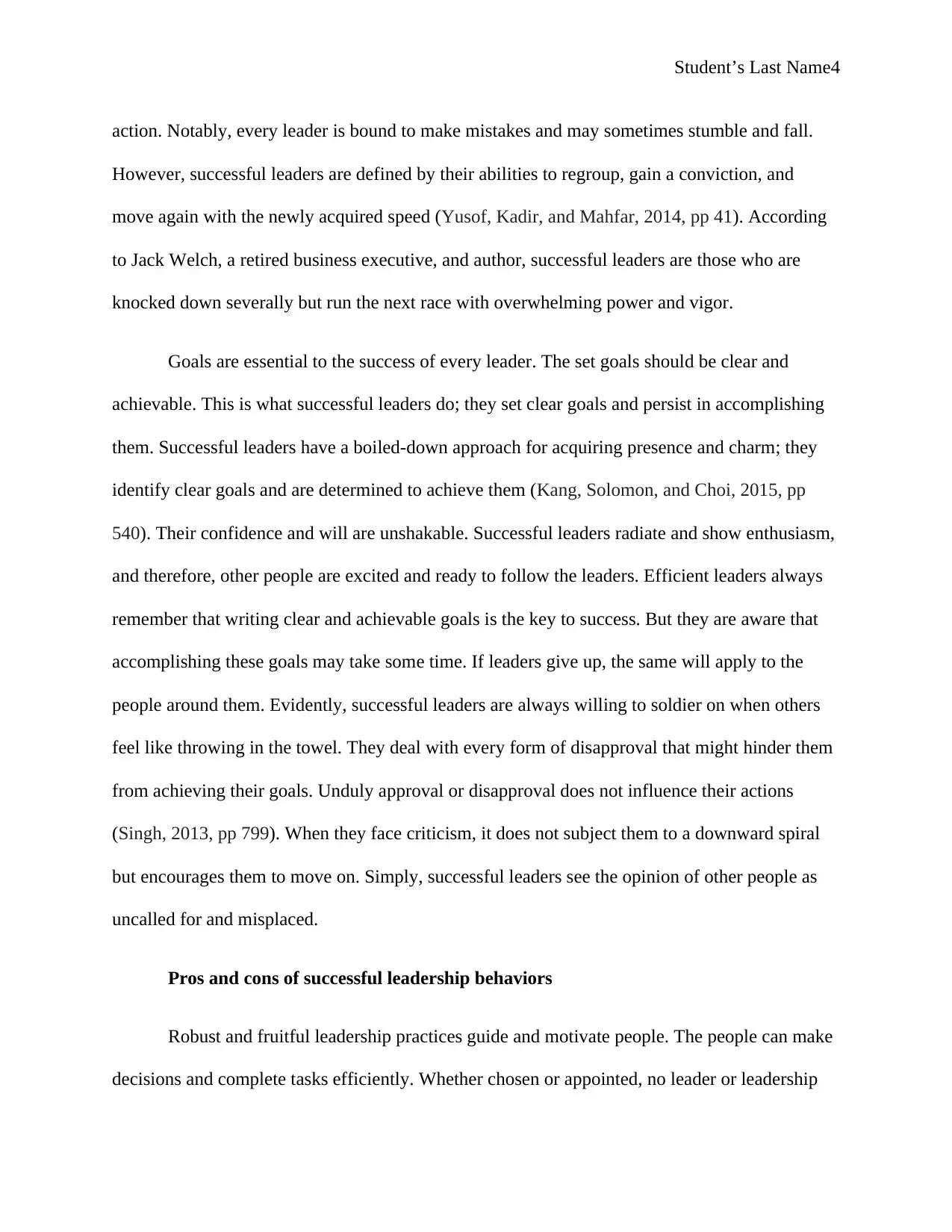
action. Notably, every leader is bound to make mistakes and may sometimes stumble and fall.
However, successful leaders are defined by their abilities to regroup, gain a conviction, and
move again with the newly acquired speed (Yusof, Kadir, and Mahfar, 2014, pp 41). According
to Jack Welch, a retired business executive, and author, successful leaders are those who are
knocked down severally but run the next race with overwhelming power and vigor.
Goals are essential to the success of every leader. The set goals should be clear and
achievable. This is what successful leaders do; they set clear goals and persist in accomplishing
them. Successful leaders have a boiled-down approach for acquiring presence and charm; they
identify clear goals and are determined to achieve them (Kang, Solomon, and Choi, 2015, pp
540). Their confidence and will are unshakable. Successful leaders radiate and show enthusiasm,
and therefore, other people are excited and ready to follow the leaders. Efficient leaders always
remember that writing clear and achievable goals is the key to success. But they are aware that
accomplishing these goals may take some time. If leaders give up, the same will apply to the
people around them. Evidently, successful leaders are always willing to soldier on when others
feel like throwing in the towel. They deal with every form of disapproval that might hinder them
from achieving their goals. Unduly approval or disapproval does not influence their actions
(Singh, 2013, pp 799). When they face criticism, it does not subject them to a downward spiral
but encourages them to move on. Simply, successful leaders see the opinion of other people as
uncalled for and misplaced.
Pros and cons of successful leadership behaviors
Robust and fruitful leadership practices guide and motivate people. The people can make
decisions and complete tasks efficiently. Whether chosen or appointed, no leader or leadership
action. Notably, every leader is bound to make mistakes and may sometimes stumble and fall.
However, successful leaders are defined by their abilities to regroup, gain a conviction, and
move again with the newly acquired speed (Yusof, Kadir, and Mahfar, 2014, pp 41). According
to Jack Welch, a retired business executive, and author, successful leaders are those who are
knocked down severally but run the next race with overwhelming power and vigor.
Goals are essential to the success of every leader. The set goals should be clear and
achievable. This is what successful leaders do; they set clear goals and persist in accomplishing
them. Successful leaders have a boiled-down approach for acquiring presence and charm; they
identify clear goals and are determined to achieve them (Kang, Solomon, and Choi, 2015, pp
540). Their confidence and will are unshakable. Successful leaders radiate and show enthusiasm,
and therefore, other people are excited and ready to follow the leaders. Efficient leaders always
remember that writing clear and achievable goals is the key to success. But they are aware that
accomplishing these goals may take some time. If leaders give up, the same will apply to the
people around them. Evidently, successful leaders are always willing to soldier on when others
feel like throwing in the towel. They deal with every form of disapproval that might hinder them
from achieving their goals. Unduly approval or disapproval does not influence their actions
(Singh, 2013, pp 799). When they face criticism, it does not subject them to a downward spiral
but encourages them to move on. Simply, successful leaders see the opinion of other people as
uncalled for and misplaced.
Pros and cons of successful leadership behaviors
Robust and fruitful leadership practices guide and motivate people. The people can make
decisions and complete tasks efficiently. Whether chosen or appointed, no leader or leadership
Paraphrase This Document
Need a fresh take? Get an instant paraphrase of this document with our AI Paraphraser

Student’s Last Name5
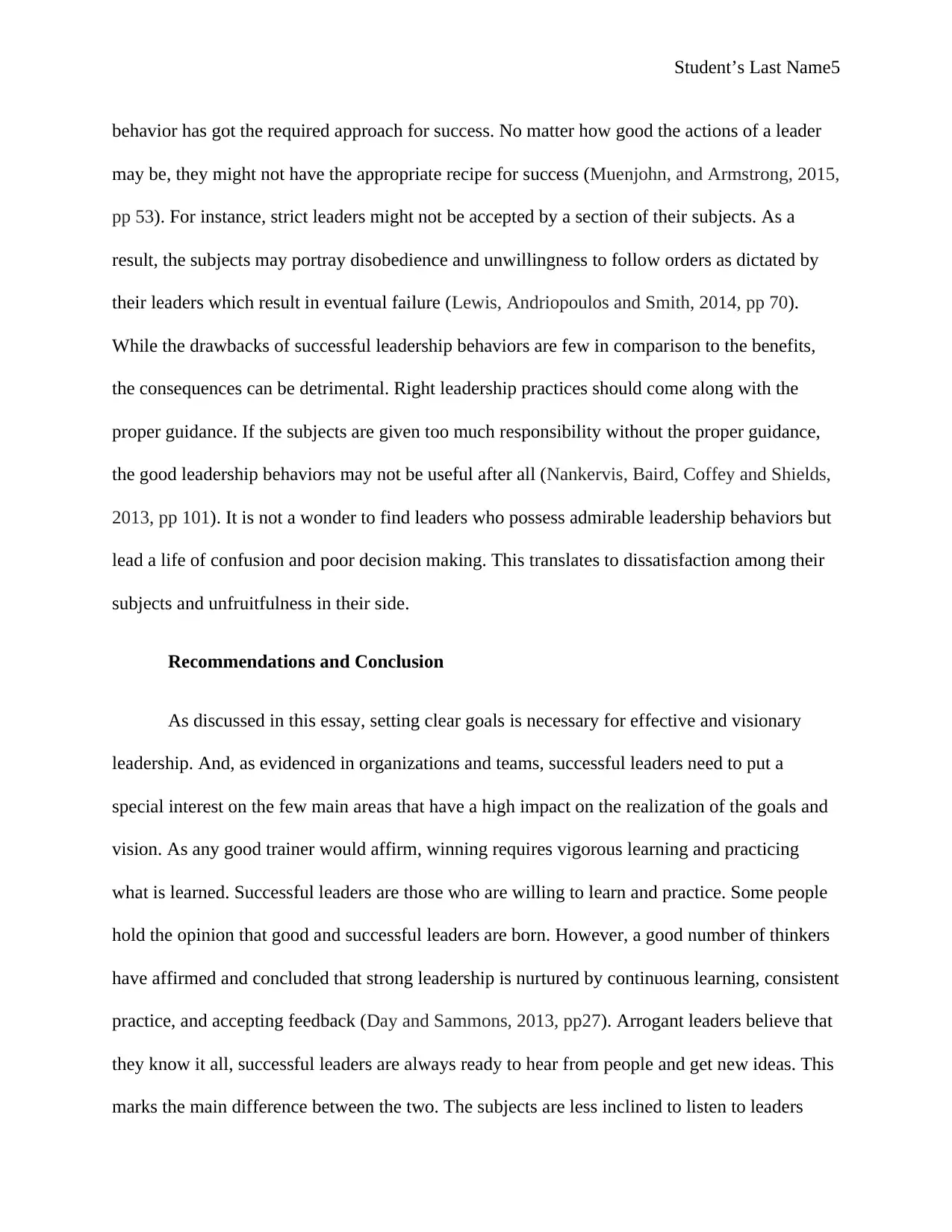
behavior has got the required approach for success. No matter how good the actions of a leader
may be, they might not have the appropriate recipe for success (Muenjohn, and Armstrong, 2015,
pp 53). For instance, strict leaders might not be accepted by a section of their subjects. As a
result, the subjects may portray disobedience and unwillingness to follow orders as dictated by
their leaders which result in eventual failure (Lewis, Andriopoulos and Smith, 2014, pp 70).
While the drawbacks of successful leadership behaviors are few in comparison to the benefits,
the consequences can be detrimental. Right leadership practices should come along with the
proper guidance. If the subjects are given too much responsibility without the proper guidance,
the good leadership behaviors may not be useful after all (Nankervis, Baird, Coffey and Shields,
2013, pp 101). It is not a wonder to find leaders who possess admirable leadership behaviors but
lead a life of confusion and poor decision making. This translates to dissatisfaction among their
subjects and unfruitfulness in their side.
Recommendations and Conclusion
As discussed in this essay, setting clear goals is necessary for effective and visionary
leadership. And, as evidenced in organizations and teams, successful leaders need to put a
special interest on the few main areas that have a high impact on the realization of the goals and
vision. As any good trainer would affirm, winning requires vigorous learning and practicing
what is learned. Successful leaders are those who are willing to learn and practice. Some people
hold the opinion that good and successful leaders are born. However, a good number of thinkers
have affirmed and concluded that strong leadership is nurtured by continuous learning, consistent
practice, and accepting feedback (Day and Sammons, 2013, pp27). Arrogant leaders believe that
they know it all, successful leaders are always ready to hear from people and get new ideas. This
marks the main difference between the two. The subjects are less inclined to listen to leaders
behavior has got the required approach for success. No matter how good the actions of a leader
may be, they might not have the appropriate recipe for success (Muenjohn, and Armstrong, 2015,
pp 53). For instance, strict leaders might not be accepted by a section of their subjects. As a
result, the subjects may portray disobedience and unwillingness to follow orders as dictated by
their leaders which result in eventual failure (Lewis, Andriopoulos and Smith, 2014, pp 70).
While the drawbacks of successful leadership behaviors are few in comparison to the benefits,
the consequences can be detrimental. Right leadership practices should come along with the
proper guidance. If the subjects are given too much responsibility without the proper guidance,
the good leadership behaviors may not be useful after all (Nankervis, Baird, Coffey and Shields,
2013, pp 101). It is not a wonder to find leaders who possess admirable leadership behaviors but
lead a life of confusion and poor decision making. This translates to dissatisfaction among their
subjects and unfruitfulness in their side.
Recommendations and Conclusion
As discussed in this essay, setting clear goals is necessary for effective and visionary
leadership. And, as evidenced in organizations and teams, successful leaders need to put a
special interest on the few main areas that have a high impact on the realization of the goals and
vision. As any good trainer would affirm, winning requires vigorous learning and practicing
what is learned. Successful leaders are those who are willing to learn and practice. Some people
hold the opinion that good and successful leaders are born. However, a good number of thinkers
have affirmed and concluded that strong leadership is nurtured by continuous learning, consistent
practice, and accepting feedback (Day and Sammons, 2013, pp27). Arrogant leaders believe that
they know it all, successful leaders are always ready to hear from people and get new ideas. This
marks the main difference between the two. The subjects are less inclined to listen to leaders

Student’s Last Name6
who are perceived as arrogant. Like an athlete who is determined to emerge as a winner,
successful leaders must continually hone their craft to achieve the desired fruits. By following
the above-stated and other necessary approaches, the journey to success will be like a walk in the
park.
who are perceived as arrogant. Like an athlete who is determined to emerge as a winner,
successful leaders must continually hone their craft to achieve the desired fruits. By following
the above-stated and other necessary approaches, the journey to success will be like a walk in the
park.
⊘ This is a preview!⊘
Do you want full access?
Subscribe today to unlock all pages.

Trusted by 1+ million students worldwide

Student’s Last Name7
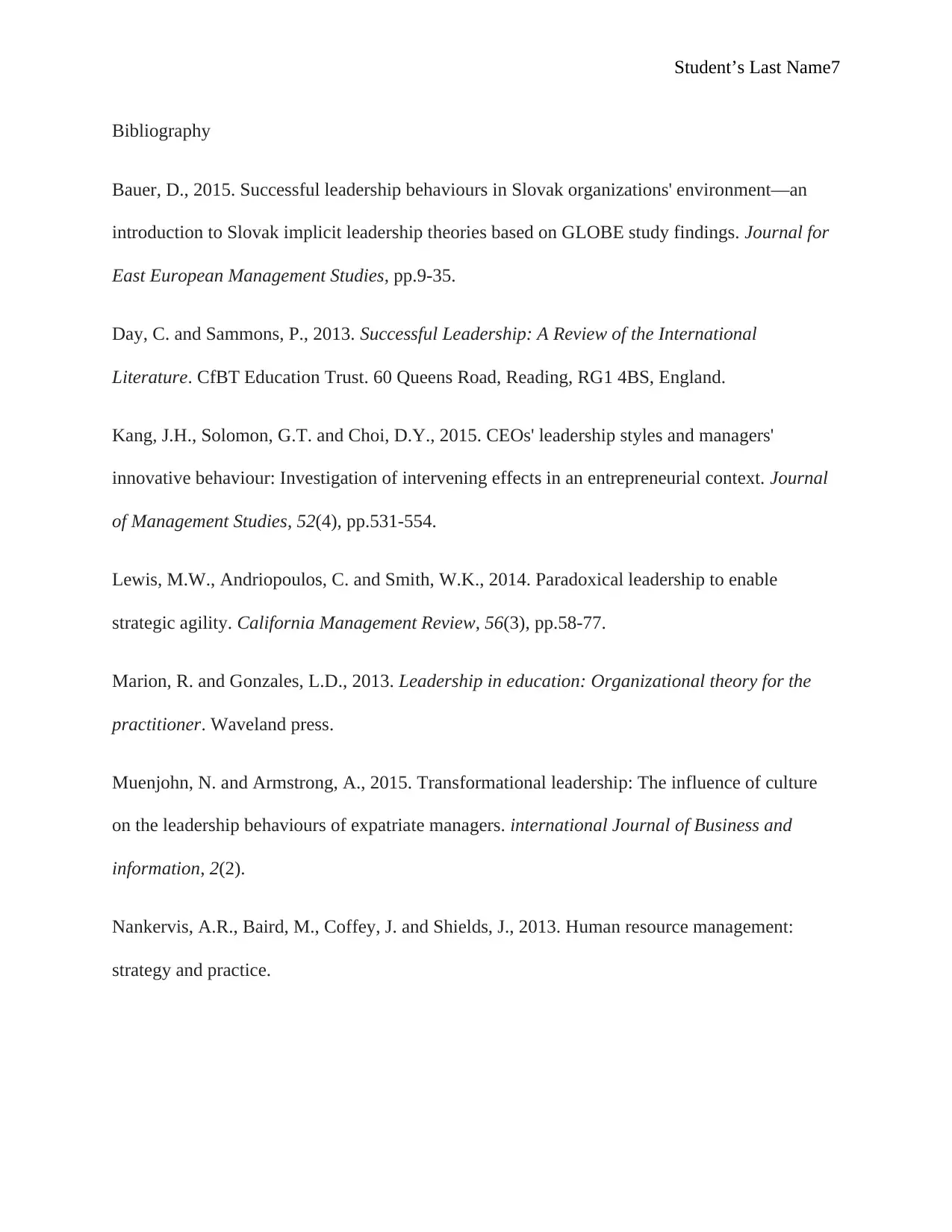
Bibliography
Bauer, D., 2015. Successful leadership behaviours in Slovak organizations' environment—an
introduction to Slovak implicit leadership theories based on GLOBE study findings. Journal for
East European Management Studies, pp.9-35.
Day, C. and Sammons, P., 2013. Successful Leadership: A Review of the International
Literature. CfBT Education Trust. 60 Queens Road, Reading, RG1 4BS, England.
Kang, J.H., Solomon, G.T. and Choi, D.Y., 2015. CEOs' leadership styles and managers'
innovative behaviour: Investigation of intervening effects in an entrepreneurial context. Journal
of Management Studies, 52(4), pp.531-554.
Lewis, M.W., Andriopoulos, C. and Smith, W.K., 2014. Paradoxical leadership to enable
strategic agility. California Management Review, 56(3), pp.58-77.
Marion, R. and Gonzales, L.D., 2013. Leadership in education: Organizational theory for the
practitioner. Waveland press.
Muenjohn, N. and Armstrong, A., 2015. Transformational leadership: The influence of culture
on the leadership behaviours of expatriate managers. international Journal of Business and
information, 2(2).
Nankervis, A.R., Baird, M., Coffey, J. and Shields, J., 2013. Human resource management:
strategy and practice.
Bibliography
Bauer, D., 2015. Successful leadership behaviours in Slovak organizations' environment—an
introduction to Slovak implicit leadership theories based on GLOBE study findings. Journal for
East European Management Studies, pp.9-35.
Day, C. and Sammons, P., 2013. Successful Leadership: A Review of the International
Literature. CfBT Education Trust. 60 Queens Road, Reading, RG1 4BS, England.
Kang, J.H., Solomon, G.T. and Choi, D.Y., 2015. CEOs' leadership styles and managers'
innovative behaviour: Investigation of intervening effects in an entrepreneurial context. Journal
of Management Studies, 52(4), pp.531-554.
Lewis, M.W., Andriopoulos, C. and Smith, W.K., 2014. Paradoxical leadership to enable
strategic agility. California Management Review, 56(3), pp.58-77.
Marion, R. and Gonzales, L.D., 2013. Leadership in education: Organizational theory for the
practitioner. Waveland press.
Muenjohn, N. and Armstrong, A., 2015. Transformational leadership: The influence of culture
on the leadership behaviours of expatriate managers. international Journal of Business and
information, 2(2).
Nankervis, A.R., Baird, M., Coffey, J. and Shields, J., 2013. Human resource management:
strategy and practice.
Paraphrase This Document
Need a fresh take? Get an instant paraphrase of this document with our AI Paraphraser

Student’s Last Name8
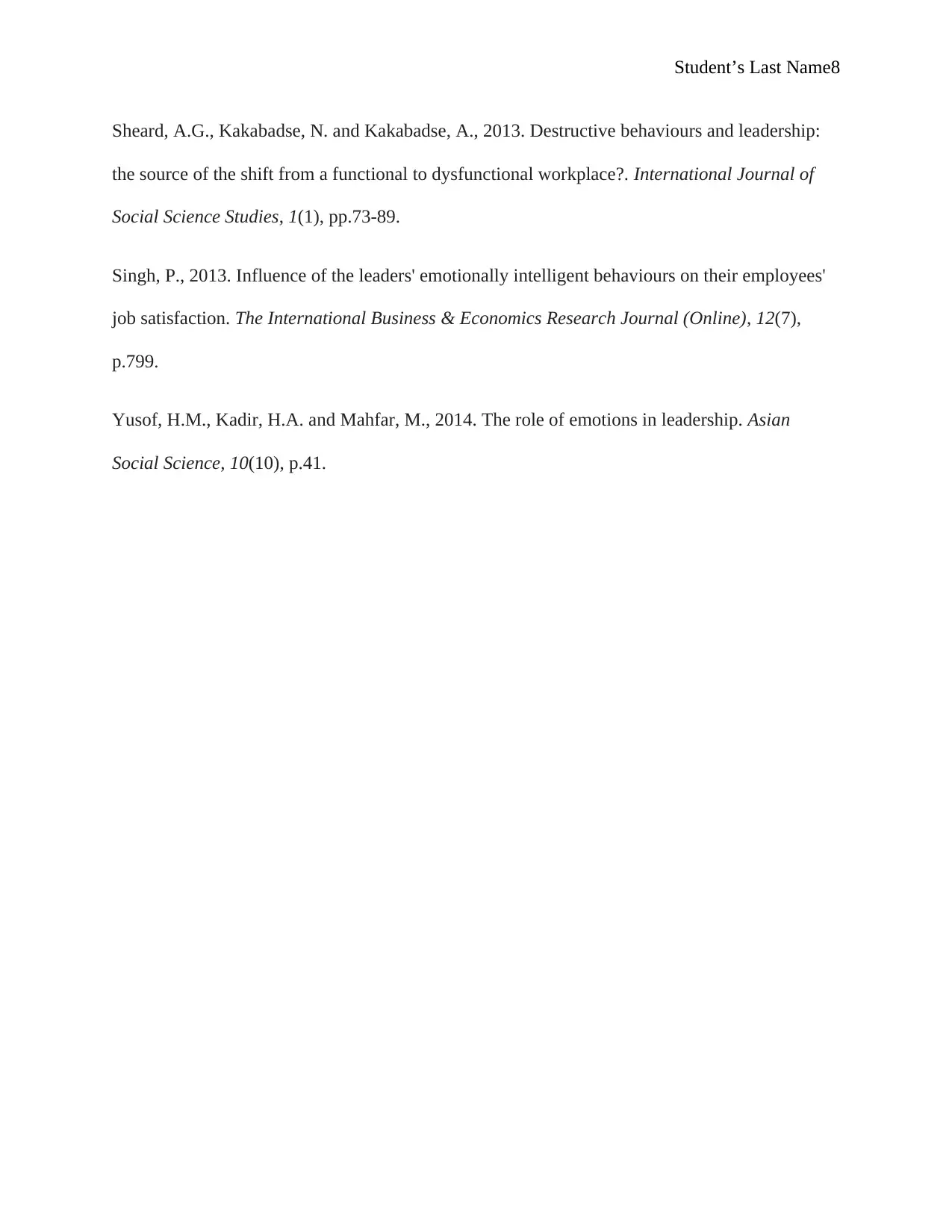
Sheard, A.G., Kakabadse, N. and Kakabadse, A., 2013. Destructive behaviours and leadership:
the source of the shift from a functional to dysfunctional workplace?. International Journal of
Social Science Studies, 1(1), pp.73-89.
Singh, P., 2013. Influence of the leaders' emotionally intelligent behaviours on their employees'
job satisfaction. The International Business & Economics Research Journal (Online), 12(7),
p.799.
Yusof, H.M., Kadir, H.A. and Mahfar, M., 2014. The role of emotions in leadership. Asian
Social Science, 10(10), p.41.
Sheard, A.G., Kakabadse, N. and Kakabadse, A., 2013. Destructive behaviours and leadership:
the source of the shift from a functional to dysfunctional workplace?. International Journal of
Social Science Studies, 1(1), pp.73-89.
Singh, P., 2013. Influence of the leaders' emotionally intelligent behaviours on their employees'
job satisfaction. The International Business & Economics Research Journal (Online), 12(7),
p.799.
Yusof, H.M., Kadir, H.A. and Mahfar, M., 2014. The role of emotions in leadership. Asian
Social Science, 10(10), p.41.
1 out of 8
Related Documents
Your All-in-One AI-Powered Toolkit for Academic Success.
+13062052269
info@desklib.com
Available 24*7 on WhatsApp / Email
Unlock your academic potential
Copyright © 2020–2026 A2Z Services. All Rights Reserved. Developed and managed by ZUCOL.