Case Study: Gender Discrimination and its Impact on the Workplace

Verified

Added on  2019/09/23

|4
|476
|299
Report
AI Summary
This report presents a case study on gender discrimination experienced in a workplace setting. It details an instance of unfair treatment, specifically gender-based discrimination in promotion decisions, violating both company policy and Title VII of the Civil Rights Act of 1964. The report outlines the steps taken to address the issue, including attempts to resolve the matter internally with HR, and the subsequent involvement of a corporate lawyer. The resolution involved arbitration and resulted in a positive outcome, although the report suggests that the company's HR department could have handled the situation more effectively. The importance of HR in ensuring gender equality, as supported by research, is also emphasized. Finally, the report discusses the potential negative consequences for the company had the matter remained unresolved, particularly in terms of reputational damage related to gender discrimination issues.
Document Page
Running Head: ISSUES AND PRACTICES 1
ISSUES AND PRACTICES
tabler-icon-diamond-filled.svg

Paraphrase This Document

Need a fresh take? Get an instant paraphrase of this document with our AI Paraphraser
Document Page
ISSUES AND PRACTICES 2
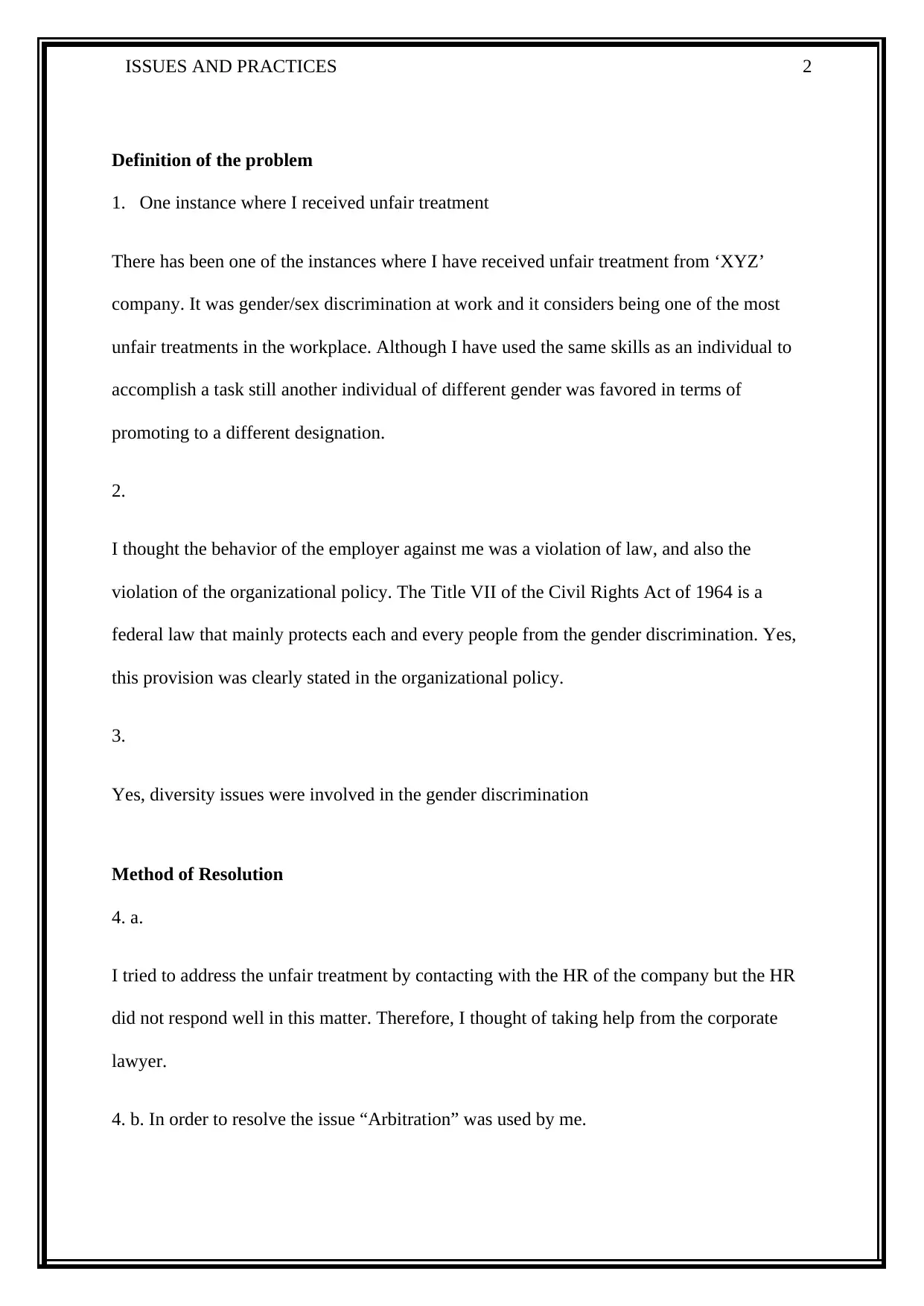
Definition of the problem
1. One instance where I received unfair treatment
There has been one of the instances where I have received unfair treatment from ‘XYZ’
company. It was gender/sex discrimination at work and it considers being one of the most
unfair treatments in the workplace. Although I have used the same skills as an individual to
accomplish a task still another individual of different gender was favored in terms of
promoting to a different designation.
2.
I thought the behavior of the employer against me was a violation of law, and also the
violation of the organizational policy. The Title VII of the Civil Rights Act of 1964 is a
federal law that mainly protects each and every people from the gender discrimination. Yes,
this provision was clearly stated in the organizational policy.
3.
Yes, diversity issues were involved in the gender discrimination
Method of Resolution
4. a.
I tried to address the unfair treatment by contacting with the HR of the company but the HR
did not respond well in this matter. Therefore, I thought of taking help from the corporate
lawyer.
4. b. In order to resolve the issue “Arbitration” was used by me.
Document Page
ISSUES AND PRACTICES 3
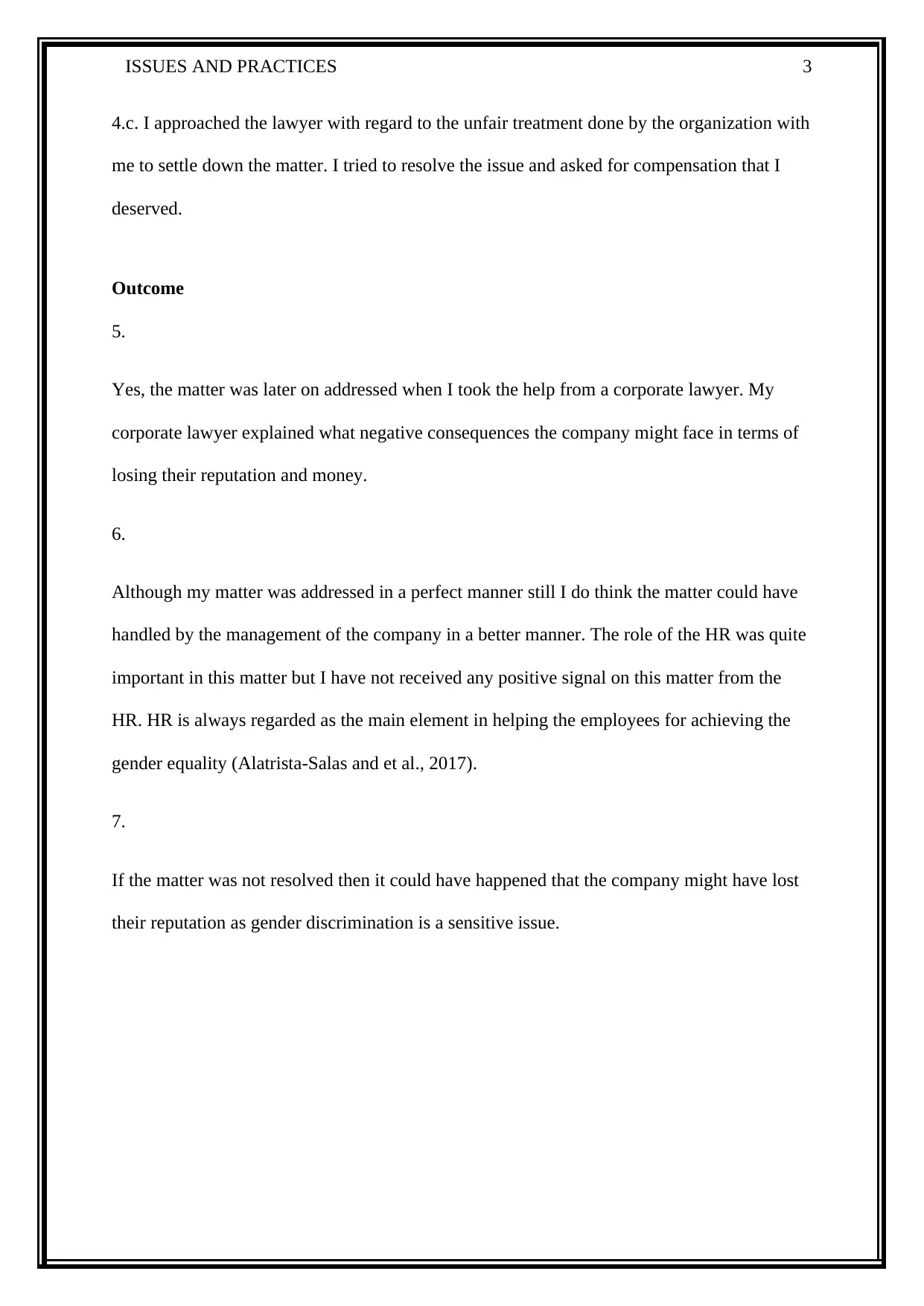
4.c. I approached the lawyer with regard to the unfair treatment done by the organization with
me to settle down the matter. I tried to resolve the issue and asked for compensation that I
deserved.
Outcome
5.
Yes, the matter was later on addressed when I took the help from a corporate lawyer. My
corporate lawyer explained what negative consequences the company might face in terms of
losing their reputation and money.
6.
Although my matter was addressed in a perfect manner still I do think the matter could have
handled by the management of the company in a better manner. The role of the HR was quite
important in this matter but I have not received any positive signal on this matter from the
HR. HR is always regarded as the main element in helping the employees for achieving the
gender equality (Alatrista-Salas and et al., 2017).
7.
If the matter was not resolved then it could have happened that the company might have lost
their reputation as gender discrimination is a sensitive issue.
Document Page
ISSUES AND PRACTICES 4
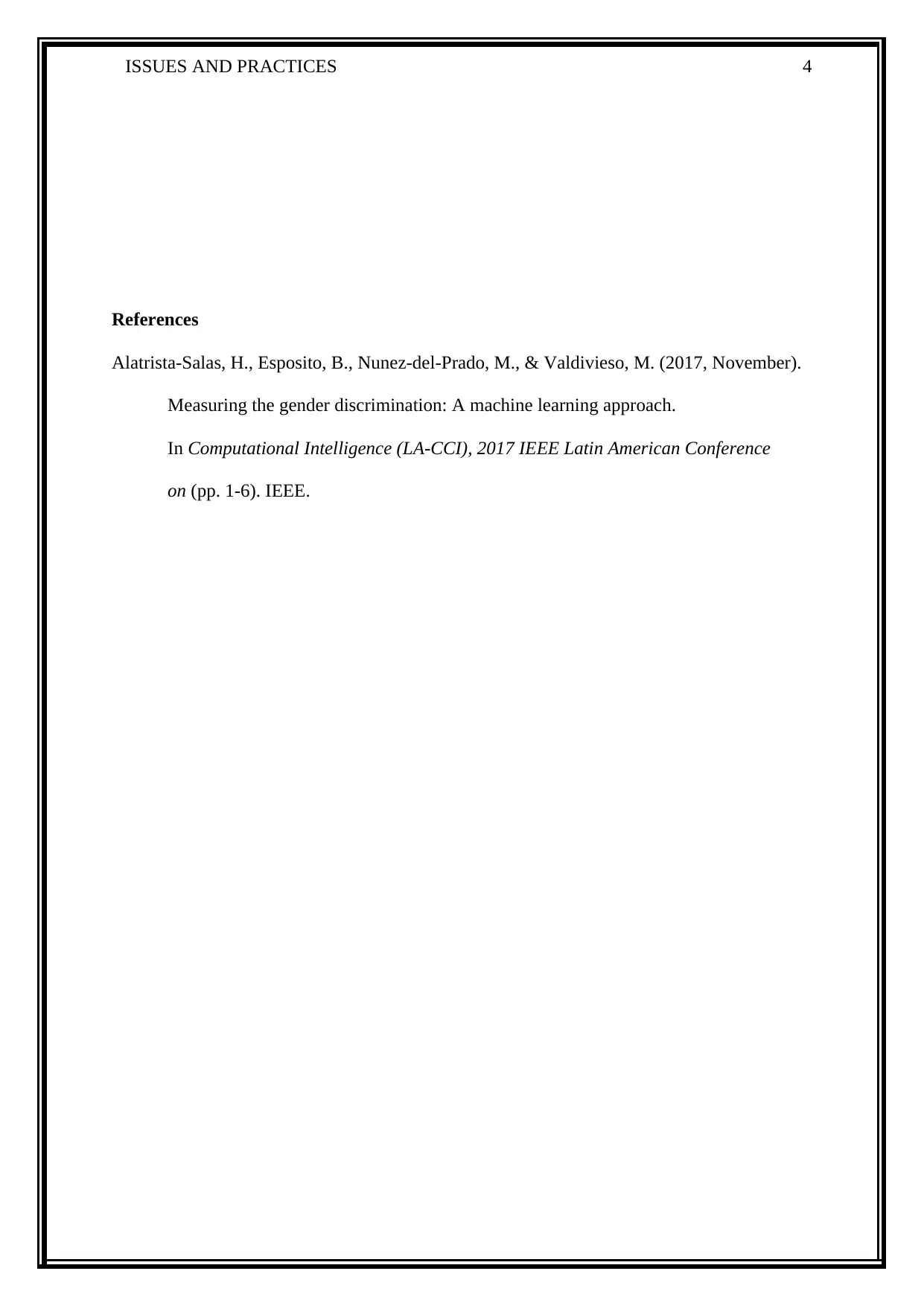
References
Alatrista-Salas, H., Esposito, B., Nunez-del-Prado, M., & Valdivieso, M. (2017, November).
Measuring the gender discrimination: A machine learning approach.
In Computational Intelligence (LA-CCI), 2017 IEEE Latin American Conference
on (pp. 1-6). IEEE.
chevron_up_icon
1 out of 4
circle_padding
hide_on_mobile
zoom_out_icon
[object Object]