Leadership Analysis: DISC, Styles, and Effectiveness

Verified

Added on  2023/04/17

|6
|1089
|401
Essay
AI Summary
This essay delves into the multifaceted concept of leadership, aiming to help students understand their leadership identities through self-assessment and the DISC analysis model. It explores how individuals can recognize their leadership qualities and provides examples of leadership experiences, analyzing their effectiveness. The essay connects leadership characteristics with various leadership styles, including autocratic, transactional, and laissez-faire approaches, offering insights into their implications. The author uses personal experiences and observations of others in leadership positions to illustrate these concepts, providing a comprehensive analysis of leadership styles, strengths, and areas for improvement. The conclusion highlights the usefulness of the DISC model in identifying leadership strengths and areas that require development, thereby offering practical advice for leaders.
Document Page
Running head: LEADERSHIP 1
Leadership
Name
Institution
tabler-icon-diamond-filled.svg

Paraphrase This Document

Need a fresh take? Get an instant paraphrase of this document with our AI Paraphraser
Document Page
LEADERSHIP 2
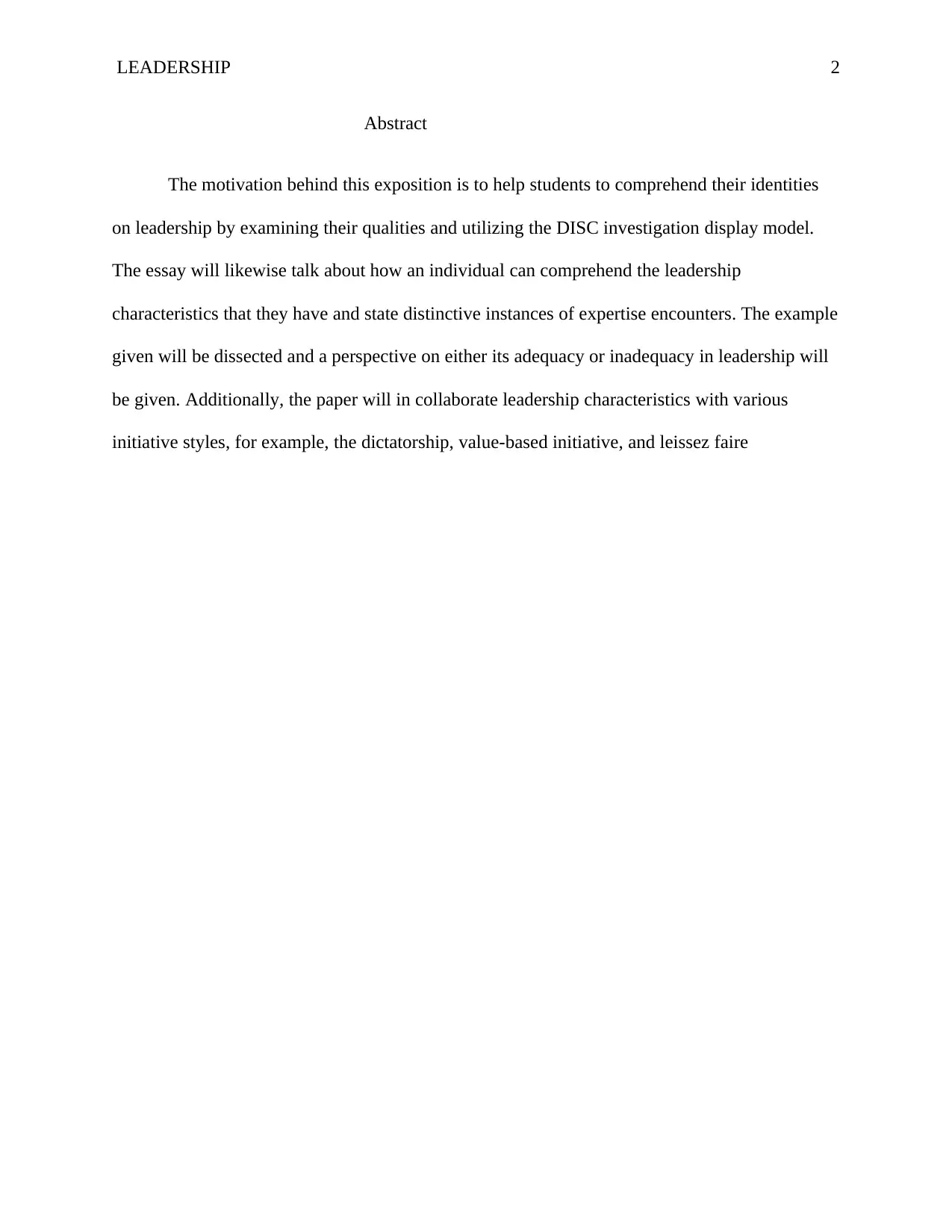
Abstract
The motivation behind this exposition is to help students to comprehend their identities
on leadership by examining their qualities and utilizing the DISC investigation display model.
The essay will likewise talk about how an individual can comprehend the leadership
characteristics that they have and state distinctive instances of expertise encounters. The example
given will be dissected and a perspective on either its adequacy or inadequacy in leadership will
be given. Additionally, the paper will in collaborate leadership characteristics with various
initiative styles, for example, the dictatorship, value-based initiative, and leissez faire
Document Page
LEADERSHIP 3
Leadership
Introduction
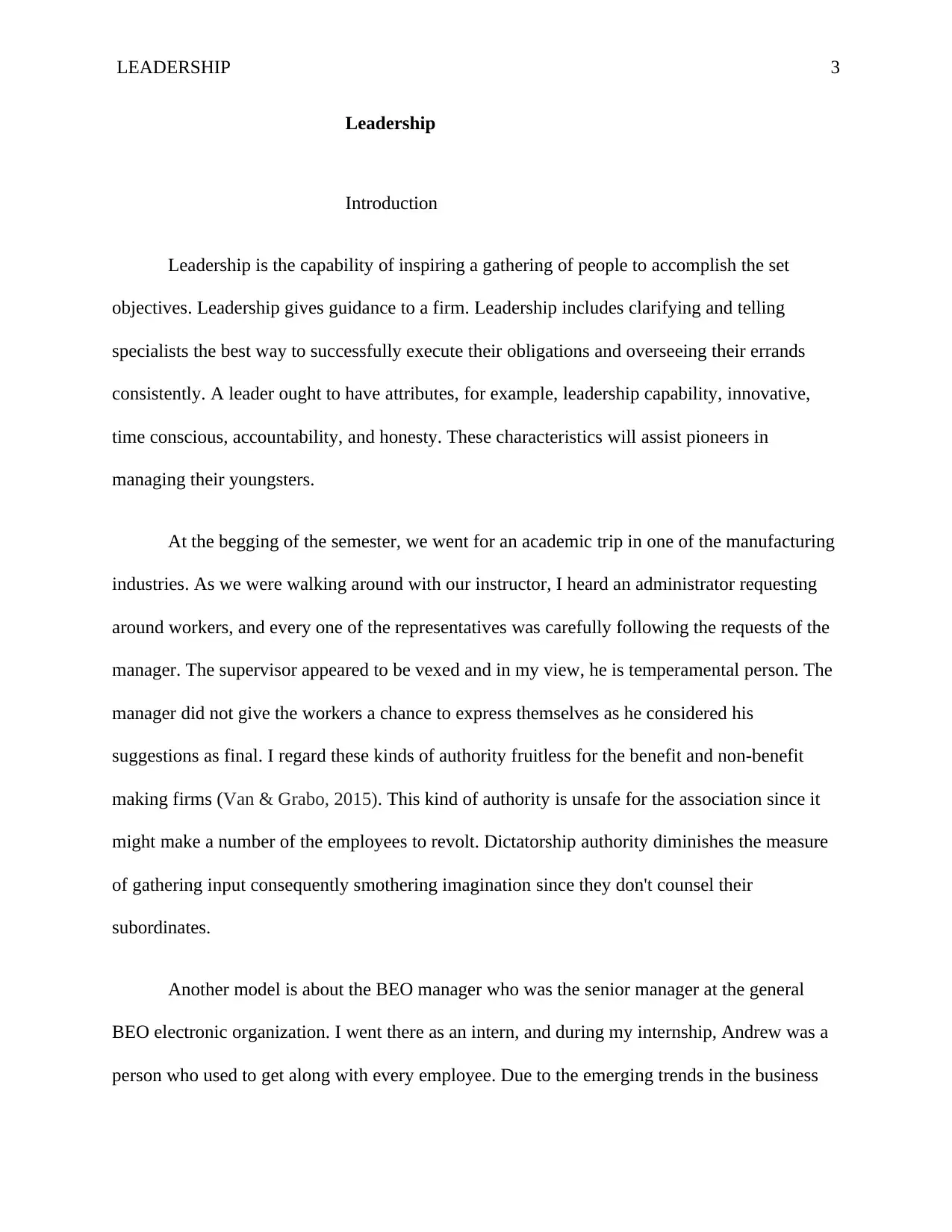
Leadership is the capability of inspiring a gathering of people to accomplish the set
objectives. Leadership gives guidance to a firm. Leadership includes clarifying and telling
specialists the best way to successfully execute their obligations and overseeing their errands
consistently. A leader ought to have attributes, for example, leadership capability, innovative,
time conscious, accountability, and honesty. These characteristics will assist pioneers in
managing their youngsters.
At the begging of the semester, we went for an academic trip in one of the manufacturing
industries. As we were walking around with our instructor, I heard an administrator requesting
around workers, and every one of the representatives was carefully following the requests of the
manager. The supervisor appeared to be vexed and in my view, he is temperamental person. The
manager did not give the workers a chance to express themselves as he considered his
suggestions as final. I regard these kinds of authority fruitless for the benefit and non-benefit
making firms (Van & Grabo, 2015). This kind of authority is unsafe for the association since it
might make a number of the employees to revolt. Dictatorship authority diminishes the measure
of gathering input consequently smothering imagination since they don't counsel their
subordinates.
Another model is about the BEO manager who was the senior manager at the general
BEO electronic organization. I went there as an intern, and during my internship, Andrew was a
person who used to get along with every employee. Due to the emerging trends in the business
Document Page
LEADERSHIP 4
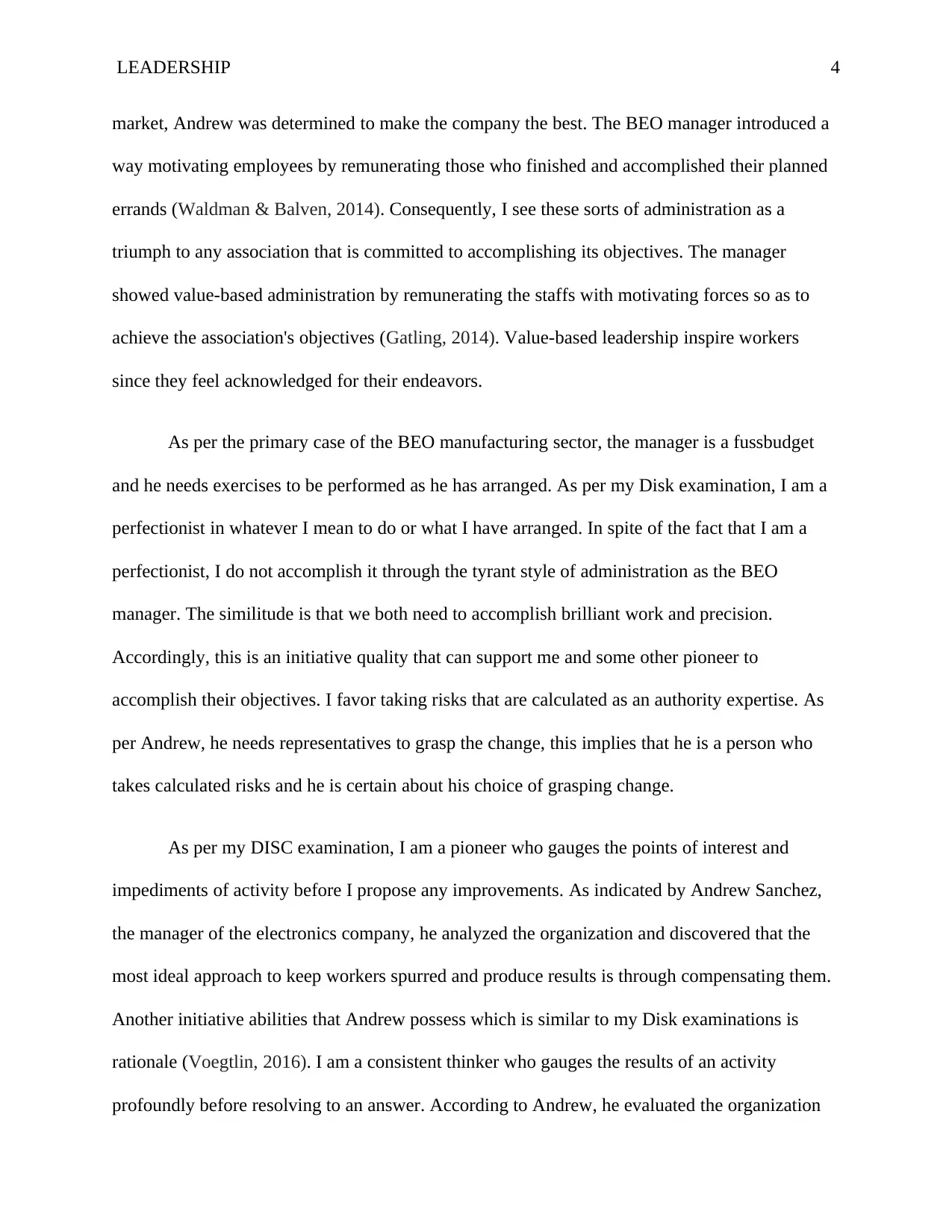
market, Andrew was determined to make the company the best. The BEO manager introduced a
way motivating employees by remunerating those who finished and accomplished their planned
errands (Waldman & Balven, 2014). Consequently, I see these sorts of administration as a
triumph to any association that is committed to accomplishing its objectives. The manager
showed value-based administration by remunerating the staffs with motivating forces so as to
achieve the association's objectives (Gatling, 2014). Value-based leadership inspire workers
since they feel acknowledged for their endeavors.
As per the primary case of the BEO manufacturing sector, the manager is a fussbudget
and he needs exercises to be performed as he has arranged. As per my Disk examination, I am a
perfectionist in whatever I mean to do or what I have arranged. In spite of the fact that I am a
perfectionist, I do not accomplish it through the tyrant style of administration as the BEO
manager. The similitude is that we both need to accomplish brilliant work and precision.
Accordingly, this is an initiative quality that can support me and some other pioneer to
accomplish their objectives. I favor taking risks that are calculated as an authority expertise. As
per Andrew, he needs representatives to grasp the change, this implies that he is a person who
takes calculated risks and he is certain about his choice of grasping change.
As per my DISC examination, I am a pioneer who gauges the points of interest and
impediments of activity before I propose any improvements. As indicated by Andrew Sanchez,
the manager of the electronics company, he analyzed the organization and discovered that the
most ideal approach to keep workers spurred and produce results is through compensating them.
Another initiative abilities that Andrew possess which is similar to my Disk examinations is
rationale (Voegtlin, 2016). I am a consistent thinker who gauges the results of an activity
profoundly before resolving to an answer. According to Andrew, he evaluated the organization
tabler-icon-diamond-filled.svg

Paraphrase This Document

Need a fresh take? Get an instant paraphrase of this document with our AI Paraphraser
Document Page
LEADERSHIP 5
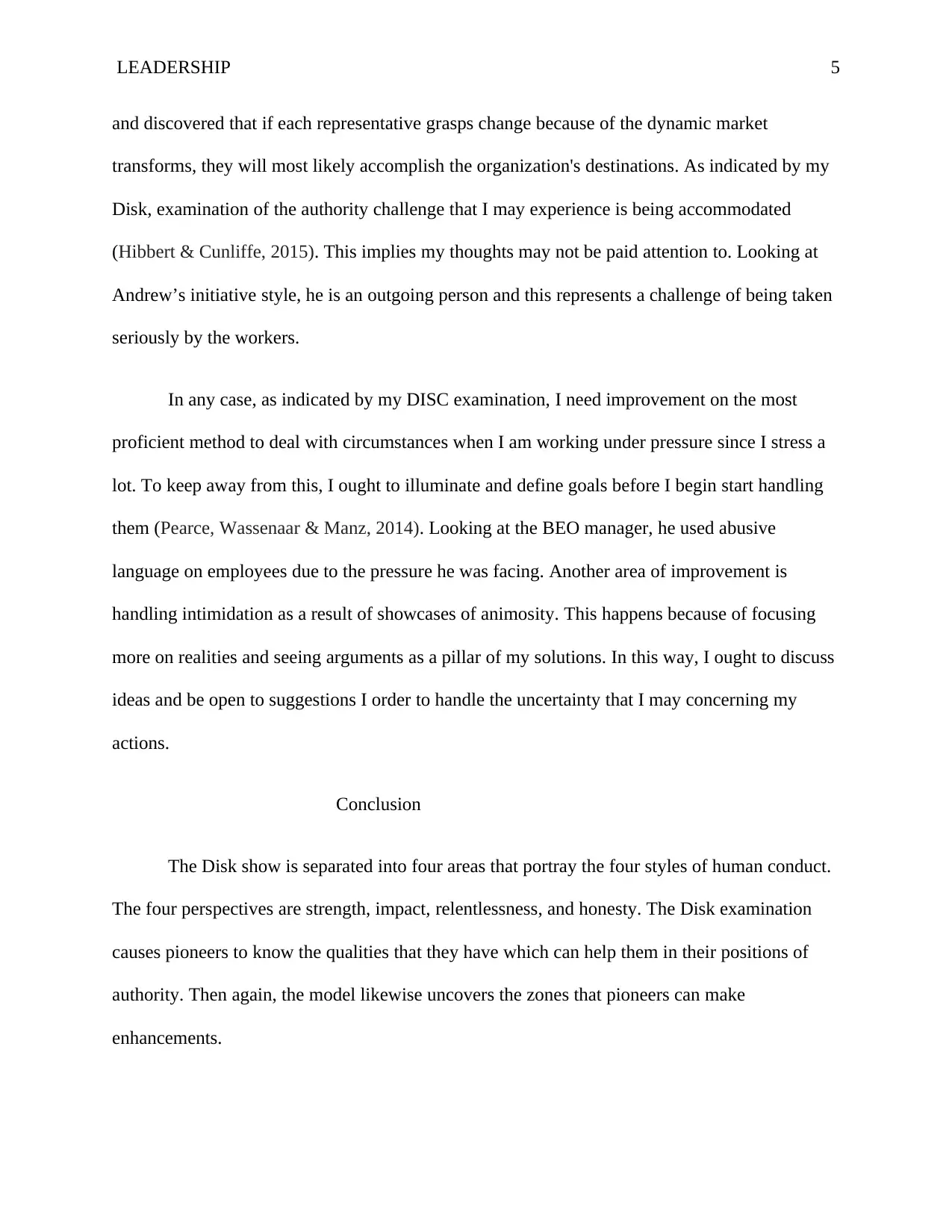
and discovered that if each representative grasps change because of the dynamic market
transforms, they will most likely accomplish the organization's destinations. As indicated by my
Disk, examination of the authority challenge that I may experience is being accommodated
(Hibbert & Cunliffe, 2015). This implies my thoughts may not be paid attention to. Looking at
Andrew’s initiative style, he is an outgoing person and this represents a challenge of being taken
seriously by the workers.
In any case, as indicated by my DISC examination, I need improvement on the most
proficient method to deal with circumstances when I am working under pressure since I stress a
lot. To keep away from this, I ought to illuminate and define goals before I begin start handling
them (Pearce, Wassenaar & Manz, 2014). Looking at the BEO manager, he used abusive
language on employees due to the pressure he was facing. Another area of improvement is
handling intimidation as a result of showcases of animosity. This happens because of focusing
more on realities and seeing arguments as a pillar of my solutions. In this way, I ought to discuss
ideas and be open to suggestions I order to handle the uncertainty that I may concerning my
actions.
Conclusion
The Disk show is separated into four areas that portray the four styles of human conduct.
The four perspectives are strength, impact, relentlessness, and honesty. The Disk examination
causes pioneers to know the qualities that they have which can help them in their positions of
authority. Then again, the model likewise uncovers the zones that pioneers can make
enhancements.
Document Page
LEADERSHIP 6
References
Pearce, C. L., Wassenaar, C. L., & Manz, C. C. (2014). Is shared leadership the key to
responsible leadership?. Academy of Management Perspectives, 28(3), 275-288.
Hibbert, P., & Cunliffe, A. (2015). Responsible management: Engaging moral reflexive practice
through threshold concepts. Journal of business ethics, 127(1), 177-188.
Voegtlin, C. (2016). What does it mean to be responsible? Addressing the missing responsibility
dimension in ethical leadership research. Leadership, 12(5), 581-608.
Gatling, A. (2014). The authentic leadership qualities of business coaches and its impact on
coaching performance. International Journal of Evidence Based Coaching and
Mentoring, 12(1), 27.
Waldman, D. A., & Balven, R. M. (2014). Responsible leadership: Theoretical issues and
research directions. Academy of Management Perspectives, 28(3), 224-234.
Van Vugt, M., & Grabo, A. E. (2015). The many faces of leadership: An evolutionary-
psychology approach. Current Directions in Psychological Science, 24(6), 484-489.
chevron_up_icon
1 out of 6
circle_padding
hide_on_mobile
zoom_out_icon
[object Object]