Analysis of Limitations and Challenges in Wired Networks

Verified

Added on  2022/10/11

|4
|458
|18
Homework Assignment
AI Summary
This assignment delves into the limitations and challenges associated with wired networks, contrasting them with the advantages and disadvantages of wireless communication. It highlights the benefits of wireless networks, such as mobility, ease of data transfer, and cost-effectiveness, while also acknowledging their drawbacks, including security vulnerabilities and potential for service disruptions due to environmental factors. The assignment covers the advantages of wired networks such as high security and reliability. The assignment also explores the challenges of wireless networks. The assignment also discusses the challenges of wireless networks, such as managing user experience and the impact of environmental factors. The assignment references relevant literature to support the analysis and provides a comprehensive overview of the key considerations in network design and implementation.
Document Page
Running head: LIMITATIONS / CHALLENGES OF WIRED NETWORKS
Limitations / Challenges of wired networks
Name of Student
Name of University
Author’s Note
tabler-icon-diamond-filled.svg

Paraphrase This Document

Need a fresh take? Get an instant paraphrase of this document with our AI Paraphraser
Document Page
1
LIMITATIONS / CHALLENGES OF WIRED NETWORKS
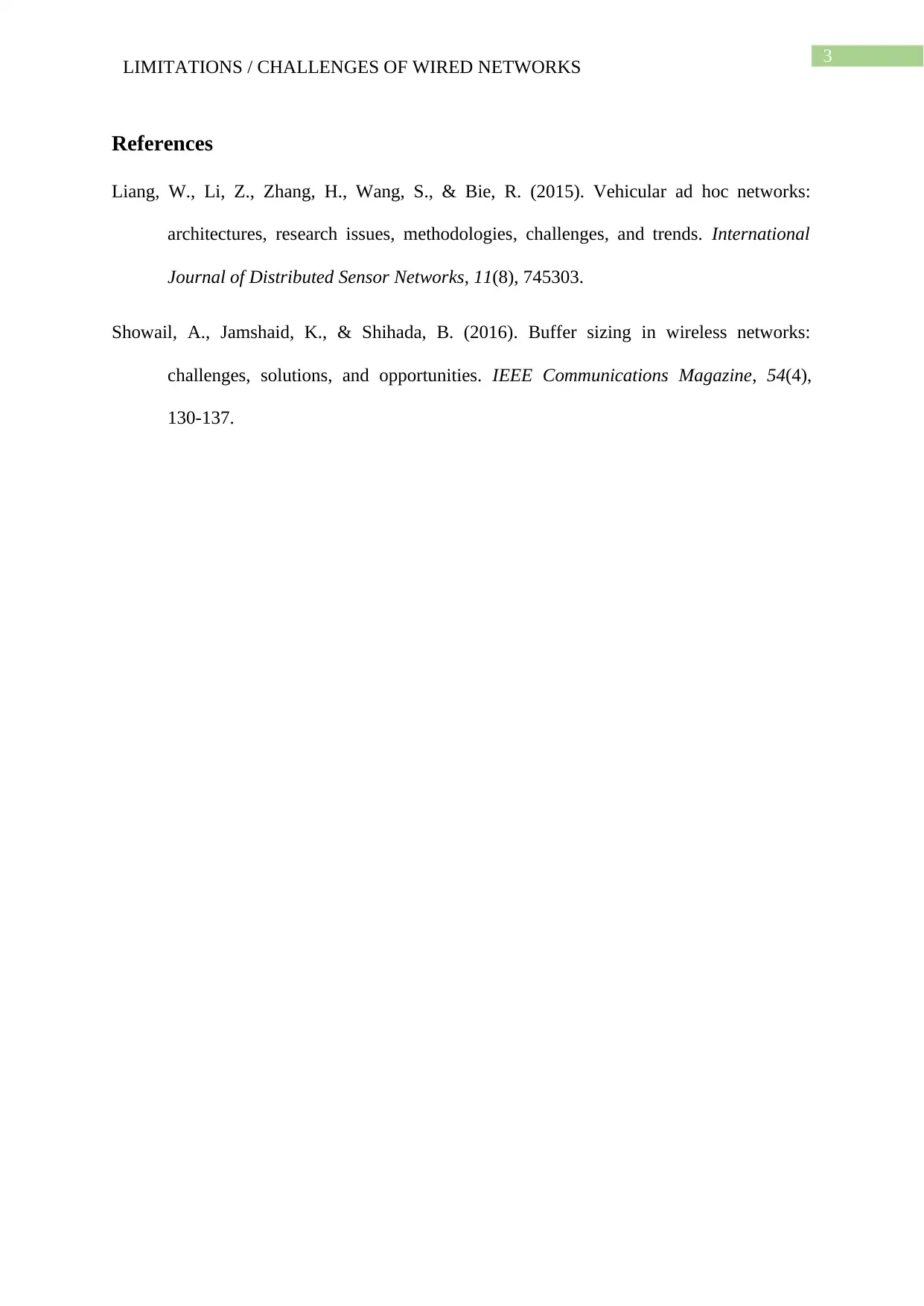
Q1: Wireless communication offers a number of advantages compared to wired
networks. However, as with any technology, there are some challenges with wireless
communication as well. List three advantages and three limitations / challenges that
wireless communication has over wired networks in real life application scenarios.
The three diverse categories of advantages and restrictions related with the
deployment of wireless communication when compared with the wired networks are
described as follows:
Advantages
The wireless networks allows the users to roam about across various places which is
not possible for the wired networks. Wireless networks can be used to transfer the
data in an easier manner.
The other significant advantage of the wireless networks is that it allows the users of
this network to share files without the involvement of any sort of cables or ports
(Liang et al., 2015).
The cost of the wireless networks is much less than the wired networks which is one
of the biggest advantage of the wireless networks. Larger amount of users can be
managed in an organized manner using the wireless networks.
Disadvantages
There are diverse categories of additional costs associated with the wireless network
to set the equipment. The security of the wireless networks is much less as compared
with the high end security which are provided by the wired networks.
Experience of the users is very much significant to manage each of the complexities
of the wireless networks. Up-gradation of the wireless network can be huge source of
concern for the users of this network (Showail, Jamshaid & Shihada, 2016).
Document Page
2
LIMITATIONS / CHALLENGES OF WIRED NETWORKS
The speed of data transfer can vary from one place to another in most of the wireless
network. Any sort of obstructions like adverse environmental conditions can have an
undesirable impact on the service provided by the wireless networks.
Document Page
3
LIMITATIONS / CHALLENGES OF WIRED NETWORKS
References
Liang, W., Li, Z., Zhang, H., Wang, S., & Bie, R. (2015). Vehicular ad hoc networks:
architectures, research issues, methodologies, challenges, and trends. International
Journal of Distributed Sensor Networks, 11(8), 745303.
Showail, A., Jamshaid, K., & Shihada, B. (2016). Buffer sizing in wireless networks:
challenges, solutions, and opportunities. IEEE Communications Magazine, 54(4),
130-137.
chevron_up_icon
1 out of 4
circle_padding
hide_on_mobile
zoom_out_icon
[object Object]