Critical Analysis: Limitations of International Commercial Arbitration
VerifiedAdded on 2023/06/11
|15
|4322
|487
Report
AI Summary
This report delves into the Arbitration Act 2001 of Bangladesh, examining its limitations concerning international commercial arbitration. It discusses the evolution of arbitration in Bangladesh from the Arbitration Act of 1940 to the current act, highlighting the increase in arbitration's utilization as an alternative dispute resolution method. The report addresses jurisdictional objections, the roles of courts and arbitration tribunals, supervisory powers of the court, choice of law, and the enforcement of foreign arbitral awards. It also touches upon challenges and views regarding Bangladesh's arbitration rules, emphasizing the importance of balancing party autonomy with judicial oversight to foster effective and fair international commercial arbitration within the country. This document is available on Desklib, a platform offering a wide range of study tools and solved assignments for students.
Arbitration Act, 2001: Limitations of International
Commercial Arbitration in Bangladesh.
Commercial Arbitration in Bangladesh.

Paraphrase This Document
Need a fresh take? Get an instant paraphrase of this document with our AI Paraphraser
Contents
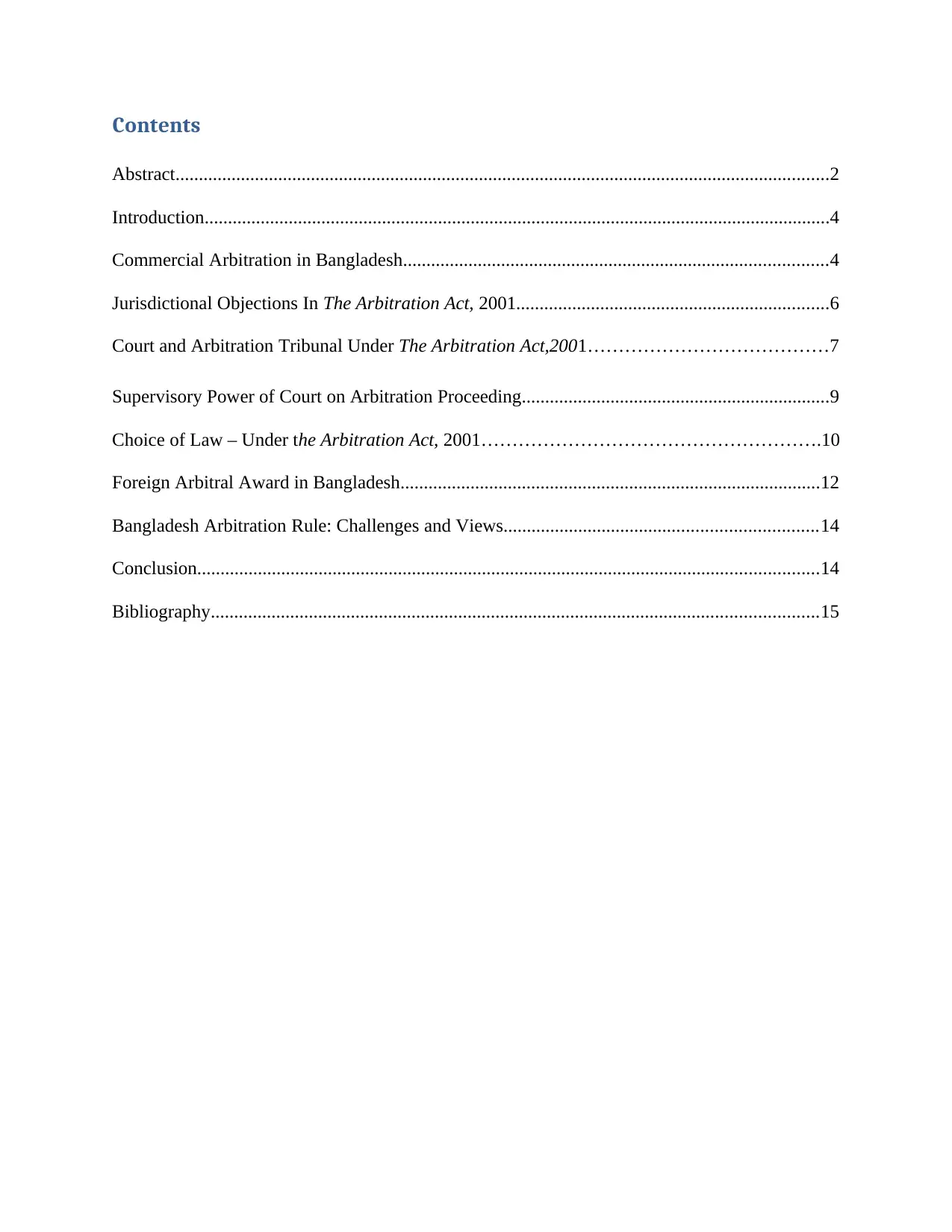
Abstract............................................................................................................................................2
Introduction......................................................................................................................................4
Commercial Arbitration in Bangladesh...........................................................................................4
Jurisdictional Objections In The Arbitration Act, 2001...................................................................6
Court and Arbitration Tribunal Under The Arbitration Act,2001…………………………………7
Supervisory Power of Court on Arbitration Proceeding..................................................................9
Choice of Law – Under the Arbitration Act, 2001……………………………………………….10
Foreign Arbitral Award in Bangladesh..........................................................................................12
Bangladesh Arbitration Rule: Challenges and Views...................................................................14
Conclusion.....................................................................................................................................14
Bibliography..................................................................................................................................15
Abstract............................................................................................................................................2
Introduction......................................................................................................................................4
Commercial Arbitration in Bangladesh...........................................................................................4
Jurisdictional Objections In The Arbitration Act, 2001...................................................................6
Court and Arbitration Tribunal Under The Arbitration Act,2001…………………………………7
Supervisory Power of Court on Arbitration Proceeding..................................................................9
Choice of Law – Under the Arbitration Act, 2001……………………………………………….10
Foreign Arbitral Award in Bangladesh..........................................................................................12
Bangladesh Arbitration Rule: Challenges and Views...................................................................14
Conclusion.....................................................................................................................................14
Bibliography..................................................................................................................................15
Introduction
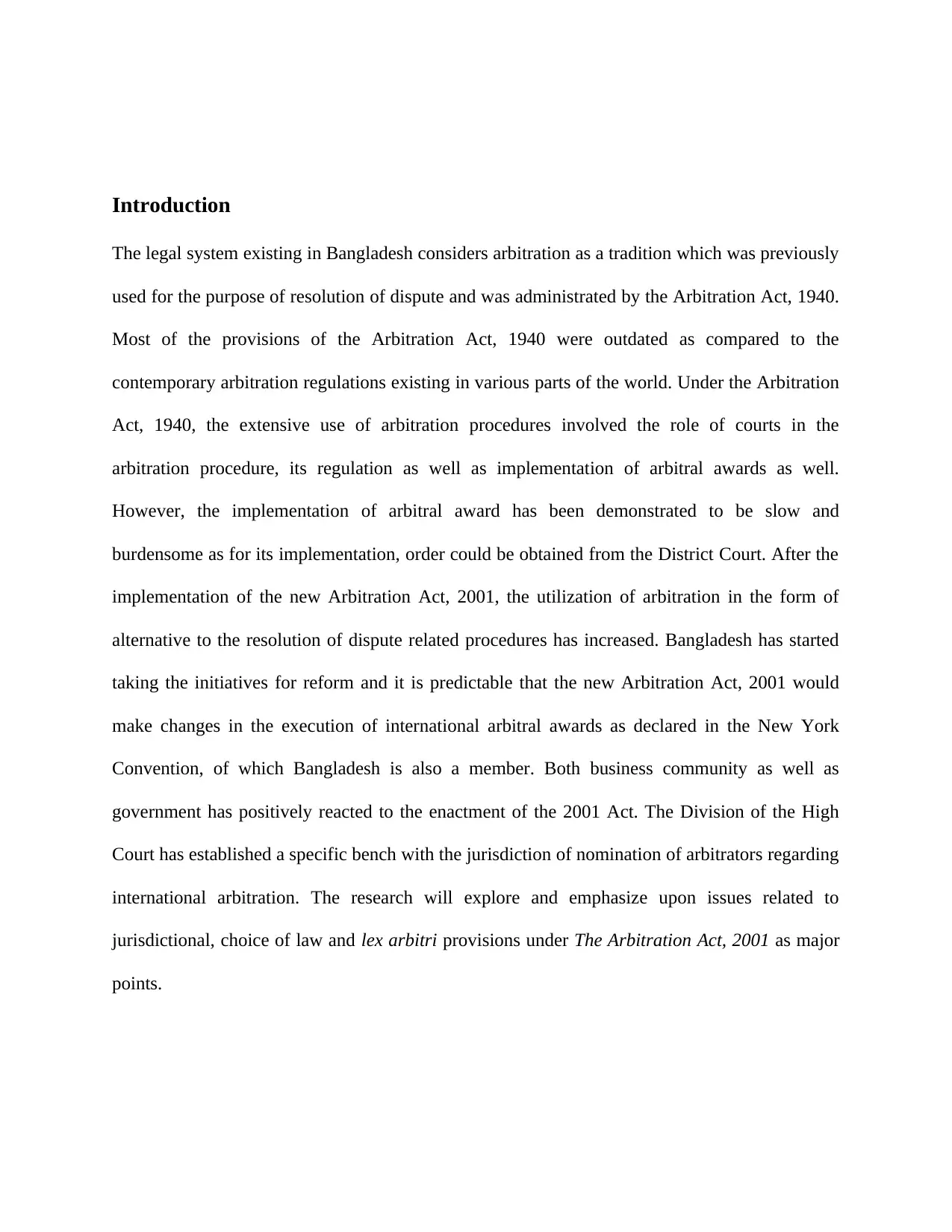
The legal system existing in Bangladesh considers arbitration as a tradition which was previously
used for the purpose of resolution of dispute and was administrated by the Arbitration Act, 1940.
Most of the provisions of the Arbitration Act, 1940 were outdated as compared to the
contemporary arbitration regulations existing in various parts of the world. Under the Arbitration
Act, 1940, the extensive use of arbitration procedures involved the role of courts in the
arbitration procedure, its regulation as well as implementation of arbitral awards as well.
However, the implementation of arbitral award has been demonstrated to be slow and
burdensome as for its implementation, order could be obtained from the District Court. After the
implementation of the new Arbitration Act, 2001, the utilization of arbitration in the form of
alternative to the resolution of dispute related procedures has increased. Bangladesh has started
taking the initiatives for reform and it is predictable that the new Arbitration Act, 2001 would
make changes in the execution of international arbitral awards as declared in the New York
Convention, of which Bangladesh is also a member. Both business community as well as
government has positively reacted to the enactment of the 2001 Act. The Division of the High
Court has established a specific bench with the jurisdiction of nomination of arbitrators regarding
international arbitration. The research will explore and emphasize upon issues related to
jurisdictional, choice of law and lex arbitri provisions under The Arbitration Act, 2001 as major
points.
The legal system existing in Bangladesh considers arbitration as a tradition which was previously
used for the purpose of resolution of dispute and was administrated by the Arbitration Act, 1940.
Most of the provisions of the Arbitration Act, 1940 were outdated as compared to the
contemporary arbitration regulations existing in various parts of the world. Under the Arbitration
Act, 1940, the extensive use of arbitration procedures involved the role of courts in the
arbitration procedure, its regulation as well as implementation of arbitral awards as well.
However, the implementation of arbitral award has been demonstrated to be slow and
burdensome as for its implementation, order could be obtained from the District Court. After the
implementation of the new Arbitration Act, 2001, the utilization of arbitration in the form of
alternative to the resolution of dispute related procedures has increased. Bangladesh has started
taking the initiatives for reform and it is predictable that the new Arbitration Act, 2001 would
make changes in the execution of international arbitral awards as declared in the New York
Convention, of which Bangladesh is also a member. Both business community as well as
government has positively reacted to the enactment of the 2001 Act. The Division of the High
Court has established a specific bench with the jurisdiction of nomination of arbitrators regarding
international arbitration. The research will explore and emphasize upon issues related to
jurisdictional, choice of law and lex arbitri provisions under The Arbitration Act, 2001 as major
points.
⊘ This is a preview!⊘
Do you want full access?
Subscribe today to unlock all pages.

Trusted by 1+ million students worldwide
Commercial Arbitration in Bangladesh
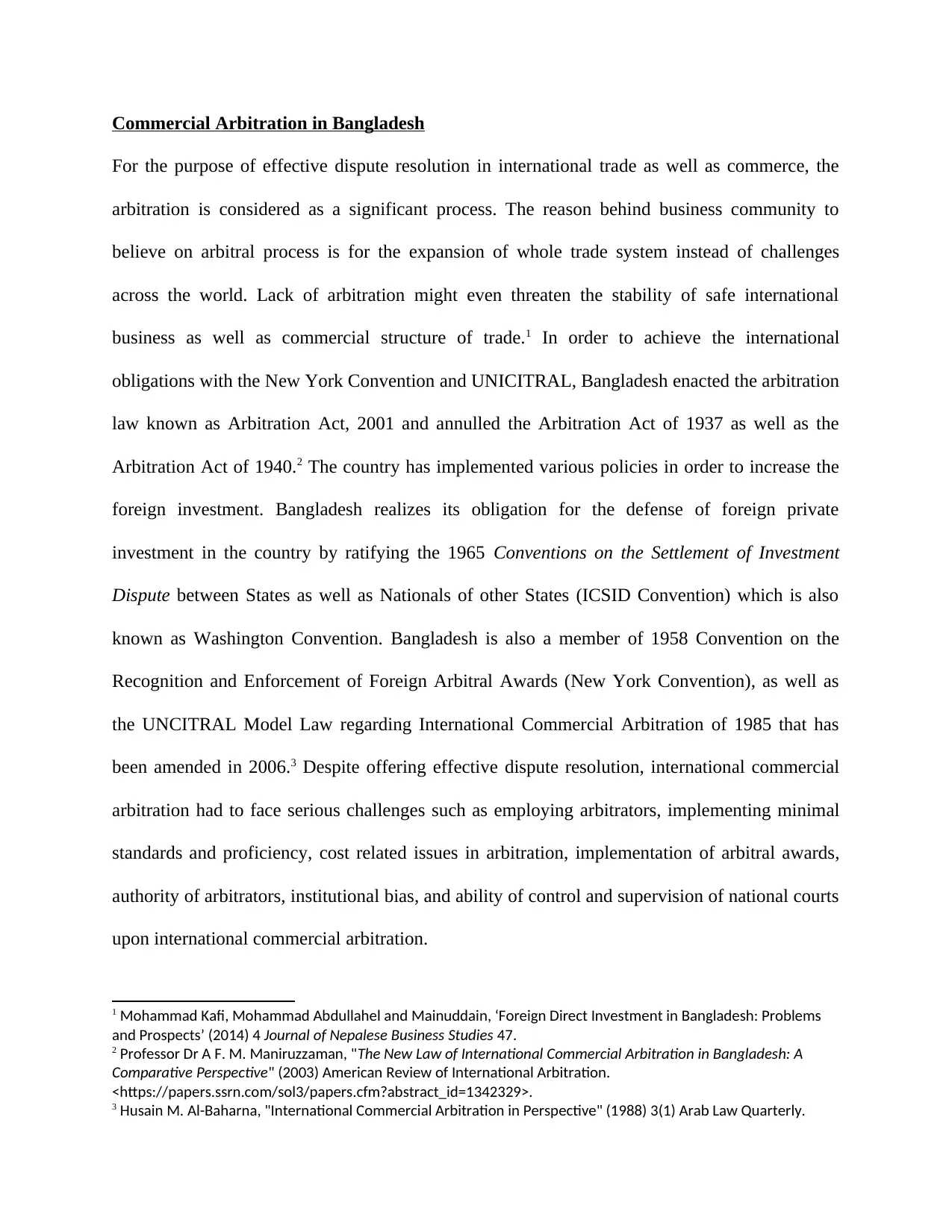
For the purpose of effective dispute resolution in international trade as well as commerce, the
arbitration is considered as a significant process. The reason behind business community to
believe on arbitral process is for the expansion of whole trade system instead of challenges
across the world. Lack of arbitration might even threaten the stability of safe international
business as well as commercial structure of trade.1 In order to achieve the international
obligations with the New York Convention and UNICITRAL, Bangladesh enacted the arbitration
law known as Arbitration Act, 2001 and annulled the Arbitration Act of 1937 as well as the
Arbitration Act of 1940.2 The country has implemented various policies in order to increase the
foreign investment. Bangladesh realizes its obligation for the defense of foreign private
investment in the country by ratifying the 1965 Conventions on the Settlement of Investment
Dispute between States as well as Nationals of other States (ICSID Convention) which is also
known as Washington Convention. Bangladesh is also a member of 1958 Convention on the
Recognition and Enforcement of Foreign Arbitral Awards (New York Convention), as well as
the UNCITRAL Model Law regarding International Commercial Arbitration of 1985 that has
been amended in 2006.3 Despite offering effective dispute resolution, international commercial
arbitration had to face serious challenges such as employing arbitrators, implementing minimal
standards and proficiency, cost related issues in arbitration, implementation of arbitral awards,
authority of arbitrators, institutional bias, and ability of control and supervision of national courts
upon international commercial arbitration.
1 Mohammad Kafi, Mohammad Abdullahel and Mainuddain, ‘Foreign Direct Investment in Bangladesh: Problems
and Prospects’ (2014) 4 Journal of Nepalese Business Studies 47.
2 Professor Dr A F. M. Maniruzzaman, "The New Law of International Commercial Arbitration in Bangladesh: A
Comparative Perspective" (2003) American Review of International Arbitration.
<https://papers.ssrn.com/sol3/papers.cfm?abstract_id=1342329>.
3 Husain M. Al-Baharna, "International Commercial Arbitration in Perspective" (1988) 3(1) Arab Law Quarterly.
For the purpose of effective dispute resolution in international trade as well as commerce, the
arbitration is considered as a significant process. The reason behind business community to
believe on arbitral process is for the expansion of whole trade system instead of challenges
across the world. Lack of arbitration might even threaten the stability of safe international
business as well as commercial structure of trade.1 In order to achieve the international
obligations with the New York Convention and UNICITRAL, Bangladesh enacted the arbitration
law known as Arbitration Act, 2001 and annulled the Arbitration Act of 1937 as well as the
Arbitration Act of 1940.2 The country has implemented various policies in order to increase the
foreign investment. Bangladesh realizes its obligation for the defense of foreign private
investment in the country by ratifying the 1965 Conventions on the Settlement of Investment
Dispute between States as well as Nationals of other States (ICSID Convention) which is also
known as Washington Convention. Bangladesh is also a member of 1958 Convention on the
Recognition and Enforcement of Foreign Arbitral Awards (New York Convention), as well as
the UNCITRAL Model Law regarding International Commercial Arbitration of 1985 that has
been amended in 2006.3 Despite offering effective dispute resolution, international commercial
arbitration had to face serious challenges such as employing arbitrators, implementing minimal
standards and proficiency, cost related issues in arbitration, implementation of arbitral awards,
authority of arbitrators, institutional bias, and ability of control and supervision of national courts
upon international commercial arbitration.
1 Mohammad Kafi, Mohammad Abdullahel and Mainuddain, ‘Foreign Direct Investment in Bangladesh: Problems
and Prospects’ (2014) 4 Journal of Nepalese Business Studies 47.
2 Professor Dr A F. M. Maniruzzaman, "The New Law of International Commercial Arbitration in Bangladesh: A
Comparative Perspective" (2003) American Review of International Arbitration.
<https://papers.ssrn.com/sol3/papers.cfm?abstract_id=1342329>.
3 Husain M. Al-Baharna, "International Commercial Arbitration in Perspective" (1988) 3(1) Arab Law Quarterly.
Paraphrase This Document
Need a fresh take? Get an instant paraphrase of this document with our AI Paraphraser
Jurisdictional Objection under The Arbitration Act, 2001:
The competence-competence principle provides the authority to the arbitral tribunal in order to
govern its authority and relevant oppositions regarding the disputed entitlements. This principle
was introduced in the English law by the Arbitration Act of 1996 and stated that except if not
consented by the related parties, and subjected to challenges by arbitral procedure of appeal or
review or alliance with the provisions of Part I of the 1996 Act, an arbitral tribunal might rule
upon its own fundamental authority regarding if there is lawful arbitration agreement, if tribunal
has been appropriately established and if the issues have been given to arbitration consistent with
the arbitration agreement. The ability of the tribunal in inducing jurisdictional objections require
various terms and conditions to be fulfilled such as presence of legalized arbitration agreement
amongst the parties, the prospect of the arbitration agreement should include the matter of
dispute as well as the arbitral tribunal is required to be aptly established.
There are certain restrictions of the 2001 Act such as Section 17 has mentioned five
jurisdictional questions upon which arbitral tribunal might apply its power of competence-
competence.4 The five questions are whether there is presence of lawful arbitration agreement,
whether arbitration agreement is incompetent to be executed, the issues have been provided for
arbitration according to the arbitration agreement. The arbitral tribunal deals with the issue of
competence if applied by either of the parties. Section 18 has discussed about the amendments in
the arbitration clause and explains that arbitration agreement which is a part of another
agreement is considered as separate agreement at the time of decision making for defining the
4 Law Desk, Modernisation Of Arbitration Process Has Been Limited For The Scope Of The Arbitration Act 2001,
Lawyer Monthly (Online), 18 December 2017.
<https://www.lawyer-monthly.com/2017/11/modernisation-of-arbitration-process-has-been-limited-for-the-
scope-of-the-arbitration-act-2001/ >
The competence-competence principle provides the authority to the arbitral tribunal in order to
govern its authority and relevant oppositions regarding the disputed entitlements. This principle
was introduced in the English law by the Arbitration Act of 1996 and stated that except if not
consented by the related parties, and subjected to challenges by arbitral procedure of appeal or
review or alliance with the provisions of Part I of the 1996 Act, an arbitral tribunal might rule
upon its own fundamental authority regarding if there is lawful arbitration agreement, if tribunal
has been appropriately established and if the issues have been given to arbitration consistent with
the arbitration agreement. The ability of the tribunal in inducing jurisdictional objections require
various terms and conditions to be fulfilled such as presence of legalized arbitration agreement
amongst the parties, the prospect of the arbitration agreement should include the matter of
dispute as well as the arbitral tribunal is required to be aptly established.
There are certain restrictions of the 2001 Act such as Section 17 has mentioned five
jurisdictional questions upon which arbitral tribunal might apply its power of competence-
competence.4 The five questions are whether there is presence of lawful arbitration agreement,
whether arbitration agreement is incompetent to be executed, the issues have been provided for
arbitration according to the arbitration agreement. The arbitral tribunal deals with the issue of
competence if applied by either of the parties. Section 18 has discussed about the amendments in
the arbitration clause and explains that arbitration agreement which is a part of another
agreement is considered as separate agreement at the time of decision making for defining the
4 Law Desk, Modernisation Of Arbitration Process Has Been Limited For The Scope Of The Arbitration Act 2001,
Lawyer Monthly (Online), 18 December 2017.
<https://www.lawyer-monthly.com/2017/11/modernisation-of-arbitration-process-has-been-limited-for-the-
scope-of-the-arbitration-act-2001/ >
jurisdictional authority of arbitral tribunal.5 Thus, without taking into consideration that the
fundamental or parent contract might be void, it becomes completely possible to have a binding
arbitration agreement emerging from the same contract.
Court and Arbitration Tribunal
The contradiction of arbitration is that it examines the support of the public authorities to remain
free which requires relationship between the courts and arbitral processes. In various situations,
the influence of national systems appears to be normal, expected, and welcomed, though other
times, it might appear troublesome and unjustified. The knowledge of these characteristics is
beneficial for assessing the possibility of party independence and the way topmost parties should
take benefit of international arbitration and identify drawbacks and possible consequences and
remedies as well.6 The courts should identify the reasons slowly in order to undertake authority
over an issue that the parties have contracted to consider for the purpose of arbitration. It should
also be kept in mind that the International Arbitration Act was aimed to reduce the contribution
of courts in the issues that are decided by the parties to be taken for arbitration.7
The existing arbitration and court actions should be avoided except if it is regarding offering of
essential support for the arbitral process. In addition, jurisdictional challenges must also be
handled quickly and decisively as the preparedness of the courts to deal with jurisdictional
challenges or use supervisory role regarding arbitration proceedings, it will inspire the parties to
stall the proceedings of arbitration, which in sequence, reduce the pace of arbitrations and
5The Arbitration Act, 2001 s18.
6 ITC, Rules of Arbitration of the Bangladesh Council of Arbitration (2018) Intracen.org
<http://www.intracen.org/Rules-of-Arbitration-of-the-Bangladesh-Council-of-Arbitration/>.
7 Rajin Ahmed, "International Commercial Arbitration in Bangladesh" (2014) 21(107) The Financial Express.
fundamental or parent contract might be void, it becomes completely possible to have a binding
arbitration agreement emerging from the same contract.
Court and Arbitration Tribunal
The contradiction of arbitration is that it examines the support of the public authorities to remain
free which requires relationship between the courts and arbitral processes. In various situations,
the influence of national systems appears to be normal, expected, and welcomed, though other
times, it might appear troublesome and unjustified. The knowledge of these characteristics is
beneficial for assessing the possibility of party independence and the way topmost parties should
take benefit of international arbitration and identify drawbacks and possible consequences and
remedies as well.6 The courts should identify the reasons slowly in order to undertake authority
over an issue that the parties have contracted to consider for the purpose of arbitration. It should
also be kept in mind that the International Arbitration Act was aimed to reduce the contribution
of courts in the issues that are decided by the parties to be taken for arbitration.7
The existing arbitration and court actions should be avoided except if it is regarding offering of
essential support for the arbitral process. In addition, jurisdictional challenges must also be
handled quickly and decisively as the preparedness of the courts to deal with jurisdictional
challenges or use supervisory role regarding arbitration proceedings, it will inspire the parties to
stall the proceedings of arbitration, which in sequence, reduce the pace of arbitrations and
5The Arbitration Act, 2001 s18.
6 ITC, Rules of Arbitration of the Bangladesh Council of Arbitration (2018) Intracen.org
<http://www.intracen.org/Rules-of-Arbitration-of-the-Bangladesh-Council-of-Arbitration/>.
7 Rajin Ahmed, "International Commercial Arbitration in Bangladesh" (2014) 21(107) The Financial Express.
⊘ This is a preview!⊘
Do you want full access?
Subscribe today to unlock all pages.
Trusted by 1+ million students worldwide
enhance the overall costs of proceedings.8 Thus, the role of the court is to provide backing the
arbitral process instead of displacing it.
The involvement of the court has been anticipated by the Arbitration Act 2001in various sections
of the Act which are Section 8 (arbitration agreement as well as practical claim before Court for
stay on proceedings), Section 7A (temporary measures), Section 12 (employment of arbitrators),
Section 14 (challenge processes), Section 15 (termination of arbitrator’s mandate), Section 17
(capability of arbitral tribunal to regulate its jurisdiction), Section 33 (assistance of court in
taking evidence), Section 42 (setting aside an award) and Section 44 and Section 45
(appreciation and implementation of awards). In this manner, the Arbitration Act 2001 enables
the national courts of Bangladesh to play significant role in assisting the arbitration tribunal and
provides them the authority to intervene in some cases by not providing the awards in case of
breach of basic rights of parties or when arbitral tribunal has acted beyond its jurisdiction
powers.9 However, arbitration is described by flexibility and autonomy from the procedures of
litigation which is not a substitute of the court but interconnected to each other and both can
perform together in order to reduce the accumulation of cases.10
Supervisory Power of Court on Arbitration Proceedings
Previously, the English Courts did not prefer arbitration and used to consider arbitrators as their
opponents. In middle of the 20th century, the English Courts started changing their attitudes
concerning to the arbitration proceedings and commercial courts started identifying the self-
8 R. Goode, "The Role of the Lex Loci Arbitri in International Commercial Arbitration" (2001) 17(1) Arbitration
International, 84.
9 Karl-Heinz Böckstiegel, "Role of the State on Protecting the System of Arbitration" in Ciarb Centenary Conference
(2015)
<http://www.ciarb.org/docs/default-source/ciarbdocuments/london/b%C3%B6ckstiegel.pdf?sfvrsn=0>.
10 Professor David A R Williams QC, ‘Defining the Role of The Court in Modern International Commercial
Arbitration’ (Lecture, Singapore, 2012).
arbitral process instead of displacing it.
The involvement of the court has been anticipated by the Arbitration Act 2001in various sections
of the Act which are Section 8 (arbitration agreement as well as practical claim before Court for
stay on proceedings), Section 7A (temporary measures), Section 12 (employment of arbitrators),
Section 14 (challenge processes), Section 15 (termination of arbitrator’s mandate), Section 17
(capability of arbitral tribunal to regulate its jurisdiction), Section 33 (assistance of court in
taking evidence), Section 42 (setting aside an award) and Section 44 and Section 45
(appreciation and implementation of awards). In this manner, the Arbitration Act 2001 enables
the national courts of Bangladesh to play significant role in assisting the arbitration tribunal and
provides them the authority to intervene in some cases by not providing the awards in case of
breach of basic rights of parties or when arbitral tribunal has acted beyond its jurisdiction
powers.9 However, arbitration is described by flexibility and autonomy from the procedures of
litigation which is not a substitute of the court but interconnected to each other and both can
perform together in order to reduce the accumulation of cases.10
Supervisory Power of Court on Arbitration Proceedings
Previously, the English Courts did not prefer arbitration and used to consider arbitrators as their
opponents. In middle of the 20th century, the English Courts started changing their attitudes
concerning to the arbitration proceedings and commercial courts started identifying the self-
8 R. Goode, "The Role of the Lex Loci Arbitri in International Commercial Arbitration" (2001) 17(1) Arbitration
International, 84.
9 Karl-Heinz Böckstiegel, "Role of the State on Protecting the System of Arbitration" in Ciarb Centenary Conference
(2015)
<http://www.ciarb.org/docs/default-source/ciarbdocuments/london/b%C3%B6ckstiegel.pdf?sfvrsn=0>.
10 Professor David A R Williams QC, ‘Defining the Role of The Court in Modern International Commercial
Arbitration’ (Lecture, Singapore, 2012).
Paraphrase This Document
Need a fresh take? Get an instant paraphrase of this document with our AI Paraphraser
sufficiency of the arbitration process. However, the courts continued supervising the arbitration
process through case-stated method and arbitrators were required to state cases on a question of
law for the judgment of the court regarding the issue. In Bangladesh, there were provisions in the
Arbitration Act 1940 which permit the courts for intervening in the arbitration proceedings.
However, Act 2001 aims to restrict it despite holding the supervisory role of the courts in a
restricted manner. Section 7 of the Act 2001 limits the court to decide the matters in which either
of the parties in the procedures of the arbitration initiates for the procedures of the court. In
Bangladesh Jute Mills Corporation v Maico Jute and Bag Corporation & Others11, it was stated
that the court cannot try the case which is already pending to the arbitral tribunal. Section 7A of
the Act authorizes the local courts to make interim or temporary orders regarding matters such as
for temporary orders to confine the transfer of property about to create obstruction to the
enactment of arbitral award. Similar to Section 7 of the Act, the courts in Bangladesh shall not
intervene in the matter exposed to arbitration agreement existing between the opposing parties
under Section 10 of the Act. If a party under arbitration agreement initiates trial to a court in
Bangladesh while the other party has objection to it before the filing of the statement of defense,
then the court should halt the proceedings and advise the parties for arbitration until they are
convinced that the agreement is annulled, out of action or unable to be resolved by arbitration.12
This section is in line with the commonly conventional principle that authority to search for
arbitration is a predetermined right and a contract cannot be individually repealed for the purpose
of avoiding the arbitration clause. Under Section 10 of the Act, any party or person under
arbitration agreement appealing commences legal actions against any other party or person to the
agreement appealing any issue to be raised for the arbitration, any party to such legal actions
11 Bangladesh Jute Mills Corporation v Maico Jute and Bag Corporation & Others (2002) 22 BLD 320.
12 Ibid 8.
process through case-stated method and arbitrators were required to state cases on a question of
law for the judgment of the court regarding the issue. In Bangladesh, there were provisions in the
Arbitration Act 1940 which permit the courts for intervening in the arbitration proceedings.
However, Act 2001 aims to restrict it despite holding the supervisory role of the courts in a
restricted manner. Section 7 of the Act 2001 limits the court to decide the matters in which either
of the parties in the procedures of the arbitration initiates for the procedures of the court. In
Bangladesh Jute Mills Corporation v Maico Jute and Bag Corporation & Others11, it was stated
that the court cannot try the case which is already pending to the arbitral tribunal. Section 7A of
the Act authorizes the local courts to make interim or temporary orders regarding matters such as
for temporary orders to confine the transfer of property about to create obstruction to the
enactment of arbitral award. Similar to Section 7 of the Act, the courts in Bangladesh shall not
intervene in the matter exposed to arbitration agreement existing between the opposing parties
under Section 10 of the Act. If a party under arbitration agreement initiates trial to a court in
Bangladesh while the other party has objection to it before the filing of the statement of defense,
then the court should halt the proceedings and advise the parties for arbitration until they are
convinced that the agreement is annulled, out of action or unable to be resolved by arbitration.12
This section is in line with the commonly conventional principle that authority to search for
arbitration is a predetermined right and a contract cannot be individually repealed for the purpose
of avoiding the arbitration clause. Under Section 10 of the Act, any party or person under
arbitration agreement appealing commences legal actions against any other party or person to the
agreement appealing any issue to be raised for the arbitration, any party to such legal actions
11 Bangladesh Jute Mills Corporation v Maico Jute and Bag Corporation & Others (2002) 22 BLD 320.
12 Ibid 8.
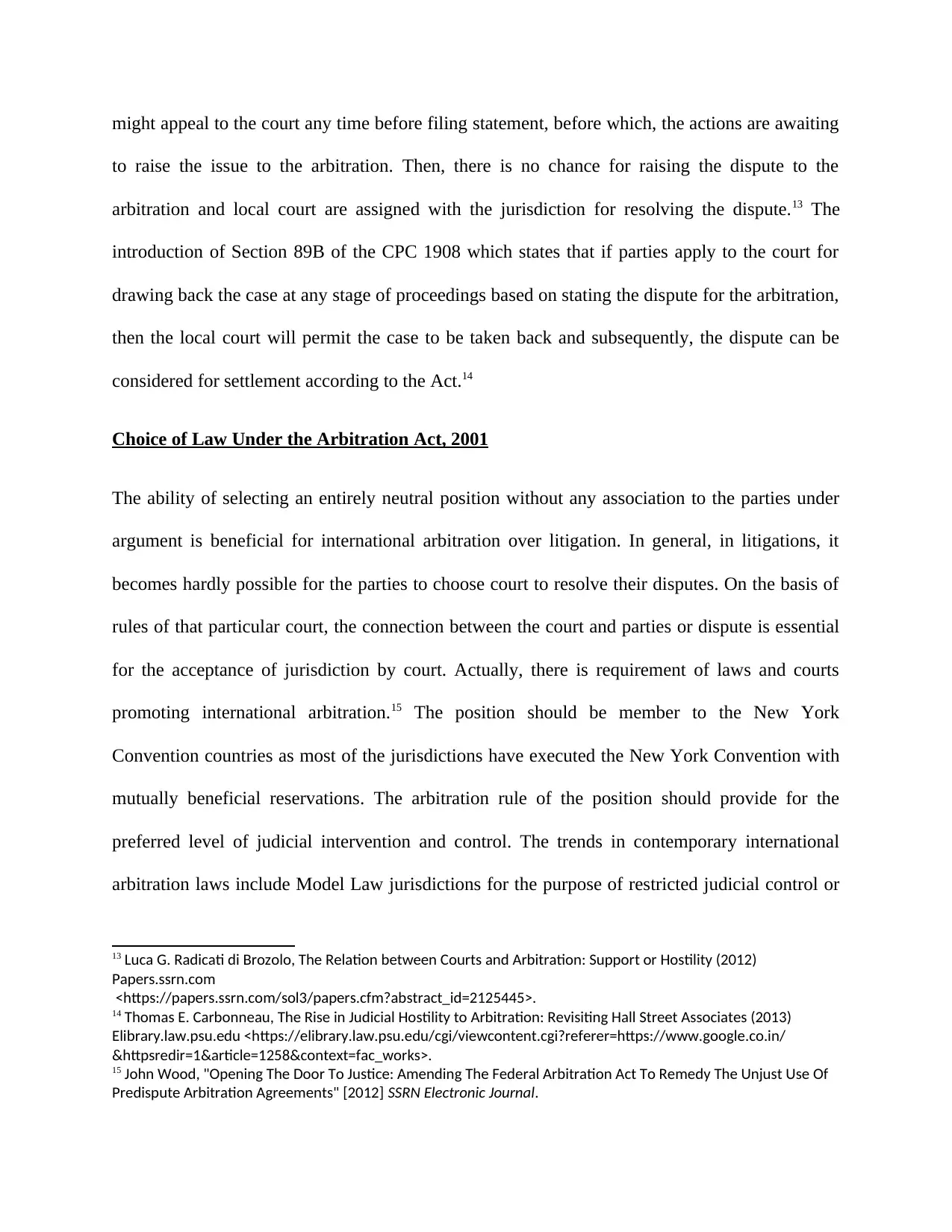
might appeal to the court any time before filing statement, before which, the actions are awaiting
to raise the issue to the arbitration. Then, there is no chance for raising the dispute to the
arbitration and local court are assigned with the jurisdiction for resolving the dispute.13 The
introduction of Section 89B of the CPC 1908 which states that if parties apply to the court for
drawing back the case at any stage of proceedings based on stating the dispute for the arbitration,
then the local court will permit the case to be taken back and subsequently, the dispute can be
considered for settlement according to the Act.14
Choice of Law Under the Arbitration Act, 2001
The ability of selecting an entirely neutral position without any association to the parties under
argument is beneficial for international arbitration over litigation. In general, in litigations, it
becomes hardly possible for the parties to choose court to resolve their disputes. On the basis of
rules of that particular court, the connection between the court and parties or dispute is essential
for the acceptance of jurisdiction by court. Actually, there is requirement of laws and courts
promoting international arbitration.15 The position should be member to the New York
Convention countries as most of the jurisdictions have executed the New York Convention with
mutually beneficial reservations. The arbitration rule of the position should provide for the
preferred level of judicial intervention and control. The trends in contemporary international
arbitration laws include Model Law jurisdictions for the purpose of restricted judicial control or
13 Luca G. Radicati di Brozolo, The Relation between Courts and Arbitration: Support or Hostility (2012)
Papers.ssrn.com
<https://papers.ssrn.com/sol3/papers.cfm?abstract_id=2125445>.
14 Thomas E. Carbonneau, The Rise in Judicial Hostility to Arbitration: Revisiting Hall Street Associates (2013)
Elibrary.law.psu.edu <https://elibrary.law.psu.edu/cgi/viewcontent.cgi?referer=https://www.google.co.in/
&httpsredir=1&article=1258&context=fac_works>.
15 John Wood, "Opening The Door To Justice: Amending The Federal Arbitration Act To Remedy The Unjust Use Of
Predispute Arbitration Agreements" [2012] SSRN Electronic Journal.
to raise the issue to the arbitration. Then, there is no chance for raising the dispute to the
arbitration and local court are assigned with the jurisdiction for resolving the dispute.13 The
introduction of Section 89B of the CPC 1908 which states that if parties apply to the court for
drawing back the case at any stage of proceedings based on stating the dispute for the arbitration,
then the local court will permit the case to be taken back and subsequently, the dispute can be
considered for settlement according to the Act.14
Choice of Law Under the Arbitration Act, 2001
The ability of selecting an entirely neutral position without any association to the parties under
argument is beneficial for international arbitration over litigation. In general, in litigations, it
becomes hardly possible for the parties to choose court to resolve their disputes. On the basis of
rules of that particular court, the connection between the court and parties or dispute is essential
for the acceptance of jurisdiction by court. Actually, there is requirement of laws and courts
promoting international arbitration.15 The position should be member to the New York
Convention countries as most of the jurisdictions have executed the New York Convention with
mutually beneficial reservations. The arbitration rule of the position should provide for the
preferred level of judicial intervention and control. The trends in contemporary international
arbitration laws include Model Law jurisdictions for the purpose of restricted judicial control or
13 Luca G. Radicati di Brozolo, The Relation between Courts and Arbitration: Support or Hostility (2012)
Papers.ssrn.com
<https://papers.ssrn.com/sol3/papers.cfm?abstract_id=2125445>.
14 Thomas E. Carbonneau, The Rise in Judicial Hostility to Arbitration: Revisiting Hall Street Associates (2013)
Elibrary.law.psu.edu <https://elibrary.law.psu.edu/cgi/viewcontent.cgi?referer=https://www.google.co.in/
&httpsredir=1&article=1258&context=fac_works>.
15 John Wood, "Opening The Door To Justice: Amending The Federal Arbitration Act To Remedy The Unjust Use Of
Predispute Arbitration Agreements" [2012] SSRN Electronic Journal.
⊘ This is a preview!⊘
Do you want full access?
Subscribe today to unlock all pages.
Trusted by 1+ million students worldwide
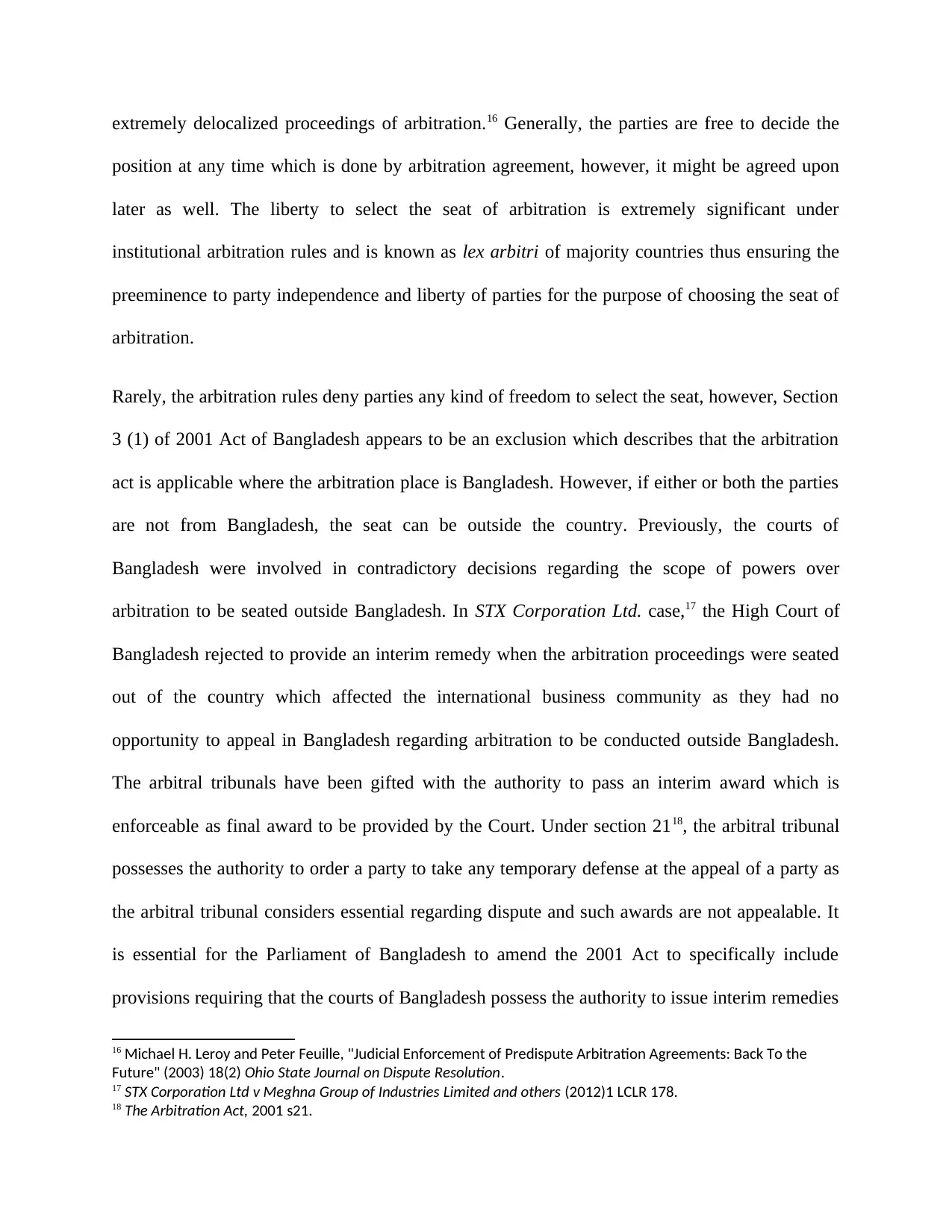
extremely delocalized proceedings of arbitration.16 Generally, the parties are free to decide the
position at any time which is done by arbitration agreement, however, it might be agreed upon
later as well. The liberty to select the seat of arbitration is extremely significant under
institutional arbitration rules and is known as lex arbitri of majority countries thus ensuring the
preeminence to party independence and liberty of parties for the purpose of choosing the seat of
arbitration.
Rarely, the arbitration rules deny parties any kind of freedom to select the seat, however, Section
3 (1) of 2001 Act of Bangladesh appears to be an exclusion which describes that the arbitration
act is applicable where the arbitration place is Bangladesh. However, if either or both the parties
are not from Bangladesh, the seat can be outside the country. Previously, the courts of
Bangladesh were involved in contradictory decisions regarding the scope of powers over
arbitration to be seated outside Bangladesh. In STX Corporation Ltd. case,17 the High Court of
Bangladesh rejected to provide an interim remedy when the arbitration proceedings were seated
out of the country which affected the international business community as they had no
opportunity to appeal in Bangladesh regarding arbitration to be conducted outside Bangladesh.
The arbitral tribunals have been gifted with the authority to pass an interim award which is
enforceable as final award to be provided by the Court. Under section 2118, the arbitral tribunal
possesses the authority to order a party to take any temporary defense at the appeal of a party as
the arbitral tribunal considers essential regarding dispute and such awards are not appealable. It
is essential for the Parliament of Bangladesh to amend the 2001 Act to specifically include
provisions requiring that the courts of Bangladesh possess the authority to issue interim remedies
16 Michael H. Leroy and Peter Feuille, "Judicial Enforcement of Predispute Arbitration Agreements: Back To the
Future" (2003) 18(2) Ohio State Journal on Dispute Resolution.
17 STX Corporation Ltd v Meghna Group of Industries Limited and others (2012)1 LCLR 178.
18 The Arbitration Act, 2001 s21.
position at any time which is done by arbitration agreement, however, it might be agreed upon
later as well. The liberty to select the seat of arbitration is extremely significant under
institutional arbitration rules and is known as lex arbitri of majority countries thus ensuring the
preeminence to party independence and liberty of parties for the purpose of choosing the seat of
arbitration.
Rarely, the arbitration rules deny parties any kind of freedom to select the seat, however, Section
3 (1) of 2001 Act of Bangladesh appears to be an exclusion which describes that the arbitration
act is applicable where the arbitration place is Bangladesh. However, if either or both the parties
are not from Bangladesh, the seat can be outside the country. Previously, the courts of
Bangladesh were involved in contradictory decisions regarding the scope of powers over
arbitration to be seated outside Bangladesh. In STX Corporation Ltd. case,17 the High Court of
Bangladesh rejected to provide an interim remedy when the arbitration proceedings were seated
out of the country which affected the international business community as they had no
opportunity to appeal in Bangladesh regarding arbitration to be conducted outside Bangladesh.
The arbitral tribunals have been gifted with the authority to pass an interim award which is
enforceable as final award to be provided by the Court. Under section 2118, the arbitral tribunal
possesses the authority to order a party to take any temporary defense at the appeal of a party as
the arbitral tribunal considers essential regarding dispute and such awards are not appealable. It
is essential for the Parliament of Bangladesh to amend the 2001 Act to specifically include
provisions requiring that the courts of Bangladesh possess the authority to issue interim remedies
16 Michael H. Leroy and Peter Feuille, "Judicial Enforcement of Predispute Arbitration Agreements: Back To the
Future" (2003) 18(2) Ohio State Journal on Dispute Resolution.
17 STX Corporation Ltd v Meghna Group of Industries Limited and others (2012)1 LCLR 178.
18 The Arbitration Act, 2001 s21.
Paraphrase This Document
Need a fresh take? Get an instant paraphrase of this document with our AI Paraphraser
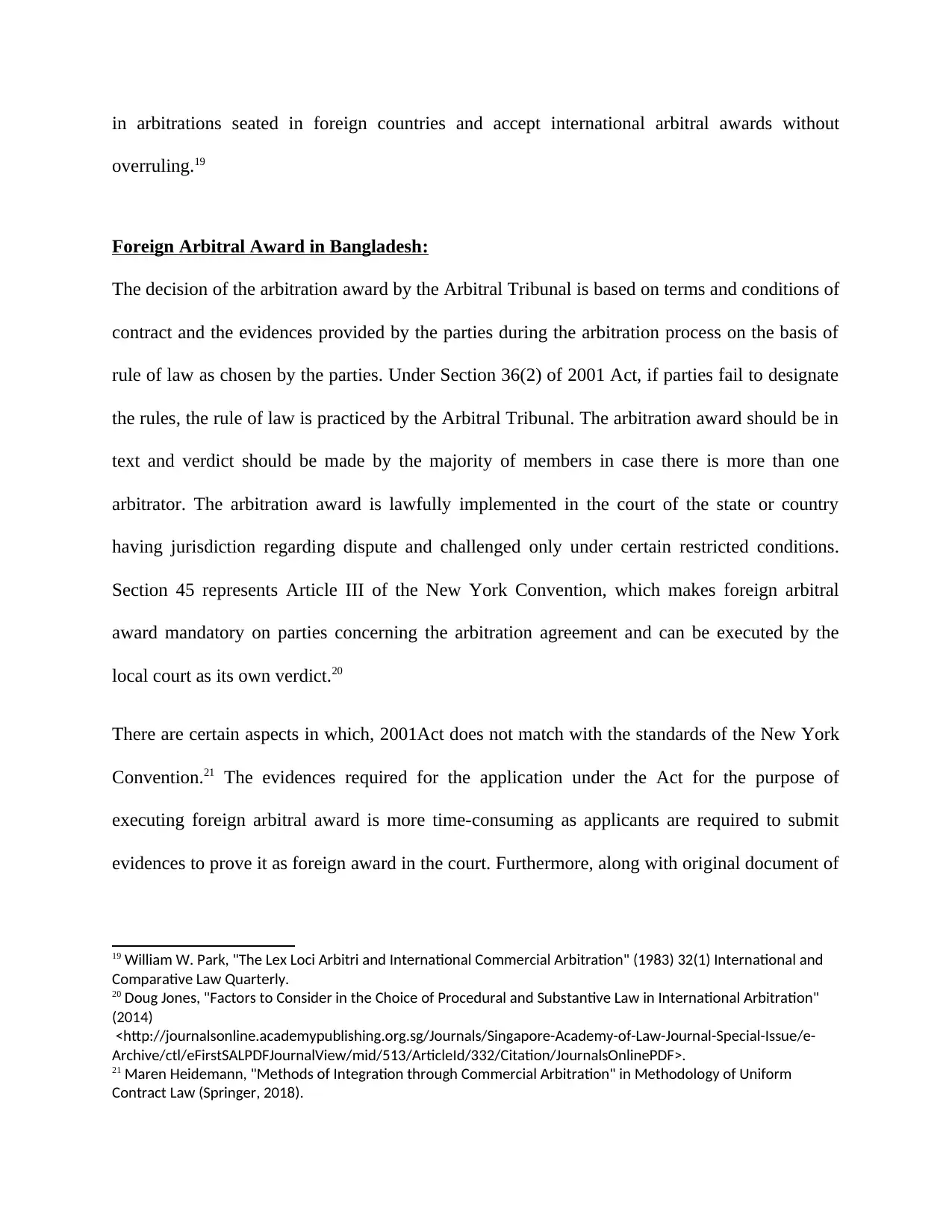
in arbitrations seated in foreign countries and accept international arbitral awards without
overruling.19
Foreign Arbitral Award in Bangladesh:
The decision of the arbitration award by the Arbitral Tribunal is based on terms and conditions of
contract and the evidences provided by the parties during the arbitration process on the basis of
rule of law as chosen by the parties. Under Section 36(2) of 2001 Act, if parties fail to designate
the rules, the rule of law is practiced by the Arbitral Tribunal. The arbitration award should be in
text and verdict should be made by the majority of members in case there is more than one
arbitrator. The arbitration award is lawfully implemented in the court of the state or country
having jurisdiction regarding dispute and challenged only under certain restricted conditions.
Section 45 represents Article III of the New York Convention, which makes foreign arbitral
award mandatory on parties concerning the arbitration agreement and can be executed by the
local court as its own verdict.20
There are certain aspects in which, 2001Act does not match with the standards of the New York
Convention.21 The evidences required for the application under the Act for the purpose of
executing foreign arbitral award is more time-consuming as applicants are required to submit
evidences to prove it as foreign award in the court. Furthermore, along with original document of
19 William W. Park, "The Lex Loci Arbitri and International Commercial Arbitration" (1983) 32(1) International and
Comparative Law Quarterly.
20 Doug Jones, "Factors to Consider in the Choice of Procedural and Substantive Law in International Arbitration"
(2014)
<http://journalsonline.academypublishing.org.sg/Journals/Singapore-Academy-of-Law-Journal-Special-Issue/e-
Archive/ctl/eFirstSALPDFJournalView/mid/513/ArticleId/332/Citation/JournalsOnlinePDF>.
21 Maren Heidemann, "Methods of Integration through Commercial Arbitration" in Methodology of Uniform
Contract Law (Springer, 2018).
overruling.19
Foreign Arbitral Award in Bangladesh:
The decision of the arbitration award by the Arbitral Tribunal is based on terms and conditions of
contract and the evidences provided by the parties during the arbitration process on the basis of
rule of law as chosen by the parties. Under Section 36(2) of 2001 Act, if parties fail to designate
the rules, the rule of law is practiced by the Arbitral Tribunal. The arbitration award should be in
text and verdict should be made by the majority of members in case there is more than one
arbitrator. The arbitration award is lawfully implemented in the court of the state or country
having jurisdiction regarding dispute and challenged only under certain restricted conditions.
Section 45 represents Article III of the New York Convention, which makes foreign arbitral
award mandatory on parties concerning the arbitration agreement and can be executed by the
local court as its own verdict.20
There are certain aspects in which, 2001Act does not match with the standards of the New York
Convention.21 The evidences required for the application under the Act for the purpose of
executing foreign arbitral award is more time-consuming as applicants are required to submit
evidences to prove it as foreign award in the court. Furthermore, along with original document of
19 William W. Park, "The Lex Loci Arbitri and International Commercial Arbitration" (1983) 32(1) International and
Comparative Law Quarterly.
20 Doug Jones, "Factors to Consider in the Choice of Procedural and Substantive Law in International Arbitration"
(2014)
<http://journalsonline.academypublishing.org.sg/Journals/Singapore-Academy-of-Law-Journal-Special-Issue/e-
Archive/ctl/eFirstSALPDFJournalView/mid/513/ArticleId/332/Citation/JournalsOnlinePDF>.
21 Maren Heidemann, "Methods of Integration through Commercial Arbitration" in Methodology of Uniform
Contract Law (Springer, 2018).
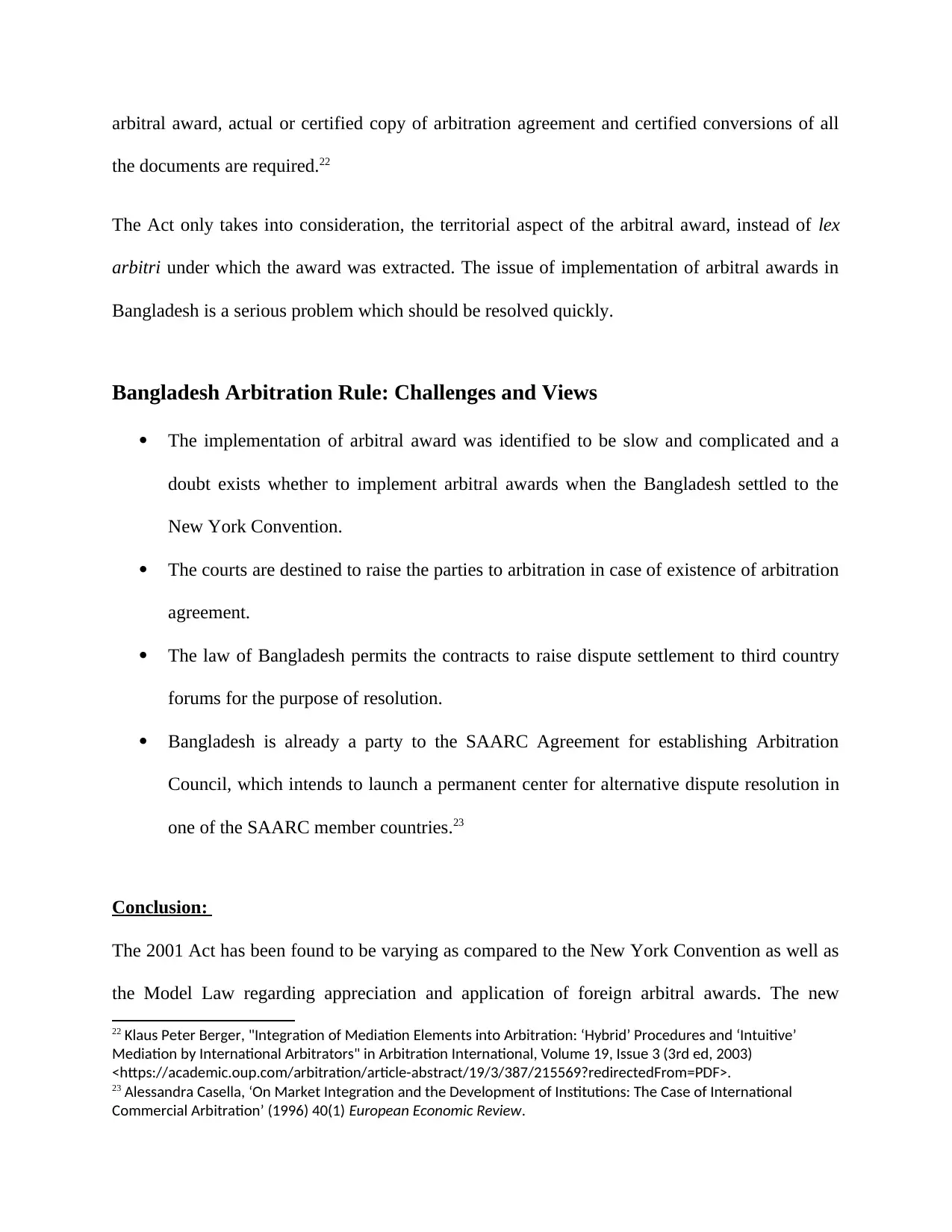
arbitral award, actual or certified copy of arbitration agreement and certified conversions of all
the documents are required.22
The Act only takes into consideration, the territorial aspect of the arbitral award, instead of lex
arbitri under which the award was extracted. The issue of implementation of arbitral awards in
Bangladesh is a serious problem which should be resolved quickly.
Bangladesh Arbitration Rule: Challenges and Views
The implementation of arbitral award was identified to be slow and complicated and a
doubt exists whether to implement arbitral awards when the Bangladesh settled to the
New York Convention.
The courts are destined to raise the parties to arbitration in case of existence of arbitration
agreement.
The law of Bangladesh permits the contracts to raise dispute settlement to third country
forums for the purpose of resolution.
Bangladesh is already a party to the SAARC Agreement for establishing Arbitration
Council, which intends to launch a permanent center for alternative dispute resolution in
one of the SAARC member countries.23
Conclusion:
The 2001 Act has been found to be varying as compared to the New York Convention as well as
the Model Law regarding appreciation and application of foreign arbitral awards. The new
22 Klaus Peter Berger, "Integration of Mediation Elements into Arbitration: ‘Hybrid’ Procedures and ‘Intuitive’
Mediation by International Arbitrators" in Arbitration International, Volume 19, Issue 3 (3rd ed, 2003)
<https://academic.oup.com/arbitration/article-abstract/19/3/387/215569?redirectedFrom=PDF>.
23 Alessandra Casella, ‘On Market Integration and the Development of Institutions: The Case of International
Commercial Arbitration’ (1996) 40(1) European Economic Review.
the documents are required.22
The Act only takes into consideration, the territorial aspect of the arbitral award, instead of lex
arbitri under which the award was extracted. The issue of implementation of arbitral awards in
Bangladesh is a serious problem which should be resolved quickly.
Bangladesh Arbitration Rule: Challenges and Views
The implementation of arbitral award was identified to be slow and complicated and a
doubt exists whether to implement arbitral awards when the Bangladesh settled to the
New York Convention.
The courts are destined to raise the parties to arbitration in case of existence of arbitration
agreement.
The law of Bangladesh permits the contracts to raise dispute settlement to third country
forums for the purpose of resolution.
Bangladesh is already a party to the SAARC Agreement for establishing Arbitration
Council, which intends to launch a permanent center for alternative dispute resolution in
one of the SAARC member countries.23
Conclusion:
The 2001 Act has been found to be varying as compared to the New York Convention as well as
the Model Law regarding appreciation and application of foreign arbitral awards. The new
22 Klaus Peter Berger, "Integration of Mediation Elements into Arbitration: ‘Hybrid’ Procedures and ‘Intuitive’
Mediation by International Arbitrators" in Arbitration International, Volume 19, Issue 3 (3rd ed, 2003)
<https://academic.oup.com/arbitration/article-abstract/19/3/387/215569?redirectedFrom=PDF>.
23 Alessandra Casella, ‘On Market Integration and the Development of Institutions: The Case of International
Commercial Arbitration’ (1996) 40(1) European Economic Review.
⊘ This is a preview!⊘
Do you want full access?
Subscribe today to unlock all pages.
Trusted by 1+ million students worldwide

1 out of 15


Related Documents


Your All-in-One AI-Powered Toolkit for Academic Success.
+13062052269
info@desklib.com
Available 24*7 on WhatsApp / Email
![[object Object]](/_next/static/media/star-bottom.7253800d.svg)
Unlock your academic potential
Copyright © 2020–2026 A2Z Services. All Rights Reserved. Developed and managed by ZUCOL.