HNC Unit 5: Management Accounting Systems and its Applications
VerifiedAdded on 2023/01/11
|19
|4393
|68
Report
AI Summary
This report provides a comprehensive overview of management accounting systems and their practical applications within an organizational context. It begins by defining management accounting, outlining its essential requirements, and differentiating it from financial accounting. The report then delves into various management accounting methods, including cost accounting, inventory management, and job costing systems, evaluating their benefits and integration within organizational processes. Task 2 focuses on applying management accounting techniques to produce financial statements, including budgeted profit and loss statements using both marginal and absorption costing. The report further analyzes planning tools used in budgetary control, discussing their advantages and disadvantages and evaluating their role in preparing and forecasting budgets. Finally, the report examines how organizations adapt management accounting systems to respond to financial problems, analyzing how these systems can lead to sustainable success.
Management Accounting
Systems and its Applications
Systems and its Applications

Paraphrase This Document
Need a fresh take? Get an instant paraphrase of this document with our AI Paraphraser

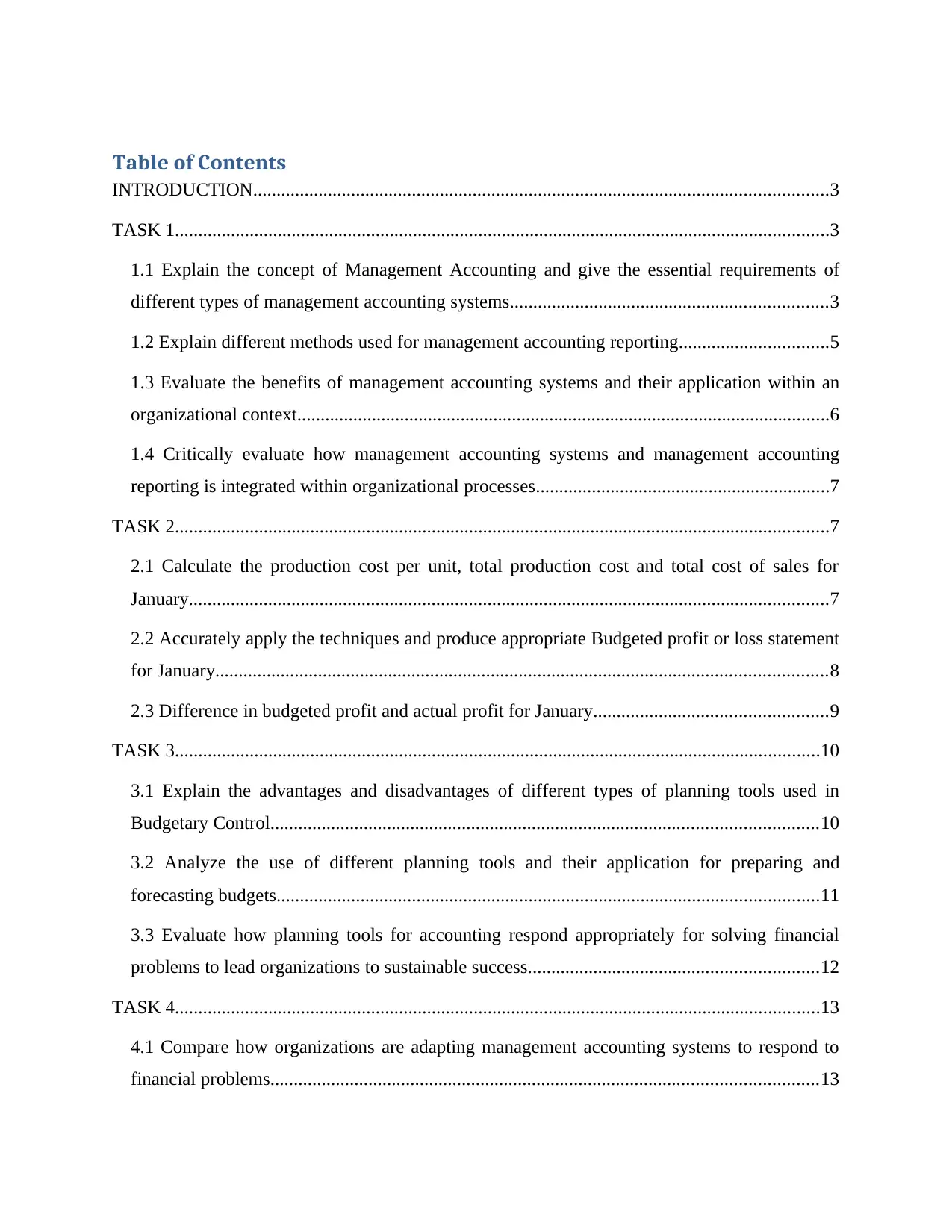
Table of Contents
INTRODUCTION...........................................................................................................................3
TASK 1............................................................................................................................................3
1.1 Explain the concept of Management Accounting and give the essential requirements of
different types of management accounting systems....................................................................3
1.2 Explain different methods used for management accounting reporting................................5
1.3 Evaluate the benefits of management accounting systems and their application within an
organizational context..................................................................................................................6
1.4 Critically evaluate how management accounting systems and management accounting
reporting is integrated within organizational processes...............................................................7
TASK 2............................................................................................................................................7
2.1 Calculate the production cost per unit, total production cost and total cost of sales for
January.........................................................................................................................................7
2.2 Accurately apply the techniques and produce appropriate Budgeted profit or loss statement
for January...................................................................................................................................8
2.3 Difference in budgeted profit and actual profit for January..................................................9
TASK 3..........................................................................................................................................10
3.1 Explain the advantages and disadvantages of different types of planning tools used in
Budgetary Control.....................................................................................................................10
3.2 Analyze the use of different planning tools and their application for preparing and
forecasting budgets....................................................................................................................11
3.3 Evaluate how planning tools for accounting respond appropriately for solving financial
problems to lead organizations to sustainable success..............................................................12
TASK 4..........................................................................................................................................13
4.1 Compare how organizations are adapting management accounting systems to respond to
financial problems.....................................................................................................................13
INTRODUCTION...........................................................................................................................3
TASK 1............................................................................................................................................3
1.1 Explain the concept of Management Accounting and give the essential requirements of
different types of management accounting systems....................................................................3
1.2 Explain different methods used for management accounting reporting................................5
1.3 Evaluate the benefits of management accounting systems and their application within an
organizational context..................................................................................................................6
1.4 Critically evaluate how management accounting systems and management accounting
reporting is integrated within organizational processes...............................................................7
TASK 2............................................................................................................................................7
2.1 Calculate the production cost per unit, total production cost and total cost of sales for
January.........................................................................................................................................7
2.2 Accurately apply the techniques and produce appropriate Budgeted profit or loss statement
for January...................................................................................................................................8
2.3 Difference in budgeted profit and actual profit for January..................................................9
TASK 3..........................................................................................................................................10
3.1 Explain the advantages and disadvantages of different types of planning tools used in
Budgetary Control.....................................................................................................................10
3.2 Analyze the use of different planning tools and their application for preparing and
forecasting budgets....................................................................................................................11
3.3 Evaluate how planning tools for accounting respond appropriately for solving financial
problems to lead organizations to sustainable success..............................................................12
TASK 4..........................................................................................................................................13
4.1 Compare how organizations are adapting management accounting systems to respond to
financial problems.....................................................................................................................13
⊘ This is a preview!⊘
Do you want full access?
Subscribe today to unlock all pages.

Trusted by 1+ million students worldwide
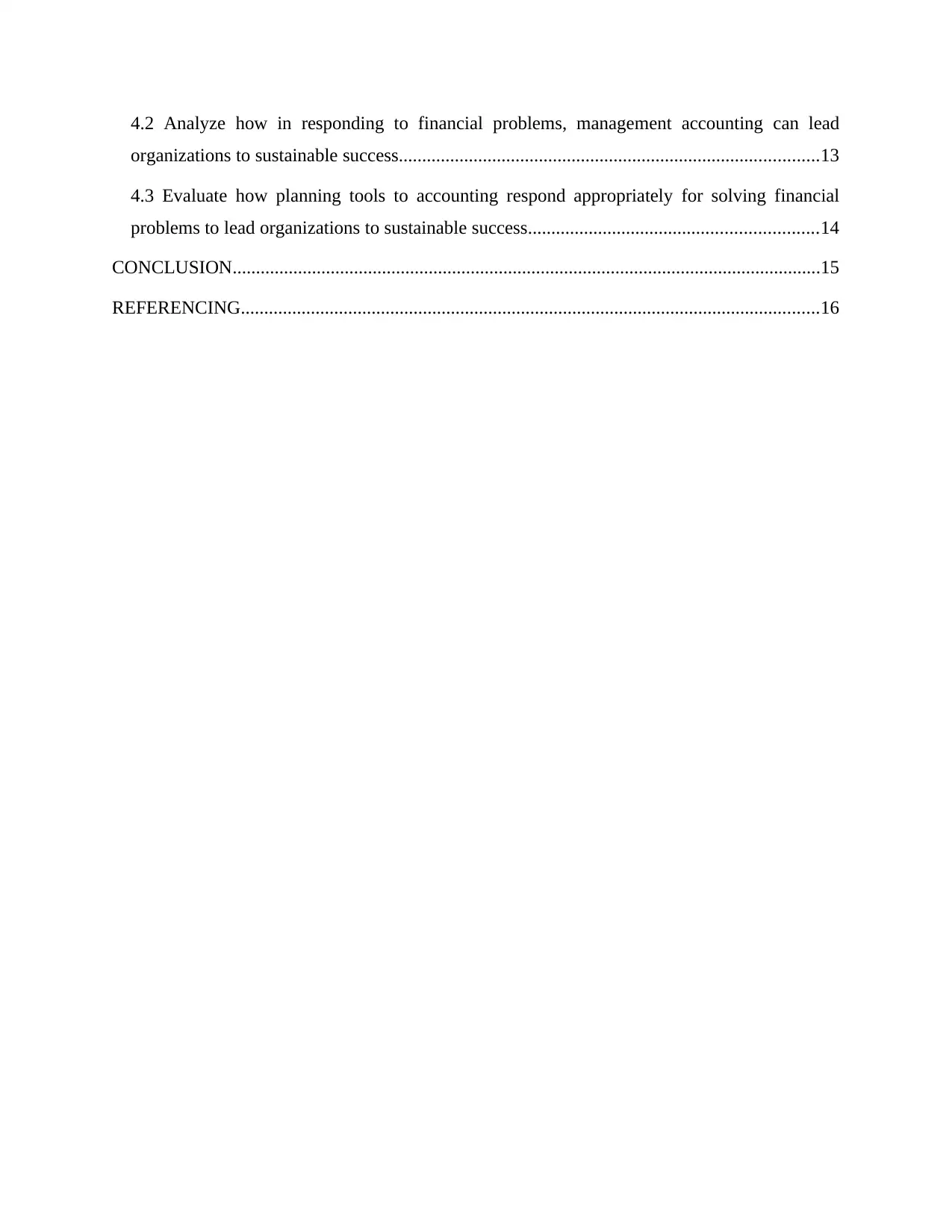
4.2 Analyze how in responding to financial problems, management accounting can lead
organizations to sustainable success..........................................................................................13
4.3 Evaluate how planning tools to accounting respond appropriately for solving financial
problems to lead organizations to sustainable success..............................................................14
CONCLUSION..............................................................................................................................15
REFERENCING............................................................................................................................16
organizations to sustainable success..........................................................................................13
4.3 Evaluate how planning tools to accounting respond appropriately for solving financial
problems to lead organizations to sustainable success..............................................................14
CONCLUSION..............................................................................................................................15
REFERENCING............................................................................................................................16
Paraphrase This Document
Need a fresh take? Get an instant paraphrase of this document with our AI Paraphraser
INTRODUCTION
The main objective of the report is to reveal the administrative accounting requirements
applicable to the business situation, as well as the partnerships operating in that position. The
study of how council accounting implements budget information to help visualize, organize
choices and monitor money within associations. When the unit is successfully completed,
subscribers will be equipped to present budget reports in a work environment and will be able to
assist ranking managers in organizing liquidity. In addition, they will have the skills and
knowledge necessary to move on to the most important stage of learning. The board of directors
accounting helps managers and entrepreneurs to screen the organization's presentation and is set
up through accounting programs as needed. Depending on the type of adventure and the duration
of the information, the director or owner may request reports every day, week by week, month
by month or even quarterly.
TASK 1
1.1 Explain the concept of Management Accounting and give the essential
requirements of different types of management accounting systems
Management accounting refers to the method of measuring data relating to cash, differentiation,
verification, decay and dispatch in achieving the organisation's goals. Cost accounting is also
mentioned. The main difference between cash accounting and transactional accounting is that
council accounting data is programmed to determine leaders in a society, while cash accounting
aims to offer data at meetings outside society. . . The way to prepare management records and
reports is to offer accurate and accurate data of good fortune and related to the money needed by
management to set the daily and short-term options (Appelbaum and Kogan, 2017). There are
reports set up to meet administrative prerequisites.
Accounting is the way to evaluate, recognize and forward financial information to allow
customers to make informed choices and make decisions about information according to the
American Accounting Association (AAA). The administrative accounting frameworks differ in
their application. Each framework is created to adapt management data based on the needs of
The main objective of the report is to reveal the administrative accounting requirements
applicable to the business situation, as well as the partnerships operating in that position. The
study of how council accounting implements budget information to help visualize, organize
choices and monitor money within associations. When the unit is successfully completed,
subscribers will be equipped to present budget reports in a work environment and will be able to
assist ranking managers in organizing liquidity. In addition, they will have the skills and
knowledge necessary to move on to the most important stage of learning. The board of directors
accounting helps managers and entrepreneurs to screen the organization's presentation and is set
up through accounting programs as needed. Depending on the type of adventure and the duration
of the information, the director or owner may request reports every day, week by week, month
by month or even quarterly.
TASK 1
1.1 Explain the concept of Management Accounting and give the essential
requirements of different types of management accounting systems
Management accounting refers to the method of measuring data relating to cash, differentiation,
verification, decay and dispatch in achieving the organisation's goals. Cost accounting is also
mentioned. The main difference between cash accounting and transactional accounting is that
council accounting data is programmed to determine leaders in a society, while cash accounting
aims to offer data at meetings outside society. . . The way to prepare management records and
reports is to offer accurate and accurate data of good fortune and related to the money needed by
management to set the daily and short-term options (Appelbaum and Kogan, 2017). There are
reports set up to meet administrative prerequisites.
Accounting is the way to evaluate, recognize and forward financial information to allow
customers to make informed choices and make decisions about information according to the
American Accounting Association (AAA). The administrative accounting frameworks differ in
their application. Each framework is created to adapt management data based on the needs of
managers, to aid decision making (Blocher, 2016). There are several types of dashboard
frameworks that include inventory management, cost accounting framework, value development
and cost overruns framework all with different objectives, components and accounting
capabilities. However, all the essential components of the accounting frameworks make the
approach normalized to focus on the information that is analyzed, recognized and transferred
(Edmonds and Olds, 2013).
Cost accounting system
A cost containment framework or cost framework is the system that the company has put in
place to calculate the costs of its items for inventory evaluation, productivity analysis and cost
control. In the cost accounting framework, the specification of costs is obtained based on a
function-based cost framework or a standard cost framework. Estimating the cost of items is
critical to the success of skills (Blocher, 2016).
Inventory management
Inventory management refers to the way to control the demand, usage and capacity of the
components that the company puts into creating the products they sell. The inventory
management framework combines the use of custom identification scanners, workspace
programming, cell phones and scanner label printers to facilitate inventory management, such as
supply, products, inventory and supply (Drury, 2015). Similarly, it is the responsibility of
examining and managing the quantities of the total products available for purchase. The
objective of inventory management is to properly understand current stock levels and eliminate
excess weight and default conditions. Through effectively tracking the amounts in the storage
area, administrators will have the experience and be able to adjust for appropriate warehouse
options. Company stock is one of the company's major resources and registrations related to the
sale of articles.
Job costing system
The operating cost system refers to the agreement to assign production costs to the individual
article or piece of articles. It is applied if the processed products are not equal to each other. It
involves gathering information about costs identified by special assistance or creation work. The
frameworks that include inventory management, cost accounting framework, value development
and cost overruns framework all with different objectives, components and accounting
capabilities. However, all the essential components of the accounting frameworks make the
approach normalized to focus on the information that is analyzed, recognized and transferred
(Edmonds and Olds, 2013).
Cost accounting system
A cost containment framework or cost framework is the system that the company has put in
place to calculate the costs of its items for inventory evaluation, productivity analysis and cost
control. In the cost accounting framework, the specification of costs is obtained based on a
function-based cost framework or a standard cost framework. Estimating the cost of items is
critical to the success of skills (Blocher, 2016).
Inventory management
Inventory management refers to the way to control the demand, usage and capacity of the
components that the company puts into creating the products they sell. The inventory
management framework combines the use of custom identification scanners, workspace
programming, cell phones and scanner label printers to facilitate inventory management, such as
supply, products, inventory and supply (Drury, 2015). Similarly, it is the responsibility of
examining and managing the quantities of the total products available for purchase. The
objective of inventory management is to properly understand current stock levels and eliminate
excess weight and default conditions. Through effectively tracking the amounts in the storage
area, administrators will have the experience and be able to adjust for appropriate warehouse
options. Company stock is one of the company's major resources and registrations related to the
sale of articles.
Job costing system
The operating cost system refers to the agreement to assign production costs to the individual
article or piece of articles. It is applied if the processed products are not equal to each other. It
involves gathering information about costs identified by special assistance or creation work. The
⊘ This is a preview!⊘
Do you want full access?
Subscribe today to unlock all pages.
Trusted by 1+ million students worldwide
data may present cost information to a customer based on the agreement in which the costs are
discounted. Similarly, data is important for determining exactly what the organization's
evaluation logic needs to be equipped to provide cost estimates that allow for significant
payments (Drury, 2015). The data can also be used to adapt tactical costs to prepared articles.
The transaction cost framework must gather the three types of direct data operations, direct
products and above them.
Price optimization systems
Price optimization systems refer to the use of scientific analysis for the organization to determine
how customers manage different costs for their products and campaigns through different
channels (Edmonds and Olds, 2013). Likewise, it is applied to determine the costs that an
organization decides to achieve its goals as a contribution to job performance. Find the choice by
maximizing accessibility or financial savings based on the requirements presented by raising the
desired options and limiting the unwanted ones (Edmonds and Olds, 2013)
1.2 Explain different methods used for management accounting reporting
Management accounting focuses on internal data obtained through cash accounting. Functional
accounting is applied to control, organization, and dynamics. Management accountants are based
on reports on the balance sheet that include cash documents, the payment structure and the
definition of income (Edmonds and Olds, 2013). In any event, they also apply various types of
accounting reports in the organization's data assessment. These can include financial plan cost,
item and execution reports
Cost reports
The board's accounting measures the cost of manufactured items. It is done by taking care of all
the raw materials, costs, labor as well as any extra expenditure in thinking. The integers are then
divided into phases of manufactured goods (Edmonds and Olds, 2013). All the information is
summarized in the expenses report. The report enables managers to view the cost of items
relative to the cost of sales. Helps control clothing and designs net income.
Budgets
discounted. Similarly, data is important for determining exactly what the organization's
evaluation logic needs to be equipped to provide cost estimates that allow for significant
payments (Drury, 2015). The data can also be used to adapt tactical costs to prepared articles.
The transaction cost framework must gather the three types of direct data operations, direct
products and above them.
Price optimization systems
Price optimization systems refer to the use of scientific analysis for the organization to determine
how customers manage different costs for their products and campaigns through different
channels (Edmonds and Olds, 2013). Likewise, it is applied to determine the costs that an
organization decides to achieve its goals as a contribution to job performance. Find the choice by
maximizing accessibility or financial savings based on the requirements presented by raising the
desired options and limiting the unwanted ones (Edmonds and Olds, 2013)
1.2 Explain different methods used for management accounting reporting
Management accounting focuses on internal data obtained through cash accounting. Functional
accounting is applied to control, organization, and dynamics. Management accountants are based
on reports on the balance sheet that include cash documents, the payment structure and the
definition of income (Edmonds and Olds, 2013). In any event, they also apply various types of
accounting reports in the organization's data assessment. These can include financial plan cost,
item and execution reports
Cost reports
The board's accounting measures the cost of manufactured items. It is done by taking care of all
the raw materials, costs, labor as well as any extra expenditure in thinking. The integers are then
divided into phases of manufactured goods (Edmonds and Olds, 2013). All the information is
summarized in the expenses report. The report enables managers to view the cost of items
relative to the cost of sales. Helps control clothing and designs net income.
Budgets
Paraphrase This Document
Need a fresh take? Get an instant paraphrase of this document with our AI Paraphraser
Drawing up spending plans is one of the key components of the board's accounts. Financial plans
are designed by implementing the previous years' spending plans and converting them into future
assumptions. Group financial plans list all expenses and sources of revenue. Companies strive to
achieve their goals and objectives while remaining within their intended amounts (Edmonds and
Olds, 2013). The directors believe that new sellers are used as suppliers of raw materials to set
aside money. Likewise, they are looking for ways to expand their sacrifices while reducing costs.
Performance reports
The executive accountants execute financial plans to compare actual income and expenditure to
expected amounts. The calculated differences are estimated when designing new financial plans
as well as all the data relating to the amounts recorded in the presentation report (Horngreen and
et.al., 2013). These ratios are calculated annually, with the exception of some partnerships that
are built quarterly or month-to-month. The reports help administrators monitor future ongoing
requests and increase costs.
1.3 Evaluate the benefits of management accounting systems and their
application within an organizational context
Benefits of management accounting system:
Increase efficiency: it supports the productivity of the company's activities through a logical
evaluation of performance and coordination with the criterion established by the organization.
Executives make exceptional choices, pay and promote failure to meet agents' expectations of
developing next through the administration's accounting frameworks.
Increasing Net Income: Through budgetary control and a capital utilization model, the company
can restrict labor and capital use together. This also helps the organization to reap huge benefits
by reducing the cost of the item and the cost of the activities.
Make the basic budget summaries: the financial announcement can be complicated to read for
people who still have no place in this area, but through the administration's accounting
frameworks it becomes a direct benefit, an unfortunate interpretation and cash register just by
looking at their final report. It makes it easy for senior management to make decisions in practice
by reading the facts introduced by cash accountants based on budget summaries.
are designed by implementing the previous years' spending plans and converting them into future
assumptions. Group financial plans list all expenses and sources of revenue. Companies strive to
achieve their goals and objectives while remaining within their intended amounts (Edmonds and
Olds, 2013). The directors believe that new sellers are used as suppliers of raw materials to set
aside money. Likewise, they are looking for ways to expand their sacrifices while reducing costs.
Performance reports
The executive accountants execute financial plans to compare actual income and expenditure to
expected amounts. The calculated differences are estimated when designing new financial plans
as well as all the data relating to the amounts recorded in the presentation report (Horngreen and
et.al., 2013). These ratios are calculated annually, with the exception of some partnerships that
are built quarterly or month-to-month. The reports help administrators monitor future ongoing
requests and increase costs.
1.3 Evaluate the benefits of management accounting systems and their
application within an organizational context
Benefits of management accounting system:
Increase efficiency: it supports the productivity of the company's activities through a logical
evaluation of performance and coordination with the criterion established by the organization.
Executives make exceptional choices, pay and promote failure to meet agents' expectations of
developing next through the administration's accounting frameworks.
Increasing Net Income: Through budgetary control and a capital utilization model, the company
can restrict labor and capital use together. This also helps the organization to reap huge benefits
by reducing the cost of the item and the cost of the activities.
Make the basic budget summaries: the financial announcement can be complicated to read for
people who still have no place in this area, but through the administration's accounting
frameworks it becomes a direct benefit, an unfortunate interpretation and cash register just by
looking at their final report. It makes it easy for senior management to make decisions in practice
by reading the facts introduced by cash accountants based on budget summaries.
Company regulatory revenues: the accounting administrator examines sources of liquidity and
its application within the society. They consider restricting unnecessary use of income.
1.4 Critically evaluate how management accounting systems and management
accounting reporting is integrated within organizational processes
Financial accounting records can be used as the primary database for management accounting
techniques (eg item cost or design), naming and approximation. We characterize such a plan,
which is commonly seen in Anglo-American societies, as "coordinated". Two important
favorable situations can be found with the structure of a coordinated accounting framework. First
of all, the officers' accounting data is provided at an incremental cost. Second, internal control
measures and money are actually taken on every level of importance, giving the board a "one-
sided contribution" just like financial experts. This point is particularly important in corporations
that require clear links between the objectives of financial experts and the accounting data of
managers. In addition, the information on cash retention may not be reasonable in all cases for
the purposes of the control of the board of directors, since the hidden accounting guidelines are
not intended for dynamic internal purposes or otherwise might be interested in the main example.
TASK 2
2.1 Calculate the production cost per unit, total production cost and total cost
of sales for January
1. Production cost per unit =
Production cost per unit = £(10+20+5)
= £35
2. Total production cost = £720,000
3. Total cost of sales for January =
Total cost of sales for January = £560,000
its application within the society. They consider restricting unnecessary use of income.
1.4 Critically evaluate how management accounting systems and management
accounting reporting is integrated within organizational processes
Financial accounting records can be used as the primary database for management accounting
techniques (eg item cost or design), naming and approximation. We characterize such a plan,
which is commonly seen in Anglo-American societies, as "coordinated". Two important
favorable situations can be found with the structure of a coordinated accounting framework. First
of all, the officers' accounting data is provided at an incremental cost. Second, internal control
measures and money are actually taken on every level of importance, giving the board a "one-
sided contribution" just like financial experts. This point is particularly important in corporations
that require clear links between the objectives of financial experts and the accounting data of
managers. In addition, the information on cash retention may not be reasonable in all cases for
the purposes of the control of the board of directors, since the hidden accounting guidelines are
not intended for dynamic internal purposes or otherwise might be interested in the main example.
TASK 2
2.1 Calculate the production cost per unit, total production cost and total cost
of sales for January
1. Production cost per unit =
Production cost per unit = £(10+20+5)
= £35
2. Total production cost = £720,000
3. Total cost of sales for January =
Total cost of sales for January = £560,000
⊘ This is a preview!⊘
Do you want full access?
Subscribe today to unlock all pages.
Trusted by 1+ million students worldwide
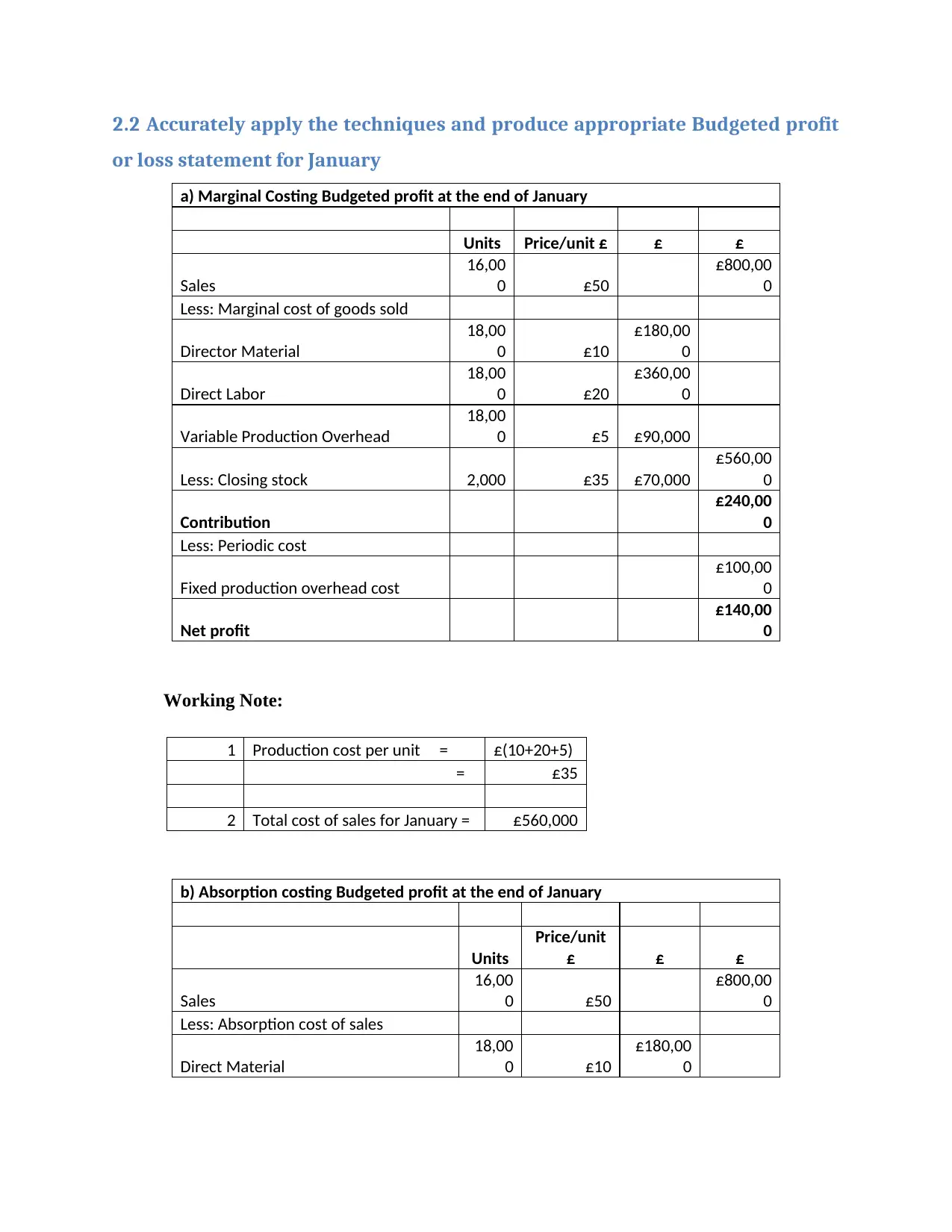
2.2 Accurately apply the techniques and produce appropriate Budgeted profit
or loss statement for January
a) Marginal Costing Budgeted profit at the end of January
Units Price/unit £ £ £
Sales
16,00
0 £50
£800,00
0
Less: Marginal cost of goods sold
Director Material
18,00
0 £10
£180,00
0
Direct Labor
18,00
0 £20
£360,00
0
Variable Production Overhead
18,00
0 £5 £90,000
Less: Closing stock 2,000 £35 £70,000
£560,00
0
Contribution
£240,00
0
Less: Periodic cost
Fixed production overhead cost
£100,00
0
Net profit
£140,00
0
Working Note:
1 Production cost per unit = £(10+20+5)
= £35
2 Total cost of sales for January = £560,000
b) Absorption costing Budgeted profit at the end of January
Units
Price/unit
£ £ £
Sales
16,00
0 £50
£800,00
0
Less: Absorption cost of sales
Direct Material
18,00
0 £10
£180,00
0
or loss statement for January
a) Marginal Costing Budgeted profit at the end of January
Units Price/unit £ £ £
Sales
16,00
0 £50
£800,00
0
Less: Marginal cost of goods sold
Director Material
18,00
0 £10
£180,00
0
Direct Labor
18,00
0 £20
£360,00
0
Variable Production Overhead
18,00
0 £5 £90,000
Less: Closing stock 2,000 £35 £70,000
£560,00
0
Contribution
£240,00
0
Less: Periodic cost
Fixed production overhead cost
£100,00
0
Net profit
£140,00
0
Working Note:
1 Production cost per unit = £(10+20+5)
= £35
2 Total cost of sales for January = £560,000
b) Absorption costing Budgeted profit at the end of January
Units
Price/unit
£ £ £
Sales
16,00
0 £50
£800,00
0
Less: Absorption cost of sales
Direct Material
18,00
0 £10
£180,00
0
Paraphrase This Document
Need a fresh take? Get an instant paraphrase of this document with our AI Paraphraser
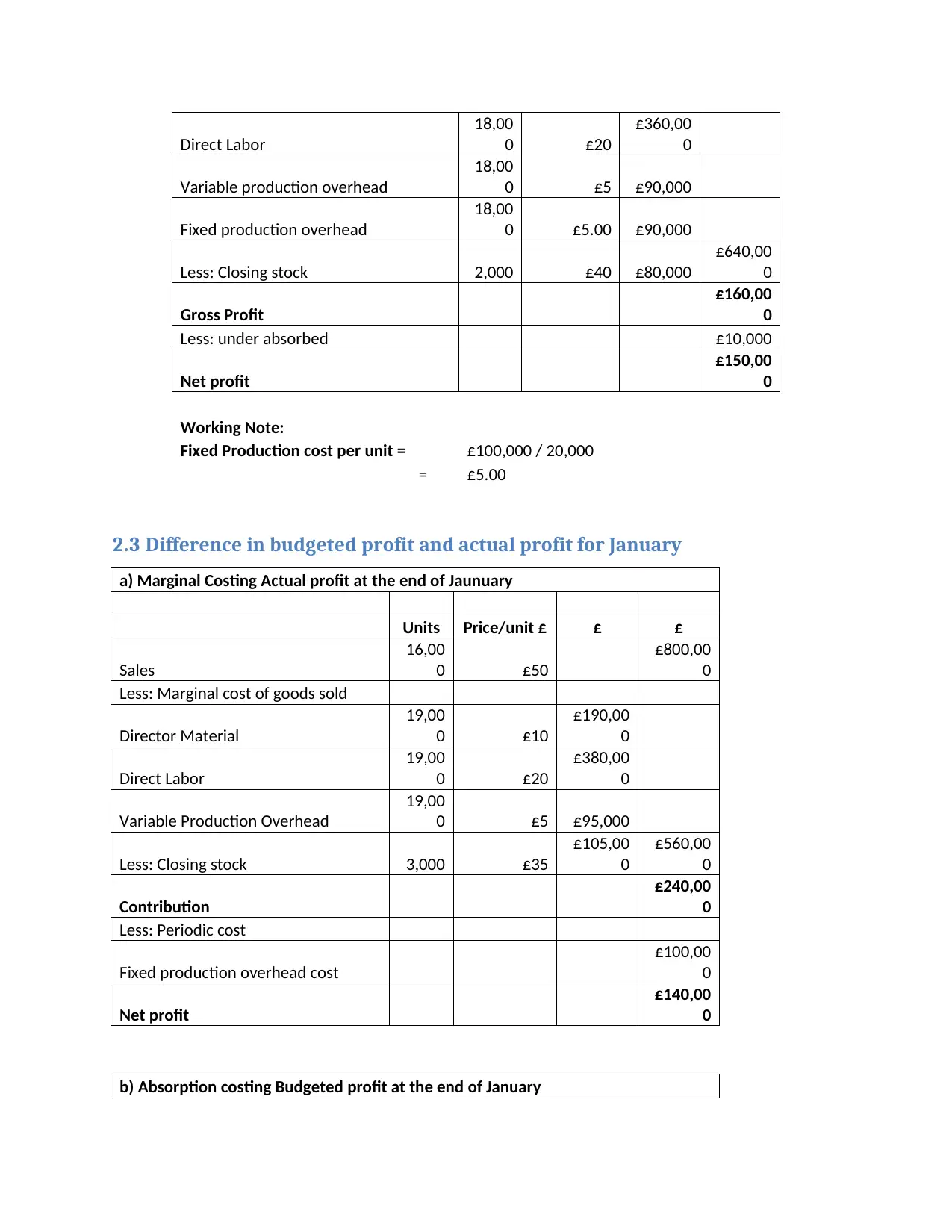
Direct Labor
18,00
0 £20
£360,00
0
Variable production overhead
18,00
0 £5 £90,000
Fixed production overhead
18,00
0 £5.00 £90,000
Less: Closing stock 2,000 £40 £80,000
£640,00
0
Gross Profit
£160,00
0
Less: under absorbed £10,000
Net profit
£150,00
0
Working Note:
Fixed Production cost per unit = £100,000 / 20,000
= £5.00
2.3 Difference in budgeted profit and actual profit for January
a) Marginal Costing Actual profit at the end of Jaunuary
Units Price/unit £ £ £
Sales
16,00
0 £50
£800,00
0
Less: Marginal cost of goods sold
Director Material
19,00
0 £10
£190,00
0
Direct Labor
19,00
0 £20
£380,00
0
Variable Production Overhead
19,00
0 £5 £95,000
Less: Closing stock 3,000 £35
£105,00
0
£560,00
0
Contribution
£240,00
0
Less: Periodic cost
Fixed production overhead cost
£100,00
0
Net profit
£140,00
0
b) Absorption costing Budgeted profit at the end of January
18,00
0 £20
£360,00
0
Variable production overhead
18,00
0 £5 £90,000
Fixed production overhead
18,00
0 £5.00 £90,000
Less: Closing stock 2,000 £40 £80,000
£640,00
0
Gross Profit
£160,00
0
Less: under absorbed £10,000
Net profit
£150,00
0
Working Note:
Fixed Production cost per unit = £100,000 / 20,000
= £5.00
2.3 Difference in budgeted profit and actual profit for January
a) Marginal Costing Actual profit at the end of Jaunuary
Units Price/unit £ £ £
Sales
16,00
0 £50
£800,00
0
Less: Marginal cost of goods sold
Director Material
19,00
0 £10
£190,00
0
Direct Labor
19,00
0 £20
£380,00
0
Variable Production Overhead
19,00
0 £5 £95,000
Less: Closing stock 3,000 £35
£105,00
0
£560,00
0
Contribution
£240,00
0
Less: Periodic cost
Fixed production overhead cost
£100,00
0
Net profit
£140,00
0
b) Absorption costing Budgeted profit at the end of January
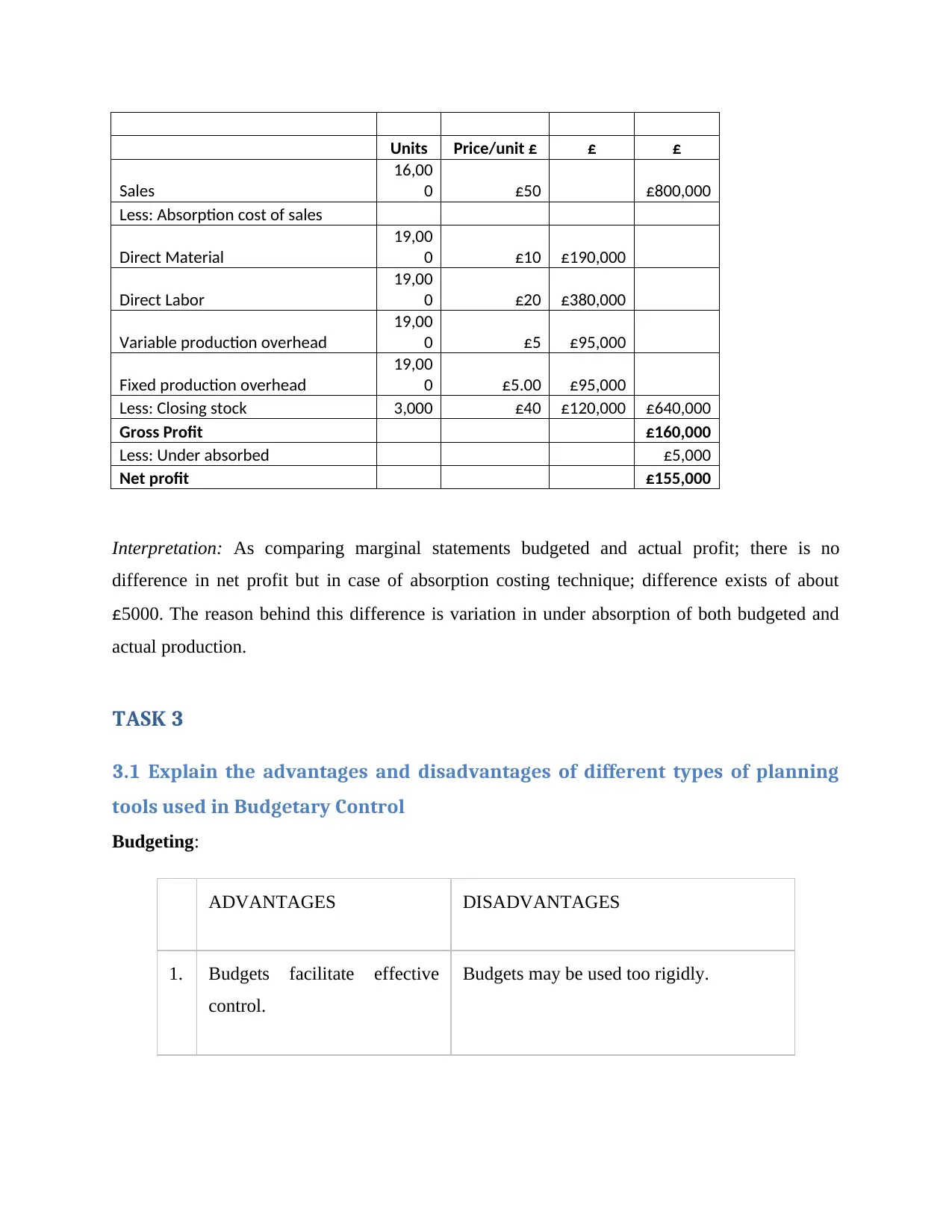
Units Price/unit £ £ £
Sales
16,00
0 £50 £800,000
Less: Absorption cost of sales
Direct Material
19,00
0 £10 £190,000
Direct Labor
19,00
0 £20 £380,000
Variable production overhead
19,00
0 £5 £95,000
Fixed production overhead
19,00
0 £5.00 £95,000
Less: Closing stock 3,000 £40 £120,000 £640,000
Gross Profit £160,000
Less: Under absorbed £5,000
Net profit £155,000
Interpretation: As comparing marginal statements budgeted and actual profit; there is no
difference in net profit but in case of absorption costing technique; difference exists of about
£5000. The reason behind this difference is variation in under absorption of both budgeted and
actual production.
TASK 3
3.1 Explain the advantages and disadvantages of different types of planning
tools used in Budgetary Control
Budgeting:
ADVANTAGES DISADVANTAGES
1. Budgets facilitate effective
control.
Budgets may be used too rigidly.
Sales
16,00
0 £50 £800,000
Less: Absorption cost of sales
Direct Material
19,00
0 £10 £190,000
Direct Labor
19,00
0 £20 £380,000
Variable production overhead
19,00
0 £5 £95,000
Fixed production overhead
19,00
0 £5.00 £95,000
Less: Closing stock 3,000 £40 £120,000 £640,000
Gross Profit £160,000
Less: Under absorbed £5,000
Net profit £155,000
Interpretation: As comparing marginal statements budgeted and actual profit; there is no
difference in net profit but in case of absorption costing technique; difference exists of about
£5000. The reason behind this difference is variation in under absorption of both budgeted and
actual production.
TASK 3
3.1 Explain the advantages and disadvantages of different types of planning
tools used in Budgetary Control
Budgeting:
ADVANTAGES DISADVANTAGES
1. Budgets facilitate effective
control.
Budgets may be used too rigidly.
⊘ This is a preview!⊘
Do you want full access?
Subscribe today to unlock all pages.
Trusted by 1+ million students worldwide

1 out of 19


Related Documents


Your All-in-One AI-Powered Toolkit for Academic Success.
+13062052269
info@desklib.com
Available 24*7 on WhatsApp / Email
![[object Object]](/_next/static/media/star-bottom.7253800d.svg)
Unlock your academic potential
Copyright © 2020–2026 A2Z Services. All Rights Reserved. Developed and managed by ZUCOL.