Strategic HRM: Guest's Model, Flexibility & Welfare at Marks & Spencer
VerifiedAdded on 2019/12/04
|19
|5859
|357
Report
AI Summary
This report analyzes the human resource management (HRM) practices at Marks & Spencer (M&S), focusing on the application of Guest's model and the implementation of flexibility within the workplace. It explores how M&S can align its HRM practices with organizational goals, emphasizing the importance of employee skills and knowledge development. The report discusses the six dimensions of Guest's model (HRM Strategy, HRM Practices, HRM Outcomes, Behaviour outcomes, Performance outcomes, Financial Outcomes) and the hard and soft HRM approaches. It also examines Storey's definition of HRM and differentiates between HRM and IR practices. Furthermore, the report investigates various types of flexibility, including numerical, functional, and temporal flexibility, and analyzes the benefits of flexible work arrangements for both employers and employees. Finally, it assesses approaches to managing employee welfare in organizations, providing a comprehensive overview of HRM practices at M&S.
MANAGING
HUMAN
RESOURCES
HUMAN
RESOURCES

Paraphrase This Document
Need a fresh take? Get an instant paraphrase of this document with our AI Paraphraser
TABLE OF CONTENTS
INTRODUCTION...........................................................................................................................3
TASK 1............................................................................................................................................3
AC 1.1..........................................................................................................................................3
AC 1.2..........................................................................................................................................5
AC 1.3..........................................................................................................................................6
TASK 2............................................................................................................................................7
AC 2.1..........................................................................................................................................7
AC 2.2..........................................................................................................................................8
AC 2.3..........................................................................................................................................9
AC 2.4........................................................................................................................................10
TASK 3..........................................................................................................................................11
AC 3.1........................................................................................................................................11
AC 3.2........................................................................................................................................12
AC 3.3........................................................................................................................................13
TASK 4..........................................................................................................................................13
AC 4.1........................................................................................................................................13
AC 4.2 .......................................................................................................................................14
AC 4.3........................................................................................................................................15
AC 4.4........................................................................................................................................16
CONCLUSION..............................................................................................................................16
REFERENCES..............................................................................................................................17
2
INTRODUCTION...........................................................................................................................3
TASK 1............................................................................................................................................3
AC 1.1..........................................................................................................................................3
AC 1.2..........................................................................................................................................5
AC 1.3..........................................................................................................................................6
TASK 2............................................................................................................................................7
AC 2.1..........................................................................................................................................7
AC 2.2..........................................................................................................................................8
AC 2.3..........................................................................................................................................9
AC 2.4........................................................................................................................................10
TASK 3..........................................................................................................................................11
AC 3.1........................................................................................................................................11
AC 3.2........................................................................................................................................12
AC 3.3........................................................................................................................................13
TASK 4..........................................................................................................................................13
AC 4.1........................................................................................................................................13
AC 4.2 .......................................................................................................................................14
AC 4.3........................................................................................................................................15
AC 4.4........................................................................................................................................16
CONCLUSION..............................................................................................................................16
REFERENCES..............................................................................................................................17
2
INTRODUCTION
In modern business, human resources play various roles and responsibilities towards the
growth and development of organization (Aladwan, Bhanugopan and Fish, 2014). Managing
human is the art with systematic methodology. Any business cannot put their efforts without
skilful and knowledgeable human resources. Present report is based on Mark and Spencer which
is international, multi-channel retailer. They provide high quality and great value products
through physical store as well as e-commerce. They build strong value of innovation, inspiration
and integrity in their products (Mark & Spencer, 2016). This report covers Guest's model of
HRM which can be used by cited firm. Furthermore, it explains flexibility of application of this
model in practices. Moreover, it covers impact that make changes in labour market for flexible
working practices. In addition to this, it includes various types of flexibility which may be
developed in organization. Beside this, this report assess the approaches to practice of managing
employee welfare in organizations.
TASK 1
AC 1.1
M&S is requisite to align its HRM practices with organisational purpose goals, so that
firm can accomplish its goals. Thus, it is very necessary for HR manager to develop skills and
knowledge of employee, so that they can effectively implement strategies to balance the same.
There have been various models and theories proposed by researchers which can be adopt by
corporate bodies in an effective manner (Jiang and et.al., 2012). David Guest had developed
model which comprises of several HR practices along with definite strategies, which will
ultimately results into the improved performance if employees of M&S. Guest model
encompasses of HR activities, such as training and development course, reward system,
commitment, appraisal and flexibility. The employee of Marks and Spencer's need to involve and
enhance their efforts with the implications of Guest model in the management system. There are
six dimensions of the Guest Model, which are as follows:
HRM Strategy In order to attain desired goals, M&S is requisite to make effective
strategies, such as differentiation of products and services, cost
reduction and focusing on enhancing quality. With the implications
3
In modern business, human resources play various roles and responsibilities towards the
growth and development of organization (Aladwan, Bhanugopan and Fish, 2014). Managing
human is the art with systematic methodology. Any business cannot put their efforts without
skilful and knowledgeable human resources. Present report is based on Mark and Spencer which
is international, multi-channel retailer. They provide high quality and great value products
through physical store as well as e-commerce. They build strong value of innovation, inspiration
and integrity in their products (Mark & Spencer, 2016). This report covers Guest's model of
HRM which can be used by cited firm. Furthermore, it explains flexibility of application of this
model in practices. Moreover, it covers impact that make changes in labour market for flexible
working practices. In addition to this, it includes various types of flexibility which may be
developed in organization. Beside this, this report assess the approaches to practice of managing
employee welfare in organizations.
TASK 1
AC 1.1
M&S is requisite to align its HRM practices with organisational purpose goals, so that
firm can accomplish its goals. Thus, it is very necessary for HR manager to develop skills and
knowledge of employee, so that they can effectively implement strategies to balance the same.
There have been various models and theories proposed by researchers which can be adopt by
corporate bodies in an effective manner (Jiang and et.al., 2012). David Guest had developed
model which comprises of several HR practices along with definite strategies, which will
ultimately results into the improved performance if employees of M&S. Guest model
encompasses of HR activities, such as training and development course, reward system,
commitment, appraisal and flexibility. The employee of Marks and Spencer's need to involve and
enhance their efforts with the implications of Guest model in the management system. There are
six dimensions of the Guest Model, which are as follows:
HRM Strategy In order to attain desired goals, M&S is requisite to make effective
strategies, such as differentiation of products and services, cost
reduction and focusing on enhancing quality. With the implications
3
⊘ This is a preview!⊘
Do you want full access?
Subscribe today to unlock all pages.

Trusted by 1+ million students worldwide
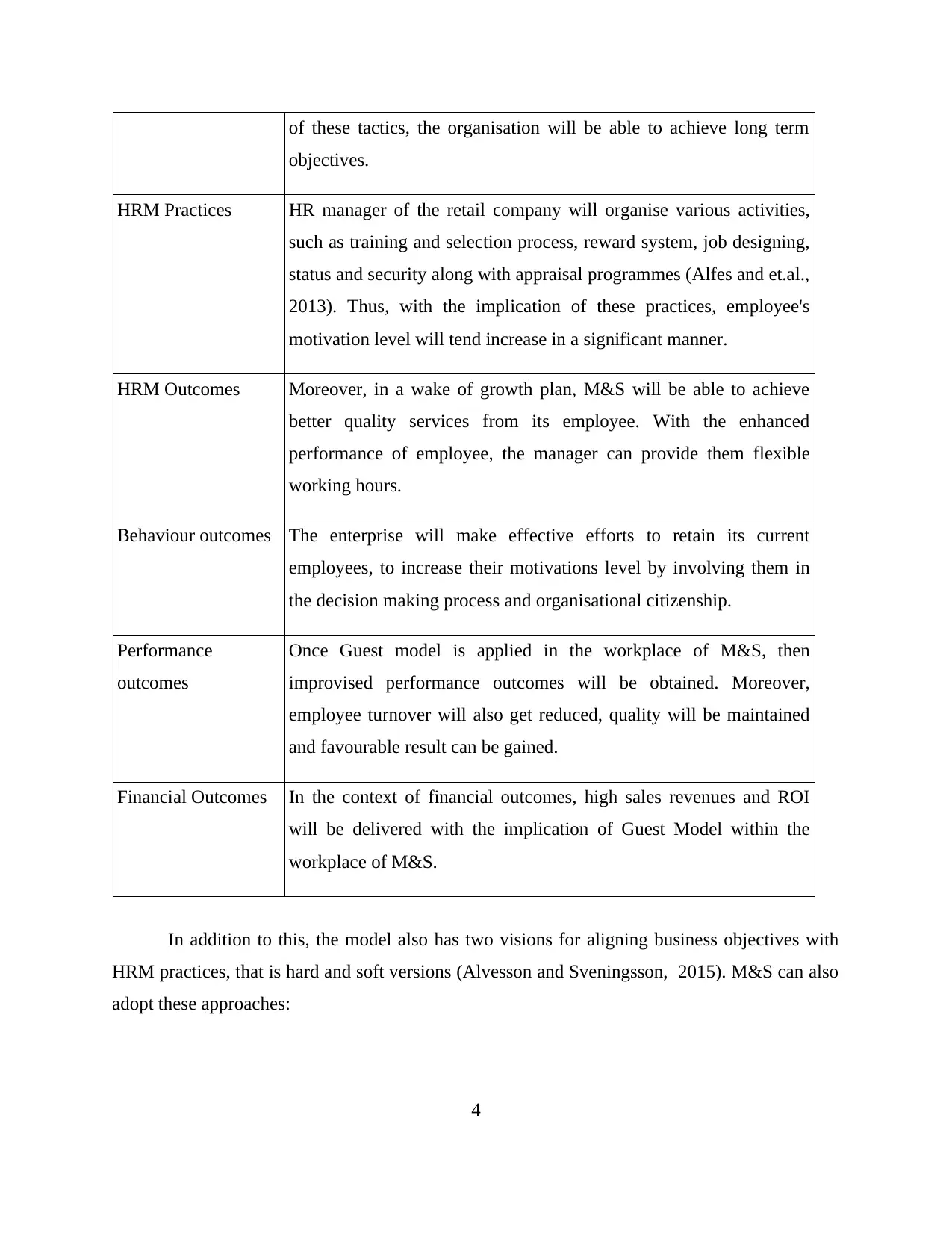
of these tactics, the organisation will be able to achieve long term
objectives.
HRM Practices HR manager of the retail company will organise various activities,
such as training and selection process, reward system, job designing,
status and security along with appraisal programmes (Alfes and et.al.,
2013). Thus, with the implication of these practices, employee's
motivation level will tend increase in a significant manner.
HRM Outcomes Moreover, in a wake of growth plan, M&S will be able to achieve
better quality services from its employee. With the enhanced
performance of employee, the manager can provide them flexible
working hours.
Behaviour outcomes The enterprise will make effective efforts to retain its current
employees, to increase their motivations level by involving them in
the decision making process and organisational citizenship.
Performance
outcomes
Once Guest model is applied in the workplace of M&S, then
improvised performance outcomes will be obtained. Moreover,
employee turnover will also get reduced, quality will be maintained
and favourable result can be gained.
Financial Outcomes In the context of financial outcomes, high sales revenues and ROI
will be delivered with the implication of Guest Model within the
workplace of M&S.
In addition to this, the model also has two visions for aligning business objectives with
HRM practices, that is hard and soft versions (Alvesson and Sveningsson, 2015). M&S can also
adopt these approaches:
4
objectives.
HRM Practices HR manager of the retail company will organise various activities,
such as training and selection process, reward system, job designing,
status and security along with appraisal programmes (Alfes and et.al.,
2013). Thus, with the implication of these practices, employee's
motivation level will tend increase in a significant manner.
HRM Outcomes Moreover, in a wake of growth plan, M&S will be able to achieve
better quality services from its employee. With the enhanced
performance of employee, the manager can provide them flexible
working hours.
Behaviour outcomes The enterprise will make effective efforts to retain its current
employees, to increase their motivations level by involving them in
the decision making process and organisational citizenship.
Performance
outcomes
Once Guest model is applied in the workplace of M&S, then
improvised performance outcomes will be obtained. Moreover,
employee turnover will also get reduced, quality will be maintained
and favourable result can be gained.
Financial Outcomes In the context of financial outcomes, high sales revenues and ROI
will be delivered with the implication of Guest Model within the
workplace of M&S.
In addition to this, the model also has two visions for aligning business objectives with
HRM practices, that is hard and soft versions (Alvesson and Sveningsson, 2015). M&S can also
adopt these approaches:
4
Paraphrase This Document
Need a fresh take? Get an instant paraphrase of this document with our AI Paraphraser
Hard HRM approach: By adopting this hard approach, manager can impose strict rules
and procedures that have to complied by the employees. In addition to this, they can also
replaced and assigned with more responsibilities.
Soft HRM approach: Here, employees are treated as important assets of the company,
whereby emphasize is given on implementing motivational and leadership practices to
enhance their performance and achieve organisational goals.
AC 1.2
Perspectives of HRM can also be undertaken by the HR manager of the M&S with the
assistance of Storey's definition of human resource management. According to him, employment
management is systematic prospect of deploying highly capable and skilled and committed
workforces to attain success and desired objectives with the implications of strategic techniques
(Kehoe and Wright, 2013.). The HR manager of the M&S will be able to distinguish the
prospectives of HRM with IR practices by above cited approach.
Beliefs and assumptions Personnel management and
IR practices
Human Resource
Management
Written agreement bridge Here, delineated contracts are
complied
Main objective is to reach the
organisational objectives
beyond the written
statements.
Compliance of norms and
terms
Under personnel
management, employees are
requisite to follow all rule
and regulations.
The role and responsibilities
of employees under HRM can
go beyond the set rules.
Managerial practices Systematic structured process
is followed
According to the requirement
of business needs of M&S,
necessary actions will be
taken.
5
and procedures that have to complied by the employees. In addition to this, they can also
replaced and assigned with more responsibilities.
Soft HRM approach: Here, employees are treated as important assets of the company,
whereby emphasize is given on implementing motivational and leadership practices to
enhance their performance and achieve organisational goals.
AC 1.2
Perspectives of HRM can also be undertaken by the HR manager of the M&S with the
assistance of Storey's definition of human resource management. According to him, employment
management is systematic prospect of deploying highly capable and skilled and committed
workforces to attain success and desired objectives with the implications of strategic techniques
(Kehoe and Wright, 2013.). The HR manager of the M&S will be able to distinguish the
prospectives of HRM with IR practices by above cited approach.
Beliefs and assumptions Personnel management and
IR practices
Human Resource
Management
Written agreement bridge Here, delineated contracts are
complied
Main objective is to reach the
organisational objectives
beyond the written
statements.
Compliance of norms and
terms
Under personnel
management, employees are
requisite to follow all rule
and regulations.
The role and responsibilities
of employees under HRM can
go beyond the set rules.
Managerial practices Systematic structured process
is followed
According to the requirement
of business needs of M&S,
necessary actions will be
taken.
5
Communication process There is no direct
communication occurred
between employees
(Messersmith and Guthrie,
2010).
Here, emphasize is given on
conducting open
communication practices, like
open sessions, face-to-face
meetings and many more.
Nature of relationships Pluralist approach Unitarist approach
Process of decision making slow Quick and effective
Prized management skills Structured and negotiable Facilitation of services
Hence, by undergoing from above approaches, M&S can effectively improve its
management system and enhance productivity.
AC 1.3
Marks and Spencer's the giant retailer need to develop various strategies and approaches
with the contribution of line manager and employees. The company is seeking for betterments in
its performance and profitability, thus there can be following implications of these theories and
models applied within the workplace of M&S in a strategic way:
Implications on staff-members:
The roles and responsibilities line managers will tend to increase, they need to more work
upon their skills and knowledge so that adequate leadership and management styles can
be imposed in the workplace of M&S (Bauuer and Erdogan, 2008).
Strong bond will be formed between employee and employers.
Line managers will be able to set definite goals and objectives according to business
needs with the help of many personnel, structural and managerial techniques.
These people will be responsible for providing job security and other facilities to
employees, such as balanced work life, rewards and many more. (Long and et. al., 2013)
Implications on workforces:
Employees will render better services by putting their high efforts and contribution into
the development procedures.
6
communication occurred
between employees
(Messersmith and Guthrie,
2010).
Here, emphasize is given on
conducting open
communication practices, like
open sessions, face-to-face
meetings and many more.
Nature of relationships Pluralist approach Unitarist approach
Process of decision making slow Quick and effective
Prized management skills Structured and negotiable Facilitation of services
Hence, by undergoing from above approaches, M&S can effectively improve its
management system and enhance productivity.
AC 1.3
Marks and Spencer's the giant retailer need to develop various strategies and approaches
with the contribution of line manager and employees. The company is seeking for betterments in
its performance and profitability, thus there can be following implications of these theories and
models applied within the workplace of M&S in a strategic way:
Implications on staff-members:
The roles and responsibilities line managers will tend to increase, they need to more work
upon their skills and knowledge so that adequate leadership and management styles can
be imposed in the workplace of M&S (Bauuer and Erdogan, 2008).
Strong bond will be formed between employee and employers.
Line managers will be able to set definite goals and objectives according to business
needs with the help of many personnel, structural and managerial techniques.
These people will be responsible for providing job security and other facilities to
employees, such as balanced work life, rewards and many more. (Long and et. al., 2013)
Implications on workforces:
Employees will render better services by putting their high efforts and contribution into
the development procedures.
6
⊘ This is a preview!⊘
Do you want full access?
Subscribe today to unlock all pages.
Trusted by 1+ million students worldwide
With the implications of HRM practices, high skilled and capable employee will be
deployed who can contribute to the success of M&S.
With the provision of flexibility in the workplace, workforces will be motivated and
encouraged to deliver quality performance with full dedication.
Key levers of HRM subsequently gain the commitment of employees to the growth and
success of M&S.
TASK 2
AC 2.1
Flexibility is an ability or capability of management system to bring changes in the
working approaches of the employee and employers. In today's changing business-need and
demands of workforces, it has become necessary for M&S to provide flexibility related to
working hours, pattern, structure, location and several other factors within the workplace, so that
employees can boost up their performance and render enhanced productivity. The HR manger of
the M&S can develop flexibility with the aid of many ICT techniques along with several others
models (Organisational Flexibility. 2012). Handy's model of Shamrock can be implemented in
the M&S by analysing following three elements: Professional core: It is an effective way of achieving flexibility in the organisation with
the assistance of highly skilled professionals and employees who possess critical skills.
Professors, marketing experts, managers and other professionals significantly represent
these qualities. Contractual fringe: It constituent of temporary employees and self-employed persons
who can carry out the management process in the workplace of M&S. Moreover, these
people accounts for flexible hours and amount of work that need to be provided to the
employees of M&S according to the requirement of company.
Contingent Workforce: Here, flexible labour workforce, such as part-time and seasonal
workers who posses basic skills and significantly contribute to the success of
organisation.
7
deployed who can contribute to the success of M&S.
With the provision of flexibility in the workplace, workforces will be motivated and
encouraged to deliver quality performance with full dedication.
Key levers of HRM subsequently gain the commitment of employees to the growth and
success of M&S.
TASK 2
AC 2.1
Flexibility is an ability or capability of management system to bring changes in the
working approaches of the employee and employers. In today's changing business-need and
demands of workforces, it has become necessary for M&S to provide flexibility related to
working hours, pattern, structure, location and several other factors within the workplace, so that
employees can boost up their performance and render enhanced productivity. The HR manger of
the M&S can develop flexibility with the aid of many ICT techniques along with several others
models (Organisational Flexibility. 2012). Handy's model of Shamrock can be implemented in
the M&S by analysing following three elements: Professional core: It is an effective way of achieving flexibility in the organisation with
the assistance of highly skilled professionals and employees who possess critical skills.
Professors, marketing experts, managers and other professionals significantly represent
these qualities. Contractual fringe: It constituent of temporary employees and self-employed persons
who can carry out the management process in the workplace of M&S. Moreover, these
people accounts for flexible hours and amount of work that need to be provided to the
employees of M&S according to the requirement of company.
Contingent Workforce: Here, flexible labour workforce, such as part-time and seasonal
workers who posses basic skills and significantly contribute to the success of
organisation.
7
Paraphrase This Document
Need a fresh take? Get an instant paraphrase of this document with our AI Paraphraser
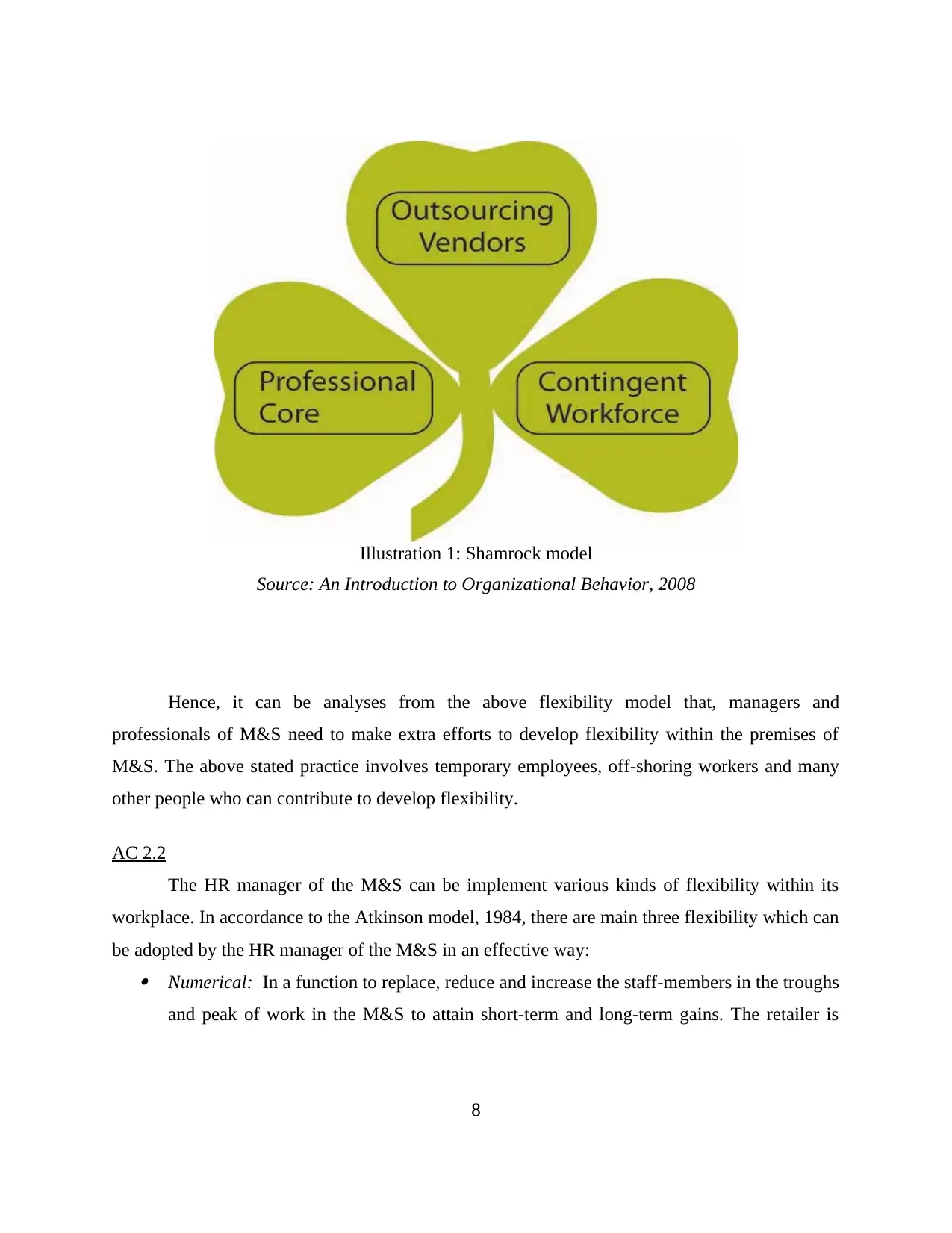
Hence, it can be analyses from the above flexibility model that, managers and
professionals of M&S need to make extra efforts to develop flexibility within the premises of
M&S. The above stated practice involves temporary employees, off-shoring workers and many
other people who can contribute to develop flexibility.
AC 2.2
The HR manager of the M&S can be implement various kinds of flexibility within its
workplace. In accordance to the Atkinson model, 1984, there are main three flexibility which can
be adopted by the HR manager of the M&S in an effective way: Numerical: In a function to replace, reduce and increase the staff-members in the troughs
and peak of work in the M&S to attain short-term and long-term gains. The retailer is
8
Illustration 1: Shamrock model
Source: An Introduction to Organizational Behavior, 2008
professionals of M&S need to make extra efforts to develop flexibility within the premises of
M&S. The above stated practice involves temporary employees, off-shoring workers and many
other people who can contribute to develop flexibility.
AC 2.2
The HR manager of the M&S can be implement various kinds of flexibility within its
workplace. In accordance to the Atkinson model, 1984, there are main three flexibility which can
be adopted by the HR manager of the M&S in an effective way: Numerical: In a function to replace, reduce and increase the staff-members in the troughs
and peak of work in the M&S to attain short-term and long-term gains. The retailer is
8
Illustration 1: Shamrock model
Source: An Introduction to Organizational Behavior, 2008
responsible to maintain the availability of employees, which can involve hiring part-time
job seekers, agency workers and permanent employees. Functional: Here, flexibility can be introduce by assigning different level of tasks to
employees so that they widen their area of interest and specifications. In Marks and
Spencer's, women are also provided with varied level of work, including dual skilling and
multi facet tasks (Organisational Flexibility. 2012). Temporal flexibility: It determine the specific pattern of the work which can be
undertaken the employees of Marks and Spencer's. It also comprises of voluntary or
seasonal which will highly benefit to employees who are working there. Working hours
can also be adjusted on demand. Place-to-work flexibility can also be provided them with
home-working and many other provisions. Job sharing: The allotted task has been split among team members with proper
arrangements and managements, as a result if which high quality performance can be
obtained (Buller and McEvoy, 2012).
Job rotation: The jobs of specific person can be rotated in the same of different
department in the M&S, so that each one can have understanding of all subjects.
AC 2.3
In every organization employees wants flexible work arrangements. Apart from this,
employers want higher morale, lower absenteeism to provide better quality of product to
customers. In chosen business they offer flex plans as successful recruitment tactic. It is the best
way to stay in competitive marketplace (Camps and Luna‐Arocas, 2012). Following are the merit
for both employer and employee within the business:
Improve job satisfaction, morale and productivity
Enhance employee recruitment and retention
Increase energy and creativity
Improve balance of work
For the above benefit, following are the most flexible arrangement includes in Mark and
Spencer:
9
job seekers, agency workers and permanent employees. Functional: Here, flexibility can be introduce by assigning different level of tasks to
employees so that they widen their area of interest and specifications. In Marks and
Spencer's, women are also provided with varied level of work, including dual skilling and
multi facet tasks (Organisational Flexibility. 2012). Temporal flexibility: It determine the specific pattern of the work which can be
undertaken the employees of Marks and Spencer's. It also comprises of voluntary or
seasonal which will highly benefit to employees who are working there. Working hours
can also be adjusted on demand. Place-to-work flexibility can also be provided them with
home-working and many other provisions. Job sharing: The allotted task has been split among team members with proper
arrangements and managements, as a result if which high quality performance can be
obtained (Buller and McEvoy, 2012).
Job rotation: The jobs of specific person can be rotated in the same of different
department in the M&S, so that each one can have understanding of all subjects.
AC 2.3
In every organization employees wants flexible work arrangements. Apart from this,
employers want higher morale, lower absenteeism to provide better quality of product to
customers. In chosen business they offer flex plans as successful recruitment tactic. It is the best
way to stay in competitive marketplace (Camps and Luna‐Arocas, 2012). Following are the merit
for both employer and employee within the business:
Improve job satisfaction, morale and productivity
Enhance employee recruitment and retention
Increase energy and creativity
Improve balance of work
For the above benefit, following are the most flexible arrangement includes in Mark and
Spencer:
9
⊘ This is a preview!⊘
Do you want full access?
Subscribe today to unlock all pages.
Trusted by 1+ million students worldwide
Flex time: This is a system where employees and employer can choose their starting and
ending times from the range of available hours (Chatterji and Patro, 2014). Flexible time
is common practice in a wide variety of business with cutting-edge arrangement.
Compressed work week: In this arrangement, employees need to work just for five days
in a week not more than that and in such situation workers require to work for more than
average working hours in order to compensate the left out two days in a week. They can
include other option as three 12 hours/day or arrangement in which employee can work 9
or 10 hours/day. Beside this, they can also compensate with an extra day or two of time
off during working hours (Dahlgaard-Park, 2012).
Flex place: This system include various arrangement in which employee works from
home or some other non-office location. Chosen business can provides such facilities to
develop flexible working place for employees as well as employers (Dijk, Beck, and
Viney, 2013).
Work sharing: These program is increasingly used by companies for avoid lay-off. It
allows Mark and Spencer to temporarily reduce hours and salary for a portion of their
workforce for maintaining workforce within the organization (Géczy, Izumi and Hasida,
2012).
AC 2.4
Flexible work program is facilitated to manage employees and employers of the business,
but in some cases it creates negative impact on organization. In Mark and Spencer need to
provide owners and managers flexible working hours according to their preferences. Further,
there are cases in which employees misuse the given opportunity as manager felt to make note of
their performance as they work according to their performance (Jiang, Lepak and Baer, 2012).
Apart from this, flexible system is difficult for many companies for conducting business
operations. In this context following are the factors that have impact on flexibility for labour
market: Mobility of labour: This includes occupational mobility, geographical mobility and
industrial mobility. In occupation mobility, people move from one job to another on their
willingness and ability (Kim, 2012). Further, geographical mobility includes moving
from one region to other. At last in industrial mobility it includes moving between
10
ending times from the range of available hours (Chatterji and Patro, 2014). Flexible time
is common practice in a wide variety of business with cutting-edge arrangement.
Compressed work week: In this arrangement, employees need to work just for five days
in a week not more than that and in such situation workers require to work for more than
average working hours in order to compensate the left out two days in a week. They can
include other option as three 12 hours/day or arrangement in which employee can work 9
or 10 hours/day. Beside this, they can also compensate with an extra day or two of time
off during working hours (Dahlgaard-Park, 2012).
Flex place: This system include various arrangement in which employee works from
home or some other non-office location. Chosen business can provides such facilities to
develop flexible working place for employees as well as employers (Dijk, Beck, and
Viney, 2013).
Work sharing: These program is increasingly used by companies for avoid lay-off. It
allows Mark and Spencer to temporarily reduce hours and salary for a portion of their
workforce for maintaining workforce within the organization (Géczy, Izumi and Hasida,
2012).
AC 2.4
Flexible work program is facilitated to manage employees and employers of the business,
but in some cases it creates negative impact on organization. In Mark and Spencer need to
provide owners and managers flexible working hours according to their preferences. Further,
there are cases in which employees misuse the given opportunity as manager felt to make note of
their performance as they work according to their performance (Jiang, Lepak and Baer, 2012).
Apart from this, flexible system is difficult for many companies for conducting business
operations. In this context following are the factors that have impact on flexibility for labour
market: Mobility of labour: This includes occupational mobility, geographical mobility and
industrial mobility. In occupation mobility, people move from one job to another on their
willingness and ability (Kim, 2012). Further, geographical mobility includes moving
from one region to other. At last in industrial mobility it includes moving between
10
Paraphrase This Document
Need a fresh take? Get an instant paraphrase of this document with our AI Paraphraser
industries. This has negative impact on chosen business, as they recruit new members
again and again (Oldroyd and Morris, 2012). Thus, it increases expenditure of the
organization.
Wage Flexibility: Key element of labour market flexibility is maintaining equilibrium
between demand and supply. In this context, cited firm can include various types of wage
flexibility such as relative and real as well. In relative wage, flexibility includes
adjustment of wage rate between sectors of an economy or different region. In real wage
flexibility includes nominal wages adjusted to economy of country. This will impact on
economy of business that they have to maintain both flexibility for labour market
flexibility (Schiuma, 2012).
TASK 3
AC 3.1
Discrimination is harmful treatment towards people within group. While laws are take
place to prevent discrimination in the workplace, but many person find that they still
discriminated against work (Tseng, Chang and Chen, 2012). Various types of discrimination help
to identify workplace discrimination when it occurs. Following are the different types of
discrimination which can be seen in cited firm:
Discrimination based on race or ethnicity: Discrimination based on race is discarded
by law. In Mark and Spencer people may racial discrimination in form of harassment
around workplace. For example in organization people having derogatory remarks and it
made regarding their skin colour or family background (Turner, Swart, and Maylor,
2013). Thus, in this case employers should not allow favouring discrimination against
employees of their race.
Discrimination based on Sex: Apart from race or ethnicity discrimination, sex- based
discrimination take many forms at workplace. In this context, many forms includes in sex
discrimination includes such as sexual harassment, crude remarks and sexual advances
towards an employee. In chosen business these forms are also happened with the
employees (Verbano and Venturini, 2013). It may also includes negative treatment due to
gender. For example in company employers discriminate between female and male
towards the work of their business, that female not able to do work properly but male can
11
again and again (Oldroyd and Morris, 2012). Thus, it increases expenditure of the
organization.
Wage Flexibility: Key element of labour market flexibility is maintaining equilibrium
between demand and supply. In this context, cited firm can include various types of wage
flexibility such as relative and real as well. In relative wage, flexibility includes
adjustment of wage rate between sectors of an economy or different region. In real wage
flexibility includes nominal wages adjusted to economy of country. This will impact on
economy of business that they have to maintain both flexibility for labour market
flexibility (Schiuma, 2012).
TASK 3
AC 3.1
Discrimination is harmful treatment towards people within group. While laws are take
place to prevent discrimination in the workplace, but many person find that they still
discriminated against work (Tseng, Chang and Chen, 2012). Various types of discrimination help
to identify workplace discrimination when it occurs. Following are the different types of
discrimination which can be seen in cited firm:
Discrimination based on race or ethnicity: Discrimination based on race is discarded
by law. In Mark and Spencer people may racial discrimination in form of harassment
around workplace. For example in organization people having derogatory remarks and it
made regarding their skin colour or family background (Turner, Swart, and Maylor,
2013). Thus, in this case employers should not allow favouring discrimination against
employees of their race.
Discrimination based on Sex: Apart from race or ethnicity discrimination, sex- based
discrimination take many forms at workplace. In this context, many forms includes in sex
discrimination includes such as sexual harassment, crude remarks and sexual advances
towards an employee. In chosen business these forms are also happened with the
employees (Verbano and Venturini, 2013). It may also includes negative treatment due to
gender. For example in company employers discriminate between female and male
towards the work of their business, that female not able to do work properly but male can
11
do. In this case companies have no right to discriminate people against their sex. Both
male and female can be victims of sex-based workplace discrimination.
Discrimination based on disability: Disability means persons are not able to do work
properly due to physical disable. In many organization disability discrimination take
place when people are physically not able to perform their work and due to which they
are provided with equal opportunity. This does not mean an employer is required to hire
only those people who are capable without any disability, but also need to protect disable
person ate their workplace (Argenti, 2015). Employers must make reasonable
accommodation employees with disability. For instance, in chosen business any person
work who is not able to walk properly, organization should provide them wheelchair to
move anywhere at workplace. In recent news a woman is suffering from dyslexia has
won disability discrimination. Due to this she gives lesser duty at workplace.
AC 3.2
Equal opportunities' policy and statement offer equality for all people to avoid
discrimination at workplace. Following are the legislation policy explain to achieve equality of
opportunity within the organization: Equality Act 1988: According to this act organization have to remove discrimination on
the basis of family status, sexual orientation, religious belief, age, disability, race and
community. This act provide equal remuneration clauses to the employees of chosen
business. In this act employers of Mark and Spencer is liable for sexual harassment of
employees (Budhwar and Debrah, 2013). This act set up for equality authority which is
work to eliminate discrimination, promote equality of opportunity of the act (Hannon
and Sinclair, 2016). Race discrimination Act 1965: The race relation act 1965 define as prohibition of racial
discrimination within the business. According to this act chosen business protect the
right of their employees. In this includes elimination of discrimination from the colour,
race, ethnic and national origin (Mayo, 2016).
Sex discrimination Act 1975: This act render unlawful certain kinds of sex discrimination
on the ground of gender. This function is working towards the elimination of
discrimination and promoting equality of opportunity between male and female. In
12
male and female can be victims of sex-based workplace discrimination.
Discrimination based on disability: Disability means persons are not able to do work
properly due to physical disable. In many organization disability discrimination take
place when people are physically not able to perform their work and due to which they
are provided with equal opportunity. This does not mean an employer is required to hire
only those people who are capable without any disability, but also need to protect disable
person ate their workplace (Argenti, 2015). Employers must make reasonable
accommodation employees with disability. For instance, in chosen business any person
work who is not able to walk properly, organization should provide them wheelchair to
move anywhere at workplace. In recent news a woman is suffering from dyslexia has
won disability discrimination. Due to this she gives lesser duty at workplace.
AC 3.2
Equal opportunities' policy and statement offer equality for all people to avoid
discrimination at workplace. Following are the legislation policy explain to achieve equality of
opportunity within the organization: Equality Act 1988: According to this act organization have to remove discrimination on
the basis of family status, sexual orientation, religious belief, age, disability, race and
community. This act provide equal remuneration clauses to the employees of chosen
business. In this act employers of Mark and Spencer is liable for sexual harassment of
employees (Budhwar and Debrah, 2013). This act set up for equality authority which is
work to eliminate discrimination, promote equality of opportunity of the act (Hannon
and Sinclair, 2016). Race discrimination Act 1965: The race relation act 1965 define as prohibition of racial
discrimination within the business. According to this act chosen business protect the
right of their employees. In this includes elimination of discrimination from the colour,
race, ethnic and national origin (Mayo, 2016).
Sex discrimination Act 1975: This act render unlawful certain kinds of sex discrimination
on the ground of gender. This function is working towards the elimination of
discrimination and promoting equality of opportunity between male and female. In
12
⊘ This is a preview!⊘
Do you want full access?
Subscribe today to unlock all pages.
Trusted by 1+ million students worldwide

1 out of 19


Related Documents


Your All-in-One AI-Powered Toolkit for Academic Success.
+13062052269
info@desklib.com
Available 24*7 on WhatsApp / Email
![[object Object]](/_next/static/media/star-bottom.7253800d.svg)
Unlock your academic potential
Copyright © 2020–2026 A2Z Services. All Rights Reserved. Developed and managed by ZUCOL.