Marketing Plan for Samsung Galaxy S6: SWOT, Segmentation, and Strategy
VerifiedAdded on 2019/09/30
|32
|7356
|447
Report
AI Summary
This report presents a comprehensive marketing plan for the Samsung Galaxy S6, encompassing a detailed analysis of the current market situation, including a thorough SWOT analysis to identify strengths, weaknesses, opportunities, and threats. The plan focuses on target market segmentation, identifying the middle-class, elite class, and young generation as key segments, with the middle class being the primary target due to their affordability and suitability for the product's features. Product positioning strategies, specifically cost leadership and product differentiation, are recommended to build brand image and attract consumers. The marketing mix includes product, price, distribution, and communication strategies, with emphasis on promotional activities such as sponsorship, advertisement, and social media to increase sales. The implementation plan outlines a schedule, evaluation methods, and contingency plans, along with financial projections and implications. Overall, the report recommends a combination of cost leadership and product differentiation to ensure Samsung's competitiveness in the market, supported by the SWOT analysis and relevant marketing concepts.
Running head: Marketing plan
Marketing plan
SAMSUNG GALAXY S6
Student name
Course work
Marketing plan
SAMSUNG GALAXY S6
Student name
Course work

Paraphrase This Document
Need a fresh take? Get an instant paraphrase of this document with our AI Paraphraser
MARKETING PLAN 1
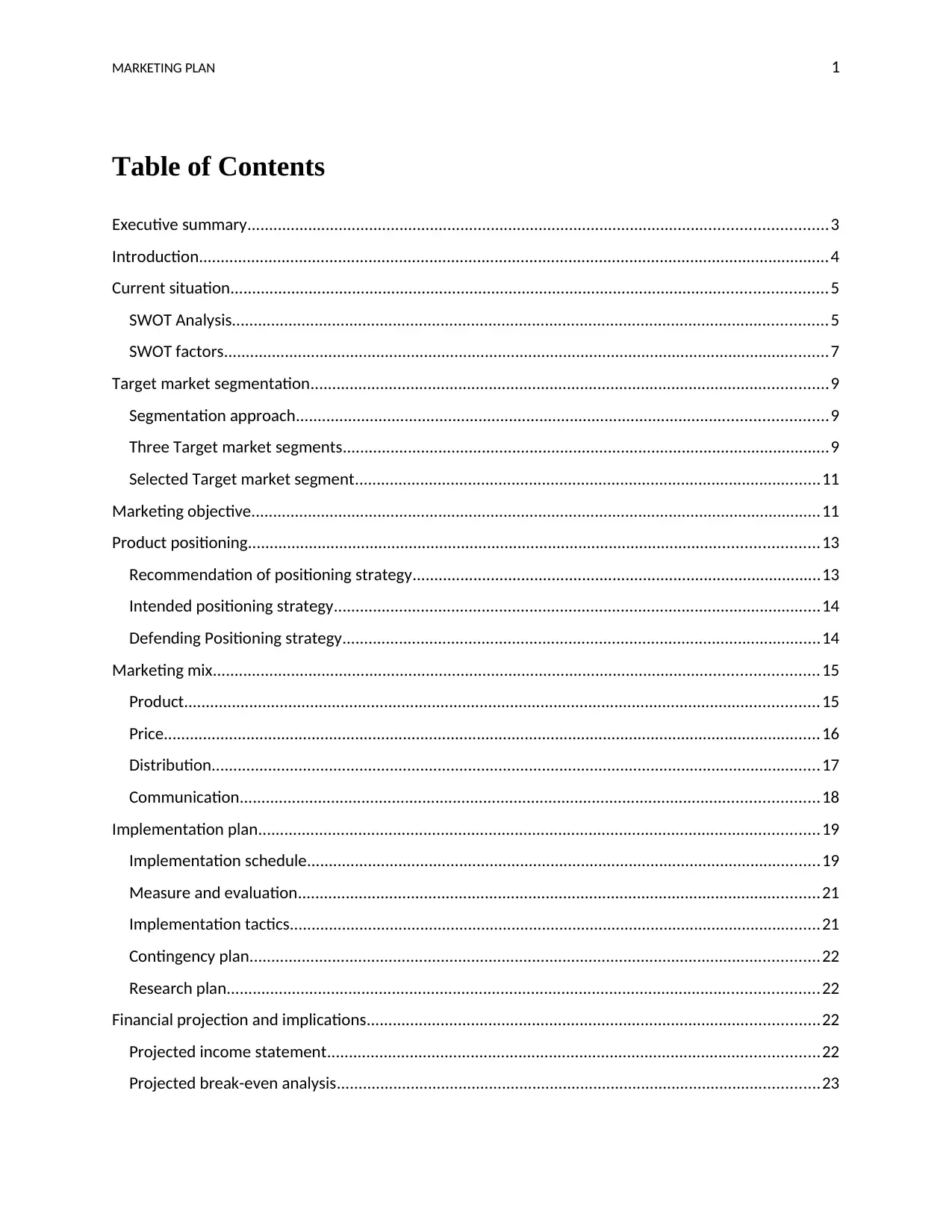
Table of Contents
Executive summary.....................................................................................................................................3
Introduction.................................................................................................................................................4
Current situation.........................................................................................................................................5
SWOT Analysis.........................................................................................................................................5
SWOT factors...........................................................................................................................................7
Target market segmentation.......................................................................................................................9
Segmentation approach..........................................................................................................................9
Three Target market segments................................................................................................................9
Selected Target market segment...........................................................................................................11
Marketing objective...................................................................................................................................11
Product positioning...................................................................................................................................13
Recommendation of positioning strategy..............................................................................................13
Intended positioning strategy................................................................................................................14
Defending Positioning strategy..............................................................................................................14
Marketing mix...........................................................................................................................................15
Product..................................................................................................................................................15
Price.......................................................................................................................................................16
Distribution............................................................................................................................................17
Communication.....................................................................................................................................18
Implementation plan.................................................................................................................................19
Implementation schedule......................................................................................................................19
Measure and evaluation........................................................................................................................21
Implementation tactics..........................................................................................................................21
Contingency plan...................................................................................................................................22
Research plan........................................................................................................................................22
Financial projection and implications........................................................................................................22
Projected income statement.................................................................................................................22
Projected break-even analysis...............................................................................................................23
Table of Contents
Executive summary.....................................................................................................................................3
Introduction.................................................................................................................................................4
Current situation.........................................................................................................................................5
SWOT Analysis.........................................................................................................................................5
SWOT factors...........................................................................................................................................7
Target market segmentation.......................................................................................................................9
Segmentation approach..........................................................................................................................9
Three Target market segments................................................................................................................9
Selected Target market segment...........................................................................................................11
Marketing objective...................................................................................................................................11
Product positioning...................................................................................................................................13
Recommendation of positioning strategy..............................................................................................13
Intended positioning strategy................................................................................................................14
Defending Positioning strategy..............................................................................................................14
Marketing mix...........................................................................................................................................15
Product..................................................................................................................................................15
Price.......................................................................................................................................................16
Distribution............................................................................................................................................17
Communication.....................................................................................................................................18
Implementation plan.................................................................................................................................19
Implementation schedule......................................................................................................................19
Measure and evaluation........................................................................................................................21
Implementation tactics..........................................................................................................................21
Contingency plan...................................................................................................................................22
Research plan........................................................................................................................................22
Financial projection and implications........................................................................................................22
Projected income statement.................................................................................................................22
Projected break-even analysis...............................................................................................................23
MARKETING PLAN 2
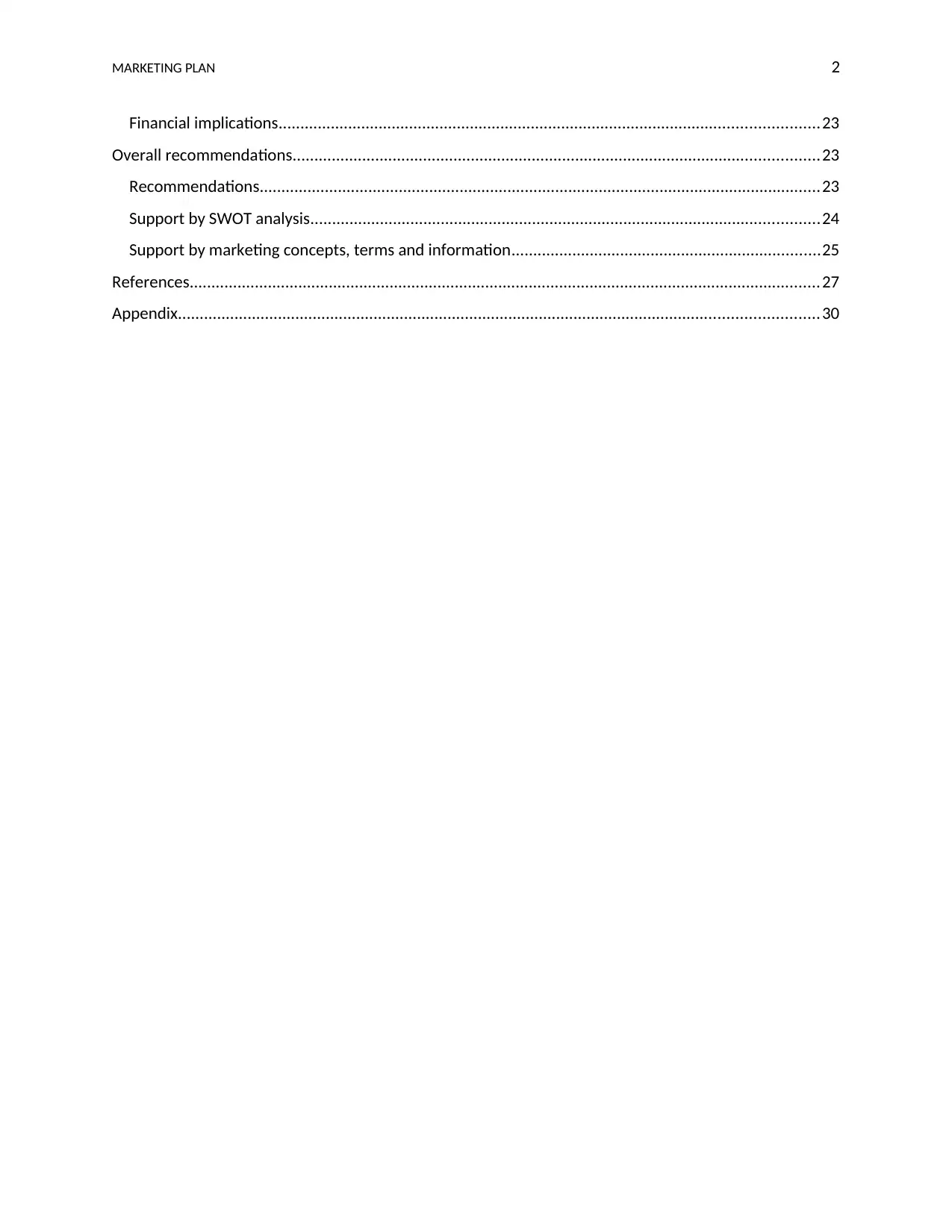
Financial implications............................................................................................................................23
Overall recommendations.........................................................................................................................23
Recommendations.................................................................................................................................23
Support by SWOT analysis.....................................................................................................................24
Support by marketing concepts, terms and information.......................................................................25
References.................................................................................................................................................27
Appendix...................................................................................................................................................30
Financial implications............................................................................................................................23
Overall recommendations.........................................................................................................................23
Recommendations.................................................................................................................................23
Support by SWOT analysis.....................................................................................................................24
Support by marketing concepts, terms and information.......................................................................25
References.................................................................................................................................................27
Appendix...................................................................................................................................................30
⊘ This is a preview!⊘
Do you want full access?
Subscribe today to unlock all pages.

Trusted by 1+ million students worldwide
MARKETING PLAN 3
Executive summary
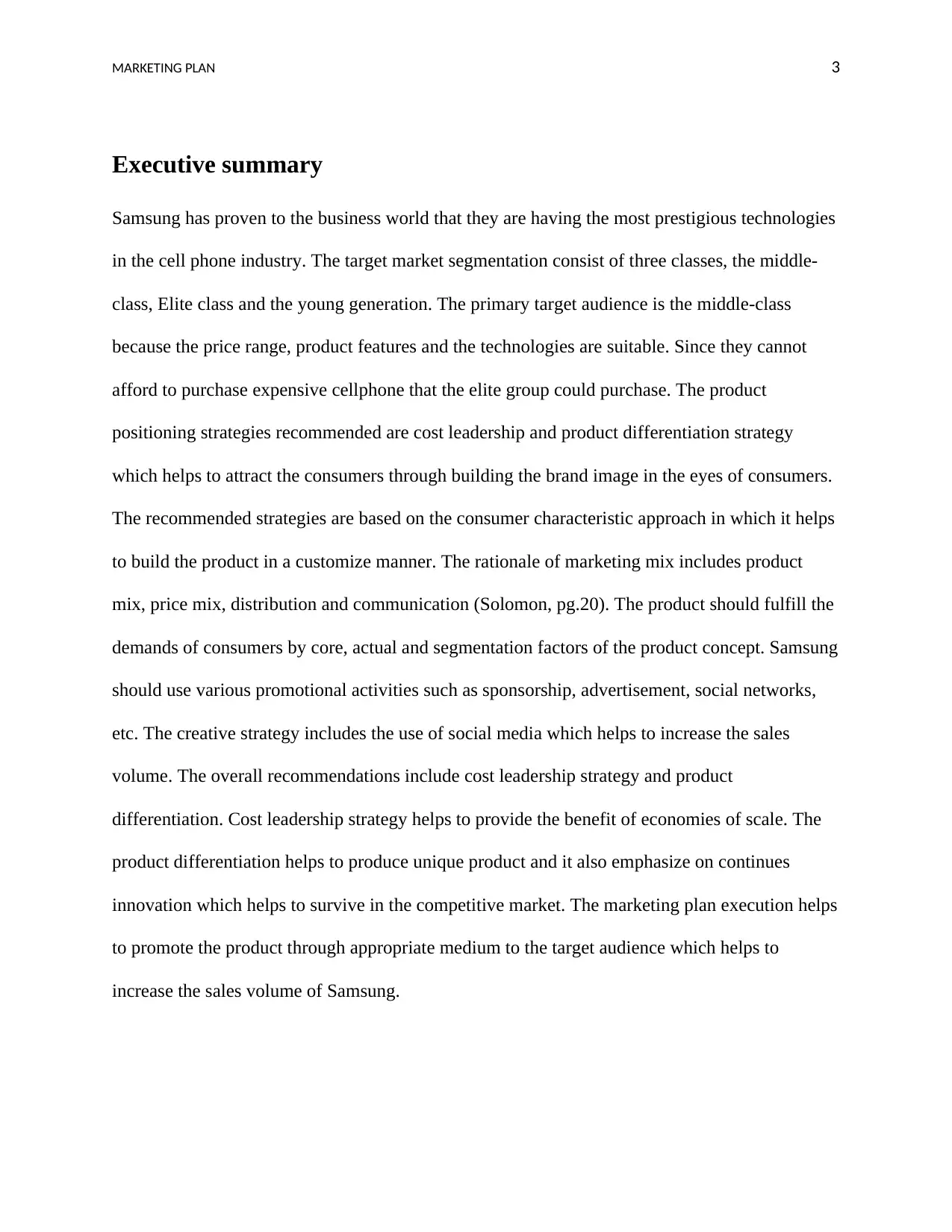
Samsung has proven to the business world that they are having the most prestigious technologies
in the cell phone industry. The target market segmentation consist of three classes, the middle-
class, Elite class and the young generation. The primary target audience is the middle-class
because the price range, product features and the technologies are suitable. Since they cannot
afford to purchase expensive cellphone that the elite group could purchase. The product
positioning strategies recommended are cost leadership and product differentiation strategy
which helps to attract the consumers through building the brand image in the eyes of consumers.
The recommended strategies are based on the consumer characteristic approach in which it helps
to build the product in a customize manner. The rationale of marketing mix includes product
mix, price mix, distribution and communication (Solomon, pg.20). The product should fulfill the
demands of consumers by core, actual and segmentation factors of the product concept. Samsung
should use various promotional activities such as sponsorship, advertisement, social networks,
etc. The creative strategy includes the use of social media which helps to increase the sales
volume. The overall recommendations include cost leadership strategy and product
differentiation. Cost leadership strategy helps to provide the benefit of economies of scale. The
product differentiation helps to produce unique product and it also emphasize on continues
innovation which helps to survive in the competitive market. The marketing plan execution helps
to promote the product through appropriate medium to the target audience which helps to
increase the sales volume of Samsung.
Executive summary
Samsung has proven to the business world that they are having the most prestigious technologies
in the cell phone industry. The target market segmentation consist of three classes, the middle-
class, Elite class and the young generation. The primary target audience is the middle-class
because the price range, product features and the technologies are suitable. Since they cannot
afford to purchase expensive cellphone that the elite group could purchase. The product
positioning strategies recommended are cost leadership and product differentiation strategy
which helps to attract the consumers through building the brand image in the eyes of consumers.
The recommended strategies are based on the consumer characteristic approach in which it helps
to build the product in a customize manner. The rationale of marketing mix includes product
mix, price mix, distribution and communication (Solomon, pg.20). The product should fulfill the
demands of consumers by core, actual and segmentation factors of the product concept. Samsung
should use various promotional activities such as sponsorship, advertisement, social networks,
etc. The creative strategy includes the use of social media which helps to increase the sales
volume. The overall recommendations include cost leadership strategy and product
differentiation. Cost leadership strategy helps to provide the benefit of economies of scale. The
product differentiation helps to produce unique product and it also emphasize on continues
innovation which helps to survive in the competitive market. The marketing plan execution helps
to promote the product through appropriate medium to the target audience which helps to
increase the sales volume of Samsung.
Paraphrase This Document
Need a fresh take? Get an instant paraphrase of this document with our AI Paraphraser
MARKETING PLAN 4
Introduction
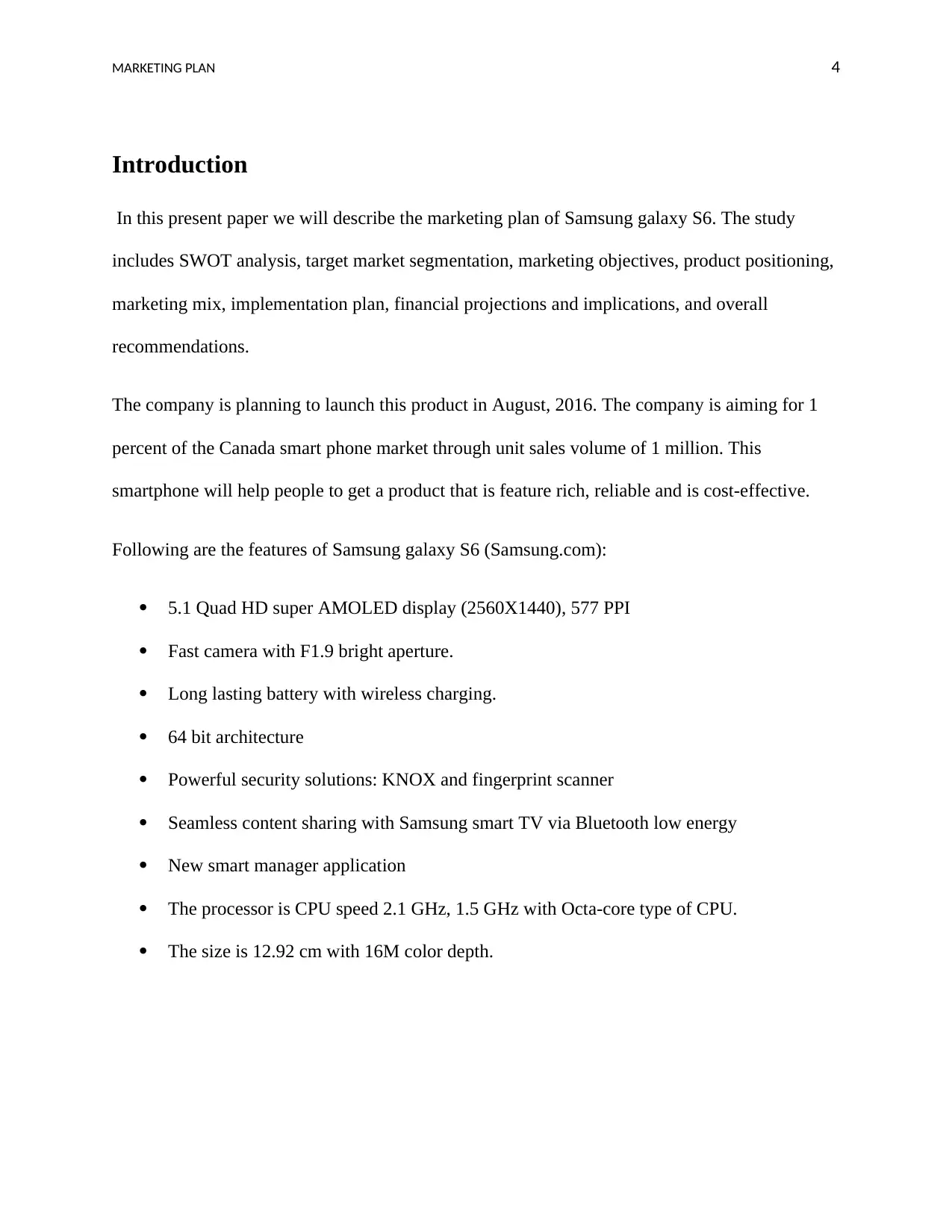
In this present paper we will describe the marketing plan of Samsung galaxy S6. The study
includes SWOT analysis, target market segmentation, marketing objectives, product positioning,
marketing mix, implementation plan, financial projections and implications, and overall
recommendations.
The company is planning to launch this product in August, 2016. The company is aiming for 1
percent of the Canada smart phone market through unit sales volume of 1 million. This
smartphone will help people to get a product that is feature rich, reliable and is cost-effective.
Following are the features of Samsung galaxy S6 (Samsung.com):
5.1 Quad HD super AMOLED display (2560X1440), 577 PPI
Fast camera with F1.9 bright aperture.
Long lasting battery with wireless charging.
64 bit architecture
Powerful security solutions: KNOX and fingerprint scanner
Seamless content sharing with Samsung smart TV via Bluetooth low energy
New smart manager application
The processor is CPU speed 2.1 GHz, 1.5 GHz with Octa-core type of CPU.
The size is 12.92 cm with 16M color depth.
Introduction
In this present paper we will describe the marketing plan of Samsung galaxy S6. The study
includes SWOT analysis, target market segmentation, marketing objectives, product positioning,
marketing mix, implementation plan, financial projections and implications, and overall
recommendations.
The company is planning to launch this product in August, 2016. The company is aiming for 1
percent of the Canada smart phone market through unit sales volume of 1 million. This
smartphone will help people to get a product that is feature rich, reliable and is cost-effective.
Following are the features of Samsung galaxy S6 (Samsung.com):
5.1 Quad HD super AMOLED display (2560X1440), 577 PPI
Fast camera with F1.9 bright aperture.
Long lasting battery with wireless charging.
64 bit architecture
Powerful security solutions: KNOX and fingerprint scanner
Seamless content sharing with Samsung smart TV via Bluetooth low energy
New smart manager application
The processor is CPU speed 2.1 GHz, 1.5 GHz with Octa-core type of CPU.
The size is 12.92 cm with 16M color depth.
MARKETING PLAN 5
Current situation
SWOT Analysis
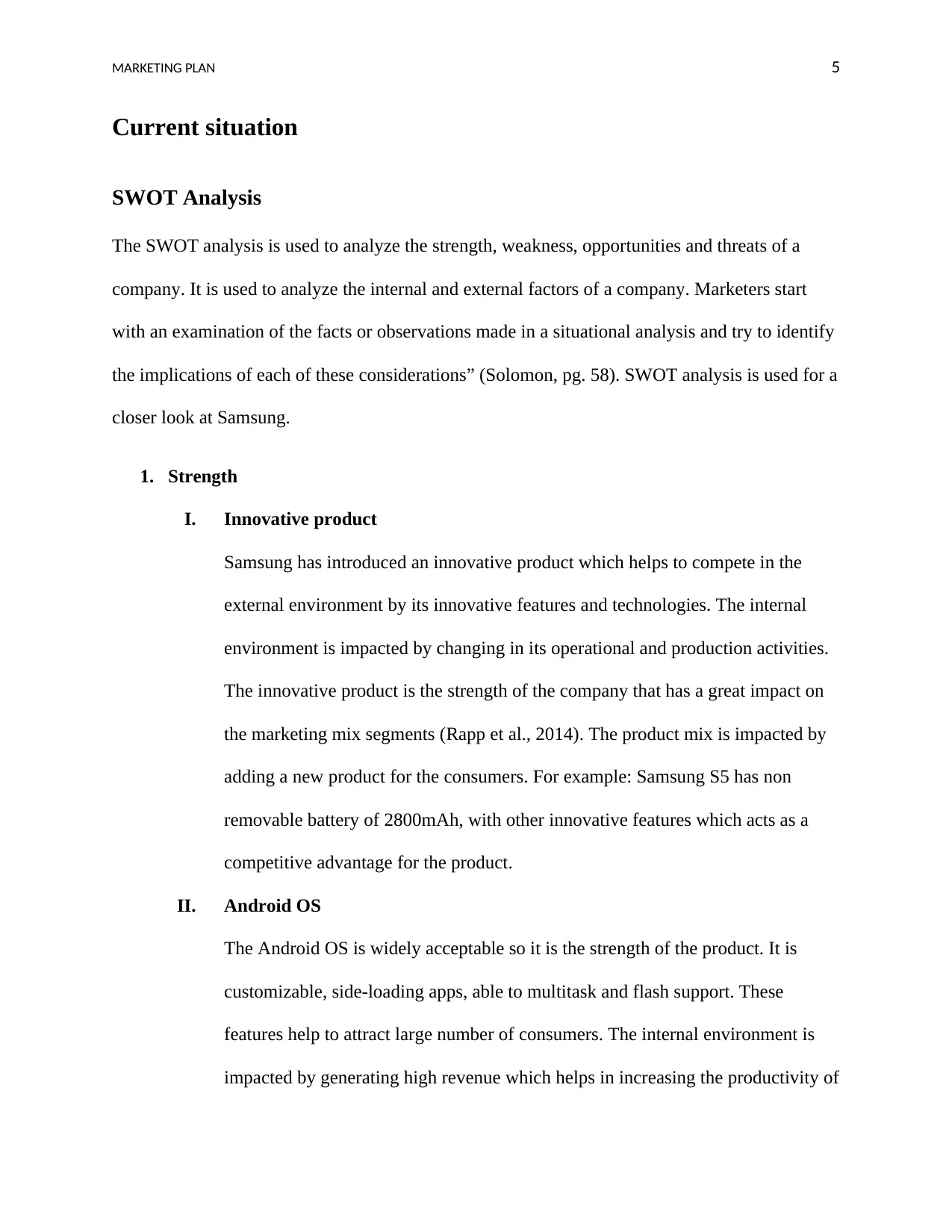
The SWOT analysis is used to analyze the strength, weakness, opportunities and threats of a
company. It is used to analyze the internal and external factors of a company. Marketers start
with an examination of the facts or observations made in a situational analysis and try to identify
the implications of each of these considerations” (Solomon, pg. 58). SWOT analysis is used for a
closer look at Samsung.
1. Strength
I. Innovative product
Samsung has introduced an innovative product which helps to compete in the
external environment by its innovative features and technologies. The internal
environment is impacted by changing in its operational and production activities.
The innovative product is the strength of the company that has a great impact on
the marketing mix segments (Rapp et al., 2014). The product mix is impacted by
adding a new product for the consumers. For example: Samsung S5 has non
removable battery of 2800mAh, with other innovative features which acts as a
competitive advantage for the product.
II. Android OS
The Android OS is widely acceptable so it is the strength of the product. It is
customizable, side-loading apps, able to multitask and flash support. These
features help to attract large number of consumers. The internal environment is
impacted by generating high revenue which helps in increasing the productivity of
Current situation
SWOT Analysis
The SWOT analysis is used to analyze the strength, weakness, opportunities and threats of a
company. It is used to analyze the internal and external factors of a company. Marketers start
with an examination of the facts or observations made in a situational analysis and try to identify
the implications of each of these considerations” (Solomon, pg. 58). SWOT analysis is used for a
closer look at Samsung.
1. Strength
I. Innovative product
Samsung has introduced an innovative product which helps to compete in the
external environment by its innovative features and technologies. The internal
environment is impacted by changing in its operational and production activities.
The innovative product is the strength of the company that has a great impact on
the marketing mix segments (Rapp et al., 2014). The product mix is impacted by
adding a new product for the consumers. For example: Samsung S5 has non
removable battery of 2800mAh, with other innovative features which acts as a
competitive advantage for the product.
II. Android OS
The Android OS is widely acceptable so it is the strength of the product. It is
customizable, side-loading apps, able to multitask and flash support. These
features help to attract large number of consumers. The internal environment is
impacted by generating high revenue which helps in increasing the productivity of
⊘ This is a preview!⊘
Do you want full access?
Subscribe today to unlock all pages.
Trusted by 1+ million students worldwide
MARKETING PLAN 6
the company. These features help Samsung to compete with major players in the
external environment such as Apple. The promotional activities should consider
the features that the android provides in order to increase the sales of the product.
The pricing strategy should consider the widely accepted price. The android
feature helps in building strong product portfolio which helps to string the product
mix of Samsung. For example: Samsung galaxy S in having Android OS which is
widely acceptable because of its features such as multi-tasking, flash support and
others.
2. Weakness
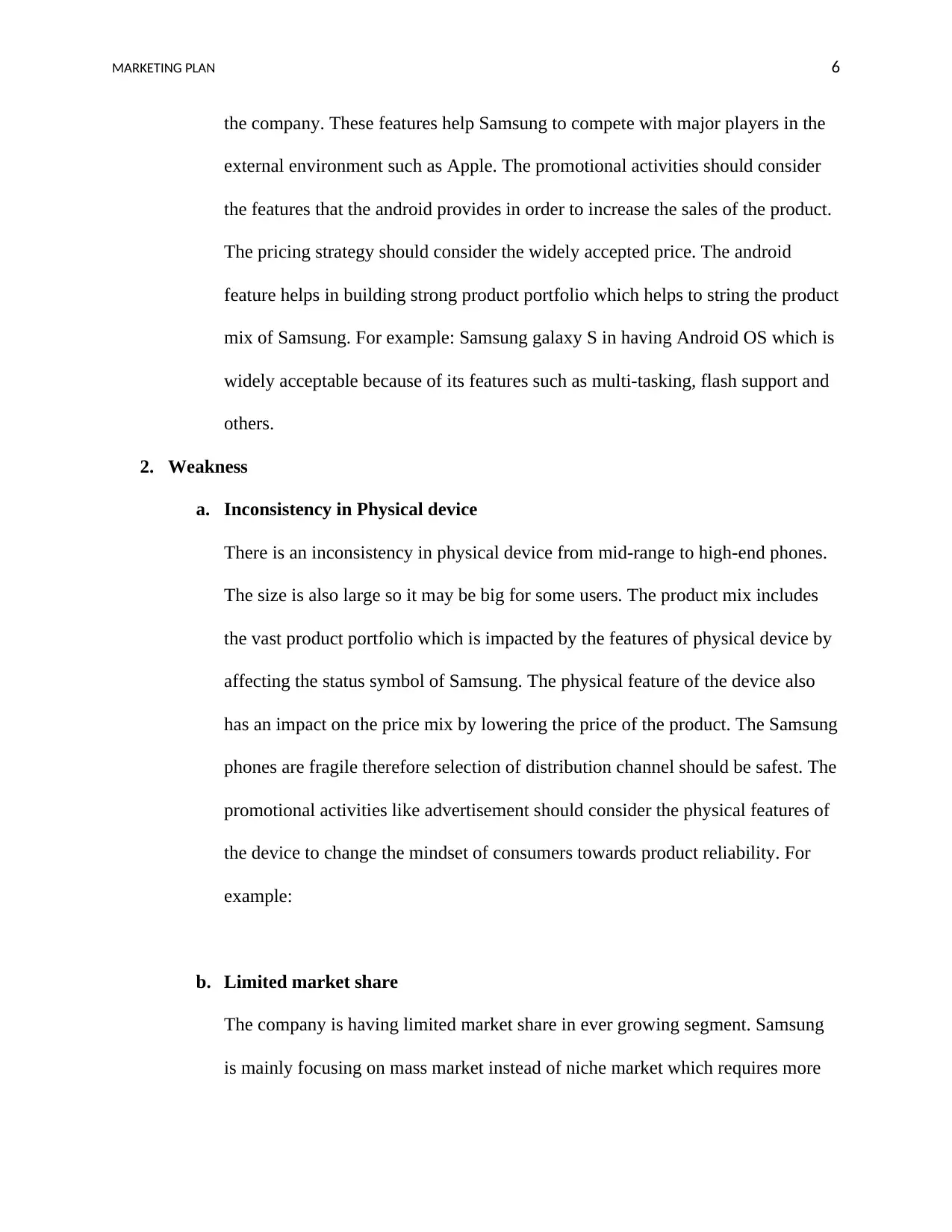
a. Inconsistency in Physical device
There is an inconsistency in physical device from mid-range to high-end phones.
The size is also large so it may be big for some users. The product mix includes
the vast product portfolio which is impacted by the features of physical device by
affecting the status symbol of Samsung. The physical feature of the device also
has an impact on the price mix by lowering the price of the product. The Samsung
phones are fragile therefore selection of distribution channel should be safest. The
promotional activities like advertisement should consider the physical features of
the device to change the mindset of consumers towards product reliability. For
example:
b. Limited market share
The company is having limited market share in ever growing segment. Samsung
is mainly focusing on mass market instead of niche market which requires more
the company. These features help Samsung to compete with major players in the
external environment such as Apple. The promotional activities should consider
the features that the android provides in order to increase the sales of the product.
The pricing strategy should consider the widely accepted price. The android
feature helps in building strong product portfolio which helps to string the product
mix of Samsung. For example: Samsung galaxy S in having Android OS which is
widely acceptable because of its features such as multi-tasking, flash support and
others.
2. Weakness
a. Inconsistency in Physical device
There is an inconsistency in physical device from mid-range to high-end phones.
The size is also large so it may be big for some users. The product mix includes
the vast product portfolio which is impacted by the features of physical device by
affecting the status symbol of Samsung. The physical feature of the device also
has an impact on the price mix by lowering the price of the product. The Samsung
phones are fragile therefore selection of distribution channel should be safest. The
promotional activities like advertisement should consider the physical features of
the device to change the mindset of consumers towards product reliability. For
example:
b. Limited market share
The company is having limited market share in ever growing segment. Samsung
is mainly focusing on mass market instead of niche market which requires more
Paraphrase This Document
Need a fresh take? Get an instant paraphrase of this document with our AI Paraphraser
MARKETING PLAN 7
focus on developing the product. The limited market share impacts on the pricing
mix by forces the company to choose competitive pricing for the survival in the
market. For example: Samsung
3. Opportunity
a. Improvement in services
The consumers in cell phone industry can be attracted from providing excellent
services which help to maintain the brand image and it directly impacts on
increasing the demand (Bull et al., 2016). It impacts on product mix by increasing
the demand of the product. For example: Samsung after sales services for S5 has
tremendously increased the sales volume by 1% of total android market.
b. Access to large market
The company is having wide range of product which can address large market. It
impacts on product mix by targeting large audience. For example: Sony has wide
variety of products which enable to access the large market and it directly impacts
on the sales volume.
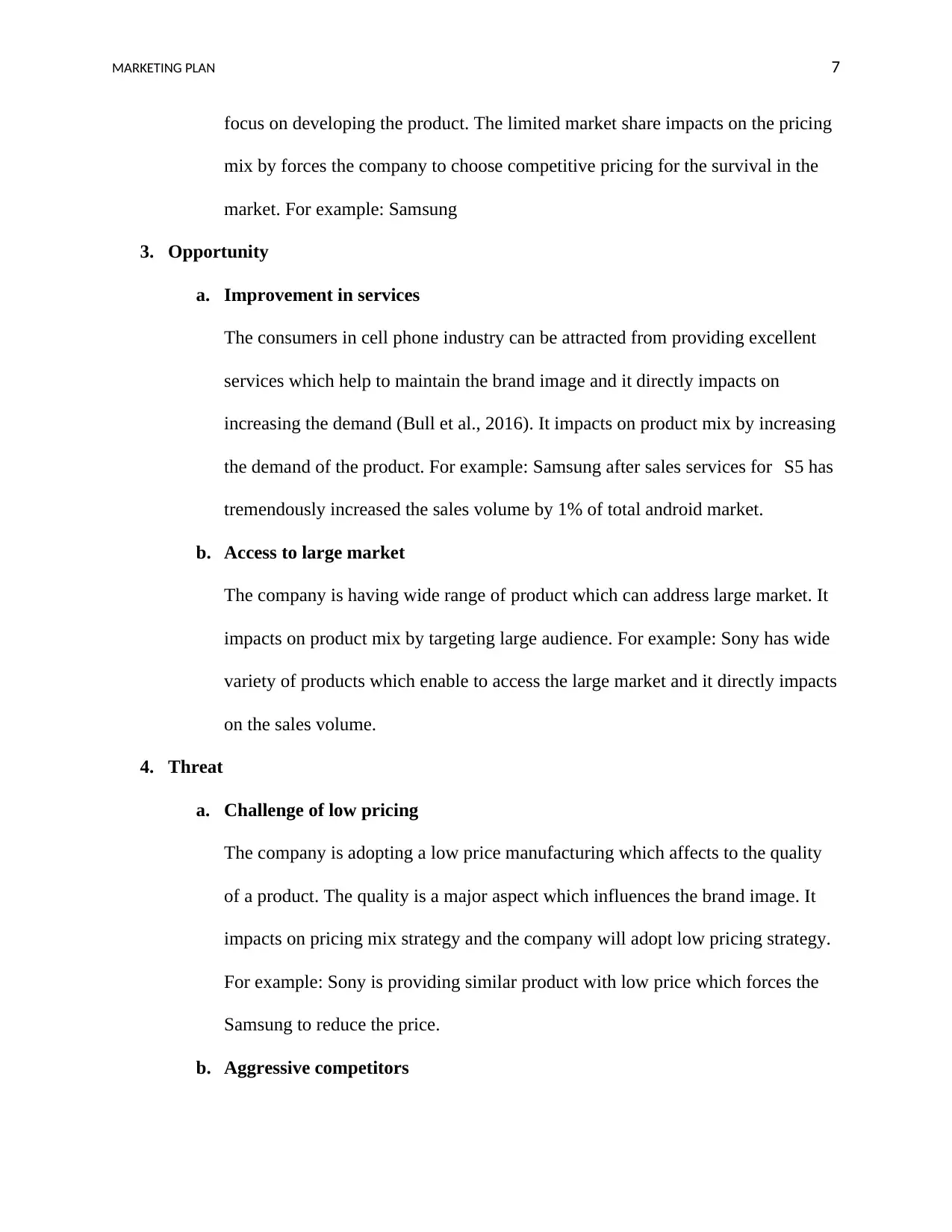
4. Threat
a. Challenge of low pricing
The company is adopting a low price manufacturing which affects to the quality
of a product. The quality is a major aspect which influences the brand image. It
impacts on pricing mix strategy and the company will adopt low pricing strategy.
For example: Sony is providing similar product with low price which forces the
Samsung to reduce the price.
b. Aggressive competitors
focus on developing the product. The limited market share impacts on the pricing
mix by forces the company to choose competitive pricing for the survival in the
market. For example: Samsung
3. Opportunity
a. Improvement in services
The consumers in cell phone industry can be attracted from providing excellent
services which help to maintain the brand image and it directly impacts on
increasing the demand (Bull et al., 2016). It impacts on product mix by increasing
the demand of the product. For example: Samsung after sales services for S5 has
tremendously increased the sales volume by 1% of total android market.
b. Access to large market
The company is having wide range of product which can address large market. It
impacts on product mix by targeting large audience. For example: Sony has wide
variety of products which enable to access the large market and it directly impacts
on the sales volume.
4. Threat
a. Challenge of low pricing
The company is adopting a low price manufacturing which affects to the quality
of a product. The quality is a major aspect which influences the brand image. It
impacts on pricing mix strategy and the company will adopt low pricing strategy.
For example: Sony is providing similar product with low price which forces the
Samsung to reduce the price.
b. Aggressive competitors
MARKETING PLAN 8
There are many competitors in cell phone industry and they are competing with
new technologies and innovations. So the survival in a market is a major threat for
the market. It impacts on promotion mix and the company needs to do more
promotional activities for the survival in a competitive world. For example:
Apple, Sony, HTC is present in the market with advanced technologies which
provide a major competition to Samsung for the survival in the market.
SWOT factors
Following are the five important SWOT factors:
1. Innovative product
The innovative product is strength of the company because it is very necessary for the
survival of the company in a competitive mobile phone industry. It is very important factor
from the marketing prospective because the company needs to new technologies and
innovations.
2. Excellent service
The company needs to provide excellent service to create a brand name in the market which
is very necessary for the survival in the competitive world. It helps in promoting products
and services which directly impacts on sales volume.
3. Aggressive competitors
It is a very important factor because the company needs to compete with existing major
players. The product and services served by competitors needs to be taken into account
before making strategies. It helps in building promotional activities which promote the
products and services.
4. Limited market share
There are many competitors in cell phone industry and they are competing with
new technologies and innovations. So the survival in a market is a major threat for
the market. It impacts on promotion mix and the company needs to do more
promotional activities for the survival in a competitive world. For example:
Apple, Sony, HTC is present in the market with advanced technologies which
provide a major competition to Samsung for the survival in the market.
SWOT factors
Following are the five important SWOT factors:
1. Innovative product
The innovative product is strength of the company because it is very necessary for the
survival of the company in a competitive mobile phone industry. It is very important factor
from the marketing prospective because the company needs to new technologies and
innovations.
2. Excellent service
The company needs to provide excellent service to create a brand name in the market which
is very necessary for the survival in the competitive world. It helps in promoting products
and services which directly impacts on sales volume.
3. Aggressive competitors
It is a very important factor because the company needs to compete with existing major
players. The product and services served by competitors needs to be taken into account
before making strategies. It helps in building promotional activities which promote the
products and services.
4. Limited market share
⊘ This is a preview!⊘
Do you want full access?
Subscribe today to unlock all pages.
Trusted by 1+ million students worldwide
MARKETING PLAN 9
It is also an important factor which needs to be considered because market share is very
necessary for promoting the products and services. The company must consider on the
growth of market share which helps in building the image.
5. Address to large market
The company is having wide range of products which helps to access large market and it is
very necessary for marketing of products and services which directly impacts on the sales
volume.
Target market segmentation
Segmentation approach
The consumer characteristic segmentation approach is used to segment the market on the basis of
demographic characteristics. The characters include age-group, sex, income, family-size,
occupation, level of education and others (Wedel et al., 2012). The consumer characteristic
approach is appropriate for the marketing prospective because of the following reasons:
Consumer characteristic approach helps to segment the market on the basis of
demographic and geographic characteristics which helps to build the marketing strategy
according to the age group, income, occupation and others (Valencia et al., 2016).
The approach helps to build strategy by clearing the vision of target audience according
to the product.
The Consumer product is Samsung galaxy S6, the organization is Samsung and the
marketplace is both online and offline which helps to promote the product widely.
It is also an important factor which needs to be considered because market share is very
necessary for promoting the products and services. The company must consider on the
growth of market share which helps in building the image.
5. Address to large market
The company is having wide range of products which helps to access large market and it is
very necessary for marketing of products and services which directly impacts on the sales
volume.
Target market segmentation
Segmentation approach
The consumer characteristic segmentation approach is used to segment the market on the basis of
demographic characteristics. The characters include age-group, sex, income, family-size,
occupation, level of education and others (Wedel et al., 2012). The consumer characteristic
approach is appropriate for the marketing prospective because of the following reasons:
Consumer characteristic approach helps to segment the market on the basis of
demographic and geographic characteristics which helps to build the marketing strategy
according to the age group, income, occupation and others (Valencia et al., 2016).
The approach helps to build strategy by clearing the vision of target audience according
to the product.
The Consumer product is Samsung galaxy S6, the organization is Samsung and the
marketplace is both online and offline which helps to promote the product widely.
Paraphrase This Document
Need a fresh take? Get an instant paraphrase of this document with our AI Paraphraser
MARKETING PLAN 10
The marketing is done by identifying the target audience and the strategy is decided
according to the type of audience. The consumer characteristic approach helps to identify
all the requirements of marketing.
Thus the consumer characteristic approach is appropriate from the marketing prospective.
Three Target market segments
Following are the three target market segments:
a. Middle class
The summary profile of middle class include the price range acceptable by them, how they
select the particular product, what are the features required by them, market place adopted
by a middle class, what are the expectations, taste and preferences and others. The price
range is lower than elite class, they want more features with in a price range, their
expectations are also high and they purchase to touch the level of elite class. It is one of
the targeted markets for selling Samsung Galaxy S6 because the consumers under middle
class cannot afford luxurious product but they can purchase superior product to come
under elite class. For example: Samsung S5 has targeted middle-class audience and the
company has successfully done by fulfilling the consumer’s expectations.
b. Elite class
The elite class consumers can easily afford the product according to their level of income.
The elite class is focusing on the status and class so they easily purchase by considering
the features of products. The summary profile include rich people who can easily afford
the price range, the market place is mainly offline, the product purchased on the basis of
features and its look. It is the second target market because the consumers can afford its
The marketing is done by identifying the target audience and the strategy is decided
according to the type of audience. The consumer characteristic approach helps to identify
all the requirements of marketing.
Thus the consumer characteristic approach is appropriate from the marketing prospective.
Three Target market segments
Following are the three target market segments:
a. Middle class
The summary profile of middle class include the price range acceptable by them, how they
select the particular product, what are the features required by them, market place adopted
by a middle class, what are the expectations, taste and preferences and others. The price
range is lower than elite class, they want more features with in a price range, their
expectations are also high and they purchase to touch the level of elite class. It is one of
the targeted markets for selling Samsung Galaxy S6 because the consumers under middle
class cannot afford luxurious product but they can purchase superior product to come
under elite class. For example: Samsung S5 has targeted middle-class audience and the
company has successfully done by fulfilling the consumer’s expectations.
b. Elite class
The elite class consumers can easily afford the product according to their level of income.
The elite class is focusing on the status and class so they easily purchase by considering
the features of products. The summary profile include rich people who can easily afford
the price range, the market place is mainly offline, the product purchased on the basis of
features and its look. It is the second target market because the consumers can afford its
MARKETING PLAN 11
price range. For example: Samsung galaxy Note 5 has targeted Elite-class and the
company has successful done.
c. Young generation
The young generation is the third target market because the Youngers are focusing on
purchasing and flaunting expenses products. They are attracted by its brand image and
superior features. The market place is mainly online. The price range is not considered for
targeting the young generation but its features and image helps to attract large number of
consumers. The Samsung S6 is having high brand image and the product is having
advanced technology features which attracts the young generation. The summary profile
includes the age class of 18-30 who are willing to purchase by its looks and advance
features. For example: Samsung Yuva is targeting young generation and the company has
successfully done.
Selected Target market segment
The middle class is chosen over the others because the elite consumers is not having an issue of
price range so they can also purchase a high class product and the young generation also shift its
demand to the other products. The middle class is focusing on purchasing the expensive products
so they can reach at the elite class and they cannot afford higher than this price range so they are
the primary target audience. The marketing of middle class audience is done through
advertisement, promotional activities such as discount, coupons and others (Abeza et al., 2014).
The company can make marketing on the basis of social class and income. The income level of
middle class is also average so the pricing of Samsung galaxy S6 is also comes under the income
level of middle class. The middle class is the primary target audience because it is suitable from
every aspect which includes pricing, features and others. The middle class is more emotional
price range. For example: Samsung galaxy Note 5 has targeted Elite-class and the
company has successful done.
c. Young generation
The young generation is the third target market because the Youngers are focusing on
purchasing and flaunting expenses products. They are attracted by its brand image and
superior features. The market place is mainly online. The price range is not considered for
targeting the young generation but its features and image helps to attract large number of
consumers. The Samsung S6 is having high brand image and the product is having
advanced technology features which attracts the young generation. The summary profile
includes the age class of 18-30 who are willing to purchase by its looks and advance
features. For example: Samsung Yuva is targeting young generation and the company has
successfully done.
Selected Target market segment
The middle class is chosen over the others because the elite consumers is not having an issue of
price range so they can also purchase a high class product and the young generation also shift its
demand to the other products. The middle class is focusing on purchasing the expensive products
so they can reach at the elite class and they cannot afford higher than this price range so they are
the primary target audience. The marketing of middle class audience is done through
advertisement, promotional activities such as discount, coupons and others (Abeza et al., 2014).
The company can make marketing on the basis of social class and income. The income level of
middle class is also average so the pricing of Samsung galaxy S6 is also comes under the income
level of middle class. The middle class is the primary target audience because it is suitable from
every aspect which includes pricing, features and others. The middle class is more emotional
⊘ This is a preview!⊘
Do you want full access?
Subscribe today to unlock all pages.
Trusted by 1+ million students worldwide

1 out of 32


Related Documents


Your All-in-One AI-Powered Toolkit for Academic Success.
+13062052269
info@desklib.com
Available 24*7 on WhatsApp / Email
![[object Object]](/_next/static/media/star-bottom.7253800d.svg)
Unlock your academic potential
Copyright © 2020–2025 A2Z Services. All Rights Reserved. Developed and managed by ZUCOL.