Financial Analysis: Metropolis Health System Prosthetic Department
VerifiedAdded on  2022/08/12
|8
|1993
|439
Case Study
AI Summary
This case study analyzes the financial feasibility of establishing a prosthetic and assisted equipment department within the Metropolis Health System (MHS). The study begins by outlining the goals of the project, which aims to enhance MHS's service offerings and expand its business. It then details the costs associated with the project, including equipment purchases, room costs, and initial expenses. A comprehensive budget and financial analysis is presented, projecting revenue, expenses, and profitability over five years. Key assumptions such as service price, demand growth, and financing terms are clearly stated. The analysis calculates profit after tax, cash flow, Net Present Value (NPV), and Internal Rate of Return (IRR) to assess the project's financial viability. A sensitivity analysis is also conducted to evaluate the impact of changes in demand on the project's profitability. The study concludes that the project is financially feasible, recommending its implementation as a business expansion strategy for MHS. References and bibliography are included.
Running head: HEALTH CARE FINANCE
Health Care Finance
Name of the Student:
Name of the University:
Author’s Note:
Health Care Finance
Name of the Student:
Name of the University:
Author’s Note:
Paraphrase This Document
Need a fresh take? Get an instant paraphrase of this document with our AI Paraphraser

1HEALTH CARE FINANCE
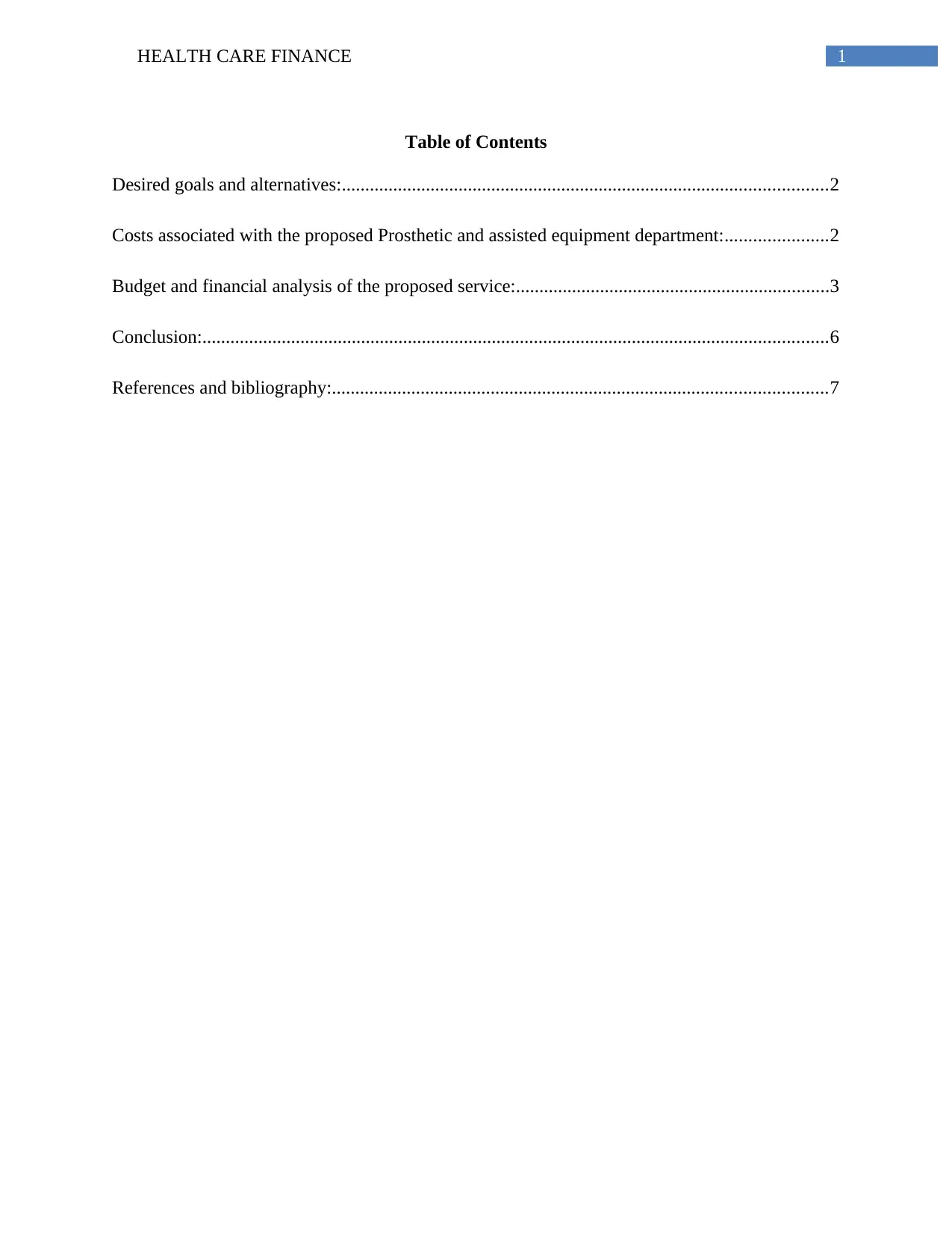
Table of Contents
Desired goals and alternatives:........................................................................................................2
Costs associated with the proposed Prosthetic and assisted equipment department:......................2
Budget and financial analysis of the proposed service:...................................................................3
Conclusion:......................................................................................................................................6
References and bibliography:..........................................................................................................7
Table of Contents
Desired goals and alternatives:........................................................................................................2
Costs associated with the proposed Prosthetic and assisted equipment department:......................2
Budget and financial analysis of the proposed service:...................................................................3
Conclusion:......................................................................................................................................6
References and bibliography:..........................................................................................................7

2HEALTH CARE FINANCE
Desired goals and alternatives:
The Metropolis Health System (MHS) is a health care service provider, providing various
integrated healthcare services with their advanced medical equipments. Based on their quality of
services they have been established as a well known brand in the health care service industry.
Their health care services include rehabilitation and wellness, same day surgery, skilled nursing
facility, community health and wellness services and home health services. Based on their
quality of service they have been able to gain a huge market share and to become one of the
leading organizations in the health care industry. As a business growth strategy, the organization
is going to adopt certain projects in the near future. There are various services or projects
available to the organization which can be selected as a growth or business expansion. In this
case study, the Prosthetic and assisted equipment department has been proposed as the new
project as a business expansion strategy to assist the ambulatory service and enhance the
facilities (Kengatharan & Prashanth Diluxshan 2017). It will include a wide range of therapy and
respiratory services to enhance their healthcare services. The goal of the proposed project is to
enhance the quality of their health care services and to add a new service segment in their service
line.
Costs associated with the proposed Prosthetic and assisted equipment department:
The prosthetic and assisted equipment department will be established with the high end
medical equipments and facilities. The department will be fully equipped and able to provide any
kind of such services with those equipments and highly trained and professional personnel.
Therefore, the main cost in establishing the project is the purchasing cost of such equipments, it
has been assumed that the purchasing costs of equipment will be $20,000 and the room allocated
Desired goals and alternatives:
The Metropolis Health System (MHS) is a health care service provider, providing various
integrated healthcare services with their advanced medical equipments. Based on their quality of
services they have been established as a well known brand in the health care service industry.
Their health care services include rehabilitation and wellness, same day surgery, skilled nursing
facility, community health and wellness services and home health services. Based on their
quality of service they have been able to gain a huge market share and to become one of the
leading organizations in the health care industry. As a business growth strategy, the organization
is going to adopt certain projects in the near future. There are various services or projects
available to the organization which can be selected as a growth or business expansion. In this
case study, the Prosthetic and assisted equipment department has been proposed as the new
project as a business expansion strategy to assist the ambulatory service and enhance the
facilities (Kengatharan & Prashanth Diluxshan 2017). It will include a wide range of therapy and
respiratory services to enhance their healthcare services. The goal of the proposed project is to
enhance the quality of their health care services and to add a new service segment in their service
line.
Costs associated with the proposed Prosthetic and assisted equipment department:
The prosthetic and assisted equipment department will be established with the high end
medical equipments and facilities. The department will be fully equipped and able to provide any
kind of such services with those equipments and highly trained and professional personnel.
Therefore, the main cost in establishing the project is the purchasing cost of such equipments, it
has been assumed that the purchasing costs of equipment will be $20,000 and the room allocated
⊘ This is a preview!⊘
Do you want full access?
Subscribe today to unlock all pages.

Trusted by 1+ million students worldwide

3HEALTH CARE FINANCE
for the service will have an opportunity cost of $2,000 per month. To forecast about the expected
demand of the service and to study the market there will be and expenses of $5,000 in the initial
year, which is considered as the sunk cost. Based on the expected demand for the service and
estimated expenses to operate the department, following budgets and financial analysis can be
made further (Kengatharan & Prashanth Diluxshan 2017).
Budget and financial analysis of the proposed service:
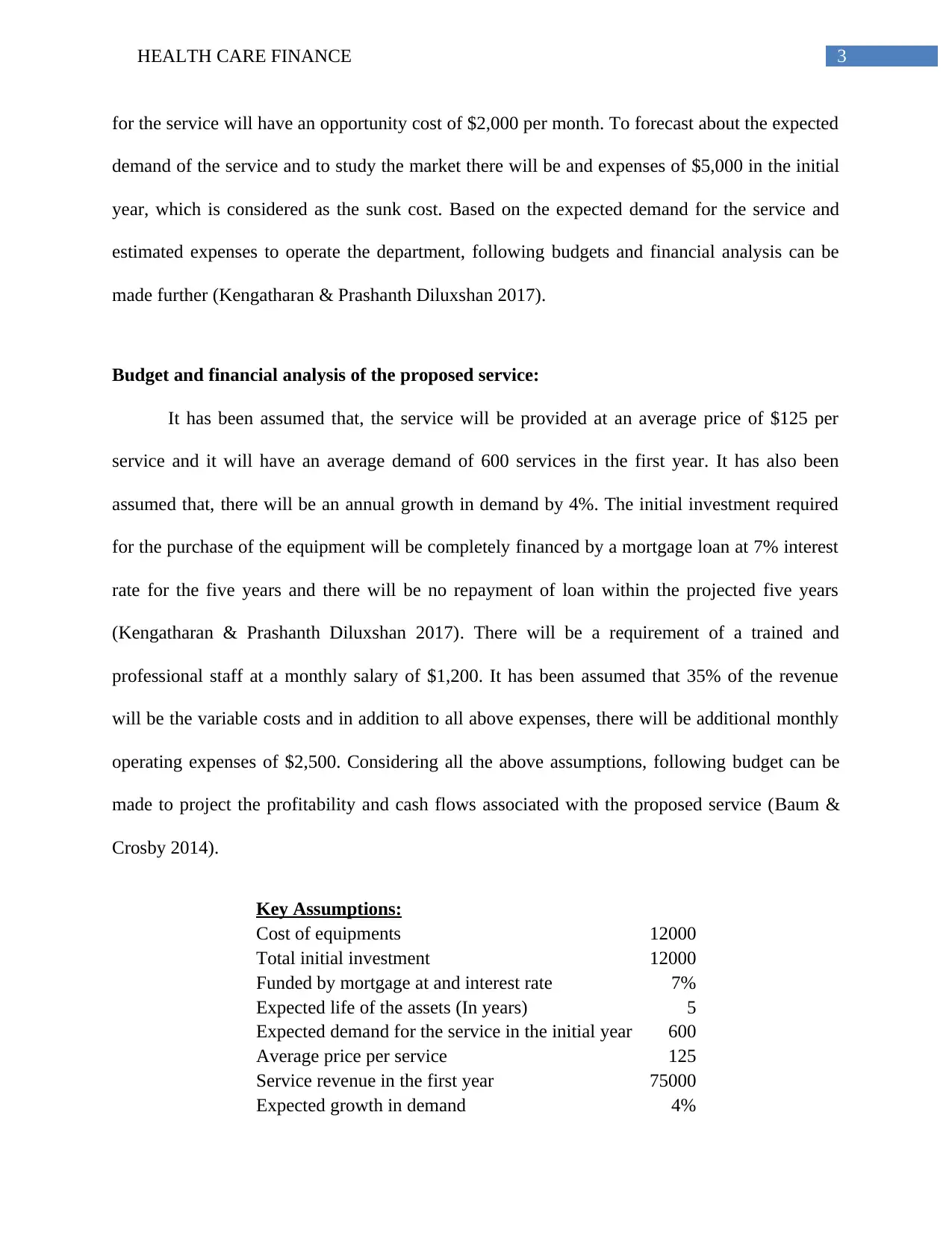
It has been assumed that, the service will be provided at an average price of $125 per
service and it will have an average demand of 600 services in the first year. It has also been
assumed that, there will be an annual growth in demand by 4%. The initial investment required
for the purchase of the equipment will be completely financed by a mortgage loan at 7% interest
rate for the five years and there will be no repayment of loan within the projected five years
(Kengatharan & Prashanth Diluxshan 2017). There will be a requirement of a trained and
professional staff at a monthly salary of $1,200. It has been assumed that 35% of the revenue
will be the variable costs and in addition to all above expenses, there will be additional monthly
operating expenses of $2,500. Considering all the above assumptions, following budget can be
made to project the profitability and cash flows associated with the proposed service (Baum &
Crosby 2014).
Key Assumptions:
Cost of equipments 12000
Total initial investment 12000
Funded by mortgage at and interest rate 7%
Expected life of the assets (In years) 5
Expected demand for the service in the initial year 600
Average price per service 125
Service revenue in the first year 75000
Expected growth in demand 4%
for the service will have an opportunity cost of $2,000 per month. To forecast about the expected
demand of the service and to study the market there will be and expenses of $5,000 in the initial
year, which is considered as the sunk cost. Based on the expected demand for the service and
estimated expenses to operate the department, following budgets and financial analysis can be
made further (Kengatharan & Prashanth Diluxshan 2017).
Budget and financial analysis of the proposed service:
It has been assumed that, the service will be provided at an average price of $125 per
service and it will have an average demand of 600 services in the first year. It has also been
assumed that, there will be an annual growth in demand by 4%. The initial investment required
for the purchase of the equipment will be completely financed by a mortgage loan at 7% interest
rate for the five years and there will be no repayment of loan within the projected five years
(Kengatharan & Prashanth Diluxshan 2017). There will be a requirement of a trained and
professional staff at a monthly salary of $1,200. It has been assumed that 35% of the revenue
will be the variable costs and in addition to all above expenses, there will be additional monthly
operating expenses of $2,500. Considering all the above assumptions, following budget can be
made to project the profitability and cash flows associated with the proposed service (Baum &
Crosby 2014).
Key Assumptions:
Cost of equipments 12000
Total initial investment 12000
Funded by mortgage at and interest rate 7%
Expected life of the assets (In years) 5
Expected demand for the service in the initial year 600
Average price per service 125
Service revenue in the first year 75000
Expected growth in demand 4%
Paraphrase This Document
Need a fresh take? Get an instant paraphrase of this document with our AI Paraphraser

4HEALTH CARE FINANCE
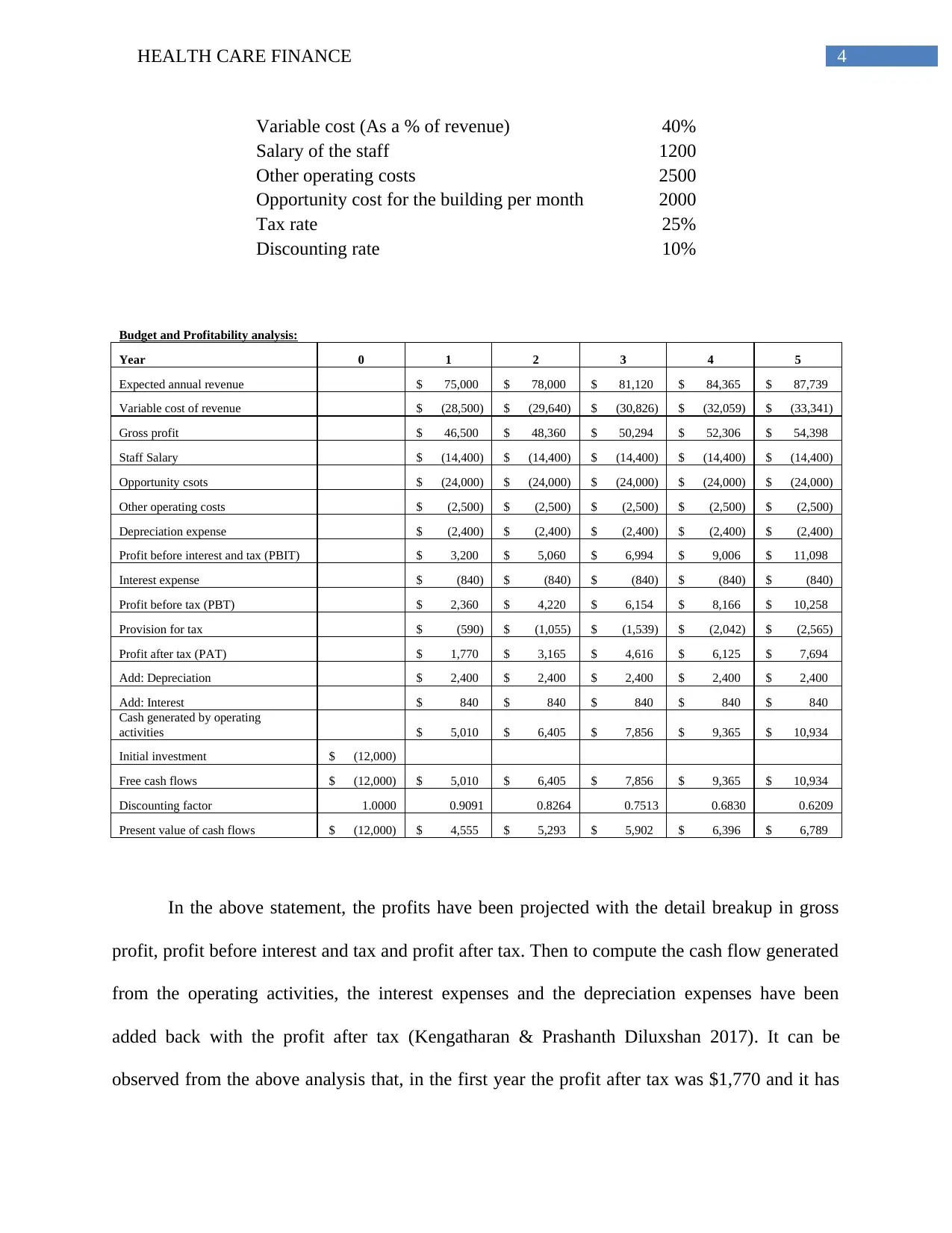
Variable cost (As a % of revenue) 40%
Salary of the staff 1200
Other operating costs 2500
Opportunity cost for the building per month 2000
Tax rate 25%
Discounting rate 10%
Budget and Profitability analysis:
Year 0 1 2 3 4 5
Expected annual revenue $ 75,000 $ 78,000 $ 81,120 $ 84,365 $ 87,739
Variable cost of revenue $ (28,500) $ (29,640) $ (30,826) $ (32,059) $ (33,341)
Gross profit $ 46,500 $ 48,360 $ 50,294 $ 52,306 $ 54,398
Staff Salary $ (14,400) $ (14,400) $ (14,400) $ (14,400) $ (14,400)
Opportunity csots $ (24,000) $ (24,000) $ (24,000) $ (24,000) $ (24,000)
Other operating costs $ (2,500) $ (2,500) $ (2,500) $ (2,500) $ (2,500)
Depreciation expense $ (2,400) $ (2,400) $ (2,400) $ (2,400) $ (2,400)
Profit before interest and tax (PBIT) $ 3,200 $ 5,060 $ 6,994 $ 9,006 $ 11,098
Interest expense $ (840) $ (840) $ (840) $ (840) $ (840)
Profit before tax (PBT) $ 2,360 $ 4,220 $ 6,154 $ 8,166 $ 10,258
Provision for tax $ (590) $ (1,055) $ (1,539) $ (2,042) $ (2,565)
Profit after tax (PAT) $ 1,770 $ 3,165 $ 4,616 $ 6,125 $ 7,694
Add: Depreciation $ 2,400 $ 2,400 $ 2,400 $ 2,400 $ 2,400
Add: Interest $ 840 $ 840 $ 840 $ 840 $ 840
Cash generated by operating
activities $ 5,010 $ 6,405 $ 7,856 $ 9,365 $ 10,934
Initial investment $ (12,000)
Free cash flows $ (12,000) $ 5,010 $ 6,405 $ 7,856 $ 9,365 $ 10,934
Discounting factor 1.0000 0.9091 0.8264 0.7513 0.6830 0.6209
Present value of cash flows $ (12,000) $ 4,555 $ 5,293 $ 5,902 $ 6,396 $ 6,789
In the above statement, the profits have been projected with the detail breakup in gross
profit, profit before interest and tax and profit after tax. Then to compute the cash flow generated
from the operating activities, the interest expenses and the depreciation expenses have been
added back with the profit after tax (Kengatharan & Prashanth Diluxshan 2017). It can be
observed from the above analysis that, in the first year the profit after tax was $1,770 and it has
Variable cost (As a % of revenue) 40%
Salary of the staff 1200
Other operating costs 2500
Opportunity cost for the building per month 2000
Tax rate 25%
Discounting rate 10%
Budget and Profitability analysis:
Year 0 1 2 3 4 5
Expected annual revenue $ 75,000 $ 78,000 $ 81,120 $ 84,365 $ 87,739
Variable cost of revenue $ (28,500) $ (29,640) $ (30,826) $ (32,059) $ (33,341)
Gross profit $ 46,500 $ 48,360 $ 50,294 $ 52,306 $ 54,398
Staff Salary $ (14,400) $ (14,400) $ (14,400) $ (14,400) $ (14,400)
Opportunity csots $ (24,000) $ (24,000) $ (24,000) $ (24,000) $ (24,000)
Other operating costs $ (2,500) $ (2,500) $ (2,500) $ (2,500) $ (2,500)
Depreciation expense $ (2,400) $ (2,400) $ (2,400) $ (2,400) $ (2,400)
Profit before interest and tax (PBIT) $ 3,200 $ 5,060 $ 6,994 $ 9,006 $ 11,098
Interest expense $ (840) $ (840) $ (840) $ (840) $ (840)
Profit before tax (PBT) $ 2,360 $ 4,220 $ 6,154 $ 8,166 $ 10,258
Provision for tax $ (590) $ (1,055) $ (1,539) $ (2,042) $ (2,565)
Profit after tax (PAT) $ 1,770 $ 3,165 $ 4,616 $ 6,125 $ 7,694
Add: Depreciation $ 2,400 $ 2,400 $ 2,400 $ 2,400 $ 2,400
Add: Interest $ 840 $ 840 $ 840 $ 840 $ 840
Cash generated by operating
activities $ 5,010 $ 6,405 $ 7,856 $ 9,365 $ 10,934
Initial investment $ (12,000)
Free cash flows $ (12,000) $ 5,010 $ 6,405 $ 7,856 $ 9,365 $ 10,934
Discounting factor 1.0000 0.9091 0.8264 0.7513 0.6830 0.6209
Present value of cash flows $ (12,000) $ 4,555 $ 5,293 $ 5,902 $ 6,396 $ 6,789
In the above statement, the profits have been projected with the detail breakup in gross
profit, profit before interest and tax and profit after tax. Then to compute the cash flow generated
from the operating activities, the interest expenses and the depreciation expenses have been
added back with the profit after tax (Kengatharan & Prashanth Diluxshan 2017). It can be
observed from the above analysis that, in the first year the profit after tax was $1,770 and it has

5HEALTH CARE FINANCE
been increased to $7,694 in the fifth year. On other hand, the cash flow generated from
operations was $5,010 in the initial year and it has been increased to $10,934 in the last year.
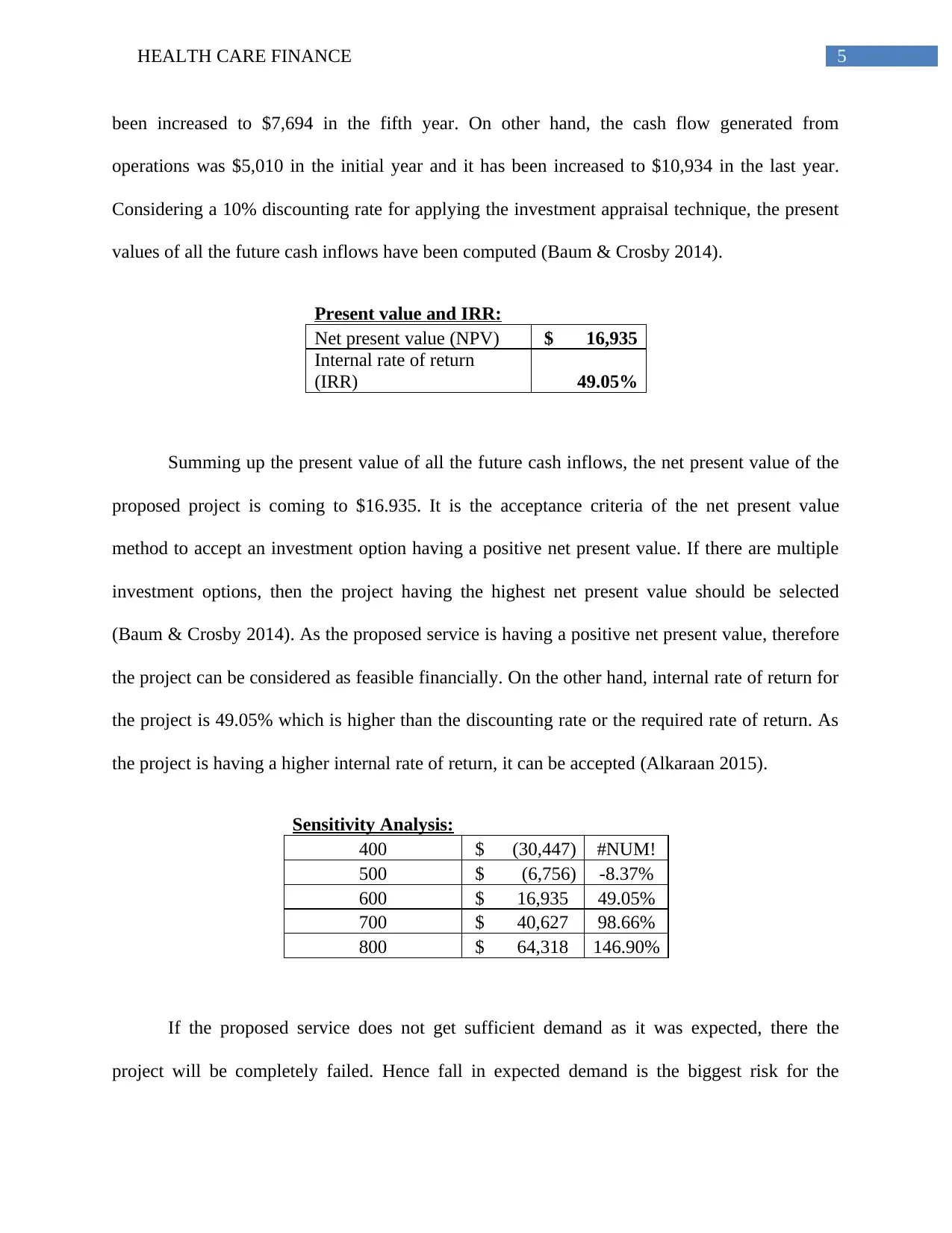
Considering a 10% discounting rate for applying the investment appraisal technique, the present
values of all the future cash inflows have been computed (Baum & Crosby 2014).
Present value and IRR:
Net present value (NPV) $ 16,935
Internal rate of return
(IRR) 49.05%
Summing up the present value of all the future cash inflows, the net present value of the
proposed project is coming to $16.935. It is the acceptance criteria of the net present value
method to accept an investment option having a positive net present value. If there are multiple
investment options, then the project having the highest net present value should be selected
(Baum & Crosby 2014). As the proposed service is having a positive net present value, therefore
the project can be considered as feasible financially. On the other hand, internal rate of return for
the project is 49.05% which is higher than the discounting rate or the required rate of return. As
the project is having a higher internal rate of return, it can be accepted (Alkaraan 2015).
Sensitivity Analysis:
400 $ (30,447) #NUM!
500 $ (6,756) -8.37%
600 $ 16,935 49.05%
700 $ 40,627 98.66%
800 $ 64,318 146.90%
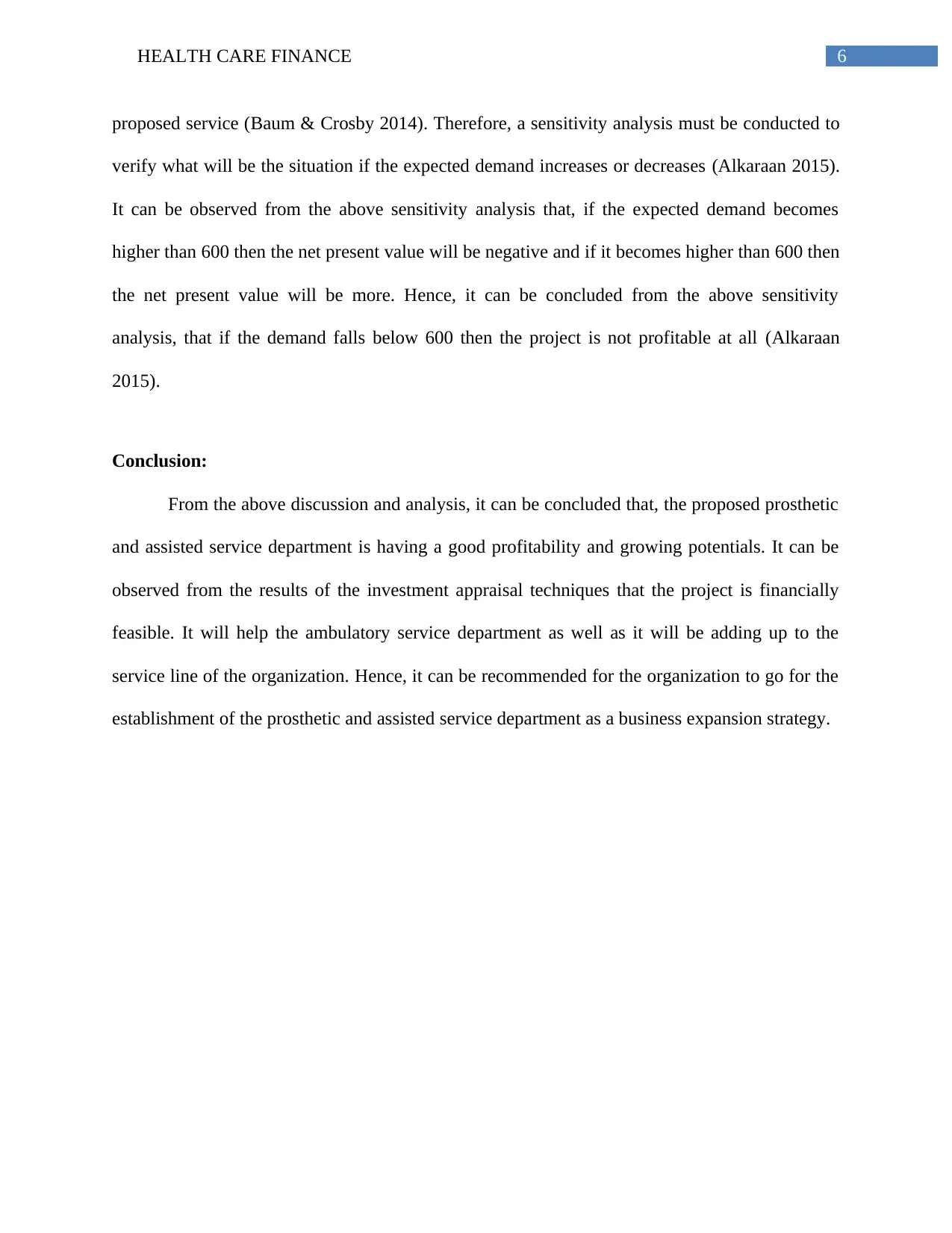
If the proposed service does not get sufficient demand as it was expected, there the
project will be completely failed. Hence fall in expected demand is the biggest risk for the
been increased to $7,694 in the fifth year. On other hand, the cash flow generated from
operations was $5,010 in the initial year and it has been increased to $10,934 in the last year.
Considering a 10% discounting rate for applying the investment appraisal technique, the present
values of all the future cash inflows have been computed (Baum & Crosby 2014).
Present value and IRR:
Net present value (NPV) $ 16,935
Internal rate of return
(IRR) 49.05%
Summing up the present value of all the future cash inflows, the net present value of the
proposed project is coming to $16.935. It is the acceptance criteria of the net present value
method to accept an investment option having a positive net present value. If there are multiple
investment options, then the project having the highest net present value should be selected
(Baum & Crosby 2014). As the proposed service is having a positive net present value, therefore
the project can be considered as feasible financially. On the other hand, internal rate of return for
the project is 49.05% which is higher than the discounting rate or the required rate of return. As
the project is having a higher internal rate of return, it can be accepted (Alkaraan 2015).
Sensitivity Analysis:
400 $ (30,447) #NUM!
500 $ (6,756) -8.37%
600 $ 16,935 49.05%
700 $ 40,627 98.66%
800 $ 64,318 146.90%
If the proposed service does not get sufficient demand as it was expected, there the
project will be completely failed. Hence fall in expected demand is the biggest risk for the
⊘ This is a preview!⊘
Do you want full access?
Subscribe today to unlock all pages.

Trusted by 1+ million students worldwide

6HEALTH CARE FINANCE
proposed service (Baum & Crosby 2014). Therefore, a sensitivity analysis must be conducted to
verify what will be the situation if the expected demand increases or decreases (Alkaraan 2015).
It can be observed from the above sensitivity analysis that, if the expected demand becomes
higher than 600 then the net present value will be negative and if it becomes higher than 600 then
the net present value will be more. Hence, it can be concluded from the above sensitivity
analysis, that if the demand falls below 600 then the project is not profitable at all (Alkaraan
2015).
Conclusion:
From the above discussion and analysis, it can be concluded that, the proposed prosthetic
and assisted service department is having a good profitability and growing potentials. It can be
observed from the results of the investment appraisal techniques that the project is financially
feasible. It will help the ambulatory service department as well as it will be adding up to the
service line of the organization. Hence, it can be recommended for the organization to go for the
establishment of the prosthetic and assisted service department as a business expansion strategy.
proposed service (Baum & Crosby 2014). Therefore, a sensitivity analysis must be conducted to
verify what will be the situation if the expected demand increases or decreases (Alkaraan 2015).
It can be observed from the above sensitivity analysis that, if the expected demand becomes
higher than 600 then the net present value will be negative and if it becomes higher than 600 then
the net present value will be more. Hence, it can be concluded from the above sensitivity
analysis, that if the demand falls below 600 then the project is not profitable at all (Alkaraan
2015).
Conclusion:
From the above discussion and analysis, it can be concluded that, the proposed prosthetic
and assisted service department is having a good profitability and growing potentials. It can be
observed from the results of the investment appraisal techniques that the project is financially
feasible. It will help the ambulatory service department as well as it will be adding up to the
service line of the organization. Hence, it can be recommended for the organization to go for the
establishment of the prosthetic and assisted service department as a business expansion strategy.
Paraphrase This Document
Need a fresh take? Get an instant paraphrase of this document with our AI Paraphraser

7HEALTH CARE FINANCE
References and bibliography:
Alkaraan, F. (2015). Strategic investment decision-making perspectives. Advances in mergers
and acquisitions, 14, 53-66.
Awojobi, O., & Jenkins, G. P. (2016). Managing the cost overrun risks of hydroelectric dams:
An application of reference class forecasting techniques. Renewable and Sustainable
Energy Reviews, 63, 19-32.
Baum, A. E., & Crosby, N. (2014). Property investment appraisal. John Wiley & Sons.
Dagar, A. (2014). Review of performance appraisal techniques. International Research Journal
of Commerce Arts and Science, 5(10), 16-23.
Harris, E. (2017). Strategic project risk appraisal and management. Routledge.
Higham, A. P., Fortune, C., & Boothman, J. C. (2016). Sustainability and investment appraisal
for housing regeneration projects. Structural Survey.
Kengatharan, L., & Prashanth Diluxshan, C. (2017). Use of Capital Investment Appraisal
Practices and Effectiveness of Investment Decisions: A Study on Listed Manufacturing
Companies in Sri Lanka. Asian Journal of Finance & Accounting, 9(2), 287-306.
Sims, J., Powell, P., & Vidgen, R. (2015). Investment appraisal and evaluation: preserving tacit
knowledge and competitive advantage. International Journal of Business and Systems
Research, 9(1), 86-103.
Throsby, D. (2016). Investment in urban heritage conservation in developing countries:
Concepts, methods and data. City, Culture and Society, 7(2), 81-86.
References and bibliography:
Alkaraan, F. (2015). Strategic investment decision-making perspectives. Advances in mergers
and acquisitions, 14, 53-66.
Awojobi, O., & Jenkins, G. P. (2016). Managing the cost overrun risks of hydroelectric dams:
An application of reference class forecasting techniques. Renewable and Sustainable
Energy Reviews, 63, 19-32.
Baum, A. E., & Crosby, N. (2014). Property investment appraisal. John Wiley & Sons.
Dagar, A. (2014). Review of performance appraisal techniques. International Research Journal
of Commerce Arts and Science, 5(10), 16-23.
Harris, E. (2017). Strategic project risk appraisal and management. Routledge.
Higham, A. P., Fortune, C., & Boothman, J. C. (2016). Sustainability and investment appraisal
for housing regeneration projects. Structural Survey.
Kengatharan, L., & Prashanth Diluxshan, C. (2017). Use of Capital Investment Appraisal
Practices and Effectiveness of Investment Decisions: A Study on Listed Manufacturing
Companies in Sri Lanka. Asian Journal of Finance & Accounting, 9(2), 287-306.
Sims, J., Powell, P., & Vidgen, R. (2015). Investment appraisal and evaluation: preserving tacit
knowledge and competitive advantage. International Journal of Business and Systems
Research, 9(1), 86-103.
Throsby, D. (2016). Investment in urban heritage conservation in developing countries:
Concepts, methods and data. City, Culture and Society, 7(2), 81-86.
1 out of 8
Related Documents
Your All-in-One AI-Powered Toolkit for Academic Success.
 +13062052269
info@desklib.com
Available 24*7 on WhatsApp / Email
Unlock your academic potential
Copyright © 2020–2026 A2Z Services. All Rights Reserved. Developed and managed by ZUCOL.