Performance Management: Theories, Models, and Validation Processes
VerifiedAdded on 2023/06/03
|8
|1489
|410
Report
AI Summary
This report provides an overview of performance management, highlighting key theories and models used by organizations to evaluate employee performance and achieve objectives. It discusses the Balanced Scorecard, a widely used system that considers both leading and lagging indicators, as well as the Performance Prism, a customizable method focusing on stakeholder contributions and satisfaction. The report also examines RAG analysis as a warning system and various quality management processes like Total Quality Management and Six Sigma. Finally, it validates the importance of performance measurement in improving employee motivation, identifying weaknesses, and facilitating informed decision-making. Desklib offers this solved assignment and many other resources to support student learning.
Running head: PERFORMANCE MANAGEMENT
Performance Management
Name of the Student
Name of the University
Author Note
Performance Management
Name of the Student
Name of the University
Author Note
Paraphrase This Document
Need a fresh take? Get an instant paraphrase of this document with our AI Paraphraser

1PERFORMANCE MANAGEMENT
Table of Contents
Introduction......................................................................................................................................2
Balanced Scorecard.........................................................................................................................2
Performance Prism...........................................................................................................................3
RAG Analysis..................................................................................................................................4
Quality Management.......................................................................................................................5
Validation of the Processes..............................................................................................................5
Conclusion.......................................................................................................................................6
References........................................................................................................................................7
Table of Contents
Introduction......................................................................................................................................2
Balanced Scorecard.........................................................................................................................2
Performance Prism...........................................................................................................................3
RAG Analysis..................................................................................................................................4
Quality Management.......................................................................................................................5
Validation of the Processes..............................................................................................................5
Conclusion.......................................................................................................................................6
References........................................................................................................................................7

2PERFORMANCE MANAGEMENT
Introduction
Performance Measurement serves as a key to the success of many international
organisations. Firms use various tools and systems to take care of the performances of the
various departments of employees. It can be stated that performance management involves a
stringent measurement system. This system consists of tools and techniques that enables a
management of a firm to plan, evaluate and measure the performances of individual employees
which in turn enable the firm to set objectives and understand to what extent the goals are being
achieved by the firm (Johnson, Beiman and Thompson 2007). This measurement involves a lot
of variables and is generally dependent on the productivity level changes. There are many
theories and models of performance management which are used for performance management
evaluation. This report focuses on these theories and models and studies them in detail.
Balanced Scorecard
A balanced scorecard is one of the few tools used for performance management in any
firm. It is asserted to be the most widely used systems of performance management in the firms
recently. This method is perceived to also be the most balanced forms of performance
management as it helps in identifying both the lags and the leaders in every department
(Bhattacharya et al. 2014). There are various variables used in the process and some of these
variables used include new product development, customer satisfaction index, employee
motivation and development and on- time delivery (leading indicators). The other variables
include revenue growth, profitability and other financial variables (lagging indicators). The type
Introduction
Performance Measurement serves as a key to the success of many international
organisations. Firms use various tools and systems to take care of the performances of the
various departments of employees. It can be stated that performance management involves a
stringent measurement system. This system consists of tools and techniques that enables a
management of a firm to plan, evaluate and measure the performances of individual employees
which in turn enable the firm to set objectives and understand to what extent the goals are being
achieved by the firm (Johnson, Beiman and Thompson 2007). This measurement involves a lot
of variables and is generally dependent on the productivity level changes. There are many
theories and models of performance management which are used for performance management
evaluation. This report focuses on these theories and models and studies them in detail.
Balanced Scorecard
A balanced scorecard is one of the few tools used for performance management in any
firm. It is asserted to be the most widely used systems of performance management in the firms
recently. This method is perceived to also be the most balanced forms of performance
management as it helps in identifying both the lags and the leaders in every department
(Bhattacharya et al. 2014). There are various variables used in the process and some of these
variables used include new product development, customer satisfaction index, employee
motivation and development and on- time delivery (leading indicators). The other variables
include revenue growth, profitability and other financial variables (lagging indicators). The type
⊘ This is a preview!⊘
Do you want full access?
Subscribe today to unlock all pages.

Trusted by 1+ million students worldwide

3PERFORMANCE MANAGEMENT
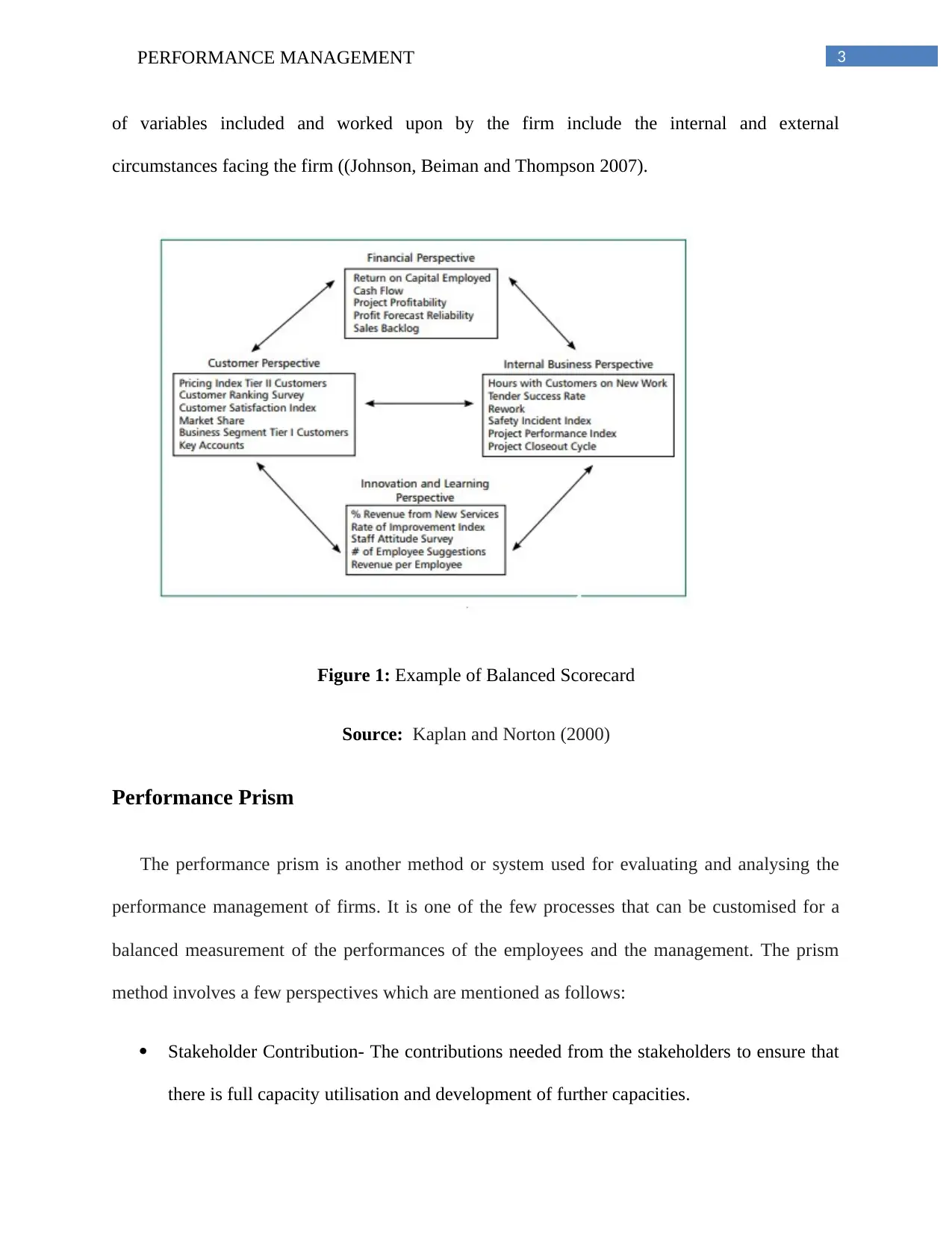
of variables included and worked upon by the firm include the internal and external
circumstances facing the firm ((Johnson, Beiman and Thompson 2007).
Figure 1: Example of Balanced Scorecard
Source: Kaplan and Norton (2000)
Performance Prism
The performance prism is another method or system used for evaluating and analysing the
performance management of firms. It is one of the few processes that can be customised for a
balanced measurement of the performances of the employees and the management. The prism
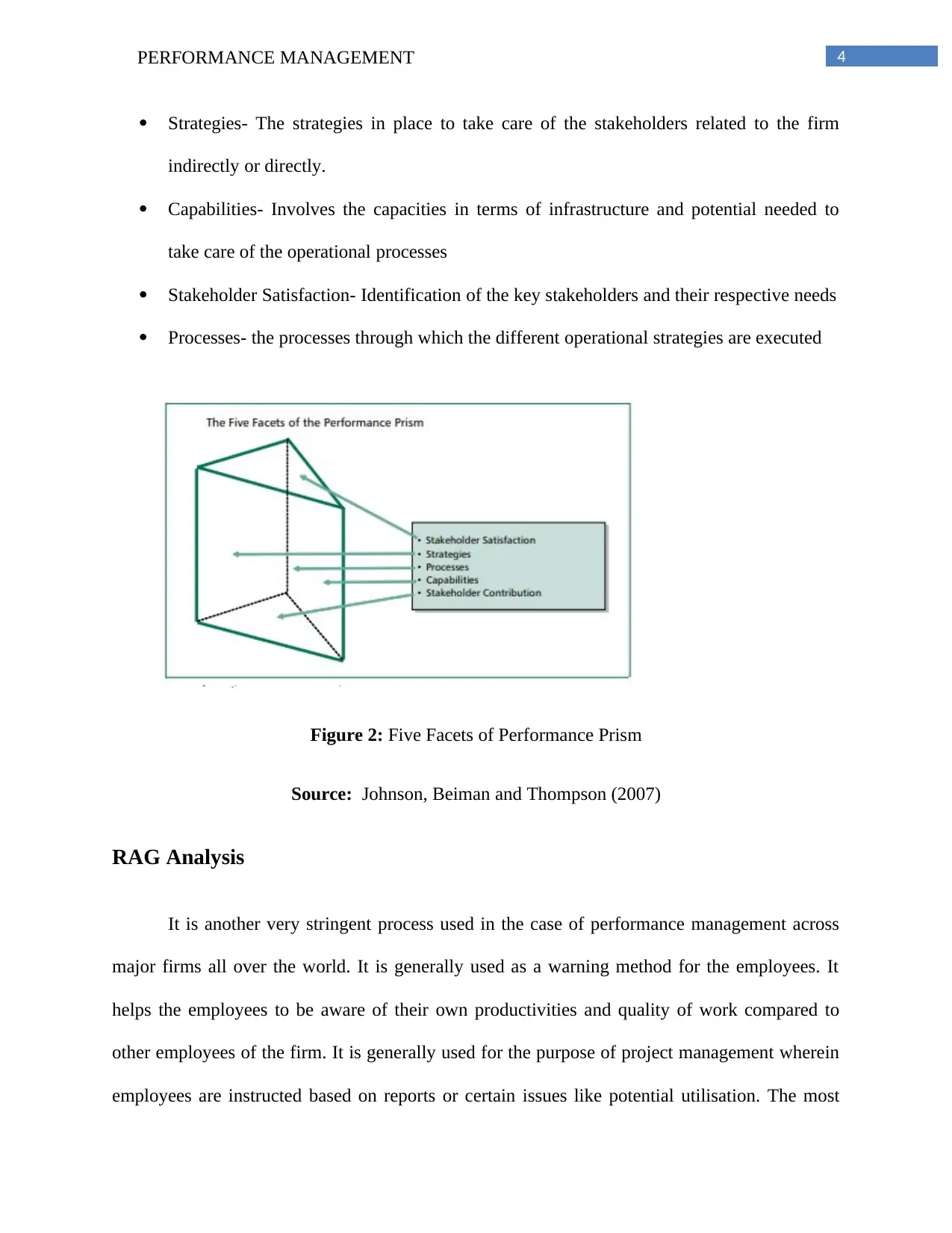
method involves a few perspectives which are mentioned as follows:
Stakeholder Contribution- The contributions needed from the stakeholders to ensure that
there is full capacity utilisation and development of further capacities.
of variables included and worked upon by the firm include the internal and external
circumstances facing the firm ((Johnson, Beiman and Thompson 2007).
Figure 1: Example of Balanced Scorecard
Source: Kaplan and Norton (2000)
Performance Prism
The performance prism is another method or system used for evaluating and analysing the
performance management of firms. It is one of the few processes that can be customised for a
balanced measurement of the performances of the employees and the management. The prism
method involves a few perspectives which are mentioned as follows:
Stakeholder Contribution- The contributions needed from the stakeholders to ensure that
there is full capacity utilisation and development of further capacities.
Paraphrase This Document
Need a fresh take? Get an instant paraphrase of this document with our AI Paraphraser

4PERFORMANCE MANAGEMENT
Strategies- The strategies in place to take care of the stakeholders related to the firm
indirectly or directly.
Capabilities- Involves the capacities in terms of infrastructure and potential needed to
take care of the operational processes
Stakeholder Satisfaction- Identification of the key stakeholders and their respective needs
Processes- the processes through which the different operational strategies are executed
Figure 2: Five Facets of Performance Prism
Source: Johnson, Beiman and Thompson (2007)
RAG Analysis
It is another very stringent process used in the case of performance management across
major firms all over the world. It is generally used as a warning method for the employees. It
helps the employees to be aware of their own productivities and quality of work compared to
other employees of the firm. It is generally used for the purpose of project management wherein
employees are instructed based on reports or certain issues like potential utilisation. The most
Strategies- The strategies in place to take care of the stakeholders related to the firm
indirectly or directly.
Capabilities- Involves the capacities in terms of infrastructure and potential needed to
take care of the operational processes
Stakeholder Satisfaction- Identification of the key stakeholders and their respective needs
Processes- the processes through which the different operational strategies are executed
Figure 2: Five Facets of Performance Prism
Source: Johnson, Beiman and Thompson (2007)
RAG Analysis
It is another very stringent process used in the case of performance management across
major firms all over the world. It is generally used as a warning method for the employees. It
helps the employees to be aware of their own productivities and quality of work compared to
other employees of the firm. It is generally used for the purpose of project management wherein
employees are instructed based on reports or certain issues like potential utilisation. The most

5PERFORMANCE MANAGEMENT
recent form of toolkit used involves Early Warning System which help in analysing which
employees are going to say as right fits and which employees are going to quit. In this process
the red, amber and green colours are used for identifying the employees who are being able to
comply with the operational processes and hence reach organisational targets both in financial
and non- financial terms. It helps the management to take the steps necessary for improving the
performances of the candidates.
Quality Management
Quality management has been one of the most widely used processes across most
multinational organisations and other firms as well around the world. There are various processes
used for measuring performance with respect t to quality management (Bourne and Bourne
2012). These include Total Quality Management, The Baldridge National Quality Program, Six
Sigma and European Foundation Quality Management. All of these quality management systems
are aimed at increasing and improving the quality of work done by the firm in terms of service
offerings and the quality of manufacturing as well. This process involves the usage of strategic
maps and cascaded objectives in terms of the implicit causal links more than the Balanced
Scorecard method. This particular method helps in Customer Relationship Management and
Customer Value Analysis.
Validation of the Processes
According to Armstrong (2009), performance measurement is one of the proven and most
important processes for any firm and especially multinational firms. This is so because it helps in
analysing and evaluating the various processes and techniques by which a firm can reach its
recent form of toolkit used involves Early Warning System which help in analysing which
employees are going to say as right fits and which employees are going to quit. In this process
the red, amber and green colours are used for identifying the employees who are being able to
comply with the operational processes and hence reach organisational targets both in financial
and non- financial terms. It helps the management to take the steps necessary for improving the
performances of the candidates.
Quality Management
Quality management has been one of the most widely used processes across most
multinational organisations and other firms as well around the world. There are various processes
used for measuring performance with respect t to quality management (Bourne and Bourne
2012). These include Total Quality Management, The Baldridge National Quality Program, Six
Sigma and European Foundation Quality Management. All of these quality management systems
are aimed at increasing and improving the quality of work done by the firm in terms of service
offerings and the quality of manufacturing as well. This process involves the usage of strategic
maps and cascaded objectives in terms of the implicit causal links more than the Balanced
Scorecard method. This particular method helps in Customer Relationship Management and
Customer Value Analysis.
Validation of the Processes
According to Armstrong (2009), performance measurement is one of the proven and most
important processes for any firm and especially multinational firms. This is so because it helps in
analysing and evaluating the various processes and techniques by which a firm can reach its
⊘ This is a preview!⊘
Do you want full access?
Subscribe today to unlock all pages.

Trusted by 1+ million students worldwide

6PERFORMANCE MANAGEMENT
desired objectives and helps to reduce the amount of time needed for reaching those objectives.
Other studies assert that performance measurement has been rampant across many industries and
firms even traditionally and is not a recent phenomenon. In fact, the variables were included both
for the primary and secondary forms of analysis of the performances of the employees (Johnson,
Beiman and Thompson 2007). This is so because it is indeed important for firms to increase the
compliance level and ensure that every employee is evolving with the changing goals of the
firms which in turn are aligned towards the changing demands of the customers. As a matter of
fact, the performance measurement of employees is very important for both the individual
growth of employees as well as their motivational levels (Mackie and Williamson 2007). It also
helps the firm to understand the methods by which the weaknesses of the employees together can
be used for reaching the existing objectives of the firms. It helps the firm in opening up
alternative solutions to problems by informed and automated decision making (Neely, Kennerly
and Walters 2006). As a matter of fact, the firms will have no basis of understanding the goals in
an organised manner and which are more urgent and important as compared to other goals facing
the firm at the same period of time.
Conclusion
In order to conclude, it can thus be asserted that the theories and models of performance
management has evolved over the years and helped in perfecting the art of management to a
huge extent. It helps the firm to understand the importance of the goals facing the firm and the
capacities of the employees based on which the strengths and weaknesses of the firm as a whole
can be evaluated.
desired objectives and helps to reduce the amount of time needed for reaching those objectives.
Other studies assert that performance measurement has been rampant across many industries and
firms even traditionally and is not a recent phenomenon. In fact, the variables were included both
for the primary and secondary forms of analysis of the performances of the employees (Johnson,
Beiman and Thompson 2007). This is so because it is indeed important for firms to increase the
compliance level and ensure that every employee is evolving with the changing goals of the
firms which in turn are aligned towards the changing demands of the customers. As a matter of
fact, the performance measurement of employees is very important for both the individual
growth of employees as well as their motivational levels (Mackie and Williamson 2007). It also
helps the firm to understand the methods by which the weaknesses of the employees together can
be used for reaching the existing objectives of the firms. It helps the firm in opening up
alternative solutions to problems by informed and automated decision making (Neely, Kennerly
and Walters 2006). As a matter of fact, the firms will have no basis of understanding the goals in
an organised manner and which are more urgent and important as compared to other goals facing
the firm at the same period of time.
Conclusion
In order to conclude, it can thus be asserted that the theories and models of performance
management has evolved over the years and helped in perfecting the art of management to a
huge extent. It helps the firm to understand the importance of the goals facing the firm and the
capacities of the employees based on which the strengths and weaknesses of the firm as a whole
can be evaluated.
Paraphrase This Document
Need a fresh take? Get an instant paraphrase of this document with our AI Paraphraser

7PERFORMANCE MANAGEMENT
References
Armstrong, M., 2009. Armstrong's handbook of performance management: an evidence-based
guide to delivering high performance. Kogan Page Publishers.
Bhattacharya, A., Mohapatra, P., Kumar, V., Dey, P.K., Brady, M., Tiwari, M.K. and
Nudurupati, S.S., 2014. Green supply chain performance measurement using fuzzy ANP-based
balanced scorecard: a collaborative decision-making approach. Production Planning &
Control, 25(8), pp.698-714.
Bourne, M. and Bourne, P., 2012. Handbook of corporate performance management. John Wiley
& Sons.
Johnson, C.C., Beiman, I. and Thompson, J., 2007. Balanced Scorecard: for State-owned
Enterprises: Driving Performance and Corporate Governance. Asian Development Bank.
Kaplan, R.S. and Norton, D.P., 2000. Putting the balanced scorecard to work. Harvard Business
Review OnPoint.
Lawson, R., Stratton, W. and Hatch, T., 2004. Automating the balanced scorecard. CMA
MANAGEMENT, 77(9), pp.39-39.
Mackie, B. and Williamson, N.H., 2007. The New Public Management of Scottish Further
Education, 1979-2004. Scottish Affairs, 59(1), pp.92-115.
Neely, A., Kennerly, M. and Walters, A., 2006. Performance measurement and management:
public and private. Centre for Business Performance, Cranfield University, Cranfield, pp.339-46.
References
Armstrong, M., 2009. Armstrong's handbook of performance management: an evidence-based
guide to delivering high performance. Kogan Page Publishers.
Bhattacharya, A., Mohapatra, P., Kumar, V., Dey, P.K., Brady, M., Tiwari, M.K. and
Nudurupati, S.S., 2014. Green supply chain performance measurement using fuzzy ANP-based
balanced scorecard: a collaborative decision-making approach. Production Planning &
Control, 25(8), pp.698-714.
Bourne, M. and Bourne, P., 2012. Handbook of corporate performance management. John Wiley
& Sons.
Johnson, C.C., Beiman, I. and Thompson, J., 2007. Balanced Scorecard: for State-owned
Enterprises: Driving Performance and Corporate Governance. Asian Development Bank.
Kaplan, R.S. and Norton, D.P., 2000. Putting the balanced scorecard to work. Harvard Business
Review OnPoint.
Lawson, R., Stratton, W. and Hatch, T., 2004. Automating the balanced scorecard. CMA
MANAGEMENT, 77(9), pp.39-39.
Mackie, B. and Williamson, N.H., 2007. The New Public Management of Scottish Further
Education, 1979-2004. Scottish Affairs, 59(1), pp.92-115.
Neely, A., Kennerly, M. and Walters, A., 2006. Performance measurement and management:
public and private. Centre for Business Performance, Cranfield University, Cranfield, pp.339-46.
1 out of 8
Related Documents
Your All-in-One AI-Powered Toolkit for Academic Success.
+13062052269
info@desklib.com
Available 24*7 on WhatsApp / Email
Unlock your academic potential
Copyright © 2020–2026 A2Z Services. All Rights Reserved. Developed and managed by ZUCOL.