Business Law: Exploring Case Studies, Principles, and Applications

Verified

Added on  2020/05/16

|3
|354
|46
Case Study
AI Summary
This assignment examines several business law cases, focusing on legal principles and applications. The first case explores a scenario involving discrimination and the violation of human rights, specifically addressing the legal recourse available to an individual facing such discrimination. It also delves into the application of the BC human rights code and discusses the principle of due process in the legal system, highlighting how a judge should consider the facts and protect the rights of the accused. Furthermore, the assignment includes a case study on mediation, evaluating the fairness of including disinherited children in a will. Finally, it analyzes a scenario involving an accounting firm, determining whether investors can take legal action based on the provided financial statements. The assignment also references key legal texts to support the analysis.
Document Page
Surname 1
Name
Professor
Subject
Date
Business Law Questions 4, 5, 6 and 8
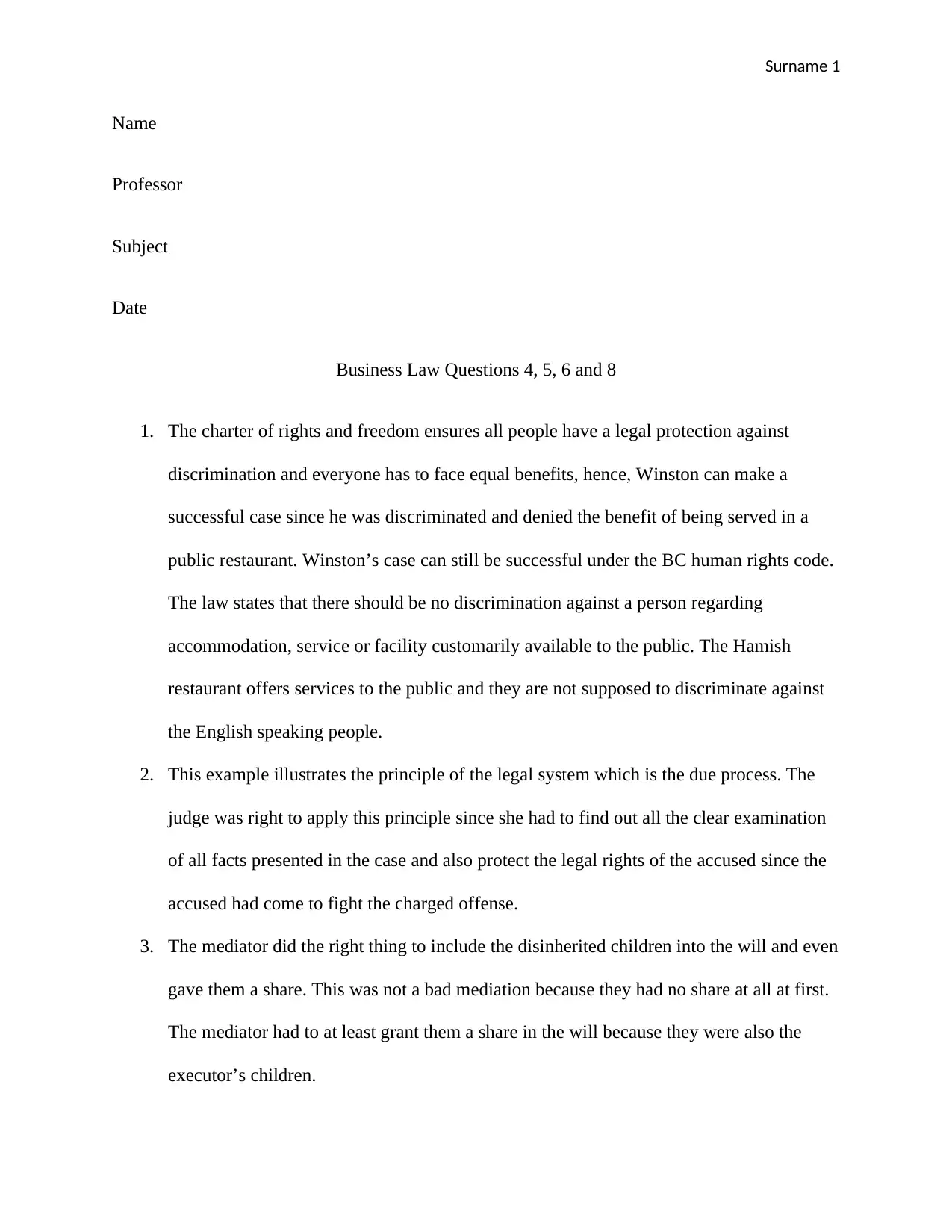
1. The charter of rights and freedom ensures all people have a legal protection against
discrimination and everyone has to face equal benefits, hence, Winston can make a
successful case since he was discriminated and denied the benefit of being served in a
public restaurant. Winston’s case can still be successful under the BC human rights code.
The law states that there should be no discrimination against a person regarding
accommodation, service or facility customarily available to the public. The Hamish
restaurant offers services to the public and they are not supposed to discriminate against
the English speaking people.
2. This example illustrates the principle of the legal system which is the due process. The
judge was right to apply this principle since she had to find out all the clear examination
of all facts presented in the case and also protect the legal rights of the accused since the
accused had come to fight the charged offense.
3. The mediator did the right thing to include the disinherited children into the will and even
gave them a share. This was not a bad mediation because they had no share at all at first.
The mediator had to at least grant them a share in the will because they were also the
executor’s children.
tabler-icon-diamond-filled.svg

Paraphrase This Document

Need a fresh take? Get an instant paraphrase of this document with our AI Paraphraser
Document Page
Surname 2
4. The investors cannot have any action against the accounting firm since they are not the
ones who gave them the statements. If the statements would have been given by the
accounting firm then they would have been able to take an action against the firm for
granting them inaccurate statements.
Document Page
Surname 3
Work Cited
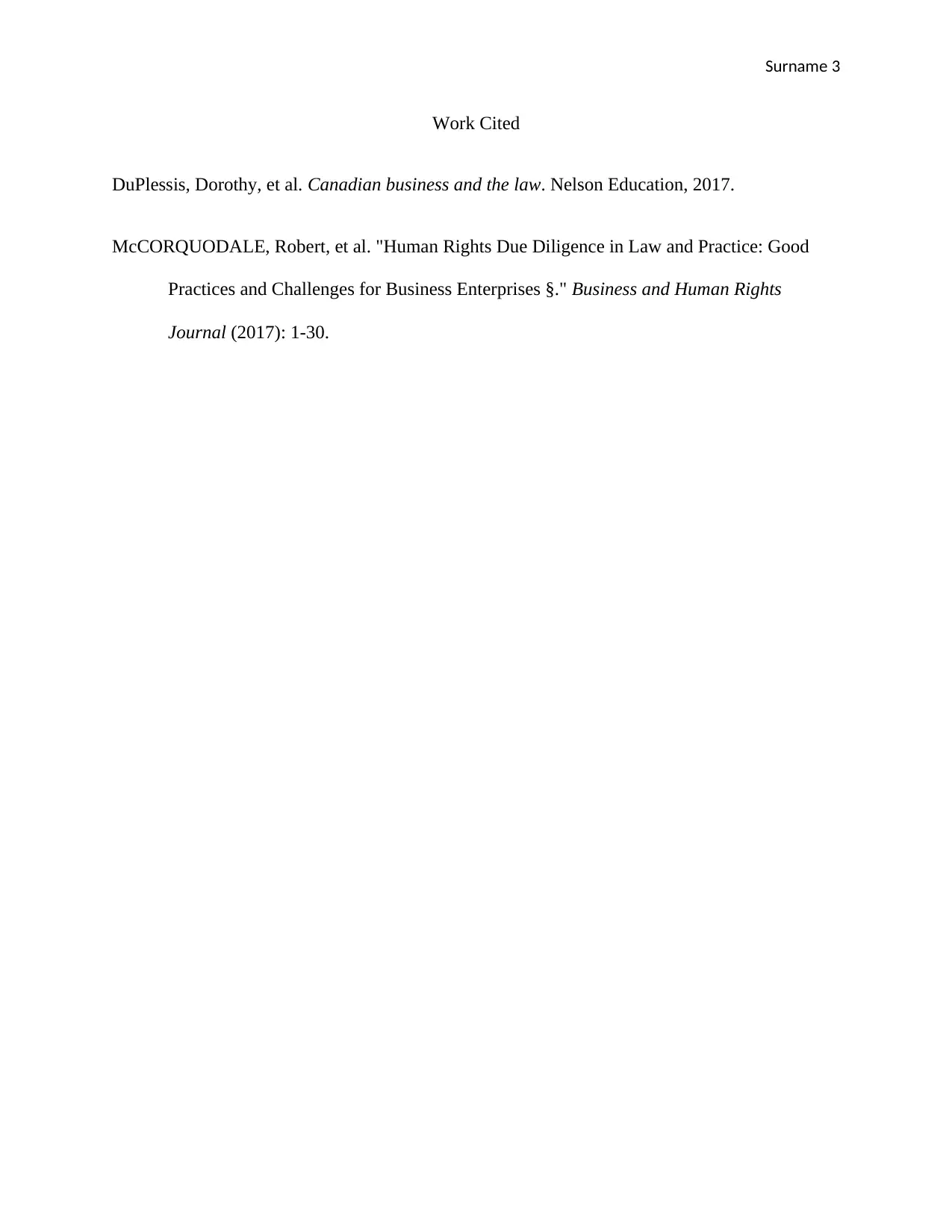
DuPlessis, Dorothy, et al. Canadian business and the law. Nelson Education, 2017.
McCORQUODALE, Robert, et al. "Human Rights Due Diligence in Law and Practice: Good
Practices and Challenges for Business Enterprises §." Business and Human Rights
Journal (2017): 1-30.
chevron_up_icon
1 out of 3
circle_padding
hide_on_mobile
zoom_out_icon
[object Object]