Student Assessment: Professional Development Report Analysis

Verified

Added on  2023/05/29

|7
|1670
|442
Report
AI Summary
This report provides a detailed analysis of professional development activities, covering their purpose, advantages, and disadvantages. It explores various activities, such as teacher-oriented, business and management, and leadership activities, emphasizing the expansion of job content and risk-taking opportunities. The report discusses the cost of training, decreased productivity, staff seeking new employment, and the uncertainty associated with professional development. It highlights the importance of continuous learning, skill enhancement, and adapting to technical advancements. The report also examines the benefits of flexibility in professional development programs and includes a reference list for further reading.

Document Page
1
Business Communication
tabler-icon-diamond-filled.svg

Paraphrase This Document

Need a fresh take? Get an instant paraphrase of this document with our AI Paraphraser
Document Page
2
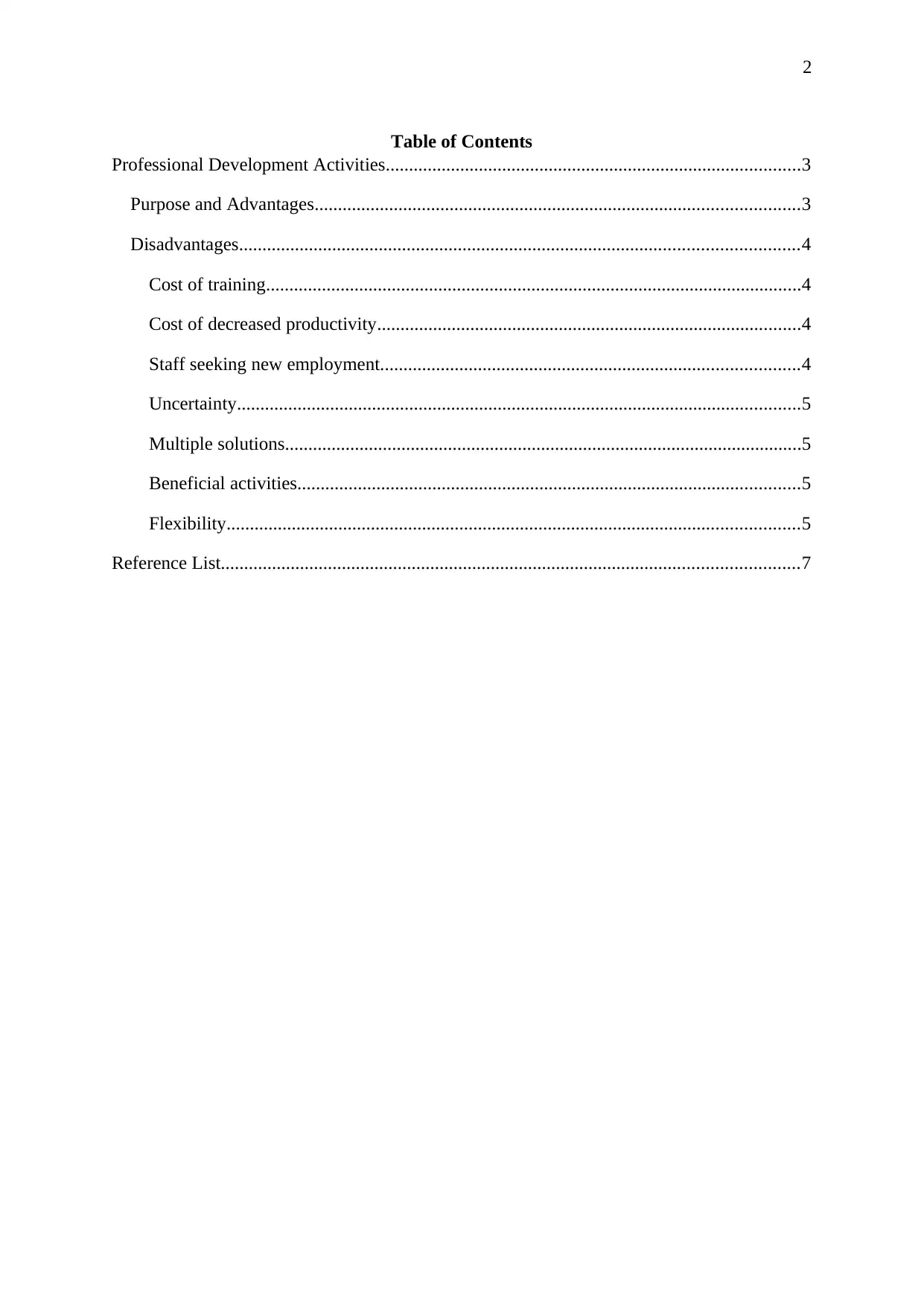
Table of Contents
Professional Development Activities.........................................................................................3
Purpose and Advantages........................................................................................................3
Disadvantages........................................................................................................................4
Cost of training...................................................................................................................4
Cost of decreased productivity...........................................................................................4
Staff seeking new employment..........................................................................................4
Uncertainty.........................................................................................................................5
Multiple solutions...............................................................................................................5
Beneficial activities............................................................................................................5
Flexibility...........................................................................................................................5
Reference List............................................................................................................................7
Document Page
3
Professional Development Activities
The activities that usually contribute in the professional development of an individual which
leads to the accomplishment and enhancement of the knowledge and skills that is needed for
independent practice by an individual, are known as professional development activities
(Desimone, 2011). Some of the examples of the professional development activities are
teacher-oriented activities, business and management activities, leadership and supervisory
activities, in-service activities sponsored by the employers, education continuation activities,
college course work, etc.
I would take part in the professional development activity of expanding accountabilities.
Here, the activities that would be undertaken are, expansion of my job content for including a
greater variety of tasks, risk taking opportunities and a greater sense of authority and
responsibility. Such an activity would help me in ensuring that different levels of
responsibilities and types of tasks are needed for the same tasks. It would also help in
monitoring and reviewing the progress of other staff members.
Purpose and Advantages
Professional development activities are activities of learning and development that are related
to work which should essentially continue throughout the career of an individual. A wide
range of professional development options are covered by these activities. These activities
involve indulgence into activities such as participating in short term courses which help in
enhancing or adding to the skills of an individuals. Activities like courses related to work and
attending conferences are included. Informal professional development includes learning of
new skills and competence on the job and getting mentored and supervised by someone who
has more experience in the same field (Richter, Kunter, Klusmann, Lüdtke and Baumert,
2011). Informal professional development can also sometimes take the place of an individual
away from the workplace. For instance, when leadership is learnt by professionals by the
means of volunteering in local communities is an informal professional development activity.
When a new young professional or a fresh graduate is in the early stages of his career, he is
presented with an opportunity of setting his course and driving his own professional
development instead of allowing it to be imposed on him by others. When such an individual
needs to take control of his own professional development, he would be positioned for
ensuring that they are satisfied personally and the requirements of professional registration
are met easily and it also helps the individual in contributing towards standing of his
Document Page
4
profession. The primary purpose of professional development activities is to maintain,
enhance and extend the competence, expertise and knowledge of a person (Zepeda, 2013).
These activities help in keeping a person up-to-date with technical advancements in their
specialization area and also extend their knowledge in other significant fields. Professional
development activities polish the existing skills and competence of a person and help in
acquiring and developing new such skills (Zepeda, 2013). It also helps in developing a
thorough understanding of the practical applications of the newly acquired knowledge and
skills as well as for gathering experience by applying the learnings (Fitzgerald and
Theilheimer, 2013).
Disadvantages
There are certain things which I do not like about professional development activities that are
explained below:
Cost of training
It should be decided by an employer if the cost needed for online learning or brining a new
trainer is worthy of improving the skills of an employee. If the courses of professional
development are undertaken by private companies which might require the staff of the
company to travel which would cost as much as which can outweigh the advantage of
enhanced effectiveness of employees (Légaré, 2015). Online learning should be considered
by employers as there are several modules which an be easily completed by the employees
over the web. Once payment is made for the modules of online learning, they can be used
multiple times without the hassle of travelling or incurring instructor costs.
Cost of decreased productivity
If an employee who is eligible for training is a vital part of the operations of a small company
but mostly stays absent due to the days of development, it can result in decreasing the level of
productivity since the worker is not present himself. Productivity reduces gradually if
numerous staff or employees are involved in a single training session at once. Hence, the
employers should decide whether such an investment would incur a reasonable cost.
Staff seeking new employment.
There is always a possibility that when employers start working on improvement of their staff
members or employees, employees might begin seeking new job and employment
opportunities. According to research and studies, it has been proven that the companies which
have significant programs for professional development, usually have employees who
tabler-icon-diamond-filled.svg

Paraphrase This Document

Need a fresh take? Get an instant paraphrase of this document with our AI Paraphraser
Document Page
5
possess a greater sense of job satisfaction (Légaré, 2015). People desire to work well and
excel in their careers and professional development helps the employees in the same.
Uncertainty
There is no guarantee of having a successful result in spite of the best plans. Uncertainty is
one of the disadvantages of a professional development activities and plan (Fishman, 2013).
A person might select getting a degree in accountancy but after his graduation might find out
that his job is not satisfying enough and that he should go for higher education. Before his
graduation, the market for jobs might change drastically and the person might not be able to
find a desirable position in his chosen field. Sometime, it often happens that people find
themselves engaged into careers which have no relation to their degree which is due to poor
label markets.
Multiple solutions
The choices and options of a person might get limited due to putting together a professional
development program. Often, there are more than one solution to several career objectives.
For instance, only those computer specialists who possess as bachelor’s degree might be
hired by a company or employer (Harris, 2012). Sometime, professional certification is
valued more than a degree. It is possible to find such employers who are willing to provide
on-job training. Time and money can be saved by going from such a route. Conceptual
knowledge can be gained through the route of formal education which helps in opening doors
for advanced positions which would require a professional degree.
Beneficial activities
The professional development activities which are put together by employees and managers
may not be successful in providing the employees with beneficial activities of learning. One
of the major difficulties of the professional development programs is the learning process
itself (Harris, 2012). In some of the cases, appropriate and adequate resources are not
possessed by organizations for providing the best opportunities for learning. There are several
factors such as time, personnel constraints and budget might make it uneasy for providing
every employee with learning activities which they require.
Flexibility
It often happens that freshly graduate candidates might accept job positions which are part of
a professional development program. Candidates are groomed with the help of many such
programs for the positions of executive level management. The job assignments and rotations
Document Page
6
management which are undergone by trainees are predetermined by a company or
organization (Fishman, 2013). More time might be spent in learning than research and
development. Companies do not always provide employees with choices in the skills which
they develop.
Document Page
7
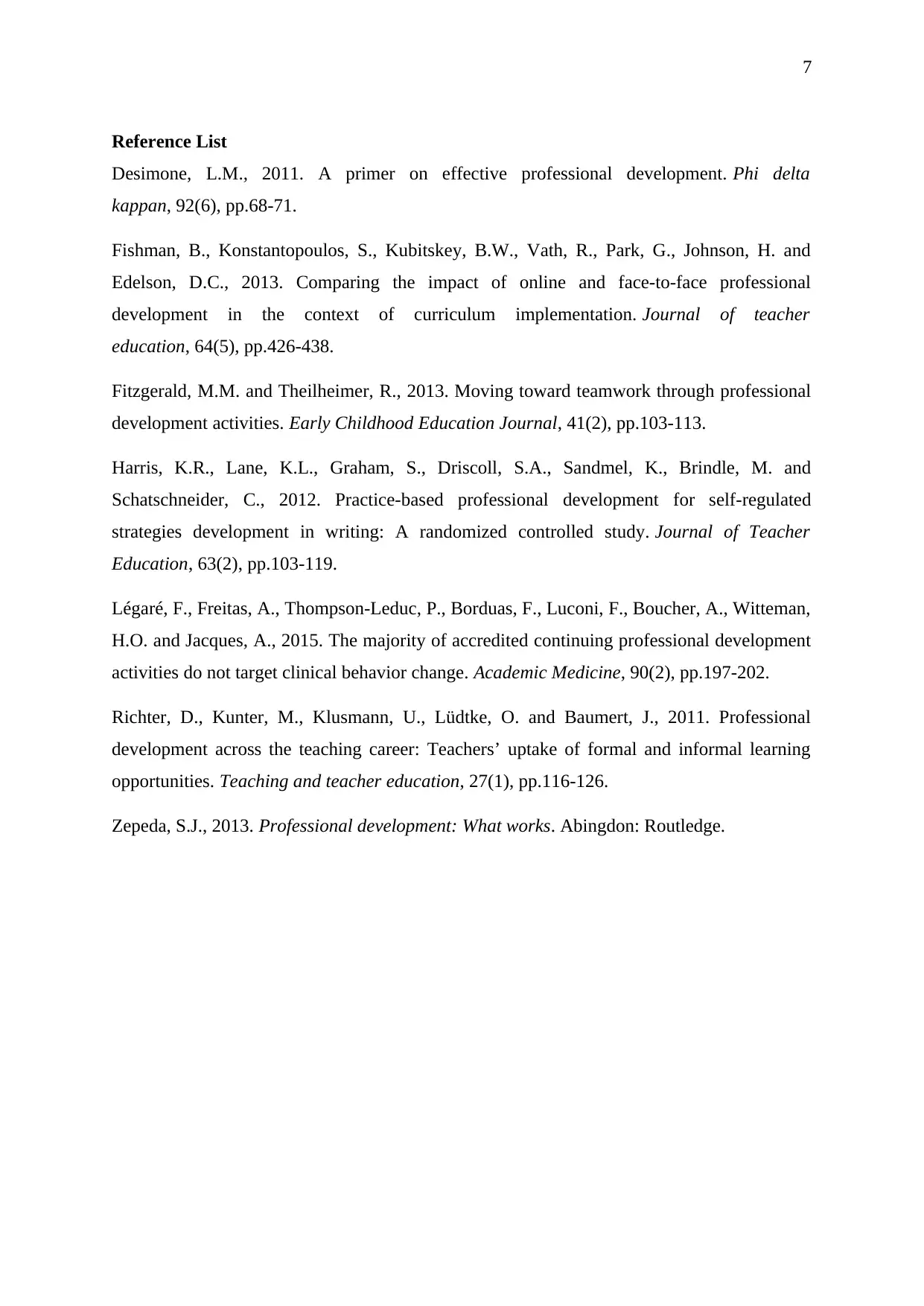
Reference List
Desimone, L.M., 2011. A primer on effective professional development. Phi delta
kappan, 92(6), pp.68-71.
Fishman, B., Konstantopoulos, S., Kubitskey, B.W., Vath, R., Park, G., Johnson, H. and
Edelson, D.C., 2013. Comparing the impact of online and face-to-face professional
development in the context of curriculum implementation. Journal of teacher
education, 64(5), pp.426-438.
Fitzgerald, M.M. and Theilheimer, R., 2013. Moving toward teamwork through professional
development activities. Early Childhood Education Journal, 41(2), pp.103-113.
Harris, K.R., Lane, K.L., Graham, S., Driscoll, S.A., Sandmel, K., Brindle, M. and
Schatschneider, C., 2012. Practice-based professional development for self-regulated
strategies development in writing: A randomized controlled study. Journal of Teacher
Education, 63(2), pp.103-119.
Légaré, F., Freitas, A., Thompson-Leduc, P., Borduas, F., Luconi, F., Boucher, A., Witteman,
H.O. and Jacques, A., 2015. The majority of accredited continuing professional development
activities do not target clinical behavior change. Academic Medicine, 90(2), pp.197-202.
Richter, D., Kunter, M., Klusmann, U., Lüdtke, O. and Baumert, J., 2011. Professional
development across the teaching career: Teachers’ uptake of formal and informal learning
opportunities. Teaching and teacher education, 27(1), pp.116-126.
Zepeda, S.J., 2013. Professional development: What works. Abingdon: Routledge.
chevron_up_icon
1 out of 7
circle_padding
hide_on_mobile
zoom_out_icon
[object Object]