Critical Literature Review: Project Stakeholder Management Theory
VerifiedAdded on 2023/06/03
|10
|2949
|109
Literature Review
AI Summary
This literature review provides a comprehensive overview of project stakeholder management, exploring various theories and their practical applications across industries, particularly construction. It begins by defining stakeholders and the stakeholder management process, emphasizing the importance of identifying, planning, managing, and controlling stakeholder engagement. The review delves into the stakeholder theory, contrasting normative, instrumental, and descriptive perspectives, and also examines the corporate social responsibility theory. It highlights the application of stakeholder management in construction projects, addressing challenges like conflicting interests and the need for clear communication. The review concludes by underscoring the importance of stakeholder management for project success and suggests further research into factors influencing stakeholder acceptance of projects. Desklib offers more solved assignments for students.
Running head: PROJECT STAKEHOLDER MANAGEMENT
Project Stakeholders Management
Name
Institution
Project Stakeholders Management
Name
Institution

Paraphrase This Document
Need a fresh take? Get an instant paraphrase of this document with our AI Paraphraser
PROJECT STAKEHOLDER MANAGEMENT
Introduction
According to (Freeman, 1984), stakeholders constitute a group of individual influence and are
affected as the organizations pursue their goals Stakeholders management requires the manager to
acknowledge the diversity of the stakeholders and understand their interests in the corporations
(Govender & Abratt, 2016). Many stakeholders such as investors, customers and employees are easily
identified due to their contractual connections to the firms. Others identify themselves due to the negative
or positive impact the firm has on their well-being (Vracheva & Mason, 2015). The specific concerns of
the stakeholders vary among the various areas of managerial decision making and the interactions of the
organization over time. Freeman, (1984) adds that stakeholder management is the reason for the existence
of organizations. The stakeholder management is very significant to project-based firms as they have to
understand the influences of the stakeholders based on the analysis of the key capabilities, skills, and
contributions.
Stakeholder management process
Stakeholder management process is the process by which firms involve parties who are affected
by the decisions they make or those who influence the implementations of the firms’ decisions. The
project managers need analytical skills to identify the stakeholders and engage them to understand their
influence on the project (Freeman, 1984). This minimizes potential detrimental impact and uplifts the
stakeholder’s positive input on the project. The management process follows the following stages.
Identification of stakeholders
Identifying the stakeholders and analyzing their interests from the information document is very
important (Jensen, Kim, and Kim, 2011). The stakeholder’s involvement, influence and the possible
impact on the project success are crucial. It is important to understand who the stakeholders are
(Frooman, 1999). Eskerod and Jepsen (2013) also pointed out the significance of identifying stakeholders
in a project. In project management, project managers need to interact and identify with key stakeholders
in the project system’s environment. It is important to manage the environment of a project to determine
Introduction
According to (Freeman, 1984), stakeholders constitute a group of individual influence and are
affected as the organizations pursue their goals Stakeholders management requires the manager to
acknowledge the diversity of the stakeholders and understand their interests in the corporations
(Govender & Abratt, 2016). Many stakeholders such as investors, customers and employees are easily
identified due to their contractual connections to the firms. Others identify themselves due to the negative
or positive impact the firm has on their well-being (Vracheva & Mason, 2015). The specific concerns of
the stakeholders vary among the various areas of managerial decision making and the interactions of the
organization over time. Freeman, (1984) adds that stakeholder management is the reason for the existence
of organizations. The stakeholder management is very significant to project-based firms as they have to
understand the influences of the stakeholders based on the analysis of the key capabilities, skills, and
contributions.
Stakeholder management process
Stakeholder management process is the process by which firms involve parties who are affected
by the decisions they make or those who influence the implementations of the firms’ decisions. The
project managers need analytical skills to identify the stakeholders and engage them to understand their
influence on the project (Freeman, 1984). This minimizes potential detrimental impact and uplifts the
stakeholder’s positive input on the project. The management process follows the following stages.
Identification of stakeholders
Identifying the stakeholders and analyzing their interests from the information document is very
important (Jensen, Kim, and Kim, 2011). The stakeholder’s involvement, influence and the possible
impact on the project success are crucial. It is important to understand who the stakeholders are
(Frooman, 1999). Eskerod and Jepsen (2013) also pointed out the significance of identifying stakeholders
in a project. In project management, project managers need to interact and identify with key stakeholders
in the project system’s environment. It is important to manage the environment of a project to determine
PROJECT STAKEHOLDER MANAGEMENT
how they’ll react to project decisions. Identification should include all stakeholders involved in the
project and the potential stakeholders who might be affected by the project (Achterkamp & Vox, J2008).
Plan stakeholder management
It is important to develop management strategies that would enable you to engage the
stakeholders throughout the project efficiently. Develop a strategy that would enable you to stay focused
and keep track of the stakeholders. It will also reduce uncertainty.
Manage stakeholder engagement
Ensure communication with the stakeholders in order to meet their expectation. Ensure to address
challenges that may arise and encourage appropriate engagement in project activities. Work together with
the stakeholders. Determine all their interests and contributions. Keep constant communication in order to
address any conflict that may arise.
Control stakeholder engagement
Monitor the relationship of the stakeholders in the project and establish plans and strategies for
their engagement. Ensure they do not interfere with other stakeholders. Every stakeholder involved
should work within their limit.
The stakeholder theory
The stakeholder theory indicates that, for firms to be successful in the long run, they must attend
to stakeholders goals and needs and look beyond their shareholders (Freeman, 1984). Past studies have
well documented a positive relationship between project management and stakeholder management.
Vracheva and Mason, (2015) the simplicity of the stakeholder management have offer a comprehensive
and unifying framework for understanding the complex relationships between firms and their diverse
stakeholders. The theory opposes the norm of capitalization of the interests of the shareholder and
promotes maximization of the stakeholders (Garsia-Castro, Arino, & Canela, 2011).
Strategic theory indicates that managers should strive to satisfy all the parties that have been
involved in the business. Eskerod and Jepsen, (2013) added that the project outcome is influenced by the
stakeholders who have an interest in the project. The main task is to integrate and manage all the
how they’ll react to project decisions. Identification should include all stakeholders involved in the
project and the potential stakeholders who might be affected by the project (Achterkamp & Vox, J2008).
Plan stakeholder management
It is important to develop management strategies that would enable you to engage the
stakeholders throughout the project efficiently. Develop a strategy that would enable you to stay focused
and keep track of the stakeholders. It will also reduce uncertainty.
Manage stakeholder engagement
Ensure communication with the stakeholders in order to meet their expectation. Ensure to address
challenges that may arise and encourage appropriate engagement in project activities. Work together with
the stakeholders. Determine all their interests and contributions. Keep constant communication in order to
address any conflict that may arise.
Control stakeholder engagement
Monitor the relationship of the stakeholders in the project and establish plans and strategies for
their engagement. Ensure they do not interfere with other stakeholders. Every stakeholder involved
should work within their limit.
The stakeholder theory
The stakeholder theory indicates that, for firms to be successful in the long run, they must attend
to stakeholders goals and needs and look beyond their shareholders (Freeman, 1984). Past studies have
well documented a positive relationship between project management and stakeholder management.
Vracheva and Mason, (2015) the simplicity of the stakeholder management have offer a comprehensive
and unifying framework for understanding the complex relationships between firms and their diverse
stakeholders. The theory opposes the norm of capitalization of the interests of the shareholder and
promotes maximization of the stakeholders (Garsia-Castro, Arino, & Canela, 2011).
Strategic theory indicates that managers should strive to satisfy all the parties that have been
involved in the business. Eskerod and Jepsen, (2013) added that the project outcome is influenced by the
stakeholders who have an interest in the project. The main task is to integrate and manage all the
⊘ This is a preview!⊘
Do you want full access?
Subscribe today to unlock all pages.

Trusted by 1+ million students worldwide
PROJECT STAKEHOLDER MANAGEMENT
relationship and interests of the stakeholders such as suppliers, employees, shareholders, customers and
the community that will ensure the long-term success of the business. The theory is concerned with the
active role of the management in the business environment, promotion of shared interests and
development of business strategy. The paper focused on the literature that distinguishes the normative and
strategic or analytical stakeholder theory.
The stakeholder approach offers a managerial scope that provides a base for development of
stakeholder theory. The theory has been widely developed over the years, and it gave rise to a theoretical
development that is explained in the below literature.
Normative, instrumental and descriptive stakeholder theory
Normative stakeholder theory
The normative theory is linked to the values, philosophic and moral guidelines of the firm
management. The normative theory determines the organization's responsibilities concerning the
stakeholders and also notes the importance of the stakeholders’ interests (Freeman, 1984). Donaldson and
Preston (1995) point out that normative theory is the core of the stakeholders’ theory as it involves the
intrinsic values. Freeman, however, disputes the idea as he argued that there is a separation between
economic and ethnic spheres. For many scholars, the relationship between the stakeholders and the firm
can be valuable to the organization as a reflection of their commitment, values, and principles. Each
company should define their moral principles and use them as a basis for decision making. Freeman,
Harrison, Wicks, Parmar, and Colle (2010) further argued that the normative theory is based on the
definition of stakeholder where stakeholders are critical to the survival of the organization. The firm acts
as a vehicle for coordinating the interest of the key stakeholders. They proposed two principles:
The principle of corporate legitimacy- It states that the stakeholders should participate in decision
making that impacts their welfare. Therefore the company should act in the best interest of its
stakeholders.
The fiduciary principle- To ensure the survival of the firm, managers should act in the interest of the
stakeholders. Managers are considered to be the agents of firm to ensure its survival. Managers have the
relationship and interests of the stakeholders such as suppliers, employees, shareholders, customers and
the community that will ensure the long-term success of the business. The theory is concerned with the
active role of the management in the business environment, promotion of shared interests and
development of business strategy. The paper focused on the literature that distinguishes the normative and
strategic or analytical stakeholder theory.
The stakeholder approach offers a managerial scope that provides a base for development of
stakeholder theory. The theory has been widely developed over the years, and it gave rise to a theoretical
development that is explained in the below literature.
Normative, instrumental and descriptive stakeholder theory
Normative stakeholder theory
The normative theory is linked to the values, philosophic and moral guidelines of the firm
management. The normative theory determines the organization's responsibilities concerning the
stakeholders and also notes the importance of the stakeholders’ interests (Freeman, 1984). Donaldson and
Preston (1995) point out that normative theory is the core of the stakeholders’ theory as it involves the
intrinsic values. Freeman, however, disputes the idea as he argued that there is a separation between
economic and ethnic spheres. For many scholars, the relationship between the stakeholders and the firm
can be valuable to the organization as a reflection of their commitment, values, and principles. Each
company should define their moral principles and use them as a basis for decision making. Freeman,
Harrison, Wicks, Parmar, and Colle (2010) further argued that the normative theory is based on the
definition of stakeholder where stakeholders are critical to the survival of the organization. The firm acts
as a vehicle for coordinating the interest of the key stakeholders. They proposed two principles:
The principle of corporate legitimacy- It states that the stakeholders should participate in decision
making that impacts their welfare. Therefore the company should act in the best interest of its
stakeholders.
The fiduciary principle- To ensure the survival of the firm, managers should act in the interest of the
stakeholders. Managers are considered to be the agents of firm to ensure its survival. Managers have the
Paraphrase This Document
Need a fresh take? Get an instant paraphrase of this document with our AI Paraphraser
PROJECT STAKEHOLDER MANAGEMENT
similar responsibilities as employees, but also they safeguard the welfare of the firm. Garsia-Castro et al.,
(2011) added that to make the stakeholder management practicable, a board of directors with
representatives of all the stakeholder's interest should be put in place to care for the interests of all
stakeholders.
Instrumental theory
The theory considers the ethical relationships between the stakeholders and the performance of
the firm (Elms, Johnson-Cramer, & d Berman, 2011). It is characterized by a high level of cooperation,
trust, and sharing of information. The instrumental theory states that managing meaningful stakeholders
relationships that result in the accomplishment of the goals and objectives of business. It should enhance
increased profitability, growth and sustainability. This model allows comparison of the effectiveness of
the relationships between stakeholders managing and attaining the business targets (Greenwood & Buren,
2010).
Descriptive Theory
The descriptive stakeholder model uses concepts and language to describe corporations in the
businesses, their mode of operations and the impact on the wider environment. It is useful in helping
understand the stakeholder relationship and management of the organizations (Jawahar & McLaughlin,
2001)
The corporate social responsibility theory
The theory states that businesses involve all the stakeholders, that is the customers, employees,
customers, suppliers, non-profit organizations, government, and other stakeholders is the key issue in the
corporate social responsibility concept. Barnett (2007) adds that stakeholders influence the financial and
social returns of the firm. The concept of CSR involves the voluntary integration of environmental and
social concerns in business operations. It emphasizes on the importance of businesses interaction with
their internal and external stakeholders. (Gao & Slawinski, 2015). The interaction with the stakeholders
will determine the performance of the firm.
similar responsibilities as employees, but also they safeguard the welfare of the firm. Garsia-Castro et al.,
(2011) added that to make the stakeholder management practicable, a board of directors with
representatives of all the stakeholder's interest should be put in place to care for the interests of all
stakeholders.
Instrumental theory
The theory considers the ethical relationships between the stakeholders and the performance of
the firm (Elms, Johnson-Cramer, & d Berman, 2011). It is characterized by a high level of cooperation,
trust, and sharing of information. The instrumental theory states that managing meaningful stakeholders
relationships that result in the accomplishment of the goals and objectives of business. It should enhance
increased profitability, growth and sustainability. This model allows comparison of the effectiveness of
the relationships between stakeholders managing and attaining the business targets (Greenwood & Buren,
2010).
Descriptive Theory
The descriptive stakeholder model uses concepts and language to describe corporations in the
businesses, their mode of operations and the impact on the wider environment. It is useful in helping
understand the stakeholder relationship and management of the organizations (Jawahar & McLaughlin,
2001)
The corporate social responsibility theory
The theory states that businesses involve all the stakeholders, that is the customers, employees,
customers, suppliers, non-profit organizations, government, and other stakeholders is the key issue in the
corporate social responsibility concept. Barnett (2007) adds that stakeholders influence the financial and
social returns of the firm. The concept of CSR involves the voluntary integration of environmental and
social concerns in business operations. It emphasizes on the importance of businesses interaction with
their internal and external stakeholders. (Gao & Slawinski, 2015). The interaction with the stakeholders
will determine the performance of the firm.
PROJECT STAKEHOLDER MANAGEMENT
Application in various industries
Construction projects
Stakeholder management has been used in the construction projects. The complex nature of
construction projects represents different stakeholders and the use of stakeholder management will lead to
success in their projects. To analyze the impact of stakeholders on projects, it is important to assess their
interests (Freeman, 2010). They do impact projects in various complex ways. Their behaviors, attitudes
and potential influence on the project should be assessed (Tiwari, Pankaj, & Sunita, 2017). The prevailing
conflicts among the stakeholders should be analyzed based on the available information and solutions
provided in order to avoid wasting resources and for the project to be successful.
Traditionally the projects were divided into various operations by different individuals or groups
with different levels of involvement and interests in the project. The construction projects are unique and
involve various stakeholders. Time is one of the critical constraints to this industry for a project to be
completed in time. Therefore the process includes involvement and collaboration of the different
stakeholders. The stakeholders may include the designers, contractors, client, employees, the general
project environment and other bodies who feel they are affected by the construction project going on. The
management of these stakeholders is important to the success of the project. Therefore, the stakeholder
management theory has been recognized in the construction industry. They all have a different level of
interest in the project, and their management is important to the success of the project. Conflict in the
attitude and interests of a construction project among the stakeholders can lead to overruns in time, poor
quality, cost and poor implementation of the project. Evaluation of stakeholders influence should be taken
into consideration when implementing or managing a project. Therefore, project managers have to
identify and consider all the stakeholders in a construction project.
For business project managers, lack of stakeholder engagement can be a big challenge. At some
point, all the crucial stakeholders tend to drift away from the project as they may lose interests or exit due
to lack of communication. It is the project manager responsibility to engage the stakeholders of a project.
Below are some of the best’s practices for project stakeholder management.
Application in various industries
Construction projects
Stakeholder management has been used in the construction projects. The complex nature of
construction projects represents different stakeholders and the use of stakeholder management will lead to
success in their projects. To analyze the impact of stakeholders on projects, it is important to assess their
interests (Freeman, 2010). They do impact projects in various complex ways. Their behaviors, attitudes
and potential influence on the project should be assessed (Tiwari, Pankaj, & Sunita, 2017). The prevailing
conflicts among the stakeholders should be analyzed based on the available information and solutions
provided in order to avoid wasting resources and for the project to be successful.
Traditionally the projects were divided into various operations by different individuals or groups
with different levels of involvement and interests in the project. The construction projects are unique and
involve various stakeholders. Time is one of the critical constraints to this industry for a project to be
completed in time. Therefore the process includes involvement and collaboration of the different
stakeholders. The stakeholders may include the designers, contractors, client, employees, the general
project environment and other bodies who feel they are affected by the construction project going on. The
management of these stakeholders is important to the success of the project. Therefore, the stakeholder
management theory has been recognized in the construction industry. They all have a different level of
interest in the project, and their management is important to the success of the project. Conflict in the
attitude and interests of a construction project among the stakeholders can lead to overruns in time, poor
quality, cost and poor implementation of the project. Evaluation of stakeholders influence should be taken
into consideration when implementing or managing a project. Therefore, project managers have to
identify and consider all the stakeholders in a construction project.
For business project managers, lack of stakeholder engagement can be a big challenge. At some
point, all the crucial stakeholders tend to drift away from the project as they may lose interests or exit due
to lack of communication. It is the project manager responsibility to engage the stakeholders of a project.
Below are some of the best’s practices for project stakeholder management.
⊘ This is a preview!⊘
Do you want full access?
Subscribe today to unlock all pages.
Trusted by 1+ million students worldwide
PROJECT STAKEHOLDER MANAGEMENT
Identification of stakeholders correctly
Identifying the right stakeholders in a project is important as it helps to avoid conflicts and
wastage of resources such as time when agreements are made. It also helps determine the interests,
attitudes and influences of the stakeholders.
Clear expectations addressed
Different interests can be affected negatively or positively throughout the course of major
projects. Failing to address the concerns of the stakeholders involved can lead to ultimate failure of the
project. Therefore, the expectations of all the stakeholders should be addressed in order to achieve a
solution for the problems presented. Provide clear explanations of the commitments needed for the project
from each of the involved stakeholders. The information should be shared throughout the project
Break barriers
Project management may bring together people who do not interact often. Project managers
should ensure to engage all the stakeholders in order to determine their influence and enhance information
sharing. Collaborative team can deliver benefits to the project.
Maintain communication
The project manager needs to communicate the role and expectation at the beginning of the
project. Provide continuous information throughout the project and do not assume the stakeholders are
aware of their responsibility.
Many scholars and professionals have recognized the importance of stakeholder management in
project management. Different aspects of stakeholder management are discussed in the literature, though
it is noted that stakeholder management has not been fully embraced in the business world. All elements
of the stakeholder management need to be fully considered. It is evident that companies dealing with
large number of stakeholders in their respective projects need to use the stakeholder management theory
for the success of their various projects. From the literature review, it is evident that the interests,
influence, and attitudes of the stakeholders are important in managing stakeholders. Exploring their
Identification of stakeholders correctly
Identifying the right stakeholders in a project is important as it helps to avoid conflicts and
wastage of resources such as time when agreements are made. It also helps determine the interests,
attitudes and influences of the stakeholders.
Clear expectations addressed
Different interests can be affected negatively or positively throughout the course of major
projects. Failing to address the concerns of the stakeholders involved can lead to ultimate failure of the
project. Therefore, the expectations of all the stakeholders should be addressed in order to achieve a
solution for the problems presented. Provide clear explanations of the commitments needed for the project
from each of the involved stakeholders. The information should be shared throughout the project
Break barriers
Project management may bring together people who do not interact often. Project managers
should ensure to engage all the stakeholders in order to determine their influence and enhance information
sharing. Collaborative team can deliver benefits to the project.
Maintain communication
The project manager needs to communicate the role and expectation at the beginning of the
project. Provide continuous information throughout the project and do not assume the stakeholders are
aware of their responsibility.
Many scholars and professionals have recognized the importance of stakeholder management in
project management. Different aspects of stakeholder management are discussed in the literature, though
it is noted that stakeholder management has not been fully embraced in the business world. All elements
of the stakeholder management need to be fully considered. It is evident that companies dealing with
large number of stakeholders in their respective projects need to use the stakeholder management theory
for the success of their various projects. From the literature review, it is evident that the interests,
influence, and attitudes of the stakeholders are important in managing stakeholders. Exploring their
Paraphrase This Document
Need a fresh take? Get an instant paraphrase of this document with our AI Paraphraser
PROJECT STAKEHOLDER MANAGEMENT
needs about projects helps increase the success of projects. Project managers therefore need to
communicate constantly with the stakeholders.
From the literature, further studies need to be conducted to address the factors that influence the
stakeholder's decision on accepting the projects or not. It would be important to provide various strategies
to the project manager to handle different challenges. The theory can also be put into more practice in the
businesses. The theory needs to emphasize the practices of the theory.
Projects involve different stakeholders who need to be considered in project management.
Therefore it is important for project managers to consider the interests of the stakeholders. They
determine the success or failure of the business. The diverse nature of the stakeholders also needs to be
considered when handling them. Due to the difference in the interests of the stakeholders, project
managers should promote collaboration.
needs about projects helps increase the success of projects. Project managers therefore need to
communicate constantly with the stakeholders.
From the literature, further studies need to be conducted to address the factors that influence the
stakeholder's decision on accepting the projects or not. It would be important to provide various strategies
to the project manager to handle different challenges. The theory can also be put into more practice in the
businesses. The theory needs to emphasize the practices of the theory.
Projects involve different stakeholders who need to be considered in project management.
Therefore it is important for project managers to consider the interests of the stakeholders. They
determine the success or failure of the business. The diverse nature of the stakeholders also needs to be
considered when handling them. Due to the difference in the interests of the stakeholders, project
managers should promote collaboration.
PROJECT STAKEHOLDER MANAGEMENT
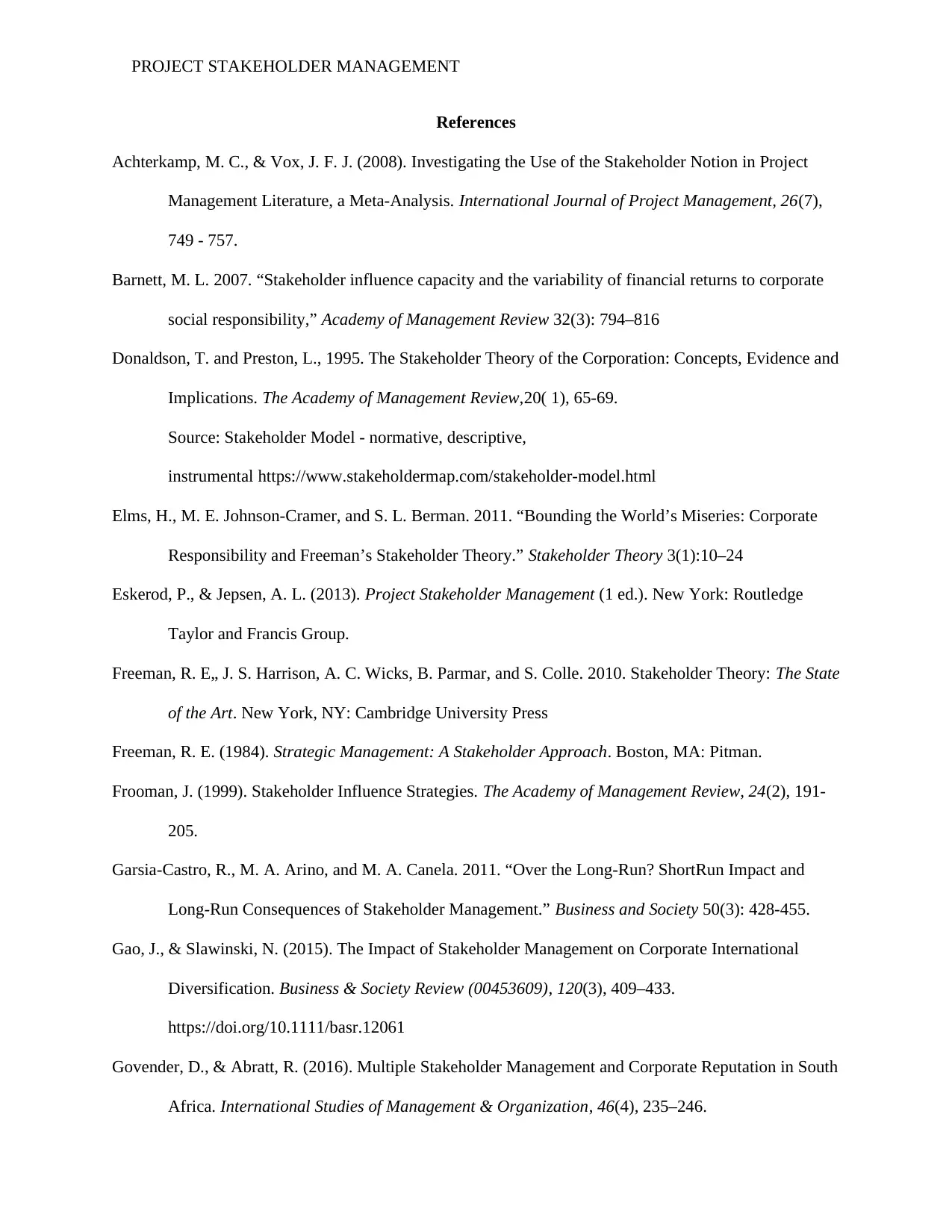
References
Achterkamp, M. C., & Vox, J. F. J. (2008). Investigating the Use of the Stakeholder Notion in Project
Management Literature, a Meta-Analysis. International Journal of Project Management, 26(7),
749 - 757.
Barnett, M. L. 2007. “Stakeholder influence capacity and the variability of financial returns to corporate
social responsibility,” Academy of Management Review 32(3): 794–816
Donaldson, T. and Preston, L., 1995. The Stakeholder Theory of the Corporation: Concepts, Evidence and
Implications. The Academy of Management Review,20( 1), 65-69.
Source: Stakeholder Model - normative, descriptive,
instrumental https://www.stakeholdermap.com/stakeholder-model.html
Elms, H., M. E. Johnson-Cramer, and S. L. Berman. 2011. “Bounding the World’s Miseries: Corporate
Responsibility and Freeman’s Stakeholder Theory.” Stakeholder Theory 3(1):10–24
Eskerod, P., & Jepsen, A. L. (2013). Project Stakeholder Management (1 ed.). New York: Routledge
Taylor and Francis Group.
Freeman, R. E„ J. S. Harrison, A. C. Wicks, B. Parmar, and S. Colle. 2010. Stakeholder Theory: The State
of the Art. New York, NY: Cambridge University Press
Freeman, R. E. (1984). Strategic Management: A Stakeholder Approach. Boston, MA: Pitman.
Frooman, J. (1999). Stakeholder Influence Strategies. The Academy of Management Review, 24(2), 191-
205.
Garsia-Castro, R., M. A. Arino, and M. A. Canela. 2011. “Over the Long-Run? ShortRun Impact and
Long-Run Consequences of Stakeholder Management.” Business and Society 50(3): 428-455.
Gao, J., & Slawinski, N. (2015). The Impact of Stakeholder Management on Corporate International
Diversification. Business & Society Review (00453609), 120(3), 409–433.
https://doi.org/10.1111/basr.12061
Govender, D., & Abratt, R. (2016). Multiple Stakeholder Management and Corporate Reputation in South
Africa. International Studies of Management & Organization, 46(4), 235–246.
References
Achterkamp, M. C., & Vox, J. F. J. (2008). Investigating the Use of the Stakeholder Notion in Project
Management Literature, a Meta-Analysis. International Journal of Project Management, 26(7),
749 - 757.
Barnett, M. L. 2007. “Stakeholder influence capacity and the variability of financial returns to corporate
social responsibility,” Academy of Management Review 32(3): 794–816
Donaldson, T. and Preston, L., 1995. The Stakeholder Theory of the Corporation: Concepts, Evidence and
Implications. The Academy of Management Review,20( 1), 65-69.
Source: Stakeholder Model - normative, descriptive,
instrumental https://www.stakeholdermap.com/stakeholder-model.html
Elms, H., M. E. Johnson-Cramer, and S. L. Berman. 2011. “Bounding the World’s Miseries: Corporate
Responsibility and Freeman’s Stakeholder Theory.” Stakeholder Theory 3(1):10–24
Eskerod, P., & Jepsen, A. L. (2013). Project Stakeholder Management (1 ed.). New York: Routledge
Taylor and Francis Group.
Freeman, R. E„ J. S. Harrison, A. C. Wicks, B. Parmar, and S. Colle. 2010. Stakeholder Theory: The State
of the Art. New York, NY: Cambridge University Press
Freeman, R. E. (1984). Strategic Management: A Stakeholder Approach. Boston, MA: Pitman.
Frooman, J. (1999). Stakeholder Influence Strategies. The Academy of Management Review, 24(2), 191-
205.
Garsia-Castro, R., M. A. Arino, and M. A. Canela. 2011. “Over the Long-Run? ShortRun Impact and
Long-Run Consequences of Stakeholder Management.” Business and Society 50(3): 428-455.
Gao, J., & Slawinski, N. (2015). The Impact of Stakeholder Management on Corporate International
Diversification. Business & Society Review (00453609), 120(3), 409–433.
https://doi.org/10.1111/basr.12061
Govender, D., & Abratt, R. (2016). Multiple Stakeholder Management and Corporate Reputation in South
Africa. International Studies of Management & Organization, 46(4), 235–246.
⊘ This is a preview!⊘
Do you want full access?
Subscribe today to unlock all pages.
Trusted by 1+ million students worldwide
PROJECT STAKEHOLDER MANAGEMENT
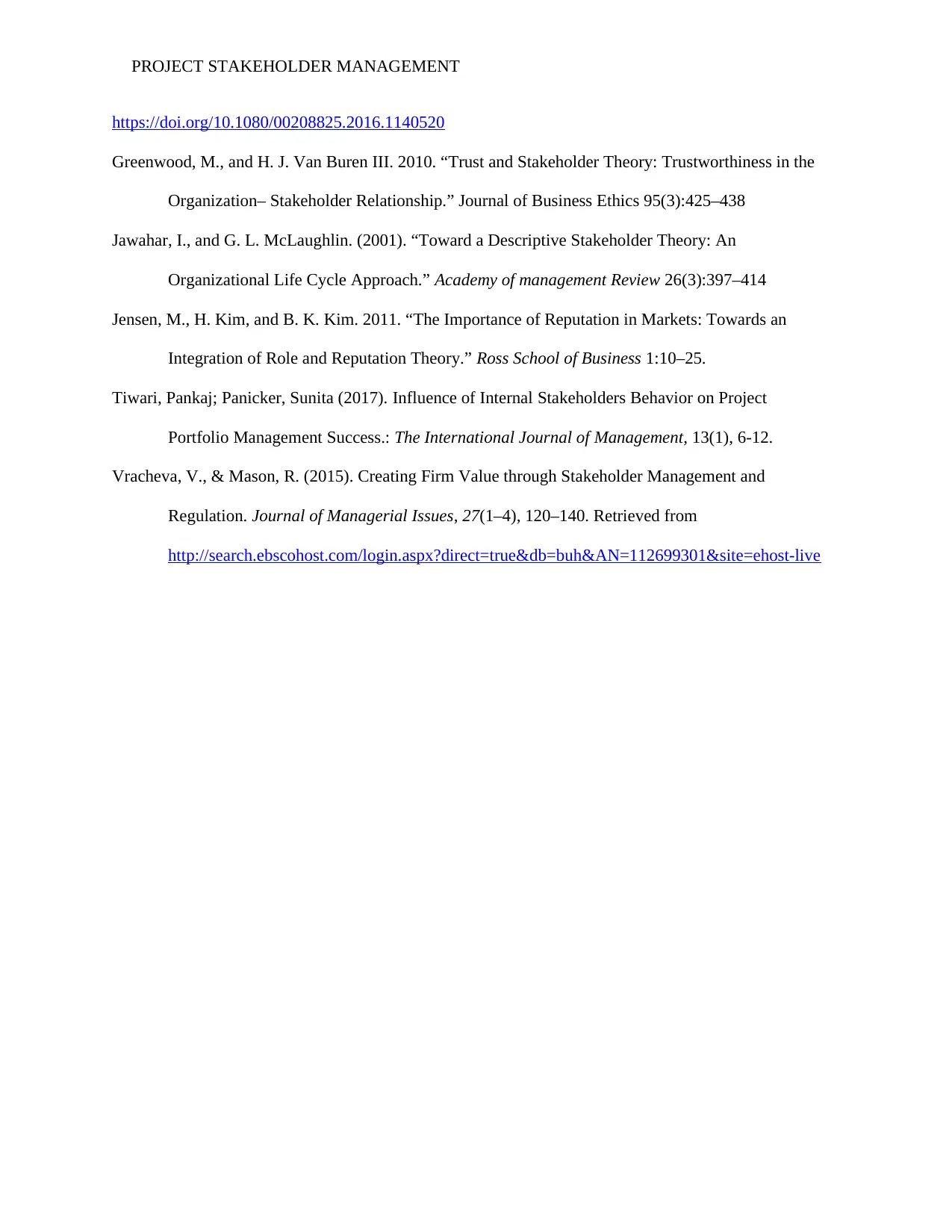
https://doi.org/10.1080/00208825.2016.1140520
Greenwood, M., and H. J. Van Buren III. 2010. “Trust and Stakeholder Theory: Trustworthiness in the
Organization– Stakeholder Relationship.” Journal of Business Ethics 95(3):425–438
Jawahar, I., and G. L. McLaughlin. (2001). “Toward a Descriptive Stakeholder Theory: An
Organizational Life Cycle Approach.” Academy of management Review 26(3):397–414
Jensen, M., H. Kim, and B. K. Kim. 2011. “The Importance of Reputation in Markets: Towards an
Integration of Role and Reputation Theory.” Ross School of Business 1:10–25.
Tiwari, Pankaj; Panicker, Sunita (2017). Influence of Internal Stakeholders Behavior on Project
Portfolio Management Success.: The International Journal of Management, 13(1), 6-12.
Vracheva, V., & Mason, R. (2015). Creating Firm Value through Stakeholder Management and
Regulation. Journal of Managerial Issues, 27(1–4), 120–140. Retrieved from
http://search.ebscohost.com/login.aspx?direct=true&db=buh&AN=112699301&site=ehost-live
https://doi.org/10.1080/00208825.2016.1140520
Greenwood, M., and H. J. Van Buren III. 2010. “Trust and Stakeholder Theory: Trustworthiness in the
Organization– Stakeholder Relationship.” Journal of Business Ethics 95(3):425–438
Jawahar, I., and G. L. McLaughlin. (2001). “Toward a Descriptive Stakeholder Theory: An
Organizational Life Cycle Approach.” Academy of management Review 26(3):397–414
Jensen, M., H. Kim, and B. K. Kim. 2011. “The Importance of Reputation in Markets: Towards an
Integration of Role and Reputation Theory.” Ross School of Business 1:10–25.
Tiwari, Pankaj; Panicker, Sunita (2017). Influence of Internal Stakeholders Behavior on Project
Portfolio Management Success.: The International Journal of Management, 13(1), 6-12.
Vracheva, V., & Mason, R. (2015). Creating Firm Value through Stakeholder Management and
Regulation. Journal of Managerial Issues, 27(1–4), 120–140. Retrieved from
http://search.ebscohost.com/login.aspx?direct=true&db=buh&AN=112699301&site=ehost-live

1 out of 10


Related Documents


Your All-in-One AI-Powered Toolkit for Academic Success.
+13062052269
info@desklib.com
Available 24*7 on WhatsApp / Email
![[object Object]](/_next/static/media/star-bottom.7253800d.svg)
Unlock your academic potential
Copyright © 2020–2026 A2Z Services. All Rights Reserved. Developed and managed by ZUCOL.