Quality and Process Improvement Report: Analysis and Recommendations
VerifiedAdded on 2022/11/25
|12
|2403
|457
Report
AI Summary
This report delves into the principles and practices of quality and process improvement, emphasizing their significance in enhancing organizational performance and achieving competitive advantages. The report explores various quality control tools and models, including the Total Quality Management (TQM) model, and Six Sigma methodologies (DMAIC and DMADV), to detect and eliminate defects. It provides a detailed analysis of the cost of quality, categorized into prevention, appraisal, internal failure, and external failure costs, and how these costs can be managed using the P-A-F and ABC models. Furthermore, the report compares the TQM and ABC models for effective defect analysis and presents suggestions and recommendations for establishing a disciplined work environment, employee training, and proper material handling to minimize defects and improve product quality. The conclusion highlights the effectiveness of quality cost models in error minimization.
Running head: QUALITY AND PROCESS IMPROVEMENT
QUALITY AND PROCESS IMPROVEMENT
Name of the Student
Name of the University
Author Note
QUALITY AND PROCESS IMPROVEMENT
Name of the Student
Name of the University
Author Note

Paraphrase This Document
Need a fresh take? Get an instant paraphrase of this document with our AI Paraphraser
1
QUALITY AND PROCESS IMPROVEMENT
Table of Contents
Introduction................................................................................................................................3
Principles of quality...................................................................................................................3
Total quality Management model..............................................................................................4
Cost of Quality...........................................................................................................................6
Quality tools...............................................................................................................................6
Comparison between two models for effective analysis of defect.............................................8
TQM model................................................................................................................................8
Quality Cost Matrix....................................................................................................................9
Suggestion and recommendation.............................................................................................10
Conclusion................................................................................................................................11
Reference..................................................................................................................................12
QUALITY AND PROCESS IMPROVEMENT
Table of Contents
Introduction................................................................................................................................3
Principles of quality...................................................................................................................3
Total quality Management model..............................................................................................4
Cost of Quality...........................................................................................................................6
Quality tools...............................................................................................................................6
Comparison between two models for effective analysis of defect.............................................8
TQM model................................................................................................................................8
Quality Cost Matrix....................................................................................................................9
Suggestion and recommendation.............................................................................................10
Conclusion................................................................................................................................11
Reference..................................................................................................................................12
2
QUALITY AND PROCESS IMPROVEMENT
Introduction
Quality improvement is a systematic approach to analyse the performance by
managers and workers and initiate efforts for improving the performance level. The quality
and process improvement helps to increase the profit margin and revenue of the company.
Some of the quality control tools are used by the company to build a valuable and enrich with
cost effective approach to achieve the organisational goals and objectives. Competitive
advantage denotes a firm’s ability to gain market superiority. With strong competitive
advantage, the company can be benefited by gaining customer value this results in financial
success with unique strategy and business sustainability. To achieve the competitive
advantage of the business, it should focus on the techniques which can reduce the cost and
improve the betterment of quality product. The quality improvement program in a company is
introduced to design and implement to enhance the potential for more profit. With quality
improvement approach, this leads to improvement in productivity level and also lowers the
rate of rejection of products. The purpose of this study is to increase the quality level of the
process and detect the defect in products.
Principles of quality
The manager of the company must be able to identify the problem for quality control
and determine what needs to be controlled by identifying the negligence and reduce the
source of variation. The manager needs to establish units of measurement to evaluate the
data, provide standards of performance and the actual performance (Allahbakhsh, et al.,
2013). This is to differentiate between the standard and actual performance and proceed with
required actions when there is a difference.
Proof of the need: Managers of the company must focus on improving the quality to
increase the economy of the company. By collecting the data and information about
QUALITY AND PROCESS IMPROVEMENT
Introduction
Quality improvement is a systematic approach to analyse the performance by
managers and workers and initiate efforts for improving the performance level. The quality
and process improvement helps to increase the profit margin and revenue of the company.
Some of the quality control tools are used by the company to build a valuable and enrich with
cost effective approach to achieve the organisational goals and objectives. Competitive
advantage denotes a firm’s ability to gain market superiority. With strong competitive
advantage, the company can be benefited by gaining customer value this results in financial
success with unique strategy and business sustainability. To achieve the competitive
advantage of the business, it should focus on the techniques which can reduce the cost and
improve the betterment of quality product. The quality improvement program in a company is
introduced to design and implement to enhance the potential for more profit. With quality
improvement approach, this leads to improvement in productivity level and also lowers the
rate of rejection of products. The purpose of this study is to increase the quality level of the
process and detect the defect in products.
Principles of quality
The manager of the company must be able to identify the problem for quality control
and determine what needs to be controlled by identifying the negligence and reduce the
source of variation. The manager needs to establish units of measurement to evaluate the
data, provide standards of performance and the actual performance (Allahbakhsh, et al.,
2013). This is to differentiate between the standard and actual performance and proceed with
required actions when there is a difference.
Proof of the need: Managers of the company must focus on improving the quality to
increase the economy of the company. By collecting the data and information about
⊘ This is a preview!⊘
Do you want full access?
Subscribe today to unlock all pages.

Trusted by 1+ million students worldwide
3
QUALITY AND PROCESS IMPROVEMENT
poor quality, reasons for low productivity can help to identify the need for resources
for implementing quality improvement program.
Project identification: In a project, management must convert the atmosphere for
constructive action.
Organisation for breakthrough: Improvement in the organisation requires dedicated
responsibility for guiding the project. The management have some responsibility
towards the project which provides agreement for specific aim of the project.
Diagnostic Journey: Diagnosticians are skilled persons in areas of statistics, data
collection and problem solving tools. Some projects needs full time diagnosis such as
six- sigma black belt. There is a need of special diagnosis for operator controllable
problems and management controllable problems.
Remedial Journey: It contains an alternative option for optimizing total cost, to
implement remedial actions and deals with resistance for any change.
Holding the gains: It involves new standards, effective procedures and workforce
training.
Total quality Management model
The total quality management is managed by top level management and employees of
the company to formulate sophisticated and effective strategies. There are several policies
that can achieve high quality products which meets customer satisfaction and improves
production. The successful implementation of total quality management model requires
extensive planning and effective participation in mentoring each task. Six sigma is an
effective business management strategy that visions to increase the quality of various
processes by eradicating the errors (Chakrabortty, 2013). Quality plays a vital role in the
achieving success of every organisation for a long run aspect.
There are two Six Sigma methods:
QUALITY AND PROCESS IMPROVEMENT
poor quality, reasons for low productivity can help to identify the need for resources
for implementing quality improvement program.
Project identification: In a project, management must convert the atmosphere for
constructive action.
Organisation for breakthrough: Improvement in the organisation requires dedicated
responsibility for guiding the project. The management have some responsibility
towards the project which provides agreement for specific aim of the project.
Diagnostic Journey: Diagnosticians are skilled persons in areas of statistics, data
collection and problem solving tools. Some projects needs full time diagnosis such as
six- sigma black belt. There is a need of special diagnosis for operator controllable
problems and management controllable problems.
Remedial Journey: It contains an alternative option for optimizing total cost, to
implement remedial actions and deals with resistance for any change.
Holding the gains: It involves new standards, effective procedures and workforce
training.
Total quality Management model
The total quality management is managed by top level management and employees of
the company to formulate sophisticated and effective strategies. There are several policies
that can achieve high quality products which meets customer satisfaction and improves
production. The successful implementation of total quality management model requires
extensive planning and effective participation in mentoring each task. Six sigma is an
effective business management strategy that visions to increase the quality of various
processes by eradicating the errors (Chakrabortty, 2013). Quality plays a vital role in the
achieving success of every organisation for a long run aspect.
There are two Six Sigma methods:
Paraphrase This Document
Need a fresh take? Get an instant paraphrase of this document with our AI Paraphraser
4
QUALITY AND PROCESS IMPROVEMENT
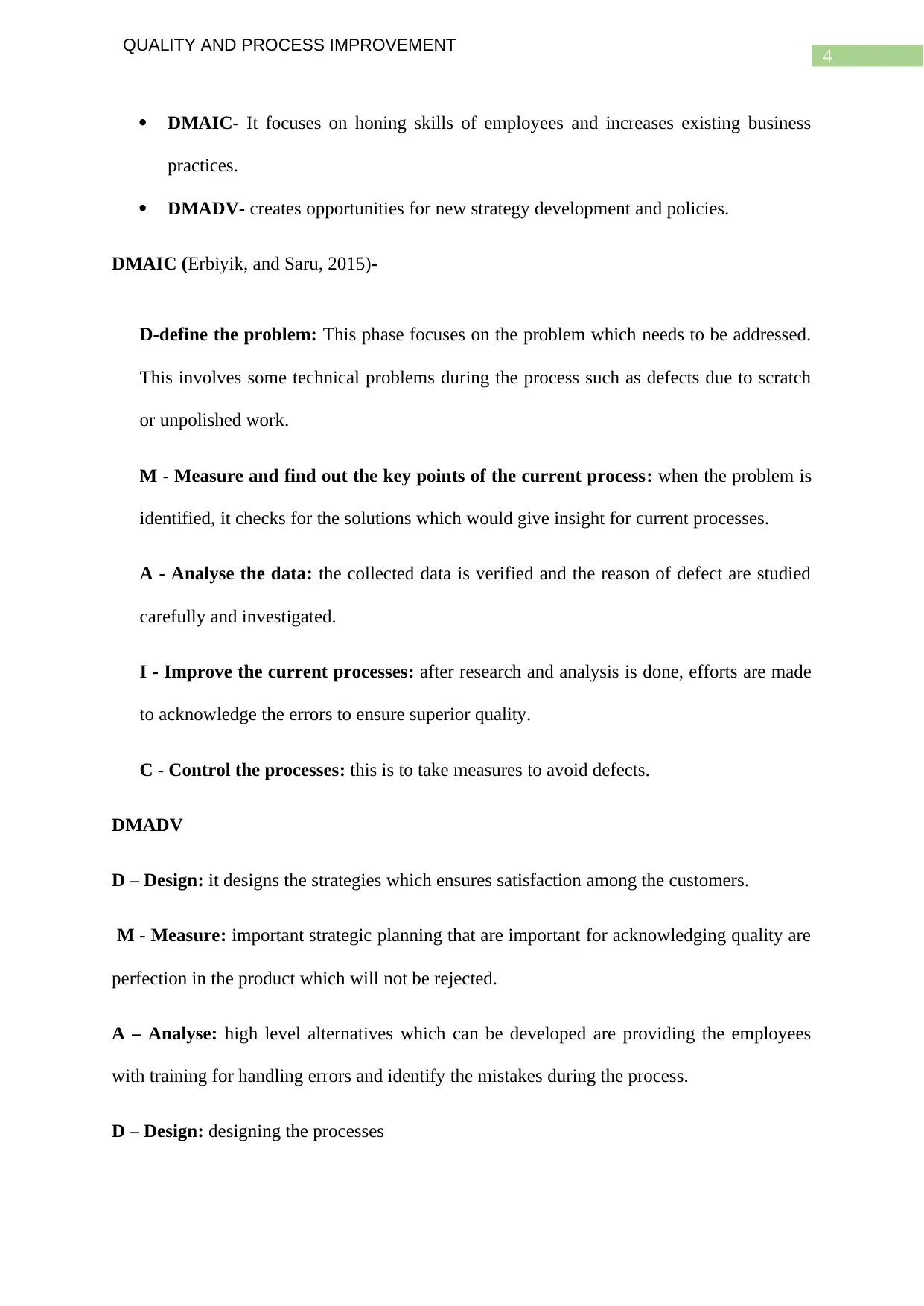
DMAIC- It focuses on honing skills of employees and increases existing business
practices.
DMADV- creates opportunities for new strategy development and policies.
DMAIC (Erbiyik, and Saru, 2015)-
D-define the problem: This phase focuses on the problem which needs to be addressed.
This involves some technical problems during the process such as defects due to scratch
or unpolished work.
M - Measure and find out the key points of the current process: when the problem is
identified, it checks for the solutions which would give insight for current processes.
A - Analyse the data: the collected data is verified and the reason of defect are studied
carefully and investigated.
I - Improve the current processes: after research and analysis is done, efforts are made
to acknowledge the errors to ensure superior quality.
C - Control the processes: this is to take measures to avoid defects.
DMADV
D – Design: it designs the strategies which ensures satisfaction among the customers.
M - Measure: important strategic planning that are important for acknowledging quality are
perfection in the product which will not be rejected.
A – Analyse: high level alternatives which can be developed are providing the employees
with training for handling errors and identify the mistakes during the process.
D – Design: designing the processes
QUALITY AND PROCESS IMPROVEMENT
DMAIC- It focuses on honing skills of employees and increases existing business
practices.
DMADV- creates opportunities for new strategy development and policies.
DMAIC (Erbiyik, and Saru, 2015)-
D-define the problem: This phase focuses on the problem which needs to be addressed.
This involves some technical problems during the process such as defects due to scratch
or unpolished work.
M - Measure and find out the key points of the current process: when the problem is
identified, it checks for the solutions which would give insight for current processes.
A - Analyse the data: the collected data is verified and the reason of defect are studied
carefully and investigated.
I - Improve the current processes: after research and analysis is done, efforts are made
to acknowledge the errors to ensure superior quality.
C - Control the processes: this is to take measures to avoid defects.
DMADV
D – Design: it designs the strategies which ensures satisfaction among the customers.
M - Measure: important strategic planning that are important for acknowledging quality are
perfection in the product which will not be rejected.
A – Analyse: high level alternatives which can be developed are providing the employees
with training for handling errors and identify the mistakes during the process.
D – Design: designing the processes
5
QUALITY AND PROCESS IMPROVEMENT
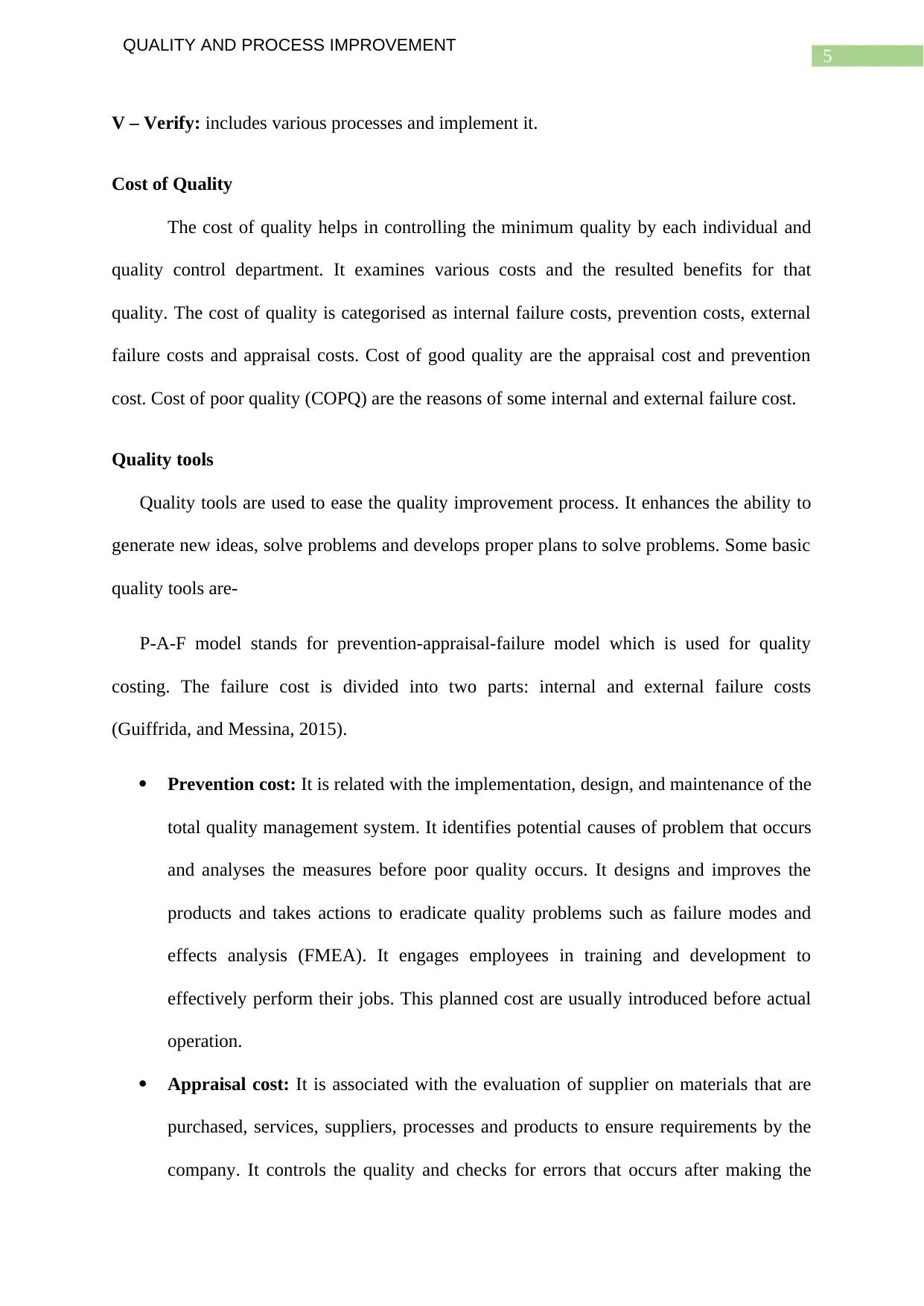
V – Verify: includes various processes and implement it.
Cost of Quality
The cost of quality helps in controlling the minimum quality by each individual and
quality control department. It examines various costs and the resulted benefits for that
quality. The cost of quality is categorised as internal failure costs, prevention costs, external
failure costs and appraisal costs. Cost of good quality are the appraisal cost and prevention
cost. Cost of poor quality (COPQ) are the reasons of some internal and external failure cost.
Quality tools
Quality tools are used to ease the quality improvement process. It enhances the ability to
generate new ideas, solve problems and develops proper plans to solve problems. Some basic
quality tools are-
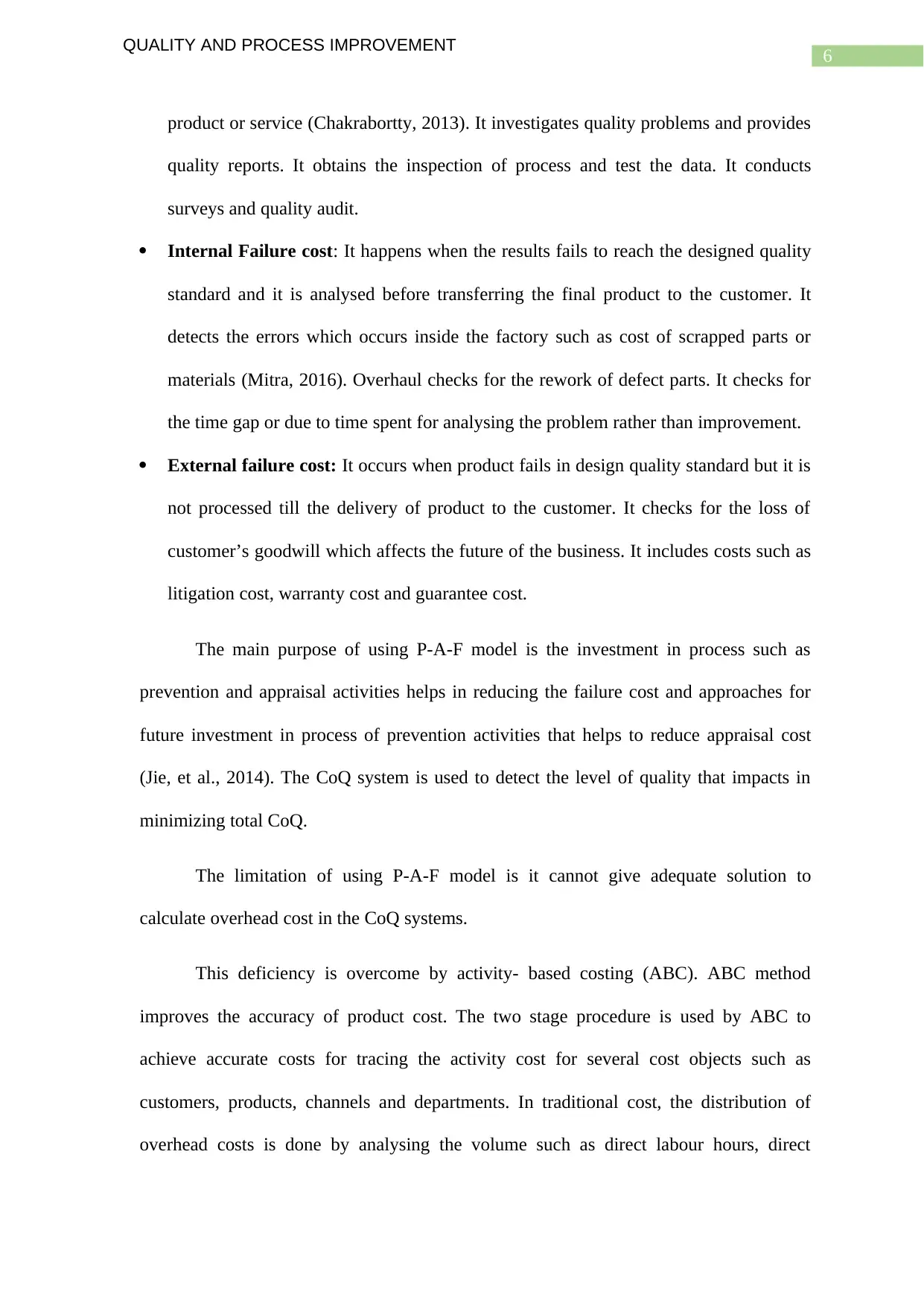
P-A-F model stands for prevention-appraisal-failure model which is used for quality
costing. The failure cost is divided into two parts: internal and external failure costs
(Guiffrida, and Messina, 2015).
Prevention cost: It is related with the implementation, design, and maintenance of the
total quality management system. It identifies potential causes of problem that occurs
and analyses the measures before poor quality occurs. It designs and improves the
products and takes actions to eradicate quality problems such as failure modes and
effects analysis (FMEA). It engages employees in training and development to
effectively perform their jobs. This planned cost are usually introduced before actual
operation.
Appraisal cost: It is associated with the evaluation of supplier on materials that are
purchased, services, suppliers, processes and products to ensure requirements by the
company. It controls the quality and checks for errors that occurs after making the
QUALITY AND PROCESS IMPROVEMENT
V – Verify: includes various processes and implement it.
Cost of Quality
The cost of quality helps in controlling the minimum quality by each individual and
quality control department. It examines various costs and the resulted benefits for that
quality. The cost of quality is categorised as internal failure costs, prevention costs, external
failure costs and appraisal costs. Cost of good quality are the appraisal cost and prevention
cost. Cost of poor quality (COPQ) are the reasons of some internal and external failure cost.
Quality tools
Quality tools are used to ease the quality improvement process. It enhances the ability to
generate new ideas, solve problems and develops proper plans to solve problems. Some basic
quality tools are-
P-A-F model stands for prevention-appraisal-failure model which is used for quality
costing. The failure cost is divided into two parts: internal and external failure costs
(Guiffrida, and Messina, 2015).
Prevention cost: It is related with the implementation, design, and maintenance of the
total quality management system. It identifies potential causes of problem that occurs
and analyses the measures before poor quality occurs. It designs and improves the
products and takes actions to eradicate quality problems such as failure modes and
effects analysis (FMEA). It engages employees in training and development to
effectively perform their jobs. This planned cost are usually introduced before actual
operation.
Appraisal cost: It is associated with the evaluation of supplier on materials that are
purchased, services, suppliers, processes and products to ensure requirements by the
company. It controls the quality and checks for errors that occurs after making the
⊘ This is a preview!⊘
Do you want full access?
Subscribe today to unlock all pages.
Trusted by 1+ million students worldwide
6
QUALITY AND PROCESS IMPROVEMENT
product or service (Chakrabortty, 2013). It investigates quality problems and provides
quality reports. It obtains the inspection of process and test the data. It conducts
surveys and quality audit.
Internal Failure cost: It happens when the results fails to reach the designed quality
standard and it is analysed before transferring the final product to the customer. It
detects the errors which occurs inside the factory such as cost of scrapped parts or
materials (Mitra, 2016). Overhaul checks for the rework of defect parts. It checks for
the time gap or due to time spent for analysing the problem rather than improvement.
External failure cost: It occurs when product fails in design quality standard but it is
not processed till the delivery of product to the customer. It checks for the loss of
customer’s goodwill which affects the future of the business. It includes costs such as
litigation cost, warranty cost and guarantee cost.
The main purpose of using P-A-F model is the investment in process such as
prevention and appraisal activities helps in reducing the failure cost and approaches for
future investment in process of prevention activities that helps to reduce appraisal cost
(Jie, et al., 2014). The CoQ system is used to detect the level of quality that impacts in
minimizing total CoQ.
The limitation of using P-A-F model is it cannot give adequate solution to
calculate overhead cost in the CoQ systems.
This deficiency is overcome by activity- based costing (ABC). ABC method
improves the accuracy of product cost. The two stage procedure is used by ABC to
achieve accurate costs for tracing the activity cost for several cost objects such as
customers, products, channels and departments. In traditional cost, the distribution of
overhead costs is done by analysing the volume such as direct labour hours, direct
QUALITY AND PROCESS IMPROVEMENT
product or service (Chakrabortty, 2013). It investigates quality problems and provides
quality reports. It obtains the inspection of process and test the data. It conducts
surveys and quality audit.
Internal Failure cost: It happens when the results fails to reach the designed quality
standard and it is analysed before transferring the final product to the customer. It
detects the errors which occurs inside the factory such as cost of scrapped parts or
materials (Mitra, 2016). Overhaul checks for the rework of defect parts. It checks for
the time gap or due to time spent for analysing the problem rather than improvement.
External failure cost: It occurs when product fails in design quality standard but it is
not processed till the delivery of product to the customer. It checks for the loss of
customer’s goodwill which affects the future of the business. It includes costs such as
litigation cost, warranty cost and guarantee cost.
The main purpose of using P-A-F model is the investment in process such as
prevention and appraisal activities helps in reducing the failure cost and approaches for
future investment in process of prevention activities that helps to reduce appraisal cost
(Jie, et al., 2014). The CoQ system is used to detect the level of quality that impacts in
minimizing total CoQ.
The limitation of using P-A-F model is it cannot give adequate solution to
calculate overhead cost in the CoQ systems.
This deficiency is overcome by activity- based costing (ABC). ABC method
improves the accuracy of product cost. The two stage procedure is used by ABC to
achieve accurate costs for tracing the activity cost for several cost objects such as
customers, products, channels and departments. In traditional cost, the distribution of
overhead costs is done by analysing the volume such as direct labour hours, direct
Paraphrase This Document
Need a fresh take? Get an instant paraphrase of this document with our AI Paraphraser
7
QUALITY AND PROCESS IMPROVEMENT
material cost, direct labour cost and many more. In modern manufacturing environment,
the overhead grows rapidly as manufacturer increases the level of automation. The
traditional cost accounting gives the overall cost of products which are higher in volume
and under cost of products which are lower in volume.
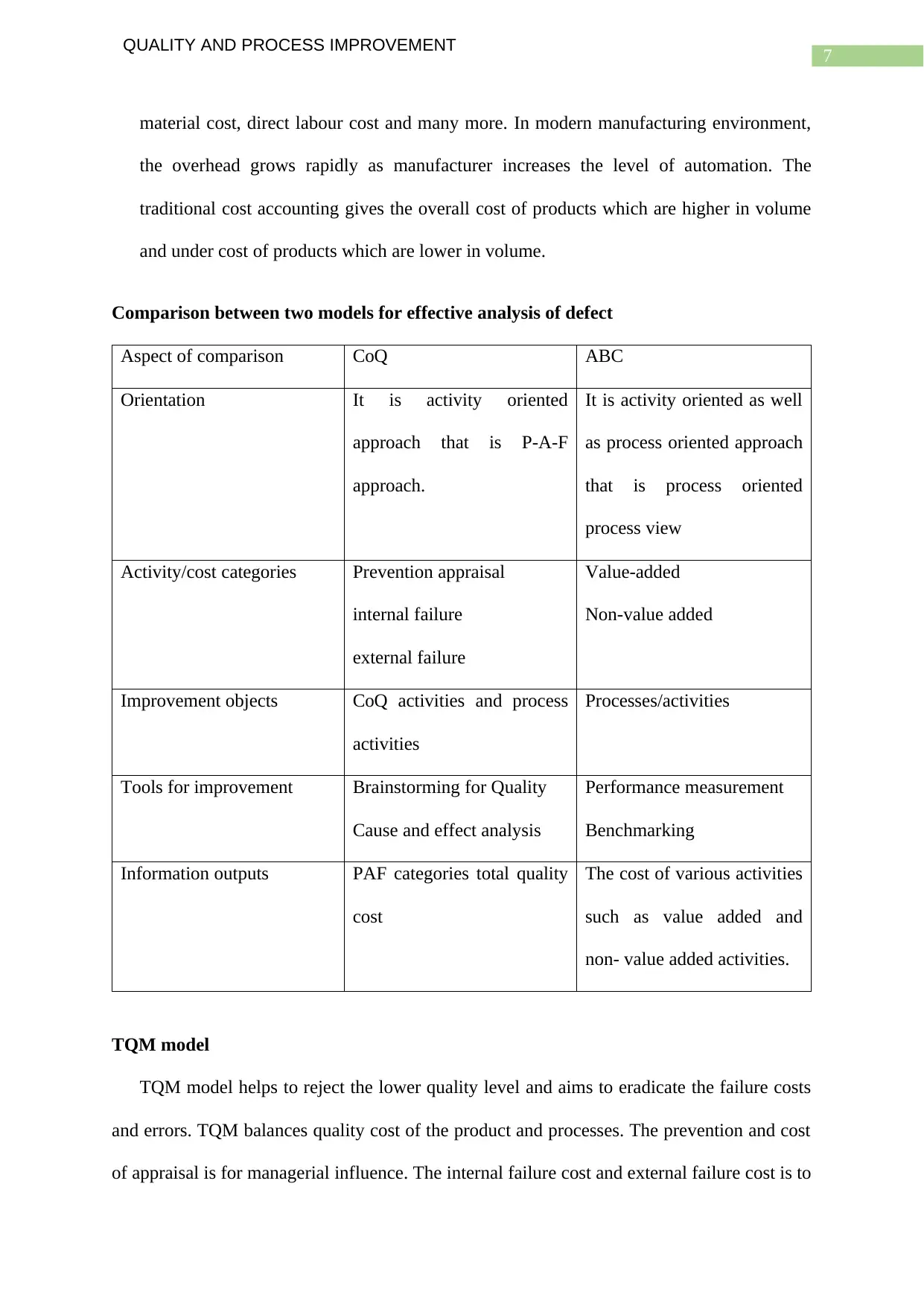
Comparison between two models for effective analysis of defect
Aspect of comparison CoQ ABC
Orientation It is activity oriented
approach that is P-A-F
approach.
It is activity oriented as well
as process oriented approach
that is process oriented
process view
Activity/cost categories Prevention appraisal
internal failure
external failure
Value-added
Non-value added
Improvement objects CoQ activities and process
activities
Processes/activities
Tools for improvement Brainstorming for Quality
Cause and effect analysis
Performance measurement
Benchmarking
Information outputs PAF categories total quality
cost
The cost of various activities
such as value added and
non- value added activities.
TQM model
TQM model helps to reject the lower quality level and aims to eradicate the failure costs
and errors. TQM balances quality cost of the product and processes. The prevention and cost
of appraisal is for managerial influence. The internal failure cost and external failure cost is to
QUALITY AND PROCESS IMPROVEMENT
material cost, direct labour cost and many more. In modern manufacturing environment,
the overhead grows rapidly as manufacturer increases the level of automation. The
traditional cost accounting gives the overall cost of products which are higher in volume
and under cost of products which are lower in volume.
Comparison between two models for effective analysis of defect
Aspect of comparison CoQ ABC
Orientation It is activity oriented
approach that is P-A-F
approach.
It is activity oriented as well
as process oriented approach
that is process oriented
process view
Activity/cost categories Prevention appraisal
internal failure
external failure
Value-added
Non-value added
Improvement objects CoQ activities and process
activities
Processes/activities
Tools for improvement Brainstorming for Quality
Cause and effect analysis
Performance measurement
Benchmarking
Information outputs PAF categories total quality
cost
The cost of various activities
such as value added and
non- value added activities.
TQM model
TQM model helps to reject the lower quality level and aims to eradicate the failure costs
and errors. TQM balances quality cost of the product and processes. The prevention and cost
of appraisal is for managerial influence. The internal failure cost and external failure cost is to
8
QUALITY AND PROCESS IMPROVEMENT
check for the consequences of changes in the prevention and appraisal cost. TQM model
emphasis on appraisal to check bad products and service should not reach the customer.
The purpose of using TQM model in business is to prevent and stop errors that occurs.
TQM prioritize on prevention process to eradicate errors. The more emphasis is provided
for error prevention that aims to reduce external and internal failure costs. After this appraisal
cost can be reduced once confidence is established.
Quality Cost Matrix
By using quality cost matrix, the report for cost of quality can be addressed. This
allows expert team to recognise the effort of employees towards cost of quality. This
enhances their skill and improves participation in a cost of quality programme. It helps to
detect areas of high quality cost and also directs the attention towards improving the quality
(Guiffrida, 2015). By considering Pareto principle, 80% of the internal failure costs is due to
manufacturing problem. This matrix helps to identify main errors and allows the company to
highlight on these areas and to take corrective actions.
QUALITY AND PROCESS IMPROVEMENT
check for the consequences of changes in the prevention and appraisal cost. TQM model
emphasis on appraisal to check bad products and service should not reach the customer.
The purpose of using TQM model in business is to prevent and stop errors that occurs.
TQM prioritize on prevention process to eradicate errors. The more emphasis is provided
for error prevention that aims to reduce external and internal failure costs. After this appraisal
cost can be reduced once confidence is established.
Quality Cost Matrix
By using quality cost matrix, the report for cost of quality can be addressed. This
allows expert team to recognise the effort of employees towards cost of quality. This
enhances their skill and improves participation in a cost of quality programme. It helps to
detect areas of high quality cost and also directs the attention towards improving the quality
(Guiffrida, 2015). By considering Pareto principle, 80% of the internal failure costs is due to
manufacturing problem. This matrix helps to identify main errors and allows the company to
highlight on these areas and to take corrective actions.
⊘ This is a preview!⊘
Do you want full access?
Subscribe today to unlock all pages.
Trusted by 1+ million students worldwide
9
QUALITY AND PROCESS IMPROVEMENT
Suggestion and recommendation
Company must establish a disciplined work environment and all operators/ employees
must be trained to enhance their skills and aware them to practice effective working.
They must be aware about handling the materials properly for finger print, scratches
and stain mark (Hasan, 2018).
Machine must be checked regularly and its condition must be checked for confirming
the products are in good condition or expired products. The machine’s pressure,
holding time and temperature must be accurate to avoid flow lines/ marks defects
(Yadav and Sukhwani, 2016). The mould must be checked for avoiding dirt and stain
free marks and scratches.
All the new materials must be checked by melt flow index to avoid flow line defects.
QUALITY AND PROCESS IMPROVEMENT
Suggestion and recommendation
Company must establish a disciplined work environment and all operators/ employees
must be trained to enhance their skills and aware them to practice effective working.
They must be aware about handling the materials properly for finger print, scratches
and stain mark (Hasan, 2018).
Machine must be checked regularly and its condition must be checked for confirming
the products are in good condition or expired products. The machine’s pressure,
holding time and temperature must be accurate to avoid flow lines/ marks defects
(Yadav and Sukhwani, 2016). The mould must be checked for avoiding dirt and stain
free marks and scratches.
All the new materials must be checked by melt flow index to avoid flow line defects.
Paraphrase This Document
Need a fresh take? Get an instant paraphrase of this document with our AI Paraphraser
10
QUALITY AND PROCESS IMPROVEMENT
Conclusion
The report concludes that the error which occurs during various process can be
recovered and minimized through different quality cost model. The P-A-F model and ABC
model helps the organisation to understand all four categories: prevention cost, appraisal cost,
internal failure cost and external failure cost to be focused on for error detection. The quality
cost matrix results in quality improvement process and stimulate competition between
different departments.
QUALITY AND PROCESS IMPROVEMENT
Conclusion
The report concludes that the error which occurs during various process can be
recovered and minimized through different quality cost model. The P-A-F model and ABC
model helps the organisation to understand all four categories: prevention cost, appraisal cost,
internal failure cost and external failure cost to be focused on for error detection. The quality
cost matrix results in quality improvement process and stimulate competition between
different departments.
11
QUALITY AND PROCESS IMPROVEMENT
Reference
Allahbakhsh, M., Benatallah, B., Ignjatovic, A., Motahari-Nezhad, H.R., Bertino, E. and
Dustdar, S., 2013. Quality control in crowdsourcing systems: Issues and directions. IEEE
Internet Computing, 17(2), pp.76-81.
Azizi, A., 2015, March. Relationships between total quality management critical techniques
in automotive industry. In 2015 International Conference on Industrial Engineering and
Operations Management (IEOM) (pp. 1-8). IEEE.
Chakrabortty, R.K., Biswas, T.K. and Ahmed, I., 2013. REDUCING PROCESS
VARIABILITY BY USING DMAIC MODEL: A CASE STUDY IN
BANGLADESH. International Journal for Quality Research, 7(1).
Guiffrida, A.L. and Messina, M.J., 2015. Quality control techniques in services marketing.
In Proceedings of the 1988 International Conference of Services Marketing (pp. 223-234).
Springer, Cham.
Hasan, M., Rezwan, A., Islam, M. and Dutta, A., 2018. Defect reduction by total quality
management in a crackers manufacturing system. World Scientific News, 98, pp.150-171.
Mitra, A., 2016. Fundamentals of quality control and improvement. John Wiley & Sons.
Yadav, A. and Sukhwani, V.K., 2016. Quality improvement by using Six Sigma DMAIC in
an industry. International Journal of Current Engineering and Technology, pp.41-46.
QUALITY AND PROCESS IMPROVEMENT
Reference
Allahbakhsh, M., Benatallah, B., Ignjatovic, A., Motahari-Nezhad, H.R., Bertino, E. and
Dustdar, S., 2013. Quality control in crowdsourcing systems: Issues and directions. IEEE
Internet Computing, 17(2), pp.76-81.
Azizi, A., 2015, March. Relationships between total quality management critical techniques
in automotive industry. In 2015 International Conference on Industrial Engineering and
Operations Management (IEOM) (pp. 1-8). IEEE.
Chakrabortty, R.K., Biswas, T.K. and Ahmed, I., 2013. REDUCING PROCESS
VARIABILITY BY USING DMAIC MODEL: A CASE STUDY IN
BANGLADESH. International Journal for Quality Research, 7(1).
Guiffrida, A.L. and Messina, M.J., 2015. Quality control techniques in services marketing.
In Proceedings of the 1988 International Conference of Services Marketing (pp. 223-234).
Springer, Cham.
Hasan, M., Rezwan, A., Islam, M. and Dutta, A., 2018. Defect reduction by total quality
management in a crackers manufacturing system. World Scientific News, 98, pp.150-171.
Mitra, A., 2016. Fundamentals of quality control and improvement. John Wiley & Sons.
Yadav, A. and Sukhwani, V.K., 2016. Quality improvement by using Six Sigma DMAIC in
an industry. International Journal of Current Engineering and Technology, pp.41-46.
⊘ This is a preview!⊘
Do you want full access?
Subscribe today to unlock all pages.
Trusted by 1+ million students worldwide

1 out of 12


Related Documents


Your All-in-One AI-Powered Toolkit for Academic Success.
+13062052269
info@desklib.com
Available 24*7 on WhatsApp / Email
![[object Object]](/_next/static/media/star-bottom.7253800d.svg)
Unlock your academic potential
Copyright © 2020–2026 A2Z Services. All Rights Reserved. Developed and managed by ZUCOL.