Comprehensive Financial Ratio Analysis and Performance Report

Verified

Added on Ā 2019/09/26

|5
|1183
|227
Report
AI Summary
This report provides a comprehensive financial ratio analysis of a company's performance, focusing on key metrics such as current ratio, quick ratio, interest coverage ratio, inventory turnover, average collection period, sales to fixed assets, profit on sales, return on assets, and return on net worth. The analysis reveals the company's strengths and weaknesses in terms of liquidity, efficiency, and profitability. The report also provides recommendations for improvement, emphasizing the importance of better inventory management, reducing debtor collection periods, and increasing net profit without additional capital investments. The report utilizes the insights from the financial ratios to provide a holistic view of the company's financial health and offers actionable strategies for enhancing its performance.
Document Page
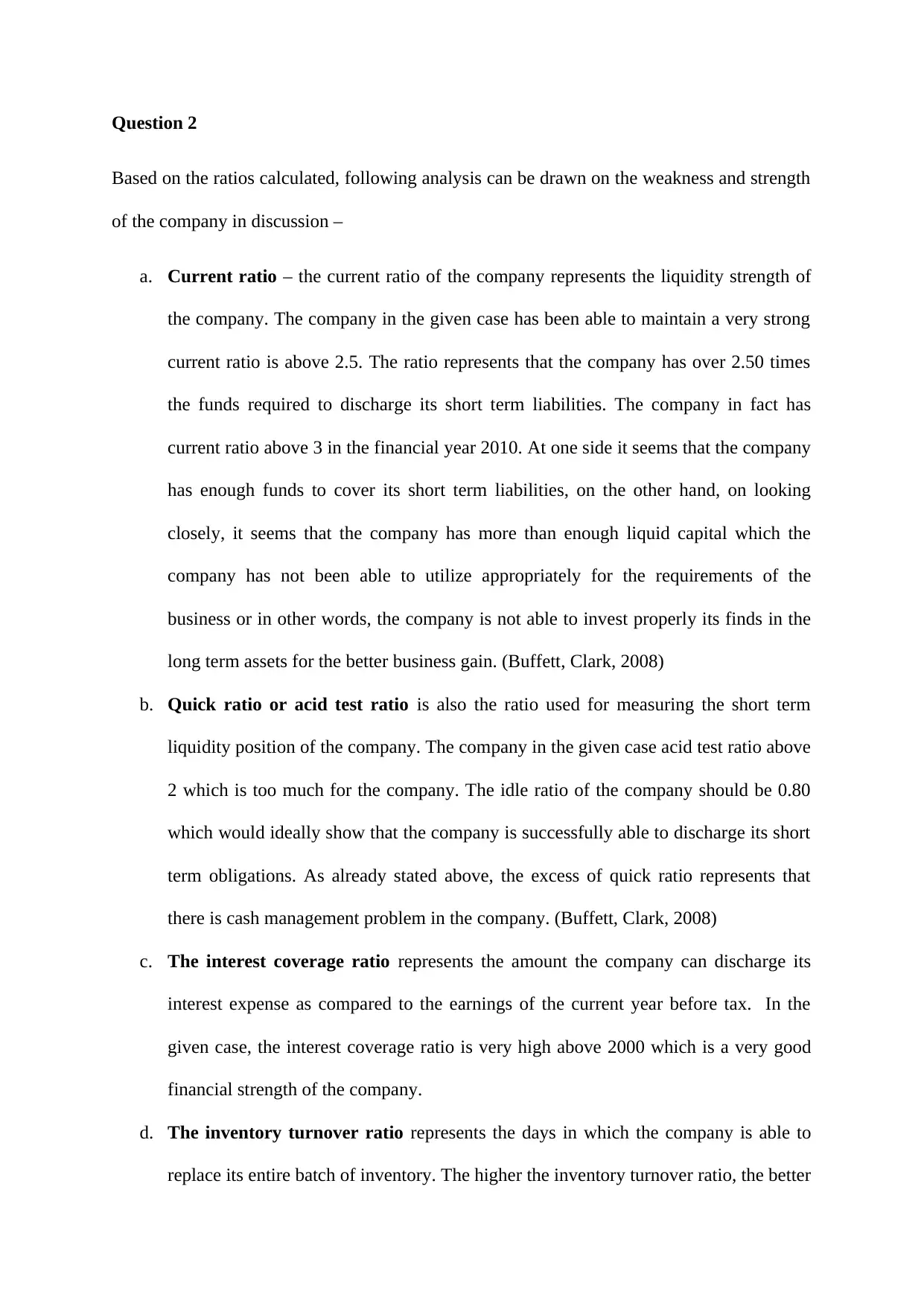
Question 2
Based on the ratios calculated, following analysis can be drawn on the weakness and strength
of the company in discussion –
a. Current ratio – the current ratio of the company represents the liquidity strength of
the company. The company in the given case has been able to maintain a very strong
current ratio is above 2.5. The ratio represents that the company has over 2.50 times
the funds required to discharge its short term liabilities. The company in fact has
current ratio above 3 in the financial year 2010. At one side it seems that the company
has enough funds to cover its short term liabilities, on the other hand, on looking
closely, it seems that the company has more than enough liquid capital which the
company has not been able to utilize appropriately for the requirements of the
business or in other words, the company is not able to invest properly its finds in the
long term assets for the better business gain. (Buffett, Clark, 2008)
b. Quick ratio or acid test ratio is also the ratio used for measuring the short term
liquidity position of the company. The company in the given case acid test ratio above
2 which is too much for the company. The idle ratio of the company should be 0.80
which would ideally show that the company is successfully able to discharge its short
term obligations. As already stated above, the excess of quick ratio represents that
there is cash management problem in the company. (Buffett, Clark, 2008)
c. The interest coverage ratio represents the amount the company can discharge its
interest expense as compared to the earnings of the current year before tax. In the
given case, the interest coverage ratio is very high above 2000 which is a very good
financial strength of the company.
d. The inventory turnover ratio represents the days in which the company is able to
replace its entire batch of inventory. The higher the inventory turnover ratio, the better
tabler-icon-diamond-filled.svg

Paraphrase This Document

Need a fresh take? Get an instant paraphrase of this document with our AI Paraphraser
Document Page
it is for the company as this would represent a better inventory management of the
company. In the given case, the inventory turnover of the company has reduced which
is not a good sign of the company as it seems it has become a trend which could affect
the financial health of the company. This also indicates that the there is a possibility
of the reduction in the demand of sales.
e. Average collection period of the company has also increased indicating that the
company are not able to convert the debtors into cash at a steady pace which again is
not a good sign for the company. This would further require the company to manage
more working capital which is an indirect interest loss to the company.
f. Sales to Gross fixed asset ratio indicates that how much the fixed assets of the
company are able to support the sales generated by the company. The sales to fixed
asset ratio decreased over the last two years but this year the company has a very high
sales to fixed asset ratio which is 24. The turnover of the company has also increased
indicating efficiency on the part of company.
g. Sales to total fixed assets represents the same analysis as that represented by the
sales to gross fixed assets ratio but the net fixed assets present a more accurate view
as to how the fixed assets are able to generate the sales of the company. In the given
case, the sales to net fixed asset ratio of the company has decreased significantly over
the past few years under study indicating that the assets are getting depreciated and
they may not be able to support the sales for a longer duration and the company may
in the longer term need bigger investments to replace its assets. (Koen, Oberholster,
1999)
h. Profit on sales ratio indicates the income that is earned by the company on the sales
generated by it. The company as seen in the last 4 years has had a fluctuating trend on
income from sales. The margin initially 4 years back was not impressive but was still
Document Page
acceptable up to 7%. However, the company had shown decreasing trend in the next 2
years which was little worried. However, the company even though performed poorly
is able to get a little momentum and has made 4.36% profit. If this is the growth rate
of the company, then the investor will be reluctant in making investments in the
company. (Koen, Oberholster, 1999)
i. Return on total assets indicates at how much investment in the fixed assets the
company can earn profit. The company has fluctuating trend in the given case and is
not up to the mark as had shown serious downfall in this ratio which is not a good
sign for the financial health of the company.
j. Return on net worth is one of the most important ratio and is widely used by the
investors. The return on net worth indicates at how much net worth of the company, it
can generate profit and up to what percentage. The company in the given case has not
performed very well and has shown a decreasing trend except the current financial
year where it has shown an upward trend which is also not that impressive. (Fridson, ,
Alvarez, 2002)
Question 3.
Tim must focus on increasing the net profit of the company without making investment in the
capital base of the company. This could be done by infusing new capital in the company but
this would incur extra cost in form of interest. The company must focus on better inventory
management by either curtailing the production to the market demand level or maintaining a
minimum level of stock. The company should also follow just in time approach to optimize
the working capital of the company. Other way is that the company should focus on reducing
the debtor collection period of the company. This would not only reduce the risk of bad debts
Document Page
towards the company but also help in collecting the money which would reduce the external
dependency on the working capital or save the company on the notional interest cost.
tabler-icon-diamond-filled.svg

Paraphrase This Document

Need a fresh take? Get an instant paraphrase of this document with our AI Paraphraser
Document Page
References
Buffett, M, Clark, D (2008) Warren Buffett and The Interpretation of Financial Statements,
London, Simon & Schuster
Koen, M, Oberholster, J (1999) Analysis and Interpretation of Financial Statements, 2ed.,
Kenwyn, Juta & Co. Ltd
Fridson, M, Alvarez, F (2002) Financial Statement Analysis : A Practitioner's Guide, 3rd Ed.,
New York, John Wiley & Sons, Inc.
chevron_up_icon
1 out of 5
circle_padding
hide_on_mobile
zoom_out_icon
[object Object]