Recruitment and Selection: Documents, Interviews, and Analysis
VerifiedAdded on 2019/12/28
|11
|2840
|434
Report
AI Summary
This report delves into the multifaceted realm of recruitment and selection, providing a comprehensive overview of the processes involved. It begins by exploring the utilization of both internal and external resources in attracting potential candidates, followed by an analysis of the legal and regulatory frameworks that govern these practices. The report then examines the crucial role of various documents used in selection and recruitment, including job descriptions and person specifications. It proceeds to address the planning and execution of selection interviews, including the potential challenges and biases. The report also analyzes the contribution to the selection process and evaluates the experience of planning and participating in the process. The report uses Aldi and M&S as examples. The report concludes by summarizing best practices in recruitment and selection.

RECURITMENT
& SELECTION
& SELECTION

Paraphrase This Document
Need a fresh take? Get an instant paraphrase of this document with our AI Paraphraser
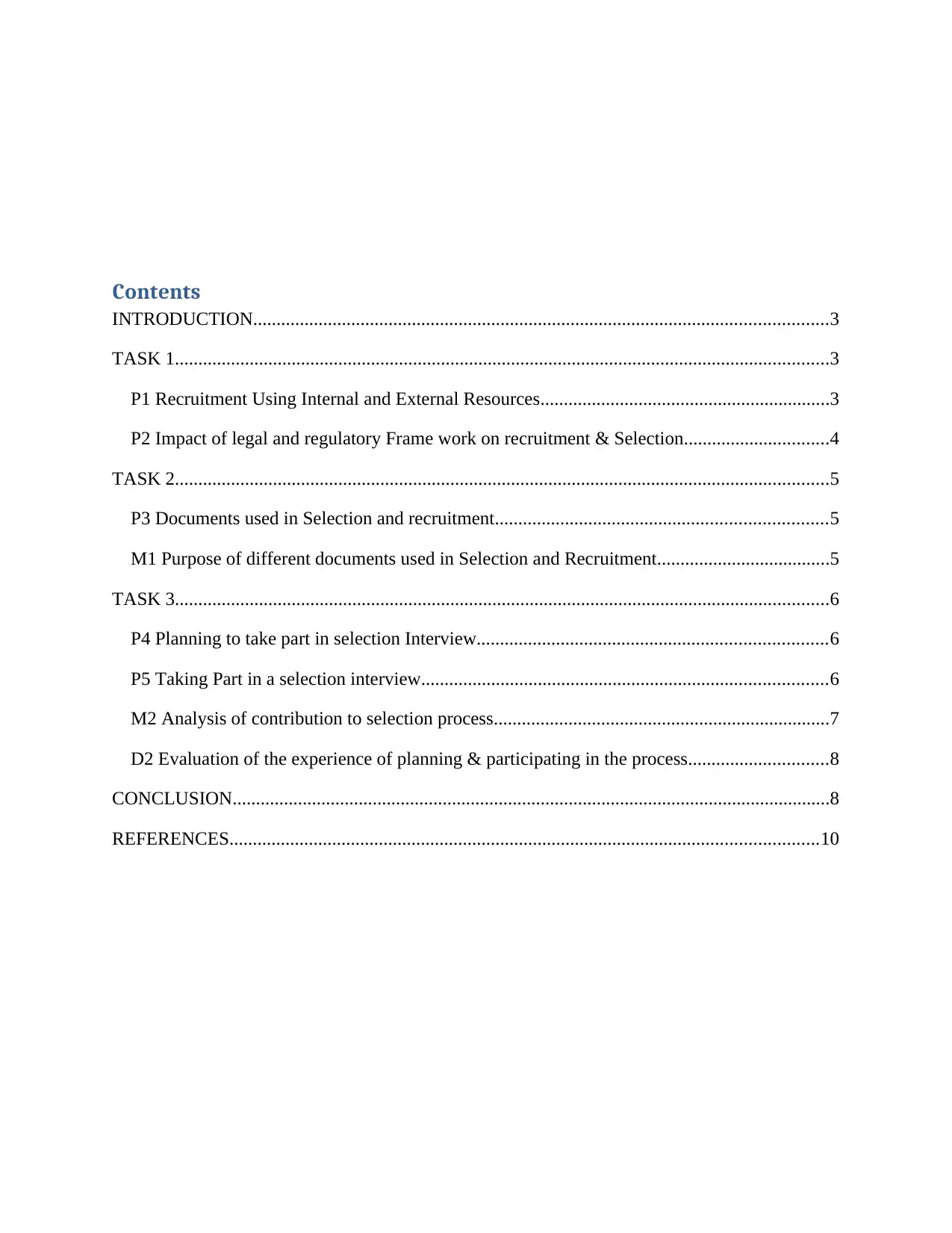
Contents
INTRODUCTION...........................................................................................................................3
TASK 1............................................................................................................................................3
P1 Recruitment Using Internal and External Resources..............................................................3
P2 Impact of legal and regulatory Frame work on recruitment & Selection...............................4
TASK 2............................................................................................................................................5
P3 Documents used in Selection and recruitment.......................................................................5
M1 Purpose of different documents used in Selection and Recruitment.....................................5
TASK 3............................................................................................................................................6
P4 Planning to take part in selection Interview...........................................................................6
P5 Taking Part in a selection interview.......................................................................................6
M2 Analysis of contribution to selection process........................................................................7
D2 Evaluation of the experience of planning & participating in the process..............................8
CONCLUSION................................................................................................................................8
REFERENCES..............................................................................................................................10
INTRODUCTION...........................................................................................................................3
TASK 1............................................................................................................................................3
P1 Recruitment Using Internal and External Resources..............................................................3
P2 Impact of legal and regulatory Frame work on recruitment & Selection...............................4
TASK 2............................................................................................................................................5
P3 Documents used in Selection and recruitment.......................................................................5
M1 Purpose of different documents used in Selection and Recruitment.....................................5
TASK 3............................................................................................................................................6
P4 Planning to take part in selection Interview...........................................................................6
P5 Taking Part in a selection interview.......................................................................................6
M2 Analysis of contribution to selection process........................................................................7
D2 Evaluation of the experience of planning & participating in the process..............................8
CONCLUSION................................................................................................................................8
REFERENCES..............................................................................................................................10
INTRODUCTION
Recruitment is the process of attracting the most suitable people for the position,
selection is the process of choosing the best person for the position, and induction is introducing
the person to the position. This module describes a series of well-tested steps to help you identify
the right person, to ensure he or she will fit well with your farm business, and to meet the various
legal obligations of an employer. If recruitment is done well, the business benefits from happier
and more productive people, reduced staff turnover, good working relationships and ultimately a
more profitable farm(Girard and Fallery, 2017). Thus the present report is conducted in order to
make the things clear on recruitment and selection topic which will make the reader of this report
full fill his domain of knowledge. The companies for this undertaken are Aldi and Mark &
Spencer.
TASK 1
P1 Recruitment Using Internal and External Resources
For any organization, recruitment is a crucial part of developing and maintaining
an effective and efficient team. A good recruitment strategy will cut down the wastage of
time and money, which would have incurred for extensive training and development of
unqualified resources(Hall, Pilbeam and Corbridge, 2013).
Internal Sources of Recruitment
Internal sources of recruitment refer to hiring employees within the organization
internally. In other words, applicants seeking for the different positions are those who are
currently employed with the same organization.
Promotions: Promotion refers to upgrading the cadre of the employees by evaluating
their performance in the organization. It is the process of shifting an employee from a
lower position to a higher position with more responsibilities, remuneration, facilities,
and status.
Transfers: Transfer refers to the process of interchanging from one job to another
without any change in the rank and responsibilities(McClean and Collins, 2017).
Recruitment is the process of attracting the most suitable people for the position,
selection is the process of choosing the best person for the position, and induction is introducing
the person to the position. This module describes a series of well-tested steps to help you identify
the right person, to ensure he or she will fit well with your farm business, and to meet the various
legal obligations of an employer. If recruitment is done well, the business benefits from happier
and more productive people, reduced staff turnover, good working relationships and ultimately a
more profitable farm(Girard and Fallery, 2017). Thus the present report is conducted in order to
make the things clear on recruitment and selection topic which will make the reader of this report
full fill his domain of knowledge. The companies for this undertaken are Aldi and Mark &
Spencer.
TASK 1
P1 Recruitment Using Internal and External Resources
For any organization, recruitment is a crucial part of developing and maintaining
an effective and efficient team. A good recruitment strategy will cut down the wastage of
time and money, which would have incurred for extensive training and development of
unqualified resources(Hall, Pilbeam and Corbridge, 2013).
Internal Sources of Recruitment
Internal sources of recruitment refer to hiring employees within the organization
internally. In other words, applicants seeking for the different positions are those who are
currently employed with the same organization.
Promotions: Promotion refers to upgrading the cadre of the employees by evaluating
their performance in the organization. It is the process of shifting an employee from a
lower position to a higher position with more responsibilities, remuneration, facilities,
and status.
Transfers: Transfer refers to the process of interchanging from one job to another
without any change in the rank and responsibilities(McClean and Collins, 2017).
⊘ This is a preview!⊘
Do you want full access?
Subscribe today to unlock all pages.

Trusted by 1+ million students worldwide
Recruiting Former Employees: Recruiting former employees is a process of internal
sources of recruitment, wherein the ex employees are called back depending upon the
requirement of the position. This process is cost effective and saves plenty of time.
External Sources of Recruitment
External sources of recruitment refer to hiring employees outside the organization
externally. In other words, the applicants seeking job opportunities in this case are those who are
external to the organization.
Employment Exchanges: As per the law, for certain job vacancies, it is mandatory that
the organization provides details to the employment exchange(Phillips and Gully, 2016).
Employment Agencies: Employment agencies are a good external source of recruitment.
Employment agencies are run by various sectors like private, public, or government.
P2 Impact of legal and regulatory Frame work on recruitment & Selection
Recruiting the right people is the key to the success of many organizations. These
organizations ensure that the processes and procedures involved in recruitment and selection
meet their needs and are legal. In this unit, learners will develop an understanding of the impact
of the regulatory framework on the recruitment process(Rivera, 2015). Potential applicants may
decide to apply for a post based on the quality of information that they receive. Details of the
post will usually be the first communication they have with the organization. It is important that
the organization makes a good first impression on potential applicants to ensure that they attract
sufficient applicants of the right caliber. Learners will develop their knowledge of the types of
documentation used in an interview process. A structured and planned selection procedure is
crucial to the success of the selection process. The impression a business makes may determine
an applicant's decision to accept an offer of appointment. Staff conducting the interview will also
be forming their impressions of the applicant. It is important that interviewers are well organized
and prepared. They will need to be familiar with the details supplied by the short listed
applicants, and use effective communication and listening skills during the interview(Lievens
and Sackett, 2016).
sources of recruitment, wherein the ex employees are called back depending upon the
requirement of the position. This process is cost effective and saves plenty of time.
External Sources of Recruitment
External sources of recruitment refer to hiring employees outside the organization
externally. In other words, the applicants seeking job opportunities in this case are those who are
external to the organization.
Employment Exchanges: As per the law, for certain job vacancies, it is mandatory that
the organization provides details to the employment exchange(Phillips and Gully, 2016).
Employment Agencies: Employment agencies are a good external source of recruitment.
Employment agencies are run by various sectors like private, public, or government.
P2 Impact of legal and regulatory Frame work on recruitment & Selection
Recruiting the right people is the key to the success of many organizations. These
organizations ensure that the processes and procedures involved in recruitment and selection
meet their needs and are legal. In this unit, learners will develop an understanding of the impact
of the regulatory framework on the recruitment process(Rivera, 2015). Potential applicants may
decide to apply for a post based on the quality of information that they receive. Details of the
post will usually be the first communication they have with the organization. It is important that
the organization makes a good first impression on potential applicants to ensure that they attract
sufficient applicants of the right caliber. Learners will develop their knowledge of the types of
documentation used in an interview process. A structured and planned selection procedure is
crucial to the success of the selection process. The impression a business makes may determine
an applicant's decision to accept an offer of appointment. Staff conducting the interview will also
be forming their impressions of the applicant. It is important that interviewers are well organized
and prepared. They will need to be familiar with the details supplied by the short listed
applicants, and use effective communication and listening skills during the interview(Lievens
and Sackett, 2016).
Paraphrase This Document
Need a fresh take? Get an instant paraphrase of this document with our AI Paraphraser
TASK 2
P3 Documents used in Selection and recruitment
Recruitment in organizations is a systemic process which has a number of stages and
each of these stages need to be completed for the process to become a successful one. When a
staff leaves the job, it is very essential to do a job analysis prior to approval of appointing and
advertising the same post. It is important to check whether there are any changes required for the
specific role(Cushway, 2014). Job analysis is a procedure done to obtain detailed and objective
information about the post before any advertising is done for a replacement.
Some of the information required to do a job analysis may include the tasks the previous
post holder carried out, the level of these tasks, whether the reporting lines are still, whether any
new tasks need to be added for the post and/or whether the working hours are suitable or need to
be changed. In addition to the above, there are other essential documents that need to be prepared
in the process of recruiting or hiring a new employee. For example the job description, person
specification, application form, monitoring form and applicant's resume. The job description
basically describes the job in terms of its duties responsibilities and purpose.
M1 Purpose of different documents used in Selection and Recruitment
Gather consumer rating reports by consolidating, formatting and summarizing
information.
Update competitor database by inputting database from field sales
Accomplishes, marketing and organization mission by completing related results as
needed.
Preparing mailers and brochures by formatting content and graphics, arranging printing
and internet packages.
Salary: Negotiable
Skills / Qualifications: Reporting skills, Analyzing information, Written communication,
Self Development, Financial Skills, and Microsoft Office Skills.
Person Specification(Suff, 2014).
The person specification is used to provide recruiters with an ideal profile of the
candidate the company wishes to attend.
P3 Documents used in Selection and recruitment
Recruitment in organizations is a systemic process which has a number of stages and
each of these stages need to be completed for the process to become a successful one. When a
staff leaves the job, it is very essential to do a job analysis prior to approval of appointing and
advertising the same post. It is important to check whether there are any changes required for the
specific role(Cushway, 2014). Job analysis is a procedure done to obtain detailed and objective
information about the post before any advertising is done for a replacement.
Some of the information required to do a job analysis may include the tasks the previous
post holder carried out, the level of these tasks, whether the reporting lines are still, whether any
new tasks need to be added for the post and/or whether the working hours are suitable or need to
be changed. In addition to the above, there are other essential documents that need to be prepared
in the process of recruiting or hiring a new employee. For example the job description, person
specification, application form, monitoring form and applicant's resume. The job description
basically describes the job in terms of its duties responsibilities and purpose.
M1 Purpose of different documents used in Selection and Recruitment
Gather consumer rating reports by consolidating, formatting and summarizing
information.
Update competitor database by inputting database from field sales
Accomplishes, marketing and organization mission by completing related results as
needed.
Preparing mailers and brochures by formatting content and graphics, arranging printing
and internet packages.
Salary: Negotiable
Skills / Qualifications: Reporting skills, Analyzing information, Written communication,
Self Development, Financial Skills, and Microsoft Office Skills.
Person Specification(Suff, 2014).
The person specification is used to provide recruiters with an ideal profile of the
candidate the company wishes to attend.
TASK 3
P4 Planning to take part in selection Interview
Interview process can consider about some limitations which can decrease the potential
opportunities for the workers. Many organizations are using traditional poor bibliographic
interview process to predict the employee's performance. They are gathering information in an
unsystematic manner and judgment are making based on taking care of the variety of reasons.
Interview process can create big challenge for Aldi & M&S such as it may ask the questions by
confirming the initial impression about the candidate gained from their previous working
experiences or interview in the early stages(Wilton, 2013). Moreover, the halo and horns effects
is also creating problems in the interview process such as interviewers may rate the candidate as
good or bad based on the decision made by the selection board. It may create an unbalanced
results for measuring the employee's performance and reduce their potential level. In addition,
bias can problems in the interview planning where higher level management is not judging the
employee's skills properly than it will not motivate the employees. Failure to monitor the
interview planning can also makes mistakes in the selection process and makes mistakes on
selecting good candidates for the organization(Kline, 2013).
P5 Taking Part in a selection interview
Employee selection process is the process of matching the people with the organizational
requirements with the available skills and qualification of the people. The main criteria of
making an effective selection are to find out the effective matching with the employees.
Effective selection can maximize the quality of the employees and maximize the organizational
performance(Guion, 2015). Effective selection process can save time and money for the
organization and create more opportunities for the candidates to maximize the organizational
performance.
The following steps are taken to make the selection process such as:-
1. Preliminary Interview: It is the beginning stage of the selection process where the
candidates will be eliminated if they don't meet the minimum eligibility criteria laid done
by any organization.
P4 Planning to take part in selection Interview
Interview process can consider about some limitations which can decrease the potential
opportunities for the workers. Many organizations are using traditional poor bibliographic
interview process to predict the employee's performance. They are gathering information in an
unsystematic manner and judgment are making based on taking care of the variety of reasons.
Interview process can create big challenge for Aldi & M&S such as it may ask the questions by
confirming the initial impression about the candidate gained from their previous working
experiences or interview in the early stages(Wilton, 2013). Moreover, the halo and horns effects
is also creating problems in the interview process such as interviewers may rate the candidate as
good or bad based on the decision made by the selection board. It may create an unbalanced
results for measuring the employee's performance and reduce their potential level. In addition,
bias can problems in the interview planning where higher level management is not judging the
employee's skills properly than it will not motivate the employees. Failure to monitor the
interview planning can also makes mistakes in the selection process and makes mistakes on
selecting good candidates for the organization(Kline, 2013).
P5 Taking Part in a selection interview
Employee selection process is the process of matching the people with the organizational
requirements with the available skills and qualification of the people. The main criteria of
making an effective selection are to find out the effective matching with the employees.
Effective selection can maximize the quality of the employees and maximize the organizational
performance(Guion, 2015). Effective selection process can save time and money for the
organization and create more opportunities for the candidates to maximize the organizational
performance.
The following steps are taken to make the selection process such as:-
1. Preliminary Interview: It is the beginning stage of the selection process where the
candidates will be eliminated if they don't meet the minimum eligibility criteria laid done
by any organization.
⊘ This is a preview!⊘
Do you want full access?
Subscribe today to unlock all pages.
Trusted by 1+ million students worldwide
2. Application blanks: Candidates who are selected from the preliminary or selection
interview will have to fill up the application blank which contains the records of the
employees(Covert, 2015).
3. Written Test: At this level employees have to give some written test such as aptitude
test, intelligence test, personality test or reasoning test.
4. Psychological test: Psychological test is also known as the personality test which will
identify the personal characteristics of the employees.
5. Situational judgment test: At this stage, employees are given some similar situations of
organizational problems. It includes different types of multiple choice format questions
about handling different job related effectively.
6. Aptitude test: Aptitude test can measure the ability of their candidate for a particular
type of work(Chapman and Webster, 2016).
7. Employment interview: After having different tests in the selection process companies
will go for taking the one-to-one employment interview between the interviewer and the
potential candidate.
8. Appointment letter: At the final stage companies will issue the appointment letter for
the organization and select their candidate.
M2 Analysis of contribution to selection process
Managers need to establish the effectiveness of the interview planning by using some
tools such as SMART tool can help to measure the factors for improving the quality of the
interview planning(Breaugh, 2013). Organizations can take the measurement of the following
factors for making an effective interview process such as:-
Consistent: Interview planning need to be consistent with the previous interview process
such as it will consider the objectives of the interview and compare with the job roles.
Consistent interview planning can also reduce the errors at the selection process.
Realistic: Interview planning realistic so that it can ask reliable and valid questions
which are relevant for that job. Irrelevant questions will not identify the skills of the
employees and fail to meet the job requirements. Realistic interview questions can build
up a good impression about the organisation in the employee's mind(Armstrong and
Taylor, 2014).
interview will have to fill up the application blank which contains the records of the
employees(Covert, 2015).
3. Written Test: At this level employees have to give some written test such as aptitude
test, intelligence test, personality test or reasoning test.
4. Psychological test: Psychological test is also known as the personality test which will
identify the personal characteristics of the employees.
5. Situational judgment test: At this stage, employees are given some similar situations of
organizational problems. It includes different types of multiple choice format questions
about handling different job related effectively.
6. Aptitude test: Aptitude test can measure the ability of their candidate for a particular
type of work(Chapman and Webster, 2016).
7. Employment interview: After having different tests in the selection process companies
will go for taking the one-to-one employment interview between the interviewer and the
potential candidate.
8. Appointment letter: At the final stage companies will issue the appointment letter for
the organization and select their candidate.
M2 Analysis of contribution to selection process
Managers need to establish the effectiveness of the interview planning by using some
tools such as SMART tool can help to measure the factors for improving the quality of the
interview planning(Breaugh, 2013). Organizations can take the measurement of the following
factors for making an effective interview process such as:-
Consistent: Interview planning need to be consistent with the previous interview process
such as it will consider the objectives of the interview and compare with the job roles.
Consistent interview planning can also reduce the errors at the selection process.
Realistic: Interview planning realistic so that it can ask reliable and valid questions
which are relevant for that job. Irrelevant questions will not identify the skills of the
employees and fail to meet the job requirements. Realistic interview questions can build
up a good impression about the organisation in the employee's mind(Armstrong and
Taylor, 2014).
Paraphrase This Document
Need a fresh take? Get an instant paraphrase of this document with our AI Paraphraser
Specific: Interview process can be specific to the job roles so that it can measure the
specific skills of the employees required for satisfying the job roles. Specific interview
planning can also reduce the mistakes of the managers when measuring the staff's skills.
Measurable: Interview process need to be measure within a time limit so that it can
identify the performance of the interview plans. It can be done by taking feedback from
the staffs and takes various factors for improving the quality of the interview planning.
Challenging: Interview process can be challenging with the changing working conditions
and it can provide different information for handling the pressure in the workplace
(Armstrong, 2014).
Dynamic: Interview can be dynamic with the changing working conditions,
organisational demand and can be changed with the demand of the organisation.
D2 Evaluation of the experience of planning & participating in the process
Recruitment is closely monitored to ensure that it is only authorized if the Company is
confident that the business need is critical. So, it can be concluded that Aldi & M&S is following
a balanced combination of both models in order to maintain efficiency and cost effectiveness by
carefully hiring and training employees and on the other hand self-satisfaction and benefit of
workers by using a humanistic approach. In the Fact Book 2007 BA claims: "Aldi & M&S
places great emphasis on 'Investing in its people"(Aylott, 2014). This investment is always very
considerable because of its effectiveness and the unjustifiable consequences if it is not made
according to the requirements. Aldi & M&S 's focus on establishment of effective recruitment
and selection methods and more importantly on training and development of employees can be
understood by this increase of 5% on the employee costs.
CONCLUSION
This essay has set out the current recommended best practice in respect of recruitment
and selection. It has illustrated the complexity and resource intensive nature of the process, and
also emphasized the importance of prior planning and preparation to ensure that the most suitable
candidates are shortlisted for the role, and that they have the necessary skills and attributes. As
has been discussed throughout the essay, there are a number of alternative methods for actually
selecting a candidate for the job role, and the determination of which of these methods is used
specific skills of the employees required for satisfying the job roles. Specific interview
planning can also reduce the mistakes of the managers when measuring the staff's skills.
Measurable: Interview process need to be measure within a time limit so that it can
identify the performance of the interview plans. It can be done by taking feedback from
the staffs and takes various factors for improving the quality of the interview planning.
Challenging: Interview process can be challenging with the changing working conditions
and it can provide different information for handling the pressure in the workplace
(Armstrong, 2014).
Dynamic: Interview can be dynamic with the changing working conditions,
organisational demand and can be changed with the demand of the organisation.
D2 Evaluation of the experience of planning & participating in the process
Recruitment is closely monitored to ensure that it is only authorized if the Company is
confident that the business need is critical. So, it can be concluded that Aldi & M&S is following
a balanced combination of both models in order to maintain efficiency and cost effectiveness by
carefully hiring and training employees and on the other hand self-satisfaction and benefit of
workers by using a humanistic approach. In the Fact Book 2007 BA claims: "Aldi & M&S
places great emphasis on 'Investing in its people"(Aylott, 2014). This investment is always very
considerable because of its effectiveness and the unjustifiable consequences if it is not made
according to the requirements. Aldi & M&S 's focus on establishment of effective recruitment
and selection methods and more importantly on training and development of employees can be
understood by this increase of 5% on the employee costs.
CONCLUSION
This essay has set out the current recommended best practice in respect of recruitment
and selection. It has illustrated the complexity and resource intensive nature of the process, and
also emphasized the importance of prior planning and preparation to ensure that the most suitable
candidates are shortlisted for the role, and that they have the necessary skills and attributes. As
has been discussed throughout the essay, there are a number of alternative methods for actually
selecting a candidate for the job role, and the determination of which of these methods is used

relies on the specifics of the job itself and also the long-term HR and human capital requirements
of the organisation.
of the organisation.
⊘ This is a preview!⊘
Do you want full access?
Subscribe today to unlock all pages.
Trusted by 1+ million students worldwide
REFERENCES
Books and Journals
Armstrong, M., and Taylor, S., 2014 Armstrong's handbook of human resource
management practice. (13th Ed) London: Kogan Page Publishers.
Aylott, E., 2014 Employment law: HR fundamentals. London: Kogan page.
Breaugh, J. A., 2013 Employee recruitment. Annual review of psychology. 64(4). 389-
416.
Chapman, D. S., and Webster, J., 2016 The use of technologies in the recruiting, screening, and
selection processes for job candidates, International Journal of Selection
and Assessment. 11(2/3). 113-120.
Covert, S. P., 2015 Creating a Web-Based Employee Orientation and Induction
Program. School Business Affairs. 77(1). 8-10.
Cushway, B., 2014 The employer's handbook 2014-15: An essential guide to
employment law, personnel policies and procedures. London: Kogan Page
Publishers.
Girard, A., and Fallery, B., 2017 E-recruitment: new practices, new issues. An exploratory study.
In Boudarouk, T., and Ruel, H., (Ed.) Human resource information systems.
London: Emerald Group Publishing.
Guion, R. M., 2015 Assessment, measurement, and prediction for personnel
decisions. London: Taylor and Francis.
Hall, D., Pilbeam, S., and Corbridge, M., 2013 Contemporary themes in strategic
people management: a case-based approach. London: Palgrave Macmillan.
Books and Journals
Armstrong, M., and Taylor, S., 2014 Armstrong's handbook of human resource
management practice. (13th Ed) London: Kogan Page Publishers.
Aylott, E., 2014 Employment law: HR fundamentals. London: Kogan page.
Breaugh, J. A., 2013 Employee recruitment. Annual review of psychology. 64(4). 389-
416.
Chapman, D. S., and Webster, J., 2016 The use of technologies in the recruiting, screening, and
selection processes for job candidates, International Journal of Selection
and Assessment. 11(2/3). 113-120.
Covert, S. P., 2015 Creating a Web-Based Employee Orientation and Induction
Program. School Business Affairs. 77(1). 8-10.
Cushway, B., 2014 The employer's handbook 2014-15: An essential guide to
employment law, personnel policies and procedures. London: Kogan Page
Publishers.
Girard, A., and Fallery, B., 2017 E-recruitment: new practices, new issues. An exploratory study.
In Boudarouk, T., and Ruel, H., (Ed.) Human resource information systems.
London: Emerald Group Publishing.
Guion, R. M., 2015 Assessment, measurement, and prediction for personnel
decisions. London: Taylor and Francis.
Hall, D., Pilbeam, S., and Corbridge, M., 2013 Contemporary themes in strategic
people management: a case-based approach. London: Palgrave Macmillan.
Paraphrase This Document
Need a fresh take? Get an instant paraphrase of this document with our AI Paraphraser
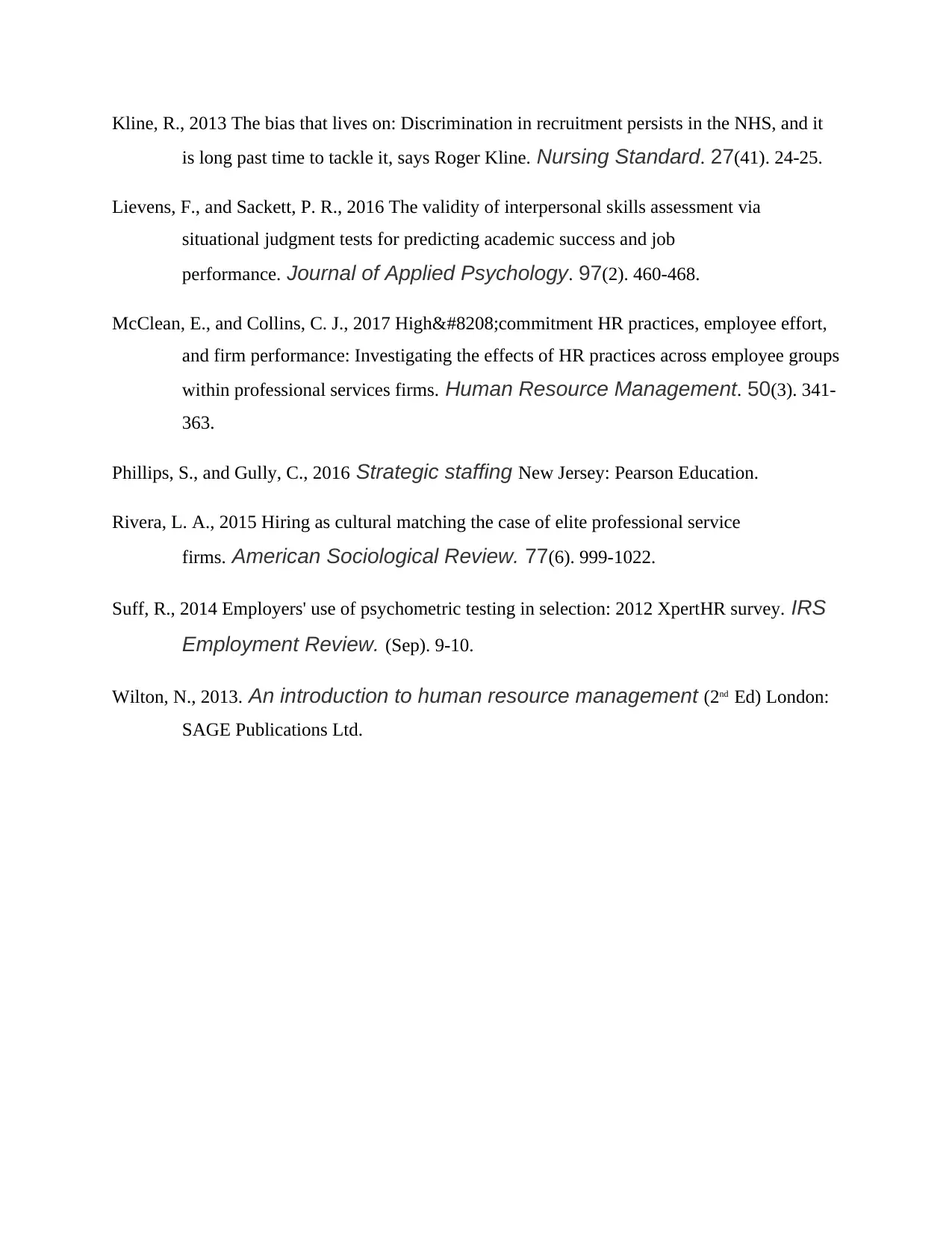
Kline, R., 2013 The bias that lives on: Discrimination in recruitment persists in the NHS, and it
is long past time to tackle it, says Roger Kline. Nursing Standard. 27(41). 24-25.
Lievens, F., and Sackett, P. R., 2016 The validity of interpersonal skills assessment via
situational judgment tests for predicting academic success and job
performance. Journal of Applied Psychology. 97(2). 460-468.
McClean, E., and Collins, C. J., 2017 High‐commitment HR practices, employee effort,
and firm performance: Investigating the effects of HR practices across employee groups
within professional services firms. Human Resource Management. 50(3). 341-
363.
Phillips, S., and Gully, C., 2016 Strategic staffing New Jersey: Pearson Education.
Rivera, L. A., 2015 Hiring as cultural matching the case of elite professional service
firms. American Sociological Review. 77(6). 999-1022.
Suff, R., 2014 Employers' use of psychometric testing in selection: 2012 XpertHR survey. IRS
Employment Review. (Sep). 9-10.
Wilton, N., 2013. An introduction to human resource management (2nd Ed) London:
SAGE Publications Ltd.
is long past time to tackle it, says Roger Kline. Nursing Standard. 27(41). 24-25.
Lievens, F., and Sackett, P. R., 2016 The validity of interpersonal skills assessment via
situational judgment tests for predicting academic success and job
performance. Journal of Applied Psychology. 97(2). 460-468.
McClean, E., and Collins, C. J., 2017 High‐commitment HR practices, employee effort,
and firm performance: Investigating the effects of HR practices across employee groups
within professional services firms. Human Resource Management. 50(3). 341-
363.
Phillips, S., and Gully, C., 2016 Strategic staffing New Jersey: Pearson Education.
Rivera, L. A., 2015 Hiring as cultural matching the case of elite professional service
firms. American Sociological Review. 77(6). 999-1022.
Suff, R., 2014 Employers' use of psychometric testing in selection: 2012 XpertHR survey. IRS
Employment Review. (Sep). 9-10.
Wilton, N., 2013. An introduction to human resource management (2nd Ed) London:
SAGE Publications Ltd.

1 out of 11


Related Documents


Your All-in-One AI-Powered Toolkit for Academic Success.
+13062052269
info@desklib.com
Available 24*7 on WhatsApp / Email
![[object Object]](/_next/static/media/star-bottom.7253800d.svg)
Unlock your academic potential
Copyright © 2020–2026 A2Z Services. All Rights Reserved. Developed and managed by ZUCOL.