BUL Financial Statements: Revaluation Model Analysis & AASB 110 Memo
VerifiedAdded on 2023/06/10
|10
|1617
|103
Report
AI Summary
This report provides a comprehensive analysis of financial statements, focusing on the revaluation model and compliance with AASB standards. It includes an internal memo addressing the Chairperson on relevant aspects of the revaluation model, along with prepared financial statements for Business as Usual Limited (BUL), including the Statement of Profit or Loss and Other Comprehensive Income and the Statement of Financial Position. Partial notes support the balances in the statements. Additionally, an internal memo for the CEO and board of directors discusses adjusting and non-adjusting events as per AASB 110. The report concludes by emphasizing the importance of adhering to accounting standards and making appropriate adjustments after the reporting period.
Individual Assessment
Paraphrase This Document
Need a fresh take? Get an instant paraphrase of this document with our AI Paraphraser

Contents
INTRODUCTION......................................................................................................................3
QUESTION 1.............................................................................................................................3
Prepare an internal memo addressing Chairperson Frox’s for other relevant aspects of the
revaluation model...................................................................................................................3
QUESTION 2.............................................................................................................................4
1. Statement of Profit or Loss and Other Comprehensive Income for the year ended 30
June 2022, prepared using the function method.....................................................................4
2. Classified Statement of Financial Position as at 30 June 2022..........................................5
Include partial notes to support the balances in the statements where necessary..................7
QUESTION 3.............................................................................................................................8
Prepare an internal memo for the CEO and the board of directors........................................8
CONCLUSION..........................................................................................................................8
REFERENCES.........................................................................................................................10
INTRODUCTION......................................................................................................................3
QUESTION 1.............................................................................................................................3
Prepare an internal memo addressing Chairperson Frox’s for other relevant aspects of the
revaluation model...................................................................................................................3
QUESTION 2.............................................................................................................................4
1. Statement of Profit or Loss and Other Comprehensive Income for the year ended 30
June 2022, prepared using the function method.....................................................................4
2. Classified Statement of Financial Position as at 30 June 2022..........................................5
Include partial notes to support the balances in the statements where necessary..................7
QUESTION 3.............................................................................................................................8
Prepare an internal memo for the CEO and the board of directors........................................8
CONCLUSION..........................................................................................................................8
REFERENCES.........................................................................................................................10

INTRODUCTION
Revaluation of assets is done to make adjustments in the accounts. These amendments
change the profit and loss figures of the financial statement (D'Andreti and Bell, 2021). In the
below report, an internal memo is prepared by the financial accountant giving the aspects of
the revaluation model. Further, the financial statements are prepared by the company
Business as Usual Limited (BUL) using the trial balance and according to the AASB
standards. Moreover, the internal memo is prepared for the CEO to know about the adjusted
and non – adjusted events in the financial statements.
QUESTION 1
Prepare an internal memo addressing Chairperson Frox’s for other relevant aspects of the
revaluation model.
To,
Jamie Frox, Chairperson
From,
Financial Accountant
Date: 9- May – 2022
Subject: Considering the relevant aspect of the relevant model.
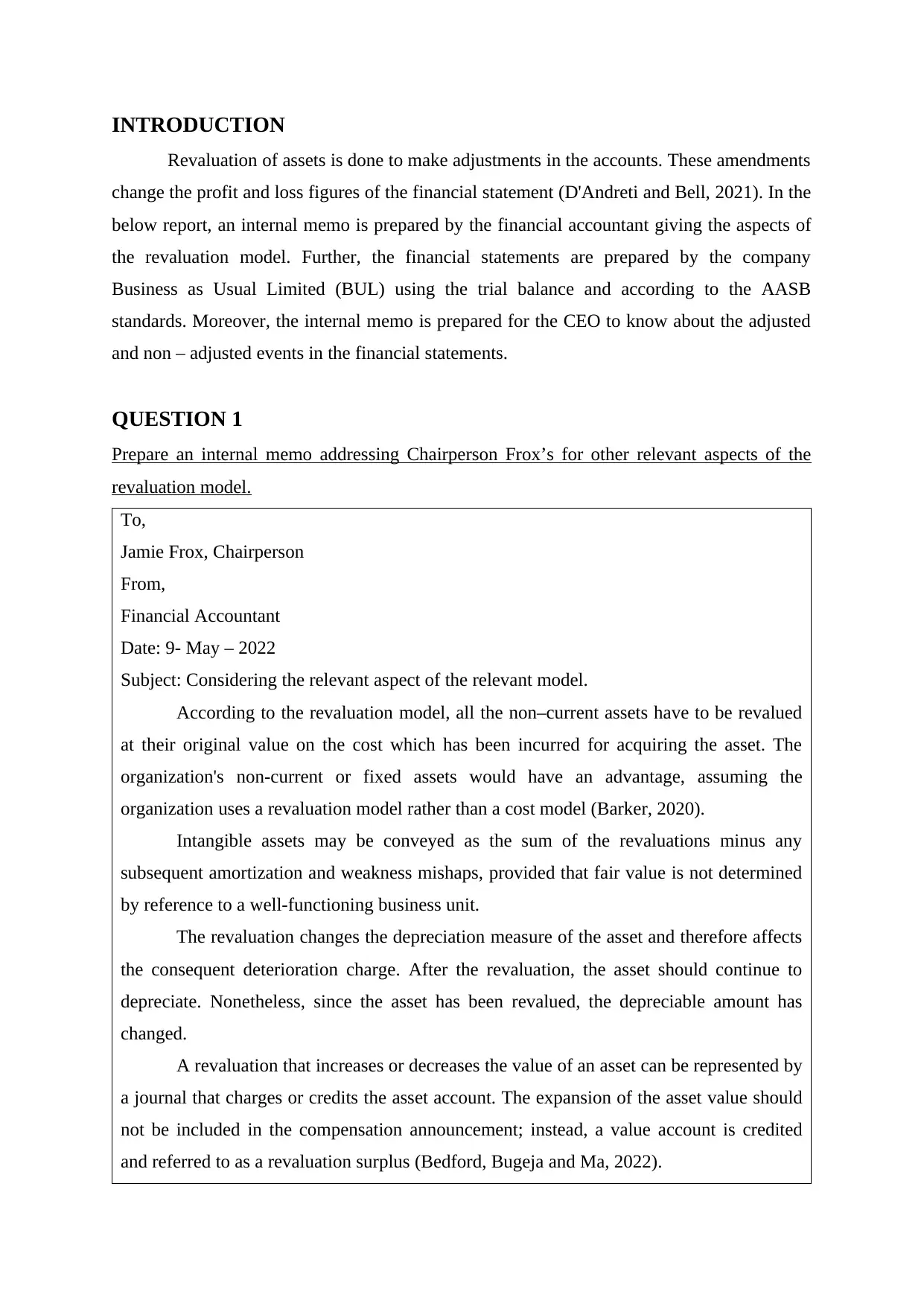
According to the revaluation model, all the non–current assets have to be revalued
at their original value on the cost which has been incurred for acquiring the asset. The
organization's non-current or fixed assets would have an advantage, assuming the
organization uses a revaluation model rather than a cost model (Barker, 2020).
Intangible assets may be conveyed as the sum of the revaluations minus any
subsequent amortization and weakness mishaps, provided that fair value is not determined
by reference to a well-functioning business unit.
The revaluation changes the depreciation measure of the asset and therefore affects
the consequent deterioration charge. After the revaluation, the asset should continue to
depreciate. Nonetheless, since the asset has been revalued, the depreciable amount has
changed.
A revaluation that increases or decreases the value of an asset can be represented by
a journal that charges or credits the asset account. The expansion of the asset value should
not be included in the compensation announcement; instead, a value account is credited
and referred to as a revaluation surplus (Bedford, Bugeja and Ma, 2022).
Revaluation of assets is done to make adjustments in the accounts. These amendments
change the profit and loss figures of the financial statement (D'Andreti and Bell, 2021). In the
below report, an internal memo is prepared by the financial accountant giving the aspects of
the revaluation model. Further, the financial statements are prepared by the company
Business as Usual Limited (BUL) using the trial balance and according to the AASB
standards. Moreover, the internal memo is prepared for the CEO to know about the adjusted
and non – adjusted events in the financial statements.
QUESTION 1
Prepare an internal memo addressing Chairperson Frox’s for other relevant aspects of the
revaluation model.
To,
Jamie Frox, Chairperson
From,
Financial Accountant
Date: 9- May – 2022
Subject: Considering the relevant aspect of the relevant model.
According to the revaluation model, all the non–current assets have to be revalued
at their original value on the cost which has been incurred for acquiring the asset. The
organization's non-current or fixed assets would have an advantage, assuming the
organization uses a revaluation model rather than a cost model (Barker, 2020).
Intangible assets may be conveyed as the sum of the revaluations minus any
subsequent amortization and weakness mishaps, provided that fair value is not determined
by reference to a well-functioning business unit.
The revaluation changes the depreciation measure of the asset and therefore affects
the consequent deterioration charge. After the revaluation, the asset should continue to
depreciate. Nonetheless, since the asset has been revalued, the depreciable amount has
changed.
A revaluation that increases or decreases the value of an asset can be represented by
a journal that charges or credits the asset account. The expansion of the asset value should
not be included in the compensation announcement; instead, a value account is credited
and referred to as a revaluation surplus (Bedford, Bugeja and Ma, 2022).
⊘ This is a preview!⊘
Do you want full access?
Subscribe today to unlock all pages.

Trusted by 1+ million students worldwide

A revaluation of assets means an adjustment in the market value of a resource,
either expanding or contracting. In most cases, resources are assessed whenever there is a
distinction between their ongoing business unit value and their value in the organization's
monetary records.
The significant and major advantage is that in the cost model, the fixed assets are
respected at a verifiable cost, but by using RM, organizations can re-evaluate their
resources based on their honest assessment. It will help elements determine if they should
go in or devote resources to another activity of the business (Brandon, 2019).
The striking contrast between the two revaluations and impairment is that
revaluation can be done upwards for increasing the value of a resource to gain market
respect or downwards for decreasing its value. Again, disability only implies one of the
two that market evaluations drop, then written down.
QUESTION 2
1. Statement of Profit or Loss and Other Comprehensive Income for the year ended 30 June
2022, prepared using the function method.
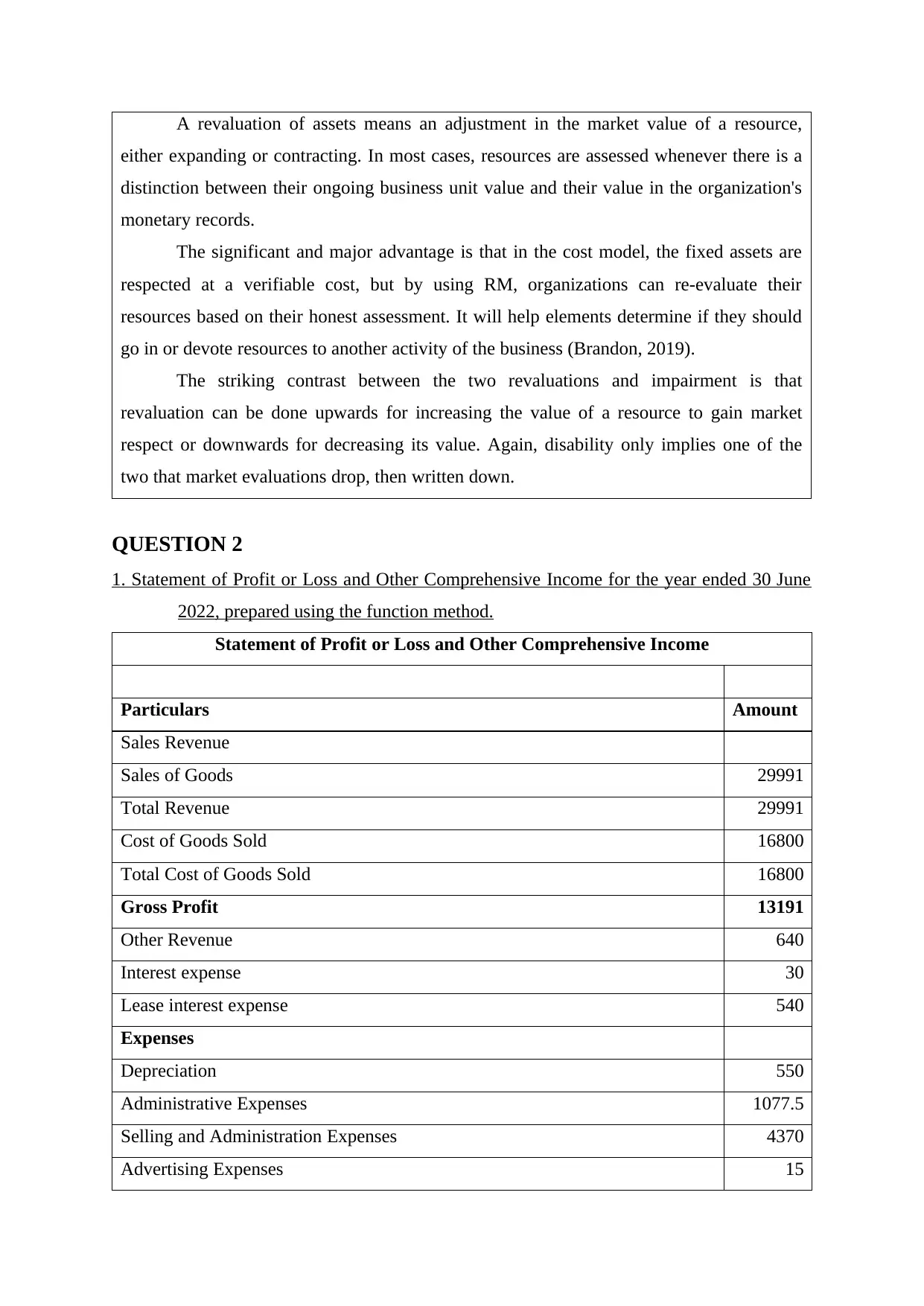
Statement of Profit or Loss and Other Comprehensive Income
Particulars Amount
Sales Revenue
Sales of Goods 29991
Total Revenue 29991
Cost of Goods Sold 16800
Total Cost of Goods Sold 16800
Gross Profit 13191
Other Revenue 640
Interest expense 30
Lease interest expense 540
Expenses
Depreciation 550
Administrative Expenses 1077.5
Selling and Administration Expenses 4370
Advertising Expenses 15
either expanding or contracting. In most cases, resources are assessed whenever there is a
distinction between their ongoing business unit value and their value in the organization's
monetary records.
The significant and major advantage is that in the cost model, the fixed assets are
respected at a verifiable cost, but by using RM, organizations can re-evaluate their
resources based on their honest assessment. It will help elements determine if they should
go in or devote resources to another activity of the business (Brandon, 2019).
The striking contrast between the two revaluations and impairment is that
revaluation can be done upwards for increasing the value of a resource to gain market
respect or downwards for decreasing its value. Again, disability only implies one of the
two that market evaluations drop, then written down.
QUESTION 2
1. Statement of Profit or Loss and Other Comprehensive Income for the year ended 30 June
2022, prepared using the function method.
Statement of Profit or Loss and Other Comprehensive Income
Particulars Amount
Sales Revenue
Sales of Goods 29991
Total Revenue 29991
Cost of Goods Sold 16800
Total Cost of Goods Sold 16800
Gross Profit 13191
Other Revenue 640
Interest expense 30
Lease interest expense 540
Expenses
Depreciation 550
Administrative Expenses 1077.5
Selling and Administration Expenses 4370
Advertising Expenses 15
Paraphrase This Document
Need a fresh take? Get an instant paraphrase of this document with our AI Paraphraser

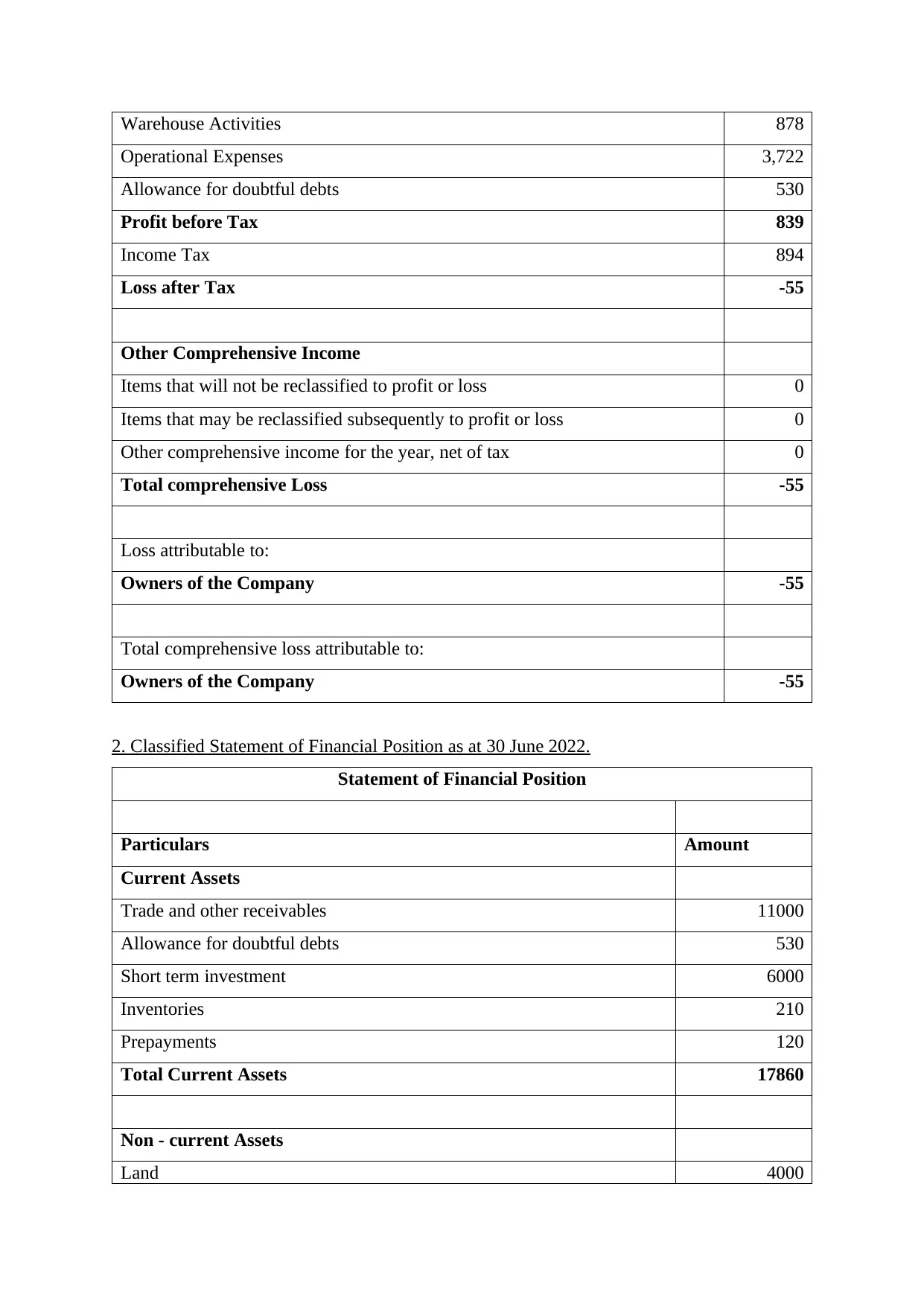
Warehouse Activities 878
Operational Expenses 3,722
Allowance for doubtful debts 530
Profit before Tax 839
Income Tax 894
Loss after Tax -55
Other Comprehensive Income
Items that will not be reclassified to profit or loss 0
Items that may be reclassified subsequently to profit or loss 0
Other comprehensive income for the year, net of tax 0
Total comprehensive Loss -55
Loss attributable to:
Owners of the Company -55
Total comprehensive loss attributable to:
Owners of the Company -55
2. Classified Statement of Financial Position as at 30 June 2022.
Statement of Financial Position
Particulars Amount
Current Assets
Trade and other receivables 11000
Allowance for doubtful debts 530
Short term investment 6000
Inventories 210
Prepayments 120
Total Current Assets 17860
Non - current Assets
Land 4000
Operational Expenses 3,722
Allowance for doubtful debts 530
Profit before Tax 839
Income Tax 894
Loss after Tax -55
Other Comprehensive Income
Items that will not be reclassified to profit or loss 0
Items that may be reclassified subsequently to profit or loss 0
Other comprehensive income for the year, net of tax 0
Total comprehensive Loss -55
Loss attributable to:
Owners of the Company -55
Total comprehensive loss attributable to:
Owners of the Company -55
2. Classified Statement of Financial Position as at 30 June 2022.
Statement of Financial Position
Particulars Amount
Current Assets
Trade and other receivables 11000
Allowance for doubtful debts 530
Short term investment 6000
Inventories 210
Prepayments 120
Total Current Assets 17860
Non - current Assets
Land 4000

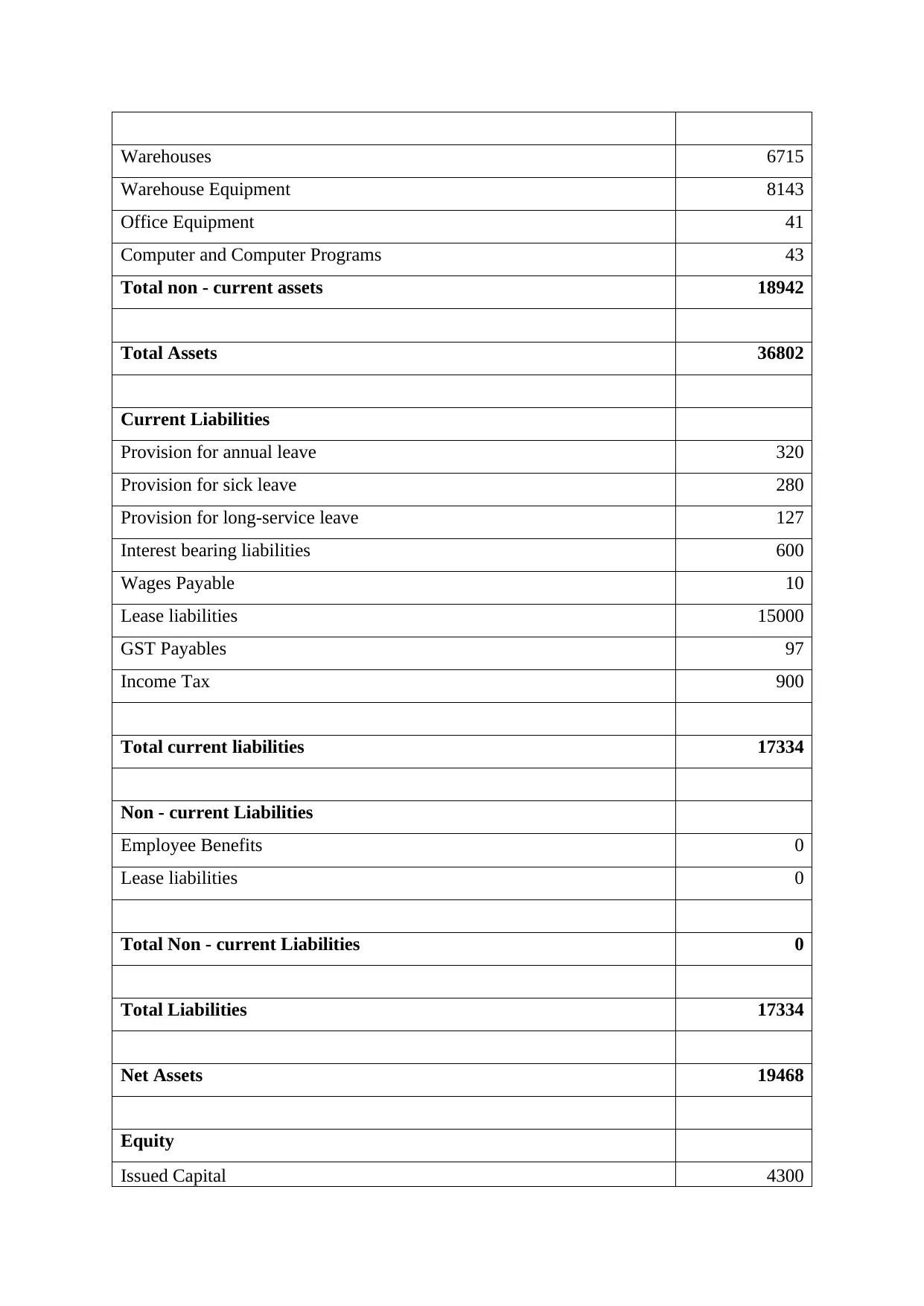
Warehouses 6715
Warehouse Equipment 8143
Office Equipment 41
Computer and Computer Programs 43
Total non - current assets 18942
Total Assets 36802
Current Liabilities
Provision for annual leave 320
Provision for sick leave 280
Provision for long-service leave 127
Interest bearing liabilities 600
Wages Payable 10
Lease liabilities 15000
GST Payables 97
Income Tax 900
Total current liabilities 17334
Non - current Liabilities
Employee Benefits 0
Lease liabilities 0
Total Non - current Liabilities 0
Total Liabilities 17334
Net Assets 19468
Equity
Issued Capital 4300
Warehouse Equipment 8143
Office Equipment 41
Computer and Computer Programs 43
Total non - current assets 18942
Total Assets 36802
Current Liabilities
Provision for annual leave 320
Provision for sick leave 280
Provision for long-service leave 127
Interest bearing liabilities 600
Wages Payable 10
Lease liabilities 15000
GST Payables 97
Income Tax 900
Total current liabilities 17334
Non - current Liabilities
Employee Benefits 0
Lease liabilities 0
Total Non - current Liabilities 0
Total Liabilities 17334
Net Assets 19468
Equity
Issued Capital 4300
⊘ This is a preview!⊘
Do you want full access?
Subscribe today to unlock all pages.

Trusted by 1+ million students worldwide

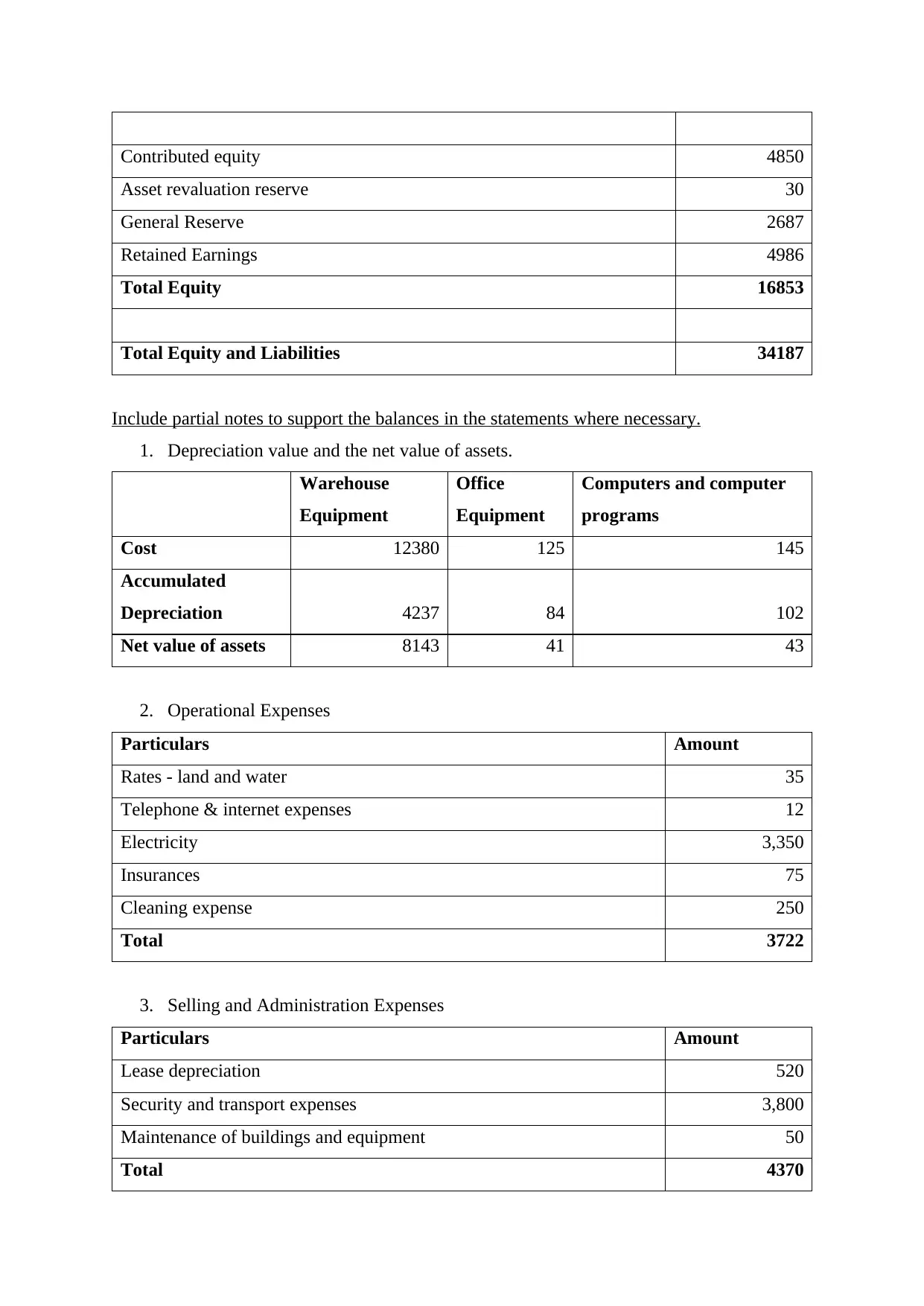
Contributed equity 4850
Asset revaluation reserve 30
General Reserve 2687
Retained Earnings 4986
Total Equity 16853
Total Equity and Liabilities 34187
Include partial notes to support the balances in the statements where necessary.
1. Depreciation value and the net value of assets.
Warehouse
Equipment
Office
Equipment
Computers and computer
programs
Cost 12380 125 145
Accumulated
Depreciation 4237 84 102
Net value of assets 8143 41 43
2. Operational Expenses
Particulars Amount
Rates - land and water 35
Telephone & internet expenses 12
Electricity 3,350
Insurances 75
Cleaning expense 250
Total 3722
3. Selling and Administration Expenses
Particulars Amount
Lease depreciation 520
Security and transport expenses 3,800
Maintenance of buildings and equipment 50
Total 4370
Asset revaluation reserve 30
General Reserve 2687
Retained Earnings 4986
Total Equity 16853
Total Equity and Liabilities 34187
Include partial notes to support the balances in the statements where necessary.
1. Depreciation value and the net value of assets.
Warehouse
Equipment
Office
Equipment
Computers and computer
programs
Cost 12380 125 145
Accumulated
Depreciation 4237 84 102
Net value of assets 8143 41 43
2. Operational Expenses
Particulars Amount
Rates - land and water 35
Telephone & internet expenses 12
Electricity 3,350
Insurances 75
Cleaning expense 250
Total 3722
3. Selling and Administration Expenses
Particulars Amount
Lease depreciation 520
Security and transport expenses 3,800
Maintenance of buildings and equipment 50
Total 4370
Paraphrase This Document
Need a fresh take? Get an instant paraphrase of this document with our AI Paraphraser

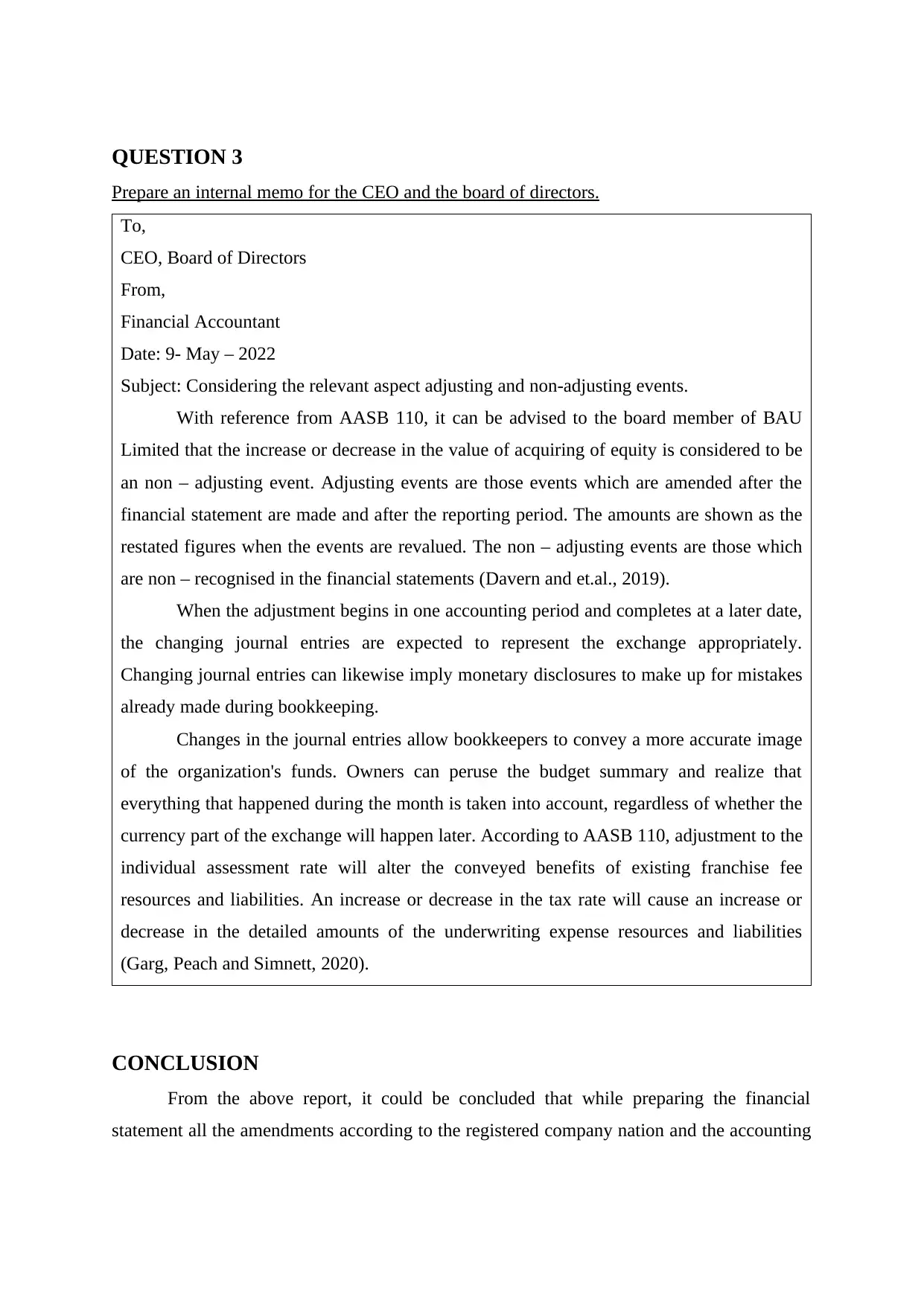
QUESTION 3
Prepare an internal memo for the CEO and the board of directors.
To,
CEO, Board of Directors
From,
Financial Accountant
Date: 9- May – 2022
Subject: Considering the relevant aspect adjusting and non-adjusting events.
With reference from AASB 110, it can be advised to the board member of BAU
Limited that the increase or decrease in the value of acquiring of equity is considered to be
an non – adjusting event. Adjusting events are those events which are amended after the
financial statement are made and after the reporting period. The amounts are shown as the
restated figures when the events are revalued. The non – adjusting events are those which
are non – recognised in the financial statements (Davern and et.al., 2019).
When the adjustment begins in one accounting period and completes at a later date,
the changing journal entries are expected to represent the exchange appropriately.
Changing journal entries can likewise imply monetary disclosures to make up for mistakes
already made during bookkeeping.
Changes in the journal entries allow bookkeepers to convey a more accurate image
of the organization's funds. Owners can peruse the budget summary and realize that
everything that happened during the month is taken into account, regardless of whether the
currency part of the exchange will happen later. According to AASB 110, adjustment to the
individual assessment rate will alter the conveyed benefits of existing franchise fee
resources and liabilities. An increase or decrease in the tax rate will cause an increase or
decrease in the detailed amounts of the underwriting expense resources and liabilities
(Garg, Peach and Simnett, 2020).
CONCLUSION
From the above report, it could be concluded that while preparing the financial
statement all the amendments according to the registered company nation and the accounting
Prepare an internal memo for the CEO and the board of directors.
To,
CEO, Board of Directors
From,
Financial Accountant
Date: 9- May – 2022
Subject: Considering the relevant aspect adjusting and non-adjusting events.
With reference from AASB 110, it can be advised to the board member of BAU
Limited that the increase or decrease in the value of acquiring of equity is considered to be
an non – adjusting event. Adjusting events are those events which are amended after the
financial statement are made and after the reporting period. The amounts are shown as the
restated figures when the events are revalued. The non – adjusting events are those which
are non – recognised in the financial statements (Davern and et.al., 2019).
When the adjustment begins in one accounting period and completes at a later date,
the changing journal entries are expected to represent the exchange appropriately.
Changing journal entries can likewise imply monetary disclosures to make up for mistakes
already made during bookkeeping.
Changes in the journal entries allow bookkeepers to convey a more accurate image
of the organization's funds. Owners can peruse the budget summary and realize that
everything that happened during the month is taken into account, regardless of whether the
currency part of the exchange will happen later. According to AASB 110, adjustment to the
individual assessment rate will alter the conveyed benefits of existing franchise fee
resources and liabilities. An increase or decrease in the tax rate will cause an increase or
decrease in the detailed amounts of the underwriting expense resources and liabilities
(Garg, Peach and Simnett, 2020).
CONCLUSION
From the above report, it could be concluded that while preparing the financial
statement all the amendments according to the registered company nation and the accounting

standard which the company follows is looked into. Moreover, the amendments that are made
after the reporting period should be adjusted appropriately.
⊘ This is a preview!⊘
Do you want full access?
Subscribe today to unlock all pages.

Trusted by 1+ million students worldwide

REFERENCES
Books and Journals
Barker, S., 2020. The strategist: Coming clean. Company Director, 36(10), p.28.
Bedford, A., Bugeja, M. and Ma, N., 2022. The impact of IFRS 10 on consolidated financial
reporting. Accounting & Finance, 62(1), pp.101-141.
Brandon, G., 2019. ASX listed junior exploration companies and tax losses: Part 1. Taxation
in Australia, 54(4), pp.174-177.
D'Andreti, A. and Bell, C., 2021. ASX clarifies expectations around disclosure of earnings
surprises. Governance Directions, 73(1), pp.15-18.
Davern, M and et.al., 2019. Implementing AASB 15 revenue from contracts with customers:
the preparer perspective. Accounting Research Journal.
Garg, M., Peach, K. and Simnett, R., 2020. Evidence‐informed Approach to Setting
Standards: A Discussion on the Research Strategies of AASB and
AUASB. Australian Accounting Review, 30(4), pp.243-248.
Yao, D.T., Qu, X. and Kummer, T., 2022. Presentation prominence: Does it matter to non-
professional investors? The case of ‘Other Comprehensive Income’.
Books and Journals
Barker, S., 2020. The strategist: Coming clean. Company Director, 36(10), p.28.
Bedford, A., Bugeja, M. and Ma, N., 2022. The impact of IFRS 10 on consolidated financial
reporting. Accounting & Finance, 62(1), pp.101-141.
Brandon, G., 2019. ASX listed junior exploration companies and tax losses: Part 1. Taxation
in Australia, 54(4), pp.174-177.
D'Andreti, A. and Bell, C., 2021. ASX clarifies expectations around disclosure of earnings
surprises. Governance Directions, 73(1), pp.15-18.
Davern, M and et.al., 2019. Implementing AASB 15 revenue from contracts with customers:
the preparer perspective. Accounting Research Journal.
Garg, M., Peach, K. and Simnett, R., 2020. Evidence‐informed Approach to Setting
Standards: A Discussion on the Research Strategies of AASB and
AUASB. Australian Accounting Review, 30(4), pp.243-248.
Yao, D.T., Qu, X. and Kummer, T., 2022. Presentation prominence: Does it matter to non-
professional investors? The case of ‘Other Comprehensive Income’.
1 out of 10
Related Documents
Your All-in-One AI-Powered Toolkit for Academic Success.
+13062052269
info@desklib.com
Available 24*7 on WhatsApp / Email
Unlock your academic potential
Copyright © 2020–2026 A2Z Services. All Rights Reserved. Developed and managed by ZUCOL.