Effective Risk Management Strategies for Healthcare Employees
VerifiedAdded on 2023/03/23
|11
|1135
|88
Report
AI Summary
This report provides a detailed analysis of risk management within healthcare employment, emphasizing the importance of identifying, assessing, and mitigating risks to ensure employee safety and financial stability for healthcare institutions. It highlights the necessity of qualified healthcare risk managers, proactive risk management strategies, and effective communication channels between employees, patients, and visitors. The report also addresses financial risks, stressing the importance of minimizing operational risks and improving balance sheets through strategic financial management. Ultimately, the report underscores the need for comprehensive risk management to enhance patient care, employee well-being, and the overall productivity of healthcare institutions, advocating for continuous improvement and adherence to established principles and guidelines.
Risk Management
Name of the Student
Name of the University
Author Note
Name of the Student
Name of the University
Author Note
Paraphrase This Document
Need a fresh take? Get an instant paraphrase of this document with our AI Paraphraser

Risk Management in Employment
• Risk management can be defined as the identification, judging and
computation of risks
• It is followed by the coordinated and financial usage of resources to
reduce, monitor and control the effect of adverse or damaging events
or to increase the awareness of opportunities
• Risk management in employment is the process of managing or
solving the problems faced in terms of the people who are working in
the organizations
• It is the method to measure or assess the risk occurred or can be
occurred and strategizing the plans accordingly
• Risk management in the healthcare institutions has grown to a huge
extent due to the corporatization of health
• Risk management can be defined as the identification, judging and
computation of risks
• It is followed by the coordinated and financial usage of resources to
reduce, monitor and control the effect of adverse or damaging events
or to increase the awareness of opportunities
• Risk management in employment is the process of managing or
solving the problems faced in terms of the people who are working in
the organizations
• It is the method to measure or assess the risk occurred or can be
occurred and strategizing the plans accordingly
• Risk management in the healthcare institutions has grown to a huge
extent due to the corporatization of health

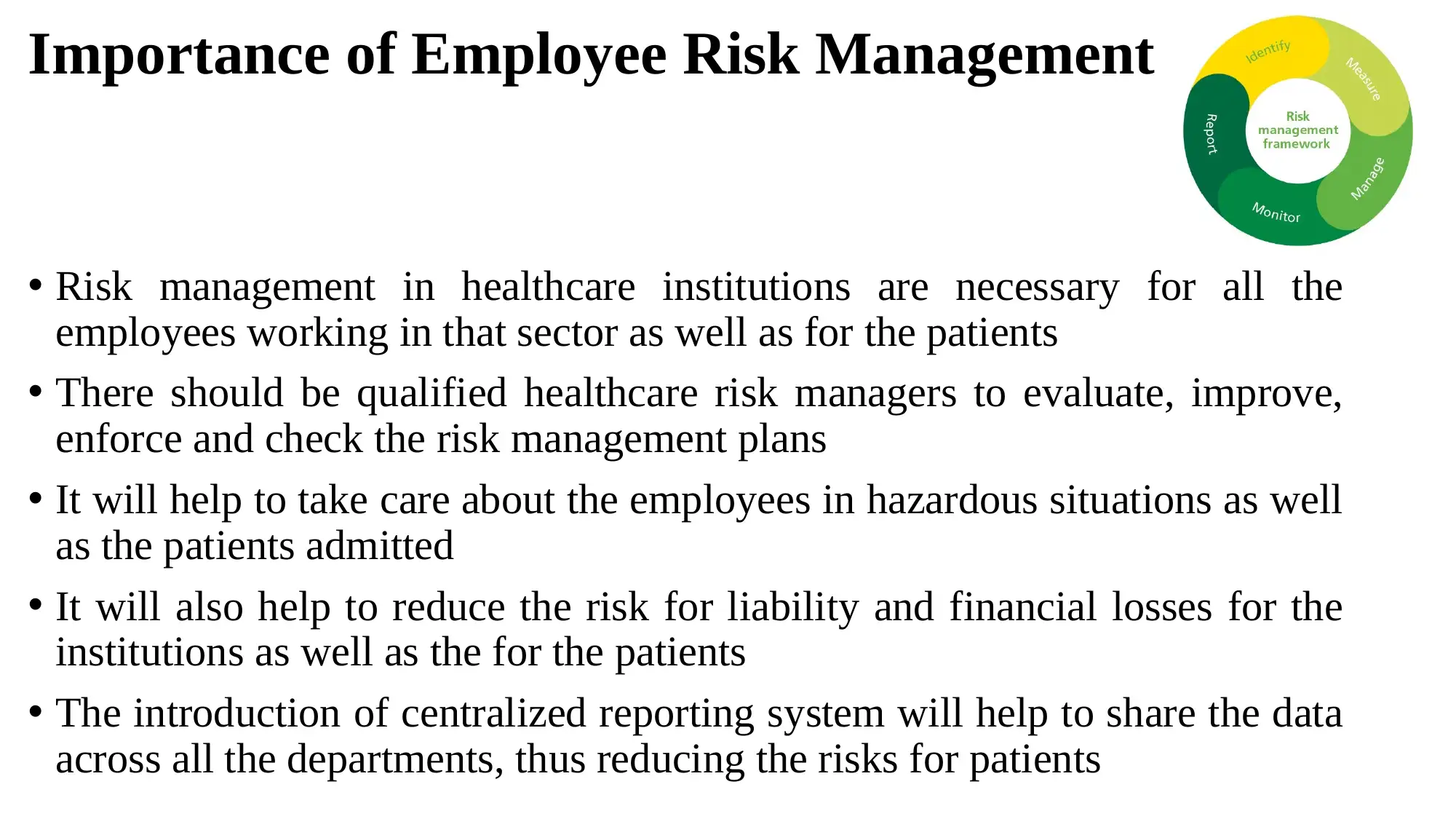
Importance of Employee Risk Management
• Risk management in healthcare institutions are necessary for all the
employees working in that sector as well as for the patients
• There should be qualified healthcare risk managers to evaluate, improve,
enforce and check the risk management plans
• It will help to take care about the employees in hazardous situations as well
as the patients admitted
• It will also help to reduce the risk for liability and financial losses for the
institutions as well as the for the patients
• The introduction of centralized reporting system will help to share the data
across all the departments, thus reducing the risks for patients
• Risk management in healthcare institutions are necessary for all the
employees working in that sector as well as for the patients
• There should be qualified healthcare risk managers to evaluate, improve,
enforce and check the risk management plans
• It will help to take care about the employees in hazardous situations as well
as the patients admitted
• It will also help to reduce the risk for liability and financial losses for the
institutions as well as the for the patients
• The introduction of centralized reporting system will help to share the data
across all the departments, thus reducing the risks for patients
⊘ This is a preview!⊘
Do you want full access?
Subscribe today to unlock all pages.

Trusted by 1+ million students worldwide

Processes to Avoid Employee Risk Management
• A simple strategy can be followed by the healthcare industries to
enforce a proactive risk management strategy
• First of all, it is necessary to educate all the employees regarding all
the conditions of the risk management strategies, which will include
the process or prevention as well as respond to the risks
• Proper and complete documentation is very much important in
healthcare sectors, which can be used to study as a reference in future
• Proper and effective coordination between the departments is
necessary to keep everybody on track, which will help to accelerate
the process of risk management and help protection against the claims
regarding misconducts
• Steps should be taken by the employees to prevent the avoidable
• A simple strategy can be followed by the healthcare industries to
enforce a proactive risk management strategy
• First of all, it is necessary to educate all the employees regarding all
the conditions of the risk management strategies, which will include
the process or prevention as well as respond to the risks
• Proper and complete documentation is very much important in
healthcare sectors, which can be used to study as a reference in future
• Proper and effective coordination between the departments is
necessary to keep everybody on track, which will help to accelerate
the process of risk management and help protection against the claims
regarding misconducts
• Steps should be taken by the employees to prevent the avoidable
Paraphrase This Document
Need a fresh take? Get an instant paraphrase of this document with our AI Paraphraser

Need for Communication
• Risk communication can be termed as an open and two way transfer of
information as well as opinion regarding the harms and benefits
• It also helps to improve the realization and understanding of the risks
and to advertise the better decisions about the clinical management
• Risk communication need to protect the probability of occurrence of
the risks, the importance of the described negative events and the
effect of the event happened on the patient
• Proper and effective communication will help to reduce the risk and
will help to provide patient satisfaction and providing good care to the
patients admitted or visiting the healthcare institutions
• The principles and guidelines of the healthcare institutions need to be
communicated among the employees as well as the patients and
visitors
• Risk communication can be termed as an open and two way transfer of
information as well as opinion regarding the harms and benefits
• It also helps to improve the realization and understanding of the risks
and to advertise the better decisions about the clinical management
• Risk communication need to protect the probability of occurrence of
the risks, the importance of the described negative events and the
effect of the event happened on the patient
• Proper and effective communication will help to reduce the risk and
will help to provide patient satisfaction and providing good care to the
patients admitted or visiting the healthcare institutions
• The principles and guidelines of the healthcare institutions need to be
communicated among the employees as well as the patients and
visitors

Ways of Improving Risk Communication
• It is important to approach the present method of communication in
the healthcare sector
• Need to streamline or construct efficiently the communication
channels between the employees and the patients along with the
visitors
• Need to encourage the collaboration or association through mobile
• Providing the employees of the healthcare institutions a value or voice
to express the needs, wants and concerns
• Providing face-to-face communication, which helps to reduce the
occurrences of risks
• Need to include an effective communication in the training programs
of the healthcare institutions
• It is important to approach the present method of communication in
the healthcare sector
• Need to streamline or construct efficiently the communication
channels between the employees and the patients along with the
visitors
• Need to encourage the collaboration or association through mobile
• Providing the employees of the healthcare institutions a value or voice
to express the needs, wants and concerns
• Providing face-to-face communication, which helps to reduce the
occurrences of risks
• Need to include an effective communication in the training programs
of the healthcare institutions
⊘ This is a preview!⊘
Do you want full access?
Subscribe today to unlock all pages.

Trusted by 1+ million students worldwide

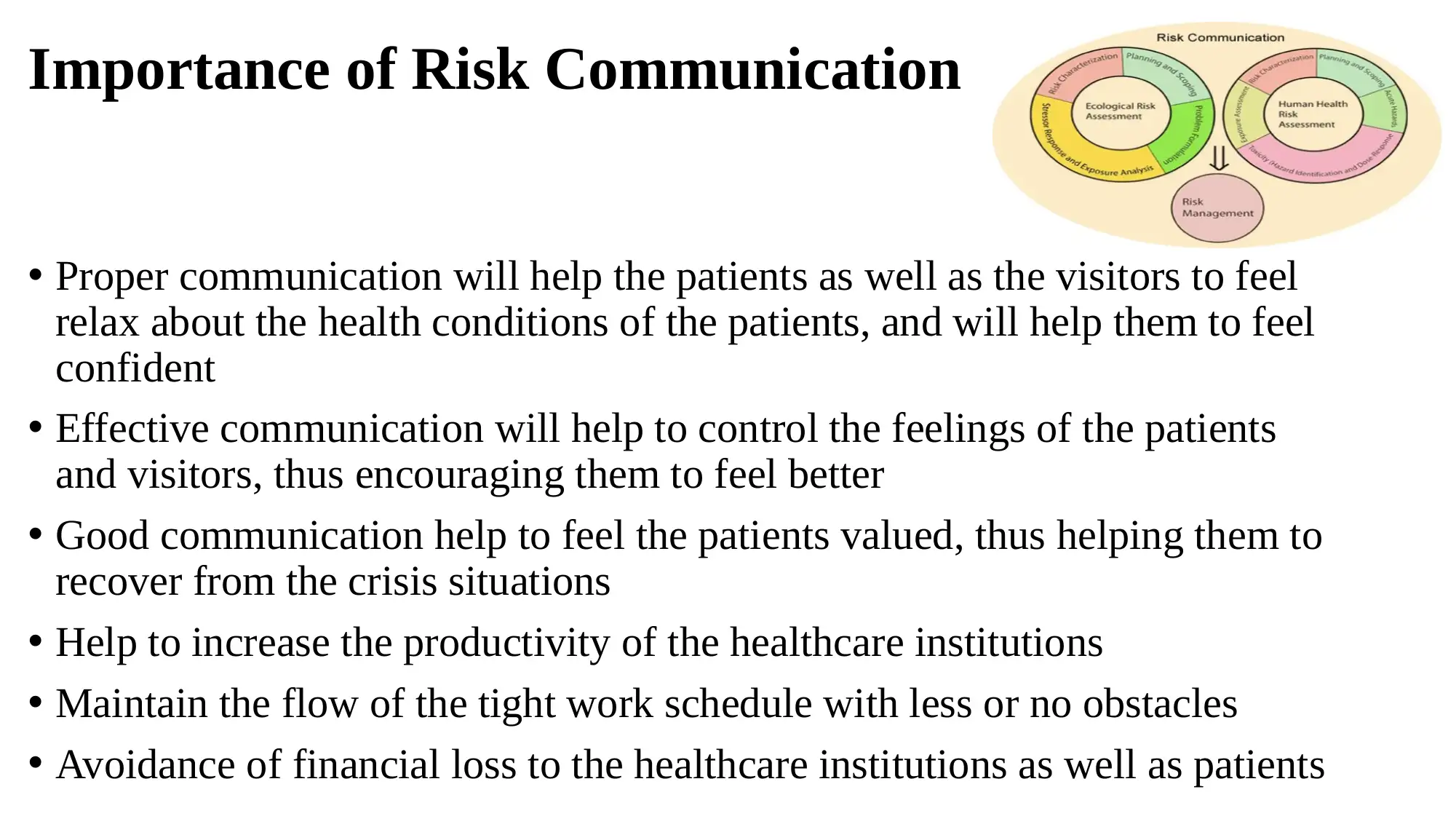
Importance of Risk Communication
• Proper communication will help the patients as well as the visitors to feel
relax about the health conditions of the patients, and will help them to feel
confident
• Effective communication will help to control the feelings of the patients
and visitors, thus encouraging them to feel better
• Good communication help to feel the patients valued, thus helping them to
recover from the crisis situations
• Help to increase the productivity of the healthcare institutions
• Maintain the flow of the tight work schedule with less or no obstacles
• Avoidance of financial loss to the healthcare institutions as well as patients
• Proper communication will help the patients as well as the visitors to feel
relax about the health conditions of the patients, and will help them to feel
confident
• Effective communication will help to control the feelings of the patients
and visitors, thus encouraging them to feel better
• Good communication help to feel the patients valued, thus helping them to
recover from the crisis situations
• Help to increase the productivity of the healthcare institutions
• Maintain the flow of the tight work schedule with less or no obstacles
• Avoidance of financial loss to the healthcare institutions as well as patients
Paraphrase This Document
Need a fresh take? Get an instant paraphrase of this document with our AI Paraphraser

Financial Risk
• The major problem in the healthcare institutions is to minimize the
risks in the operational process and organizational cultures
• Improper risk management can be seen on the balance sheets of the
healthcare institutions
• Different kinds of transactions may involve different kind of risks
• Expansions and fresh construction of projects are less in numbers in
modern world
• Evaluation is important to tackle the risks involved in the capital
expenditure of the healthcare institutions
• The healthcare institutions need to follow the strategies which improve
the balance sheet as well as reduce the risk, like monetization of non-
core assets and sale-leasebacks
• The major problem in the healthcare institutions is to minimize the
risks in the operational process and organizational cultures
• Improper risk management can be seen on the balance sheets of the
healthcare institutions
• Different kinds of transactions may involve different kind of risks
• Expansions and fresh construction of projects are less in numbers in
modern world
• Evaluation is important to tackle the risks involved in the capital
expenditure of the healthcare institutions
• The healthcare institutions need to follow the strategies which improve
the balance sheet as well as reduce the risk, like monetization of non-
core assets and sale-leasebacks

Importance of Financial Risk
• Financial management in the healthcare sector helps to manage the
monetary risk
• Will help to achieve the financial aim and goals of the healthcare
institutions
• Helps to provide efficient healthcare facilities to the patients who are
visiting the institutions for health check-ups and treatments
• Proper financial management will also help in long term investment
decisions for the betterment of the facilities provided to the patients
• Helps to strategize the plans and procedures of risk management
effectively and efficiently in order to reduce the occurrences of risks
• Financial risk management will also help to reduce the financial risks
involved with either the institutions or patients or both
• Financial management in the healthcare sector helps to manage the
monetary risk
• Will help to achieve the financial aim and goals of the healthcare
institutions
• Helps to provide efficient healthcare facilities to the patients who are
visiting the institutions for health check-ups and treatments
• Proper financial management will also help in long term investment
decisions for the betterment of the facilities provided to the patients
• Helps to strategize the plans and procedures of risk management
effectively and efficiently in order to reduce the occurrences of risks
• Financial risk management will also help to reduce the financial risks
involved with either the institutions or patients or both
⊘ This is a preview!⊘
Do you want full access?
Subscribe today to unlock all pages.

Trusted by 1+ million students worldwide

Conclusion
• The healthcare industry needs the employee risk management the most
• Proper, effective and efficient risk management is mandatory in the
healthcare institutions
• Will help to better the treatment facilities to the patients
• Will help to allow the safety to all the employees as well as the
patients
• Proper flow of communication should be maintained between the
employees of the organizations and also between the employees and
patients
• The healthcare industry needs the employee risk management the most
• Proper, effective and efficient risk management is mandatory in the
healthcare institutions
• Will help to better the treatment facilities to the patients
• Will help to allow the safety to all the employees as well as the
patients
• Proper flow of communication should be maintained between the
employees of the organizations and also between the employees and
patients
Paraphrase This Document
Need a fresh take? Get an instant paraphrase of this document with our AI Paraphraser

Reference
•Kavaler, F., & Alexander, R. S. (2012). Risk management in healthcare institutions: Limiting liability
and enhancing care. Jones & Bartlett Publishers.
•Van Deursen, N., Buchanan, W. J., & Duff, A. (2013). Monitoring information security risks within
health care. computers & security, 37, 31-45.
•Yue, X., Wang, H., Jin, D., Li, M., & Jiang, W. (2016). Healthcare data gateways: found healthcare
intelligence on blockchain with novel privacy risk control. Journal of medical systems, 40(10), 218.
•Kavaler, F., & Alexander, R. S. (2012). Risk management in healthcare institutions: Limiting liability
and enhancing care. Jones & Bartlett Publishers.
•Van Deursen, N., Buchanan, W. J., & Duff, A. (2013). Monitoring information security risks within
health care. computers & security, 37, 31-45.
•Yue, X., Wang, H., Jin, D., Li, M., & Jiang, W. (2016). Healthcare data gateways: found healthcare
intelligence on blockchain with novel privacy risk control. Journal of medical systems, 40(10), 218.
1 out of 11
Related Documents
Your All-in-One AI-Powered Toolkit for Academic Success.
+13062052269
info@desklib.com
Available 24*7 on WhatsApp / Email
Unlock your academic potential
Copyright © 2020–2026 A2Z Services. All Rights Reserved. Developed and managed by ZUCOL.