Eco-Innovation's Role in Sustainable Marketing: A Detailed Analysis
VerifiedAdded on 2023/04/19
|22
|10565
|176
Report
AI Summary
This report investigates the critical role of eco-innovation in implementing sustainable marketing strategies. It begins by establishing a foundation in sustainability, eco-innovation, and sustainable marketing, highlighting their importance for business and environmental well-being. The report identifies the implementation constraints of sustainable marketing, including market, operational, and corporate image challenges. It then explores eco-innovation as a potential solution, aiming to detail its role in mitigating these challenges. The research questions address the constraints of sustainable marketing, the feasibility of eco-innovation as a solution, and how eco-innovation can solve existing problems. The scope of the study emphasizes the benefits of adopting eco-innovation for firms, including improved marketing efficiency, increased CSR efforts, and potential for future research and technological advancements. The limitations include budget and schedule constraints, as well as the academic researcher's approach. The report aims to provide valuable insights for businesses seeking to enhance their sustainable marketing practices through eco-innovation.
Running head: ROLE OF ECO-INNOVATION IN SUSTAINABLE MARKETING IMPLEMENTATION
ROLE OF ECO-INNOVATION IN SUSTAINABLE MARKETING IMPLEMENTATION
Name of the Student
Name of the University
Author Note
ROLE OF ECO-INNOVATION IN SUSTAINABLE MARKETING IMPLEMENTATION
Name of the Student
Name of the University
Author Note

Paraphrase This Document
Need a fresh take? Get an instant paraphrase of this document with our AI Paraphraser
1ROLE OF ECO-INNOVATION IN SUSTAINABLE MARKETING IMPLEMENTATION
Table of Contents
1 Introduction........................................................................................................................2
1.1 Background..................................................................................................................2
1.2 Problem Statement.......................................................................................................4
1.3 Research Aim..............................................................................................................5
1.3.1 Research Objectives.............................................................................................5
1.4 Research Questions.....................................................................................................5
1.5 Scope...........................................................................................................................5
1.6 Limitations...................................................................................................................6
1.7 Structure......................................................................................................................6
2 Theory................................................................................................................................7
2.1 Introduction.................................................................................................................7
2.2 Sustainability and its variables....................................................................................8
2.2.1 Sustainable Development.....................................................................................9
2.2.2 Sustainable Development for Business................................................................9
2.3 Sustainable and Marketing relationships...................................................................10
2.3.1 Service Marketing..............................................................................................11
2.3.2 Macro Marketing................................................................................................11
2.4 Sustainable Marketing...............................................................................................12
2.4.1 Benefits of Sustainable Marketing.....................................................................13
2.4.2 Challenges/ Constraints for and of Sustainable Marketing................................14
2.5 Eco-Innovation..........................................................................................................15
2.6 Summary....................................................................................................................16
3 References........................................................................................................................18
Table of Contents
1 Introduction........................................................................................................................2
1.1 Background..................................................................................................................2
1.2 Problem Statement.......................................................................................................4
1.3 Research Aim..............................................................................................................5
1.3.1 Research Objectives.............................................................................................5
1.4 Research Questions.....................................................................................................5
1.5 Scope...........................................................................................................................5
1.6 Limitations...................................................................................................................6
1.7 Structure......................................................................................................................6
2 Theory................................................................................................................................7
2.1 Introduction.................................................................................................................7
2.2 Sustainability and its variables....................................................................................8
2.2.1 Sustainable Development.....................................................................................9
2.2.2 Sustainable Development for Business................................................................9
2.3 Sustainable and Marketing relationships...................................................................10
2.3.1 Service Marketing..............................................................................................11
2.3.2 Macro Marketing................................................................................................11
2.4 Sustainable Marketing...............................................................................................12
2.4.1 Benefits of Sustainable Marketing.....................................................................13
2.4.2 Challenges/ Constraints for and of Sustainable Marketing................................14
2.5 Eco-Innovation..........................................................................................................15
2.6 Summary....................................................................................................................16
3 References........................................................................................................................18
2ROLE OF ECO-INNOVATION IN SUSTAINABLE MARKETING IMPLEMENTATION
1 Introduction
Sustainability, eco-innovation, sustainable marketing and similar other crucial aspects
of the part of the discussed study and to earn a relevant understanding of the subjects, aspects
and eventually, the topic it is crucial to establish the base and the discussed section is
dedicated to the detailed task. Different sub-sections have been detailed so that an improved
and understandable establishment of the background can be achieved.
1.1 Background
Human development is led by different advancements that lead from the industrial
revolution, technological revolution and many other development in terms of technology,
machine automation and others. The discussed revolutions have provided the human with
different advantages and have contributed to an easy, effective and productive standard of
living. However, in improving the standard of living, one of the primary resources that
witnessed exploitation was the environmental resources (Rees, 2017). The discussed
development have led to the depletion of natural resources and development of practices that
were harmful for the ecology and in the process for the human life. Several scholars,
researchers, organisations and other entities invested their time and effort to conclude on the
need for protection of the ecology for human survival.
The discussed researches were then summarised to coin different terms that were
dedicated to human development while taking consideration of the natural resources
preservation. One of the key term that was coined for the protection of the nature and its
resources while ensuring human development was sustainability. Wood et al., (2015), have
defined sustainability as the approach towards technological advancements that meets the
current demand while preserving the natural resources so that it can be leveraged by the
future generations. The coining of the term by Crane and Matten (2016), revolutionised the
perception of the individuals as well as the organisations towards the use of natural resources.
The term in discussion was further refined to make it more suitable for the human
development. The improvement and researches led to the addition of social and economic
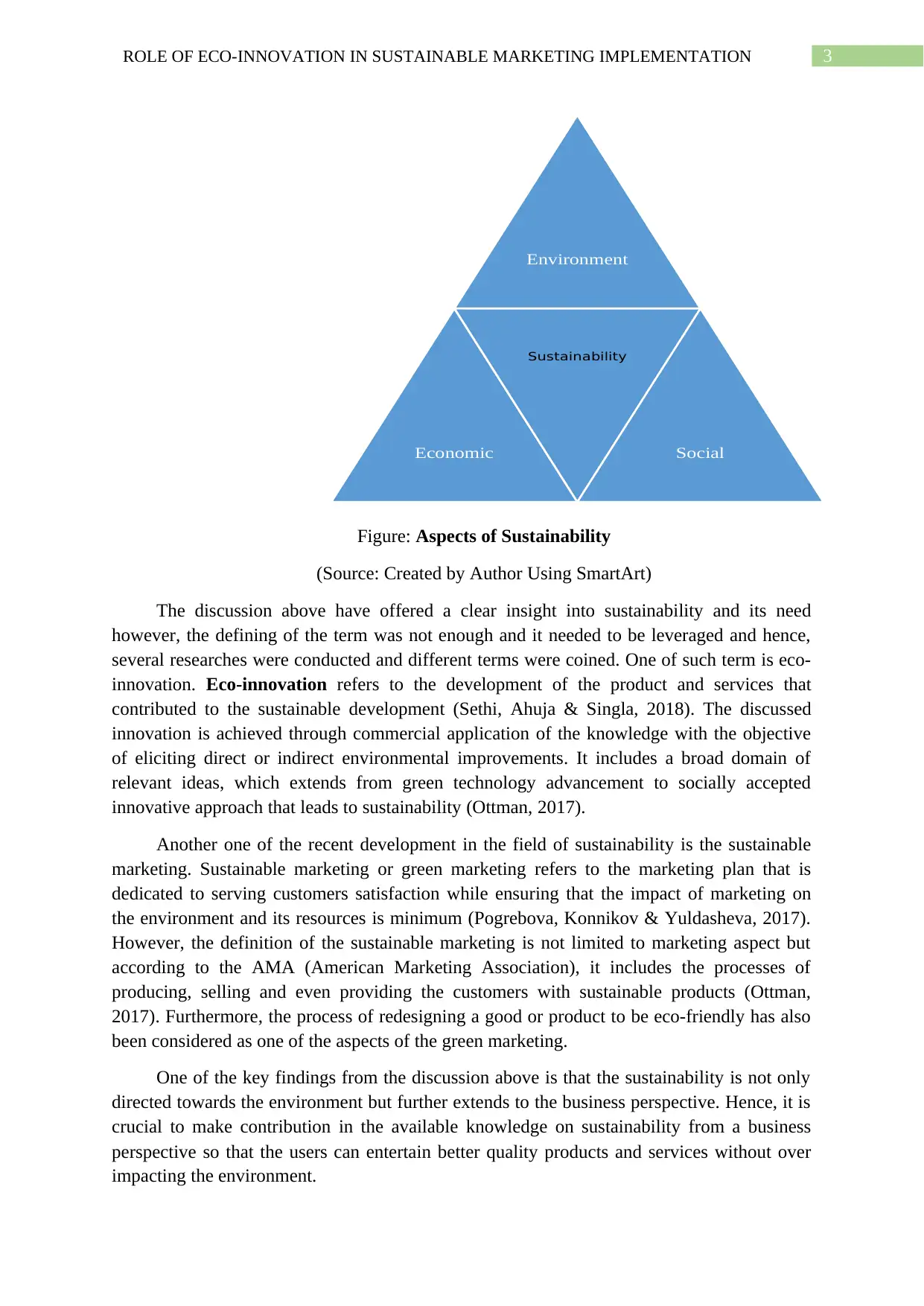
aspect along with the environmental factor (Childers et al., 2015). The three most prominent
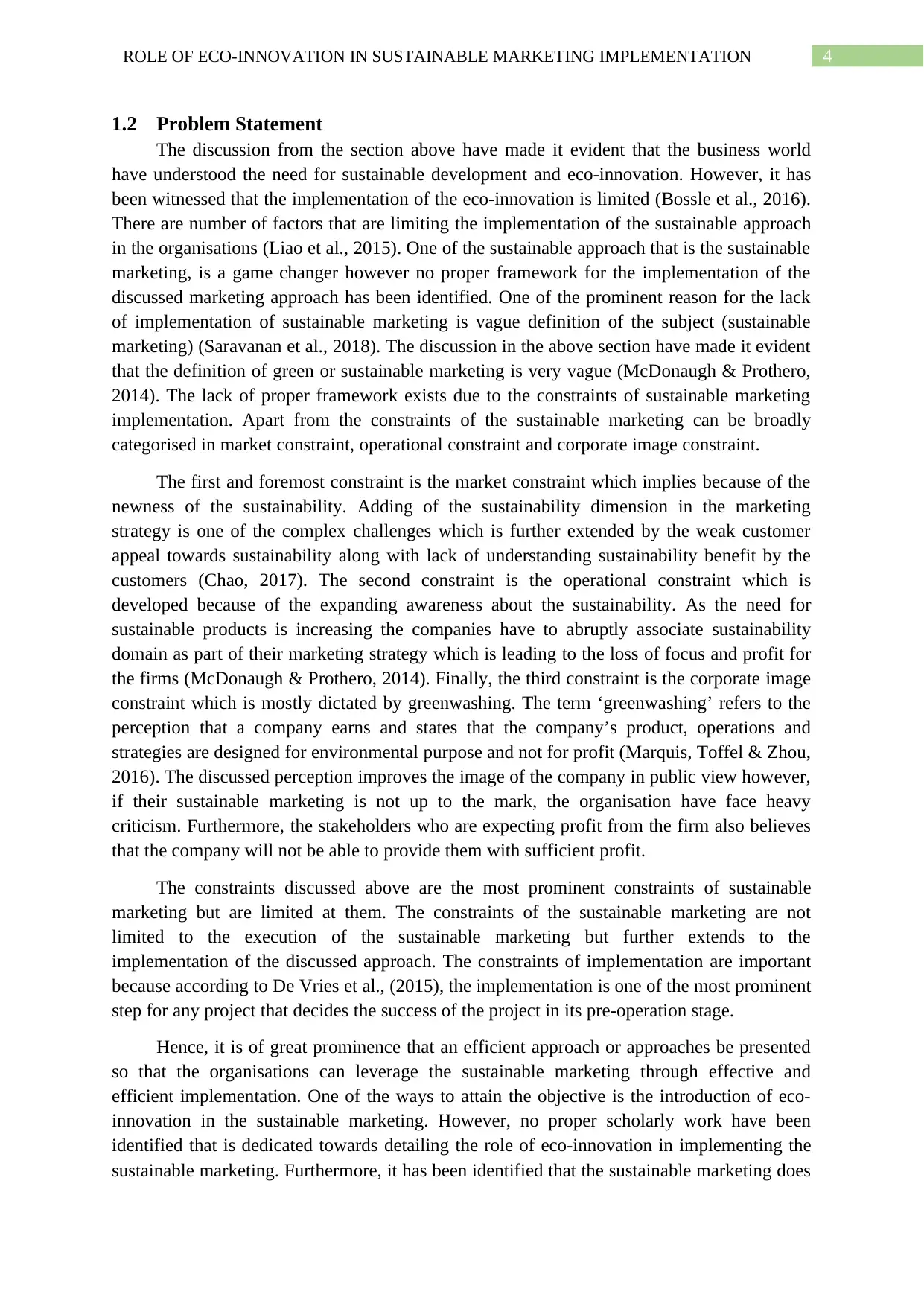
aspect of sustainability has been presented in the image below:
1 Introduction
Sustainability, eco-innovation, sustainable marketing and similar other crucial aspects
of the part of the discussed study and to earn a relevant understanding of the subjects, aspects
and eventually, the topic it is crucial to establish the base and the discussed section is
dedicated to the detailed task. Different sub-sections have been detailed so that an improved
and understandable establishment of the background can be achieved.
1.1 Background
Human development is led by different advancements that lead from the industrial
revolution, technological revolution and many other development in terms of technology,
machine automation and others. The discussed revolutions have provided the human with
different advantages and have contributed to an easy, effective and productive standard of
living. However, in improving the standard of living, one of the primary resources that
witnessed exploitation was the environmental resources (Rees, 2017). The discussed
development have led to the depletion of natural resources and development of practices that
were harmful for the ecology and in the process for the human life. Several scholars,
researchers, organisations and other entities invested their time and effort to conclude on the
need for protection of the ecology for human survival.
The discussed researches were then summarised to coin different terms that were
dedicated to human development while taking consideration of the natural resources
preservation. One of the key term that was coined for the protection of the nature and its
resources while ensuring human development was sustainability. Wood et al., (2015), have
defined sustainability as the approach towards technological advancements that meets the
current demand while preserving the natural resources so that it can be leveraged by the
future generations. The coining of the term by Crane and Matten (2016), revolutionised the
perception of the individuals as well as the organisations towards the use of natural resources.
The term in discussion was further refined to make it more suitable for the human
development. The improvement and researches led to the addition of social and economic
aspect along with the environmental factor (Childers et al., 2015). The three most prominent
aspect of sustainability has been presented in the image below:
⊘ This is a preview!⊘
Do you want full access?
Subscribe today to unlock all pages.

Trusted by 1+ million students worldwide
3ROLE OF ECO-INNOVATION IN SUSTAINABLE MARKETING IMPLEMENTATION
Figure: Aspects of Sustainability
(Source: Created by Author Using SmartArt)
The discussion above have offered a clear insight into sustainability and its need
however, the defining of the term was not enough and it needed to be leveraged and hence,
several researches were conducted and different terms were coined. One of such term is eco-
innovation. Eco-innovation refers to the development of the product and services that
contributed to the sustainable development (Sethi, Ahuja & Singla, 2018). The discussed
innovation is achieved through commercial application of the knowledge with the objective
of eliciting direct or indirect environmental improvements. It includes a broad domain of
relevant ideas, which extends from green technology advancement to socially accepted
innovative approach that leads to sustainability (Ottman, 2017).
Another one of the recent development in the field of sustainability is the sustainable
marketing. Sustainable marketing or green marketing refers to the marketing plan that is
dedicated to serving customers satisfaction while ensuring that the impact of marketing on
the environment and its resources is minimum (Pogrebova, Konnikov & Yuldasheva, 2017).
However, the definition of the sustainable marketing is not limited to marketing aspect but
according to the AMA (American Marketing Association), it includes the processes of
producing, selling and even providing the customers with sustainable products (Ottman,
2017). Furthermore, the process of redesigning a good or product to be eco-friendly has also
been considered as one of the aspects of the green marketing.
One of the key findings from the discussion above is that the sustainability is not only
directed towards the environment but further extends to the business perspective. Hence, it is
crucial to make contribution in the available knowledge on sustainability from a business
perspective so that the users can entertain better quality products and services without over
impacting the environment.
Environment
Economic
Sustainability
Social
Figure: Aspects of Sustainability
(Source: Created by Author Using SmartArt)
The discussion above have offered a clear insight into sustainability and its need
however, the defining of the term was not enough and it needed to be leveraged and hence,
several researches were conducted and different terms were coined. One of such term is eco-
innovation. Eco-innovation refers to the development of the product and services that
contributed to the sustainable development (Sethi, Ahuja & Singla, 2018). The discussed
innovation is achieved through commercial application of the knowledge with the objective
of eliciting direct or indirect environmental improvements. It includes a broad domain of
relevant ideas, which extends from green technology advancement to socially accepted
innovative approach that leads to sustainability (Ottman, 2017).
Another one of the recent development in the field of sustainability is the sustainable
marketing. Sustainable marketing or green marketing refers to the marketing plan that is
dedicated to serving customers satisfaction while ensuring that the impact of marketing on
the environment and its resources is minimum (Pogrebova, Konnikov & Yuldasheva, 2017).
However, the definition of the sustainable marketing is not limited to marketing aspect but
according to the AMA (American Marketing Association), it includes the processes of
producing, selling and even providing the customers with sustainable products (Ottman,
2017). Furthermore, the process of redesigning a good or product to be eco-friendly has also
been considered as one of the aspects of the green marketing.
One of the key findings from the discussion above is that the sustainability is not only
directed towards the environment but further extends to the business perspective. Hence, it is
crucial to make contribution in the available knowledge on sustainability from a business
perspective so that the users can entertain better quality products and services without over
impacting the environment.
Environment
Economic
Sustainability
Social
Paraphrase This Document
Need a fresh take? Get an instant paraphrase of this document with our AI Paraphraser
4ROLE OF ECO-INNOVATION IN SUSTAINABLE MARKETING IMPLEMENTATION
1.2 Problem Statement
The discussion from the section above have made it evident that the business world
have understood the need for sustainable development and eco-innovation. However, it has
been witnessed that the implementation of the eco-innovation is limited (Bossle et al., 2016).
There are number of factors that are limiting the implementation of the sustainable approach
in the organisations (Liao et al., 2015). One of the sustainable approach that is the sustainable
marketing, is a game changer however no proper framework for the implementation of the
discussed marketing approach has been identified. One of the prominent reason for the lack
of implementation of sustainable marketing is vague definition of the subject (sustainable
marketing) (Saravanan et al., 2018). The discussion in the above section have made it evident
that the definition of green or sustainable marketing is very vague (McDonaugh & Prothero,
2014). The lack of proper framework exists due to the constraints of sustainable marketing
implementation. Apart from the constraints of the sustainable marketing can be broadly
categorised in market constraint, operational constraint and corporate image constraint.
The first and foremost constraint is the market constraint which implies because of the
newness of the sustainability. Adding of the sustainability dimension in the marketing
strategy is one of the complex challenges which is further extended by the weak customer
appeal towards sustainability along with lack of understanding sustainability benefit by the
customers (Chao, 2017). The second constraint is the operational constraint which is
developed because of the expanding awareness about the sustainability. As the need for
sustainable products is increasing the companies have to abruptly associate sustainability
domain as part of their marketing strategy which is leading to the loss of focus and profit for
the firms (McDonaugh & Prothero, 2014). Finally, the third constraint is the corporate image
constraint which is mostly dictated by greenwashing. The term ‘greenwashing’ refers to the
perception that a company earns and states that the company’s product, operations and
strategies are designed for environmental purpose and not for profit (Marquis, Toffel & Zhou,
2016). The discussed perception improves the image of the company in public view however,
if their sustainable marketing is not up to the mark, the organisation have face heavy
criticism. Furthermore, the stakeholders who are expecting profit from the firm also believes
that the company will not be able to provide them with sufficient profit.
The constraints discussed above are the most prominent constraints of sustainable
marketing but are limited at them. The constraints of the sustainable marketing are not
limited to the execution of the sustainable marketing but further extends to the
implementation of the discussed approach. The constraints of implementation are important
because according to De Vries et al., (2015), the implementation is one of the most prominent
step for any project that decides the success of the project in its pre-operation stage.
Hence, it is of great prominence that an efficient approach or approaches be presented
so that the organisations can leverage the sustainable marketing through effective and
efficient implementation. One of the ways to attain the objective is the introduction of eco-
innovation in the sustainable marketing. However, no proper scholarly work have been
identified that is dedicated towards detailing the role of eco-innovation in implementing the
sustainable marketing. Furthermore, it has been identified that the sustainable marketing does
1.2 Problem Statement
The discussion from the section above have made it evident that the business world
have understood the need for sustainable development and eco-innovation. However, it has
been witnessed that the implementation of the eco-innovation is limited (Bossle et al., 2016).
There are number of factors that are limiting the implementation of the sustainable approach
in the organisations (Liao et al., 2015). One of the sustainable approach that is the sustainable
marketing, is a game changer however no proper framework for the implementation of the
discussed marketing approach has been identified. One of the prominent reason for the lack
of implementation of sustainable marketing is vague definition of the subject (sustainable
marketing) (Saravanan et al., 2018). The discussion in the above section have made it evident
that the definition of green or sustainable marketing is very vague (McDonaugh & Prothero,
2014). The lack of proper framework exists due to the constraints of sustainable marketing
implementation. Apart from the constraints of the sustainable marketing can be broadly
categorised in market constraint, operational constraint and corporate image constraint.
The first and foremost constraint is the market constraint which implies because of the
newness of the sustainability. Adding of the sustainability dimension in the marketing
strategy is one of the complex challenges which is further extended by the weak customer
appeal towards sustainability along with lack of understanding sustainability benefit by the
customers (Chao, 2017). The second constraint is the operational constraint which is
developed because of the expanding awareness about the sustainability. As the need for
sustainable products is increasing the companies have to abruptly associate sustainability
domain as part of their marketing strategy which is leading to the loss of focus and profit for
the firms (McDonaugh & Prothero, 2014). Finally, the third constraint is the corporate image
constraint which is mostly dictated by greenwashing. The term ‘greenwashing’ refers to the
perception that a company earns and states that the company’s product, operations and
strategies are designed for environmental purpose and not for profit (Marquis, Toffel & Zhou,
2016). The discussed perception improves the image of the company in public view however,
if their sustainable marketing is not up to the mark, the organisation have face heavy
criticism. Furthermore, the stakeholders who are expecting profit from the firm also believes
that the company will not be able to provide them with sufficient profit.
The constraints discussed above are the most prominent constraints of sustainable
marketing but are limited at them. The constraints of the sustainable marketing are not
limited to the execution of the sustainable marketing but further extends to the
implementation of the discussed approach. The constraints of implementation are important
because according to De Vries et al., (2015), the implementation is one of the most prominent
step for any project that decides the success of the project in its pre-operation stage.
Hence, it is of great prominence that an efficient approach or approaches be presented
so that the organisations can leverage the sustainable marketing through effective and
efficient implementation. One of the ways to attain the objective is the introduction of eco-
innovation in the sustainable marketing. However, no proper scholarly work have been
identified that is dedicated towards detailing the role of eco-innovation in implementing the
sustainable marketing. Furthermore, it has been identified that the sustainable marketing does
5ROLE OF ECO-INNOVATION IN SUSTAINABLE MARKETING IMPLEMENTATION
have certain existing problem that needs to be mitigated. Hence, the problem statement that
the discussed paper have attempted to address is to the ways in which eco-innovation can
face/solve the existing problems of implementing sustainable marketing by the
firms/companies.
1.3 Research Aim
The problem statement in the section above have made it evident that no proper
discussion is available on ways through which the eco-innovation is capable of facing/solving
the existing problems faced by sustainability marketing implementation. The primary aim of
the study is to identify the role that eco-innovation is capable in mitigating the implementing
challenges faced by sustainable marketing. It will be supported by certain sub-objectives that
have been in the following sub-section.
1.3.1 Research Objectives
The objectives that will support in attaining the primary aim of the paper have been
listed below along with the primary aim of the research study.
i. To detail the implementation constraints of sustainability marketing.
ii. To identify the feasibility of eco-innovation as a solution for mitigating the problems
related to sustainable domain.
iii. To detail the role that eco-innovation is capable of playing in mitigating the problem
faced during the implementation of sustainability marketing.
1.4 Research Questions
The paper in discussion will answer certain questions for ensuring that the deliverables
of the study are feasible and those questions have been listed below:
i. What are the constraints of implementing sustainability marketing?
ii. Is eco-innovation solution to the problems that the sustainable associated factors is
facing?
iii. How eco-innovation can face/solve the existing problems of implementing sustainable
marketing (by firms/companies)
1.5 Scope
The study in discussion is aimed at identify the role of eco-innovation as solution for
the problems that the sustainable marketing implementation is facing. So, the findings from
the paper will enable the firms/companies to adopt eco-innovation as a solution for the
challenges in sustainable marketing implementation. The adequate way of adoption of eco-
innovation will ensure that the implementation of the green marketing is efficient which in
turn will enable the firms to leverage the green marketing strategy. The leveraging of the
green marketing will enable the firms to leverage the benefits of the green marketing that will
prove to be hugely beneficial for the firm. It will also offer motivation to the firms adopt the
green marketing as part of their CSR (Corporate Social Responsibility). Additionally, the
understanding of the companies about the subject and eco-innovation will get them interested
in investing their time, budget and effort in research over the subject which will further
improve the sustainable marketing and its implications. The research over the green
have certain existing problem that needs to be mitigated. Hence, the problem statement that
the discussed paper have attempted to address is to the ways in which eco-innovation can
face/solve the existing problems of implementing sustainable marketing by the
firms/companies.
1.3 Research Aim
The problem statement in the section above have made it evident that no proper
discussion is available on ways through which the eco-innovation is capable of facing/solving
the existing problems faced by sustainability marketing implementation. The primary aim of
the study is to identify the role that eco-innovation is capable in mitigating the implementing
challenges faced by sustainable marketing. It will be supported by certain sub-objectives that
have been in the following sub-section.
1.3.1 Research Objectives
The objectives that will support in attaining the primary aim of the paper have been
listed below along with the primary aim of the research study.
i. To detail the implementation constraints of sustainability marketing.
ii. To identify the feasibility of eco-innovation as a solution for mitigating the problems
related to sustainable domain.
iii. To detail the role that eco-innovation is capable of playing in mitigating the problem
faced during the implementation of sustainability marketing.
1.4 Research Questions
The paper in discussion will answer certain questions for ensuring that the deliverables
of the study are feasible and those questions have been listed below:
i. What are the constraints of implementing sustainability marketing?
ii. Is eco-innovation solution to the problems that the sustainable associated factors is
facing?
iii. How eco-innovation can face/solve the existing problems of implementing sustainable
marketing (by firms/companies)
1.5 Scope
The study in discussion is aimed at identify the role of eco-innovation as solution for
the problems that the sustainable marketing implementation is facing. So, the findings from
the paper will enable the firms/companies to adopt eco-innovation as a solution for the
challenges in sustainable marketing implementation. The adequate way of adoption of eco-
innovation will ensure that the implementation of the green marketing is efficient which in
turn will enable the firms to leverage the green marketing strategy. The leveraging of the
green marketing will enable the firms to leverage the benefits of the green marketing that will
prove to be hugely beneficial for the firm. It will also offer motivation to the firms adopt the
green marketing as part of their CSR (Corporate Social Responsibility). Additionally, the
understanding of the companies about the subject and eco-innovation will get them interested
in investing their time, budget and effort in research over the subject which will further
improve the sustainable marketing and its implications. The research over the green
⊘ This is a preview!⊘
Do you want full access?
Subscribe today to unlock all pages.
Trusted by 1+ million students worldwide
6ROLE OF ECO-INNOVATION IN SUSTAINABLE MARKETING IMPLEMENTATION
marketing may also lead to the development of new sustainable technologies that will offer
environmental, economic and social benefit at a global level.
Furthermore, the findings from the paper will act as literary work for future works that
will establish platform for further researches. The identification will offer scope for future
researches in the field of sustainability, eco-innovation and sustainable marketing. The
readers can carry out study on the same topic through qualitative approach for further refining
the findings that will make the green marketing more interesting for the companies and firms.
Similarly, the study in discussion can be leveraged through different other means and hence,
the scope of is vast.
1.6 Limitations
A discussion over the limitation of the study is very crucial because it enable the
readers to understand what to expect from the study and even avails the scholars to identify
the gap that they can leverage for further studies and the limitations of the study have been
detailed. The most prominent limitation of the study is the budget and schedule of the study.
As the study in discussion is an academic study and hence, limited budget and time have been
offered to the study. Furthermore, the limited approach of the academic researcher that is
pursuing the discussed study is also a limitation of the study.
The researcher is an academic student so the approach of the researcher is limited,
which developed restriction in selecting the most viable population as part of the respondent.
It is because the respondents may provide biased answers or responses that are irrelevant. The
discussed limitation raises the question over the reliability of the findings and hence, to
mitigate the discussed limitation secondary data will act as the standard to justify the
findings. Another measure adopted to limit the discussed limitation is selection of the
quantitative data. The selection of quantitative data is based on the fact that it offers closed
end questions which will offer the respondents with the opportunity to offer the most relevant
response. Additionally, the survey questions will be developed based on the review of the
secondary sources such as journals, government publications, reliable company blogs,
newspapers and magazines articles along with other reliable secondary sources.
Another notable limitation of the study is the availability of the secondary data. The
secondary sources will be collected from the internet and not all the data available on the
internet are free and as it has been discussed above that budget of the study is limited, so
some relevant secondary sources may not be accessible to the author of the paper. Finally, the
findings from the paper will not be reliable and justified for a general audience but will
remain limited to the public of the geographical domain of research. The statement above
could be justified by the fact that the respondents of the paper will be from the domain of
research so their opinion and knowledge will be restricted to the domain of research and
hence, the findings will also be limited to the domain of research.
1.7 Structure
The final paper has been divided in five different chapters that are dedicated to different
objectives of an academic report. The first chapter is dedicated to detailing the key concepts
and establishing a background for the study. The establishment will enable the readers to
marketing may also lead to the development of new sustainable technologies that will offer
environmental, economic and social benefit at a global level.
Furthermore, the findings from the paper will act as literary work for future works that
will establish platform for further researches. The identification will offer scope for future
researches in the field of sustainability, eco-innovation and sustainable marketing. The
readers can carry out study on the same topic through qualitative approach for further refining
the findings that will make the green marketing more interesting for the companies and firms.
Similarly, the study in discussion can be leveraged through different other means and hence,
the scope of is vast.
1.6 Limitations
A discussion over the limitation of the study is very crucial because it enable the
readers to understand what to expect from the study and even avails the scholars to identify
the gap that they can leverage for further studies and the limitations of the study have been
detailed. The most prominent limitation of the study is the budget and schedule of the study.
As the study in discussion is an academic study and hence, limited budget and time have been
offered to the study. Furthermore, the limited approach of the academic researcher that is
pursuing the discussed study is also a limitation of the study.
The researcher is an academic student so the approach of the researcher is limited,
which developed restriction in selecting the most viable population as part of the respondent.
It is because the respondents may provide biased answers or responses that are irrelevant. The
discussed limitation raises the question over the reliability of the findings and hence, to
mitigate the discussed limitation secondary data will act as the standard to justify the
findings. Another measure adopted to limit the discussed limitation is selection of the
quantitative data. The selection of quantitative data is based on the fact that it offers closed
end questions which will offer the respondents with the opportunity to offer the most relevant
response. Additionally, the survey questions will be developed based on the review of the
secondary sources such as journals, government publications, reliable company blogs,
newspapers and magazines articles along with other reliable secondary sources.
Another notable limitation of the study is the availability of the secondary data. The
secondary sources will be collected from the internet and not all the data available on the
internet are free and as it has been discussed above that budget of the study is limited, so
some relevant secondary sources may not be accessible to the author of the paper. Finally, the
findings from the paper will not be reliable and justified for a general audience but will
remain limited to the public of the geographical domain of research. The statement above
could be justified by the fact that the respondents of the paper will be from the domain of
research so their opinion and knowledge will be restricted to the domain of research and
hence, the findings will also be limited to the domain of research.
1.7 Structure
The final paper has been divided in five different chapters that are dedicated to different
objectives of an academic report. The first chapter is dedicated to detailing the key concepts
and establishing a background for the study. The establishment will enable the readers to
Paraphrase This Document
Need a fresh take? Get an instant paraphrase of this document with our AI Paraphraser
7ROLE OF ECO-INNOVATION IN SUSTAINABLE MARKETING IMPLEMENTATION
understand the purpose that the paper is attempting to serve. It discusses the research aim,
objective, questions, scope, limitation and other crucial aspects that integrate together to
specify the purpose and benefits of the study along with the limitations of the study. The
following chapter is dedicated to gaining an improved insight into the subject. It will be
attained through identification of the theories, frameworks, and other knowledge that is
available on the subject (sustainable marketing) and co-subject (eco-innovation). The
identification of the findings will serve as the standard that will act as the unit for measuring,
comparing and contrasting the reliability of the findings from the analysis of the data.
The third chapter will be dedicated to the detailing the research approach that had been
selected to attain the objective of the study with accuracy and efficiency. The chapter in
discussion have detailed the research approach, design, philosophy, sampling size,
population, and data analysis along with the data analysis tool used for analysing the
collected data. The fourth chapter is dedicated at analysing the data so that it can be
summarised to conclude on the objectives. The discussed section will be the practical aspect
of the paper and is most crucial as the collected data will be summarised. Finally, conclusion
will be the final chapter that will summarise all the findings of the study to conclude and link
with the objectives. To avoid any ethical issues, a reference list has also been attached at the
end of the fifth chapter.
2 Theory
2.1 Introduction
Humans are consumers and they survive by consuming different goods and services.
The human needs are expand from house, consumable goods, technological needs and others.
The goods and services are developed for consumption through use of the man-made
resources or natural resources (Bergstrom & Randall, 2016). The population of humans
globally have increased over 7 billion and the vast increase in the population has imposed
additionally pressure on the natural resources for fulfilling of the human needs. The extra
pressure on the natural resources have proved to a prominent threat for the environment and
in the process for the living beings that are dependent on it, which includes the humans (Shao
& Yang, 2014). Hence, for the survival of the humans the prospective of sustainability was
developed. Sustainability, refers to pursuing of the objective of human development without
exerting extra pressure on the environment and preserving it for the future generations. To
ensure that human development is not restricted by the motive of environmental protection
economic and social aspect were added to the sustainability. Cultural, technological and
political domains have also been added to the sustainability for further refining it, to make it
more relevant and adoptable (Adams et al., 2016).
The discussion above have made it evident that sustainability is a broader term and
should not be limited to the environmental perspective. It accounts for the economic and
social perspective along with the environmental perspective. However, they are not the
limitation to the expansion of sustainability as new pillars are frequently added to its domain
and politics has emerged as the fourth pillar of sustainability (Hansen & Coenen, 2015).
Cultural dimension of the sustainability is also being considered as the part of the
understand the purpose that the paper is attempting to serve. It discusses the research aim,
objective, questions, scope, limitation and other crucial aspects that integrate together to
specify the purpose and benefits of the study along with the limitations of the study. The
following chapter is dedicated to gaining an improved insight into the subject. It will be
attained through identification of the theories, frameworks, and other knowledge that is
available on the subject (sustainable marketing) and co-subject (eco-innovation). The
identification of the findings will serve as the standard that will act as the unit for measuring,
comparing and contrasting the reliability of the findings from the analysis of the data.
The third chapter will be dedicated to the detailing the research approach that had been
selected to attain the objective of the study with accuracy and efficiency. The chapter in
discussion have detailed the research approach, design, philosophy, sampling size,
population, and data analysis along with the data analysis tool used for analysing the
collected data. The fourth chapter is dedicated at analysing the data so that it can be
summarised to conclude on the objectives. The discussed section will be the practical aspect
of the paper and is most crucial as the collected data will be summarised. Finally, conclusion
will be the final chapter that will summarise all the findings of the study to conclude and link
with the objectives. To avoid any ethical issues, a reference list has also been attached at the
end of the fifth chapter.
2 Theory
2.1 Introduction
Humans are consumers and they survive by consuming different goods and services.
The human needs are expand from house, consumable goods, technological needs and others.
The goods and services are developed for consumption through use of the man-made
resources or natural resources (Bergstrom & Randall, 2016). The population of humans
globally have increased over 7 billion and the vast increase in the population has imposed
additionally pressure on the natural resources for fulfilling of the human needs. The extra
pressure on the natural resources have proved to a prominent threat for the environment and
in the process for the living beings that are dependent on it, which includes the humans (Shao
& Yang, 2014). Hence, for the survival of the humans the prospective of sustainability was
developed. Sustainability, refers to pursuing of the objective of human development without
exerting extra pressure on the environment and preserving it for the future generations. To
ensure that human development is not restricted by the motive of environmental protection
economic and social aspect were added to the sustainability. Cultural, technological and
political domains have also been added to the sustainability for further refining it, to make it
more relevant and adoptable (Adams et al., 2016).
The discussion above have made it evident that sustainability is a broader term and
should not be limited to the environmental perspective. It accounts for the economic and
social perspective along with the environmental perspective. However, they are not the
limitation to the expansion of sustainability as new pillars are frequently added to its domain
and politics has emerged as the fourth pillar of sustainability (Hansen & Coenen, 2015).
Cultural dimension of the sustainability is also being considered as the part of the
8ROLE OF ECO-INNOVATION IN SUSTAINABLE MARKETING IMPLEMENTATION
sustainability by some of the scholars. However, no official confirmation over the cultural
dimension has been made by any reliable environmental protection entity(ies).
The section in discussion is aimed at aimed at detailing the findings from the secondary
sources to identify the current status of knowledge that is available on the topic in discussion.
The identification will enable the author of the paper to establish a background and standard
for the measurement of the findings from the paper (Hart, 2018). The section has been
divided into smaller subsections for better understanding of the readers. It has also enabled
the author to synthesis different findings through the use of the critical thinking. Those
synthesised statements have been provided at the end of each section that will be used as the
discussed standard and has been used for comparing and contrasting with the findings (Machi
& McEvoy, 2016). Different articles have been summarised to present one synthesised
statement and have been discussed under one heading, depending upon the relevancy in the
nature of the articles. All the sources have been referenced properly for avoiding any ethical
issue.
2.2 Sustainability and its variables
Social Development World Summit in 2005, was one of the most prominent summit
because it intensified the definition of the sustainability and added sustainable goals, which
are referred to as the three dimensions of the sustainability (Hornborg & Crumley, 2016). The
discussed dimensions are social development, economic development and environmental
protection. The three dimensions of the sustainability are interdepend and contribute together
to form sustainability. The discussed dimensions are interdependent and is evident from the
financial crisis of 2008. The crisis in 2008, weakened the economy of different countries
which led the states to reduce their attention towards the environment. Hong et al. (2018), in
their paper have discussed the impact of financial crisis on the CO2 emission in Taiwan. The
results show that at the latter phase of the financial, the CO2 emission of the country grew by
563,296 tons in the agricultural sector and 561,685 tons in the production from agricultural
products (Hong et al., 2018). Similarly, the CO2 also increases when a state is in a chaotic
social phase such as war or internal troubles. So, it would be justified to state that the three
dimensions of the sustainability are interdependent. The discussed three dimensions are taken
into considered together for providing certification to a good and service as a sustainable
product or service.
The newest added pillar of the sustainability has also made its presence and
interdependency evident. It can be made evident from the current financial crisis in Sri
Lanka. The political crisis in Sri Lanka is impacting the economy of the country because of
different factors such as a reduced rate of tourism, corporate perception and others. The
impact of economy will impact the environmental protection measures. The forecasting can
be justified by the ongoing human rights violation in the country (Chandran & Jegarajah,
2018). Additionally, multiple other cases can be taken into account to prove the impact that
politics have on the sustainability. One of which is the awareness of the politic leadership of
the country over the environmental protection need.
sustainability by some of the scholars. However, no official confirmation over the cultural
dimension has been made by any reliable environmental protection entity(ies).
The section in discussion is aimed at aimed at detailing the findings from the secondary
sources to identify the current status of knowledge that is available on the topic in discussion.
The identification will enable the author of the paper to establish a background and standard
for the measurement of the findings from the paper (Hart, 2018). The section has been
divided into smaller subsections for better understanding of the readers. It has also enabled
the author to synthesis different findings through the use of the critical thinking. Those
synthesised statements have been provided at the end of each section that will be used as the
discussed standard and has been used for comparing and contrasting with the findings (Machi
& McEvoy, 2016). Different articles have been summarised to present one synthesised
statement and have been discussed under one heading, depending upon the relevancy in the
nature of the articles. All the sources have been referenced properly for avoiding any ethical
issue.
2.2 Sustainability and its variables
Social Development World Summit in 2005, was one of the most prominent summit
because it intensified the definition of the sustainability and added sustainable goals, which
are referred to as the three dimensions of the sustainability (Hornborg & Crumley, 2016). The
discussed dimensions are social development, economic development and environmental
protection. The three dimensions of the sustainability are interdepend and contribute together
to form sustainability. The discussed dimensions are interdependent and is evident from the
financial crisis of 2008. The crisis in 2008, weakened the economy of different countries
which led the states to reduce their attention towards the environment. Hong et al. (2018), in
their paper have discussed the impact of financial crisis on the CO2 emission in Taiwan. The
results show that at the latter phase of the financial, the CO2 emission of the country grew by
563,296 tons in the agricultural sector and 561,685 tons in the production from agricultural
products (Hong et al., 2018). Similarly, the CO2 also increases when a state is in a chaotic
social phase such as war or internal troubles. So, it would be justified to state that the three
dimensions of the sustainability are interdependent. The discussed three dimensions are taken
into considered together for providing certification to a good and service as a sustainable
product or service.
The newest added pillar of the sustainability has also made its presence and
interdependency evident. It can be made evident from the current financial crisis in Sri
Lanka. The political crisis in Sri Lanka is impacting the economy of the country because of
different factors such as a reduced rate of tourism, corporate perception and others. The
impact of economy will impact the environmental protection measures. The forecasting can
be justified by the ongoing human rights violation in the country (Chandran & Jegarajah,
2018). Additionally, multiple other cases can be taken into account to prove the impact that
politics have on the sustainability. One of which is the awareness of the politic leadership of
the country over the environmental protection need.
⊘ This is a preview!⊘
Do you want full access?
Subscribe today to unlock all pages.
Trusted by 1+ million students worldwide
9ROLE OF ECO-INNOVATION IN SUSTAINABLE MARKETING IMPLEMENTATION
Hence, to summarise the discussion, it would be adequate to state that the sustainability
is a dependent factor that prominently depends on four pillars that includes environmental,
economic, social and political aspects.
2.2.1 Sustainable Development
Brundtland Report in 1987 for the World Commission on Environment and
Development gave a broader sustainability more credibility by coining the term sustainable
development (Sethi, Ahuja & Singla, 2018). Sustainable development refers to the organising
of the theories for coping up with the human development goals and expectation while at the
same instance, sustaining the capability of the natural producers to offer ecosystem services
and natural resources which are stabilising pillar for the society and economy. Nilsson,
Griggs & Visbeck (2016), in their paper have simplified the definition by stating that the
sustainable development refers to the development of state-of-art products (goods and
services) while maintaining a balanced natural system through preserving the natural
resources for the future generations. The UNGA (United Nation General Assemble) in the
year 2015 adopted 17 goals (called as SDG, abbreviation for Sustainable Development
Goals) that is aimed to be achieved by all the countries from the year 2016 to 2030 (World
Health Organisation, 2016). The 17 goals include “no hunger; zero hunger; good health and
well being for people; quality education; gender equality; clean water and sanitation;
affordable and clean energy; decent work and economic growth; industry, innovation and
infrastructure; reducing inequalities; sustainable cities and communities; responsible
consumption and production; climate action; life below water; life on land; peace, justice and
strong institutions; and partnerships for the goals.” It is evident from the goals that
It is evident from the SDG and the definition of sustainable development that the
dimensions of the sustainable development extends from economy, environment and social
dimension to its sub-categories for a ground level development.
2.2.2 Sustainable Development for Business
The most prominently accepted criterion for the sustainability in business context
constitutes of the firm/ company’s efficient use of the natural capital (Benn, Edwards &
Williams, 2014). The discussed eco-efficiency is generally calculated by the economic value
that the firm adds in context with the aggregated ecological impact of the firm. The definition
was proposed by WBCSD, which is abbreviation for World Business Council for Sustainable
Development. The definition was "Eco-efficiency is achieved by the delivery of
competitively priced goods and services that satisfy human needs and bring quality of life,
while progressively reducing ecological impacts and resource intensity throughout the life-
cycle to a level at least in line with the earth's carrying capacity" (Schaltegger & Burritt,
2017). The second most prominent criterion for the business development is the Socio-
efficiency, which details the organisational value and the social impact it have.
According to Baumgartner (2014), sustainable development in the business world is an
integration of company’s CSR (Corporate Social responsibility) and economic sustainability
(combination of socio-efficiency and eco-efficiency). CSR of a company does not refer to the
Hence, to summarise the discussion, it would be adequate to state that the sustainability
is a dependent factor that prominently depends on four pillars that includes environmental,
economic, social and political aspects.
2.2.1 Sustainable Development
Brundtland Report in 1987 for the World Commission on Environment and
Development gave a broader sustainability more credibility by coining the term sustainable
development (Sethi, Ahuja & Singla, 2018). Sustainable development refers to the organising
of the theories for coping up with the human development goals and expectation while at the
same instance, sustaining the capability of the natural producers to offer ecosystem services
and natural resources which are stabilising pillar for the society and economy. Nilsson,
Griggs & Visbeck (2016), in their paper have simplified the definition by stating that the
sustainable development refers to the development of state-of-art products (goods and
services) while maintaining a balanced natural system through preserving the natural
resources for the future generations. The UNGA (United Nation General Assemble) in the
year 2015 adopted 17 goals (called as SDG, abbreviation for Sustainable Development
Goals) that is aimed to be achieved by all the countries from the year 2016 to 2030 (World
Health Organisation, 2016). The 17 goals include “no hunger; zero hunger; good health and
well being for people; quality education; gender equality; clean water and sanitation;
affordable and clean energy; decent work and economic growth; industry, innovation and
infrastructure; reducing inequalities; sustainable cities and communities; responsible
consumption and production; climate action; life below water; life on land; peace, justice and
strong institutions; and partnerships for the goals.” It is evident from the goals that
It is evident from the SDG and the definition of sustainable development that the
dimensions of the sustainable development extends from economy, environment and social
dimension to its sub-categories for a ground level development.
2.2.2 Sustainable Development for Business
The most prominently accepted criterion for the sustainability in business context
constitutes of the firm/ company’s efficient use of the natural capital (Benn, Edwards &
Williams, 2014). The discussed eco-efficiency is generally calculated by the economic value
that the firm adds in context with the aggregated ecological impact of the firm. The definition
was proposed by WBCSD, which is abbreviation for World Business Council for Sustainable
Development. The definition was "Eco-efficiency is achieved by the delivery of
competitively priced goods and services that satisfy human needs and bring quality of life,
while progressively reducing ecological impacts and resource intensity throughout the life-
cycle to a level at least in line with the earth's carrying capacity" (Schaltegger & Burritt,
2017). The second most prominent criterion for the business development is the Socio-
efficiency, which details the organisational value and the social impact it have.
According to Baumgartner (2014), sustainable development in the business world is an
integration of company’s CSR (Corporate Social responsibility) and economic sustainability
(combination of socio-efficiency and eco-efficiency). CSR of a company does not refer to the
Paraphrase This Document
Need a fresh take? Get an instant paraphrase of this document with our AI Paraphraser
10ROLE OF ECO-INNOVATION IN SUSTAINABLE MARKETING IMPLEMENTATION
using of the firm’s profit, instead refers to the way in which the firm is making the profit
(Fassin, 2015). So, it would be justified to state that not every department of the firm makes
profit such as HRD (Human Resource Department), Value Chain department and others. So,
ecology and environment needs of a firm needs to be evaluated based on department. The
production department, sales department, marketing department and others makes profit and
they can be considered as part of the organisational sustainable development.
Hence, to summarise the discussion above it would be justified to state that Sustainable
development is not applicable at a group level but instead exists at a departmental level
based on the economic aspect. The sustainability exists at Production, Males, Marketing,
Accounts and others. The limited understanding of the sustainable marketing can also be
considered as a constraint that impacts the implementation of the sustainable marketing.
2.3 Sustainable and Marketing relationships
The relationship between socio-environmental, sustainability and marketing is one of
the relationship that can be divided in phases (McDonagh & Prothero, 2014). The phases can
be considered as early, adolescence and mature. The early age also considered to be as the
ecological marketing started in the early 1970’s. The focus of the discussed phase was
emphasised on the broader aspect of the environmental issues rather than the basic issues.
The broader issues consisted of the air pollution, impact of pesticides on the environment, oil
reserves depletion and similar others (Hsu, Tan & Mohamad Zailani, 2016). The broader
approach was directed towards a narrow range of industries and was mostly dominated by the
technical solutions as part of the problem resolution. However, with further researches it was
further refined to indulge focus on a broader range of industries and in the process start its
adolescence phase (Baker & Saren, 2016). The second phase or the adolescence phase was
dominated by the idea that instead of working towards making attempts for preserving natural
resources it would be a better option to provide a suitable alternative. The discussed phase
also known as the environmental marketing gave birth to the idea of green marketing. The
emphasis of the discussed phase was to offer eco-friendly or sustainable goods, services and
actions as an alternative for deliverables that hurts the nature and its resources, instead of
restricting the use of natural resources for environmental protection (Isaak, 2017). In 1980’s
the discussed phase became one of the prominent choice for the large producers of goods and
services because it also offered them with the opportunity to gain competitive leadership
(Armstrong et al., 2015). The competitive leadership was earned because of the consumer’s
growing concerns over the environment and their interest towards sustainable products.
The third phase or the matured phase that is currently in pursuing is the sustainable
marketing. The discussed phase is dedicated to the transformation of market for achieving
substantive development for internalisation of the socio-environmental costs that were treated
as externalities in the previous definitions or ideas (McDonagh & Prothero, 2014). The
market here is not limited to the producers or providers of goods, services and actions but
extends to include the customers and other entities who might be impactful or will be
influenced. The discussed phase was developed based on the learning of the above discussed
phases because it considers preserving of the natural resources from the first phase and
using of the firm’s profit, instead refers to the way in which the firm is making the profit
(Fassin, 2015). So, it would be justified to state that not every department of the firm makes
profit such as HRD (Human Resource Department), Value Chain department and others. So,
ecology and environment needs of a firm needs to be evaluated based on department. The
production department, sales department, marketing department and others makes profit and
they can be considered as part of the organisational sustainable development.
Hence, to summarise the discussion above it would be justified to state that Sustainable
development is not applicable at a group level but instead exists at a departmental level
based on the economic aspect. The sustainability exists at Production, Males, Marketing,
Accounts and others. The limited understanding of the sustainable marketing can also be
considered as a constraint that impacts the implementation of the sustainable marketing.
2.3 Sustainable and Marketing relationships
The relationship between socio-environmental, sustainability and marketing is one of
the relationship that can be divided in phases (McDonagh & Prothero, 2014). The phases can
be considered as early, adolescence and mature. The early age also considered to be as the
ecological marketing started in the early 1970’s. The focus of the discussed phase was
emphasised on the broader aspect of the environmental issues rather than the basic issues.
The broader issues consisted of the air pollution, impact of pesticides on the environment, oil
reserves depletion and similar others (Hsu, Tan & Mohamad Zailani, 2016). The broader
approach was directed towards a narrow range of industries and was mostly dominated by the
technical solutions as part of the problem resolution. However, with further researches it was
further refined to indulge focus on a broader range of industries and in the process start its
adolescence phase (Baker & Saren, 2016). The second phase or the adolescence phase was
dominated by the idea that instead of working towards making attempts for preserving natural
resources it would be a better option to provide a suitable alternative. The discussed phase
also known as the environmental marketing gave birth to the idea of green marketing. The
emphasis of the discussed phase was to offer eco-friendly or sustainable goods, services and
actions as an alternative for deliverables that hurts the nature and its resources, instead of
restricting the use of natural resources for environmental protection (Isaak, 2017). In 1980’s
the discussed phase became one of the prominent choice for the large producers of goods and
services because it also offered them with the opportunity to gain competitive leadership
(Armstrong et al., 2015). The competitive leadership was earned because of the consumer’s
growing concerns over the environment and their interest towards sustainable products.
The third phase or the matured phase that is currently in pursuing is the sustainable
marketing. The discussed phase is dedicated to the transformation of market for achieving
substantive development for internalisation of the socio-environmental costs that were treated
as externalities in the previous definitions or ideas (McDonagh & Prothero, 2014). The
market here is not limited to the producers or providers of goods, services and actions but
extends to include the customers and other entities who might be impactful or will be
influenced. The discussed phase was developed based on the learning of the above discussed
phases because it considers preserving of the natural resources from the first phase and
11ROLE OF ECO-INNOVATION IN SUSTAINABLE MARKETING IMPLEMENTATION
offering better ecological alternatives from the second phase (Hsu, Tan & Mohamad Zailani,
2016). Hence, it would be justified to state that the discussed phase is a combination of the
ecological and ethical marketing strategy. Furthermore, the inclusion of the social and
economic aspect also made it more relevant to the market and its associate. The impact and
dominance of the sustainable marketing also gave birth to its sub-categories. Some of the
sub-categories are prominent because of the socio-environmental impact along with the
perception of consumers that they are capable of developing towards sustainability (Brindley
& Oxborrow, 2014). The discussed sub-categories includes the tourism marketing, social
marketing and others. The discussed categories are prominent because they have a direct
impact on the consumer as the need for sustainability can be made visible in this marketing.
Hence to summarise the discussion above it would be justified to state that sustainable
marketing is an upgradation and integration of two eco-friendly marketing approach that
came before it. The two phases are ecological marketing and environmental marketing. Other
sub-discipline that needs attention are discussed in the following sub-sections.
2.3.1 Service Marketing
One of the largest market for the customers is the services industry and hence, it also
makes up as one of the biggest marketing sector. The sustainability aspect is considered in
specific services such as the ethical banking or ecotourism while other major service industry
have not adopted sustainability as part of their marketing strategy because of lack of proper
research and framework. According to Chou, Chen & Conley (2015), it is surprising that
services industry being one of the key aspects of a sustainable economy lacks in proper
framework and research on the sustainable marketing. The use services such as leasing or
rental arrangements such as the car-sharing services are mostly ignored in terms of
sustainability rather than own services (Retamal, 2017). With the exponential raise of Uber,
Airbnb and other rental services, it is of great prominence that sustainable framework and
researches are conducted so that sustainable marketing can be promoted. It increase in the
rental service sustainability will also reach a wide range of users because of, the wide range
of customers that this rental services have (Lacoste, 2016). Hence, it can be summarised to
state that sustainable marketing of the rental or leasing services offer prominent scope for the
sustainable development of an economy because their huge consumer base.
Hence, to summarise the discussion above, it would be justified to state that
sustainable marketing for the rental services is one of the most prominent need for the
sustainable development of any economy because of their huge consumer base. Lack of
research works and proper framework for rental or leasing services is also one of the
constraints for the sustainable marketing.
2.3.2 Macro Marketing
Marketing can be broadly classified in two different fields based on their consumer
base. The first is micro-marketing that focuses on the efforts invested by particular firms
towards developing attractive and profitable offerings that includes more sustainable
offerings for organisational customers (Lewis, 2015). On the contrary, the second type, which
offering better ecological alternatives from the second phase (Hsu, Tan & Mohamad Zailani,
2016). Hence, it would be justified to state that the discussed phase is a combination of the
ecological and ethical marketing strategy. Furthermore, the inclusion of the social and
economic aspect also made it more relevant to the market and its associate. The impact and
dominance of the sustainable marketing also gave birth to its sub-categories. Some of the
sub-categories are prominent because of the socio-environmental impact along with the
perception of consumers that they are capable of developing towards sustainability (Brindley
& Oxborrow, 2014). The discussed sub-categories includes the tourism marketing, social
marketing and others. The discussed categories are prominent because they have a direct
impact on the consumer as the need for sustainability can be made visible in this marketing.
Hence to summarise the discussion above it would be justified to state that sustainable
marketing is an upgradation and integration of two eco-friendly marketing approach that
came before it. The two phases are ecological marketing and environmental marketing. Other
sub-discipline that needs attention are discussed in the following sub-sections.
2.3.1 Service Marketing
One of the largest market for the customers is the services industry and hence, it also
makes up as one of the biggest marketing sector. The sustainability aspect is considered in
specific services such as the ethical banking or ecotourism while other major service industry
have not adopted sustainability as part of their marketing strategy because of lack of proper
research and framework. According to Chou, Chen & Conley (2015), it is surprising that
services industry being one of the key aspects of a sustainable economy lacks in proper
framework and research on the sustainable marketing. The use services such as leasing or
rental arrangements such as the car-sharing services are mostly ignored in terms of
sustainability rather than own services (Retamal, 2017). With the exponential raise of Uber,
Airbnb and other rental services, it is of great prominence that sustainable framework and
researches are conducted so that sustainable marketing can be promoted. It increase in the
rental service sustainability will also reach a wide range of users because of, the wide range
of customers that this rental services have (Lacoste, 2016). Hence, it can be summarised to
state that sustainable marketing of the rental or leasing services offer prominent scope for the
sustainable development of an economy because their huge consumer base.
Hence, to summarise the discussion above, it would be justified to state that
sustainable marketing for the rental services is one of the most prominent need for the
sustainable development of any economy because of their huge consumer base. Lack of
research works and proper framework for rental or leasing services is also one of the
constraints for the sustainable marketing.
2.3.2 Macro Marketing
Marketing can be broadly classified in two different fields based on their consumer
base. The first is micro-marketing that focuses on the efforts invested by particular firms
towards developing attractive and profitable offerings that includes more sustainable
offerings for organisational customers (Lewis, 2015). On the contrary, the second type, which
⊘ This is a preview!⊘
Do you want full access?
Subscribe today to unlock all pages.
Trusted by 1+ million students worldwide

1 out of 22


Related Documents


Your All-in-One AI-Powered Toolkit for Academic Success.
+13062052269
info@desklib.com
Available 24*7 on WhatsApp / Email
![[object Object]](/_next/static/media/star-bottom.7253800d.svg)
Unlock your academic potential
Copyright © 2020–2026 A2Z Services. All Rights Reserved. Developed and managed by ZUCOL.