University Research Report: Role and Impact of Mass Media in Education
VerifiedAdded on 2021/04/24
|15
|3067
|176
Report
AI Summary
This report presents an action research study investigating the role of mass media in contemporary education. The research aimed to highlight the significance of mass media and suggest improvements for the betterment of society. The study focuses on the impact of teacher-learner communication, employing both qualitative and quantitative data collection methods, including surveys, interviews, and literature reviews. The research utilized various action research models and intervention strategies. Data analysis involved statistical methods and triangulation to reach a comprehensive conclusion. The report concludes that mass media plays a vital role in education, recommending its integration for enhanced learning and broader access to information. The research also suggests areas for future studies, such as increasing the sample size and refining the questionnaire to gather more detailed information. The report aims to provide educators and researchers with a scientific foundation for generating ideas and theories, ultimately improving educational practices and outcomes. This report is available on Desklib, a platform offering AI-based study tools for students.
Running head: ROLE OF MASS MEDIA IN EDUCATION
Role of mass media in education
Name of the student:
Name of the university:
Author note
Role of mass media in education
Name of the student:
Name of the university:
Author note

Paraphrase This Document
Need a fresh take? Get an instant paraphrase of this document with our AI Paraphraser
1ROLE OF MASS MEDIA IN EDUCATION
1. Understand the purpose and nature of action research
1.1 Purpose of action research
This particular research has focused on the topic of ‘the role of mass media in education’.
The purpose behind this research was to shed light on the significance of mass media in the
contemporary area of education and the ways for its improvement for the betterment of society.
It will help the educators and researchers to be more scientific in generating ideas and theories
with the support of data. As a result, the teachers will also get a strong foundation to work upon
rather than relying on the previous secondary sources. The intention was to look for
opportunities for finding out issues in the educational field which was considered as the main
area of research (Bohl et al. 2014).
1.2 Key features
For the given topic the action research was initiated to identify the role played by mass media
in the field of education. In the beginning of the research, it was hypothesized that there is an
important role of mass media and that is why the research was undertaken to find the relevant
data and valuable information. It is responsible for initiating an action that will change the
scenario. Even though there were lot of changes previously, but still there were further
amendments in the process of teaching in schools (Dunwoody and Peters 2016).
H0- Mass media do not play an important role in education
H1- Mass media plays an important role in education
Following is a pictorial representation for clear understanding of the action research process:
1. Understand the purpose and nature of action research
1.1 Purpose of action research
This particular research has focused on the topic of ‘the role of mass media in education’.
The purpose behind this research was to shed light on the significance of mass media in the
contemporary area of education and the ways for its improvement for the betterment of society.
It will help the educators and researchers to be more scientific in generating ideas and theories
with the support of data. As a result, the teachers will also get a strong foundation to work upon
rather than relying on the previous secondary sources. The intention was to look for
opportunities for finding out issues in the educational field which was considered as the main
area of research (Bohl et al. 2014).
1.2 Key features
For the given topic the action research was initiated to identify the role played by mass media
in the field of education. In the beginning of the research, it was hypothesized that there is an
important role of mass media and that is why the research was undertaken to find the relevant
data and valuable information. It is responsible for initiating an action that will change the
scenario. Even though there were lot of changes previously, but still there were further
amendments in the process of teaching in schools (Dunwoody and Peters 2016).
H0- Mass media do not play an important role in education
H1- Mass media plays an important role in education
Following is a pictorial representation for clear understanding of the action research process:
2ROLE OF MASS MEDIA IN EDUCATION
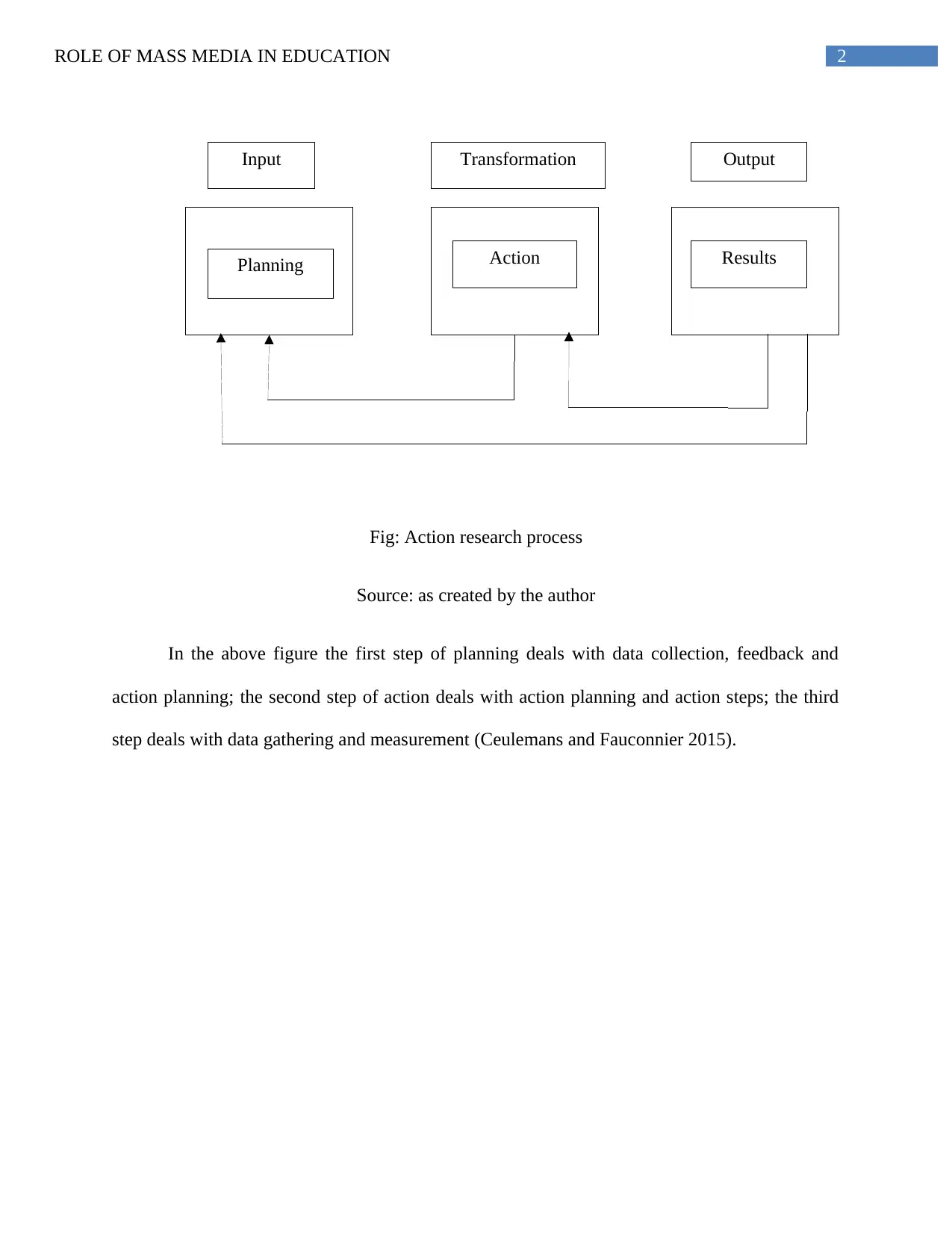
Input Transformation Output
Planning Action Results
Fig: Action research process
Source: as created by the author
In the above figure the first step of planning deals with data collection, feedback and
action planning; the second step of action deals with action planning and action steps; the third
step deals with data gathering and measurement (Ceulemans and Fauconnier 2015).
Input Transformation Output
Planning Action Results
Fig: Action research process
Source: as created by the author
In the above figure the first step of planning deals with data collection, feedback and
action planning; the second step of action deals with action planning and action steps; the third
step deals with data gathering and measurement (Ceulemans and Fauconnier 2015).
⊘ This is a preview!⊘
Do you want full access?
Subscribe today to unlock all pages.

Trusted by 1+ million students worldwide
3ROLE OF MASS MEDIA IN EDUCATION
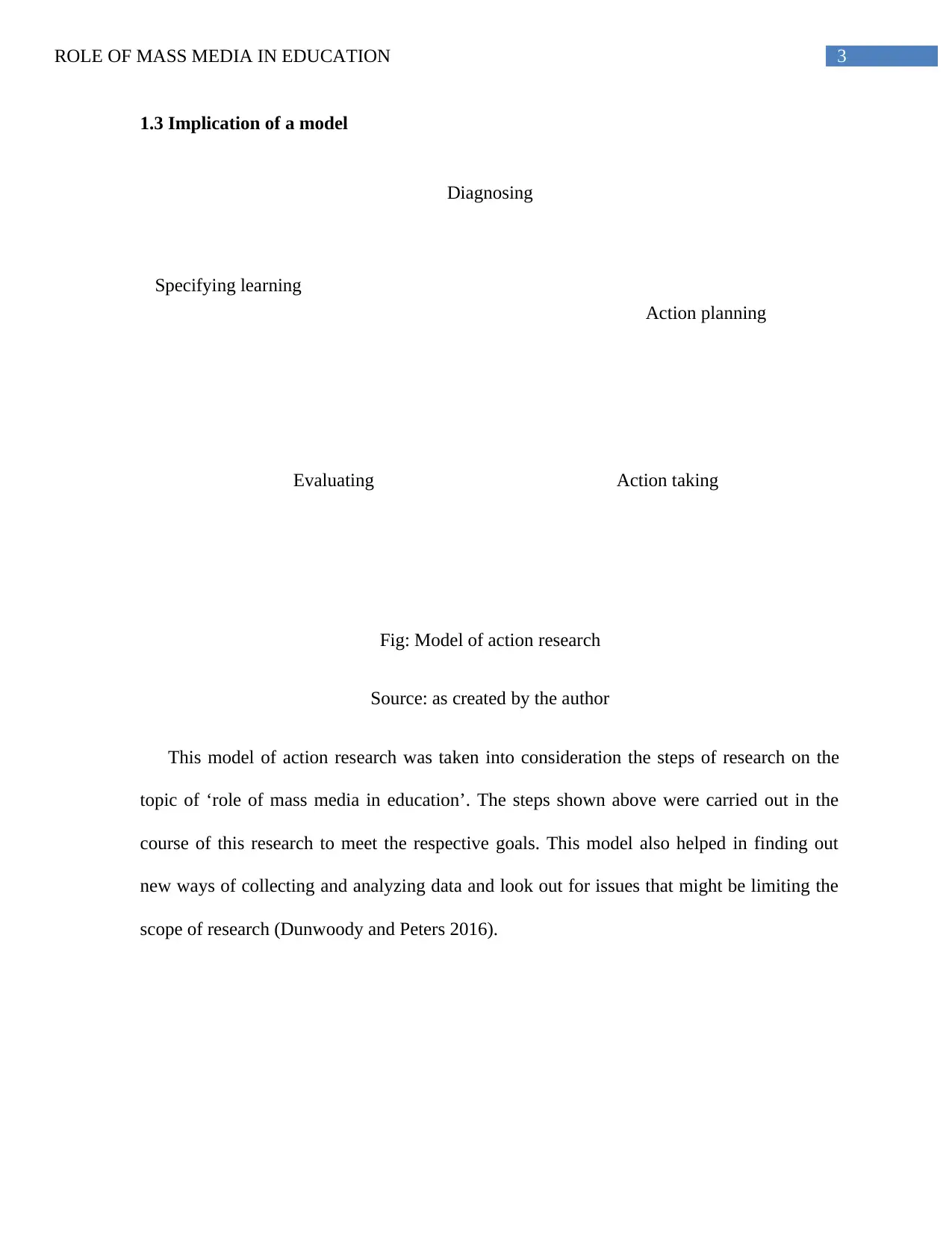
Diagnosing
Specifying learning
Evaluating Action taking
Action planning
1.3 Implication of a model
Fig: Model of action research
Source: as created by the author
This model of action research was taken into consideration the steps of research on the
topic of ‘role of mass media in education’. The steps shown above were carried out in the
course of this research to meet the respective goals. This model also helped in finding out
new ways of collecting and analyzing data and look out for issues that might be limiting the
scope of research (Dunwoody and Peters 2016).
Diagnosing
Specifying learning
Evaluating Action taking
Action planning
1.3 Implication of a model
Fig: Model of action research
Source: as created by the author
This model of action research was taken into consideration the steps of research on the
topic of ‘role of mass media in education’. The steps shown above were carried out in the
course of this research to meet the respective goals. This model also helped in finding out
new ways of collecting and analyzing data and look out for issues that might be limiting the
scope of research (Dunwoody and Peters 2016).
Paraphrase This Document
Need a fresh take? Get an instant paraphrase of this document with our AI Paraphraser
4ROLE OF MASS MEDIA IN EDUCATION
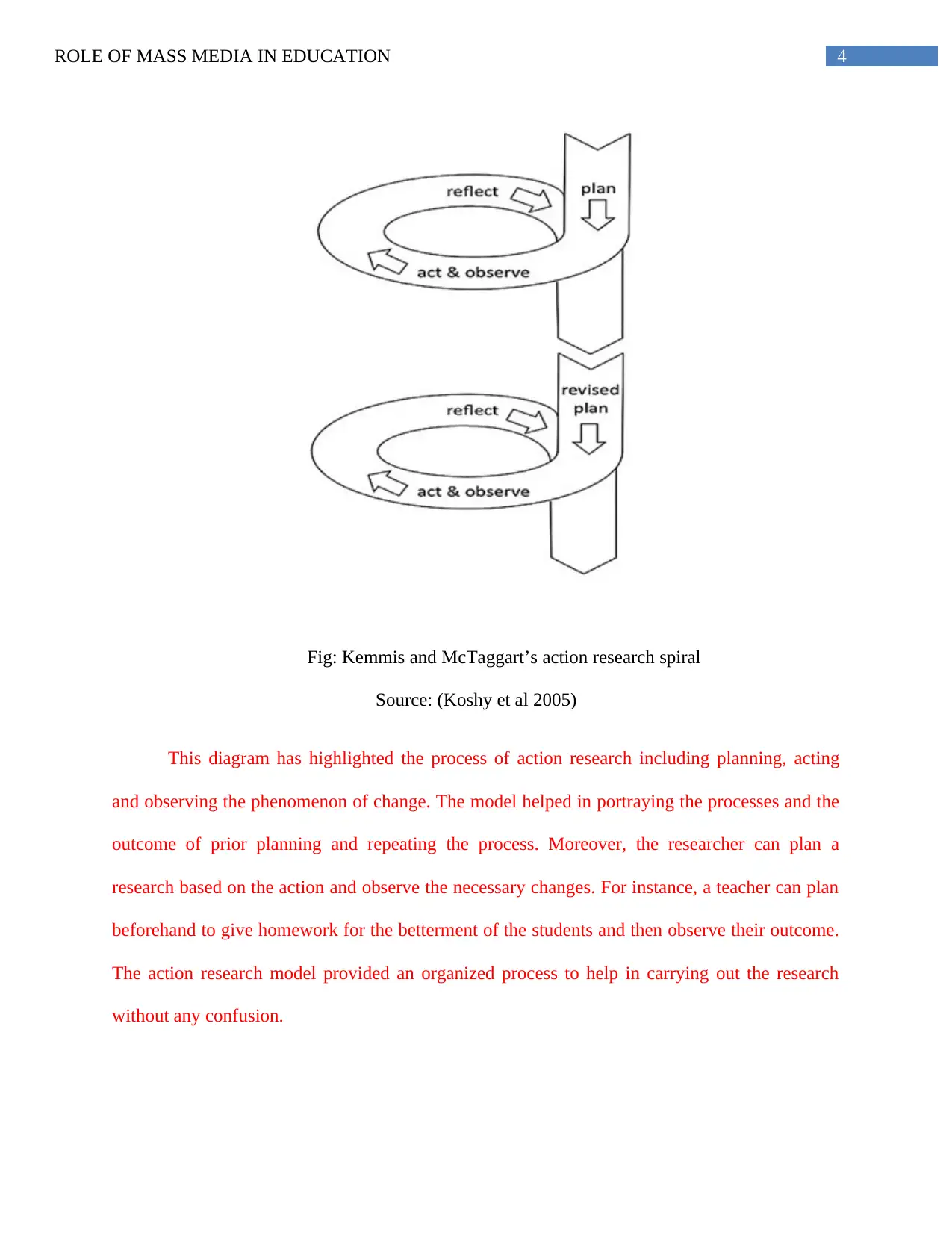
Fig: Kemmis and McTaggart’s action research spiral
Source: (Koshy et al 2005)
This diagram has highlighted the process of action research including planning, acting
and observing the phenomenon of change. The model helped in portraying the processes and the
outcome of prior planning and repeating the process. Moreover, the researcher can plan a
research based on the action and observe the necessary changes. For instance, a teacher can plan
beforehand to give homework for the betterment of the students and then observe their outcome.
The action research model provided an organized process to help in carrying out the research
without any confusion.
Fig: Kemmis and McTaggart’s action research spiral
Source: (Koshy et al 2005)
This diagram has highlighted the process of action research including planning, acting
and observing the phenomenon of change. The model helped in portraying the processes and the
outcome of prior planning and repeating the process. Moreover, the researcher can plan a
research based on the action and observe the necessary changes. For instance, a teacher can plan
beforehand to give homework for the betterment of the students and then observe their outcome.
The action research model provided an organized process to help in carrying out the research
without any confusion.
5ROLE OF MASS MEDIA IN EDUCATION
2. Initiate action research
2.1 Area of practice- impact of teacher learner communication
For conducting this research, ‘the impact of teacher- learner communication’ was
selected as the area of practice. While studying on this area of practice it was found out that
effective communication in the classroom acts as motivation for the students or learners (Hussein
2015). This topic was chosen because it is an emerging area in the field of education and need to
be focused. Moreover, communication forms the basis of relationship among the teachers and
learners; therefore, it needs to be researched upon for improvement.
2.2 Plan intervention strategy
An intervention strategy is designed to implement behavioral changes among an
individual or entire population (McCombs 2014). This strategy is helpful in achieving academic
excellence and progress in education as per the topic of this research. The researcher had planned
an intervention strategy to make the teachers and learners understand about the importance of
mass media in the field of education and the benefits that they will get by doing so. It was
proposed that the teacher should become a researcher to find out the reality and then they should
engage with the students to make them realize (Lewis 2015).
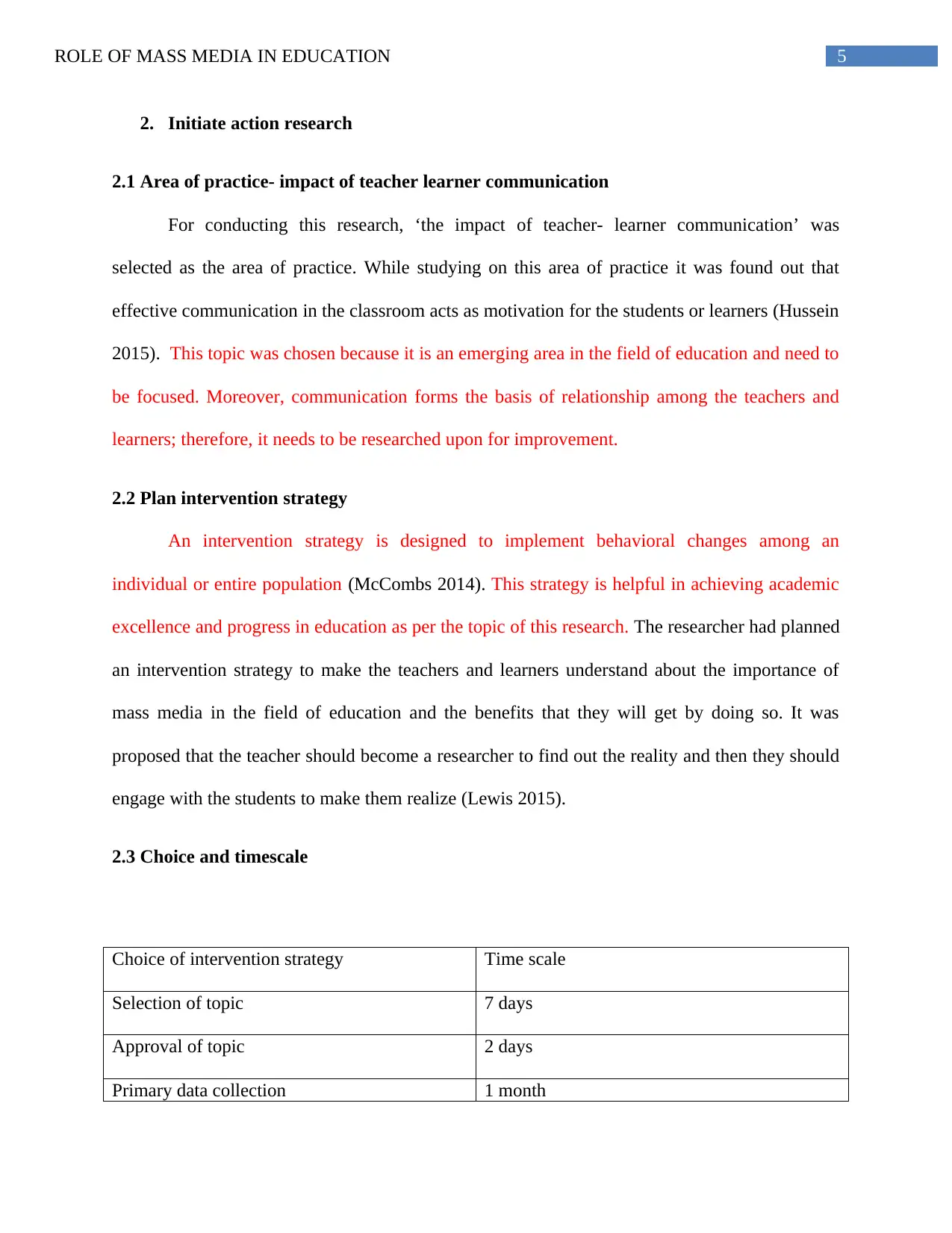
2.3 Choice and timescale
Choice of intervention strategy Time scale
Selection of topic 7 days
Approval of topic 2 days
Primary data collection 1 month
2. Initiate action research
2.1 Area of practice- impact of teacher learner communication
For conducting this research, ‘the impact of teacher- learner communication’ was
selected as the area of practice. While studying on this area of practice it was found out that
effective communication in the classroom acts as motivation for the students or learners (Hussein
2015). This topic was chosen because it is an emerging area in the field of education and need to
be focused. Moreover, communication forms the basis of relationship among the teachers and
learners; therefore, it needs to be researched upon for improvement.
2.2 Plan intervention strategy
An intervention strategy is designed to implement behavioral changes among an
individual or entire population (McCombs 2014). This strategy is helpful in achieving academic
excellence and progress in education as per the topic of this research. The researcher had planned
an intervention strategy to make the teachers and learners understand about the importance of
mass media in the field of education and the benefits that they will get by doing so. It was
proposed that the teacher should become a researcher to find out the reality and then they should
engage with the students to make them realize (Lewis 2015).
2.3 Choice and timescale
Choice of intervention strategy Time scale
Selection of topic 7 days
Approval of topic 2 days
Primary data collection 1 month
⊘ This is a preview!⊘
Do you want full access?
Subscribe today to unlock all pages.
Trusted by 1+ million students worldwide
6ROLE OF MASS MEDIA IN EDUCATION
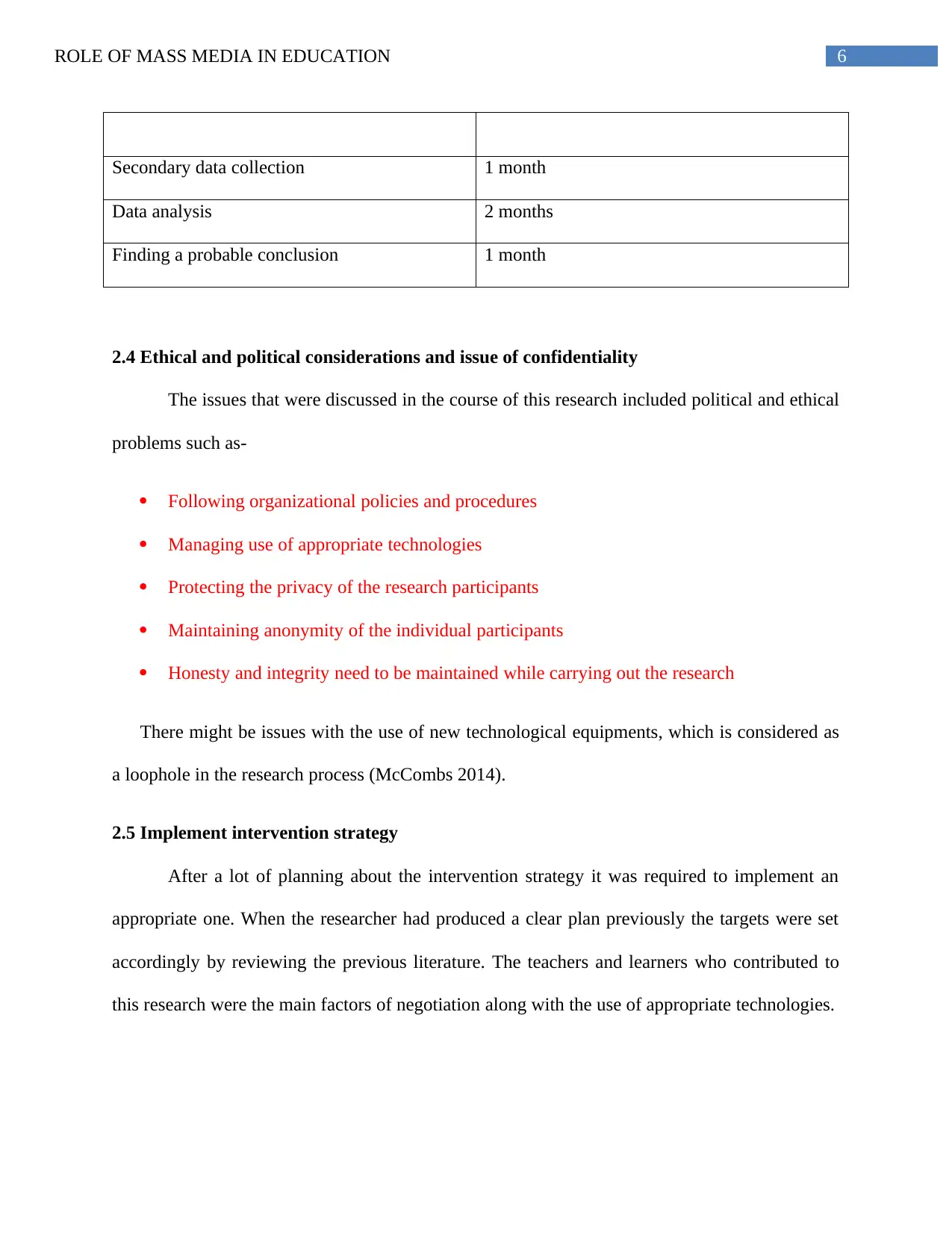
Secondary data collection 1 month
Data analysis 2 months
Finding a probable conclusion 1 month
2.4 Ethical and political considerations and issue of confidentiality
The issues that were discussed in the course of this research included political and ethical
problems such as-
Following organizational policies and procedures
Managing use of appropriate technologies
Protecting the privacy of the research participants
Maintaining anonymity of the individual participants
Honesty and integrity need to be maintained while carrying out the research
There might be issues with the use of new technological equipments, which is considered as
a loophole in the research process (McCombs 2014).
2.5 Implement intervention strategy
After a lot of planning about the intervention strategy it was required to implement an
appropriate one. When the researcher had produced a clear plan previously the targets were set
accordingly by reviewing the previous literature. The teachers and learners who contributed to
this research were the main factors of negotiation along with the use of appropriate technologies.
Secondary data collection 1 month
Data analysis 2 months
Finding a probable conclusion 1 month
2.4 Ethical and political considerations and issue of confidentiality
The issues that were discussed in the course of this research included political and ethical
problems such as-
Following organizational policies and procedures
Managing use of appropriate technologies
Protecting the privacy of the research participants
Maintaining anonymity of the individual participants
Honesty and integrity need to be maintained while carrying out the research
There might be issues with the use of new technological equipments, which is considered as
a loophole in the research process (McCombs 2014).
2.5 Implement intervention strategy
After a lot of planning about the intervention strategy it was required to implement an
appropriate one. When the researcher had produced a clear plan previously the targets were set
accordingly by reviewing the previous literature. The teachers and learners who contributed to
this research were the main factors of negotiation along with the use of appropriate technologies.
Paraphrase This Document
Need a fresh take? Get an instant paraphrase of this document with our AI Paraphraser
7ROLE OF MASS MEDIA IN EDUCATION
3. Understand ways to do research
3.1 Evaluate methods for research
For evaluating the research process that had focused on the ‘role of mass media in
communication’ there should be utilization of authentic and reliable data. The researcher had
been very careful while conducting his research because his look out was the willingness of the
participants in the process. There are certain factors such as biased information from the
participants which had to be corrected for maintaining the dependability on the collected data. At
the same time the researcher had also taken care that the data were relevant to the issues of
research and would be completed within the specific time frame (Mertens 2014).
3.2 Methods of data collection
For this particular research topic, both the methods of qualitative and quantitative data
collection were used. In order to collect qualitative data group discussions and individual
interviews were arranged by the researcher. The quantitative data was collected by surveying the
participants through questionnaire and online polls. Only close- ended questions were used in the
questionnaire for the convenience of the participants and maintaining the validity of the
response. Not only questions were asked through survey questionnaires but the researcher had
also conducted personal interview with the respondents. One hundred samples were chosen from
10 different educational institutions based on teaching. The samples were divided into 50
teachers and 50 learners. The qualitative data was based on the information and answers
provided by the respondents. The quantitative data was based on the number of respondents and
the rate of their response to the particular questions. Participant observation was also considered
in this research to find out the acceptance of the topic among them. The methods used for data
collection was also helpful in gathering a relevant conclusion of the issue.
3. Understand ways to do research
3.1 Evaluate methods for research
For evaluating the research process that had focused on the ‘role of mass media in
communication’ there should be utilization of authentic and reliable data. The researcher had
been very careful while conducting his research because his look out was the willingness of the
participants in the process. There are certain factors such as biased information from the
participants which had to be corrected for maintaining the dependability on the collected data. At
the same time the researcher had also taken care that the data were relevant to the issues of
research and would be completed within the specific time frame (Mertens 2014).
3.2 Methods of data collection
For this particular research topic, both the methods of qualitative and quantitative data
collection were used. In order to collect qualitative data group discussions and individual
interviews were arranged by the researcher. The quantitative data was collected by surveying the
participants through questionnaire and online polls. Only close- ended questions were used in the
questionnaire for the convenience of the participants and maintaining the validity of the
response. Not only questions were asked through survey questionnaires but the researcher had
also conducted personal interview with the respondents. One hundred samples were chosen from
10 different educational institutions based on teaching. The samples were divided into 50
teachers and 50 learners. The qualitative data was based on the information and answers
provided by the respondents. The quantitative data was based on the number of respondents and
the rate of their response to the particular questions. Participant observation was also considered
in this research to find out the acceptance of the topic among them. The methods used for data
collection was also helpful in gathering a relevant conclusion of the issue.
8ROLE OF MASS MEDIA IN EDUCATION
3.3 Methods of data analysis
Statistical analysis was used to put together the quantitative data that was collected from
the participants. There were more than one methods used to collect data to keep a parity because
depending on only one source does not give a valid proof (Niederkrotenthaler et al. 2014). That
is why both primary and secondary data were collected in order to maintain the authenticity. The
data analysis was done by identifying the variables such as the issues in education and those
were related to the objective of the research to find the importance of mass media in education.
Triangulation method was used in the analysis of the research question from multiple points of
view. This was helpful in coming to a probable conclusion across several data sources.
4. Carrying out research
4.1 Selected literature
Previous literature such as journal article and books on similar kind of topics was reviewed to
find out what other researchers had to say. It was found out with the reviewing of literature that
most of the authors and researchers had one common concept. They had mentioned that if mass
media is used as a form of communication by the teachers then it becomes easy for the learners
to get accurate knowledge on the topic. The students are acquainted with the new technical
advancements, which help them in later life. The researcher collected information from the
book, Themes on education: Action research by Eileen Ferrance to gain knowledge on this
particular topic. This reading helped him to describe the process of action research by relating to
his own course of work.
3.3 Methods of data analysis
Statistical analysis was used to put together the quantitative data that was collected from
the participants. There were more than one methods used to collect data to keep a parity because
depending on only one source does not give a valid proof (Niederkrotenthaler et al. 2014). That
is why both primary and secondary data were collected in order to maintain the authenticity. The
data analysis was done by identifying the variables such as the issues in education and those
were related to the objective of the research to find the importance of mass media in education.
Triangulation method was used in the analysis of the research question from multiple points of
view. This was helpful in coming to a probable conclusion across several data sources.
4. Carrying out research
4.1 Selected literature
Previous literature such as journal article and books on similar kind of topics was reviewed to
find out what other researchers had to say. It was found out with the reviewing of literature that
most of the authors and researchers had one common concept. They had mentioned that if mass
media is used as a form of communication by the teachers then it becomes easy for the learners
to get accurate knowledge on the topic. The students are acquainted with the new technical
advancements, which help them in later life. The researcher collected information from the
book, Themes on education: Action research by Eileen Ferrance to gain knowledge on this
particular topic. This reading helped him to describe the process of action research by relating to
his own course of work.
⊘ This is a preview!⊘
Do you want full access?
Subscribe today to unlock all pages.
Trusted by 1+ million students worldwide
9ROLE OF MASS MEDIA IN EDUCATION
4.2 Selected methods
Among the different options available for action research, quantitative analysis can be
considered perfect, as there are a number of factors that need to be taken into account (Orkin
2014). The reason behind selecting quantitative analysis is that it is responsible for gathering
accurate data without any scope of biasness from the participants. This is because the occurrence
of biasness is more in qualitative analysis. There is not much scope of biasness in quantitative
analysis as it deals with number and graphs, which is accurate and authentic. Qualitative data
was selected to shed light upon the verbal words spoken by the respondents. The responses were
tallied with the previous literature by the research to find out any similarity or difference.
4.3 Collect data
Use of primary data Interviewing the participants and conducting
surveys
Use of secondary data Reviewing previous literature
Choosing multiple options for data analysis To keep authenticity
Selecting one appropriate method for data
analysis
To avoid biasness of information
Comparison of gathered information To check for drawbacks and look out for new
opportunities
4.4 Data analysis
The data collected from the participants and previous literature such as journal and books
were analyzed to come to a probable conclusion. Individual meetings with the teachers and
4.2 Selected methods
Among the different options available for action research, quantitative analysis can be
considered perfect, as there are a number of factors that need to be taken into account (Orkin
2014). The reason behind selecting quantitative analysis is that it is responsible for gathering
accurate data without any scope of biasness from the participants. This is because the occurrence
of biasness is more in qualitative analysis. There is not much scope of biasness in quantitative
analysis as it deals with number and graphs, which is accurate and authentic. Qualitative data
was selected to shed light upon the verbal words spoken by the respondents. The responses were
tallied with the previous literature by the research to find out any similarity or difference.
4.3 Collect data
Use of primary data Interviewing the participants and conducting
surveys
Use of secondary data Reviewing previous literature
Choosing multiple options for data analysis To keep authenticity
Selecting one appropriate method for data
analysis
To avoid biasness of information
Comparison of gathered information To check for drawbacks and look out for new
opportunities
4.4 Data analysis
The data collected from the participants and previous literature such as journal and books
were analyzed to come to a probable conclusion. Individual meetings with the teachers and
Paraphrase This Document
Need a fresh take? Get an instant paraphrase of this document with our AI Paraphraser
10ROLE OF MASS MEDIA IN EDUCATION
students focused on their interest to adapt new ways in the field of education (Palinkas et al.
2015).
4.5 Data presentation
The collected data was presented in different forms. The interviews and group discussions
were observed and recorded in AV form (Shekhar et al. 2018). The response received from the
participants were analyzed and presented in the form of graphs and statistics. The numerical
presentation was accurate to decimal points and portrayed in percentage form. This correct
calculation helped in determining a proper conclusion for the research topic (Silverman 2015).
4.6 Conclusion
It can be concluded from this research that mass media is important in the field of education.
As per the interview session with the teachers and the learners, it was clear that they were ready
to accept the change by using the tools of mass communication.
5. Research outcome
5.1 Own findings and conclusion
The researcher had also come to the same conclusion that it is a good idea to change as per
the contemporary needs of the society. With the use of mass media in education the opportunity
for the learners will increase to gain insight about the issues surrounding them.
5.2 Recommendation
Thus, it can be recommended at the end of the research that change should be implemented
by introducing mass media in the field of education. Relevant questions were set up but there
could have been more questions to extract detailed information from the participants. Moreover,
students focused on their interest to adapt new ways in the field of education (Palinkas et al.
2015).
4.5 Data presentation
The collected data was presented in different forms. The interviews and group discussions
were observed and recorded in AV form (Shekhar et al. 2018). The response received from the
participants were analyzed and presented in the form of graphs and statistics. The numerical
presentation was accurate to decimal points and portrayed in percentage form. This correct
calculation helped in determining a proper conclusion for the research topic (Silverman 2015).
4.6 Conclusion
It can be concluded from this research that mass media is important in the field of education.
As per the interview session with the teachers and the learners, it was clear that they were ready
to accept the change by using the tools of mass communication.
5. Research outcome
5.1 Own findings and conclusion
The researcher had also come to the same conclusion that it is a good idea to change as per
the contemporary needs of the society. With the use of mass media in education the opportunity
for the learners will increase to gain insight about the issues surrounding them.
5.2 Recommendation
Thus, it can be recommended at the end of the research that change should be implemented
by introducing mass media in the field of education. Relevant questions were set up but there
could have been more questions to extract detailed information from the participants. Moreover,
11ROLE OF MASS MEDIA IN EDUCATION
the number of samples could be increased in order to work on a wide range of data. This would
be beneficial in drawing a valid conclusion after researching on a broad area and considering
several other ways.
6. Practice evaluation
6.1 Effectiveness of own practice compared to action research
The researcher had focused on his own skills while conducting this study. He has
mentioned that he need to develop himself more in the field of research from next time in order
to do the work more accurately. He has also stated that he should have allotted more time in
doing the research work. Due to lack of time he could not gather data from a wide range of
sources which was a loophole in the research work. Moreover he was unable to invest time in
constructing some more questions which would enable in extracting more information from the
participants. Apart from that, he needed to be more specific in the area of research and the issues
that were attached to it.
6.2 Own strengths and areas of improvement
The researcher has very clearly stated his strengths and weakness, which are summarized
below-
Strengths:
The researcher was able to choose a very good topic which was approved at one go.
There were ample of information available and that is why gathering data was not a problem.
The questionnaire appropriate and relevant questions were set up. His extrovert nature helped
the number of samples could be increased in order to work on a wide range of data. This would
be beneficial in drawing a valid conclusion after researching on a broad area and considering
several other ways.
6. Practice evaluation
6.1 Effectiveness of own practice compared to action research
The researcher had focused on his own skills while conducting this study. He has
mentioned that he need to develop himself more in the field of research from next time in order
to do the work more accurately. He has also stated that he should have allotted more time in
doing the research work. Due to lack of time he could not gather data from a wide range of
sources which was a loophole in the research work. Moreover he was unable to invest time in
constructing some more questions which would enable in extracting more information from the
participants. Apart from that, he needed to be more specific in the area of research and the issues
that were attached to it.
6.2 Own strengths and areas of improvement
The researcher has very clearly stated his strengths and weakness, which are summarized
below-
Strengths:
The researcher was able to choose a very good topic which was approved at one go.
There were ample of information available and that is why gathering data was not a problem.
The questionnaire appropriate and relevant questions were set up. His extrovert nature helped
⊘ This is a preview!⊘
Do you want full access?
Subscribe today to unlock all pages.
Trusted by 1+ million students worldwide

1 out of 15


Related Documents


Your All-in-One AI-Powered Toolkit for Academic Success.
+13062052269
info@desklib.com
Available 24*7 on WhatsApp / Email
![[object Object]](/_next/static/media/star-bottom.7253800d.svg)
Unlock your academic potential
Copyright © 2020–2026 A2Z Services. All Rights Reserved. Developed and managed by ZUCOL.