Police Studies Essay

Verified

Added on  2019/09/23

|4
|780
|100
Essay
AI Summary
This essay assesses the Royal Newfoundland Constabulary's (RNC) adoption and implementation of a community policing model. The author argues that the RNC has successfully integrated this model, citing examples such as the establishment of a Community Oriented Policing Section (COPS) and the adoption of principles like decentralized decision-making and proactive problem-solving. The essay highlights the RNC's commitment to community partnerships, crime prevention, and improving the quality of life. References to relevant scholarly articles support the analysis, demonstrating the RNC's alignment with established community policing best practices. The essay concludes by summarizing the RNC's success in integrating community policing principles into its operational framework.

Document Page
Second Post-Police Studies
0
tabler-icon-diamond-filled.svg

Paraphrase This Document

Need a fresh take? Get an instant paraphrase of this document with our AI Paraphraser
Document Page
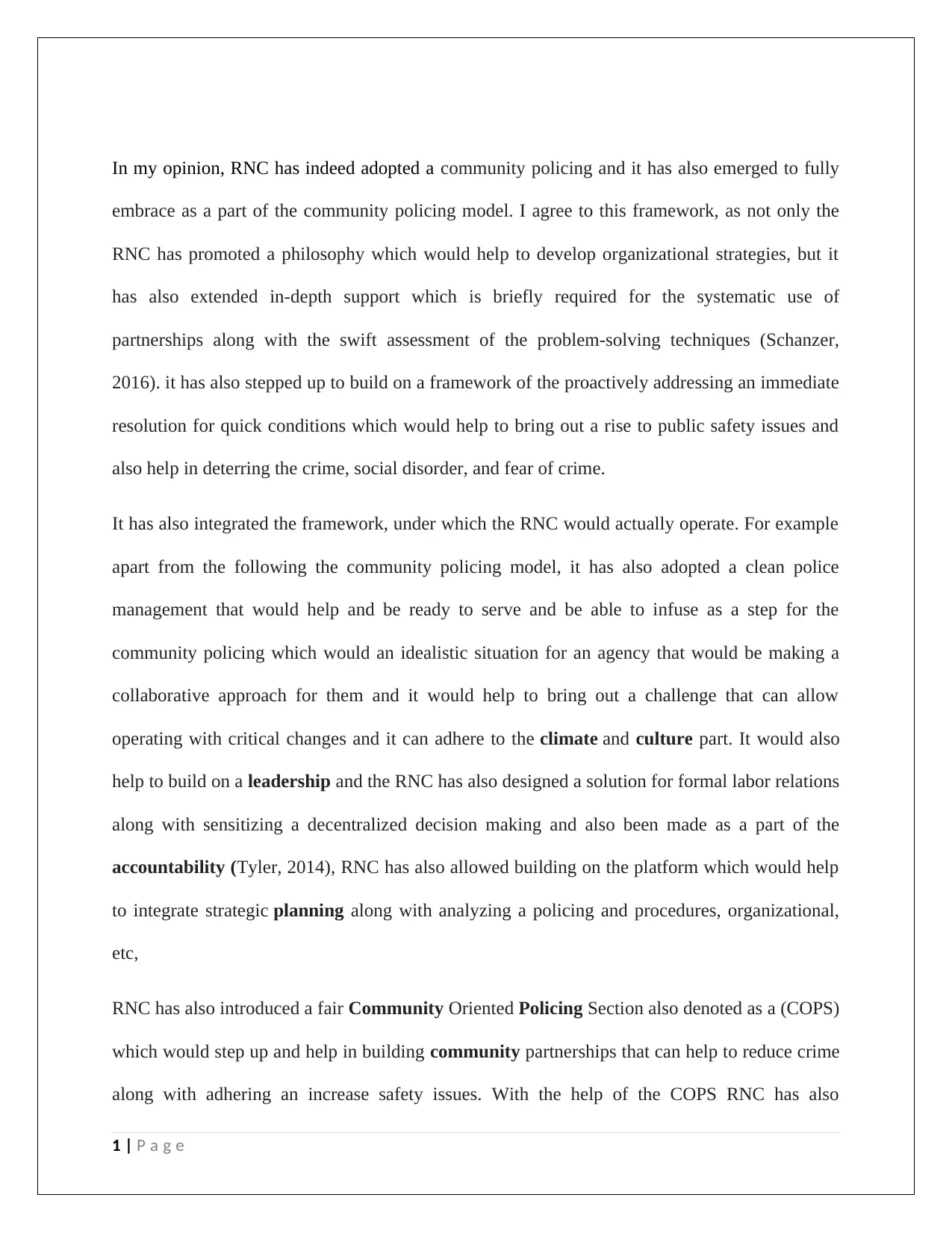
In my opinion, RNC has indeed adopted a community policing and it has also emerged to fully
embrace as a part of the community policing model. I agree to this framework, as not only the
RNC has promoted a philosophy which would help to develop organizational strategies, but it
has also extended in-depth support which is briefly required for the systematic use of
partnerships along with the swift assessment of the problem-solving techniques (Schanzer,
2016). it has also stepped up to build on a framework of the proactively addressing an immediate
resolution for quick conditions which would help to bring out a rise to public safety issues and
also help in deterring the crime, social disorder, and fear of crime.
It has also integrated the framework, under which the RNC would actually operate. For example
apart from the following the community policing model, it has also adopted a clean police
management that would help and be ready to serve and be able to infuse as a step for the
community policing which would an idealistic situation for an agency that would be making a
collaborative approach for them and it would help to bring out a challenge that can allow
operating with critical changes and it can adhere to the climate and culture part. It would also
help to build on a leadership and the RNC has also designed a solution for formal labor relations
along with sensitizing a decentralized decision making and also been made as a part of the
accountability (Tyler, 2014), RNC has also allowed building on the platform which would help
to integrate strategic planning along with analyzing a policing and procedures, organizational,
etc,
RNC has also introduced a fair Community Oriented Policing Section also denoted as a (COPS)
which would step up and help in building community partnerships that can help to reduce crime
along with adhering an increase safety issues. With the help of the COPS RNC has also
1 | P a g e
Document Page
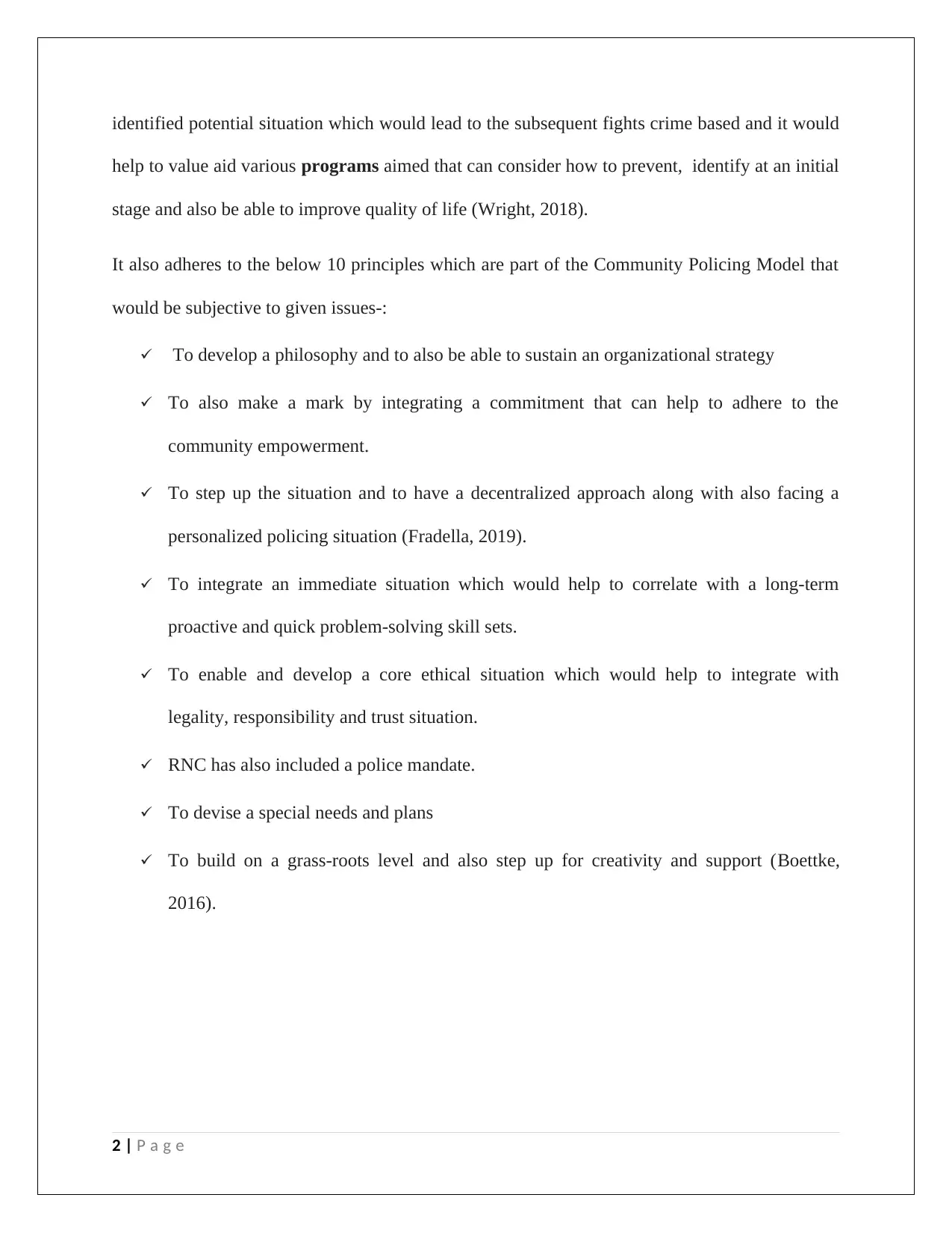
identified potential situation which would lead to the subsequent fights crime based and it would
help to value aid various programs aimed that can consider how to prevent, identify at an initial
stage and also be able to improve quality of life (Wright, 2018).
It also adheres to the below 10 principles which are part of the Community Policing Model that
would be subjective to given issues-:
To develop a philosophy and to also be able to sustain an organizational strategy
To also make a mark by integrating a commitment that can help to adhere to the
community empowerment.
To step up the situation and to have a decentralized approach along with also facing a
personalized policing situation (Fradella, 2019).
To integrate an immediate situation which would help to correlate with a long-term
proactive and quick problem-solving skill sets.
To enable and develop a core ethical situation which would help to integrate with
legality, responsibility and trust situation.
RNC has also included a police mandate.
To devise a special needs and plans
To build on a grass-roots level and also step up for creativity and support (Boettke,
2016).
2 | P a g e
Document Page
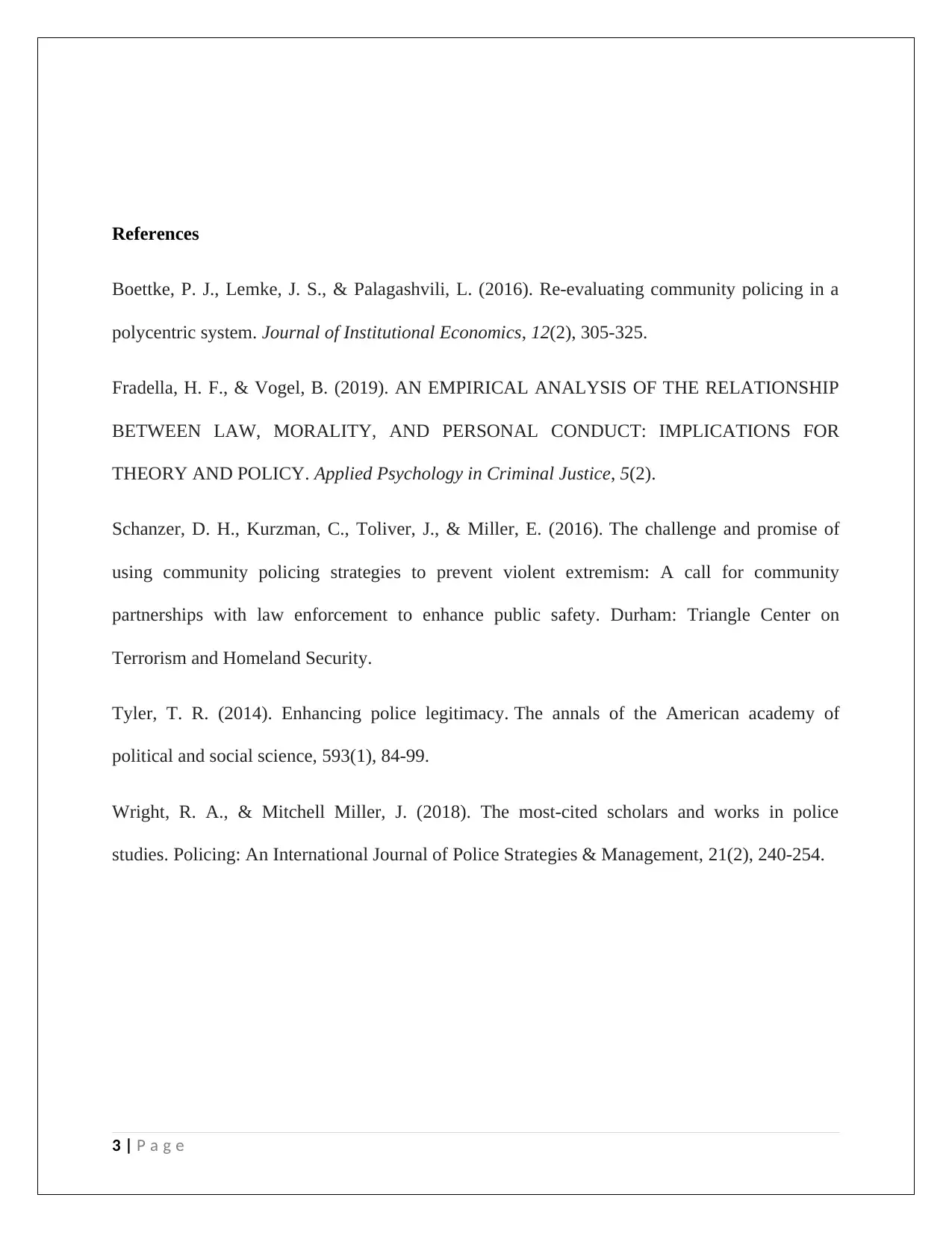
References
Boettke, P. J., Lemke, J. S., & Palagashvili, L. (2016). Re-evaluating community policing in a
polycentric system. Journal of Institutional Economics, 12(2), 305-325.
Fradella, H. F., & Vogel, B. (2019). AN EMPIRICAL ANALYSIS OF THE RELATIONSHIP
BETWEEN LAW, MORALITY, AND PERSONAL CONDUCT: IMPLICATIONS FOR
THEORY AND POLICY. Applied Psychology in Criminal Justice, 5(2).
Schanzer, D. H., Kurzman, C., Toliver, J., & Miller, E. (2016). The challenge and promise of
using community policing strategies to prevent violent extremism: A call for community
partnerships with law enforcement to enhance public safety. Durham: Triangle Center on
Terrorism and Homeland Security.
Tyler, T. R. (2014). Enhancing police legitimacy. The annals of the American academy of
political and social science, 593(1), 84-99.
Wright, R. A., & Mitchell Miller, J. (2018). The most-cited scholars and works in police
studies. Policing: An International Journal of Police Strategies & Management, 21(2), 240-254.
3 | P a g e
chevron_up_icon
1 out of 4
circle_padding
hide_on_mobile
zoom_out_icon
[object Object]