Strategic Management of Project: Straight Through Processing System
VerifiedAdded on 2019/10/18
|14
|3954
|61
Report
AI Summary
This report analyzes the strategic management of a Straight Through Processing (STP) system project within an investment bank, focusing on the implementation challenges and the application of Kotter's eight-step change management model. The author, experienced in payments and settlements, explores the transition from a manual T+3 trading settlement process to an automated STP system. The project faced significant resistance due to employee concerns about job security, highlighting the importance of effective change management. The report details the application of Kotter's model to address this resistance, emphasizing the need to create urgency, form a coalition, communicate a vision, and manage obstacles. It discusses the strengths of Kotter's model in facilitating phased implementation and minimizing resistance, offering insights into the strategic management of projects and the importance of considering human factors for successful project outcomes. The report reflects on the project implementation in reference to Kotter’s change model.

Straight Through Processing
Strategic Management of Project
Strategic Management of Project

Paraphrase This Document
Need a fresh take? Get an instant paraphrase of this document with our AI Paraphraser
Table of Contents
A. Student in Work Role............................................................................................................2
B. Unit Concepts and Principles (Selection of Relevant Concepts)..........................................3
C. Reflective Assessment: Ideas and Insights............................................................................7
D. Key learning points and actions..........................................................................................11
E. Critical reflection on the assignment process......................................................................12
References................................................................................................................................13
A. Student in Work Role............................................................................................................2
B. Unit Concepts and Principles (Selection of Relevant Concepts)..........................................3
C. Reflective Assessment: Ideas and Insights............................................................................7
D. Key learning points and actions..........................................................................................11
E. Critical reflection on the assignment process......................................................................12
References................................................................................................................................13
A. Student in Work Role
Strategic management of projects refers to selecting, nurturing, and delivering the projects
within the organization effectively. In other words, the strategic management is above generic
project management processes as it looks into the fitment of the entire project to the goals of
the organization and its long term impact. In the current paper, the author analyses the
implementation of Straight through Processing (STP) System within the organization. The
author has spent appreciable amount of time as head of payments and settlements. The author
was working as a senior associate settlement, in the investment bank as a team leader. The
responsibility was to make sure all transactions are complete without any error or delay. The
general focus of the author was to ensure that the organization is shaped and taken ahead in
coordination with the changing standards of the industry. The key focuses were management
of office settlement processes, management of documents related to on-boarding preparation
and issuance, handling client relationship management software and associated systems
within the organization. Also, the responsibility was to make sure all transactions related to
the department are completed without any delay or errors.
Straight through processing is a step towards improving the speed with which the financial
companies handle the everyday transactions. With the help of this process, the financial
organizations will be able to save their added effort of filling the same client information over
and over again during the settlement process (Simmons and Dalgleish, 2000). Through this
process, the information can be entered once into the system and can be passed over to the
other concerned parties at each stage. The organization which is under assessment uses T+3
trading settlement options, where T is the time the transaction was entered and 3 is the
number of days it takes before cash and other financial instruments exchange hands. It is
lengthy, time consuming, prone to errors and high risk due to the operational dependency on
Strategic management of projects refers to selecting, nurturing, and delivering the projects
within the organization effectively. In other words, the strategic management is above generic
project management processes as it looks into the fitment of the entire project to the goals of
the organization and its long term impact. In the current paper, the author analyses the
implementation of Straight through Processing (STP) System within the organization. The
author has spent appreciable amount of time as head of payments and settlements. The author
was working as a senior associate settlement, in the investment bank as a team leader. The
responsibility was to make sure all transactions are complete without any error or delay. The
general focus of the author was to ensure that the organization is shaped and taken ahead in
coordination with the changing standards of the industry. The key focuses were management
of office settlement processes, management of documents related to on-boarding preparation
and issuance, handling client relationship management software and associated systems
within the organization. Also, the responsibility was to make sure all transactions related to
the department are completed without any delay or errors.
Straight through processing is a step towards improving the speed with which the financial
companies handle the everyday transactions. With the help of this process, the financial
organizations will be able to save their added effort of filling the same client information over
and over again during the settlement process (Simmons and Dalgleish, 2000). Through this
process, the information can be entered once into the system and can be passed over to the
other concerned parties at each stage. The organization which is under assessment uses T+3
trading settlement options, where T is the time the transaction was entered and 3 is the
number of days it takes before cash and other financial instruments exchange hands. It is
lengthy, time consuming, prone to errors and high risk due to the operational dependency on
⊘ This is a preview!⊘
Do you want full access?
Subscribe today to unlock all pages.

Trusted by 1+ million students worldwide
manual data entry by employees.. In the T+3 process, employees manually enter and record
client and transaction data and follow-up further with the process. The entire T+3 process
takes three days to complete (Yang et al, 2014). However, the new system will eliminate the
need of human intervention and make the process smoother and a settlement can be
completed in one day. Automating the process also reduces the potential for costly errors that
increase the bank’s exposure to operational risk. The complete elimination of the human
intervention is not possible, but it can be reduced to minimum. This system will help in
streamlining the transaction processes at various checkpoints.
The company set out to implement the new system throughout the organization based on five
steps for implementing aproject: 1) imitation, 2) planning, 3) execution, 4) monitoring and
controlling, and 5) closure. The final goal of the project was the implementation of STP as
soon as possible, and the deadline defined for the project was six months. As for the various
aspects of the project, most of these were moving ahead appreciably well. The company had
a proper plan for the project, with the right scope, budget and necessary resources.
As the project progressed, the team found that some aspects of the project were more
challenging than initially anticipated. The main challenge was getting the cooperation of key
staff who were concerned that the new system will result into numerous job losses within the
company. There was little to no acceptance of the new system within the organization.
Despite the best laid plans, the project was not moving ahead due to the employee resistance.
After several weeks, this key issue was identified, and the team implemented an appropriate
change management process within the organization prior to moving ahead with the project.
The project manager had not anticipated the resistance and therefore did not plan for change
management.
client and transaction data and follow-up further with the process. The entire T+3 process
takes three days to complete (Yang et al, 2014). However, the new system will eliminate the
need of human intervention and make the process smoother and a settlement can be
completed in one day. Automating the process also reduces the potential for costly errors that
increase the bank’s exposure to operational risk. The complete elimination of the human
intervention is not possible, but it can be reduced to minimum. This system will help in
streamlining the transaction processes at various checkpoints.
The company set out to implement the new system throughout the organization based on five
steps for implementing aproject: 1) imitation, 2) planning, 3) execution, 4) monitoring and
controlling, and 5) closure. The final goal of the project was the implementation of STP as
soon as possible, and the deadline defined for the project was six months. As for the various
aspects of the project, most of these were moving ahead appreciably well. The company had
a proper plan for the project, with the right scope, budget and necessary resources.
As the project progressed, the team found that some aspects of the project were more
challenging than initially anticipated. The main challenge was getting the cooperation of key
staff who were concerned that the new system will result into numerous job losses within the
company. There was little to no acceptance of the new system within the organization.
Despite the best laid plans, the project was not moving ahead due to the employee resistance.
After several weeks, this key issue was identified, and the team implemented an appropriate
change management process within the organization prior to moving ahead with the project.
The project manager had not anticipated the resistance and therefore did not plan for change
management.
Paraphrase This Document
Need a fresh take? Get an instant paraphrase of this document with our AI Paraphraser
B. Unit Concepts and Principles (Selection of Relevant Concepts)
Having observed the project, it was clear that effective management of change within the
organization was required. The project manager failed to understand the need of project
stakeholders and took action that led to the project to fall flat. It was found that the employees
at the senior positions, who were assured that their jobs are secured, tried to participate
actively in the project implementation process. However, the mid-level and junior employees
considered the change a threat to their livelihood and thus backed out from cooperating with
the project team.
For the project to succeed, it was important that the employees reflect active participation to
the project. Their resistance required that the project manager revisit the entire project
implementation from the beginning to let the heat settle down. This led to the delayed project
implementation and thus impacted the defined project budget.
Here, citing the situation, it can be stated that the key challenge was an appropriate plan for
change management. A good change management, directed and supported by the senior
management, is necessary within an organization when a substantial number of employees
are likely to be impacted. Therefore, the author tried to narrow the focus of the study towards
change management in the STP System Project implementation.
Which concepts, principles, tools, techniques, models (MBA and wider research) apply
to this situation?
In the current project scenario, the project manager initiated the project appreciably well.
However, the failure to anticipate the need for appropriate change management delayed to the
project to an undefined duration. Therefore, the need of change management was of utmost
importance to the project’s success.
Having observed the project, it was clear that effective management of change within the
organization was required. The project manager failed to understand the need of project
stakeholders and took action that led to the project to fall flat. It was found that the employees
at the senior positions, who were assured that their jobs are secured, tried to participate
actively in the project implementation process. However, the mid-level and junior employees
considered the change a threat to their livelihood and thus backed out from cooperating with
the project team.
For the project to succeed, it was important that the employees reflect active participation to
the project. Their resistance required that the project manager revisit the entire project
implementation from the beginning to let the heat settle down. This led to the delayed project
implementation and thus impacted the defined project budget.
Here, citing the situation, it can be stated that the key challenge was an appropriate plan for
change management. A good change management, directed and supported by the senior
management, is necessary within an organization when a substantial number of employees
are likely to be impacted. Therefore, the author tried to narrow the focus of the study towards
change management in the STP System Project implementation.
Which concepts, principles, tools, techniques, models (MBA and wider research) apply
to this situation?
In the current project scenario, the project manager initiated the project appreciably well.
However, the failure to anticipate the need for appropriate change management delayed to the
project to an undefined duration. Therefore, the need of change management was of utmost
importance to the project’s success.
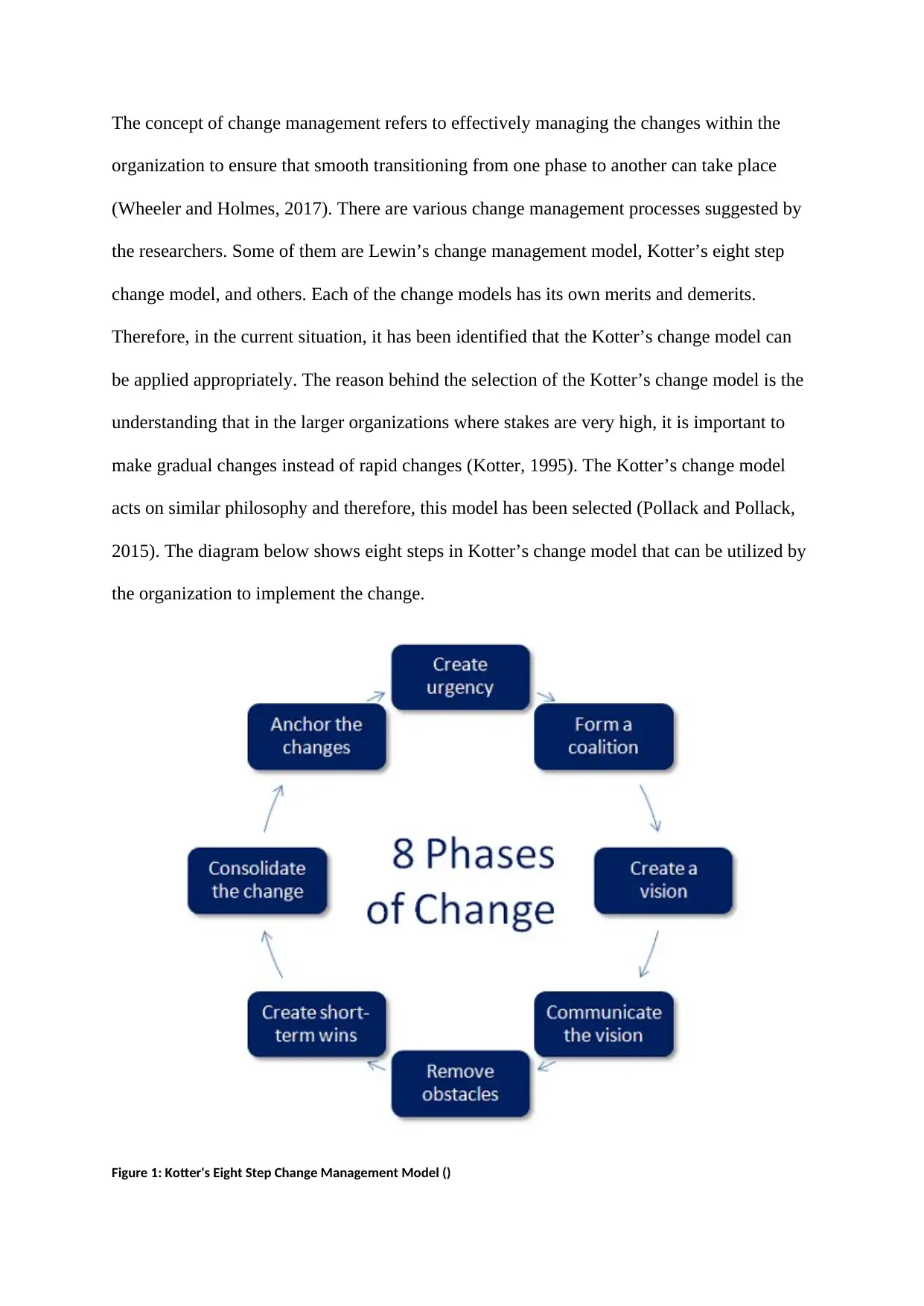
The concept of change management refers to effectively managing the changes within the
organization to ensure that smooth transitioning from one phase to another can take place
(Wheeler and Holmes, 2017). There are various change management processes suggested by
the researchers. Some of them are Lewin’s change management model, Kotter’s eight step
change model, and others. Each of the change models has its own merits and demerits.
Therefore, in the current situation, it has been identified that the Kotter’s change model can
be applied appropriately. The reason behind the selection of the Kotter’s change model is the
understanding that in the larger organizations where stakes are very high, it is important to
make gradual changes instead of rapid changes (Kotter, 1995). The Kotter’s change model
acts on similar philosophy and therefore, this model has been selected (Pollack and Pollack,
2015). The diagram below shows eight steps in Kotter’s change model that can be utilized by
the organization to implement the change.
Figure 1: Kotter's Eight Step Change Management Model ()
organization to ensure that smooth transitioning from one phase to another can take place
(Wheeler and Holmes, 2017). There are various change management processes suggested by
the researchers. Some of them are Lewin’s change management model, Kotter’s eight step
change model, and others. Each of the change models has its own merits and demerits.
Therefore, in the current situation, it has been identified that the Kotter’s change model can
be applied appropriately. The reason behind the selection of the Kotter’s change model is the
understanding that in the larger organizations where stakes are very high, it is important to
make gradual changes instead of rapid changes (Kotter, 1995). The Kotter’s change model
acts on similar philosophy and therefore, this model has been selected (Pollack and Pollack,
2015). The diagram below shows eight steps in Kotter’s change model that can be utilized by
the organization to implement the change.
Figure 1: Kotter's Eight Step Change Management Model ()
⊘ This is a preview!⊘
Do you want full access?
Subscribe today to unlock all pages.
Trusted by 1+ million students worldwide
In this change model, the Step 1 is to create the urgency among the employees regarding the
requirement of the change in the organization. This step suggests creating an environment
within the organization that reflect that for the survival of the company and everyone who is
working within the company, the change is necessary. The Step 2 is to form a coalition, that
is, the management is required to build one or two groups who can spread this idea
throughout the organization. This ensures that the environment towards change is maintained
(Wheeler and Holmes, 2017). The Step 3 is to prepare a vision that can be shared with the
organization. It is important that the need for change must be aligned with the future vision of
the company. This will help the employees to hold on to something.
The Step 4 is to communicate the vision to all the employees within the organization and
ensure that they are on the same page. It has been found that despite better communication of
vision, organizations can still face resistance at different corners of the organization. The Step
6 suggests removal of these obstacles through methods like pay increase, reputation build up,
and others. The Step 7 is to start implementing the change in a phased manner, and
incrementally observe the success rate. The Step 8 is to strengthen the change and take it
further. In the last step, the management is to anchor the change throughout the organization,
while keeping in consideration previous steps.
What is the strength of these concepts and principles?
The strength of this concept is that it allows the management to make a phased
implementation of the project. It helps ensure the project’s success. If a project is found to be
successful at the first implementation phase, then it can be replicated throughout the
organization. Moreover, the Kotter’s step change management model helps the management
to appropriately manage the employees and minimise resistance. In addition, the model also
helps the management in handling uncooperative employees through various methods (Tan et
requirement of the change in the organization. This step suggests creating an environment
within the organization that reflect that for the survival of the company and everyone who is
working within the company, the change is necessary. The Step 2 is to form a coalition, that
is, the management is required to build one or two groups who can spread this idea
throughout the organization. This ensures that the environment towards change is maintained
(Wheeler and Holmes, 2017). The Step 3 is to prepare a vision that can be shared with the
organization. It is important that the need for change must be aligned with the future vision of
the company. This will help the employees to hold on to something.
The Step 4 is to communicate the vision to all the employees within the organization and
ensure that they are on the same page. It has been found that despite better communication of
vision, organizations can still face resistance at different corners of the organization. The Step
6 suggests removal of these obstacles through methods like pay increase, reputation build up,
and others. The Step 7 is to start implementing the change in a phased manner, and
incrementally observe the success rate. The Step 8 is to strengthen the change and take it
further. In the last step, the management is to anchor the change throughout the organization,
while keeping in consideration previous steps.
What is the strength of these concepts and principles?
The strength of this concept is that it allows the management to make a phased
implementation of the project. It helps ensure the project’s success. If a project is found to be
successful at the first implementation phase, then it can be replicated throughout the
organization. Moreover, the Kotter’s step change management model helps the management
to appropriately manage the employees and minimise resistance. In addition, the model also
helps the management in handling uncooperative employees through various methods (Tan et
Paraphrase This Document
Need a fresh take? Get an instant paraphrase of this document with our AI Paraphraser
al, 2016). If the current situation of the STP Project is considered, then it can be stated that
the project was facing resistance and the use of right change management techniques could
have reduced resistance. This is where the Kotter’s change model comes into picture.
The Kotter’s change management model also requires the active involvement of the senior
management to ensure that the right environment is built around the need for change. The
need for the involvement of the senior management creates an environment where employees
understand that something very important is under process and that it is necessary to take
place for the betterment of the whole organization (LeStage, 2015).
Another appreciable aspect of this model is that it does not require any major change in the
orientation of the management. The management will be able to implement the project
change throughout the organization within the same hierarchical process. The key is to ensure
that employees at all the levels within the organization accept the change that is to be made
within the organization. It is true that this model takes longer than usual time in comparison
to the other methods such as Lewin change model and others. However, this method ensures
that the implementation takes place gradually and effectively.
C. Reflective Assessment: Ideas and Insights
The use of change management methods within the project is an important element to ensure
that the project gets implemented successfully. As stated earlier, there are multiple
approaches that can be considered to implement the required changes within the organization.
However, based on the current situation of the organization, Kotter’s eight step model is
selected for the assessment. In this section, the situation of the organization at the time of the
project implementation will be assessed in reference to the Kotter’s change model. To ensure
that the project implementation takes place successfully, the company should have used the
change strategy. The change strategy requires that the project manager considers all the
the project was facing resistance and the use of right change management techniques could
have reduced resistance. This is where the Kotter’s change model comes into picture.
The Kotter’s change management model also requires the active involvement of the senior
management to ensure that the right environment is built around the need for change. The
need for the involvement of the senior management creates an environment where employees
understand that something very important is under process and that it is necessary to take
place for the betterment of the whole organization (LeStage, 2015).
Another appreciable aspect of this model is that it does not require any major change in the
orientation of the management. The management will be able to implement the project
change throughout the organization within the same hierarchical process. The key is to ensure
that employees at all the levels within the organization accept the change that is to be made
within the organization. It is true that this model takes longer than usual time in comparison
to the other methods such as Lewin change model and others. However, this method ensures
that the implementation takes place gradually and effectively.
C. Reflective Assessment: Ideas and Insights
The use of change management methods within the project is an important element to ensure
that the project gets implemented successfully. As stated earlier, there are multiple
approaches that can be considered to implement the required changes within the organization.
However, based on the current situation of the organization, Kotter’s eight step model is
selected for the assessment. In this section, the situation of the organization at the time of the
project implementation will be assessed in reference to the Kotter’s change model. To ensure
that the project implementation takes place successfully, the company should have used the
change strategy. The change strategy requires that the project manager considers all the
variables that are likely to impact the change or the variables on which the project will leave
impact after implementation. However, the project manager never considered the fact that
there can be anything like resistance within this company.
Step 1: Create Urgency
The first element while implementing the change is creation of urgency throughout the
organization. The company should have first identified the employees who are working
within the organization and then worked towards their motivation on building a sense of
urgent project implementation. This can be done by spreading the information that the
installation of new STP system is important for the future of the company. Instead of dry
message, the company management should have been called for to bring in some emotional
response (Wheeler and Wheeler, 2017). The employees should have been brought to the
belief that the implementation is of high priority else the company will be out of the business
due to the highly competitive market. The employees understand that their survival depends
on the survival of the company. This could have brought more support than challenges.
Step 2: Form a Coalition
The spreading of the information regarding change would have given enough hints about who
are with the change and who are against the change. The project manager, along with the
management, should have identified few key individuals or influencers who are with the
change and formed a group. The group should be formed by the employees of influence and
few corporate influencers should be brought from outside. This will give an added impact.
The responsibility of the group should be to keep the momentum of discussion regarding
change going throughout the organization. The increase in the level of discussion among the
employees about the positives of change will gradually impact those who are still confused
impact after implementation. However, the project manager never considered the fact that
there can be anything like resistance within this company.
Step 1: Create Urgency
The first element while implementing the change is creation of urgency throughout the
organization. The company should have first identified the employees who are working
within the organization and then worked towards their motivation on building a sense of
urgent project implementation. This can be done by spreading the information that the
installation of new STP system is important for the future of the company. Instead of dry
message, the company management should have been called for to bring in some emotional
response (Wheeler and Wheeler, 2017). The employees should have been brought to the
belief that the implementation is of high priority else the company will be out of the business
due to the highly competitive market. The employees understand that their survival depends
on the survival of the company. This could have brought more support than challenges.
Step 2: Form a Coalition
The spreading of the information regarding change would have given enough hints about who
are with the change and who are against the change. The project manager, along with the
management, should have identified few key individuals or influencers who are with the
change and formed a group. The group should be formed by the employees of influence and
few corporate influencers should be brought from outside. This will give an added impact.
The responsibility of the group should be to keep the momentum of discussion regarding
change going throughout the organization. The increase in the level of discussion among the
employees about the positives of change will gradually impact those who are still confused
⊘ This is a preview!⊘
Do you want full access?
Subscribe today to unlock all pages.
Trusted by 1+ million students worldwide
on whether the change is good for them (Wheeler and Holmes, 2017). With passing time,
most of the organization can be covered with this effort.
Step 3: Create a vision
The most important action the company should take while implementing the change in the
organization involves the vision for the change. It is obvious that when there will be news of
change within the organization, then the employees would want to something to hold on to
that can promise them better future prospects. This can only be achieved if the project
manager or the management promotes the project with a vision. The vision for the change in
this scenario can be the improvement in the work culture, improved bonuses, compensation,
and more learning. Vision can be composed of anything which is more likely to motivate the
employees towards the change. The vision should be clear, concise and easy to remember
(LeStage, 2015). The level of complexity in the vision might confuse the employees instead
of motivating them. In addition, it should be ensured that the interpretation of the vision
should be linear instead of varied as it can be construed differently by the different group of
employees and may poorly impact the effort of change management.
Step 4: Communicate the vision
It is important that the management spreads the vision throughout the organization. This
activity should not be a one day effort. It should continue with the help of coalition team. The
management and the team should ensure to conduct formal meetings to spread the vision. In
addition to this, the vision should be kept alive in informal discussions whether it is as a
water cooler discussion or discussion in the canteen (LeStage, 2015). The communication
should be subtle and not over-imposing; else it will leave a negative impression over the
employees. The team can use informal communication channels such as the internal blog
portal, and other subtle channels.
most of the organization can be covered with this effort.
Step 3: Create a vision
The most important action the company should take while implementing the change in the
organization involves the vision for the change. It is obvious that when there will be news of
change within the organization, then the employees would want to something to hold on to
that can promise them better future prospects. This can only be achieved if the project
manager or the management promotes the project with a vision. The vision for the change in
this scenario can be the improvement in the work culture, improved bonuses, compensation,
and more learning. Vision can be composed of anything which is more likely to motivate the
employees towards the change. The vision should be clear, concise and easy to remember
(LeStage, 2015). The level of complexity in the vision might confuse the employees instead
of motivating them. In addition, it should be ensured that the interpretation of the vision
should be linear instead of varied as it can be construed differently by the different group of
employees and may poorly impact the effort of change management.
Step 4: Communicate the vision
It is important that the management spreads the vision throughout the organization. This
activity should not be a one day effort. It should continue with the help of coalition team. The
management and the team should ensure to conduct formal meetings to spread the vision. In
addition to this, the vision should be kept alive in informal discussions whether it is as a
water cooler discussion or discussion in the canteen (LeStage, 2015). The communication
should be subtle and not over-imposing; else it will leave a negative impression over the
employees. The team can use informal communication channels such as the internal blog
portal, and other subtle channels.
Paraphrase This Document
Need a fresh take? Get an instant paraphrase of this document with our AI Paraphraser
Step 5: Remove Obstacles
It is quite obvious that not everyone within the organization will accept the change even after
the methods discussed above. In such situation, the management can take additional effort,
such as keeping such employees isolated from the rest of the group or providing them
monetary incentive to support the change (Grant, 2016). It should be ensured that the
management motivates such employees with the benefits that are desired by them. It is
possible that some will find money as the motivating factor, while others will be happy with
something else. Reshuffling the entire employee groups’ sitting pattern in a manner that few
resisting employees are surrounded by agreeing groups can bring the expected change.
Step 6: Create short-term wins
After ensuring that the environment to make the changes is ripe, the project manager should
move ahead with the change. However, the project manager should make one small change at
a time, as the current organization is huge in size and making too many changes at once may
disrupt the entire process. Therefore, phased implementation is suggested (Grant, 2016). The
project manager should begin with the department or the section which is negligibly resisting
change and is smaller in size. In such department, there will be high probability of successful
implementation of the project. This short-term win will boost the morale of the entire project
team, and motivate them to go further.
Step 7: Consolidate the change
The management within the organization should keep on building on the changes that will
take place after the short wins. The vision should be communicated regularly, either formally
or informally. Otherwisethe employees might forget the changes and the resistances will
It is quite obvious that not everyone within the organization will accept the change even after
the methods discussed above. In such situation, the management can take additional effort,
such as keeping such employees isolated from the rest of the group or providing them
monetary incentive to support the change (Grant, 2016). It should be ensured that the
management motivates such employees with the benefits that are desired by them. It is
possible that some will find money as the motivating factor, while others will be happy with
something else. Reshuffling the entire employee groups’ sitting pattern in a manner that few
resisting employees are surrounded by agreeing groups can bring the expected change.
Step 6: Create short-term wins
After ensuring that the environment to make the changes is ripe, the project manager should
move ahead with the change. However, the project manager should make one small change at
a time, as the current organization is huge in size and making too many changes at once may
disrupt the entire process. Therefore, phased implementation is suggested (Grant, 2016). The
project manager should begin with the department or the section which is negligibly resisting
change and is smaller in size. In such department, there will be high probability of successful
implementation of the project. This short-term win will boost the morale of the entire project
team, and motivate them to go further.
Step 7: Consolidate the change
The management within the organization should keep on building on the changes that will
take place after the short wins. The vision should be communicated regularly, either formally
or informally. Otherwisethe employees might forget the changes and the resistances will
again resurface (Grant, 2016). The positive environment should be kept positive towards the
change until the all targeted changes are implemented.
Step 8: Anchor the changes
Another important element that should be kept in consideration is anchoring the changes. The
company can anchor the changes by ensuring those norms and values are brought into the
picture, which is important for the survival of the change. The management can promote the
deserving candidates, eliminate the rest, and modify the rewards structures to adjust to new
processes. The right training and development activities should be brought in the picture so
that the employees do not feel detached from the new system (Grant, 2016). All the other
processes, procedures, rules and policies that are likely to hinder the continuation of the new
changes should be removed.
D. Key learning points and actions
The major benefits of the consideration of change management within the STP project
implementation will be the smooth transitioning of the company from old processes to a
technologically-enhanced system that can grow and handle increased volume with more
speed, efficiency and accuracy. The change management can be a huge driver to ensure that
the changes made as per the requirements.
Changes need to be made
To successfully implement change management in the STP Project, the involvement of the
senior management in the change process is the first major change that has to be brought in
by the project manager (Huges, 2016). The rest of the changes will naturally follow after the
project manager details on the necessity of eight step model implementation to address the
current resistance. The key change at the organizational level is to bring the change in the
change until the all targeted changes are implemented.
Step 8: Anchor the changes
Another important element that should be kept in consideration is anchoring the changes. The
company can anchor the changes by ensuring those norms and values are brought into the
picture, which is important for the survival of the change. The management can promote the
deserving candidates, eliminate the rest, and modify the rewards structures to adjust to new
processes. The right training and development activities should be brought in the picture so
that the employees do not feel detached from the new system (Grant, 2016). All the other
processes, procedures, rules and policies that are likely to hinder the continuation of the new
changes should be removed.
D. Key learning points and actions
The major benefits of the consideration of change management within the STP project
implementation will be the smooth transitioning of the company from old processes to a
technologically-enhanced system that can grow and handle increased volume with more
speed, efficiency and accuracy. The change management can be a huge driver to ensure that
the changes made as per the requirements.
Changes need to be made
To successfully implement change management in the STP Project, the involvement of the
senior management in the change process is the first major change that has to be brought in
by the project manager (Huges, 2016). The rest of the changes will naturally follow after the
project manager details on the necessity of eight step model implementation to address the
current resistance. The key change at the organizational level is to bring the change in the
⊘ This is a preview!⊘
Do you want full access?
Subscribe today to unlock all pages.
Trusted by 1+ million students worldwide

1 out of 14


Related Documents


Your All-in-One AI-Powered Toolkit for Academic Success.
+13062052269
info@desklib.com
Available 24*7 on WhatsApp / Email
![[object Object]](/_next/static/media/star-bottom.7253800d.svg)
Unlock your academic potential
Copyright © 2020–2026 A2Z Services. All Rights Reserved. Developed and managed by ZUCOL.