Public Transport UK Website Design

Verified

Added on Ā 2019/09/19

|3
|530
|459
Project
AI Summary
This project requires the design of a website, "Public Transport UK (PTUK)", using an object-oriented approach and UML as the modeling language. Students must deliver five deliverables: a Use Case Diagram, a Conceptual Model (class diagram), a Use Case Text with an Activity Diagram, a Sequence Diagram, and a Design/Implementation Model (class diagram). Each deliverable focuses on a different aspect of the software development process, progressing from requirements gathering to design. The project emphasizes the use of UML tools for diagram creation and clear, readable diagrams. The deliverables are weighted equally, each contributing 20% to the final grade.
Document Page
Submission Date:
Please submit your report via the Digital
Dropbox on StudySpace.
tabler-icon-diamond-filled.svg

Paraphrase This Document

Need a fresh take? Get an instant paraphrase of this document with our AI Paraphraser
Document Page
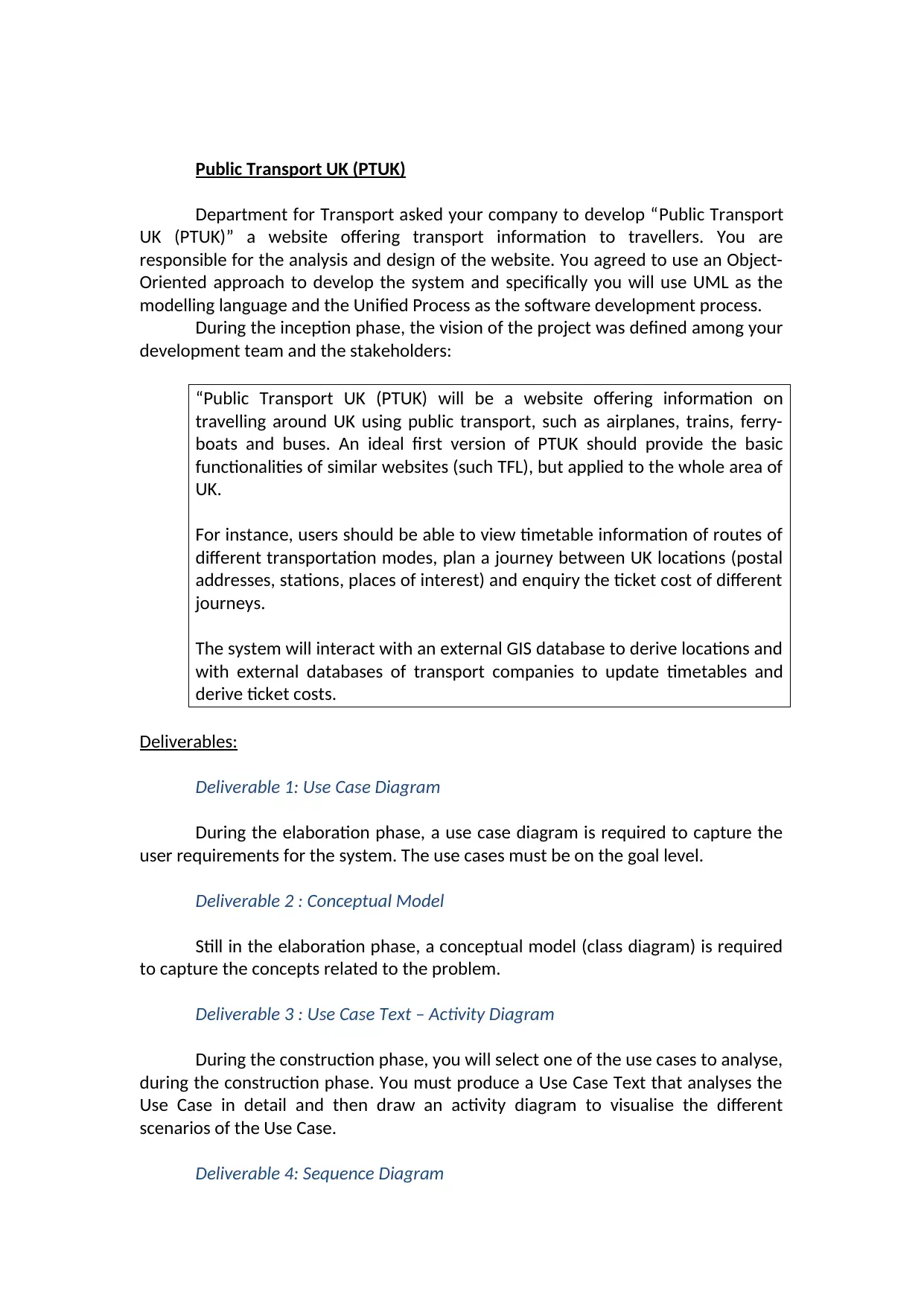
Public Transport UK (PTUK)
Department for Transport asked your company to develop ā€œPublic Transport
UK (PTUK)ā€ a website offering transport information to travellers. You are
responsible for the analysis and design of the website. You agreed to use an Object-
Oriented approach to develop the system and specifically you will use UML as the
modelling language and the Unified Process as the software development process.
During the inception phase, the vision of the project was defined among your
development team and the stakeholders:
ā€œPublic Transport UK (PTUK) will be a website offering information on
travelling around UK using public transport, such as airplanes, trains, ferry-
boats and buses. An ideal first version of PTUK should provide the basic
functionalities of similar websites (such TFL), but applied to the whole area of
UK.
For instance, users should be able to view timetable information of routes of
different transportation modes, plan a journey between UK locations (postal
addresses, stations, places of interest) and enquiry the ticket cost of different
journeys.
The system will interact with an external GIS database to derive locations and
with external databases of transport companies to update timetables and
derive ticket costs.
Deliverables:
Deliverable 1: Use Case Diagram
During the elaboration phase, a use case diagram is required to capture the
user requirements for the system. The use cases must be on the goal level.
Deliverable 2 : Conceptual Model
Still in the elaboration phase, a conceptual model (class diagram) is required
to capture the concepts related to the problem.
Deliverable 3 : Use Case Text – Activity Diagram
During the construction phase, you will select one of the use cases to analyse,
during the construction phase. You must produce a Use Case Text that analyses the
Use Case in detail and then draw an activity diagram to visualise the different
scenarios of the Use Case.
Deliverable 4: Sequence Diagram
Document Page
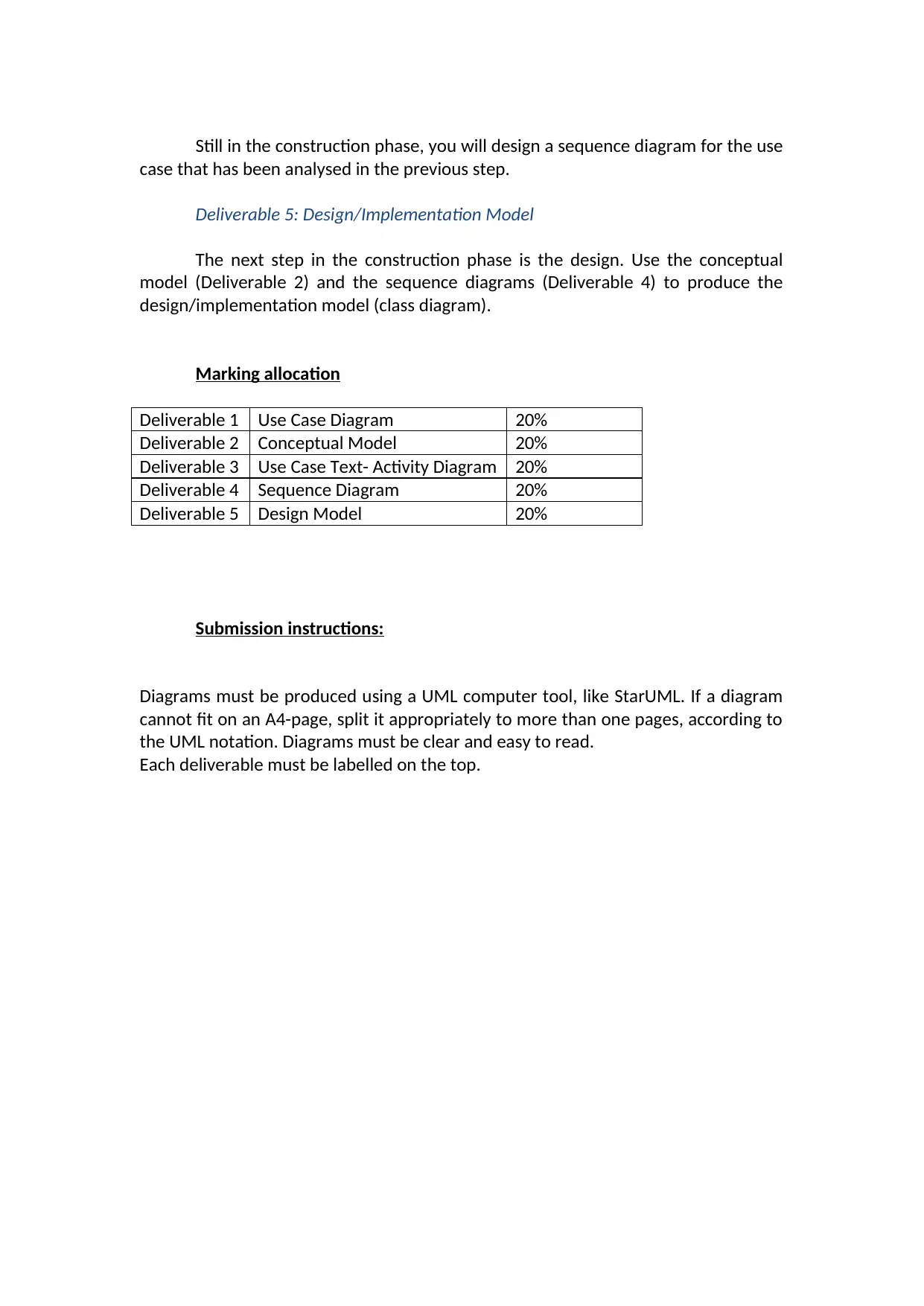
Still in the construction phase, you will design a sequence diagram for the use
case that has been analysed in the previous step.
Deliverable 5: Design/Implementation Model
The next step in the construction phase is the design. Use the conceptual
model (Deliverable 2) and the sequence diagrams (Deliverable 4) to produce the
design/implementation model (class diagram).
Marking allocation
Deliverable 1 Use Case Diagram 20%
Deliverable 2 Conceptual Model 20%
Deliverable 3 Use Case Text- Activity Diagram 20%
Deliverable 4 Sequence Diagram 20%
Deliverable 5 Design Model 20%
Submission instructions:
Diagrams must be produced using a UML computer tool, like StarUML. If a diagram
cannot fit on an A4-page, split it appropriately to more than one pages, according to
the UML notation. Diagrams must be clear and easy to read.
Each deliverable must be labelled on the top.
chevron_up_icon
1 out of 3
circle_padding
hide_on_mobile
zoom_out_icon
[object Object]