Comprehensive Report on Visitor Attraction Management Analysis
VerifiedAdded on 2024/06/11
|20
|5669
|236
Report
AI Summary
This report provides a comprehensive analysis of visitor attraction management within the tourism industry, highlighting the scope, importance, and development processes involved in establishing and managing visitor attractions. It delves into the different types of visitors, their motivations based on various tourist motivation theories, and the impacts of tourism on these attractions. The report further explores the potential issues affecting the development process and analyzes different visitor management strategies and techniques in relation to sustainability. It emphasizes the significance of understanding visitor needs, revitalizing areas, attracting new businesses, generating employment and revenues, and mitigating negative environmental and socio-cultural impacts to ensure the long-term success and sustainability of visitor attractions.
VISITOR ATTRACTION MANAGEMENT
1
1

Paraphrase This Document
Need a fresh take? Get an instant paraphrase of this document with our AI Paraphraser
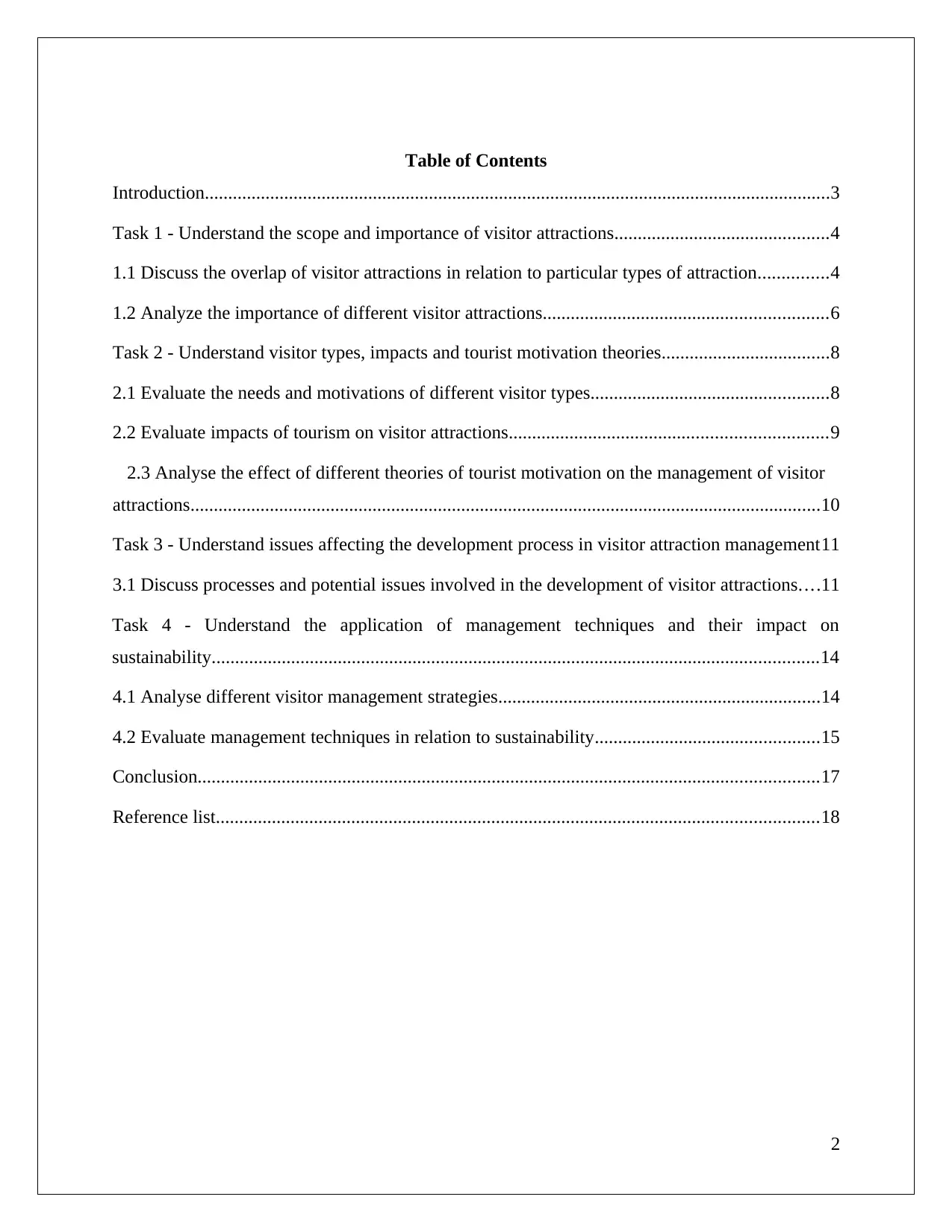
Table of Contents
Introduction......................................................................................................................................3
Task 1 - Understand the scope and importance of visitor attractions..............................................4
1.1 Discuss the overlap of visitor attractions in relation to particular types of attraction...............4
1.2 Analyze the importance of different visitor attractions.............................................................6
Task 2 - Understand visitor types, impacts and tourist motivation theories....................................8
2.1 Evaluate the needs and motivations of different visitor types...................................................8
2.2 Evaluate impacts of tourism on visitor attractions....................................................................9
2.3 Analyse the effect of different theories of tourist motivation on the management of visitor
attractions.......................................................................................................................................10
Task 3 - Understand issues affecting the development process in visitor attraction management11
3.1 Discuss processes and potential issues involved in the development of visitor attractions....11
Task 4 - Understand the application of management techniques and their impact on
sustainability..................................................................................................................................14
4.1 Analyse different visitor management strategies.....................................................................14
4.2 Evaluate management techniques in relation to sustainability................................................15
Conclusion.....................................................................................................................................17
Reference list.................................................................................................................................18
2
Introduction......................................................................................................................................3
Task 1 - Understand the scope and importance of visitor attractions..............................................4
1.1 Discuss the overlap of visitor attractions in relation to particular types of attraction...............4
1.2 Analyze the importance of different visitor attractions.............................................................6
Task 2 - Understand visitor types, impacts and tourist motivation theories....................................8
2.1 Evaluate the needs and motivations of different visitor types...................................................8
2.2 Evaluate impacts of tourism on visitor attractions....................................................................9
2.3 Analyse the effect of different theories of tourist motivation on the management of visitor
attractions.......................................................................................................................................10
Task 3 - Understand issues affecting the development process in visitor attraction management11
3.1 Discuss processes and potential issues involved in the development of visitor attractions....11
Task 4 - Understand the application of management techniques and their impact on
sustainability..................................................................................................................................14
4.1 Analyse different visitor management strategies.....................................................................14
4.2 Evaluate management techniques in relation to sustainability................................................15
Conclusion.....................................................................................................................................17
Reference list.................................................................................................................................18
2
Introduction
During the past decade, the travel and tourism industry has been one of the most rapidly growing
industries in the world. Tourists are now able to travel from one country to another country
without any hassle with the help of tour operators and various tourism companies that are
growing day by day at several tourist destinations around the globe. However, it is important for
every tour operator or every tourism company to focus on the management of visitor attraction.
One of the main factors that influences on the effectiveness and success of a tourism business is
the management of visitor attractions.
This report discusses about visitor attraction management. It discusses about factors and details
that highlights the development, management and nature of visitor attractions. It will be
highlighting the range as well as the significance of visitor attractions within the industry of
travel and tourism along with exploring the process of development establishment of new visitor
attractions. The report further moves on to exploring the various kinds of visitors, their different
impacts and the various theories for tourist motivation that acts as an aid for visitor attraction
management. It will also be investigating the different types of issues in management of visitor
attraction.
3
During the past decade, the travel and tourism industry has been one of the most rapidly growing
industries in the world. Tourists are now able to travel from one country to another country
without any hassle with the help of tour operators and various tourism companies that are
growing day by day at several tourist destinations around the globe. However, it is important for
every tour operator or every tourism company to focus on the management of visitor attraction.
One of the main factors that influences on the effectiveness and success of a tourism business is
the management of visitor attractions.
This report discusses about visitor attraction management. It discusses about factors and details
that highlights the development, management and nature of visitor attractions. It will be
highlighting the range as well as the significance of visitor attractions within the industry of
travel and tourism along with exploring the process of development establishment of new visitor
attractions. The report further moves on to exploring the various kinds of visitors, their different
impacts and the various theories for tourist motivation that acts as an aid for visitor attraction
management. It will also be investigating the different types of issues in management of visitor
attraction.
3
⊘ This is a preview!⊘
Do you want full access?
Subscribe today to unlock all pages.

Trusted by 1+ million students worldwide
Task 1 - Understand the scope and importance of visitor attractions
1.1 Discuss the overlap of visitor attractions in relation to particular types of attraction
Tourist attractions can be referred to as the
places of interest, which are visited by
tourists, usually for their respective
exhibited or inherent cultural or natural
value, built or natural beauty, historical
importance, adventure, amusement and
leisure offerings (Wang et al., 2016). The
tourist attractions in a destination are the
main reason or factor on which the volume
of tourists visiting the destination depends.
Every visitor has their own choice of
attraction and visits the destinations that
satisfy all their attractions. There are four
main types in which visitor attractions can
be categorized or classified.
However, these types of visitor attractions
are mostly face various kinds of overlaps
(Veal, 2017). This means that various types
of visitor attractions cover a part of the
similar area of interest or responsibility. The
knowledge on overlap of visitor attractions,
especially with reference to England, has
been developed while working as a Junior
Tourism Consultant for the company Visit
Britain. The overlap of visitor attractions in
relation with specific type of attractions can
be understood from the following discussion
-
Natural attractions - Natural
attractions can be referred to as the
attractions that have been created by
the nature itself (Pyke, 2016).
Natural attractions comprises of
waterfalls, seashores, caves and other
areas of scenic view, which have not
created by the man. For example, the
Lake District in UK is one of the
major natural attractions for tourists
visiting the country. However, when
this lake was formed, it was not
formed as a visitor attraction. The
Lake District now provides facilities
for tourists such as boating, which
are of major tourist attractions in
addition to enjoying the scenic
beauty of the lake. This is an
example of overlap of visitor
attractions in natural attractions.
4
1.1 Discuss the overlap of visitor attractions in relation to particular types of attraction
Tourist attractions can be referred to as the
places of interest, which are visited by
tourists, usually for their respective
exhibited or inherent cultural or natural
value, built or natural beauty, historical
importance, adventure, amusement and
leisure offerings (Wang et al., 2016). The
tourist attractions in a destination are the
main reason or factor on which the volume
of tourists visiting the destination depends.
Every visitor has their own choice of
attraction and visits the destinations that
satisfy all their attractions. There are four
main types in which visitor attractions can
be categorized or classified.
However, these types of visitor attractions
are mostly face various kinds of overlaps
(Veal, 2017). This means that various types
of visitor attractions cover a part of the
similar area of interest or responsibility. The
knowledge on overlap of visitor attractions,
especially with reference to England, has
been developed while working as a Junior
Tourism Consultant for the company Visit
Britain. The overlap of visitor attractions in
relation with specific type of attractions can
be understood from the following discussion
-
Natural attractions - Natural
attractions can be referred to as the
attractions that have been created by
the nature itself (Pyke, 2016).
Natural attractions comprises of
waterfalls, seashores, caves and other
areas of scenic view, which have not
created by the man. For example, the
Lake District in UK is one of the
major natural attractions for tourists
visiting the country. However, when
this lake was formed, it was not
formed as a visitor attraction. The
Lake District now provides facilities
for tourists such as boating, which
are of major tourist attractions in
addition to enjoying the scenic
beauty of the lake. This is an
example of overlap of visitor
attractions in natural attractions.
4
Paraphrase This Document
Need a fresh take? Get an instant paraphrase of this document with our AI Paraphraser
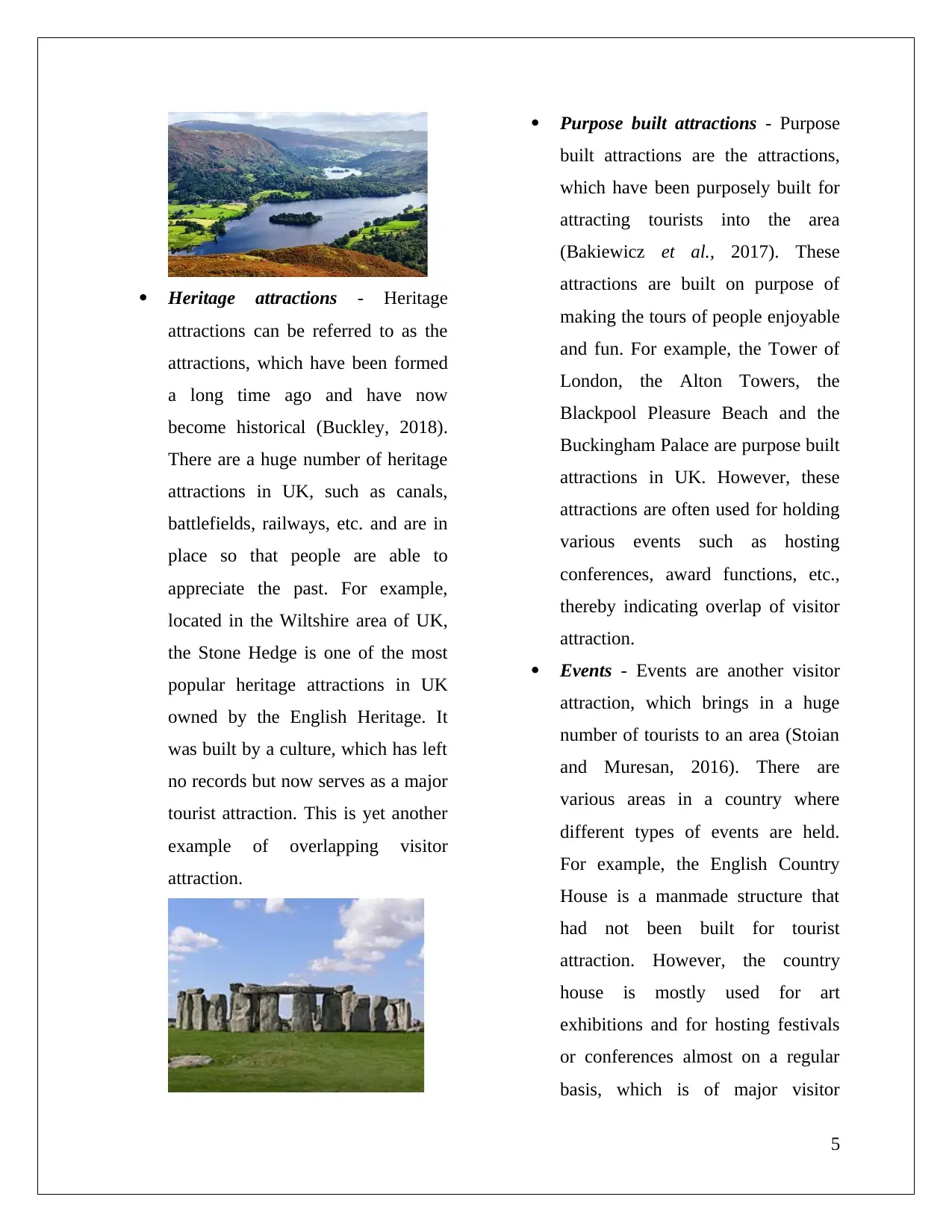
Heritage attractions - Heritage
attractions can be referred to as the
attractions, which have been formed
a long time ago and have now
become historical (Buckley, 2018).
There are a huge number of heritage
attractions in UK, such as canals,
battlefields, railways, etc. and are in
place so that people are able to
appreciate the past. For example,
located in the Wiltshire area of UK,
the Stone Hedge is one of the most
popular heritage attractions in UK
owned by the English Heritage. It
was built by a culture, which has left
no records but now serves as a major
tourist attraction. This is yet another
example of overlapping visitor
attraction.
Purpose built attractions - Purpose
built attractions are the attractions,
which have been purposely built for
attracting tourists into the area
(Bakiewicz et al., 2017). These
attractions are built on purpose of
making the tours of people enjoyable
and fun. For example, the Tower of
London, the Alton Towers, the
Blackpool Pleasure Beach and the
Buckingham Palace are purpose built
attractions in UK. However, these
attractions are often used for holding
various events such as hosting
conferences, award functions, etc.,
thereby indicating overlap of visitor
attraction.
Events - Events are another visitor
attraction, which brings in a huge
number of tourists to an area (Stoian
and Muresan, 2016). There are
various areas in a country where
different types of events are held.
For example, the English Country
House is a manmade structure that
had not been built for tourist
attraction. However, the country
house is mostly used for art
exhibitions and for hosting festivals
or conferences almost on a regular
basis, which is of major visitor
5
attractions can be referred to as the
attractions, which have been formed
a long time ago and have now
become historical (Buckley, 2018).
There are a huge number of heritage
attractions in UK, such as canals,
battlefields, railways, etc. and are in
place so that people are able to
appreciate the past. For example,
located in the Wiltshire area of UK,
the Stone Hedge is one of the most
popular heritage attractions in UK
owned by the English Heritage. It
was built by a culture, which has left
no records but now serves as a major
tourist attraction. This is yet another
example of overlapping visitor
attraction.
Purpose built attractions - Purpose
built attractions are the attractions,
which have been purposely built for
attracting tourists into the area
(Bakiewicz et al., 2017). These
attractions are built on purpose of
making the tours of people enjoyable
and fun. For example, the Tower of
London, the Alton Towers, the
Blackpool Pleasure Beach and the
Buckingham Palace are purpose built
attractions in UK. However, these
attractions are often used for holding
various events such as hosting
conferences, award functions, etc.,
thereby indicating overlap of visitor
attraction.
Events - Events are another visitor
attraction, which brings in a huge
number of tourists to an area (Stoian
and Muresan, 2016). There are
various areas in a country where
different types of events are held.
For example, the English Country
House is a manmade structure that
had not been built for tourist
attraction. However, the country
house is mostly used for art
exhibitions and for hosting festivals
or conferences almost on a regular
basis, which is of major visitor
5
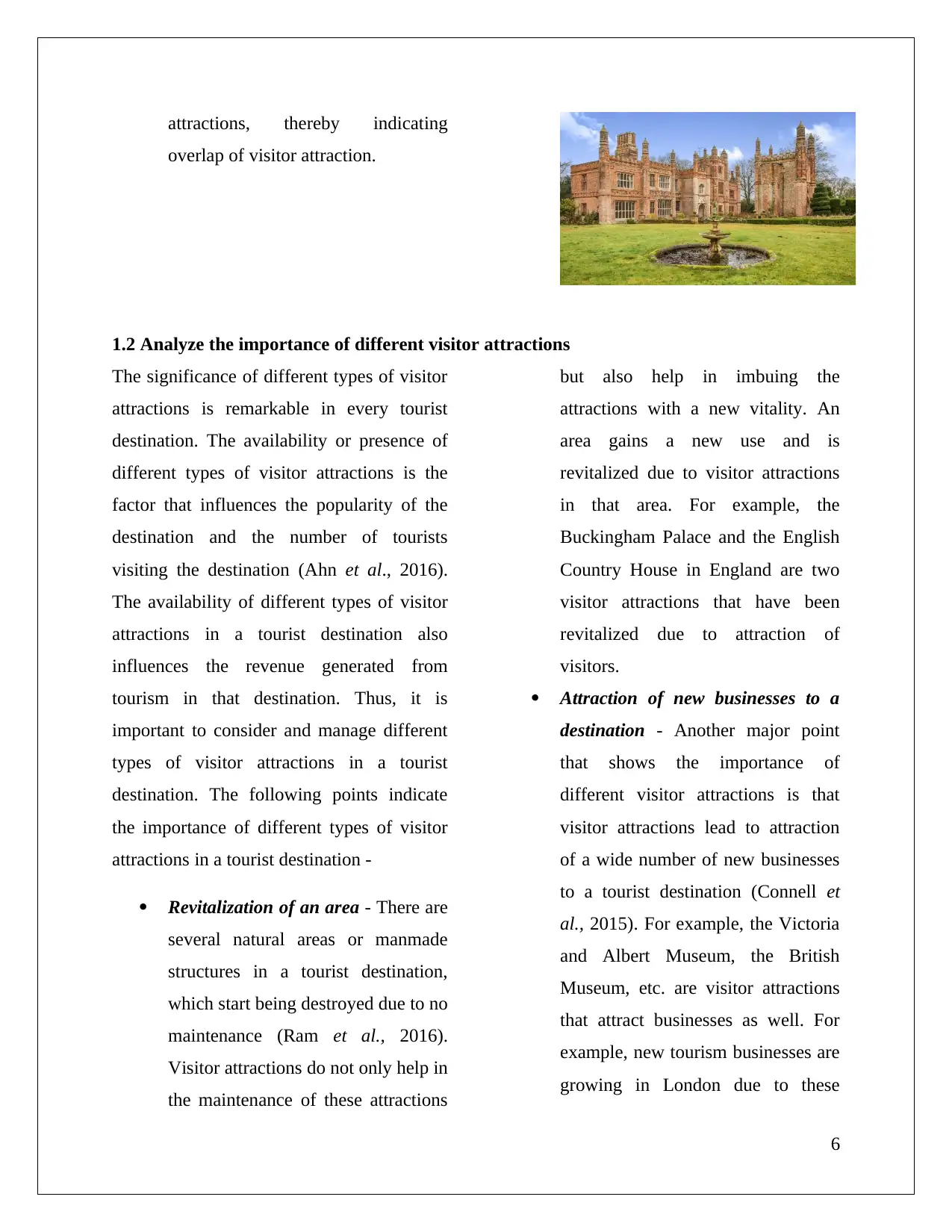
attractions, thereby indicating
overlap of visitor attraction.
1.2 Analyze the importance of different visitor attractions
The significance of different types of visitor
attractions is remarkable in every tourist
destination. The availability or presence of
different types of visitor attractions is the
factor that influences the popularity of the
destination and the number of tourists
visiting the destination (Ahn et al., 2016).
The availability of different types of visitor
attractions in a tourist destination also
influences the revenue generated from
tourism in that destination. Thus, it is
important to consider and manage different
types of visitor attractions in a tourist
destination. The following points indicate
the importance of different types of visitor
attractions in a tourist destination -
Revitalization of an area - There are
several natural areas or manmade
structures in a tourist destination,
which start being destroyed due to no
maintenance (Ram et al., 2016).
Visitor attractions do not only help in
the maintenance of these attractions
but also help in imbuing the
attractions with a new vitality. An
area gains a new use and is
revitalized due to visitor attractions
in that area. For example, the
Buckingham Palace and the English
Country House in England are two
visitor attractions that have been
revitalized due to attraction of
visitors.
Attraction of new businesses to a
destination - Another major point
that shows the importance of
different visitor attractions is that
visitor attractions lead to attraction
of a wide number of new businesses
to a tourist destination (Connell et
al., 2015). For example, the Victoria
and Albert Museum, the British
Museum, etc. are visitor attractions
that attract businesses as well. For
example, new tourism businesses are
growing in London due to these
6
overlap of visitor attraction.
1.2 Analyze the importance of different visitor attractions
The significance of different types of visitor
attractions is remarkable in every tourist
destination. The availability or presence of
different types of visitor attractions is the
factor that influences the popularity of the
destination and the number of tourists
visiting the destination (Ahn et al., 2016).
The availability of different types of visitor
attractions in a tourist destination also
influences the revenue generated from
tourism in that destination. Thus, it is
important to consider and manage different
types of visitor attractions in a tourist
destination. The following points indicate
the importance of different types of visitor
attractions in a tourist destination -
Revitalization of an area - There are
several natural areas or manmade
structures in a tourist destination,
which start being destroyed due to no
maintenance (Ram et al., 2016).
Visitor attractions do not only help in
the maintenance of these attractions
but also help in imbuing the
attractions with a new vitality. An
area gains a new use and is
revitalized due to visitor attractions
in that area. For example, the
Buckingham Palace and the English
Country House in England are two
visitor attractions that have been
revitalized due to attraction of
visitors.
Attraction of new businesses to a
destination - Another major point
that shows the importance of
different visitor attractions is that
visitor attractions lead to attraction
of a wide number of new businesses
to a tourist destination (Connell et
al., 2015). For example, the Victoria
and Albert Museum, the British
Museum, etc. are visitor attractions
that attract businesses as well. For
example, new tourism businesses are
growing in London due to these
6
⊘ This is a preview!⊘
Do you want full access?
Subscribe today to unlock all pages.
Trusted by 1+ million students worldwide
visitor attractions. Similarly, various
event management businesses are
growing in London for holding
events in these visitor attractions,
etc.
Generation of employment -
Another importance of visitor
attractions is the generation of
employment (Altinay et al., 2016).
This is because in order to visit these
visitor attractions, tourists often rely
on tour operators or guides, with the
help of whom they are able to gain
better knowledge on the places they
are visiting and have a better
experience, which in turn generates
employment. At the same time, the
various events, exhibitions, etc. held
in different visitor attractions also
generate employment in the area. For
example, the Tower of London, the
Piccadilly Square, the Trafalgar
Square, etc. are the visitor attractions
in London that end up generating
huge levels of employment in
London.
Generation of revenues - In addition
to the generation of employment,
visitor attractions play a vital role in
the generation of revenues as well
(Incera and Fernandez, 2015).
Visitor attractions generate revenues
for the various tour operators of a
tourist destination and the
government of the tourist
destination. For example, visitors
pay a fixed sum of money to tour
operators, leading of generation of
revenues for tour operators, which in
turn goes to the government of the
destination in the form of taxes. For
example, there are a large number of
visitor attractions in England, which
generate revenues for the country’s
economy.
7
event management businesses are
growing in London for holding
events in these visitor attractions,
etc.
Generation of employment -
Another importance of visitor
attractions is the generation of
employment (Altinay et al., 2016).
This is because in order to visit these
visitor attractions, tourists often rely
on tour operators or guides, with the
help of whom they are able to gain
better knowledge on the places they
are visiting and have a better
experience, which in turn generates
employment. At the same time, the
various events, exhibitions, etc. held
in different visitor attractions also
generate employment in the area. For
example, the Tower of London, the
Piccadilly Square, the Trafalgar
Square, etc. are the visitor attractions
in London that end up generating
huge levels of employment in
London.
Generation of revenues - In addition
to the generation of employment,
visitor attractions play a vital role in
the generation of revenues as well
(Incera and Fernandez, 2015).
Visitor attractions generate revenues
for the various tour operators of a
tourist destination and the
government of the tourist
destination. For example, visitors
pay a fixed sum of money to tour
operators, leading of generation of
revenues for tour operators, which in
turn goes to the government of the
destination in the form of taxes. For
example, there are a large number of
visitor attractions in England, which
generate revenues for the country’s
economy.
7
Paraphrase This Document
Need a fresh take? Get an instant paraphrase of this document with our AI Paraphraser
Task 2 - Understand visitor types, impacts and tourist motivation theories
2.1 Evaluate the needs and motivations of different visitor types
It is important for every tourism business to evaluate and realize the requirements and
motivations of various types of visitors. Visitor attractions in a tourist destination also depend on
the requirements and the motivations of the tourists visiting those destinations (Bond et al.,
2015). The following are the various needs and motivation of various types of visitors -
Incentive tourists - There are a percentage of tourists who are lucky enough to get
holiday packages as rewards from their companies of their good work and achievement
of targets that had been set by the companies. For example, various people get tour
packages of visiting London as their incentive.
Health or medical tourists - Medical tourists are the ones who travel from one
destination to another for seeking medical treatment. For example, the London Bridge
Hospital, the Royal London Hospital, etc. are famous for their medical treatment and
people from various parts of the world visit London for medical treatment.
Business tourists - The people travelling from one place to other for business purposes
are called business tourists. For example, UK is a hub for business and there are several
multinational corporations in the country such as Tesco, Marks and Spencer, HSBC, etc.,
due to which tourists from several parts of the globe travel to UK for business purpose.
Education tourists - People also travel to a destination for education purposes. For
example, UK is a center of education and contains various renowned universities and
colleges along with various historical places and monuments, due to which education
tourists in UK are also high in number.
Adventure tourists - Tourists looking for bizarre or unusual experiences are called
adventure tourists. For example, adventure tourists frequently visit UK as Scotland is a
major attraction for adventure tourists.
Leisure tourists - A large number of tourists travel in search of comfort, rejuvenation,
revitalization, and a break from their daily lives. These people are called leisure tourists.
8
2.1 Evaluate the needs and motivations of different visitor types
It is important for every tourism business to evaluate and realize the requirements and
motivations of various types of visitors. Visitor attractions in a tourist destination also depend on
the requirements and the motivations of the tourists visiting those destinations (Bond et al.,
2015). The following are the various needs and motivation of various types of visitors -
Incentive tourists - There are a percentage of tourists who are lucky enough to get
holiday packages as rewards from their companies of their good work and achievement
of targets that had been set by the companies. For example, various people get tour
packages of visiting London as their incentive.
Health or medical tourists - Medical tourists are the ones who travel from one
destination to another for seeking medical treatment. For example, the London Bridge
Hospital, the Royal London Hospital, etc. are famous for their medical treatment and
people from various parts of the world visit London for medical treatment.
Business tourists - The people travelling from one place to other for business purposes
are called business tourists. For example, UK is a hub for business and there are several
multinational corporations in the country such as Tesco, Marks and Spencer, HSBC, etc.,
due to which tourists from several parts of the globe travel to UK for business purpose.
Education tourists - People also travel to a destination for education purposes. For
example, UK is a center of education and contains various renowned universities and
colleges along with various historical places and monuments, due to which education
tourists in UK are also high in number.
Adventure tourists - Tourists looking for bizarre or unusual experiences are called
adventure tourists. For example, adventure tourists frequently visit UK as Scotland is a
major attraction for adventure tourists.
Leisure tourists - A large number of tourists travel in search of comfort, rejuvenation,
revitalization, and a break from their daily lives. These people are called leisure tourists.
8
The various beaches in UK, such as Brighton, Newquay, Chesil Beach, Bournemouth,
etc. are great attractions for leisure tourists.
2.2 Evaluate impacts of tourism on visitor attractions
Tourism often ends up having huge impacts on visitor attractions. There are several negative and
positive impacts of tourism, which affect visitor attractions. The impacts of tourism over visitor
attractions is as follows -
Environmental impacts - There are both negative and positive impacts on the
environment due to tourism (Dokulil, 2014). For example, the positive impacts of tourism
on environment that helps in improving visitor attractions are infrastructure
improvement, increase in environmental awareness among locals and tourists and
conservation and enhancement of natural areas. However, negative factors such as waste
disposal, water overuse and shortage, damage to nature and pollution often reduce visitor
attractions of a tourist destination. For example, increase in pollution in UK will damage
the tourist attraction spots in the country, thereby lowering visitor attraction.
Social and cultural impacts - Similar to environmental impacts, there are several cultural
and social impacts as well (Garcia et al., 2015). For example, the positive socio-cultural
impacts, such as cross culture exchange, improvement of quality of life, conservation of
cultural heritage, etc. is of great visitor attractions. However, congestion, overcrowding,
commercialization of heritage and culture, loss of authenticity, increase in crime, etc.
have negative impacts on visitor attractions as well. For example, in case of loss of
authenticity or commercialization of culture in UK, the visitor attractions in UK will be
decreasing.
Economic impacts - The positive economic impacts of tourism are rise in income,
generation of employment, increasing government revenues and taxes, increase in foreign
exchange, etc., which do not have negative impacts on visitor attraction (Mason, 2015).
However, there are several negative impacts of tourism as well, such as overdependence,
leakage and inflation, which influence visitor attractions. For example, in case of
inflation in UK, the attraction of visitors towards the country will reduce, as they have to
spend more due to inflation.
9
etc. are great attractions for leisure tourists.
2.2 Evaluate impacts of tourism on visitor attractions
Tourism often ends up having huge impacts on visitor attractions. There are several negative and
positive impacts of tourism, which affect visitor attractions. The impacts of tourism over visitor
attractions is as follows -
Environmental impacts - There are both negative and positive impacts on the
environment due to tourism (Dokulil, 2014). For example, the positive impacts of tourism
on environment that helps in improving visitor attractions are infrastructure
improvement, increase in environmental awareness among locals and tourists and
conservation and enhancement of natural areas. However, negative factors such as waste
disposal, water overuse and shortage, damage to nature and pollution often reduce visitor
attractions of a tourist destination. For example, increase in pollution in UK will damage
the tourist attraction spots in the country, thereby lowering visitor attraction.
Social and cultural impacts - Similar to environmental impacts, there are several cultural
and social impacts as well (Garcia et al., 2015). For example, the positive socio-cultural
impacts, such as cross culture exchange, improvement of quality of life, conservation of
cultural heritage, etc. is of great visitor attractions. However, congestion, overcrowding,
commercialization of heritage and culture, loss of authenticity, increase in crime, etc.
have negative impacts on visitor attractions as well. For example, in case of loss of
authenticity or commercialization of culture in UK, the visitor attractions in UK will be
decreasing.
Economic impacts - The positive economic impacts of tourism are rise in income,
generation of employment, increasing government revenues and taxes, increase in foreign
exchange, etc., which do not have negative impacts on visitor attraction (Mason, 2015).
However, there are several negative impacts of tourism as well, such as overdependence,
leakage and inflation, which influence visitor attractions. For example, in case of
inflation in UK, the attraction of visitors towards the country will reduce, as they have to
spend more due to inflation.
9
⊘ This is a preview!⊘
Do you want full access?
Subscribe today to unlock all pages.
Trusted by 1+ million students worldwide
2.3 Analyse the effect of different theories of tourist motivation on the management of
visitor attractions
There is a wide range of theories related to tourist motivation and each theory has its own impact
over the management of visitor attractions. The following are the two main theories of
motivating tourists and their respective impacts on visitor attraction management -
Responsible tourism - The responsible tourism refers to the type of tourism in which
tourism operations are conducted and consumed in a much responsible manner (Caruana
et al., 2014). This theory of tourist motivation focuses of minimizing the negative
economic, environmental and social impacts of tourism. However, this theory of tourism
has considerable impacts on visitor attractions management. For example, visitor
attraction management becomes easier in a destination, as responsible tourism leads to
the sustainability and preservation of visitor attractions such as natural areas, manmade
structures, natural resources, etc.
Smart consumer theory - The smart consumer theory refers to the theory of tourist
motivation, which describes and focuses over the increase in the reliance of tourist
destinations, the industries in the destination, and the tourists of the destination on the
different forms of ICT, which allow the transformation of massive volume of data into
value propositions (Gretzel et al., 2015). For example, in order to attract tourists to
visitor attractions in UK such as the Greenwich Park, British Museum, National
Maritime Museum, etc., the smart consumer theory is important to be adopted, as smart
customers are always keen towards visiting destinations that follow the smart consumer
theory. The use of smart consumer theory acts as a motivation for various tourists.
10
visitor attractions
There is a wide range of theories related to tourist motivation and each theory has its own impact
over the management of visitor attractions. The following are the two main theories of
motivating tourists and their respective impacts on visitor attraction management -
Responsible tourism - The responsible tourism refers to the type of tourism in which
tourism operations are conducted and consumed in a much responsible manner (Caruana
et al., 2014). This theory of tourist motivation focuses of minimizing the negative
economic, environmental and social impacts of tourism. However, this theory of tourism
has considerable impacts on visitor attractions management. For example, visitor
attraction management becomes easier in a destination, as responsible tourism leads to
the sustainability and preservation of visitor attractions such as natural areas, manmade
structures, natural resources, etc.
Smart consumer theory - The smart consumer theory refers to the theory of tourist
motivation, which describes and focuses over the increase in the reliance of tourist
destinations, the industries in the destination, and the tourists of the destination on the
different forms of ICT, which allow the transformation of massive volume of data into
value propositions (Gretzel et al., 2015). For example, in order to attract tourists to
visitor attractions in UK such as the Greenwich Park, British Museum, National
Maritime Museum, etc., the smart consumer theory is important to be adopted, as smart
customers are always keen towards visiting destinations that follow the smart consumer
theory. The use of smart consumer theory acts as a motivation for various tourists.
10
Paraphrase This Document
Need a fresh take? Get an instant paraphrase of this document with our AI Paraphraser
Task 3 - Understand issues affecting the development process in visitor attraction
management
3.1 Discuss processes and potential issues involved in the development of visitor attractions
As per the given case scenario, the London Resort Company Holdings Limited is planning to
establish a theme park “The London Resort”. However, establishing a theme part is not one-day
activity. The organization needs to follow a systematic process for completing the project
successfully. The process that is required to be followed for developing the project of The London
Resort to attract more visitors is stated below:
Step 1: The first step in the development process will be performing a feasibility study. In
order to perform the feasibility study, the managers need to analyze the project from
different perspectives like, demand, financial feasibility, resource requirements and
capacity and availability of resources (Jensen et al., 2017). After identifying positive
result in this step, the next step will be started.
Step 2: The second step is designing the project and developing a concrete plan so that
the theme park can attract more visitors. The design and plan for the project must be
realistic and it must be done considering the demand and choice of the visitors.
Step 3: In the third step, the management of London Resort Company Holdings Limited
needs to inform the local community about this project and needs to approach the people in
the local community to take part in the project. This will help the company performing better
stakeholder management and if the local people get involved in the project, it will be easier
for the company to make the project more successful (Milman and Zehrer, 2017).
Step 4: In the 4th step, the management will be required to gather required resources like,
human resource, financial resource and other resources for starting the project. At this step,
the company will require recruiting skilled and knowledgeable people for the project (Jensen
et al., 2017).
Step 5: The fifth step will be execution of the plan. In this step, the theme park will be
constructed by using the plan and design that have been developed in step 2.
Step 6: After constructing the theme park, the management of the company will require
performing crowd management. At this step, the management will require developing
11
management
3.1 Discuss processes and potential issues involved in the development of visitor attractions
As per the given case scenario, the London Resort Company Holdings Limited is planning to
establish a theme park “The London Resort”. However, establishing a theme part is not one-day
activity. The organization needs to follow a systematic process for completing the project
successfully. The process that is required to be followed for developing the project of The London
Resort to attract more visitors is stated below:
Step 1: The first step in the development process will be performing a feasibility study. In
order to perform the feasibility study, the managers need to analyze the project from
different perspectives like, demand, financial feasibility, resource requirements and
capacity and availability of resources (Jensen et al., 2017). After identifying positive
result in this step, the next step will be started.
Step 2: The second step is designing the project and developing a concrete plan so that
the theme park can attract more visitors. The design and plan for the project must be
realistic and it must be done considering the demand and choice of the visitors.
Step 3: In the third step, the management of London Resort Company Holdings Limited
needs to inform the local community about this project and needs to approach the people in
the local community to take part in the project. This will help the company performing better
stakeholder management and if the local people get involved in the project, it will be easier
for the company to make the project more successful (Milman and Zehrer, 2017).
Step 4: In the 4th step, the management will be required to gather required resources like,
human resource, financial resource and other resources for starting the project. At this step,
the company will require recruiting skilled and knowledgeable people for the project (Jensen
et al., 2017).
Step 5: The fifth step will be execution of the plan. In this step, the theme park will be
constructed by using the plan and design that have been developed in step 2.
Step 6: After constructing the theme park, the management of the company will require
performing crowd management. At this step, the management will require developing
11
efficient strategies for providing better customer care (Milman and Zehrer, 2017).
Step 7: The seventh step will be arranging for reservations and ticketing. The higher
management will require developing proper rules and restrictions for reservations and
ticketing. This will help to manage the visitors efficiently.
Step 8: The last step will be maintaining proper internal and external communication system.
This is one of the important steps in the entire process of visitor attractive and development
of the theme park. This step will help to manage the entire process systematically.
Therefore, considering the above discussion, it can be stated that the process developing The London
Resort for visitor attraction will be much long. However, if the management follows this process,
visitor attraction will be easier for the company.
However, in this context, it is important to be mentioned that while developing this project, the
company may face some issues, which may create barrier for successful completion of the project.
The potential issues are as follows:
Location selection issues – This is one of the biggest issue that the company may face
while developing the theme park for better visitor attraction (Ballantyne et al., 2018). In
order to make the project successful, the management of London Resort Company
Holdings Limited needs to identify such a location that has natural view and healthy
atmosphere. However, in the current scenario, London is facing certain political issues
because of Brexit effects. At the same time, the country is also facing issue of terrorism.
These are creating barriers for attracting foreign visitors in UK. Moreover, developing the
theme park will require fulfilling wide range of rules and regulations regarding maintenance
of ecological environment, which may be also challenging to the firm.
Funding issue – This is another biggest issue that the company may face at the time of
developing the theme park for better visitor attraction. As this will be a large project, the
company will require arranging huge amount of money, which will be a problem for the
organization (Biraglia et al., 2017). However, the company may arrange the required funds
from different private and public financial institutions. However, in this context, it must be
kept in mind that the company will require to bear a certain percentage of cost for availing
funds from the external sources.
Stakeholder management – This is also an issue for the theme park project planned by
London Resort Company Holdings Limited. There will be wide number of stakeholders
12
Step 7: The seventh step will be arranging for reservations and ticketing. The higher
management will require developing proper rules and restrictions for reservations and
ticketing. This will help to manage the visitors efficiently.
Step 8: The last step will be maintaining proper internal and external communication system.
This is one of the important steps in the entire process of visitor attractive and development
of the theme park. This step will help to manage the entire process systematically.
Therefore, considering the above discussion, it can be stated that the process developing The London
Resort for visitor attraction will be much long. However, if the management follows this process,
visitor attraction will be easier for the company.
However, in this context, it is important to be mentioned that while developing this project, the
company may face some issues, which may create barrier for successful completion of the project.
The potential issues are as follows:
Location selection issues – This is one of the biggest issue that the company may face
while developing the theme park for better visitor attraction (Ballantyne et al., 2018). In
order to make the project successful, the management of London Resort Company
Holdings Limited needs to identify such a location that has natural view and healthy
atmosphere. However, in the current scenario, London is facing certain political issues
because of Brexit effects. At the same time, the country is also facing issue of terrorism.
These are creating barriers for attracting foreign visitors in UK. Moreover, developing the
theme park will require fulfilling wide range of rules and regulations regarding maintenance
of ecological environment, which may be also challenging to the firm.
Funding issue – This is another biggest issue that the company may face at the time of
developing the theme park for better visitor attraction. As this will be a large project, the
company will require arranging huge amount of money, which will be a problem for the
organization (Biraglia et al., 2017). However, the company may arrange the required funds
from different private and public financial institutions. However, in this context, it must be
kept in mind that the company will require to bear a certain percentage of cost for availing
funds from the external sources.
Stakeholder management – This is also an issue for the theme park project planned by
London Resort Company Holdings Limited. There will be wide number of stakeholders
12
⊘ This is a preview!⊘
Do you want full access?
Subscribe today to unlock all pages.
Trusted by 1+ million students worldwide

1 out of 20


Related Documents


Your All-in-One AI-Powered Toolkit for Academic Success.
+13062052269
info@desklib.com
Available 24*7 on WhatsApp / Email
![[object Object]](/_next/static/media/star-bottom.7253800d.svg)
Unlock your academic potential
Copyright © 2020–2025 A2Z Services. All Rights Reserved. Developed and managed by ZUCOL.