Analyzing Communication Structure and Hierarchy at Woolworths
VerifiedAdded on 2023/06/15
|13
|2795
|416
Report
AI Summary
This report provides an analysis of the communication structure within Woolworths, a major retail organization in Australia and New Zealand. It evaluates the communication hierarchy and structure through a survey conducted with 100 employees across various levels, examining leadership and management communication styles, team and group dynamics, the emotional climate of teams, and oral and written communication processes. The report also delves into intercultural communication policies and their impact on creating a supportive work environment. Key findings highlight a well-developed communication structure with a positive emotional climate, where team leaders are skilled in handling emotions and fostering transparent communication. The research identifies important factors such as intercultural communication policies, team dynamics, and leadership communication, emphasizing the significance of effective communication for product development, customer relations, and employee management. The report concludes with recommendations for improvement, including establishing clear expectations for employees and customers, conveying the impact of employee performance on the organization, and creating strong feedback mechanisms.
Running Head: COMMUNICATION STRUCTURE 1
Communication Structure
Communication Structure

Paraphrase This Document
Need a fresh take? Get an instant paraphrase of this document with our AI Paraphraser
Communication structure 2
Introduction
The present report is focused on Woolworths, a large Australian company with extensive retail
market in Australia and New Zealand. It is the second largest company in Australia and New
Zealand. The mission of the organization is to deliver the best in convenience, value and quality
for the customers. Currently, the organization has a team of 205,000 members which serve more
than 29 million customers, with different brands. It is a trusted business partner and has
collaborations with a large number of local manufacturers and farmers. The strategy of the
organization is to build a loyal customer base, and lead a store-led culture and team. The
organization proposes to become a lean retailer through system excellence. The primary aim of
the organization is to develop a retail team, which focusses on the customers, employees, as well
as the suppliers. The organization has developed a specific climate for hard work and integrity.
The company also provides opportunity for all the employees to grow within the organization as
most of the senior leaders have grown from the shop floor. The strategy of the organization is
focused on keeping the customers first. It has a diversified portfolio of business and includes
several large brands such as Big W, Quantium and ALH.
Each brand has separate board, which ensures delivery of high shareholder value. The business
strategy of the organization is focused on five fundamentals, including the development of one
team, refreshment stores, and, reducing the costs, develop cohesive brand and update product
offering. The company has built a trustworthy relationship with the partners, which is based on
three fundamentals, namely, collaboration, fairness and local sourcing of the products. All the
relationships with the suppliers are underpinned on the mutual trust (Papa, Daniels & Spiker,
2007). The company also engages in extensive market research to understand the needs of the
customers. Each of the store is fully stocked and the company’s brands are famous in all the
Introduction
The present report is focused on Woolworths, a large Australian company with extensive retail
market in Australia and New Zealand. It is the second largest company in Australia and New
Zealand. The mission of the organization is to deliver the best in convenience, value and quality
for the customers. Currently, the organization has a team of 205,000 members which serve more
than 29 million customers, with different brands. It is a trusted business partner and has
collaborations with a large number of local manufacturers and farmers. The strategy of the
organization is to build a loyal customer base, and lead a store-led culture and team. The
organization proposes to become a lean retailer through system excellence. The primary aim of
the organization is to develop a retail team, which focusses on the customers, employees, as well
as the suppliers. The organization has developed a specific climate for hard work and integrity.
The company also provides opportunity for all the employees to grow within the organization as
most of the senior leaders have grown from the shop floor. The strategy of the organization is
focused on keeping the customers first. It has a diversified portfolio of business and includes
several large brands such as Big W, Quantium and ALH.
Each brand has separate board, which ensures delivery of high shareholder value. The business
strategy of the organization is focused on five fundamentals, including the development of one
team, refreshment stores, and, reducing the costs, develop cohesive brand and update product
offering. The company has built a trustworthy relationship with the partners, which is based on
three fundamentals, namely, collaboration, fairness and local sourcing of the products. All the
relationships with the suppliers are underpinned on the mutual trust (Papa, Daniels & Spiker,
2007). The company also engages in extensive market research to understand the needs of the
customers. Each of the store is fully stocked and the company’s brands are famous in all the
Communication structure 3
households. The intra-organization communication is important in the success of the
organization. The communication structure of the organization is important in establishing the
communication in the organization.
Evaluation of the communication hierarchy and structure
The communication hierarchy and the structure are analyzed through the medium of a survey.
The survey has been conducted with 100 employees working in Australia. All the employees are
working at various hierarchy levels of the organization ranging from floor sales executive to sore
managers. The different kind of communication strategies and methods used in the company
significantly impacts on the service quality and the variety of services provided to the customers.
It develops the core competency of the organization as well as impacts on the profitability of the
organization.
Leadership and Management Communication Style
The communication is a significant medium, which can be used to influence the perception of
others towards self. All the great leaders are great speakers. Moreover, in contrast to the
personality traits, communication can be enhanced through training. The leadership influences
the internal public communication in an organization. The transformational leadership makes use
of the effective communication channels, employee satisfaction and symmetric communication
to transmit their message (Scott & Lewis, 2017). The use of face-to-face channels is highly
associated with the employee satisfaction. Moreover, most of the employees prefer getting
emails for receiving the information regarding the new decisions, policies, events, and changes.
In ideal situations, they should be followed by the employee meetings and the interpersonal
communication with the managers. The transformational leadership is a communication and
households. The intra-organization communication is important in the success of the
organization. The communication structure of the organization is important in establishing the
communication in the organization.
Evaluation of the communication hierarchy and structure
The communication hierarchy and the structure are analyzed through the medium of a survey.
The survey has been conducted with 100 employees working in Australia. All the employees are
working at various hierarchy levels of the organization ranging from floor sales executive to sore
managers. The different kind of communication strategies and methods used in the company
significantly impacts on the service quality and the variety of services provided to the customers.
It develops the core competency of the organization as well as impacts on the profitability of the
organization.
Leadership and Management Communication Style
The communication is a significant medium, which can be used to influence the perception of
others towards self. All the great leaders are great speakers. Moreover, in contrast to the
personality traits, communication can be enhanced through training. The leadership influences
the internal public communication in an organization. The transformational leadership makes use
of the effective communication channels, employee satisfaction and symmetric communication
to transmit their message (Scott & Lewis, 2017). The use of face-to-face channels is highly
associated with the employee satisfaction. Moreover, most of the employees prefer getting
emails for receiving the information regarding the new decisions, policies, events, and changes.
In ideal situations, they should be followed by the employee meetings and the interpersonal
communication with the managers. The transformational leadership is a communication and
⊘ This is a preview!⊘
Do you want full access?
Subscribe today to unlock all pages.

Trusted by 1+ million students worldwide
Communication structure 4
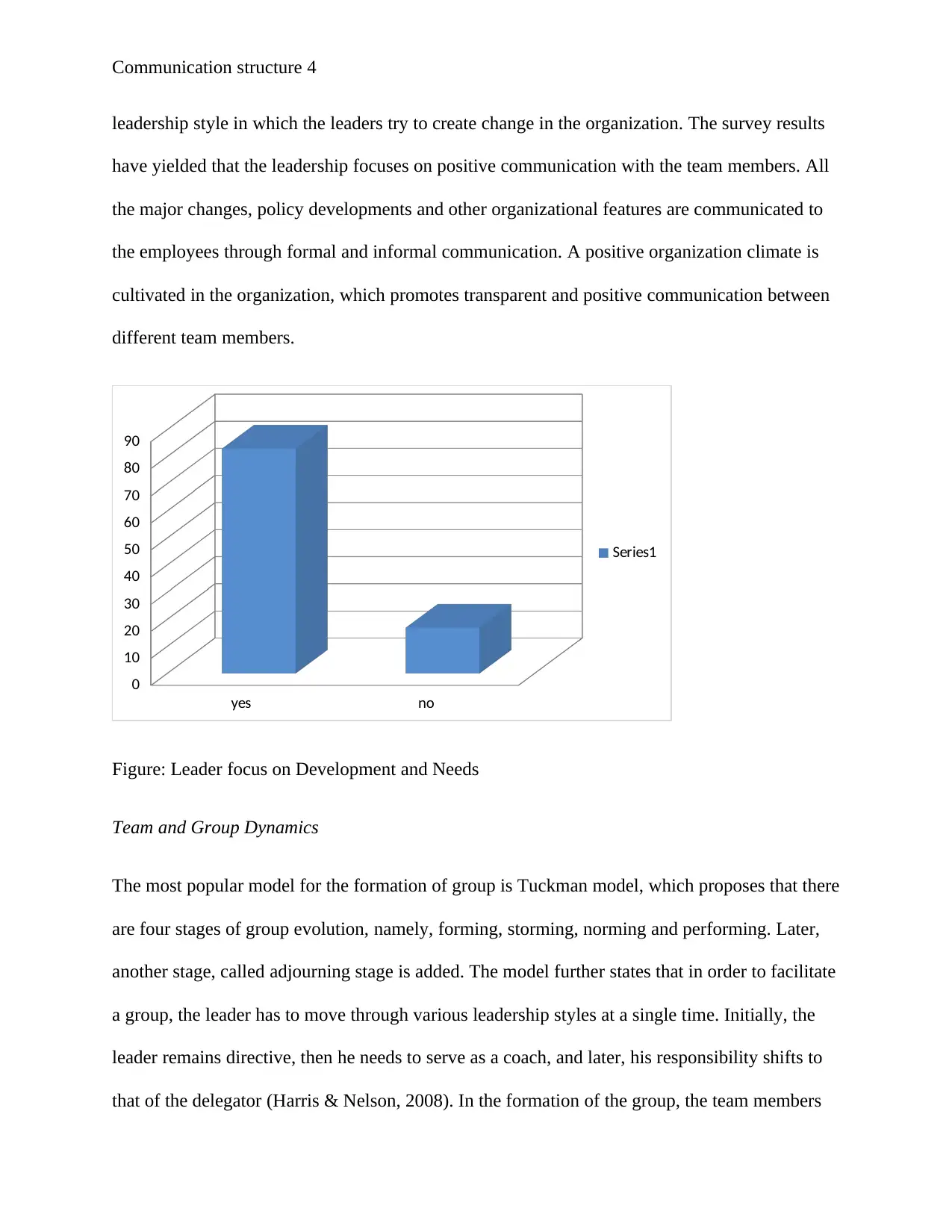
leadership style in which the leaders try to create change in the organization. The survey results
have yielded that the leadership focuses on positive communication with the team members. All
the major changes, policy developments and other organizational features are communicated to
the employees through formal and informal communication. A positive organization climate is
cultivated in the organization, which promotes transparent and positive communication between
different team members.
yes no
0
10
20
30
40
50
60
70
80
90
Series1
Figure: Leader focus on Development and Needs
Team and Group Dynamics
The most popular model for the formation of group is Tuckman model, which proposes that there
are four stages of group evolution, namely, forming, storming, norming and performing. Later,
another stage, called adjourning stage is added. The model further states that in order to facilitate
a group, the leader has to move through various leadership styles at a single time. Initially, the
leader remains directive, then he needs to serve as a coach, and later, his responsibility shifts to
that of the delegator (Harris & Nelson, 2008). In the formation of the group, the team members
leadership style in which the leaders try to create change in the organization. The survey results
have yielded that the leadership focuses on positive communication with the team members. All
the major changes, policy developments and other organizational features are communicated to
the employees through formal and informal communication. A positive organization climate is
cultivated in the organization, which promotes transparent and positive communication between
different team members.
yes no
0
10
20
30
40
50
60
70
80
90
Series1
Figure: Leader focus on Development and Needs
Team and Group Dynamics
The most popular model for the formation of group is Tuckman model, which proposes that there
are four stages of group evolution, namely, forming, storming, norming and performing. Later,
another stage, called adjourning stage is added. The model further states that in order to facilitate
a group, the leader has to move through various leadership styles at a single time. Initially, the
leader remains directive, then he needs to serve as a coach, and later, his responsibility shifts to
that of the delegator (Harris & Nelson, 2008). In the formation of the group, the team members
Paraphrase This Document
Need a fresh take? Get an instant paraphrase of this document with our AI Paraphraser
Communication structure 5
come together for the first time. At this time, there is formality, anxiety and guardedness. There
is high level of uncertainty; therefore, the team members are polite, conflict avoidant, and
observant. The storming is another phase, in which all the group members start to feel safe and
incorporated within the group. They become more authentic and argumentative. The norming is
another phase in which the team members becomes aware of the market competition and work
towards the success of the team goals. The performing is another phase in which, the employees
are motivated and knowledgeable and becomes competent to achieve the goals of the
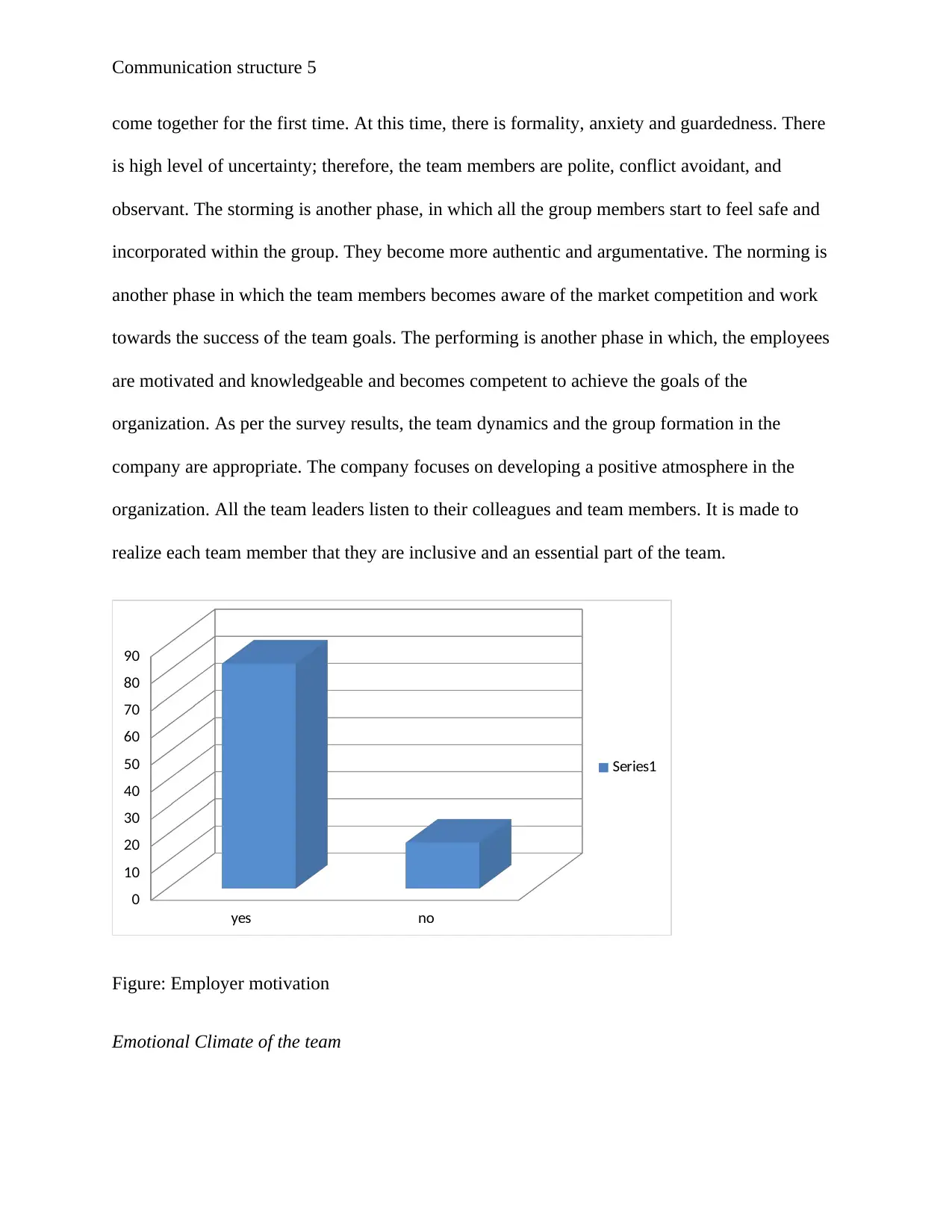
organization. As per the survey results, the team dynamics and the group formation in the
company are appropriate. The company focuses on developing a positive atmosphere in the
organization. All the team leaders listen to their colleagues and team members. It is made to
realize each team member that they are inclusive and an essential part of the team.
yes no
0
10
20
30
40
50
60
70
80
90
Series1
Figure: Employer motivation
Emotional Climate of the team
come together for the first time. At this time, there is formality, anxiety and guardedness. There
is high level of uncertainty; therefore, the team members are polite, conflict avoidant, and
observant. The storming is another phase, in which all the group members start to feel safe and
incorporated within the group. They become more authentic and argumentative. The norming is
another phase in which the team members becomes aware of the market competition and work
towards the success of the team goals. The performing is another phase in which, the employees
are motivated and knowledgeable and becomes competent to achieve the goals of the
organization. As per the survey results, the team dynamics and the group formation in the
company are appropriate. The company focuses on developing a positive atmosphere in the
organization. All the team leaders listen to their colleagues and team members. It is made to
realize each team member that they are inclusive and an essential part of the team.
yes no
0
10
20
30
40
50
60
70
80
90
Series1
Figure: Employer motivation
Emotional Climate of the team
Communication structure 6
The emotional intelligence refers to the ability of the team members to monitor or control his
own and other’s emotions. It is the ability of an individual to differentiate between positive and
negative effects of the emotions and use the emotional information to guide one’s behavior and
thinking. The emotional intelligence is the ability to perceive the emotions, manage them and use
them for the personal growth (Miller, 2012). It is not only individual competency, but also group
competency. The emotional intelligence is a skill, which can change the orientation of the team
members towards the emotions. The team members can manage their as well as other team
member’s emotions, if they have emotional intelligence. The team members should have
emotional intelligence to handle the workplace conflicts and increase productivity in the
organization. An empathetic atmosphere should be created in the organization, which should
facilitate a social and emotional atmosphere in the organization (Ayoko, Callan, & Hartel, 2008).
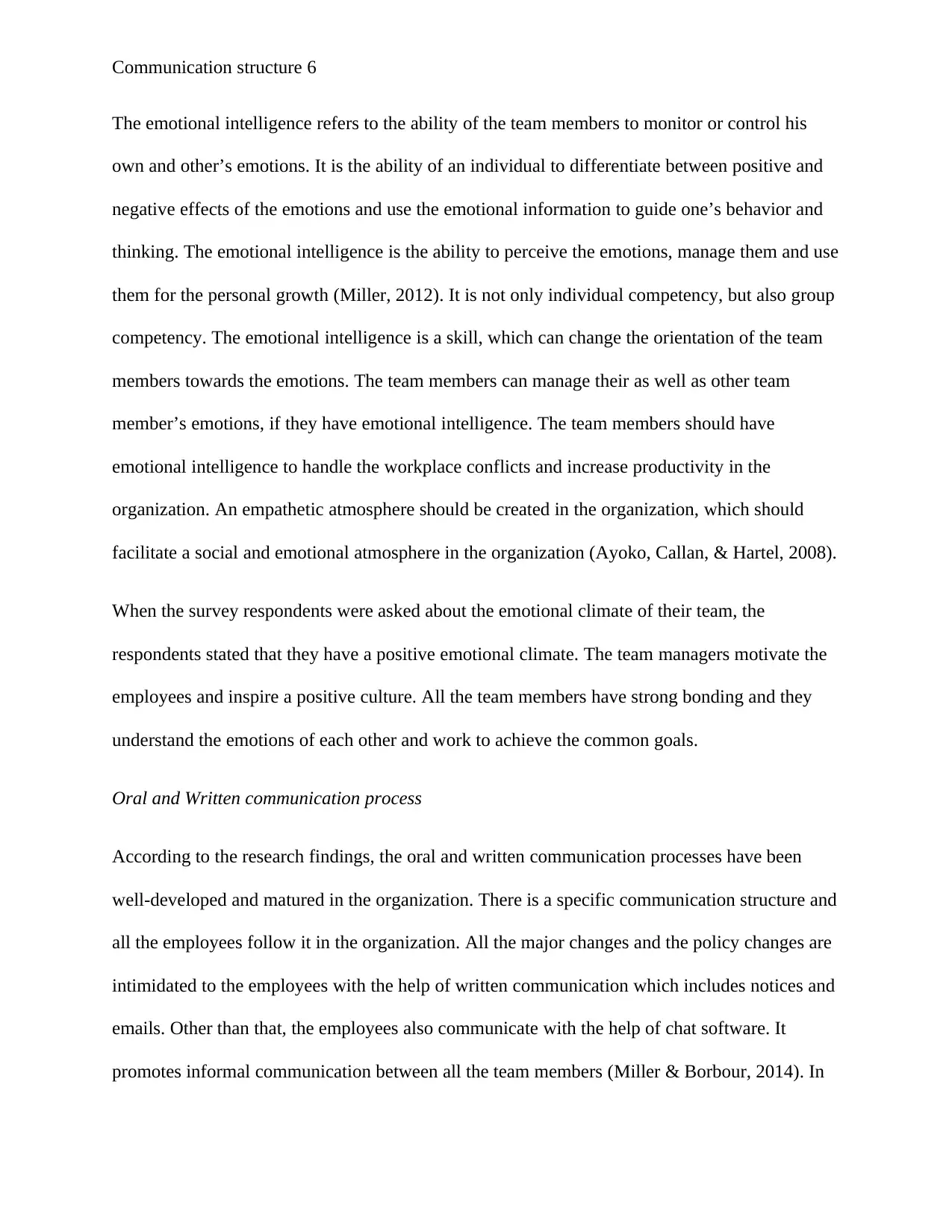
When the survey respondents were asked about the emotional climate of their team, the
respondents stated that they have a positive emotional climate. The team managers motivate the
employees and inspire a positive culture. All the team members have strong bonding and they
understand the emotions of each other and work to achieve the common goals.
Oral and Written communication process
According to the research findings, the oral and written communication processes have been
well-developed and matured in the organization. There is a specific communication structure and
all the employees follow it in the organization. All the major changes and the policy changes are
intimidated to the employees with the help of written communication which includes notices and
emails. Other than that, the employees also communicate with the help of chat software. It
promotes informal communication between all the team members (Miller & Borbour, 2014). In
The emotional intelligence refers to the ability of the team members to monitor or control his
own and other’s emotions. It is the ability of an individual to differentiate between positive and
negative effects of the emotions and use the emotional information to guide one’s behavior and
thinking. The emotional intelligence is the ability to perceive the emotions, manage them and use
them for the personal growth (Miller, 2012). It is not only individual competency, but also group
competency. The emotional intelligence is a skill, which can change the orientation of the team
members towards the emotions. The team members can manage their as well as other team
member’s emotions, if they have emotional intelligence. The team members should have
emotional intelligence to handle the workplace conflicts and increase productivity in the
organization. An empathetic atmosphere should be created in the organization, which should
facilitate a social and emotional atmosphere in the organization (Ayoko, Callan, & Hartel, 2008).
When the survey respondents were asked about the emotional climate of their team, the
respondents stated that they have a positive emotional climate. The team managers motivate the
employees and inspire a positive culture. All the team members have strong bonding and they
understand the emotions of each other and work to achieve the common goals.
Oral and Written communication process
According to the research findings, the oral and written communication processes have been
well-developed and matured in the organization. There is a specific communication structure and
all the employees follow it in the organization. All the major changes and the policy changes are
intimidated to the employees with the help of written communication which includes notices and
emails. Other than that, the employees also communicate with the help of chat software. It
promotes informal communication between all the team members (Miller & Borbour, 2014). In
⊘ This is a preview!⊘
Do you want full access?
Subscribe today to unlock all pages.
Trusted by 1+ million students worldwide
Communication structure 7
case of any doubt, they can communicate with the software instead of going through the formal
procedure of writing emails. The written communication is often followed by meetings and one-
to-one talks. When there is a significant change in policy or the operations of the organization,
oral communication is used for making communication with the employees.
Intercultural Communication
The intercultural communication has a meaningful context for the workplaces in which people
from different countries come together, identify with different ethnic groups who speak different
languages to collaborate and develop relationships. The interpersonal communication is also
important in the technology-mediated encounters, relationships and developing teams in the
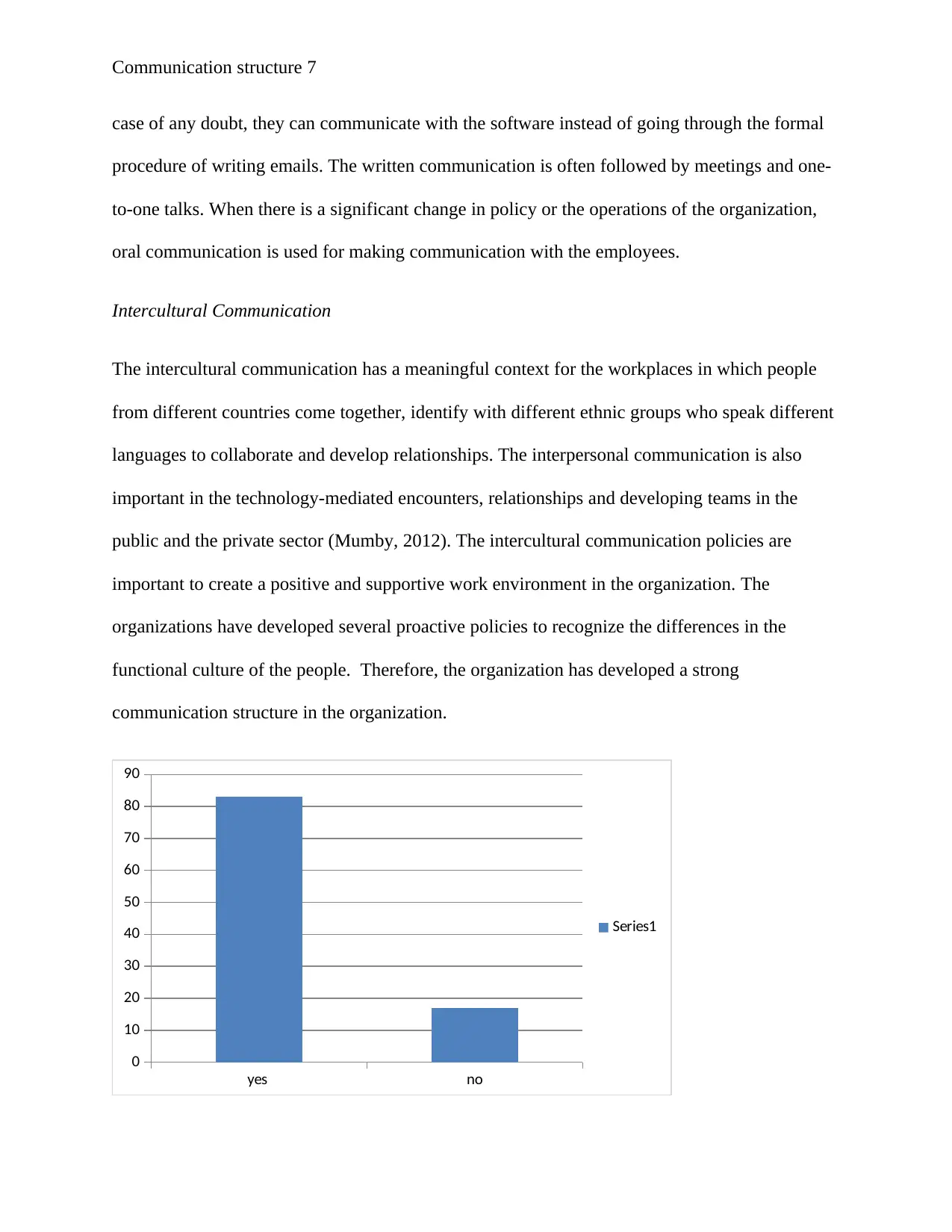
public and the private sector (Mumby, 2012). The intercultural communication policies are
important to create a positive and supportive work environment in the organization. The
organizations have developed several proactive policies to recognize the differences in the
functional culture of the people. Therefore, the organization has developed a strong
communication structure in the organization.
yes no
0
10
20
30
40
50
60
70
80
90
Series1
case of any doubt, they can communicate with the software instead of going through the formal
procedure of writing emails. The written communication is often followed by meetings and one-
to-one talks. When there is a significant change in policy or the operations of the organization,
oral communication is used for making communication with the employees.
Intercultural Communication
The intercultural communication has a meaningful context for the workplaces in which people
from different countries come together, identify with different ethnic groups who speak different
languages to collaborate and develop relationships. The interpersonal communication is also
important in the technology-mediated encounters, relationships and developing teams in the
public and the private sector (Mumby, 2012). The intercultural communication policies are
important to create a positive and supportive work environment in the organization. The
organizations have developed several proactive policies to recognize the differences in the
functional culture of the people. Therefore, the organization has developed a strong
communication structure in the organization.
yes no
0
10
20
30
40
50
60
70
80
90
Series1
Paraphrase This Document
Need a fresh take? Get an instant paraphrase of this document with our AI Paraphraser
Communication structure 8
Figure: Interorganization Policy
Success of the Organization Communication Structure
The organization has developed a strong communication structure in the organization. A
transparent and easy-going communication structure has been created in the organization. The
organization has developed several policies so that the employees can easily communicate with
each other. Several software and communication channels have been established in the
organization so that the employees can easily communicate with each other at different
hierarchal levels. It can be perceived that the employees working at different levels technical
fields often have different education backgrounds and work experience. It is quite different from
the workers in the creative fields. It results in differences in communication. The engineers tend
to think in a logical manner, whereas the marketing industry professionals are extrovert and
intuitive (Putnam & Mumby, 2013). There are several differences in different functional
cultures, which can be addressed through education and proactive policies regarding the
legitimacy of different cultures. However, the work culture in the organization is highly
competitive; therefore, there is need to implement more changes in the communication structure
of the organization. There are different communication structures in different organizations. The
decision to choose one communication structure is dependent upon the size of the organization.
The chosen line of communication must facilitate accurate messaging, timely responses and
timely completion of the work (May & Mumby, 2004). The line of communication is important
as it direct the employees to communicate within the organization. The line of communication
will create less interaction with the employees and other co-workers. Other than that, the
business also uses different communication methods, such as streamline reporting, using
Figure: Interorganization Policy
Success of the Organization Communication Structure
The organization has developed a strong communication structure in the organization. A
transparent and easy-going communication structure has been created in the organization. The
organization has developed several policies so that the employees can easily communicate with
each other. Several software and communication channels have been established in the
organization so that the employees can easily communicate with each other at different
hierarchal levels. It can be perceived that the employees working at different levels technical
fields often have different education backgrounds and work experience. It is quite different from
the workers in the creative fields. It results in differences in communication. The engineers tend
to think in a logical manner, whereas the marketing industry professionals are extrovert and
intuitive (Putnam & Mumby, 2013). There are several differences in different functional
cultures, which can be addressed through education and proactive policies regarding the
legitimacy of different cultures. However, the work culture in the organization is highly
competitive; therefore, there is need to implement more changes in the communication structure
of the organization. There are different communication structures in different organizations. The
decision to choose one communication structure is dependent upon the size of the organization.
The chosen line of communication must facilitate accurate messaging, timely responses and
timely completion of the work (May & Mumby, 2004). The line of communication is important
as it direct the employees to communicate within the organization. The line of communication
will create less interaction with the employees and other co-workers. Other than that, the
business also uses different communication methods, such as streamline reporting, using
Communication structure 9
evaluation or reimbursement form, which established structure in the organization
communication.
There are also several restraints on the organization communication, which can prevent chaos
resulted from high level of communication. It also reduces problem caused by the lack of
communication between different organization’s roles. The company has created strict
communication line, which assures that the employees are not left out of the important
communication.
Conclusion and Recommendations
The present research report is developed around Woolworths, which is one of the largest retail
business organizations in Australia. The report evaluates the communication structure of the
organization. It has been evaluated that the communication structure is well-developed and
matured. A positive emotional climate is a developed in the organization. All the team members
are considerate of the emotions if other employees. The team leaders are well-equipped with
skills to handle the emotions of other people. A survey is conducted with the employees of the
organization to evaluate the perception of the employees regarding the communication structure
of the organization. The research findings have also identified other important factors in the
communication structure of the organization. It includes that intercultural communication policy,
team dynamics and the leadership communication.
Effective communication is important in the organization as it will help in the product
development, customer relations and employee management. The company can improve
communication structure by establishing clear expectations for the employees as well as the
customers (Putnam & Mumby, 2013). It is important to convey to the employees how their
evaluation or reimbursement form, which established structure in the organization
communication.
There are also several restraints on the organization communication, which can prevent chaos
resulted from high level of communication. It also reduces problem caused by the lack of
communication between different organization’s roles. The company has created strict
communication line, which assures that the employees are not left out of the important
communication.
Conclusion and Recommendations
The present research report is developed around Woolworths, which is one of the largest retail
business organizations in Australia. The report evaluates the communication structure of the
organization. It has been evaluated that the communication structure is well-developed and
matured. A positive emotional climate is a developed in the organization. All the team members
are considerate of the emotions if other employees. The team leaders are well-equipped with
skills to handle the emotions of other people. A survey is conducted with the employees of the
organization to evaluate the perception of the employees regarding the communication structure
of the organization. The research findings have also identified other important factors in the
communication structure of the organization. It includes that intercultural communication policy,
team dynamics and the leadership communication.
Effective communication is important in the organization as it will help in the product
development, customer relations and employee management. The company can improve
communication structure by establishing clear expectations for the employees as well as the
customers (Putnam & Mumby, 2013). It is important to convey to the employees how their
⊘ This is a preview!⊘
Do you want full access?
Subscribe today to unlock all pages.
Trusted by 1+ million students worldwide
Communication structure 10
performance will impact the organization and provide a positive feedback to the employees. It is
also necessary to create strong relationships with the help of communication structure. The
communication structure should be focused on meeting important needs, convey information and
providing feedback to the employees (O'Sullivan, Smith & Esposito, 2012). The organization
communication should be able to foster knowledge, structure and positive work environment
within the organization.
performance will impact the organization and provide a positive feedback to the employees. It is
also necessary to create strong relationships with the help of communication structure. The
communication structure should be focused on meeting important needs, convey information and
providing feedback to the employees (O'Sullivan, Smith & Esposito, 2012). The organization
communication should be able to foster knowledge, structure and positive work environment
within the organization.
Paraphrase This Document
Need a fresh take? Get an instant paraphrase of this document with our AI Paraphraser
Communication structure 11
References
Ayoko, O.B., Callan, V.J., & Hartel, C.E.J. (2008). The Influence of Team Emotional
Intelligence Climate on Conflict and Team Members’ Reactions to Conflict. Small Group
Research 39(2), 121-149.
Harris, T.E., & Nelson, M.D. (2008). Applied Organizational Communication: Theory and
Practice in a Global Environment. Taylor & Francis.
May, S., & Mumby, D.K. (2004). Engaging Organizational Communication Theory and
Research: Multiple Perspectives. SAGE.
Miller, K. (2012). Organizational Communication: Approaches and Processes. Cengage
Learning.
Miller, K., & Borbour, J. (2014). Organizational Communication: Approaches and Processes.
Cengage Learning.
Mumby, D.K. (2012). Organizational Communication: A Critical Approach. SAGE.
O'Sullivan, P., Smith, M. & Esposito, M. (2012). Business Ethics: A Critical Approach:
Integrating Ethics Across the Business World. Routledge.
Papa, M.J., Daniels, T.D., & Spiker, B.K. (2007). Organizational Communication: Perspectives
and Trends. SAGE.
Putnam, L.L., & Mumby, D.K. (2013). The SAGE Handbook of Organizational Communication:
Advances in Theory, Research, and Methods. SAGE Publications.
Putnam, L.L., & Mumby, D.K. (2013). The SAGE Handbook of Organizational Communication:
Advances in Theory, Research, and Methods. SAGE Publications.
Scott, C., & Lewis, L. (2017). The International Encyclopedia of Organizational
Communication, 4 Volume Set. John Wiley & Sons.
References
Ayoko, O.B., Callan, V.J., & Hartel, C.E.J. (2008). The Influence of Team Emotional
Intelligence Climate on Conflict and Team Members’ Reactions to Conflict. Small Group
Research 39(2), 121-149.
Harris, T.E., & Nelson, M.D. (2008). Applied Organizational Communication: Theory and
Practice in a Global Environment. Taylor & Francis.
May, S., & Mumby, D.K. (2004). Engaging Organizational Communication Theory and
Research: Multiple Perspectives. SAGE.
Miller, K. (2012). Organizational Communication: Approaches and Processes. Cengage
Learning.
Miller, K., & Borbour, J. (2014). Organizational Communication: Approaches and Processes.
Cengage Learning.
Mumby, D.K. (2012). Organizational Communication: A Critical Approach. SAGE.
O'Sullivan, P., Smith, M. & Esposito, M. (2012). Business Ethics: A Critical Approach:
Integrating Ethics Across the Business World. Routledge.
Papa, M.J., Daniels, T.D., & Spiker, B.K. (2007). Organizational Communication: Perspectives
and Trends. SAGE.
Putnam, L.L., & Mumby, D.K. (2013). The SAGE Handbook of Organizational Communication:
Advances in Theory, Research, and Methods. SAGE Publications.
Putnam, L.L., & Mumby, D.K. (2013). The SAGE Handbook of Organizational Communication:
Advances in Theory, Research, and Methods. SAGE Publications.
Scott, C., & Lewis, L. (2017). The International Encyclopedia of Organizational
Communication, 4 Volume Set. John Wiley & Sons.
Communication structure 12
Appendix
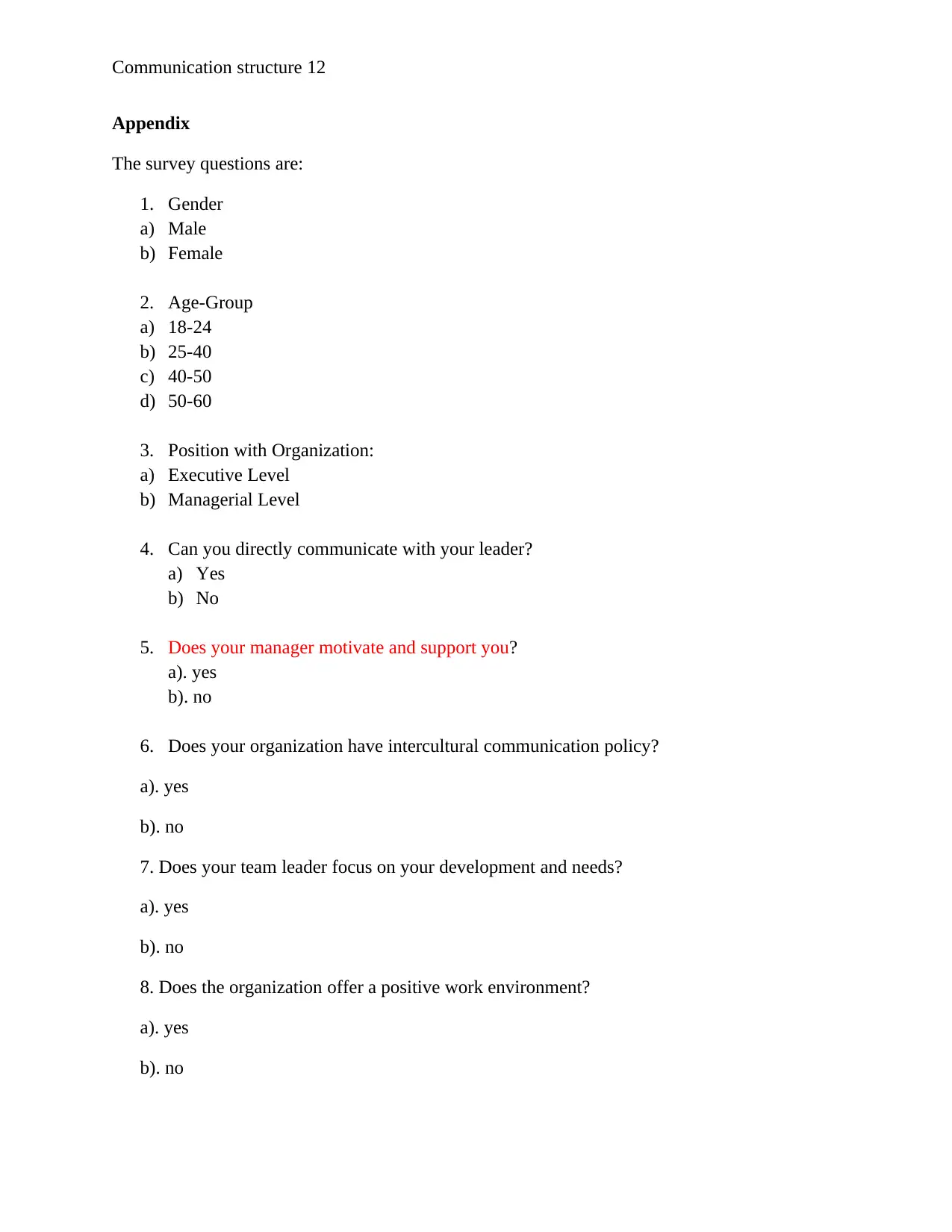
The survey questions are:
1. Gender
a) Male
b) Female
2. Age-Group
a) 18-24
b) 25-40
c) 40-50
d) 50-60
3. Position with Organization:
a) Executive Level
b) Managerial Level
4. Can you directly communicate with your leader?
a) Yes
b) No
5. Does your manager motivate and support you?
a). yes
b). no
6. Does your organization have intercultural communication policy?
a). yes
b). no
7. Does your team leader focus on your development and needs?
a). yes
b). no
8. Does the organization offer a positive work environment?
a). yes
b). no
Appendix
The survey questions are:
1. Gender
a) Male
b) Female
2. Age-Group
a) 18-24
b) 25-40
c) 40-50
d) 50-60
3. Position with Organization:
a) Executive Level
b) Managerial Level
4. Can you directly communicate with your leader?
a) Yes
b) No
5. Does your manager motivate and support you?
a). yes
b). no
6. Does your organization have intercultural communication policy?
a). yes
b). no
7. Does your team leader focus on your development and needs?
a). yes
b). no
8. Does the organization offer a positive work environment?
a). yes
b). no
⊘ This is a preview!⊘
Do you want full access?
Subscribe today to unlock all pages.
Trusted by 1+ million students worldwide

1 out of 13


Related Documents


Your All-in-One AI-Powered Toolkit for Academic Success.
+13062052269
info@desklib.com
Available 24*7 on WhatsApp / Email
![[object Object]](/_next/static/media/star-bottom.7253800d.svg)
Unlock your academic potential
Copyright © 2020–2026 A2Z Services. All Rights Reserved. Developed and managed by ZUCOL.