The Judge's Role in Statutory Interpretation: An Essay Analysis
VerifiedAdded on 2023/01/10
|8
|2646
|21
Essay
AI Summary
This essay delves into the critical area of statutory interpretation within the legal framework, focusing on the doctrine of separation of powers and its implications for the judiciary. It examines the distinct roles of the legislative, executive, and judicial branches, particularly emphasizing the judge's function in interpreting the 'will of Parliament' as a legislative power. The essay explores various methods employed by judges to ascertain and reflect the intent of Parliament, including the literal, purposive, mischief, and golden rules, along with the use of internal and external aids. It analyzes the strengths and weaknesses of each approach, ultimately arguing that the mischief rule provides the most effective means of interpreting legislation while considering the context and purpose of the law. The discussion incorporates relevant legal principles and case examples to illustrate the application of these interpretation methods, offering a comprehensive understanding of the subject.

WORD

Paraphrase This Document
Need a fresh take? Get an instant paraphrase of this document with our AI Paraphraser
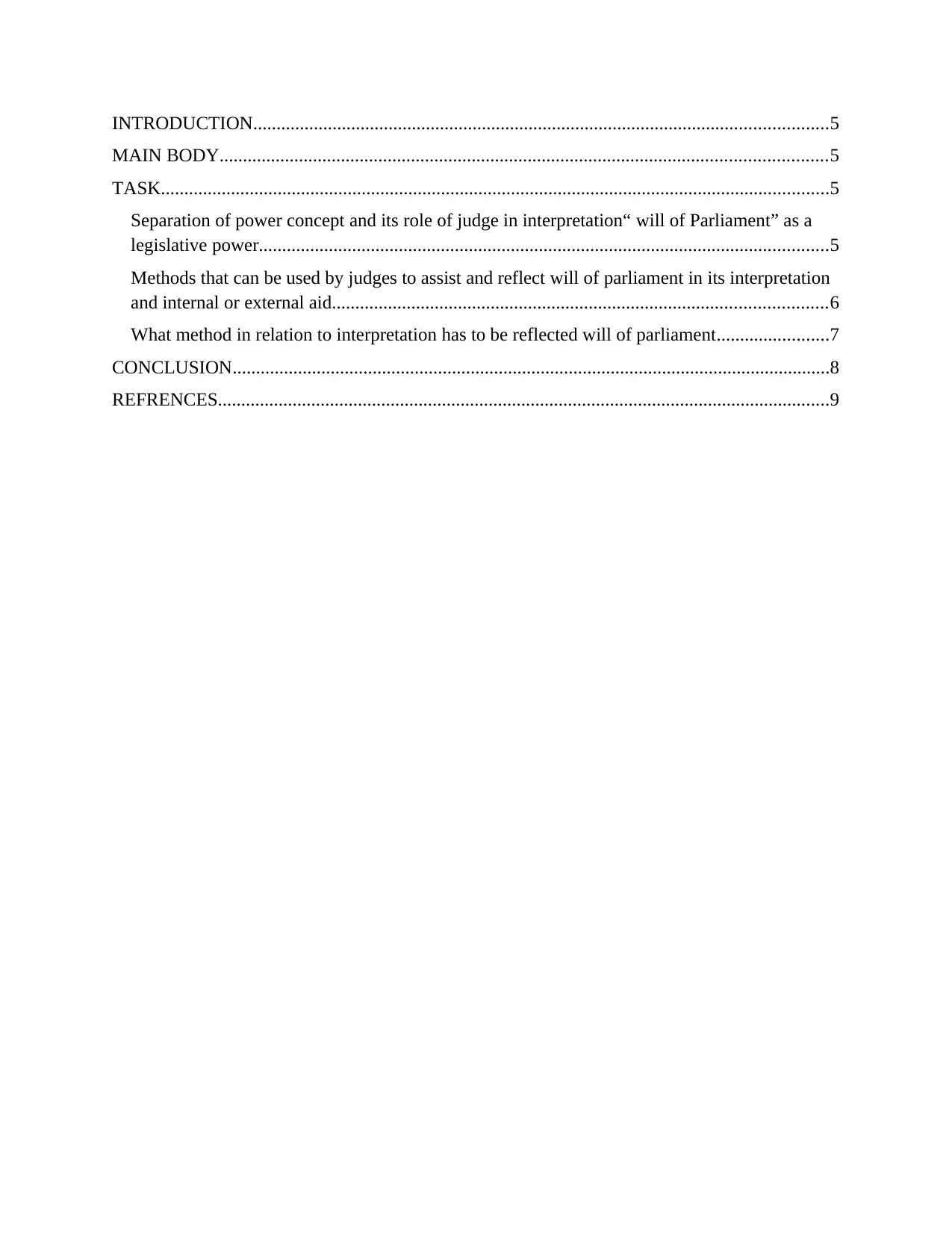
INTRODUCTION...........................................................................................................................5
MAIN BODY..................................................................................................................................5
TASK...............................................................................................................................................5
Separation of power concept and its role of judge in interpretation“ will of Parliament” as a
legislative power..........................................................................................................................5
Methods that can be used by judges to assist and reflect will of parliament in its interpretation
and internal or external aid..........................................................................................................6
What method in relation to interpretation has to be reflected will of parliament........................7
CONCLUSION................................................................................................................................8
REFRENCES...................................................................................................................................9
MAIN BODY..................................................................................................................................5
TASK...............................................................................................................................................5
Separation of power concept and its role of judge in interpretation“ will of Parliament” as a
legislative power..........................................................................................................................5
Methods that can be used by judges to assist and reflect will of parliament in its interpretation
and internal or external aid..........................................................................................................6
What method in relation to interpretation has to be reflected will of parliament........................7
CONCLUSION................................................................................................................................8
REFRENCES...................................................................................................................................9
INTRODUCTION
Law is one the basic element that is required to maintain order and balance within
society. It deals with aspects of society that creates negative impact over public and individual.
Statutory interpretation is one of the most important key which plays major role in taking out
true meaning of law that has been base for its formation. Scope of interpretation is very high
because they deal with meaning of law. This essay is based upon question that is going to cover
separation of power, Methods used by judge to interpretation will of parliament is going to be
covered.
MAIN BODY
TASK
Separation of power concept and its role of judge in interpretation“ will of Parliament” as
a legislative power
Doctrine of separation of power is referred to as that kind of doctrine that has been
created in order to divide that work under three pillars of a country that is legislative, executive
and judiciary they are being given with separate powers to maintain law and order in an country.
In UK separation of power has been done between those three organs which are of government.
This is done to distribute to executive, legislative and judiciary within their limitation.
Separation of powers helps in identifying of responsibility that has been given to parliament,
executive and court. Each of these authority has their own power and cannot cross there area of
functioning. John Lock and Charles Montesquieu are the significant figure for this doctrine.
According to him separation of power is that idea which checks and keeps balance between that
works that has been given to them. Under this no person is required to perform all the duty by
himself that is why this doctrine is being form. Each of the three organs is not allowed to
interfere in each other’s working pattern. Executive consists of government and includes Prime
Minister and the Cabinet other than in the legislative functions of Parliament The role of the
executive is to implement government policies. These include implementing legislation, security,
providing social and economic welfare, administrating public services and also try to make good
relations with other countries. That is why functions of executive is required to deal with
formation of board policies and managing them. In UK laws are being enacted only when the bill
has to be approved by the House of Commons and Lords only after accepting Royal assent that
bill can be made permanent law. Any law can be enacted even when house of Lords.
Interpretation of statues has a very important role to playing this is because law making process
deals is very long. During this process judges cannot challenge any political authority of
legislature over the laws to be amended (Islam and Rahman, 2016).
Judiciary is to include all judges and law court. Including of judicial offices in which
tribunal and magistrates court. These are applicable under civil law jurisdiction and covers both
Law is one the basic element that is required to maintain order and balance within
society. It deals with aspects of society that creates negative impact over public and individual.
Statutory interpretation is one of the most important key which plays major role in taking out
true meaning of law that has been base for its formation. Scope of interpretation is very high
because they deal with meaning of law. This essay is based upon question that is going to cover
separation of power, Methods used by judge to interpretation will of parliament is going to be
covered.
MAIN BODY
TASK
Separation of power concept and its role of judge in interpretation“ will of Parliament” as
a legislative power
Doctrine of separation of power is referred to as that kind of doctrine that has been
created in order to divide that work under three pillars of a country that is legislative, executive
and judiciary they are being given with separate powers to maintain law and order in an country.
In UK separation of power has been done between those three organs which are of government.
This is done to distribute to executive, legislative and judiciary within their limitation.
Separation of powers helps in identifying of responsibility that has been given to parliament,
executive and court. Each of these authority has their own power and cannot cross there area of
functioning. John Lock and Charles Montesquieu are the significant figure for this doctrine.
According to him separation of power is that idea which checks and keeps balance between that
works that has been given to them. Under this no person is required to perform all the duty by
himself that is why this doctrine is being form. Each of the three organs is not allowed to
interfere in each other’s working pattern. Executive consists of government and includes Prime
Minister and the Cabinet other than in the legislative functions of Parliament The role of the
executive is to implement government policies. These include implementing legislation, security,
providing social and economic welfare, administrating public services and also try to make good
relations with other countries. That is why functions of executive is required to deal with
formation of board policies and managing them. In UK laws are being enacted only when the bill
has to be approved by the House of Commons and Lords only after accepting Royal assent that
bill can be made permanent law. Any law can be enacted even when house of Lords.
Interpretation of statues has a very important role to playing this is because law making process
deals is very long. During this process judges cannot challenge any political authority of
legislature over the laws to be amended (Islam and Rahman, 2016).
Judiciary is to include all judges and law court. Including of judicial offices in which
tribunal and magistrates court. These are applicable under civil law jurisdiction and covers both
⊘ This is a preview!⊘
Do you want full access?
Subscribe today to unlock all pages.

Trusted by 1+ million students worldwide
private and public law. The court exercises various legislative functions like making rules,
governing court procedures and administrative functions also.
Legislative, judiciary and executive is having separate functioning form each other but
requires to be protected from interference within each other’s work and is required to be
protected from it. The Prime Minister has to be advised queen to dissolve parliament should be
within a year. Also queen has got power to dissolve parliament under emergency condition. For
this a minister is accountable. Judicial appointment is made by queen upon the recommendation
of Lord Chancellor. If Lord Chancellor is not there lay magistrate and certain other juniors
judges by Lord Chancellor directly. Senior post members are being chosen through the judges
and council members. Lay members are required to be selected by panel of four persons. It
contains a chairman, Lord Chief Justice and the chair commission. Civil servants are not
members of commission. Lord Chancellor is able to increase number of members that are subject
to an approval of parliament. Commissioners cannot hold its office for more than 10 years n total
Parliament makes law and judiciary plays the role of interpretation of it word by word.
They are being given discretionary power to interpret rate and legislation. Like any other
communication means legislation can include words that are having different meaning which
may changes understanding of law. Legislation is required to be written in order to apply it in
adverse situation there has to be lack of clarity or precision.
Methods that can be used by judges to assist and reflect will of parliament in its
interpretation and internal or external aid
The literal approach: These are of the view which has judicial interpretation that is holding
judges which look primarily to the words of legislation in order to make the meaning more and
has to be expecting under limited circumstances. This approach is majorly focused upon finding
the meaning of law that has been made. It is dominate within English legal system.
The purposive approach: In this approach limitation of judges has to search over the meaning
of what is not there in the explained. This means that an judge is required to look beyond the
words of statute and is required to and should keep in mind the circumstances also before
applying this approach. Such approach is typical of civil law system that is based upon general
principals of justice and judges makes use of these also to mark out proper judgment. Judges are
also required to analysis all kinds of facts that is related to judgment. As common law principal
is there which can be used while applying these approaches into a particular case (Kageyama,
2017).
There are certain rules that have been giving in order to perform interpretation of laws in
appropriate manner by the judges of the court. Such rules are based upon various aspects that can
occur during the time of case and judges are required to take decision upon considering the rules
which are going to be very helpful in interpretation of law in better and effective manner which
eventually makes process of judgment smooth. This is also responsible for passing of judgment
with fairness and gives power to judges over interpretation of statute. Also these rules are helpful
in marking law and its meaning. These are explained as follows
governing court procedures and administrative functions also.
Legislative, judiciary and executive is having separate functioning form each other but
requires to be protected from interference within each other’s work and is required to be
protected from it. The Prime Minister has to be advised queen to dissolve parliament should be
within a year. Also queen has got power to dissolve parliament under emergency condition. For
this a minister is accountable. Judicial appointment is made by queen upon the recommendation
of Lord Chancellor. If Lord Chancellor is not there lay magistrate and certain other juniors
judges by Lord Chancellor directly. Senior post members are being chosen through the judges
and council members. Lay members are required to be selected by panel of four persons. It
contains a chairman, Lord Chief Justice and the chair commission. Civil servants are not
members of commission. Lord Chancellor is able to increase number of members that are subject
to an approval of parliament. Commissioners cannot hold its office for more than 10 years n total
Parliament makes law and judiciary plays the role of interpretation of it word by word.
They are being given discretionary power to interpret rate and legislation. Like any other
communication means legislation can include words that are having different meaning which
may changes understanding of law. Legislation is required to be written in order to apply it in
adverse situation there has to be lack of clarity or precision.
Methods that can be used by judges to assist and reflect will of parliament in its
interpretation and internal or external aid
The literal approach: These are of the view which has judicial interpretation that is holding
judges which look primarily to the words of legislation in order to make the meaning more and
has to be expecting under limited circumstances. This approach is majorly focused upon finding
the meaning of law that has been made. It is dominate within English legal system.
The purposive approach: In this approach limitation of judges has to search over the meaning
of what is not there in the explained. This means that an judge is required to look beyond the
words of statute and is required to and should keep in mind the circumstances also before
applying this approach. Such approach is typical of civil law system that is based upon general
principals of justice and judges makes use of these also to mark out proper judgment. Judges are
also required to analysis all kinds of facts that is related to judgment. As common law principal
is there which can be used while applying these approaches into a particular case (Kageyama,
2017).
There are certain rules that have been giving in order to perform interpretation of laws in
appropriate manner by the judges of the court. Such rules are based upon various aspects that can
occur during the time of case and judges are required to take decision upon considering the rules
which are going to be very helpful in interpretation of law in better and effective manner which
eventually makes process of judgment smooth. This is also responsible for passing of judgment
with fairness and gives power to judges over interpretation of statute. Also these rules are helpful
in marking law and its meaning. These are explained as follows
Paraphrase This Document
Need a fresh take? Get an instant paraphrase of this document with our AI Paraphraser
The mischief rule Under this rule a hierarchical order is there because golden rule is applied
only after the literal rule is not able to provide appropriate solution. This means that it can be
applied only when two rules has failed. In this rule wider approach is applied and then only
interoperation is done of a law in an case. The wider move towards a more purposive approach to
interpretation means there may be greater application of the mischief and golden rules which
determine the meaning and effect of legislation (Liang, Choi and Joppe, 2018).
The Literal rule Under the literal rule the judge is required to mark out what the enactment has
to actually say and not considering the meaning of it. For achieving this judge is required to give
words in legislation and its literal meaning should not be disturbed even if the impact of it’s not
desirable according to the situation. This rule is mainly focused upon balancing the justice
without disturbing the meaning of a law which has been made. In other words the judge should
give the literal meaning of the law.
The Golden rule: This rule has to be generally considered to be an expanding of literal rule. In
the simple meaning such rule is used under those circumstances in which literal rule have been
applied and appropriate outcome was not generated from it.
The narrow meaning: The narrow meaning of golden rule is that it has to be used under those
circumstances which includes complicacy in it and can even have an adverse impact upon
legislative provision. It gives most preference to that meaning which has not been delivered and
absurd result has to be gained. This can be understood through example that is Adler v George in
which the defendant has been charged under the Official Secrets Act 1920. In this vicinity of a
prohibited area has been done. It was decided by the court that no restriction to literal wording of
the act and defendant has been found as guilty.
The wider meaning: The wider meaning is that the golden rule has to be used under only when
there is one meaning which is going to be considered by court which can also make in
appropriate decisions. For example, in Re Sigsworth the court introduced common law rules into
legislative provisions to prevent the estate of a murderer from benefiting from the property of the
party he had murdered (Wolf, 2018).
What method in relation to interpretation has to be reflected will of parliament
All the rules that have been mentioned in the above question are related to each other and
can only be used in sequence. These rules have provided stability within the interpretation of
laws which are being formed. Judges of a court are required to use these rules on those situation
which is very much complex in nature. So, out of these rules the one that that is going to give
appropriate result is mischief rule. It is one of the most commonly used rules and is also flexible
in nature. This rule helps in making interpretation easier. Such kind of rule is very helpful in
reducing complexity of legal system of a country. Traditional expression has been limited over
being restricted for using previous common law rules. This rule has been proven to be more
successful because it given power to judge to analyze a particular situation and listen to all facts
and scenario of case. This can be understood as Heydon’s Case in which it has been revealed that
only after the literal rule is not able to provide appropriate solution. This means that it can be
applied only when two rules has failed. In this rule wider approach is applied and then only
interoperation is done of a law in an case. The wider move towards a more purposive approach to
interpretation means there may be greater application of the mischief and golden rules which
determine the meaning and effect of legislation (Liang, Choi and Joppe, 2018).
The Literal rule Under the literal rule the judge is required to mark out what the enactment has
to actually say and not considering the meaning of it. For achieving this judge is required to give
words in legislation and its literal meaning should not be disturbed even if the impact of it’s not
desirable according to the situation. This rule is mainly focused upon balancing the justice
without disturbing the meaning of a law which has been made. In other words the judge should
give the literal meaning of the law.
The Golden rule: This rule has to be generally considered to be an expanding of literal rule. In
the simple meaning such rule is used under those circumstances in which literal rule have been
applied and appropriate outcome was not generated from it.
The narrow meaning: The narrow meaning of golden rule is that it has to be used under those
circumstances which includes complicacy in it and can even have an adverse impact upon
legislative provision. It gives most preference to that meaning which has not been delivered and
absurd result has to be gained. This can be understood through example that is Adler v George in
which the defendant has been charged under the Official Secrets Act 1920. In this vicinity of a
prohibited area has been done. It was decided by the court that no restriction to literal wording of
the act and defendant has been found as guilty.
The wider meaning: The wider meaning is that the golden rule has to be used under only when
there is one meaning which is going to be considered by court which can also make in
appropriate decisions. For example, in Re Sigsworth the court introduced common law rules into
legislative provisions to prevent the estate of a murderer from benefiting from the property of the
party he had murdered (Wolf, 2018).
What method in relation to interpretation has to be reflected will of parliament
All the rules that have been mentioned in the above question are related to each other and
can only be used in sequence. These rules have provided stability within the interpretation of
laws which are being formed. Judges of a court are required to use these rules on those situation
which is very much complex in nature. So, out of these rules the one that that is going to give
appropriate result is mischief rule. It is one of the most commonly used rules and is also flexible
in nature. This rule helps in making interpretation easier. Such kind of rule is very helpful in
reducing complexity of legal system of a country. Traditional expression has been limited over
being restricted for using previous common law rules. This rule has been proven to be more
successful because it given power to judge to analyze a particular situation and listen to all facts
and scenario of case. This can be understood as Heydon’s Case in which it has been revealed that
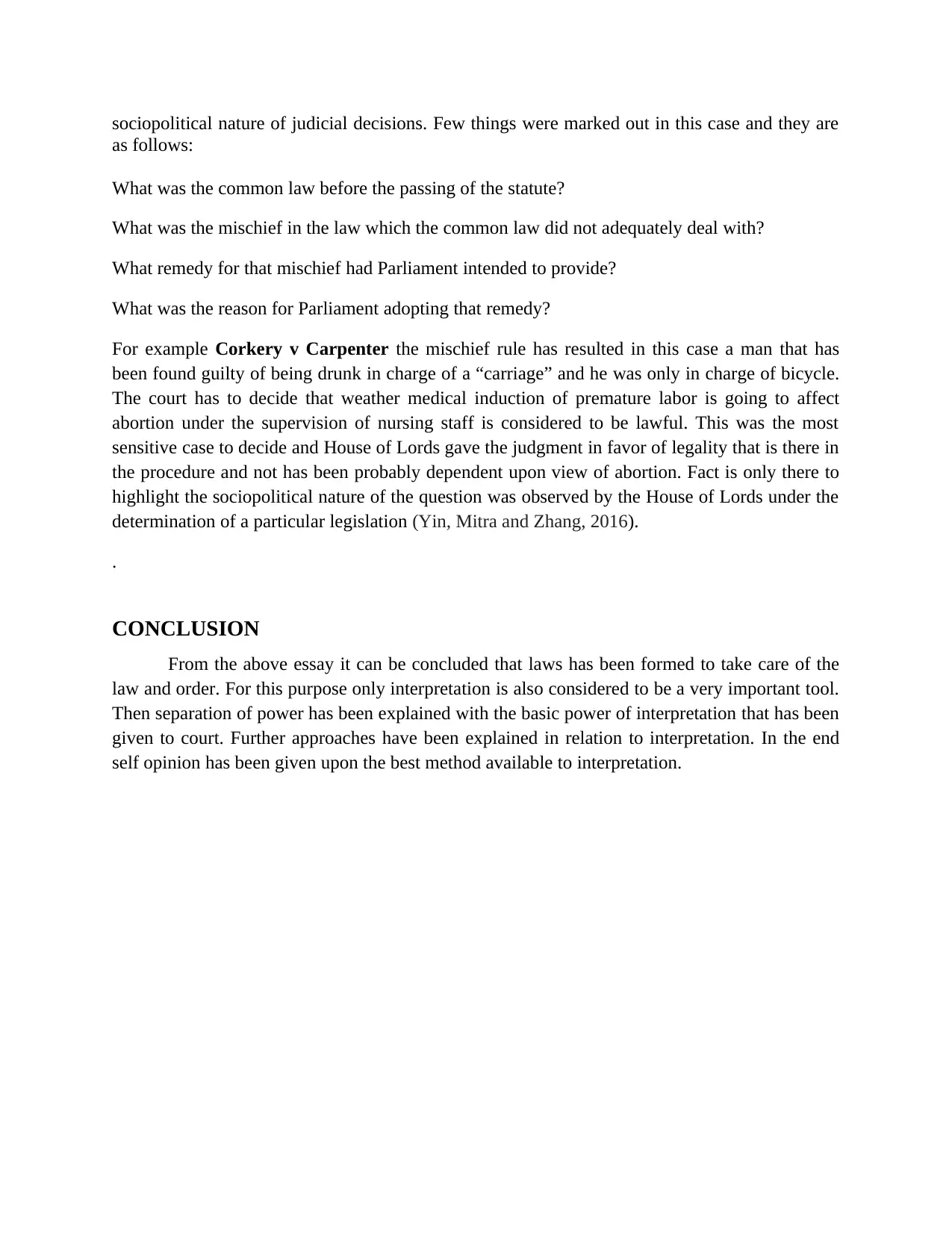
sociopolitical nature of judicial decisions. Few things were marked out in this case and they are
as follows:
What was the common law before the passing of the statute?
What was the mischief in the law which the common law did not adequately deal with?
What remedy for that mischief had Parliament intended to provide?
What was the reason for Parliament adopting that remedy?
For example Corkery v Carpenter the mischief rule has resulted in this case a man that has
been found guilty of being drunk in charge of a “carriage” and he was only in charge of bicycle.
The court has to decide that weather medical induction of premature labor is going to affect
abortion under the supervision of nursing staff is considered to be lawful. This was the most
sensitive case to decide and House of Lords gave the judgment in favor of legality that is there in
the procedure and not has been probably dependent upon view of abortion. Fact is only there to
highlight the sociopolitical nature of the question was observed by the House of Lords under the
determination of a particular legislation (Yin, Mitra and Zhang, 2016).
.
CONCLUSION
From the above essay it can be concluded that laws has been formed to take care of the
law and order. For this purpose only interpretation is also considered to be a very important tool.
Then separation of power has been explained with the basic power of interpretation that has been
given to court. Further approaches have been explained in relation to interpretation. In the end
self opinion has been given upon the best method available to interpretation.
as follows:
What was the common law before the passing of the statute?
What was the mischief in the law which the common law did not adequately deal with?
What remedy for that mischief had Parliament intended to provide?
What was the reason for Parliament adopting that remedy?
For example Corkery v Carpenter the mischief rule has resulted in this case a man that has
been found guilty of being drunk in charge of a “carriage” and he was only in charge of bicycle.
The court has to decide that weather medical induction of premature labor is going to affect
abortion under the supervision of nursing staff is considered to be lawful. This was the most
sensitive case to decide and House of Lords gave the judgment in favor of legality that is there in
the procedure and not has been probably dependent upon view of abortion. Fact is only there to
highlight the sociopolitical nature of the question was observed by the House of Lords under the
determination of a particular legislation (Yin, Mitra and Zhang, 2016).
.
CONCLUSION
From the above essay it can be concluded that laws has been formed to take care of the
law and order. For this purpose only interpretation is also considered to be a very important tool.
Then separation of power has been explained with the basic power of interpretation that has been
given to court. Further approaches have been explained in relation to interpretation. In the end
self opinion has been given upon the best method available to interpretation.
⊘ This is a preview!⊘
Do you want full access?
Subscribe today to unlock all pages.
Trusted by 1+ million students worldwide
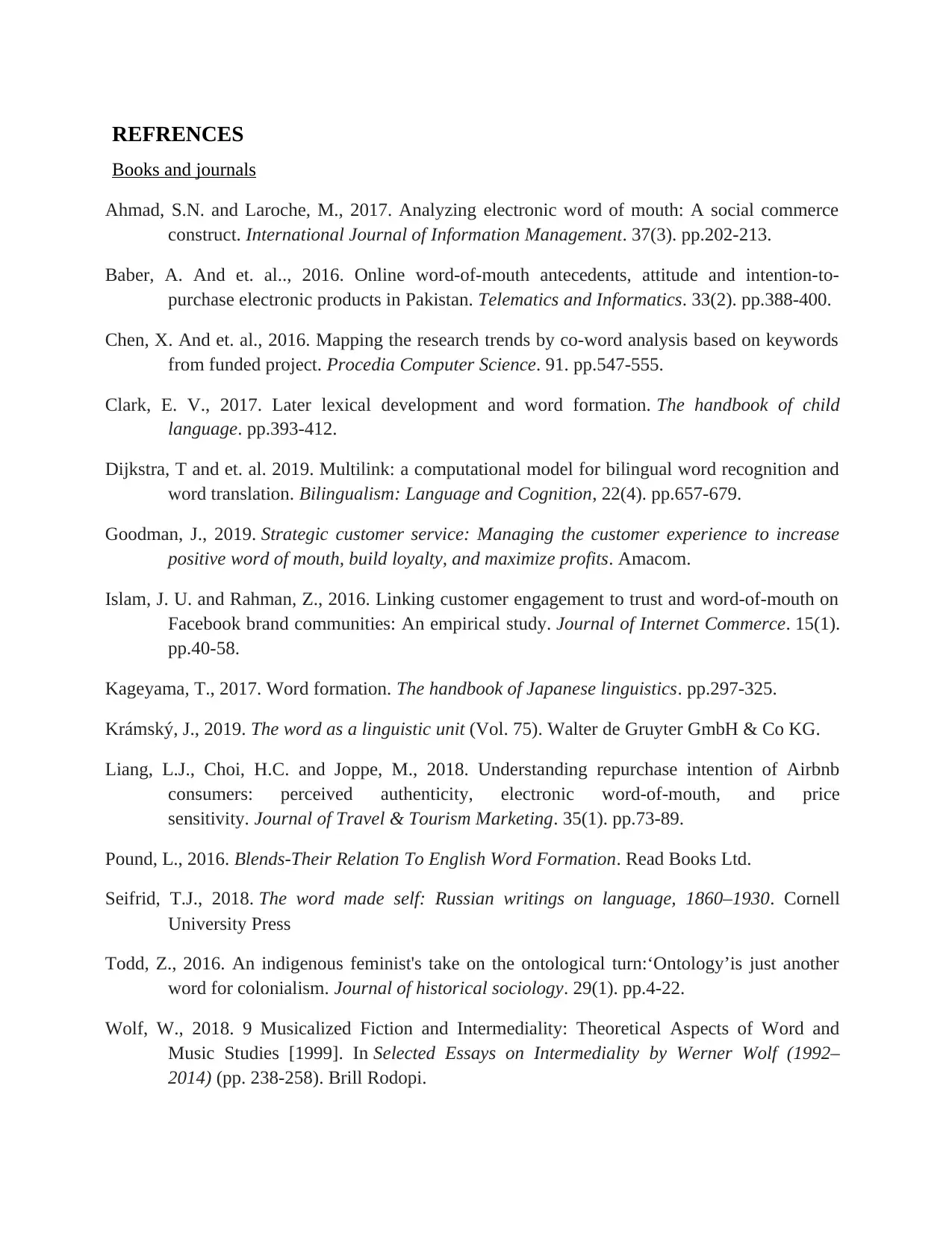
REFRENCES
Books and journals
Ahmad, S.N. and Laroche, M., 2017. Analyzing electronic word of mouth: A social commerce
construct. International Journal of Information Management. 37(3). pp.202-213.
Baber, A. And et. al.., 2016. Online word-of-mouth antecedents, attitude and intention-to-
purchase electronic products in Pakistan. Telematics and Informatics. 33(2). pp.388-400.
Chen, X. And et. al., 2016. Mapping the research trends by co-word analysis based on keywords
from funded project. Procedia Computer Science. 91. pp.547-555.
Clark, E. V., 2017. Later lexical development and word formation. The handbook of child
language. pp.393-412.
Dijkstra, T and et. al. 2019. Multilink: a computational model for bilingual word recognition and
word translation. Bilingualism: Language and Cognition, 22(4). pp.657-679.
Goodman, J., 2019. Strategic customer service: Managing the customer experience to increase
positive word of mouth, build loyalty, and maximize profits. Amacom.
Islam, J. U. and Rahman, Z., 2016. Linking customer engagement to trust and word-of-mouth on
Facebook brand communities: An empirical study. Journal of Internet Commerce. 15(1).
pp.40-58.
Kageyama, T., 2017. Word formation. The handbook of Japanese linguistics. pp.297-325.
Krámský, J., 2019. The word as a linguistic unit (Vol. 75). Walter de Gruyter GmbH & Co KG.
Liang, L.J., Choi, H.C. and Joppe, M., 2018. Understanding repurchase intention of Airbnb
consumers: perceived authenticity, electronic word-of-mouth, and price
sensitivity. Journal of Travel & Tourism Marketing. 35(1). pp.73-89.
Pound, L., 2016. Blends-Their Relation To English Word Formation. Read Books Ltd.
Seifrid, T.J., 2018. The word made self: Russian writings on language, 1860–1930. Cornell
University Press
Todd, Z., 2016. An indigenous feminist's take on the ontological turn:‘Ontology’is just another
word for colonialism. Journal of historical sociology. 29(1). pp.4-22.
Wolf, W., 2018. 9 Musicalized Fiction and Intermediality: Theoretical Aspects of Word and
Music Studies [1999]. In Selected Essays on Intermediality by Werner Wolf (1992–
2014) (pp. 238-258). Brill Rodopi.
Books and journals
Ahmad, S.N. and Laroche, M., 2017. Analyzing electronic word of mouth: A social commerce
construct. International Journal of Information Management. 37(3). pp.202-213.
Baber, A. And et. al.., 2016. Online word-of-mouth antecedents, attitude and intention-to-
purchase electronic products in Pakistan. Telematics and Informatics. 33(2). pp.388-400.
Chen, X. And et. al., 2016. Mapping the research trends by co-word analysis based on keywords
from funded project. Procedia Computer Science. 91. pp.547-555.
Clark, E. V., 2017. Later lexical development and word formation. The handbook of child
language. pp.393-412.
Dijkstra, T and et. al. 2019. Multilink: a computational model for bilingual word recognition and
word translation. Bilingualism: Language and Cognition, 22(4). pp.657-679.
Goodman, J., 2019. Strategic customer service: Managing the customer experience to increase
positive word of mouth, build loyalty, and maximize profits. Amacom.
Islam, J. U. and Rahman, Z., 2016. Linking customer engagement to trust and word-of-mouth on
Facebook brand communities: An empirical study. Journal of Internet Commerce. 15(1).
pp.40-58.
Kageyama, T., 2017. Word formation. The handbook of Japanese linguistics. pp.297-325.
Krámský, J., 2019. The word as a linguistic unit (Vol. 75). Walter de Gruyter GmbH & Co KG.
Liang, L.J., Choi, H.C. and Joppe, M., 2018. Understanding repurchase intention of Airbnb
consumers: perceived authenticity, electronic word-of-mouth, and price
sensitivity. Journal of Travel & Tourism Marketing. 35(1). pp.73-89.
Pound, L., 2016. Blends-Their Relation To English Word Formation. Read Books Ltd.
Seifrid, T.J., 2018. The word made self: Russian writings on language, 1860–1930. Cornell
University Press
Todd, Z., 2016. An indigenous feminist's take on the ontological turn:‘Ontology’is just another
word for colonialism. Journal of historical sociology. 29(1). pp.4-22.
Wolf, W., 2018. 9 Musicalized Fiction and Intermediality: Theoretical Aspects of Word and
Music Studies [1999]. In Selected Essays on Intermediality by Werner Wolf (1992–
2014) (pp. 238-258). Brill Rodopi.
Paraphrase This Document
Need a fresh take? Get an instant paraphrase of this document with our AI Paraphraser

Word, J.K. and Sowa, J.E. eds., 2017. The nonprofit human resource management handbook:
From theory to practice. Taylor & Francis.
Yin, D., Mitra, S. and Zhang, H., 2016. Research note—When do consumers value positive vs.
negative reviews? An empirical investigation of confirmation bias in online word of
mouth. Information Systems Research. 27(1). pp.131-144.
From theory to practice. Taylor & Francis.
Yin, D., Mitra, S. and Zhang, H., 2016. Research note—When do consumers value positive vs.
negative reviews? An empirical investigation of confirmation bias in online word of
mouth. Information Systems Research. 27(1). pp.131-144.

1 out of 8


Related Documents


Your All-in-One AI-Powered Toolkit for Academic Success.
+13062052269
info@desklib.com
Available 24*7 on WhatsApp / Email
![[object Object]](/_next/static/media/star-bottom.7253800d.svg)
Unlock your academic potential
Copyright © 2020–2026 A2Z Services. All Rights Reserved. Developed and managed by ZUCOL.