Foundation in Business & Computing: Accounting Equation Assignment

Verified

Added on  2023/01/05

|5
|1385
|68
Homework Assignment
AI Summary
This assignment, completed for a Foundation in Business & Computing course, provides a comprehensive overview of introductory accounting concepts. It begins by defining accounting and its importance, then explores different types of accounting including financial, managerial, and cost accounting. The assignment details the users of accounting information, both internal (owners, managers, employees) and external (investors, lenders, suppliers, etc.), highlighting their respective needs. A significant portion of the assignment is dedicated to explaining the accounting equation (Assets = Liabilities + Owner's Equity), its components, and its application with examples. The double-entry system is also explained. The assignment aims to provide a foundational understanding of accounting principles and their practical application in business contexts.
Document Page
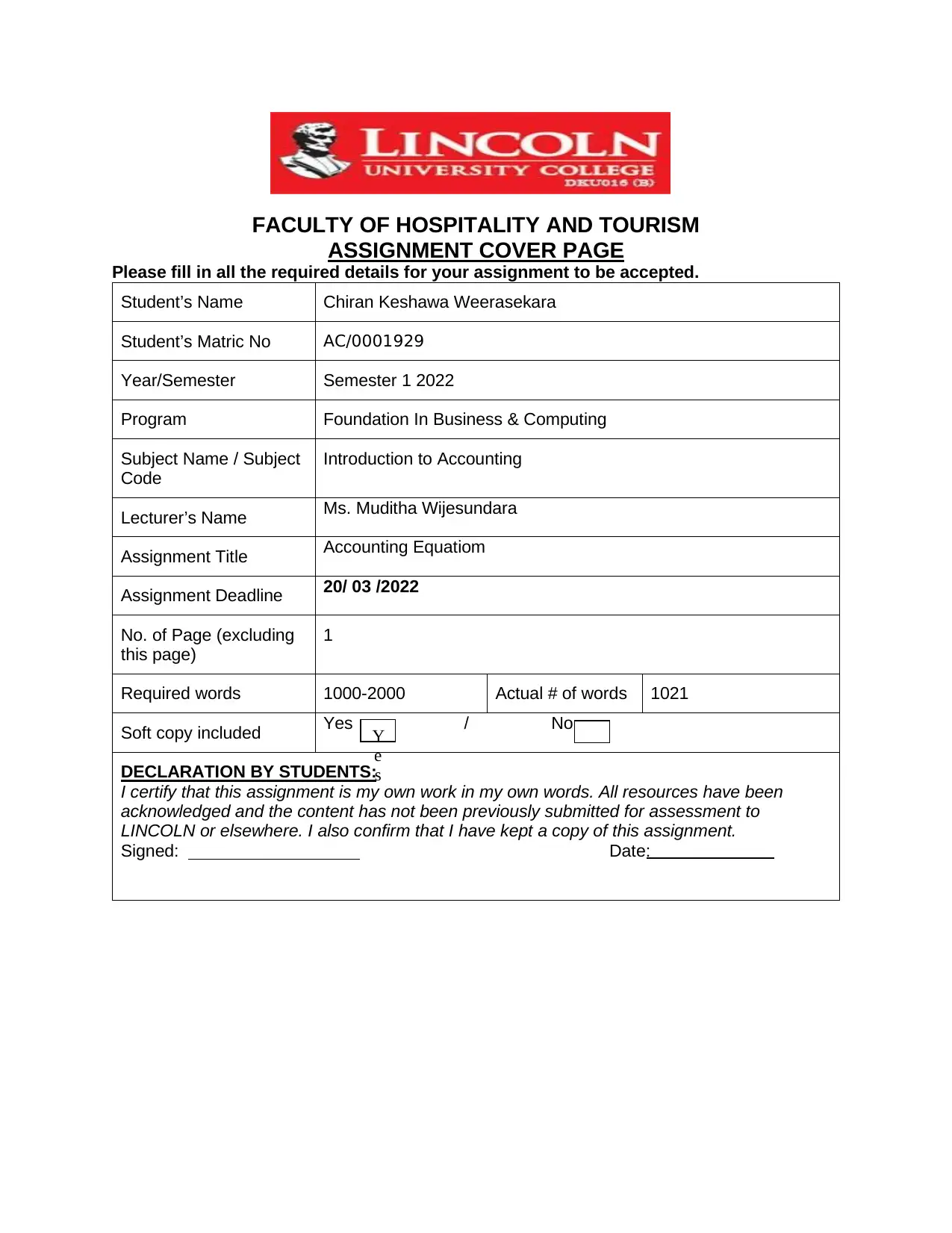
FACULTY OF HOSPITALITY AND TOURISM
ASSIGNMENT COVER PAGE
Please fill in all the required details for your assignment to be accepted.
Student’s Name Chiran Keshawa Weerasekara
Student’s Matric No AC/0001929
Year/Semester Semester 1 2022
Program Foundation In Business & Computing
Subject Name / Subject
Code
Introduction to Accounting
Lecturer’s Name Ms. Muditha Wijesundara
Assignment Title Accounting Equatiom
Assignment Deadline 20/ 03 /2022
No. of Page (excluding
this page)
1
Required words 1000-2000 Actual # of words 1021
Soft copy included Yes / No
DECLARATION BY STUDENTS:
I certify that this assignment is my own work in my own words. All resources have been
acknowledged and the content has not been previously submitted for assessment to
LINCOLN or elsewhere. I also confirm that I have kept a copy of this assignment.
Signed: Date:
Y
e
s
tabler-icon-diamond-filled.svg

Paraphrase This Document

Need a fresh take? Get an instant paraphrase of this document with our AI Paraphraser
Document Page
1. What is Accounting?
One can define accounting as the process of systematic recording, measuring, and
communicating information about financial transactions. It’s a system that provides quantitative
information about a business or a person’s financial position. Man is a social being. He cannot
live in society. Because all individuals have got their limitations, they are to depend on society as
a whole for their necessary goods and services. So, the exchange of goods and services among
them is imperative. Accounting not only records financial transactions and conveys the financial
position of a business enterprise, it also analyses and reports the information in documents called
financial statements. Recording every financial transaction is important to a business
organization and its creditors and investors. Accounting uses a formalized and regulated system
that follows standardized principles and procedures.
Types of accounting:
Financial Accounting
In simple terms, financial accounting is the practice of accounting for all money going in and out
of an organization. It involves recording, classifying, summarizing, and analyzing all financial
transactions. The results of all financial transactions that occur during an accounting period are
summarized into the balance sheet, income statement, and cash flow statement.
Recording: Transactions are recorded as either a debit or a credit. When funds come into a
business, that’s a credit. And when they go out, it’s a debit.
Classifying: There are several categories used to determine types of transactions.
Revenue:- total income received for goods or services during a specific period.
Expenses:- is the reduction in value of an asset as it is used to generate revenue.
Assets:- things the business owns that have monetary value into the future.
Liabilities:- bank loans, account payable, accrued expenses, and any other monies owed
by a business to another entity.
Equity:- equity is the value attributable to the owners of a business.
Managerial Accounting
Managerial accounting deals with allocation of the accounting information regarding financial
and non-financial matters in such a manner that financial managers prepare themselves
beforehand. Namely, in managerial accounting, an accountant generates monthly or quarterly
reports that a business's management team can use to make decisions about how the business
operates. It involves identifying, analyzing, recording and presenting financial information.
Document Page
Cost Accounting
Cost accounting is a form of a managerial accounting system designed to evaluate company
costs for the purpose of improving productivity and increasing profit. Analysts, managers,
business owners, and accountants use this information to determine what their products
should cost. In cost accounting, money is cast as an economic factor in production, whereas in
financial accounting, money is considered to be a measure of a company's economic
performance.
2.Who users Accounting Information?
Users of accounting information are internal and external.
Internal users
Internal users of accounting information are those individuals inside a company who plan,
organize, and run the business. These include owners, managers and employees.
Owners: Owners need to assess how well their business is performing. These are the investors
in the business and are the parties that are the titles holders to the organization or institution.
Accounting information helps owners in assessing the level of stability in business over the
years and to what extent have changes in economic factors affected the bottom line of the
business.
Managers: Management is responsible for taking work from others in the most appropriate
way. Preparing and monitoring budgets effectively requires reliable accounting data relating to
the various activities, processes, products, services, segments and departments of the business.
Employees: Employees are the people who serve in the business. Employees are interested in
knowing how well a company is performing as it could have implications for their job security
and income. Many employees review accounting information in the annual report just to get a
better understanding of the company’s business.
External users
External users are the secondary users of accounting. These include investors, lenders,
suppliers, customers, tax authorities, government, auditors and public.
Investors: Investors are the people who are ready to invest their money in a business. Investors
primarily rely on the financial statements published by companies to assess the profitability,
valuation and risk of their investment.
Lenders: They are the parties that provide alternative capital sources to the organizations.
Lenders offer loans and other credit facilities on terms that are based on the assessment of
financial health of borrowers.
Document Page
Suppliers: These are the parties responsible for providing the organizations and institutions
with the products or services necessary for operation and sustenance. Some suppliers only
have a handful of customers. These customers could be very large businesses themselves.
Accounting Equation
Accounting equation describes that the total value of assets of a business entity is always equal
to its liabilities plus owner’s equity. It helps the company to prepare a balance sheet and see if
the entire enterprise’s asset is equal to its liabilities and stockholder equity. It is the base of the
double-entry accounting system.
The Formula for the Accounting Equation:
Assets = Liabilities + Shareholder’s Equity
Double entry system
Double Entry System refers to the system of bookkeeping that is prevalent at present. For
instance, a person enters a transaction of borrowing money from the bank. So, this will increase
the assets for cash balance account and simultaneously the liability for loan payable account
will also increase.
Example 1:
Assets – Liabilities = Owner’s Equity
1. Assets =$200,000 , Liabilities = $80,000, Owner’s equity = ?
2. Assets = ? , Liabilities = $40,000, Owner’s equity = $60,000
3. Assets = $220,000, Liabilities = ? , Owner’s equity = $160,000
4. Assets = ?, Liabilities + Owner’s equity = $600,000
Solution:
1. Owner’s equity = Assets – Liabilities
= $200,000 – $80,000
= $120,000.
2. Assets = Liabilities + Owner’s equity
= $40,000 + $60,000
= $100,000.
3. Liabilities = Assets – Owner’s equity
= $220,000 – $160,000
= $60,000
4. The basic accounting equation is: Assets = Liabilities + Owner’s equity. Therefore, if liabilities
plus owner’s equity is equal to $600,000, then the total assets must also be equal to $600,000.
The basic accounting equation is: Assets = Liabilities + Owner’s equity. Therefore, if liabilities
plus owner’s equity is equal to $600,000, then the total assets must also be equal to $600,000.
tabler-icon-diamond-filled.svg

Paraphrase This Document

Need a fresh take? Get an instant paraphrase of this document with our AI Paraphraser
Document Page
chevron_up_icon
1 out of 5
circle_padding
hide_on_mobile
zoom_out_icon
[object Object]